

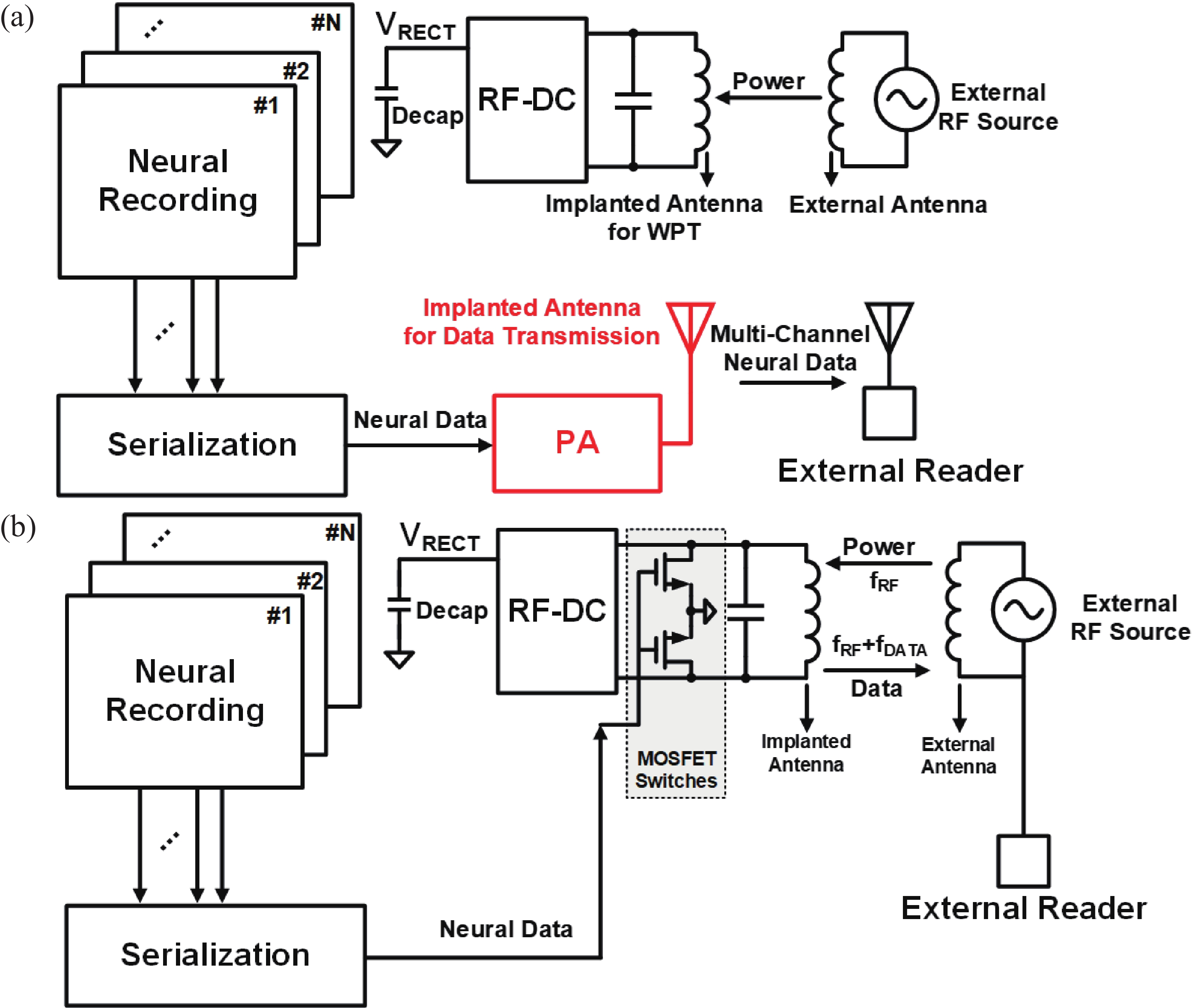
Fig. 1.
(Color online) Conventional architectures for wireless multi-channel neural-recording systems. (a) Active radio method. (b) Passive radio method, such as backscatter.
FOCUS TOPIC ARTICLES
Yili Shen1, §, Yunshan Zhang1, §, Changgui Yang1, Yuxuan Luo1 and Bo Zhao1, 2, 3,
Corresponding author: Bo Zhao, zhaobo@zju.edu.cn
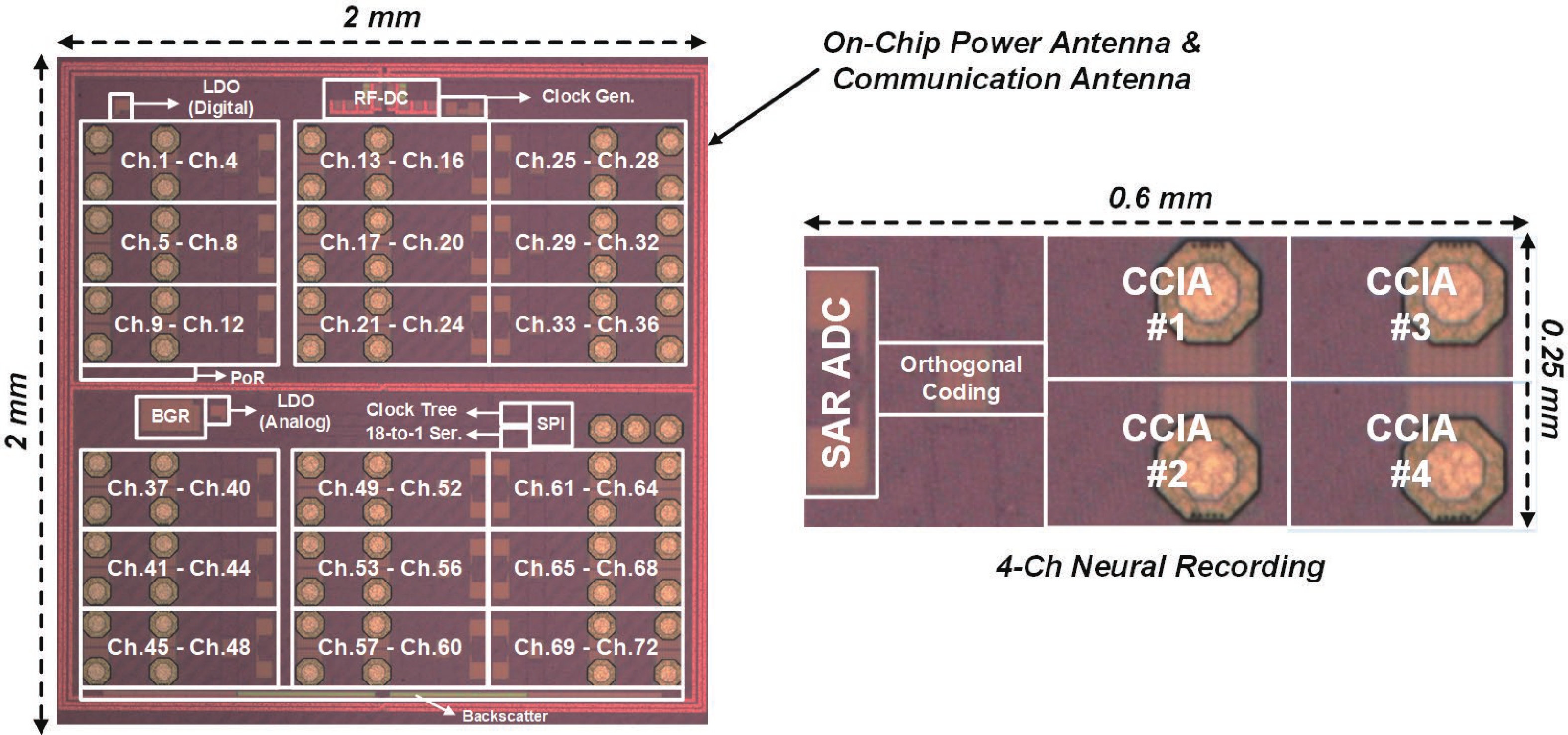
Abstract: Battery-free radio systems utilizing wireless power transfer (WPT) further facilitate the miniaturization of neural implants. However, simultaneous monitoring of multiple neuronal activities is required to obtain high-fidelity neural signals. Consequently, the integration of numerous channels on a single chip and the wireless transmission of massive multi-channel data pose significant challenges for implantable battery-free neural interfaces. This work introduces dual overlapped on-chip antennas to eliminate the need for a battery in the neural implants and enable high-data-rate backscatter for transmitting the massive data acquired simultaneously from 72 channels. Additionally, an orthogonal coding and sampling technique is employed to reduce both power consumption and area per channel. Fabricated in a 65 nm CMOS process, the proposed chip integrates 72 neural recording channels within a 2 mm × 2 mm area and achieves a backscatter data rate of 18 Mbps.
Keywords: neural interface, wireless power transfer (WPT), backscatter, on-chip antennas
| [1] |
Lee C, Kim B, Kim J, et al. A miniaturized wireless neural implant with body-coupled data transmission and power delivery for freely behaving animals. 2022 IEEE International Solid-State Circuits Conference, 2022: 1 doi: 10.1109/ISSCC42614.2022.9731733
|
| [2] |
Sanni A, Vilches A, Toumazou C. Inductive and ultrasonic multi-tier interface for low-power, deeply implantable medical devices. IEEE Trans Biomed Circuits Syst, 2012, 6(4): 297 doi: 10.1109/TBCAS.2011.2175390
|
| [3] |
ElAnsary M, Xu J X, Filho J S, et al. Bidirectional peripheral nerve interface with 64 second-order opamp-less ΔΣ ADCs and fully integrated wireless power/data transmission. IEEE J Solid-State Circuits, 2021, 56(11): 3247 doi: 10.1109/JSSC.2021.3113354
|
| [4] |
Buzsáki G. Large-scale recording of neuronal ensembles. Nat Neurosci, 2004, 7(5): 446 doi: 10.1038/nn1233
|
| [5] |
Csicsvari J, Henze D A, Jamieson B, et al. Massively parallel recording of unit and local field potentials with silicon-based electrodes. J Neurophysiol, 2003, 90(2): 1314 doi: 10.1152/jn.00116.2003
|
| [6] |
Lopez C M, Andrei A, Mitra S, et al. An implantable 455-active-electrode 52-channel CMOS neural probe. IEEE J Solid-State Circuits, 2014, 49(1): 248 doi: 10.1109/JSSC.2013.2284347
|
| [7] |
Lee S B, Lee H M, Kiani M, et al. An inductively powered scalable 32-channel wireless neural recording system-on-a-chip for neuroscience applications. 2010 IEEE International Solid-State Circuits Conference, 2010: 120 doi: 10.1109/ISSCC.2010.5434028
|
| [8] |
Ng K A, Yuan C, Rusly A, et al. A wireless multi-channel peripheral nerve signal acquisition system-on-chip. IEEE J Solid-State Circuits, 2019, 54(8): 2266 doi: 10.1109/JSSC.2019.2909158
|
| [9] |
Zhang Y S, Yang C G, Chang Z Y, et al. An 8-shaped antenna-based battery-free neural-recording system featuring 3 cm reading range and 140 pJ/bit energy efficiency. IEEE J Solid-State Circuits, 2023, 58(11): 3194 doi: 10.1109/JSSC.2023.3276174
|
| [10] |
Lo Y K, Chang C W, Kuan Y C, et al. A 176-channel 0.5cm3 0.7g wireless implant for motor function recovery after spinal cord injury. 2016 IEEE International Solid-State Circuits Conference, 2016: 382 doi: 10.1109/ISSCC.2016.7418067
|
| [11] |
Yang C G, Zhang Z H, Zhang L, et al. A 128-channel 2mm×2mm battery-free neural dielet merging simultaneous multi-channel transmission through multi-carrier orthogonal backscatter. 2023 IEEE International Solid-State Circuits Conference, 2023: 30 doi: 10.1109/ISSCC42615.2023.10067688
|
| [12] |
Yang C G, Zhang Y S, Chang Z Y, et al. A 0.4mm3 battery-less crystal-less neural-recording SoC achieving 1.6cm backscattering range with 2mm×2mm on-chip antenna. 2022 IEEE Symposium on VLSI Technology and Circuits, 2022: 164 doi: 10.1109/VLSITechnologyandCir46769.2022.9830235
|
| [13] |
Cheng C H, Tsai P Y, Yang T Y, et al. A fully integrated 16-channel closed-loop neural-prosthetic CMOS SoC with wireless power and bidirectional data telemetry for real-time efficient human epileptic seizure control. IEEE J Solid-State Circuits, 2018, 53(11): 3314 doi: 10.1109/JSSC.2018.2867293
|
| [14] |
Chang Z Y, Yang C G, Zhang Y S, et al. A battery-less crystal-less 49.8µW neural-recording chip featuring two-tone RF power harvesting. 2022 IEEE Custom Integrated Circuits Conference, 2022: 1 doi: 10.1109/CICC53496.2022.9772792
|
| [15] |
Muller R, Le H P, Li W, et al. A minimally invasive 64-channel wireless μECoG implant. IEEE J Solid-State Circuits, 2015, 50(1): 344 doi: 10.1109/JSSC.2014.2364824
|
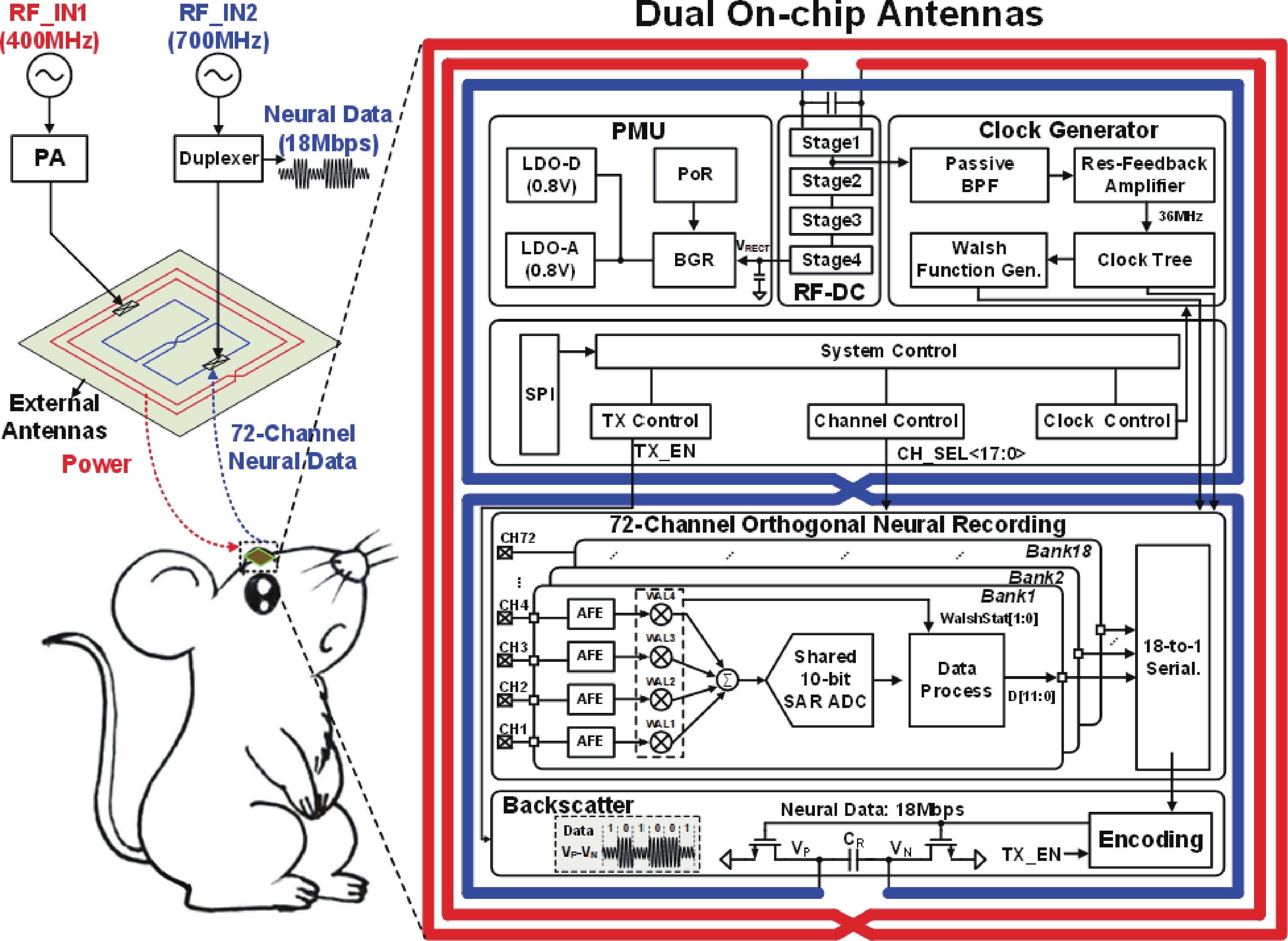

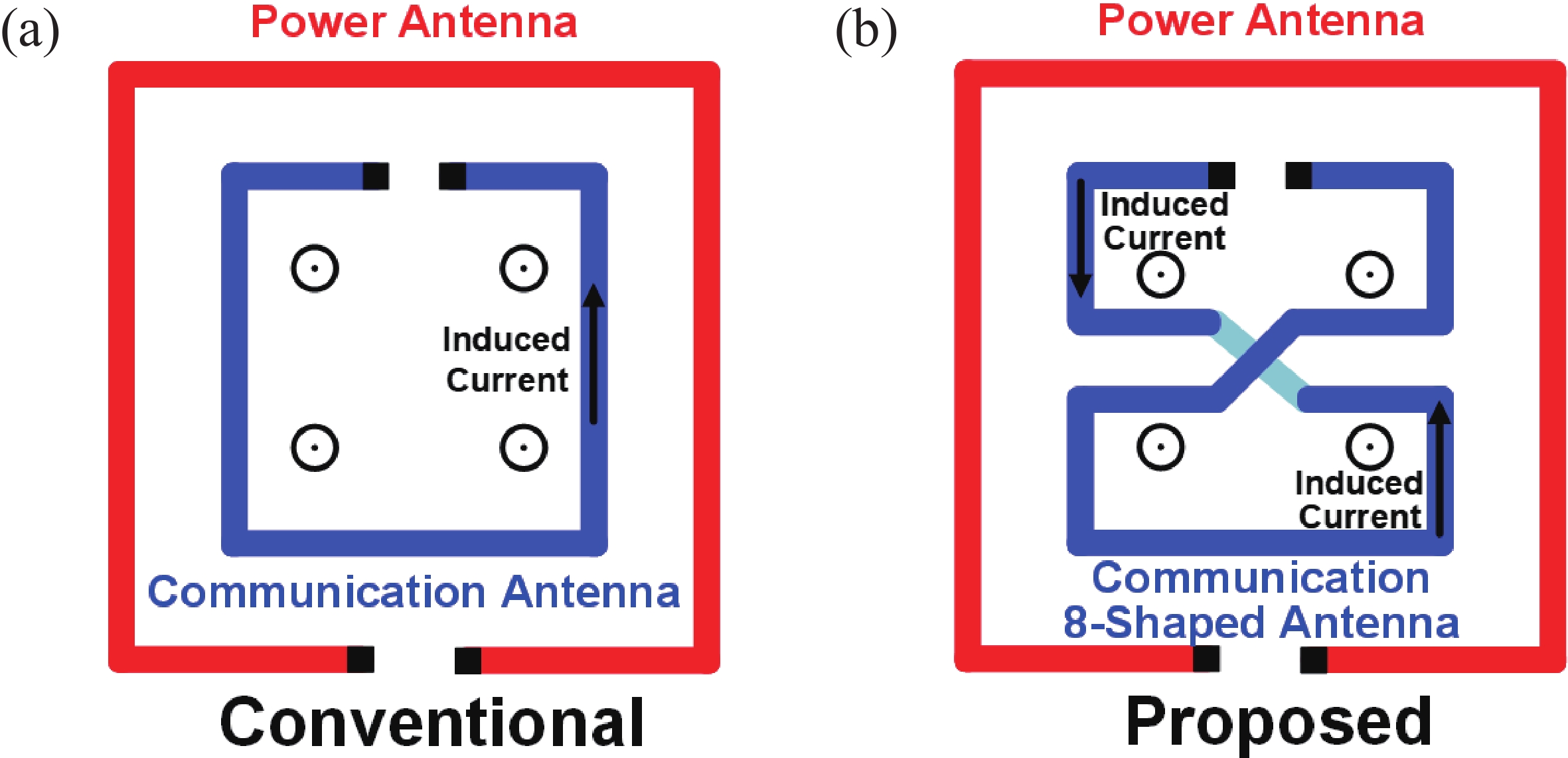
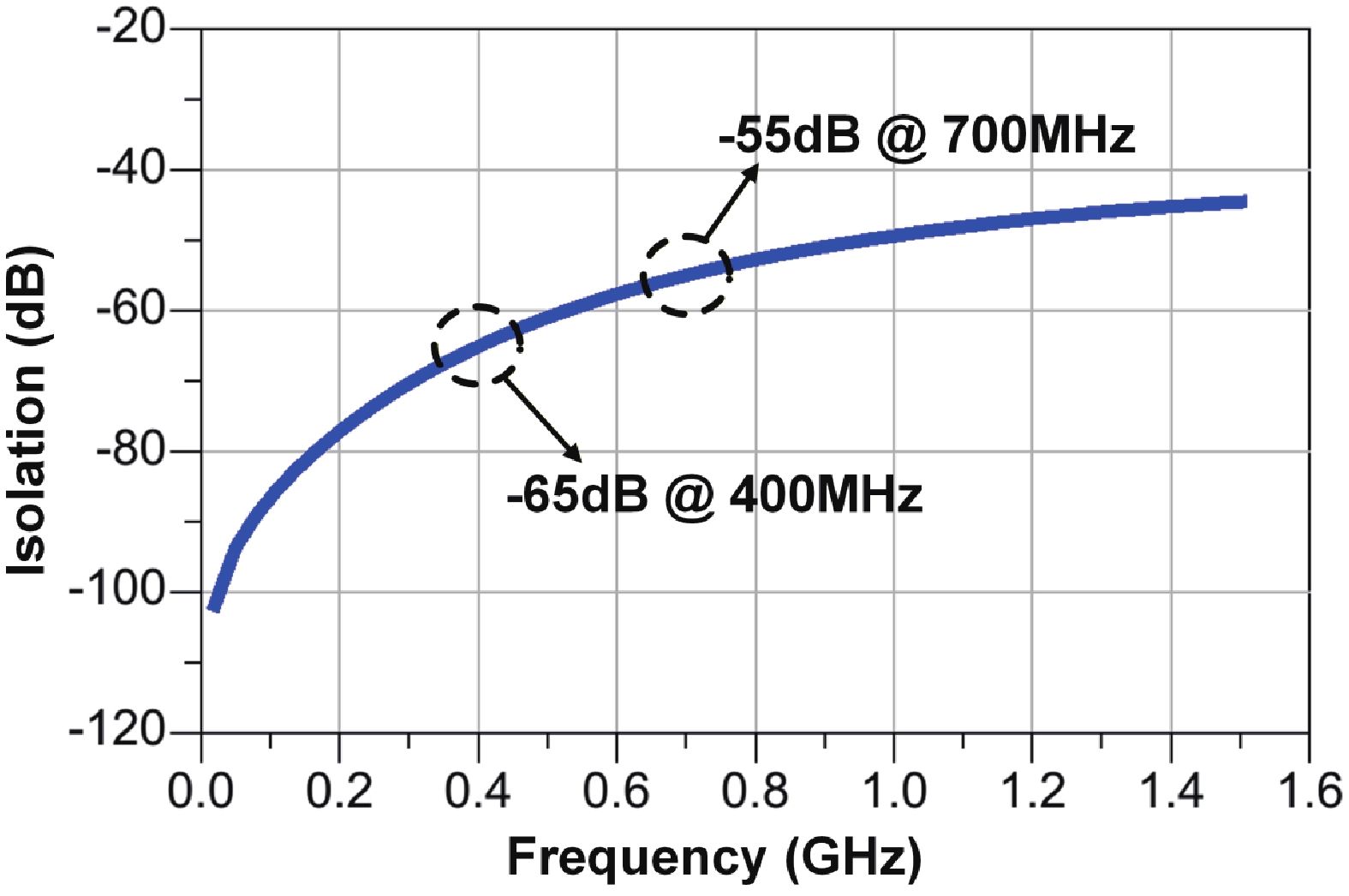
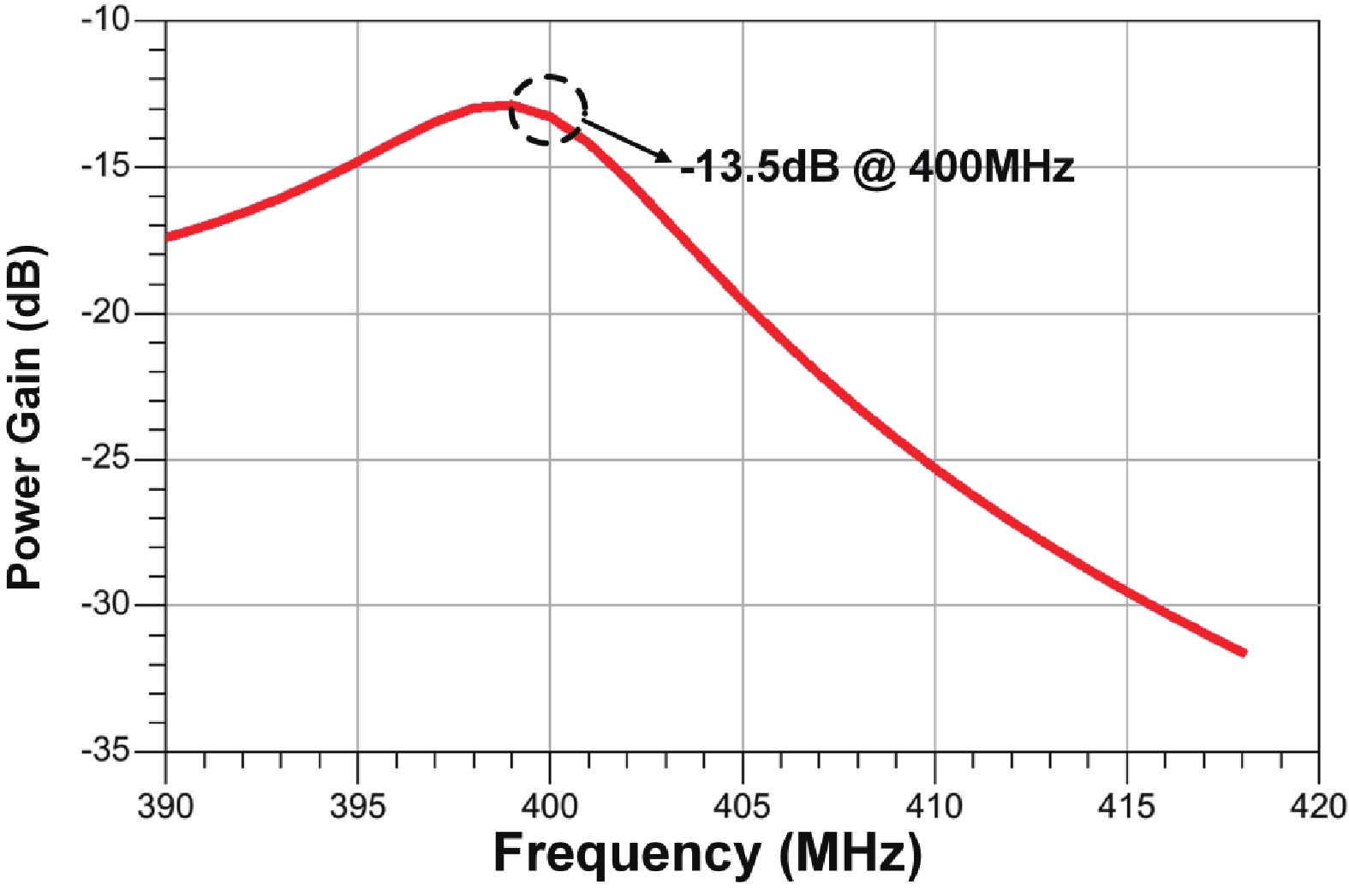
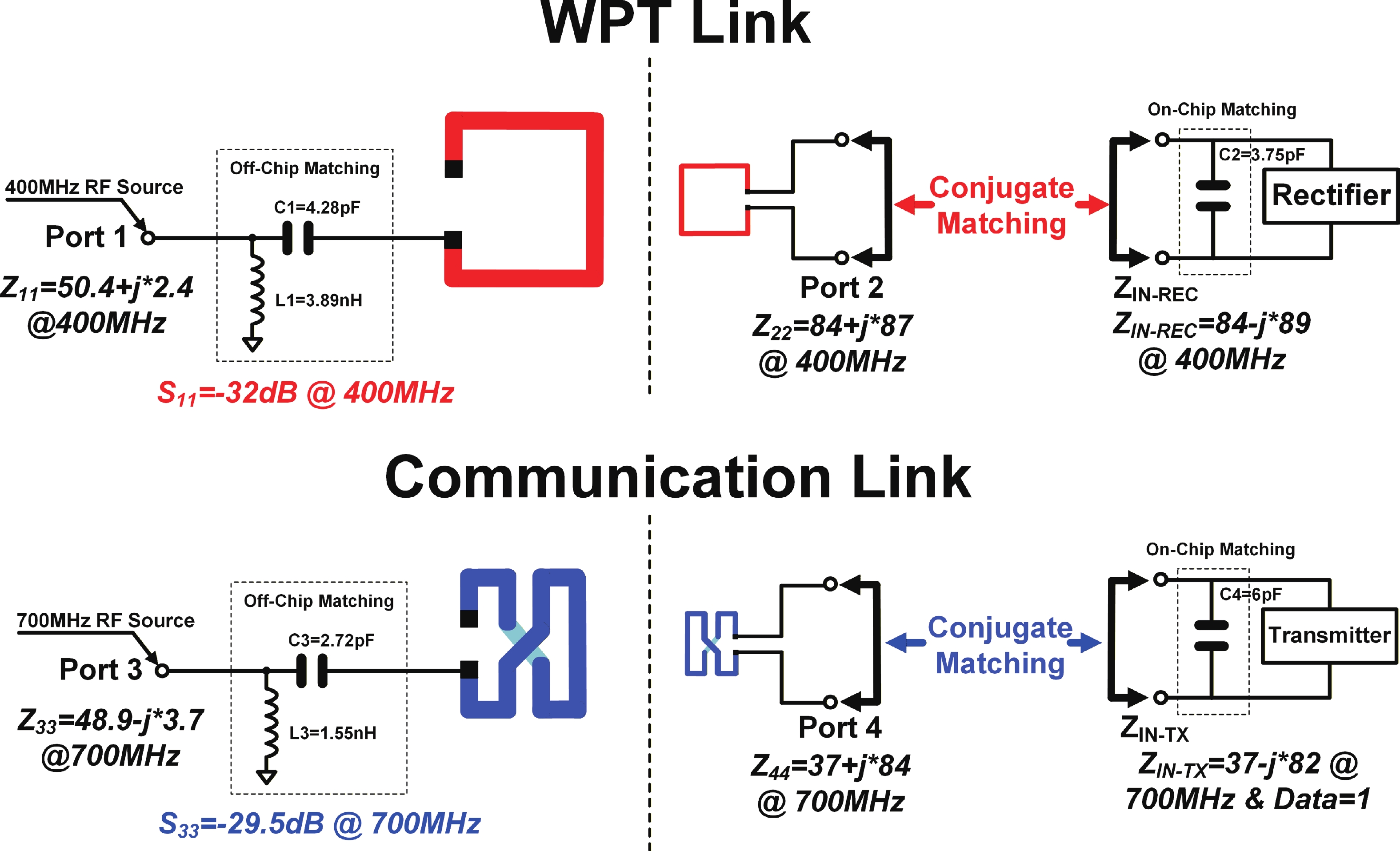
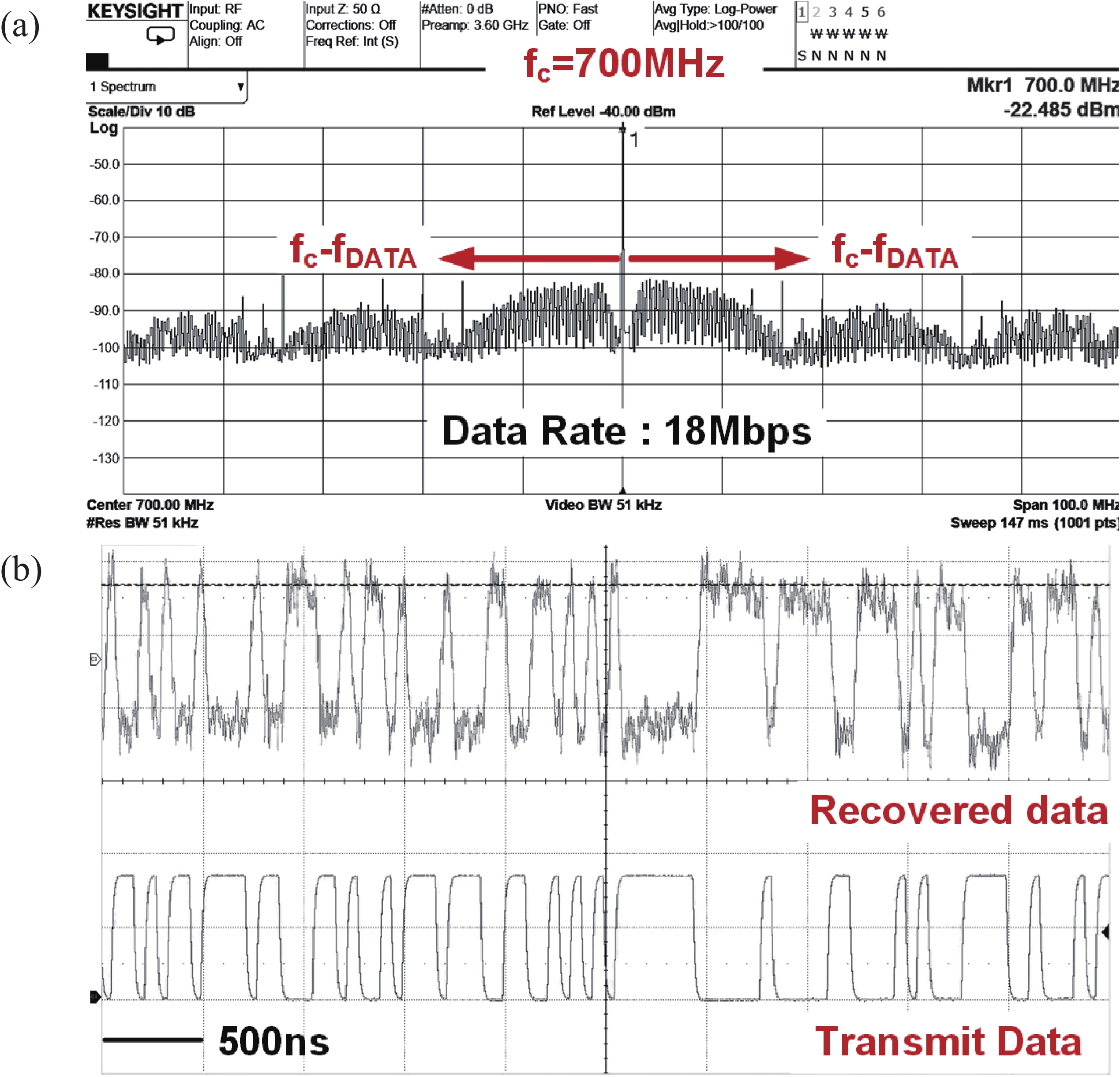
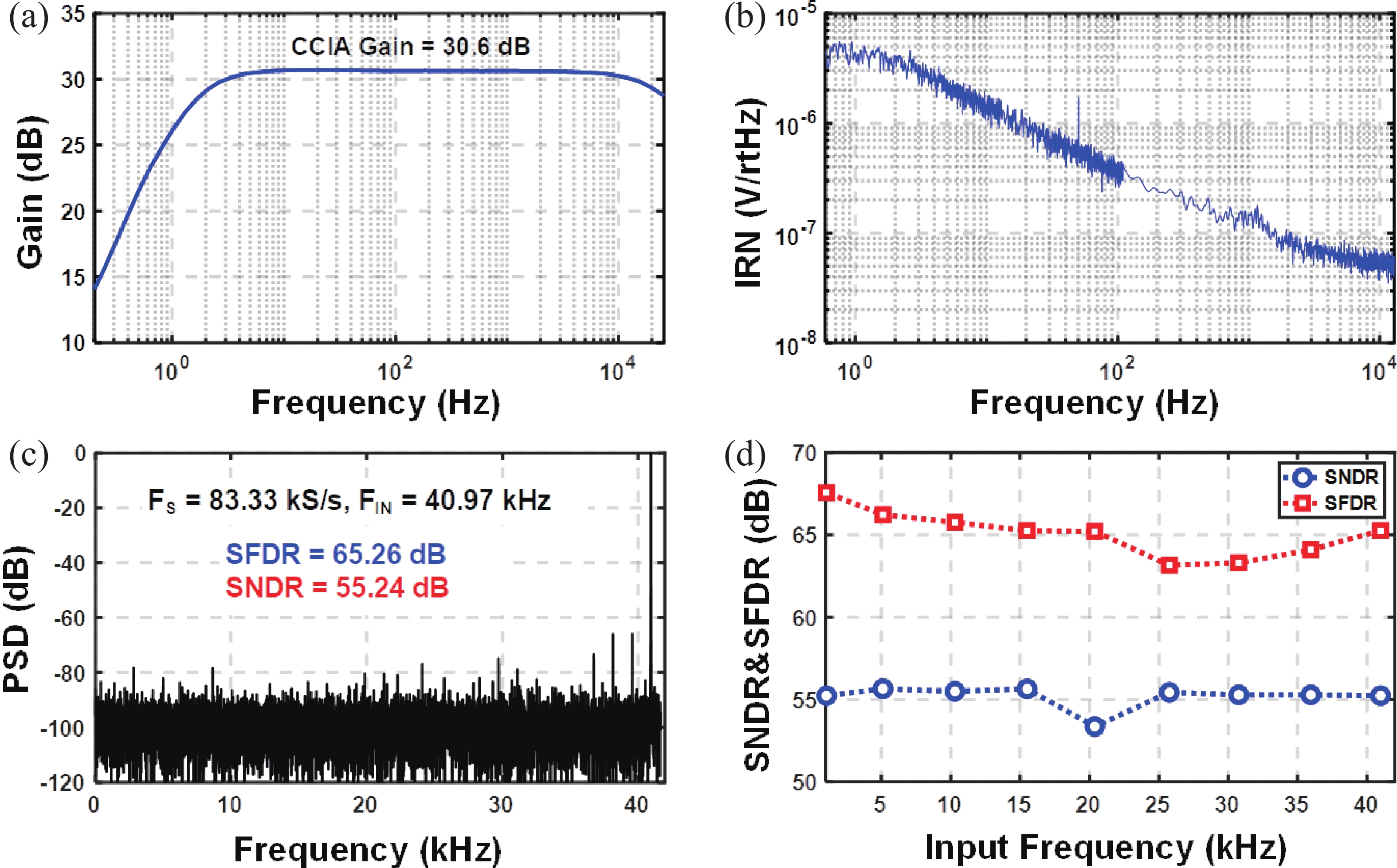
Table 1. Performance summary and comparison.
| Specifications | This Work | ISSCC’22[1] | JSSC’21[3] | JSSC’19[8] | JSSC’23[9] | ISSCC’16[10] | ||
| System | CMOS process (nm) | 65 | 110 | 130 | 180 | 65 | 180 | |
| # of channels | 72 | 4 | 64 | 10 | 1 | 16 | ||
| Chip size (mm2) | 2 × 2 | 1.4 × 2.8 | 2.34 × 3 | 3.4 × 2.3 | 2 × 2 | 4.4 × 5.7 | ||
| Area/Ch. (mm2) | 0.06 | 0.98 | 0.11 | 0.78 | 4 | 1.6 | ||
| Total power (μW) | 743 | 644 | 810 | 4400 | 35 | NA | ||
| Power/Ch. (μW) | 10.32 | 161 | 12.66 | 440 | 35 | NA | ||
| Off-chip devices | NO | Electrode | NO | 1 Coil, 1LED & 4 caps |
2 Coil | 1 Coil & caps | ||
| Clock recovery | YES | NO | NO | NO | YES | YES | ||
| WPT & Comm. |
Wireless link | Inductive | Body coupled |
Inductive | Inductive & near infrared |
Inductive | Inductive | |
| Implanted coil size | 2 × 2 mm2 & 1.94 × 1.94 mm2 (On-chip) |
NA | 2.3 × 2.3 mm2 (On-chip) |
Φ15 mm (Off-chip) |
4.7 × 4.7 mm2 (Off-chip) |
Φ13.5 mm (Off-chip) |
||
| WPT freq. (MHz) | 400 | 32 | 60 | 22 | 408 | 2 | ||
| Com. method | Backscatter | Active | Active | Active | Backscatter | Backscatter | ||
| Carrier freq. (MHz) | 700 | 40.96 | 600 | NA | 1180 | 2 | ||
| Data rate (Mbps) | 18 | 20.48 | 2 | 3 | 0.25 | 2 | ||
| Energy per bit (pJ/Bit) | 42.3 | 32 | 405 | 1466 | 140 | NA | ||
| Neural record- ing |
Architecture | Orthogonal coding & shared ADC |
Dedicated CTDSM |
Dedicated DSM |
TMD & Shared ADC |
Single channel |
TDM & shared ADC |
|
| Signal bandwidth | 1.3 Hz−10 kHz | 10 kHz | 10 kHz | 0.1 Hz−5.5 kHz | 0.9 Hz−6.9 kHz | 5 Hz−7 kHz | ||
| IRN (μVrms) | 8.62 | 6.6 | 24.7 | 1.9 | 6.77 | 7.68 | ||
| SNDR/SFDR (dB) | 55.24/65.26 | 83/94.2 | 49.92/NA | 50.5/NA | 60.15/NA | 52.93/NA | ||
 DownLoad: CSV
| [1] |
Lee C, Kim B, Kim J, et al. A miniaturized wireless neural implant with body-coupled data transmission and power delivery for freely behaving animals. 2022 IEEE International Solid-State Circuits Conference, 2022: 1 doi: 10.1109/ISSCC42614.2022.9731733
|
| [2] |
Sanni A, Vilches A, Toumazou C. Inductive and ultrasonic multi-tier interface for low-power, deeply implantable medical devices. IEEE Trans Biomed Circuits Syst, 2012, 6(4): 297 doi: 10.1109/TBCAS.2011.2175390
|
| [3] |
ElAnsary M, Xu J X, Filho J S, et al. Bidirectional peripheral nerve interface with 64 second-order opamp-less ΔΣ ADCs and fully integrated wireless power/data transmission. IEEE J Solid-State Circuits, 2021, 56(11): 3247 doi: 10.1109/JSSC.2021.3113354
|
| [4] |
Buzsáki G. Large-scale recording of neuronal ensembles. Nat Neurosci, 2004, 7(5): 446 doi: 10.1038/nn1233
|
| [5] |
Csicsvari J, Henze D A, Jamieson B, et al. Massively parallel recording of unit and local field potentials with silicon-based electrodes. J Neurophysiol, 2003, 90(2): 1314 doi: 10.1152/jn.00116.2003
|
| [6] |
Lopez C M, Andrei A, Mitra S, et al. An implantable 455-active-electrode 52-channel CMOS neural probe. IEEE J Solid-State Circuits, 2014, 49(1): 248 doi: 10.1109/JSSC.2013.2284347
|
| [7] |
Lee S B, Lee H M, Kiani M, et al. An inductively powered scalable 32-channel wireless neural recording system-on-a-chip for neuroscience applications. 2010 IEEE International Solid-State Circuits Conference, 2010: 120 doi: 10.1109/ISSCC.2010.5434028
|
| [8] |
Ng K A, Yuan C, Rusly A, et al. A wireless multi-channel peripheral nerve signal acquisition system-on-chip. IEEE J Solid-State Circuits, 2019, 54(8): 2266 doi: 10.1109/JSSC.2019.2909158
|
| [9] |
Zhang Y S, Yang C G, Chang Z Y, et al. An 8-shaped antenna-based battery-free neural-recording system featuring 3 cm reading range and 140 pJ/bit energy efficiency. IEEE J Solid-State Circuits, 2023, 58(11): 3194 doi: 10.1109/JSSC.2023.3276174
|
| [10] |
Lo Y K, Chang C W, Kuan Y C, et al. A 176-channel 0.5cm3 0.7g wireless implant for motor function recovery after spinal cord injury. 2016 IEEE International Solid-State Circuits Conference, 2016: 382 doi: 10.1109/ISSCC.2016.7418067
|
| [11] |
Yang C G, Zhang Z H, Zhang L, et al. A 128-channel 2mm×2mm battery-free neural dielet merging simultaneous multi-channel transmission through multi-carrier orthogonal backscatter. 2023 IEEE International Solid-State Circuits Conference, 2023: 30 doi: 10.1109/ISSCC42615.2023.10067688
|
| [12] |
Yang C G, Zhang Y S, Chang Z Y, et al. A 0.4mm3 battery-less crystal-less neural-recording SoC achieving 1.6cm backscattering range with 2mm×2mm on-chip antenna. 2022 IEEE Symposium on VLSI Technology and Circuits, 2022: 164 doi: 10.1109/VLSITechnologyandCir46769.2022.9830235
|
| [13] |
Cheng C H, Tsai P Y, Yang T Y, et al. A fully integrated 16-channel closed-loop neural-prosthetic CMOS SoC with wireless power and bidirectional data telemetry for real-time efficient human epileptic seizure control. IEEE J Solid-State Circuits, 2018, 53(11): 3314 doi: 10.1109/JSSC.2018.2867293
|
| [14] |
Chang Z Y, Yang C G, Zhang Y S, et al. A battery-less crystal-less 49.8µW neural-recording chip featuring two-tone RF power harvesting. 2022 IEEE Custom Integrated Circuits Conference, 2022: 1 doi: 10.1109/CICC53496.2022.9772792
|
| [15] |
Muller R, Le H P, Li W, et al. A minimally invasive 64-channel wireless μECoG implant. IEEE J Solid-State Circuits, 2015, 50(1): 344 doi: 10.1109/JSSC.2014.2364824
|





Article views: 830 Times PDF downloads: 95 Times Cited by: 0 Times
Received: 14 December 2025 Revised: 17 January 2026 Online: Accepted Manuscript: 09 February 2026Uncorrected proof: 27 February 2026Published: 11 June 2026
| Citation: |
Yili Shen, Yunshan Zhang, Changgui Yang, Yuxuan Luo, Bo Zhao. A 2 mm × 2 mm battery-free neural interface achieving 72-channel wireless simultaneous recording by dual overlapped on-chip antennas[J]. Journal of Semiconductors, 2026, 47(6): 062201. doi: 10.1088/1674-4926/25120027
****
Y L Shen, Y S Zhang, C G Yang, Y X Luo, and B Zhao, A 2 mm × 2 mm battery-free neural interface achieving 72-channel wireless simultaneous recording by dual overlapped on-chip antennas[J]. J. Semicond., 2026, 47(6): 062201 doi: 10.1088/1674-4926/25120027

|
 Yili Shen received the B.Eng. degree in Microelectronic Science and Technology from Zhejiang University, Hangzhou, China, in 2021, where he is currently pursuing the Ph.D. degree in Electronic Science and Technology. His current research interests include analog/mixed-signal IC design, biomedical sensor interface, and wireless power/data transmission circuits design for implantable medical devices
 Bo Zhao received the Ph.D. degree from the Department of Electronic Engineering, Tsinghua University, Beijing, China, in 2011. He was a Research Fellow with the National University of Singapore, Singapore, from 2013 to 2015. From 2015 to 2018, he was an Assistant Project Scientist with Berkeley Wireless Research Center (BWRC), Department of Electrical Engineering and Computer Sciences, University of California at Berkeley, Berkeley, CA, USA. Since 2018, he has been a Professor with the Institute of VLSI Design, Zhejiang University, Hangzhou, China. He has authored or coauthored more than 60 articles and book chapters, and he holds more than 30 Chinese patents. His research interests include IoT radios, wireless power transfer, and wearable/implantable radios. He was a recipient of the 2017 IEEE TRANSACTIONS ON CIRCUITS AND SYSTEMS Darlington Best Paper Award and the Design Contest Award of the 2013 IEEE International Symposium on Low Power Electronics and Design. He serves as an Associate Editor for the IEEE TRANSACTIONS ON BIOMEDICAL CIRCUITS AND SYSTEMS, as well as an Associate Editor for the IEEE TRANSACTIONS ON CIRCUITS AND SYSTEMS Ⅰ: Regular Papers. He also serves as a Committee Member of IEEE/C/SM. He was the Publication Chair of the 2016 IEEE Biomedical Circuits and Systems Conference. In 2022, he was elected to be the Chair Elect of Biomedical and Life Science Circuits and Systems Society
| [1] |
Lee C, Kim B, Kim J, et al. A miniaturized wireless neural implant with body-coupled data transmission and power delivery for freely behaving animals. 2022 IEEE International Solid-State Circuits Conference, 2022: 1 doi: 10.1109/ISSCC42614.2022.9731733
|
| [2] |
Sanni A, Vilches A, Toumazou C. Inductive and ultrasonic multi-tier interface for low-power, deeply implantable medical devices. IEEE Trans Biomed Circuits Syst, 2012, 6(4): 297 doi: 10.1109/TBCAS.2011.2175390
|
| [3] |
ElAnsary M, Xu J X, Filho J S, et al. Bidirectional peripheral nerve interface with 64 second-order opamp-less ΔΣ ADCs and fully integrated wireless power/data transmission. IEEE J Solid-State Circuits, 2021, 56(11): 3247 doi: 10.1109/JSSC.2021.3113354
|
| [4] |
Buzsáki G. Large-scale recording of neuronal ensembles. Nat Neurosci, 2004, 7(5): 446 doi: 10.1038/nn1233
|
| [5] |
Csicsvari J, Henze D A, Jamieson B, et al. Massively parallel recording of unit and local field potentials with silicon-based electrodes. J Neurophysiol, 2003, 90(2): 1314 doi: 10.1152/jn.00116.2003
|
| [6] |
Lopez C M, Andrei A, Mitra S, et al. An implantable 455-active-electrode 52-channel CMOS neural probe. IEEE J Solid-State Circuits, 2014, 49(1): 248 doi: 10.1109/JSSC.2013.2284347
|
| [7] |
Lee S B, Lee H M, Kiani M, et al. An inductively powered scalable 32-channel wireless neural recording system-on-a-chip for neuroscience applications. 2010 IEEE International Solid-State Circuits Conference, 2010: 120 doi: 10.1109/ISSCC.2010.5434028
|
| [8] |
Ng K A, Yuan C, Rusly A, et al. A wireless multi-channel peripheral nerve signal acquisition system-on-chip. IEEE J Solid-State Circuits, 2019, 54(8): 2266 doi: 10.1109/JSSC.2019.2909158
|
| [9] |
Zhang Y S, Yang C G, Chang Z Y, et al. An 8-shaped antenna-based battery-free neural-recording system featuring 3 cm reading range and 140 pJ/bit energy efficiency. IEEE J Solid-State Circuits, 2023, 58(11): 3194 doi: 10.1109/JSSC.2023.3276174
|
| [10] |
Lo Y K, Chang C W, Kuan Y C, et al. A 176-channel 0.5cm3 0.7g wireless implant for motor function recovery after spinal cord injury. 2016 IEEE International Solid-State Circuits Conference, 2016: 382 doi: 10.1109/ISSCC.2016.7418067
|
| [11] |
Yang C G, Zhang Z H, Zhang L, et al. A 128-channel 2mm×2mm battery-free neural dielet merging simultaneous multi-channel transmission through multi-carrier orthogonal backscatter. 2023 IEEE International Solid-State Circuits Conference, 2023: 30 doi: 10.1109/ISSCC42615.2023.10067688
|
| [12] |
Yang C G, Zhang Y S, Chang Z Y, et al. A 0.4mm3 battery-less crystal-less neural-recording SoC achieving 1.6cm backscattering range with 2mm×2mm on-chip antenna. 2022 IEEE Symposium on VLSI Technology and Circuits, 2022: 164 doi: 10.1109/VLSITechnologyandCir46769.2022.9830235
|
| [13] |
Cheng C H, Tsai P Y, Yang T Y, et al. A fully integrated 16-channel closed-loop neural-prosthetic CMOS SoC with wireless power and bidirectional data telemetry for real-time efficient human epileptic seizure control. IEEE J Solid-State Circuits, 2018, 53(11): 3314 doi: 10.1109/JSSC.2018.2867293
|
| [14] |
Chang Z Y, Yang C G, Zhang Y S, et al. A battery-less crystal-less 49.8µW neural-recording chip featuring two-tone RF power harvesting. 2022 IEEE Custom Integrated Circuits Conference, 2022: 1 doi: 10.1109/CICC53496.2022.9772792
|
| [15] |
Muller R, Le H P, Li W, et al. A minimally invasive 64-channel wireless μECoG implant. IEEE J Solid-State Circuits, 2015, 50(1): 344 doi: 10.1109/JSSC.2014.2364824
|

 WeChat ID
Journal of Semiconductors © 2017 All Rights Reserved 京ICP备05085259号-2