


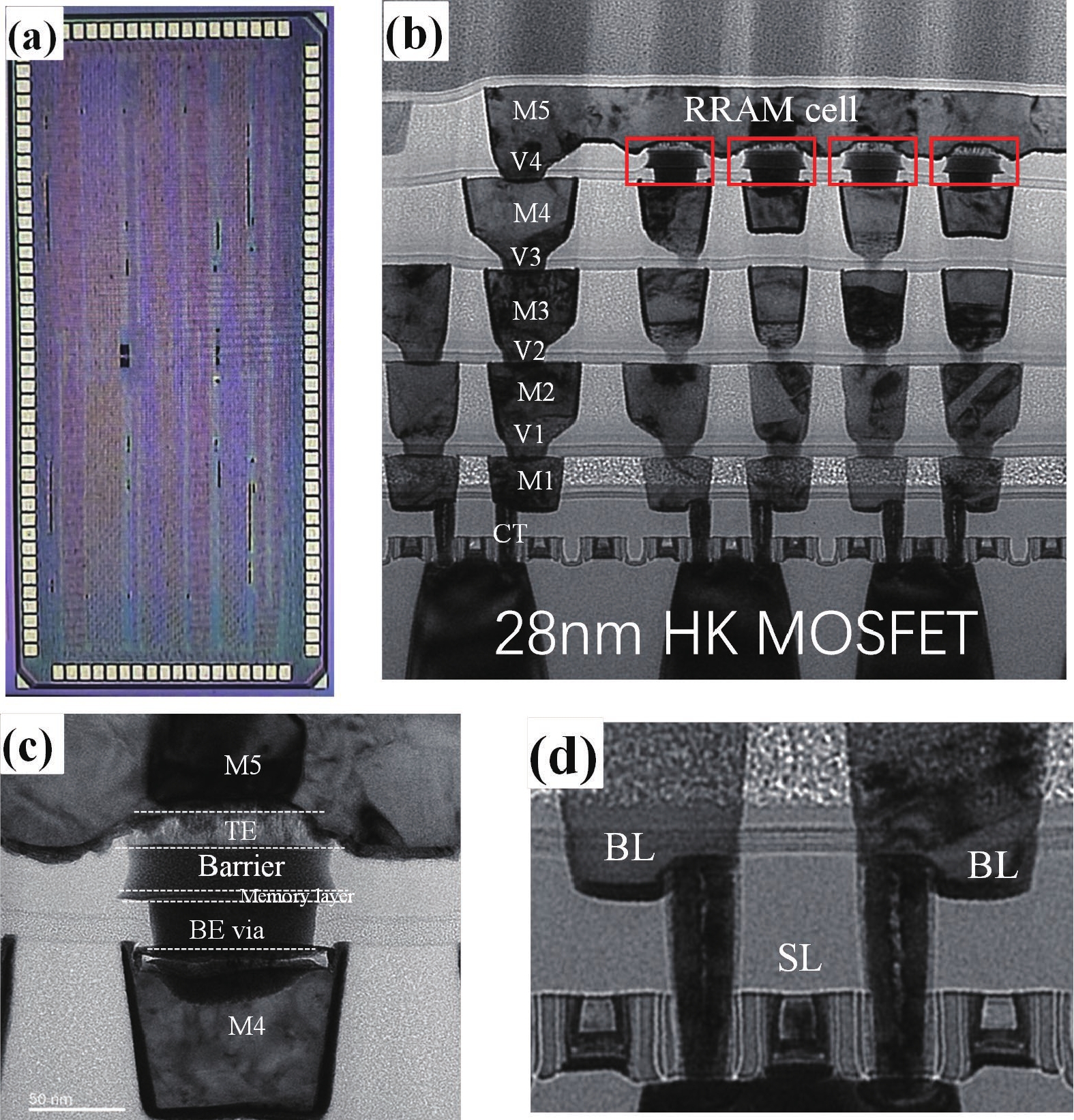
Fig. 1.
(Color online) (a) Optical micrograph of the chip. (b) Cross-sectional TEM image of the RRAM array. (c) Magnified views of the RRAM cell. (d) Magnified views of the transistor.
ARTICLES
Jinghui Tian1, 3, Chengyue Li2, 3, Pengbin Liu2, Xu Zheng2, , Qi Liu1 and Xiaoxin Xu2
Corresponding author: Xu Zheng, zhengxu2018@ime.ac.cn
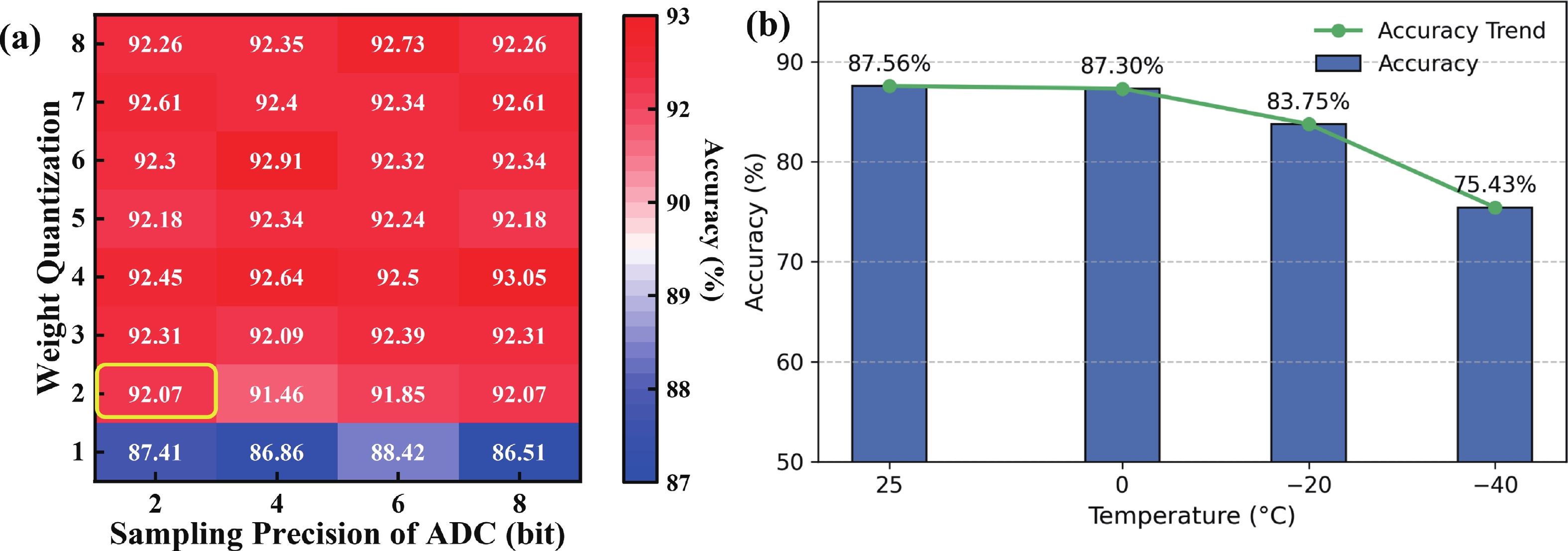
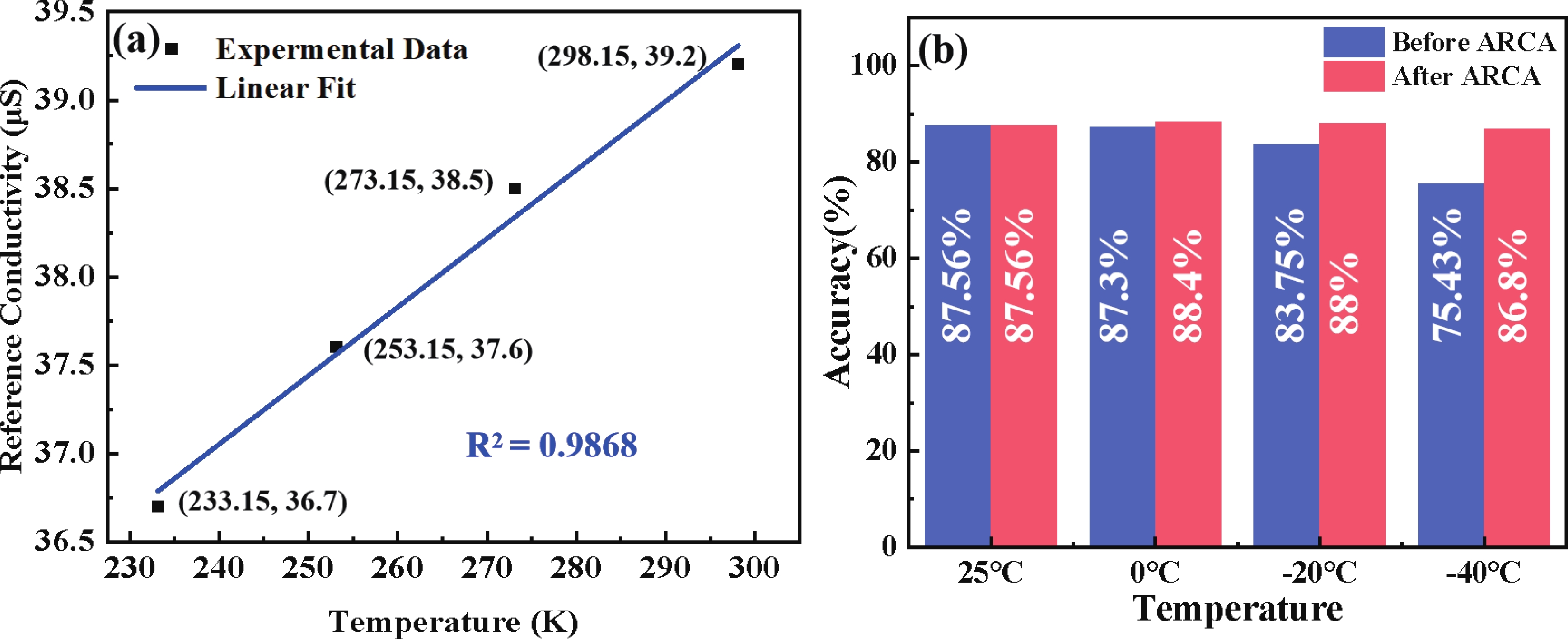
Abstract: With the widespread application of artificial intelligence (AI) computing in low-temperature scenarios such as deep space and deep sea, RRAM-based edge computing has gradually attracted attention. In this paper, an adaptive reference conductance algorithm (ARCA) is proposed to improve the inference accuracy in low-temperature scenarios due to the conduction drift. The RRAM CIM chips with high read cycles are fabricated based on 28 nm CMOS logic technology, and the read times could reach 1012. By studying the influence of conductance drifting on inference accuracy in low temperature, a model of temperature and optimal reference conductance is proposed. Furthermore, by this model, adaptive selecting optimal reference conductance of analog-to-digital converters (ADCs) to quantize column current of RRAM array under different temperatures. At −40 ℃, the reference accuracy could increase from 75.43% to 86.8%.
Keywords: RRAM, in-memory computing, low-temperature scenarios, conductance drift, inference accuracy
| [1] |
Zahoor F, Azni Zulkifli T Z, Ahmad Khanday F. Resistive random access memory (RRAM): An overview of materials, switching mechanism, performance, multilevel cell (mlc) storage, modeling, and applications. Nanoscale Res Lett, 2020, 15(1): 90 doi: 10.1186/s11671-020-03299-9
|
| [2] |
Wan W E, Kubendran R, Schaefer C, et al. A compute-in-memory chip based on resistive random-access memory. Nature, 2022, 608(7923): 504 doi: 10.1038/s41586-022-04992-8
|
| [3] |
Ielmini D, Pedretti G. Resistive switching random-access memory (RRAM): Applications and requirements for memory and computing. Chem Rev, 2025, 125(12): 5584 doi: 10.1021/acs.chemrev.4c00845
|
| [4] |
Yao P, Wu H Q, Gao B, et al. Face classification using electronic synapses. Nat Commun, 2017, 8: 15199 doi: 10.1038/ncomms15199
|
| [5] |
Wang Z W, Zheng Q L, Kang J, et al. Self-activation neural network based on self-selective memory device with rectified multilevel states. IEEE Trans Electron Devices, 2020, 67(10): 4166 doi: 10.1109/TED.2020.3014566
|
| [6] |
Zheng Q L, Wang Z W, Feng Z S, et al. Lattice: An ADC/DAC-less ReRAM-based processing-In-memory architecture for accelerating deep convolution neural networks. 2020 57th ACM/IEEE Design Automation Conference (DAC), 2020: 1 doi: 10.1109/DAC18072.2020.9218590
|
| [7] |
Min D, Park J, Weber O, et al. 18nm FDSOI technology platform embedding PCM & innovative continuous-active construct enhancing performance for leading-edge MCU applications. 2021 IEEE International Electron Devices Meeting (IEDM), 2022: 13.1.1 doi: 10.1109/IEDM19574.2021.9720542
|
| [8] |
Arnaud F, Ferreira P, Piazza F, et al. High density embedded PCM cell in 28nm FDSOI technology for automotive micro-controller applications. 2020 IEEE International Electron Devices Meeting (IEDM), 2020: 24.2.1 doi: 10.1109/IEDM13553.2020.9371934
|
| [9] |
Saito D, Kobayashi T, Koga H, et al. Analog in-memory computing in FeFET-based 1T1R array for edge AI applications. 2021 Symposium on VLSI Circuits, 2021: 1 doi: 10.23919/VLSICircuits52068.2021.9492479
|
| [10] |
Zheng Q L, Wang Z W, Gong N B, et al. Artificial neural network based on doped HfO2 ferroelectric capacitors with multilevel characteristics. IEEE Electron Device Lett, 2019, 40(8): 1309 doi: 10.1109/LED.2019.2921737
|
| [11] |
Nivetha T, Bindu B, Kamsani N A. A review on resistive RAM: From material properties to switching characteristics, reliability, models and applications. Trans Electr Electron Mater, 2025, 26(4): 405 doi: 10.1007/s42341-025-00647-3
|
| [12] |
Wu H Q, Zhao M R, Liu Y Y, et al. Reliability perspective on neuromorphic computing based on analog RRAM. 2019 IEEE International Reliability Physics Symposium (IRPS), 2019: 1 doi: 10.1109/IRPS.2019.8720609
|
| [13] |
Mao R B, Wen B, Jiang M R, et al. Experimentally-validated crossbar model for defect-aware training of neural networks. IEEE Trans Circuits Syst II Express Briefs, 2022, 69(5): 2468 doi: 10.1109/tcsii.2022.3160591
|
| [14] |
Sun Z, Pedretti G, Bricalli A, et al. One-step regression and classification with cross-point resistive memory arrays. Sci Adv, 2020, 6(5): eaay2378 doi: 10.1126/sciadv.aay2378
|
| [15] |
Zhu J D, Zhang T, Yang Y C, et al. A comprehensive review on emerging artificial neuromorphic devices. Appl Phys Rev, 2020, 7: 011312 doi: 10.1063/1.5118217
|
| [16] |
Li W T, Sun X Y, Huang S S, et al. A 40-nm MLC-RRAM compute-in-memory macro with sparsity control, on-chip write-verify, and temperature-independent ADC references. IEEE J Solid State Circuits, 2022, 57(9): 2868 doi: 10.1109/JSSC.2022.3163197
|
| [17] |
Ahn C, Kim S, Gokmen T, et al. Temperature-dependent studies of the electrical properties and the conduction mechanism of HfOx-based RRAM. Proceedings of Technical Program-2014 International Symposium on VLSI Technology, Systems and Application (VLSI-TSA), 2014: 1 doi: 10.1109/VLSI-TSA.2014.6839685
|
| [18] |
Wiśniewski P, Nieborek M, Mazurak A, et al. Investigation of the temperature effect on electrical characteristics of Al/SiO2/n++-Si RRAM devices. Micromachines, 2022, 13(10): 1641 doi: 10.3390/mi13101641
|
| [19] |
Wei Z, Takagi T, Kanzawa Y, et al. Demonstration of high-density ReRAM ensuring 10-year retention at 85°C based on a newly developed reliability model. 2011 International Electron Devices Meeting, 2012: 31.4.1 doi: 10.1109/IEDM.2011.6131650
|
| [20] |
Zhang Y, Mao G Q, Zhao X L, et al. Evolution of the conductive filament system in HfO2-based memristors observed by direct atomic-scale imaging. Nat Commun, 2021, 12: 7232 doi: 10.1038/s41467-021-27575-z
|
| [21] |
Ling Y T, Wang Z W, Yu Z Z, et al. Temperature-dependent accuracy analysis and resistance temperature correction in RRAM-based in-memory computing. IEEE Trans Electron Devices, 2024, 71(1): 294 doi: 10.1109/TED.2023.3266186
|
| [22] |
Wong H P, Lee H Y, Yu S M, et al. Metal–oxide RRAM. Proc IEEE, 2012, 100(6): 1951 doi: 10.1109/JPROC.2012.2190369
|
| [23] |
Xi Y, Tang J S, Gao B, et al. The impact of thermal enhance layers on the relaxation effect in analog RRAM. IEEE Trans Electron Devices, 2022, 69(8): 4254 doi: 10.1109/TED.2022.3183958
|
| [24] |
Feng Y L, Huang P, Zhao Y D, et al. Improvement of state stability in multi-level resistive random-access memory (RRAM) array for neuromorphic computing. IEEE Electron Device Lett, 2021, 42(8): 1168 doi: 10.1109/LED.2021.3091995
|
| [1] |
Zahoor F, Azni Zulkifli T Z, Ahmad Khanday F. Resistive random access memory (RRAM): An overview of materials, switching mechanism, performance, multilevel cell (mlc) storage, modeling, and applications. Nanoscale Res Lett, 2020, 15(1): 90 doi: 10.1186/s11671-020-03299-9
|
| [2] |
Wan W E, Kubendran R, Schaefer C, et al. A compute-in-memory chip based on resistive random-access memory. Nature, 2022, 608(7923): 504 doi: 10.1038/s41586-022-04992-8
|
| [3] |
Ielmini D, Pedretti G. Resistive switching random-access memory (RRAM): Applications and requirements for memory and computing. Chem Rev, 2025, 125(12): 5584 doi: 10.1021/acs.chemrev.4c00845
|
| [4] |
Yao P, Wu H Q, Gao B, et al. Face classification using electronic synapses. Nat Commun, 2017, 8: 15199 doi: 10.1038/ncomms15199
|
| [5] |
Wang Z W, Zheng Q L, Kang J, et al. Self-activation neural network based on self-selective memory device with rectified multilevel states. IEEE Trans Electron Devices, 2020, 67(10): 4166 doi: 10.1109/TED.2020.3014566
|
| [6] |
Zheng Q L, Wang Z W, Feng Z S, et al. Lattice: An ADC/DAC-less ReRAM-based processing-In-memory architecture for accelerating deep convolution neural networks. 2020 57th ACM/IEEE Design Automation Conference (DAC), 2020: 1 doi: 10.1109/DAC18072.2020.9218590
|
| [7] |
Min D, Park J, Weber O, et al. 18nm FDSOI technology platform embedding PCM & innovative continuous-active construct enhancing performance for leading-edge MCU applications. 2021 IEEE International Electron Devices Meeting (IEDM), 2022: 13.1.1 doi: 10.1109/IEDM19574.2021.9720542
|
| [8] |
Arnaud F, Ferreira P, Piazza F, et al. High density embedded PCM cell in 28nm FDSOI technology for automotive micro-controller applications. 2020 IEEE International Electron Devices Meeting (IEDM), 2020: 24.2.1 doi: 10.1109/IEDM13553.2020.9371934
|
| [9] |
Saito D, Kobayashi T, Koga H, et al. Analog in-memory computing in FeFET-based 1T1R array for edge AI applications. 2021 Symposium on VLSI Circuits, 2021: 1 doi: 10.23919/VLSICircuits52068.2021.9492479
|
| [10] |
Zheng Q L, Wang Z W, Gong N B, et al. Artificial neural network based on doped HfO2 ferroelectric capacitors with multilevel characteristics. IEEE Electron Device Lett, 2019, 40(8): 1309 doi: 10.1109/LED.2019.2921737
|
| [11] |
Nivetha T, Bindu B, Kamsani N A. A review on resistive RAM: From material properties to switching characteristics, reliability, models and applications. Trans Electr Electron Mater, 2025, 26(4): 405 doi: 10.1007/s42341-025-00647-3
|
| [12] |
Wu H Q, Zhao M R, Liu Y Y, et al. Reliability perspective on neuromorphic computing based on analog RRAM. 2019 IEEE International Reliability Physics Symposium (IRPS), 2019: 1 doi: 10.1109/IRPS.2019.8720609
|
| [13] |
Mao R B, Wen B, Jiang M R, et al. Experimentally-validated crossbar model for defect-aware training of neural networks. IEEE Trans Circuits Syst II Express Briefs, 2022, 69(5): 2468 doi: 10.1109/tcsii.2022.3160591
|
| [14] |
Sun Z, Pedretti G, Bricalli A, et al. One-step regression and classification with cross-point resistive memory arrays. Sci Adv, 2020, 6(5): eaay2378 doi: 10.1126/sciadv.aay2378
|
| [15] |
Zhu J D, Zhang T, Yang Y C, et al. A comprehensive review on emerging artificial neuromorphic devices. Appl Phys Rev, 2020, 7: 011312 doi: 10.1063/1.5118217
|
| [16] |
Li W T, Sun X Y, Huang S S, et al. A 40-nm MLC-RRAM compute-in-memory macro with sparsity control, on-chip write-verify, and temperature-independent ADC references. IEEE J Solid State Circuits, 2022, 57(9): 2868 doi: 10.1109/JSSC.2022.3163197
|
| [17] |
Ahn C, Kim S, Gokmen T, et al. Temperature-dependent studies of the electrical properties and the conduction mechanism of HfOx-based RRAM. Proceedings of Technical Program-2014 International Symposium on VLSI Technology, Systems and Application (VLSI-TSA), 2014: 1 doi: 10.1109/VLSI-TSA.2014.6839685
|
| [18] |
Wiśniewski P, Nieborek M, Mazurak A, et al. Investigation of the temperature effect on electrical characteristics of Al/SiO2/n++-Si RRAM devices. Micromachines, 2022, 13(10): 1641 doi: 10.3390/mi13101641
|
| [19] |
Wei Z, Takagi T, Kanzawa Y, et al. Demonstration of high-density ReRAM ensuring 10-year retention at 85°C based on a newly developed reliability model. 2011 International Electron Devices Meeting, 2012: 31.4.1 doi: 10.1109/IEDM.2011.6131650
|
| [20] |
Zhang Y, Mao G Q, Zhao X L, et al. Evolution of the conductive filament system in HfO2-based memristors observed by direct atomic-scale imaging. Nat Commun, 2021, 12: 7232 doi: 10.1038/s41467-021-27575-z
|
| [21] |
Ling Y T, Wang Z W, Yu Z Z, et al. Temperature-dependent accuracy analysis and resistance temperature correction in RRAM-based in-memory computing. IEEE Trans Electron Devices, 2024, 71(1): 294 doi: 10.1109/TED.2023.3266186
|
| [22] |
Wong H P, Lee H Y, Yu S M, et al. Metal–oxide RRAM. Proc IEEE, 2012, 100(6): 1951 doi: 10.1109/JPROC.2012.2190369
|
| [23] |
Xi Y, Tang J S, Gao B, et al. The impact of thermal enhance layers on the relaxation effect in analog RRAM. IEEE Trans Electron Devices, 2022, 69(8): 4254 doi: 10.1109/TED.2022.3183958
|
| [24] |
Feng Y L, Huang P, Zhao Y D, et al. Improvement of state stability in multi-level resistive random-access memory (RRAM) array for neuromorphic computing. IEEE Electron Device Lett, 2021, 42(8): 1168 doi: 10.1109/LED.2021.3091995
|





Article views: 643 Times PDF downloads: 50 Times Cited by: 0 Times
Received: 16 January 2026 Revised: 13 February 2026 Online: Accepted Manuscript: 19 April 2026Uncorrected proof: 15 May 2026
| Citation: |
Jinghui Tian, Chengyue Li, Pengbin Liu, Xu Zheng, Qi Liu, Xiaoxin Xu. An adaptive accuracy correction strategy in resistive random access memory (RRAM)-based computing in memory (CIM) in low-temperature scenarios[J]. Journal of Semiconductors, 2026, In Press. doi: 10.1088/1674-4926/26010024
****
J H Tian, C Y Li, P B Liu, X Zheng, Q Liu, and X X Xu, An adaptive accuracy correction strategy in resistive random access memory (RRAM)-based computing in memory (CIM) in low-temperature scenarios[J]. J. Semicond., 2026, 47(7): 072301 doi: 10.1088/1674-4926/26010024

|
 Jinghui Tian is the PhD student of College of Integrated Circuits & Micro-Nano Electronics, Fudan University, Shanghai, China. He is currently a Director of Semiconductor Manufacturing International Corp. Shanghai, China. His current research interests include emerging non-volatile memory and semiconductor process and devices
 Xu Zheng got his PhD degree in 2024 at the University of Chinese Academy of Sciences. He is currently an assistant researcher at Institute of Microelectronics of the Chinese Academy of Sciences. His research interests include the reliability and integration process of RRAM
| [1] |
Zahoor F, Azni Zulkifli T Z, Ahmad Khanday F. Resistive random access memory (RRAM): An overview of materials, switching mechanism, performance, multilevel cell (mlc) storage, modeling, and applications. Nanoscale Res Lett, 2020, 15(1): 90 doi: 10.1186/s11671-020-03299-9
|
| [2] |
Wan W E, Kubendran R, Schaefer C, et al. A compute-in-memory chip based on resistive random-access memory. Nature, 2022, 608(7923): 504 doi: 10.1038/s41586-022-04992-8
|
| [3] |
Ielmini D, Pedretti G. Resistive switching random-access memory (RRAM): Applications and requirements for memory and computing. Chem Rev, 2025, 125(12): 5584 doi: 10.1021/acs.chemrev.4c00845
|
| [4] |
Yao P, Wu H Q, Gao B, et al. Face classification using electronic synapses. Nat Commun, 2017, 8: 15199 doi: 10.1038/ncomms15199
|
| [5] |
Wang Z W, Zheng Q L, Kang J, et al. Self-activation neural network based on self-selective memory device with rectified multilevel states. IEEE Trans Electron Devices, 2020, 67(10): 4166 doi: 10.1109/TED.2020.3014566
|
| [6] |
Zheng Q L, Wang Z W, Feng Z S, et al. Lattice: An ADC/DAC-less ReRAM-based processing-In-memory architecture for accelerating deep convolution neural networks. 2020 57th ACM/IEEE Design Automation Conference (DAC), 2020: 1 doi: 10.1109/DAC18072.2020.9218590
|
| [7] |
Min D, Park J, Weber O, et al. 18nm FDSOI technology platform embedding PCM & innovative continuous-active construct enhancing performance for leading-edge MCU applications. 2021 IEEE International Electron Devices Meeting (IEDM), 2022: 13.1.1 doi: 10.1109/IEDM19574.2021.9720542
|
| [8] |
Arnaud F, Ferreira P, Piazza F, et al. High density embedded PCM cell in 28nm FDSOI technology for automotive micro-controller applications. 2020 IEEE International Electron Devices Meeting (IEDM), 2020: 24.2.1 doi: 10.1109/IEDM13553.2020.9371934
|
| [9] |
Saito D, Kobayashi T, Koga H, et al. Analog in-memory computing in FeFET-based 1T1R array for edge AI applications. 2021 Symposium on VLSI Circuits, 2021: 1 doi: 10.23919/VLSICircuits52068.2021.9492479
|
| [10] |
Zheng Q L, Wang Z W, Gong N B, et al. Artificial neural network based on doped HfO2 ferroelectric capacitors with multilevel characteristics. IEEE Electron Device Lett, 2019, 40(8): 1309 doi: 10.1109/LED.2019.2921737
|
| [11] |
Nivetha T, Bindu B, Kamsani N A. A review on resistive RAM: From material properties to switching characteristics, reliability, models and applications. Trans Electr Electron Mater, 2025, 26(4): 405 doi: 10.1007/s42341-025-00647-3
|
| [12] |
Wu H Q, Zhao M R, Liu Y Y, et al. Reliability perspective on neuromorphic computing based on analog RRAM. 2019 IEEE International Reliability Physics Symposium (IRPS), 2019: 1 doi: 10.1109/IRPS.2019.8720609
|
| [13] |
Mao R B, Wen B, Jiang M R, et al. Experimentally-validated crossbar model for defect-aware training of neural networks. IEEE Trans Circuits Syst II Express Briefs, 2022, 69(5): 2468 doi: 10.1109/tcsii.2022.3160591
|
| [14] |
Sun Z, Pedretti G, Bricalli A, et al. One-step regression and classification with cross-point resistive memory arrays. Sci Adv, 2020, 6(5): eaay2378 doi: 10.1126/sciadv.aay2378
|
| [15] |
Zhu J D, Zhang T, Yang Y C, et al. A comprehensive review on emerging artificial neuromorphic devices. Appl Phys Rev, 2020, 7: 011312 doi: 10.1063/1.5118217
|
| [16] |
Li W T, Sun X Y, Huang S S, et al. A 40-nm MLC-RRAM compute-in-memory macro with sparsity control, on-chip write-verify, and temperature-independent ADC references. IEEE J Solid State Circuits, 2022, 57(9): 2868 doi: 10.1109/JSSC.2022.3163197
|
| [17] |
Ahn C, Kim S, Gokmen T, et al. Temperature-dependent studies of the electrical properties and the conduction mechanism of HfOx-based RRAM. Proceedings of Technical Program-2014 International Symposium on VLSI Technology, Systems and Application (VLSI-TSA), 2014: 1 doi: 10.1109/VLSI-TSA.2014.6839685
|
| [18] |
Wiśniewski P, Nieborek M, Mazurak A, et al. Investigation of the temperature effect on electrical characteristics of Al/SiO2/n++-Si RRAM devices. Micromachines, 2022, 13(10): 1641 doi: 10.3390/mi13101641
|
| [19] |
Wei Z, Takagi T, Kanzawa Y, et al. Demonstration of high-density ReRAM ensuring 10-year retention at 85°C based on a newly developed reliability model. 2011 International Electron Devices Meeting, 2012: 31.4.1 doi: 10.1109/IEDM.2011.6131650
|
| [20] |
Zhang Y, Mao G Q, Zhao X L, et al. Evolution of the conductive filament system in HfO2-based memristors observed by direct atomic-scale imaging. Nat Commun, 2021, 12: 7232 doi: 10.1038/s41467-021-27575-z
|
| [21] |
Ling Y T, Wang Z W, Yu Z Z, et al. Temperature-dependent accuracy analysis and resistance temperature correction in RRAM-based in-memory computing. IEEE Trans Electron Devices, 2024, 71(1): 294 doi: 10.1109/TED.2023.3266186
|
| [22] |
Wong H P, Lee H Y, Yu S M, et al. Metal–oxide RRAM. Proc IEEE, 2012, 100(6): 1951 doi: 10.1109/JPROC.2012.2190369
|
| [23] |
Xi Y, Tang J S, Gao B, et al. The impact of thermal enhance layers on the relaxation effect in analog RRAM. IEEE Trans Electron Devices, 2022, 69(8): 4254 doi: 10.1109/TED.2022.3183958
|
| [24] |
Feng Y L, Huang P, Zhao Y D, et al. Improvement of state stability in multi-level resistive random-access memory (RRAM) array for neuromorphic computing. IEEE Electron Device Lett, 2021, 42(8): 1168 doi: 10.1109/LED.2021.3091995
|

 WeChat ID
Journal of Semiconductors © 2017 All Rights Reserved 京ICP备05085259号-2

 DownLoad: