J. Semicond. >  Just Accepted

ARTICLES

Pyroelectrically enhanced high-sensitivity self-powered position-sensitive detector based on ZnO/P(VDF-TrFE)-MAPbI3 heterojunction with multifunctional imaging capability

Congrui Jing1, 2, Haozhe Zhao1, Siyang Guo1, Jihong Liu1, , Shufang Wang1 and Shuang Qiao1,

+ Author Affiliations

 Corresponding author: Jihong Liu, liujihong@hbu.edu.cn; Shuang Qiao, sqiao@hbu.edu.cn

DOI: 10.1088/1674-4926/26010044CSTR: 32376.14.1674-4926.26010044

PDF

Turn off MathJax

Abstract: In recent years, position-sensitive detectors (PSDs) have found widespread application in displacement measurement, optical measurement, imaging, and laser communication, owing to their high spatial resolution and rapid response capabilities. However, the performance and operating mechanisms of perovskite-based PSDs remain insufficiently elucidated. In this work, we fabricated a high-sensitivity self-powered PSD based on a ZnO/P(VDF-TrFE)-CH3NH3PbI3(MAPbI3) heterojunction. Systematic optimization revealed an optimal P(VDF-TrFE) doping concentration of 5 mg/mL, enabling the device to achieve a remarkable positional sensitivity (PS) of 307.03 mV/mm with a minimum nonlinearity of 1.02%. Furthermore, the intrinsic pyroelectric property of P(VDF-TrFE) induces a significant pyroelectrically enhanced lateral photovoltaic effect (LPE), boosting the PS to 511.33 mV/mm—an enhancement of 166.5%. The heterojunction PSD maintains effective operational performance over an electrode spacing range of 0.5−2.2 mm. While the LPE response declines with increasing spacing, a considerable pyroelectric effect (PE)-enhanced PS of 70.67 mV/mm is retained even at 2.2 mm. Importantly, we demonstrate multi-wavelength imaging by exploiting both the inherent LPE response and its pyroelectrically enhanced counterpart, with imaging intensity tunable via electrode spacing control. This study provides crucial insights into the LPE behavior of the heterojunction and systematically clarifies the mechanism by which the PE modulates device performance and imaging capabilities.

Key words: lateral photovoltaic effectposition-sensitive detectorself-poweredP(VDF-TrFE)pyroelectric effect


[1]
Liu K Y, Wang W H, Yu Y F, et al. Graphene-based infrared position-sensitive detector for precise measurements and high-speed trajectory tracking. Nano Lett, 2019, 19(11): 8132 doi: 10.1021/acs.nanolett.9b03368
[2]
Dwik S, Sasikala G, Natarajan S. Advancements and applications of position-sensitive detector (PSD): A Review. Optoelectron Lett, 2024, 20(6): 330 doi: 10.1007/s11801-024-3117-2
[3]
Nie M L, Zhao W, Jiang H Y, et al. Multiple optical imaging encryption enabled by giant lateral photovoltaic response via dual noncentrosymmetry-induced gradient band alignment and the pyro-phototronic effect. ACS Photonics, 2025, 12(12): 6850 doi: 10.1021/acsphotonics.5c02031
[4]
Nie M L, Wen H Q, Jiang H Y, et al. Pyroelectric-enhanced position sensing and its multifunctional imaging in a Si nanowire/CdS core–shell heterojunction. Nano Lett, 2025, 25(11): 4503 doi: 10.1021/acs.nanolett.5c00136
[5]
Fan J F, Guo Y F, Guo S Y, et al. Doping and polar interface-induced high-position sensing in the PEDOT: PSS/Si heterojunction and its multifunctional optical imaging. J Phys Chem Lett, 2025, 16(37): 9815 doi: 10.1021/acs.jpclett.5c02476
[6]
Zhao H Z, Guo S Y, Pu Z K, et al. An electron-dominated lateral photovoltaic effect in ZnO-based perovskite heterojunctions and its performance tunability by pyroelectric effect. J Mater Chem C, 2025, 13(23): 11823 doi: 10.1039/D5TC00620A
[7]
Hu J B, Wang X J, Lin L, et al. High-performance self-powered photodetector based on the lateral photovoltaic effect of all-inorganic perovskite CsPbBr3 heterojunctions. ACS Appl Mater Interfaces, 2023, 15(1): 1505 doi: 10.1021/acsami.2c16347
[8]
Lucovsky G. Photoeffects in nonuniformly irradiated p-n junctions. J Appl Phys, 1960, 31(6): 1088 doi: 10.1063/1.1735750
[9]
Niu H, Matsuda T, Sadamatsu H, et al. Application of lateral photovoltaic effect to the measurement of the physical quantities ofP-NJunctions–sheet resistivity and junction conductance of N2+ implanted Si. Jpn J Appl Phys, 1976, 15(4): 601
[10]
Hu C, Wang X J, Song B. High-performance position-sensitive detector based on the lateral photoelectrical effect of two-dimensional materials. Light Sci Appl, 2020, 9: 88 doi: 10.1038/s41377-020-0307-y
[11]
Qiao S, Chen M J, Wang Y, et al. Ultrabroadband, large sensitivity position sensitivity detector based on a Bi2Te2.7Se0.3/Si heterojunction and its performance improvement by pyro-phototronic effect. Adv Electron Mater, 2019, 5(12): 1900786
[12]
Cong R D, Qiao S, Liu J H, et al. Ultrahigh, ultrafast, and self-powered visible-near-infrared optical position-sensitive detector based on a CVD-prepared vertically standing few-layer MoS2/Si heterojunction. Adv Sci, 2018, 5(2): 1700502
[13]
Liang Z D, Wang Q, Ma J K, et al. Self-powered Bi2Se3/Si position-sensitive detector and its performance enhancement by introducing a Si nanopyramid structure. ACS Appl Mater Interfaces, 2023, 15(22): 26993
[14]
Qiao S, Liu J H, Yao C D, et al. Boosting bulk photovoltaic effect in transition metal dichalcogenide by edge semimetal contact. Light Sci Appl, 2025, 14: 22 doi: 10.1038/s41377-024-01691-z
[15]
Liu J H, Chen J W, Zhang Z C, et al. High-sensitivity flexible position sensing in a Cu(In, Ga)Se2 multi-layer heterojunction tuned by piezo-pyroelectric effect. Nano Energy, 2023, 109: 108254 doi: 10.1016/j.nanoen.2023.108254
[16]
Foisal A R M, Qamar A, Nguyen T, et al. Ultra-sensitive self-powered position-sensitive detector based on horizontally-aligned double 3C-SiC/Si heterostructures. Nano Energy, 2021, 79: 105494 doi: 10.1016/j.nanoen.2020.105494
[17]
Nguyen T H, Nguyen T, Foisal A R M, et al. Ultrasensitive self-powered position-sensitive detector based on n-3C-SiC/p-Si heterojunctions. ACS Appl Electron Mater, 2022, 4(2): 768 doi: 10.1021/acsaelm.1c01156
[18]
Hao L Z, Liu Y J, Han Z D, et al. Large lateral photovoltaic effect in MoS2/GaAs heterojunction. Nanoscale Res Lett, 2017, 12(1): 562 doi: 10.1186/s11671-017-2334-z
[19]
Zhang J D, Liu Y, Wang Y L. Van der Waals lamination for integrating metal halide in perovskite optoelectronic devices. Adv Mater, 2026: e17111
[20]
Hu X, Zhang X D, Liang L, et al. High-performance flexible broadband photodetector based on organolead halide perovskite. Adv Funct Mater, 2014, 24(46): 7373 doi: 10.1002/adfm.201402020
[21]
Dong R, Fang Y J, Chae J, et al. High-gain and low-driving-voltage photodetectors based on organolead triiodide perovskites. Adv Mater, 2015, 27(11): 1912
[22]
Qiao S, Liu Y, Liu J H, et al. High-responsivity, fast, and self-powered narrowband perovskite heterojunction photodetectors with a tunable response range in the visible and near-infrared region. ACS Appl Mater Interfaces, 2021, 13(29): 34625 doi: 10.1021/acsami.1c09642
[23]
Zhang T, Ren Z Y, Guo S Y, et al. Broadband self-powered CdS ETL-based MAPbI3 heterojunction photodetector induced by a photovoltaic–pyroelectric–thermoelectric effect. ACS Appl Mater Interfaces, 2023, 15(37): 44444 doi: 10.1021/acsami.3c07585
[24]
Cao F R, Tian W, Meng L X, et al. Ultrahigh-performance flexible and self-powered photodetectors with ferroelectric P(VDF-TrFE)/perovskite bulk heterojunction. Adv Funct Mater, 2019, 29(15): 1808415
[25]
Wang S J, Huang Y R, Hu W G, et al. Data-driven optimization and machine learning analysis of compatible molecules for halide perovskite material. npj Comput Mater, 2024, 10: 114 doi: 10.1038/s41524-024-01297-4
[26]
Oku T, Taguchi M, Suzuki A, et al. Effects of polysilane addition to chlorobenzene and high temperature annealing on CH3NH3PbI3 perovskite photovoltaic devices. Coatings, 2021, 11(6): 665 doi: 10.3390/coatings11060665
[27]
Guo S Y, Liu J H, Sun H X, et al. Optical demodulation and multi-dimensional identification via a monolithic perovskite heterojunction. Fundam Res, 2025, (In Press
[28]
Yu J Z, Pu Z K, Guo S Y, et al. Highly sensitive weak-light positioning detection enabled by a P(VDF-TrFE)-doped perovskite heterojunction. ACS Appl Mater Interfaces, 2025, 17(45): 62304 doi: 10.1021/acsami.5c16240
[29]
Du Y J, Miao S J, Jin Z, et al. A modulated heterojunction interface via ferroelectric P(VDF-TrFE) towards high performance quasi-2D perovskite self-powered photodetectors. J Mater Chem A, 2024, 12(40): 27518 doi: 10.1039/D4TA04985C
[30]
Qiao S, Sun H J, Liu J H, et al. The nanowire length dependence of the photoresponse and pyro-phototronic response in the ZnO-based heterojunctions. Nano Energy, 2022, 95: 107004 doi: 10.1016/j.nanoen.2022.107004
[31]
Han J L, Liang Z D, Guo S Y, et al. Photoresponse improvement of a MAPbI3 p-i-n heterojunction photodetector by modifying with a PCBM layer and optimizing ZnO layer thickness. Surf Interfaces, 2022, 34: 102315 doi: 10.1016/j.surfin.2022.102315
[32]
Wang Z N, Yu R M, Pan C F, et al. Light-induced pyroelectric effect as an effective approach for ultrafast ultraviolet nanosensing. Nat Commun, 2015, 6: 8401 doi: 10.1038/ncomms9401
[33]
Zhang T, Zhang G J, Wang Q, et al. Self-powered MAPbI3 heterojunction photodetector with gradient-level electron transport layers and dual pyro-phototronic effects. J Phys Chem Lett, 2024, 15(9): 2511 doi: 10.1021/acs.jpclett.4c00238
[34]
Jiang H Y, Nie M L, Liu Y, et al. Optoelectronic logic gate using a flexible pyramid-Si/CdS/ZnO self-powered photodetector featuring dual piezo-pyroelectric effect. Chem Eng J, 2025, 525: 170527 doi: 10.1016/j.cej.2025.170527
[35]
Liu J H, Qiao S, Liang B L, et al. Lateral photovoltaic effect observed in doping-modulated GaAs/Al03Ga07As. Opt Express, 2017, 25(4): A166 doi: 10.1364/OE.25.00A166
[36]
Wang X J, Zhao X F, Hu C, et al. Large lateral photovoltaic effect with ultrafast relaxation time in SnSe/Si junction. Appl Phys Lett, 2016, 109(2): 023502 doi: 10.1063/1.4955480
[37]
Ma J K, Chen M J, Qiao S, et al. High-performance broadband position-sensitive detector based on lateral photovoltaic effect of PbSe heterostructure. Opt Express, 2021, 29(22): 35226 doi: 10.1364/OE.439796
[38]
Lang S B. A 2400 year history of pyroelectricity: From Ancient Greece to exploration of the solar system. Br Ceram Trans, 2004, 103(2): 65 doi: 10.1179/096797804225012765
[39]
Jiang H Y, Nie M L, Pu Z K, et al. Enhanced broadband photosensing and wavelength-resolved imaging via the piezo-pyroelectric effect in flexible CdS/pyramid-Si heterojunction. Nano Energy, 2025, 137: 110818 doi: 10.1016/j.nanoen.2025.110818
[40]
Xu Z X, Zhang Y L, Wang Z N. ZnO-based photodetector: From photon detector to pyro-phototronic effect enhanced detector. J Phys D Appl Phys, 2019, 52(22): 223001 doi: 10.1088/1361-6463/ab0728
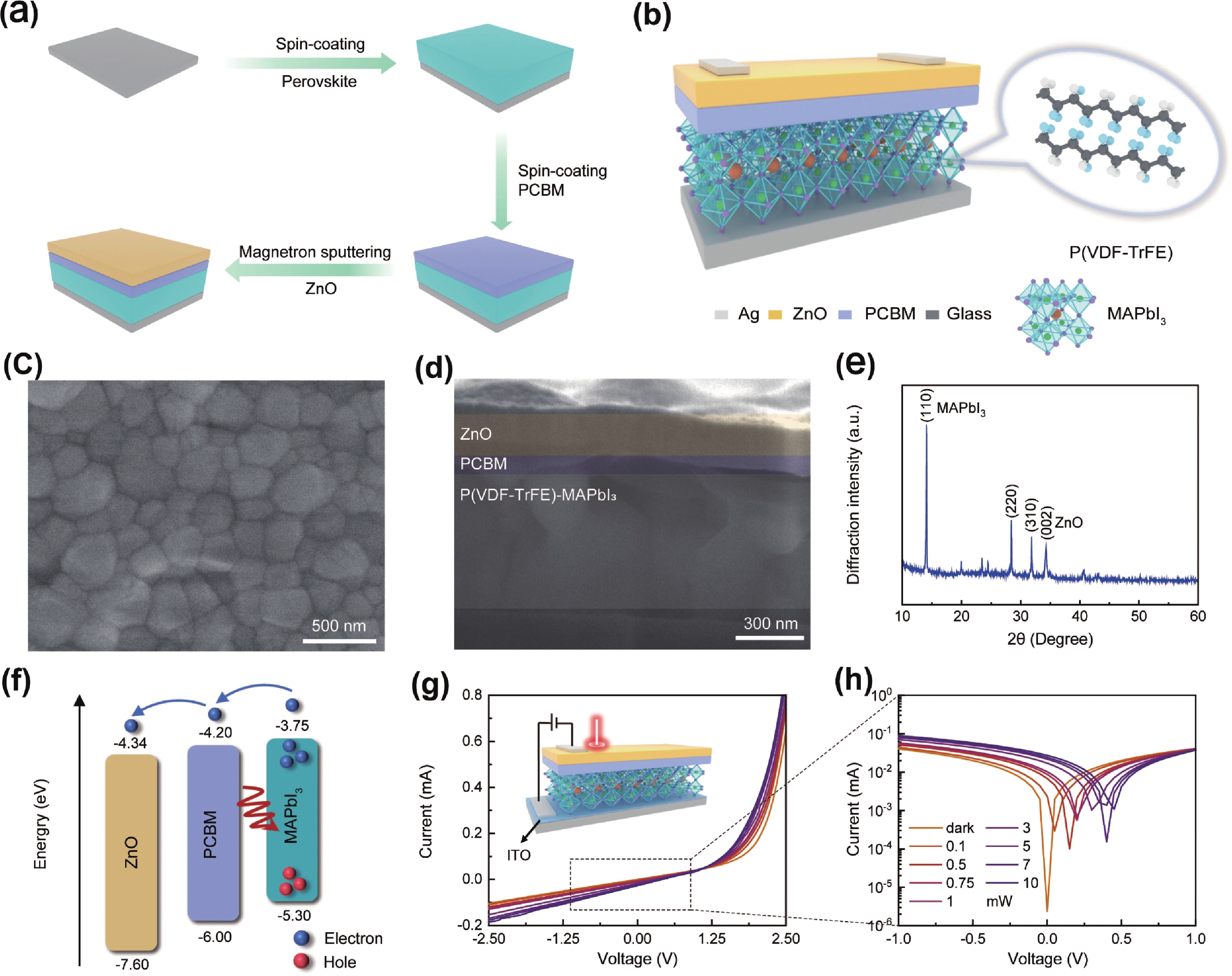
Fig. 1.  (Color online) Schematic diagram of the (a) fabrication process and (b) device structure of the ZnO/P(VDF-TrFE)-MAPbI3 heterojunction PSD. (c) Top-view SEM image of the P(VDF-TrFE)-MAPbI3 layer. (d) Cross-sectional view SEM image of the ZnO/P(VDF-TrFE)-MAPbI3 heterojunction. (e) XRD result and (f) energy band diagram of the heterojunction. (g) IV curves under 671 nm laser illumination at varying power levels, with an inset depicting the measurement schematic. (h) Amplified IV curves taken from the marked area in (g).

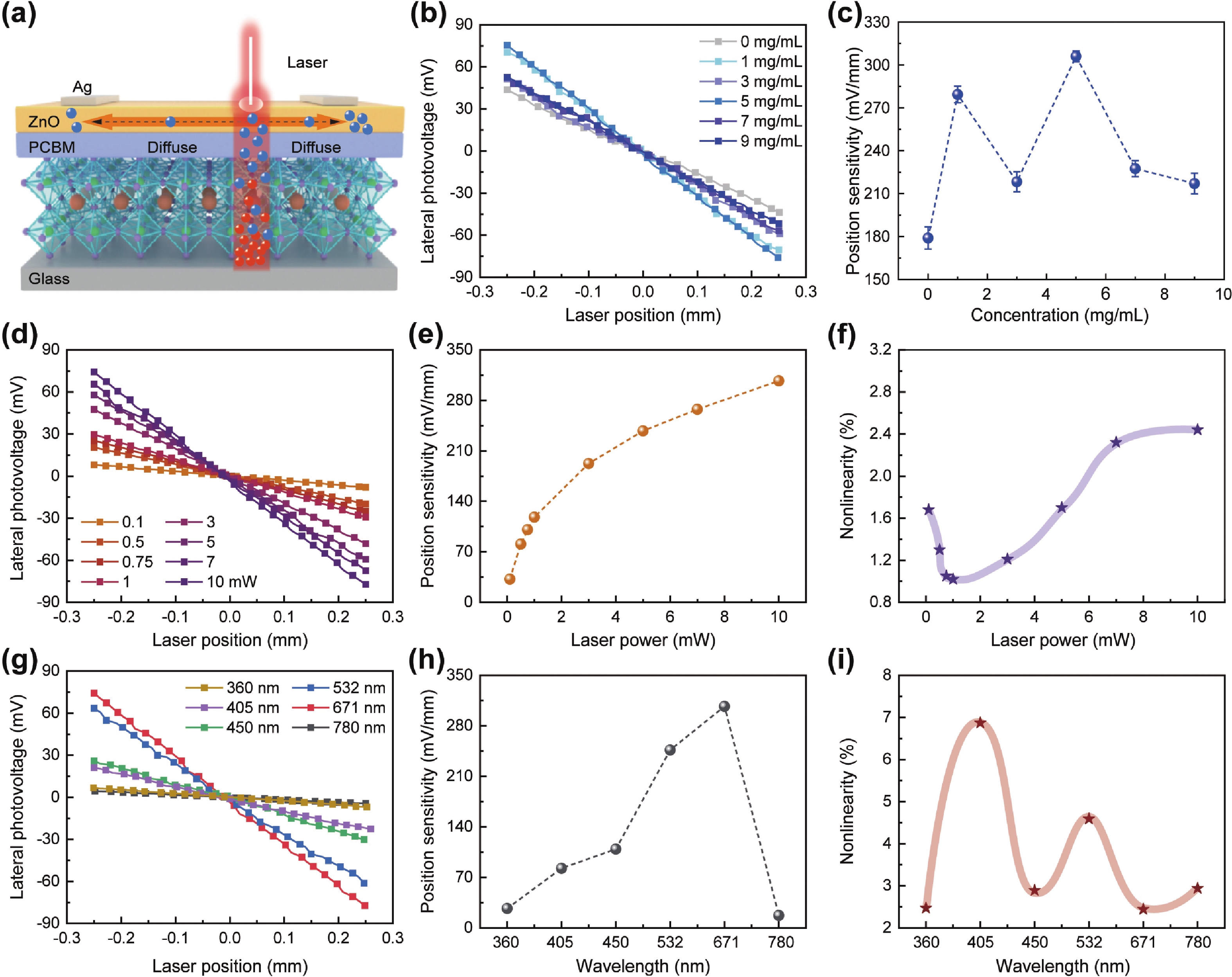
Fig. 2.  (Color online) (a) Schematic measurement diagram of the ZnO/P(VDF-TrFE)-MAPbI3 heterojunction PSD. (b) Laser position-dependent LPV curves of the ZnO/P(VDF-TrFE)-MAPbI3 heterojunction PSD with different doping concentrations of P(VDF-TrFE). (c) Extracted PSs of different doping concentrations of P(VDF-TrFE). (d) LPV curves of the ZnO/P(VDF-TrFE)-MAPbI3 heterojunction PSD under different illumination powers of a 671 nm laser. Extracted (e) PSs and (f) nonlinearities of different laser powers. (g) Laser position-dependent LPV curves of the ZnO/P(VDF-TrFE)-MAPbI3 heterojunction PSD under the irradiation of different lasers at 10 mW. Extract (h) PS and (i) nonlinearity for different laser wavelengths.

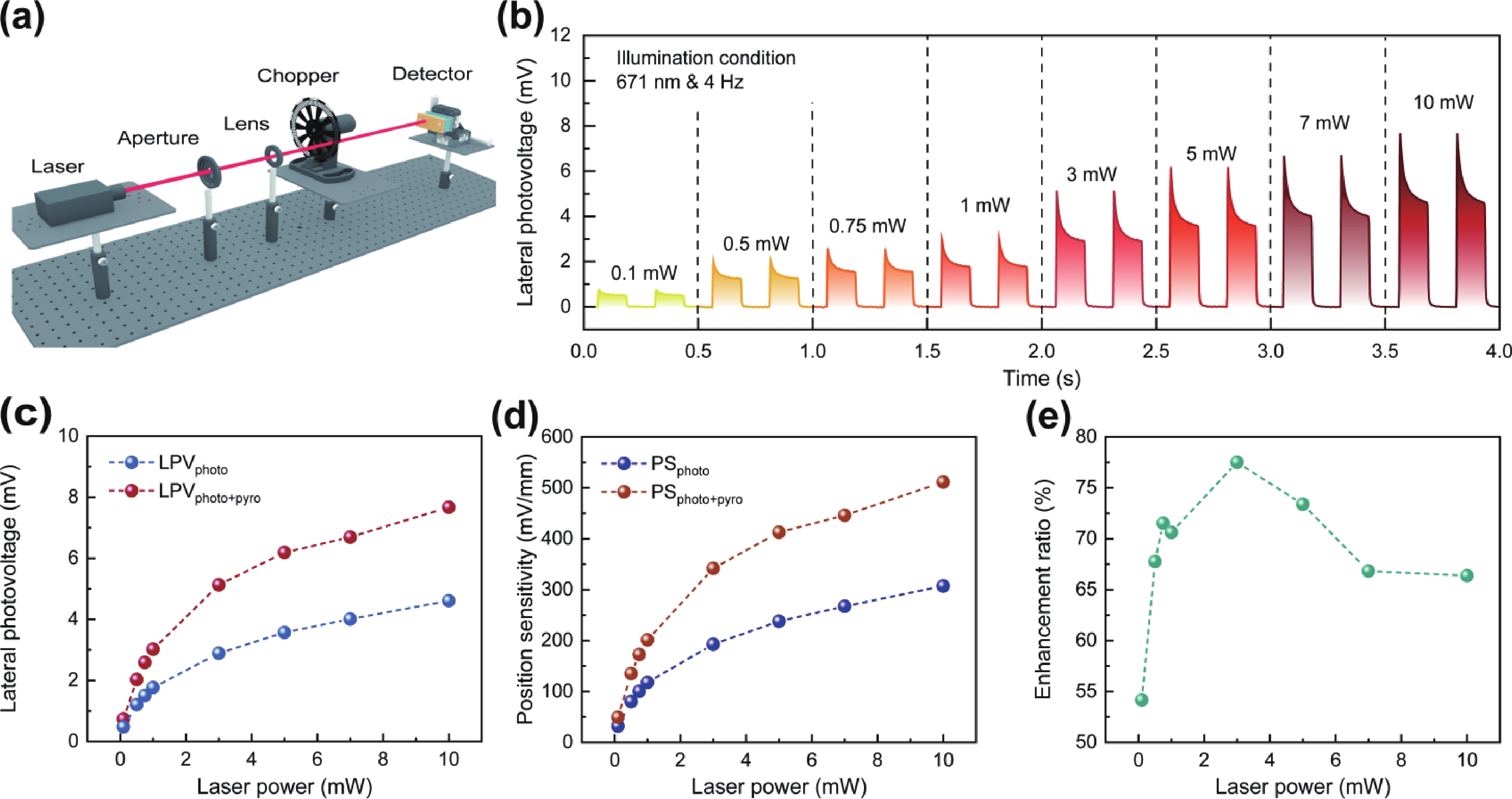
Fig. 3.  (Color online) (a) Schematic diagram of the transient LPE testing system. (b) Transient LPV−t curves of the ZnO/P(VDF-TrFE)-MAPbI3 heterojunction under the illumination of a 671 nm laser with a periodic chopper frequency of 4 Hz. Extracted (c) LPVs, (d) PSs and (e) PS enhancement ratios as a function of the laser power.

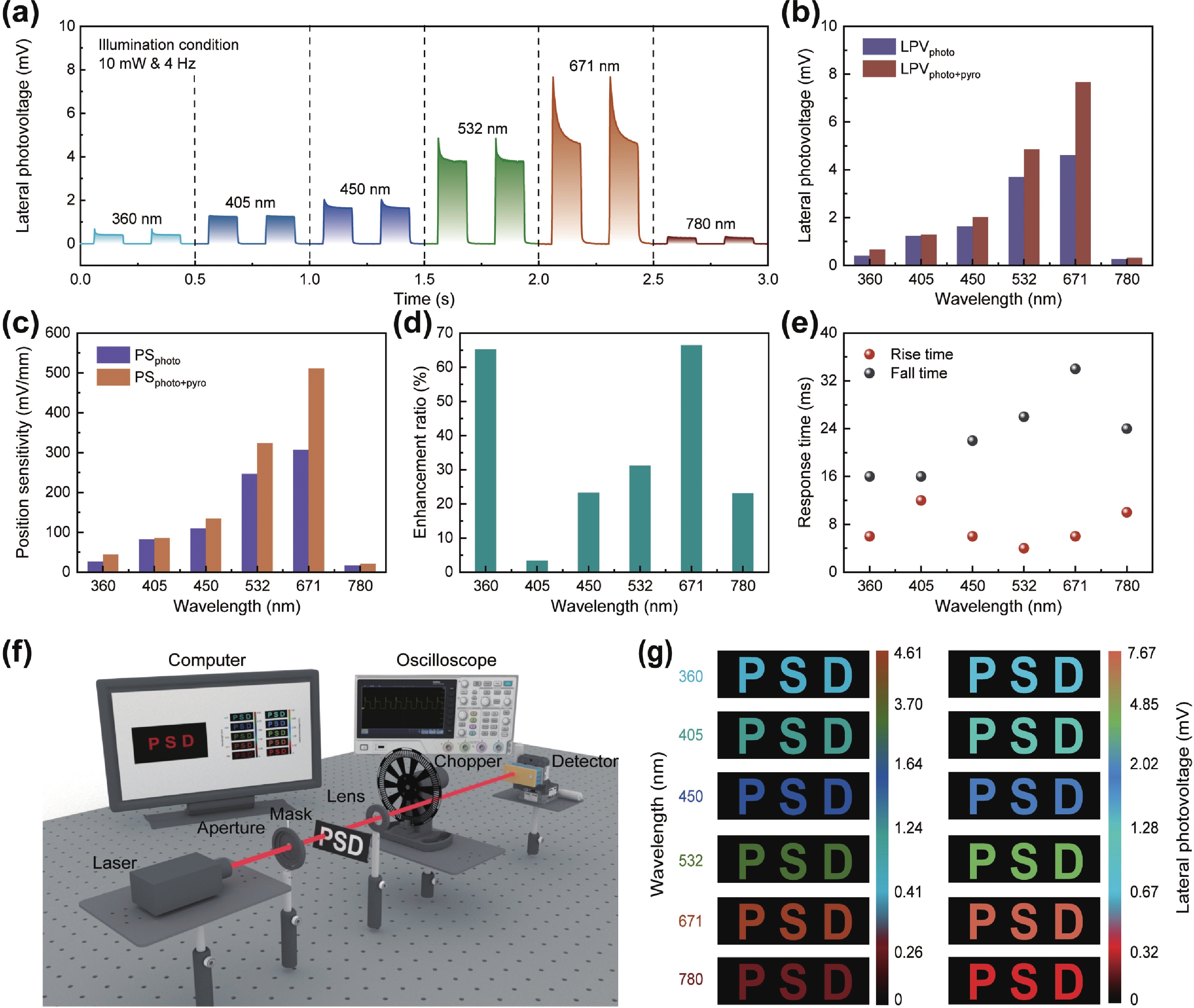
Fig. 4.  (Color online) (a) Transient LPV−t curves of the ZnO/P(VDF-TrFE)-MAPbI3 heterojunction PSD under the irradiation of different lasers (b) LPVs, (c) PSs, and (d) PS enhancement ratios as a function of the laser power. (e) Extracted rise time and fall time as a function of different lasers. (f) Schematic diagram of the measurement system. (g) Optical images of different wavelengths.

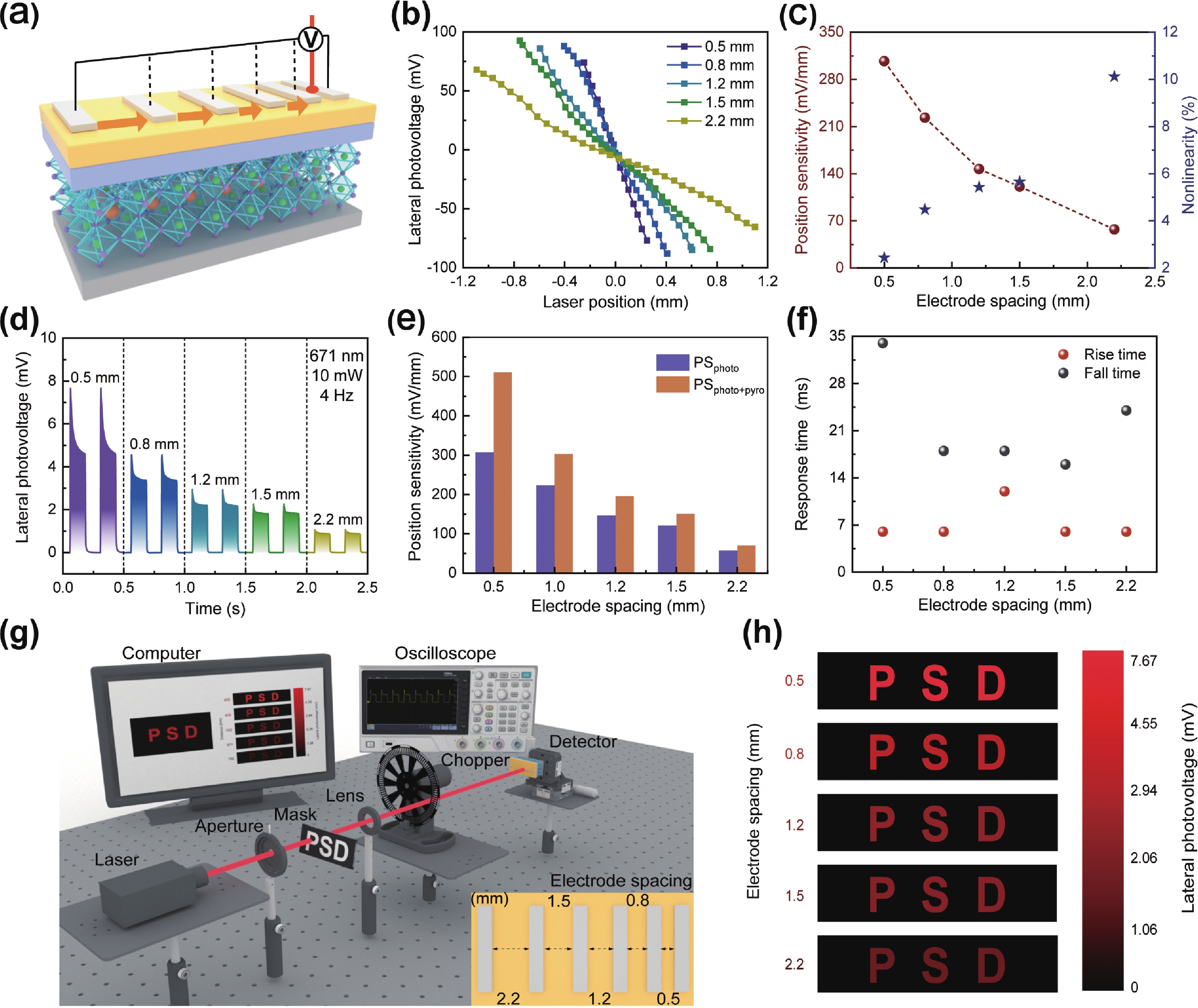
Fig. 5.  (Color online) (a) LPE measurement diagram of the ZnO/P(VDF-TrFE)-MAPbI3 heterojunction PSD with different electrode spaces. (b) Position-dependent LPV curves of the ZnO/P(VDF-TrFE)-MAPbI3 heterojunction PSD for different electrode spaces under 671 nm laser illumination at 10 mW. (c) Extracted PSs and nonlinearities of different electrode spaces. (d) Transient LPV−t responses measured under 671 nm laser illumination at 4 Hz for different electrode spacings. Extracted (e) PSs and (f) rise/fall times plotted against electrode spaces. (g) Schematic diagram of the measurement system. (h) Optical images of different electrode spaces.

Table 1.   Comparison with other published PSDs.

Device structureWavelength (nm)Position sensitivity (mV/mm)Nonlinearity (%)Ref.
Graphene-Ge1550502.2[1]
Bi2Te2.7Se0.3/Si532283.713[11]
Bi2Se3/planar-Si78589.7<7[13]
Bi2Se3/pyramid-Si785178.9<10[13]
standard-type 3C-SiC/Si980290/[16]
MoS2/GaAs650416.4/[18]
GaAs/Al0.3Ga0.7As6711353.12[35]
SnSe/Si635250/[36]
PbSe/Si10641904[37]
ZnO/P(VDF-TrFE)-MAPbI3671511.332.44This work
DownLoad: CSV
[1]
Liu K Y, Wang W H, Yu Y F, et al. Graphene-based infrared position-sensitive detector for precise measurements and high-speed trajectory tracking. Nano Lett, 2019, 19(11): 8132 doi: 10.1021/acs.nanolett.9b03368
[2]
Dwik S, Sasikala G, Natarajan S. Advancements and applications of position-sensitive detector (PSD): A Review. Optoelectron Lett, 2024, 20(6): 330 doi: 10.1007/s11801-024-3117-2
[3]
Nie M L, Zhao W, Jiang H Y, et al. Multiple optical imaging encryption enabled by giant lateral photovoltaic response via dual noncentrosymmetry-induced gradient band alignment and the pyro-phototronic effect. ACS Photonics, 2025, 12(12): 6850 doi: 10.1021/acsphotonics.5c02031
[4]
Nie M L, Wen H Q, Jiang H Y, et al. Pyroelectric-enhanced position sensing and its multifunctional imaging in a Si nanowire/CdS core–shell heterojunction. Nano Lett, 2025, 25(11): 4503 doi: 10.1021/acs.nanolett.5c00136
[5]
Fan J F, Guo Y F, Guo S Y, et al. Doping and polar interface-induced high-position sensing in the PEDOT: PSS/Si heterojunction and its multifunctional optical imaging. J Phys Chem Lett, 2025, 16(37): 9815 doi: 10.1021/acs.jpclett.5c02476
[6]
Zhao H Z, Guo S Y, Pu Z K, et al. An electron-dominated lateral photovoltaic effect in ZnO-based perovskite heterojunctions and its performance tunability by pyroelectric effect. J Mater Chem C, 2025, 13(23): 11823 doi: 10.1039/D5TC00620A
[7]
Hu J B, Wang X J, Lin L, et al. High-performance self-powered photodetector based on the lateral photovoltaic effect of all-inorganic perovskite CsPbBr3 heterojunctions. ACS Appl Mater Interfaces, 2023, 15(1): 1505 doi: 10.1021/acsami.2c16347
[8]
Lucovsky G. Photoeffects in nonuniformly irradiated p-n junctions. J Appl Phys, 1960, 31(6): 1088 doi: 10.1063/1.1735750
[9]
Niu H, Matsuda T, Sadamatsu H, et al. Application of lateral photovoltaic effect to the measurement of the physical quantities ofP-NJunctions–sheet resistivity and junction conductance of N2+ implanted Si. Jpn J Appl Phys, 1976, 15(4): 601
[10]
Hu C, Wang X J, Song B. High-performance position-sensitive detector based on the lateral photoelectrical effect of two-dimensional materials. Light Sci Appl, 2020, 9: 88 doi: 10.1038/s41377-020-0307-y
[11]
Qiao S, Chen M J, Wang Y, et al. Ultrabroadband, large sensitivity position sensitivity detector based on a Bi2Te2.7Se0.3/Si heterojunction and its performance improvement by pyro-phototronic effect. Adv Electron Mater, 2019, 5(12): 1900786
[12]
Cong R D, Qiao S, Liu J H, et al. Ultrahigh, ultrafast, and self-powered visible-near-infrared optical position-sensitive detector based on a CVD-prepared vertically standing few-layer MoS2/Si heterojunction. Adv Sci, 2018, 5(2): 1700502
[13]
Liang Z D, Wang Q, Ma J K, et al. Self-powered Bi2Se3/Si position-sensitive detector and its performance enhancement by introducing a Si nanopyramid structure. ACS Appl Mater Interfaces, 2023, 15(22): 26993
[14]
Qiao S, Liu J H, Yao C D, et al. Boosting bulk photovoltaic effect in transition metal dichalcogenide by edge semimetal contact. Light Sci Appl, 2025, 14: 22 doi: 10.1038/s41377-024-01691-z
[15]
Liu J H, Chen J W, Zhang Z C, et al. High-sensitivity flexible position sensing in a Cu(In, Ga)Se2 multi-layer heterojunction tuned by piezo-pyroelectric effect. Nano Energy, 2023, 109: 108254 doi: 10.1016/j.nanoen.2023.108254
[16]
Foisal A R M, Qamar A, Nguyen T, et al. Ultra-sensitive self-powered position-sensitive detector based on horizontally-aligned double 3C-SiC/Si heterostructures. Nano Energy, 2021, 79: 105494 doi: 10.1016/j.nanoen.2020.105494
[17]
Nguyen T H, Nguyen T, Foisal A R M, et al. Ultrasensitive self-powered position-sensitive detector based on n-3C-SiC/p-Si heterojunctions. ACS Appl Electron Mater, 2022, 4(2): 768 doi: 10.1021/acsaelm.1c01156
[18]
Hao L Z, Liu Y J, Han Z D, et al. Large lateral photovoltaic effect in MoS2/GaAs heterojunction. Nanoscale Res Lett, 2017, 12(1): 562 doi: 10.1186/s11671-017-2334-z
[19]
Zhang J D, Liu Y, Wang Y L. Van der Waals lamination for integrating metal halide in perovskite optoelectronic devices. Adv Mater, 2026: e17111
[20]
Hu X, Zhang X D, Liang L, et al. High-performance flexible broadband photodetector based on organolead halide perovskite. Adv Funct Mater, 2014, 24(46): 7373 doi: 10.1002/adfm.201402020
[21]
Dong R, Fang Y J, Chae J, et al. High-gain and low-driving-voltage photodetectors based on organolead triiodide perovskites. Adv Mater, 2015, 27(11): 1912
[22]
Qiao S, Liu Y, Liu J H, et al. High-responsivity, fast, and self-powered narrowband perovskite heterojunction photodetectors with a tunable response range in the visible and near-infrared region. ACS Appl Mater Interfaces, 2021, 13(29): 34625 doi: 10.1021/acsami.1c09642
[23]
Zhang T, Ren Z Y, Guo S Y, et al. Broadband self-powered CdS ETL-based MAPbI3 heterojunction photodetector induced by a photovoltaic–pyroelectric–thermoelectric effect. ACS Appl Mater Interfaces, 2023, 15(37): 44444 doi: 10.1021/acsami.3c07585
[24]
Cao F R, Tian W, Meng L X, et al. Ultrahigh-performance flexible and self-powered photodetectors with ferroelectric P(VDF-TrFE)/perovskite bulk heterojunction. Adv Funct Mater, 2019, 29(15): 1808415
[25]
Wang S J, Huang Y R, Hu W G, et al. Data-driven optimization and machine learning analysis of compatible molecules for halide perovskite material. npj Comput Mater, 2024, 10: 114 doi: 10.1038/s41524-024-01297-4
[26]
Oku T, Taguchi M, Suzuki A, et al. Effects of polysilane addition to chlorobenzene and high temperature annealing on CH3NH3PbI3 perovskite photovoltaic devices. Coatings, 2021, 11(6): 665 doi: 10.3390/coatings11060665
[27]
Guo S Y, Liu J H, Sun H X, et al. Optical demodulation and multi-dimensional identification via a monolithic perovskite heterojunction. Fundam Res, 2025, (In Press
[28]
Yu J Z, Pu Z K, Guo S Y, et al. Highly sensitive weak-light positioning detection enabled by a P(VDF-TrFE)-doped perovskite heterojunction. ACS Appl Mater Interfaces, 2025, 17(45): 62304 doi: 10.1021/acsami.5c16240
[29]
Du Y J, Miao S J, Jin Z, et al. A modulated heterojunction interface via ferroelectric P(VDF-TrFE) towards high performance quasi-2D perovskite self-powered photodetectors. J Mater Chem A, 2024, 12(40): 27518 doi: 10.1039/D4TA04985C
[30]
Qiao S, Sun H J, Liu J H, et al. The nanowire length dependence of the photoresponse and pyro-phototronic response in the ZnO-based heterojunctions. Nano Energy, 2022, 95: 107004 doi: 10.1016/j.nanoen.2022.107004
[31]
Han J L, Liang Z D, Guo S Y, et al. Photoresponse improvement of a MAPbI3 p-i-n heterojunction photodetector by modifying with a PCBM layer and optimizing ZnO layer thickness. Surf Interfaces, 2022, 34: 102315 doi: 10.1016/j.surfin.2022.102315
[32]
Wang Z N, Yu R M, Pan C F, et al. Light-induced pyroelectric effect as an effective approach for ultrafast ultraviolet nanosensing. Nat Commun, 2015, 6: 8401 doi: 10.1038/ncomms9401
[33]
Zhang T, Zhang G J, Wang Q, et al. Self-powered MAPbI3 heterojunction photodetector with gradient-level electron transport layers and dual pyro-phototronic effects. J Phys Chem Lett, 2024, 15(9): 2511 doi: 10.1021/acs.jpclett.4c00238
[34]
Jiang H Y, Nie M L, Liu Y, et al. Optoelectronic logic gate using a flexible pyramid-Si/CdS/ZnO self-powered photodetector featuring dual piezo-pyroelectric effect. Chem Eng J, 2025, 525: 170527 doi: 10.1016/j.cej.2025.170527
[35]
Liu J H, Qiao S, Liang B L, et al. Lateral photovoltaic effect observed in doping-modulated GaAs/Al03Ga07As. Opt Express, 2017, 25(4): A166 doi: 10.1364/OE.25.00A166
[36]
Wang X J, Zhao X F, Hu C, et al. Large lateral photovoltaic effect with ultrafast relaxation time in SnSe/Si junction. Appl Phys Lett, 2016, 109(2): 023502 doi: 10.1063/1.4955480
[37]
Ma J K, Chen M J, Qiao S, et al. High-performance broadband position-sensitive detector based on lateral photovoltaic effect of PbSe heterostructure. Opt Express, 2021, 29(22): 35226 doi: 10.1364/OE.439796
[38]
Lang S B. A 2400 year history of pyroelectricity: From Ancient Greece to exploration of the solar system. Br Ceram Trans, 2004, 103(2): 65 doi: 10.1179/096797804225012765
[39]
Jiang H Y, Nie M L, Pu Z K, et al. Enhanced broadband photosensing and wavelength-resolved imaging via the piezo-pyroelectric effect in flexible CdS/pyramid-Si heterojunction. Nano Energy, 2025, 137: 110818 doi: 10.1016/j.nanoen.2025.110818
[40]
Xu Z X, Zhang Y L, Wang Z N. ZnO-based photodetector: From photon detector to pyro-phototronic effect enhanced detector. J Phys D Appl Phys, 2019, 52(22): 223001 doi: 10.1088/1361-6463/ab0728

Supporting_Information.pdf

  • Search

    Advanced Search >>

    GET CITATION

    shu

    Export: BibTex EndNote

    Article Metrics

    Article views: 15 Times PDF downloads: 2 Times Cited by: 0 Times

    History

    Received: 28 January 2026 Revised: 02 March 2026 Online: Accepted Manuscript: 12 March 2026

    Catalog

      Email This Article

      User name:
      Email:*请输入正确邮箱
      Code:*验证码错误
      Congrui Jing, Haozhe Zhao, Siyang Guo, Jihong Liu, Shufang Wang, Shuang Qiao. Pyroelectrically enhanced high-sensitivity self-powered position-sensitive detector based on ZnO/P(VDF-TrFE)-MAPbI3 heterojunction with multifunctional imaging capability[J]. Journal of Semiconductors, 2026, In Press. doi: 10.1088/1674-4926/26010044 ****C R Jing, H Z Zhao, S Y Guo, J H Liu, S F Wang, and S Qiao, Pyroelectrically enhanced high-sensitivity self-powered position-sensitive detector based on ZnO/P(VDF-TrFE)-MAPbI3 heterojunction with multifunctional imaging capability[J]. J. Semicond., 2026, accepted doi: 10.1088/1674-4926/26010044
      Citation:
      Congrui Jing, Haozhe Zhao, Siyang Guo, Jihong Liu, Shufang Wang, Shuang Qiao. Pyroelectrically enhanced high-sensitivity self-powered position-sensitive detector based on ZnO/P(VDF-TrFE)-MAPbI3 heterojunction with multifunctional imaging capability[J]. Journal of Semiconductors, 2026, In Press. doi: 10.1088/1674-4926/26010044 ****
      C R Jing, H Z Zhao, S Y Guo, J H Liu, S F Wang, and S Qiao, Pyroelectrically enhanced high-sensitivity self-powered position-sensitive detector based on ZnO/P(VDF-TrFE)-MAPbI3 heterojunction with multifunctional imaging capability[J]. J. Semicond., 2026, accepted doi: 10.1088/1674-4926/26010044

      Pyroelectrically enhanced high-sensitivity self-powered position-sensitive detector based on ZnO/P(VDF-TrFE)-MAPbI3 heterojunction with multifunctional imaging capability

      DOI: 10.1088/1674-4926/26010044
      CSTR: 32376.14.1674-4926.26010044
      More Information
      • Congrui Jing received her M.S. degree in College of Electronic Information Engineering, Hebei University in 2020. She is currently a PhD student at College of Physics and Technology, Hebei University. Her research focuses on optoelectronic devices based on perovskite materials
      • Jihong Liu received her M.S. degree in College of Physics and Information Engineering, Hebei Normal University in 2008, and joined in College of Physics Science and Technology, Hebei University in 2014. Her research focuses on the fields of preparation of solar cells and the optoelectronic/photovoltaic performances of semiconductor heterostructures
      • Shuang Qiao earned his Ph.D. degree from the Institute of Semiconductors, Chinese Academy of Sciences in 2014. Following that, he joined the Hebei University and has been serving as a full professor since 2022. From 2017 to 2019, he worked as a visiting fellow at the Beijing Institute of Nanoenergy and Nanosystems, Chinese Academy of Sciences. His research primarily focuses on the fabrication of novel semiconductor heterostructures, investigating their optoelectronic and photovoltaic properties, exploring ultrafast dynamics, and studying the piezo/pyro-phototronic effects of nano devices
      • Corresponding author: liujihong@hbu.edu.cnsqiao@hbu.edu.cn
      • Received Date: 2026-01-28
      • Revised Date: 2026-03-02
      • Available Online: 2026-03-12

      Catalog

        /

        DownLoad:  Full-Size Img  PowerPoint
        Return
        Return