| [1] |
Ziman J M. Electrons and Phonons: The Theory of Transport Phenomena in Solids. Oxford Univ Press, 1960
|
| [2] |
Li M, Li S X, Zhang Z H, et al. Advancing thermal management technology for power semiconductors through materials and interface engineering. Acc Mater Res, 2025, 6(5): 563 doi: 10.1021/accountsmr.4c00349 |
| [3] |
Li S X, Su C J, Qin Z H, et al. Metallic θ-phase tantalum nitride has a thermal conductivity triple that of copper. Science, 2026: eaeb1142
|
| [4] |
Kundu A, Yang X L, Ma J L, et al. Ultrahigh thermal conductivity of θ-phase tantalum nitride. Phys Rev Lett, 2021, 126(11): 115901 doi: 10.1103/PhysRevLett.126.115901 |
| [5] |
Kundu A, Chen Y N, Yang X L, et al. Electron-induced nonmonotonic pressure dependence of the lattice thermal conductivity of θ-TaN. Phys Rev Lett, 2024, 132(11): 116301 doi: 10.1103/PhysRevLett.132.116301 |
| [6] |
Li C H, Broido D. Large electron-phonon drag asymmetry and reverse heat flow in the topological semimetal θ-TaN. Mater Today Phys, 2025, 53: 101706 doi: 10.1016/j.mtphys.2025.101706 |
| [7] |
Lindsay L, Broido D A, Reinecke T L. First-principles determination of ultrahigh thermal conductivity of boron arsenide: A competitor for diamond? Phys Rev Lett, 2013, 111(2): 025901 doi: 10.1103/PhysRevLett.111.025901 |
| [8] |
Kang J S, Li M, Wu H, et al. Experimental observation of high thermal conductivity in boron arsenide. Science, 2018, 361(6402): 575 doi: 10.1126/science.aat5522 |
| [9] |
Lee H, Zhou Y Y, Jung S, et al. High-pressure synthesis and thermal conductivity of semimetallic θ-tantalum nitride. Adv Funct Mater, 2023, 33(17): 2212957
|
| [10] |
Ho C Y, Powell R W, Liley P E. Thermal conductivity of the elements. J Phys Chem Ref Data, 1972, 1(2): 279
|
| [11] |
Kundu A, Ma J, Carrete J, et al. Anomalously large lattice thermal conductivity in metallic tungsten carbide and its origin in the electronic structure. Mater Today Phys, 2020, 13: 100214 doi: 10.1016/j.mtphys.2020.100214 |
| [12] |
Chen Y N, Ma J L, Wen S H, et al. Body-centered-cubic structure and weak anharmonic phonon scattering in tungsten. npj Comput Mater, 2019, 5: 98 doi: 10.1038/s41524-019-0235-7 |



 Miao-Ling Lin is now a Professor at the State Key Laboratory of Semiconductor Physics and Chip Technologies, Institute of Semiconductors, Chinese Academy of Sciences. She received her B.S. degree (2014) in Physics from Nankai University. And she obtained her Ph.D. degree from University of Chinese Academy of Sciences. Her current research interest focuses on optical properties of low-dimensional nanomaterials.
 Ping-Heng Tan is a Professor at the State Key Laboratory of Semiconductor Physics and Chip Technologies at Institute of Semiconductors, Chinese Academy of Sciences. He obtained BS (1996) in Physics from Peking University, PhD (2001) from Institute of Semiconductors, Chinese Academy of Sciences. He worked at Walter Schottky Institut, Technische Universitaet Muenchen as a Posdoc Research Associate from 2001-2003. He was a KC-Wong Royal Society Fellow at Cambridge University from 2006-2007. His current research is on two-dimensional layered materials, nanocarbon materials and low-dimensional semiconductor materials. He was supported by National Science Fund for Distinguished Young Scholars in 2012.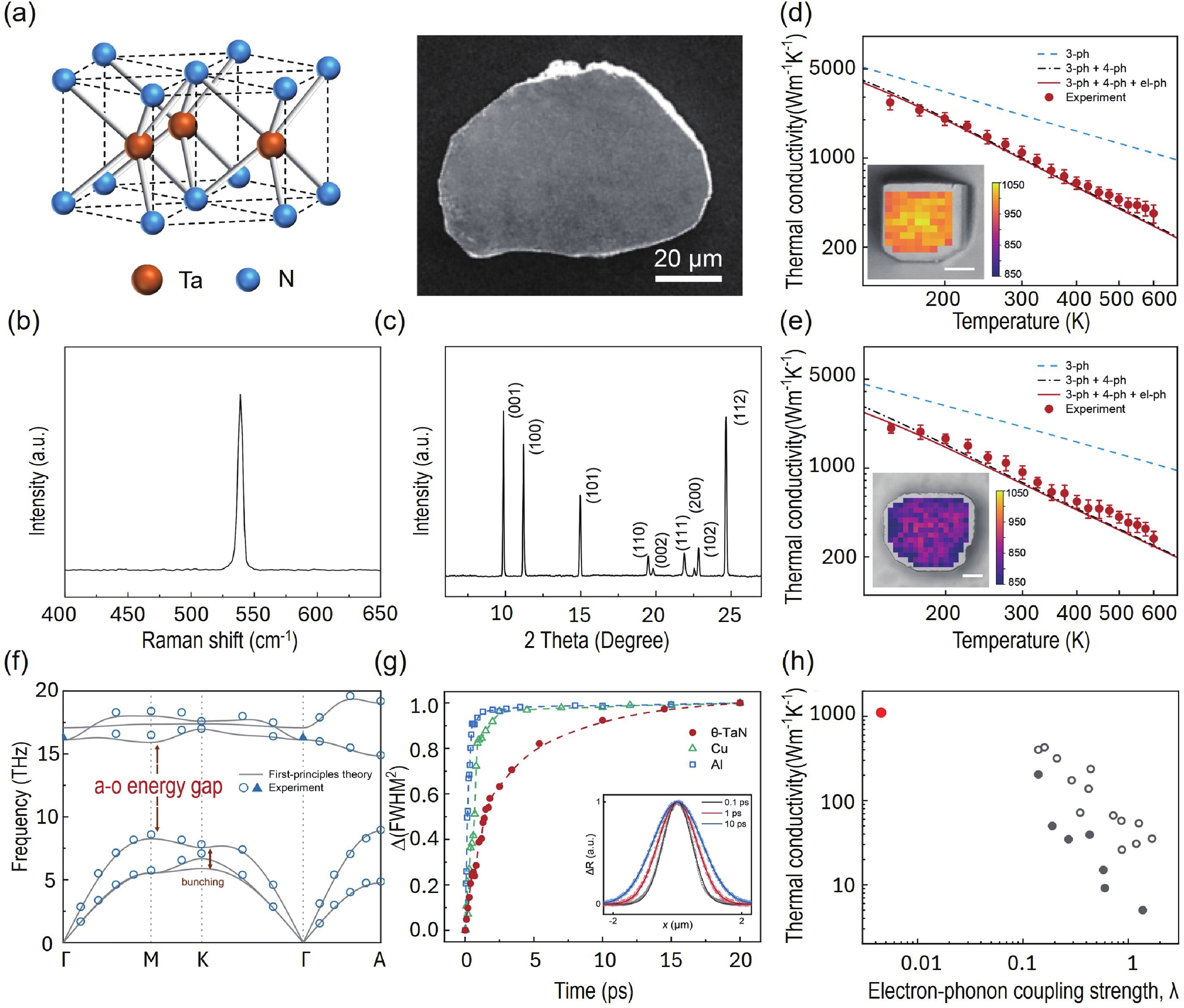
 DownLoad: