


 Xu Li is a PhD candidate in the School of Chemistry and Chemical Engineering at Nanjing University of Science and Technology. His research interests focus on the design and development of optoelectronic functional materials, as well as their applications in perovskite solar cells (PSCs).
 Yuxiao Guo is currently a postdoctoral fellow (cooperation supervisor: Prof. Bo Xu) at Nanjing University of Science and Technology. He received his B.S. and Ph.D. degree in Electronic Science and Technology from Xi’an Jiaotong University in 2016 and 2023, respectively. At present, his research primarily focuses on the photoelectric stability of wide-bandgap mixed-halide perovskites, as well as their applications in the fields of solar cells and light emitting diodes.
 Bo Xu is a Professor and Principal Investigator at the Nanjing University of Science and Technology, China. Following a Ph.D. from the KTH Royal Institute of Technology (2015), he completed postdoctoral fellowships at the University of Washington and Uppsala University. Dr. Xu currently leads the Molecular Electronics research group, specializing in the development of tailored molecular materials for energy and optoelectronic applications. His work, which emphasizes efficiency and stability in photovoltaics and light-emitting diodes, has been widely published in leading journals such as Nature, Nature Communications, Joule, Advanced Materials, and Angewandte Chemie.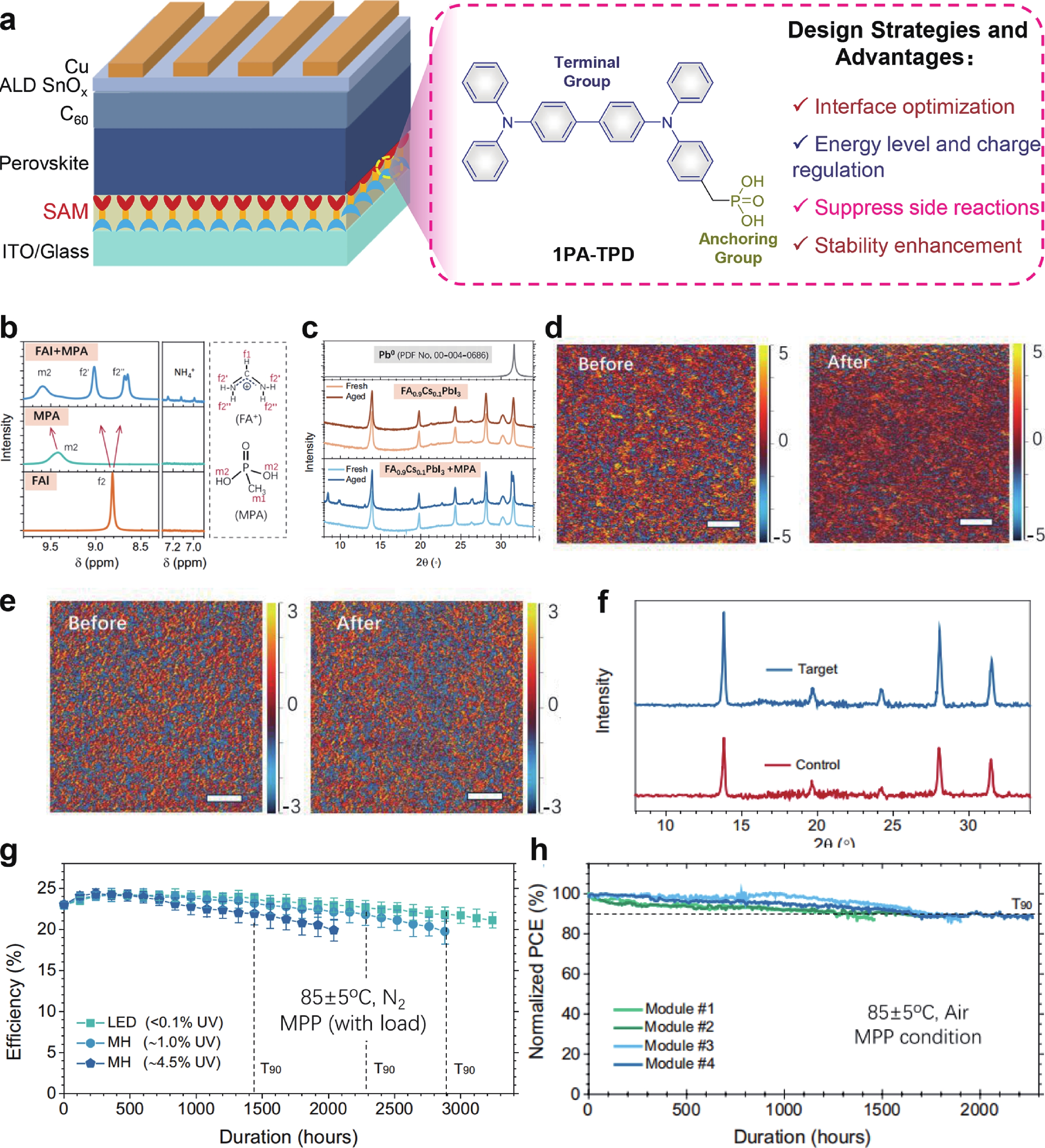
Fig. 1.
(Color online) Schematic illustration, experimental characterizations, and performance validation of 1PA-TPD-mediated interfacial optimization for PSCs. (a) Device architecture of PSCs (ITO/HTL/perovskite/C60/SnO2/Cu) and molecular design strategy of 1PA-TPD, showing strong covalent anchoring to ITO versus weak hydrogen bonding of conventional PA-SAMs. (b) 1H-NMR spectra of MPA, FAI, and the FAI-MPA mixture in DMSO-d6, confirming NH4+ formation from FA+ decomposition. (c) XRD patterns of fresh and aged (85 °C, 100 mW cm−1, 4.5% UV) FA0.9Cs0.1PbI3 films with and without MPA, showing Pb0 diffraction peaks (gray line) in MPA-containing aged films. (d) AFM-IR spectra of ITO/EtCz3EPA before and after acid treatment, monitoring C-H bending at 1020 cm−1, confirming removal of weakly bound SAMs (scale bars: 1 μm). (e) AFM-IR spectra of ITO/1PA-TPD before and after acid treatment, monitoring C-C bending in the benzene ring at 1580 cm−1, showing minimal SAM loss (scale bars: 1 μm). (f) GIXRD patterns of fresh perovskite films on different substrates (peeled from ITO, 0.3° incident angle), revealing enhanced crystallinity in the mixed SAM system. (g) Light-soaking stability of small-area devices (0.08 cm2) under MPP conditions (85±5 °C) with different UV ratios, showing T90 of nearly 3000 hours for target devices. (h) Operational stability of encapsulated minimodules (~23.1 cm2 aperture area) under 85 °C and LEP lamp illumination (100 mW cm−2, 2.2% UV), with the best module achieving T90 ~2200 hours.[8]
 DownLoad: