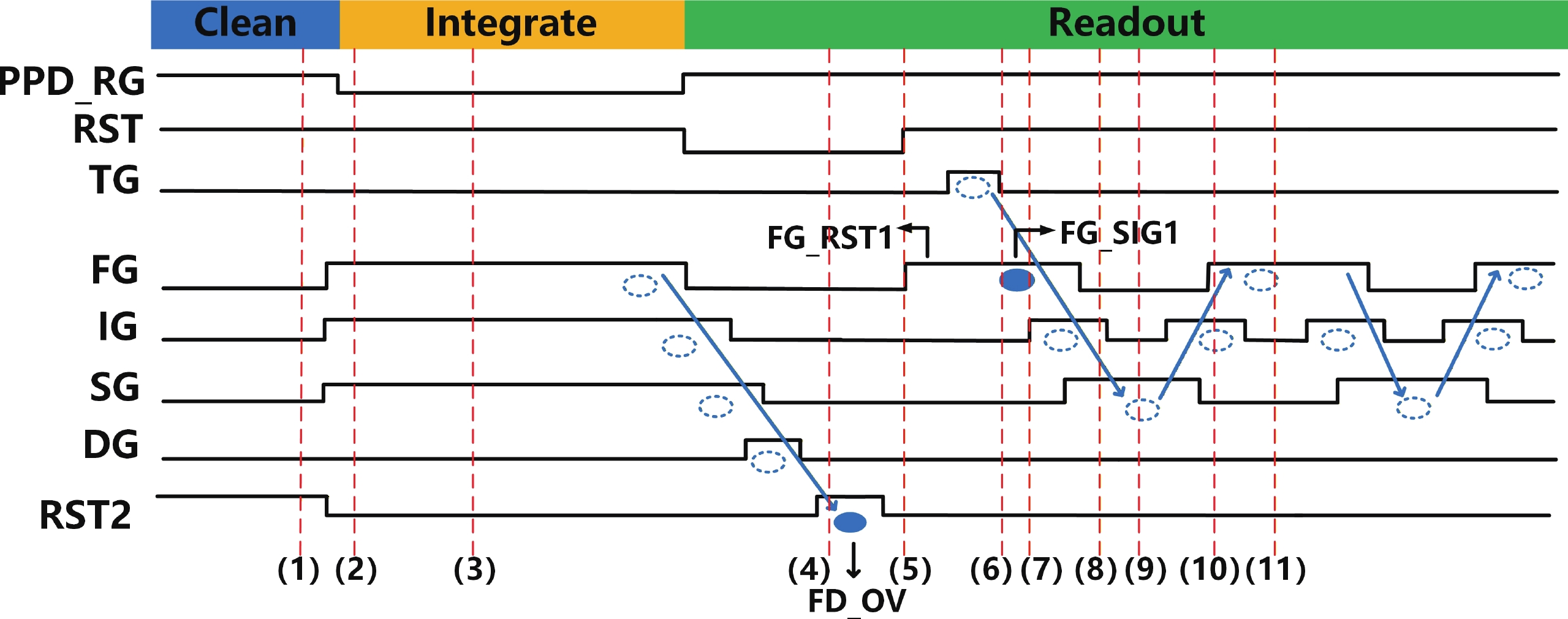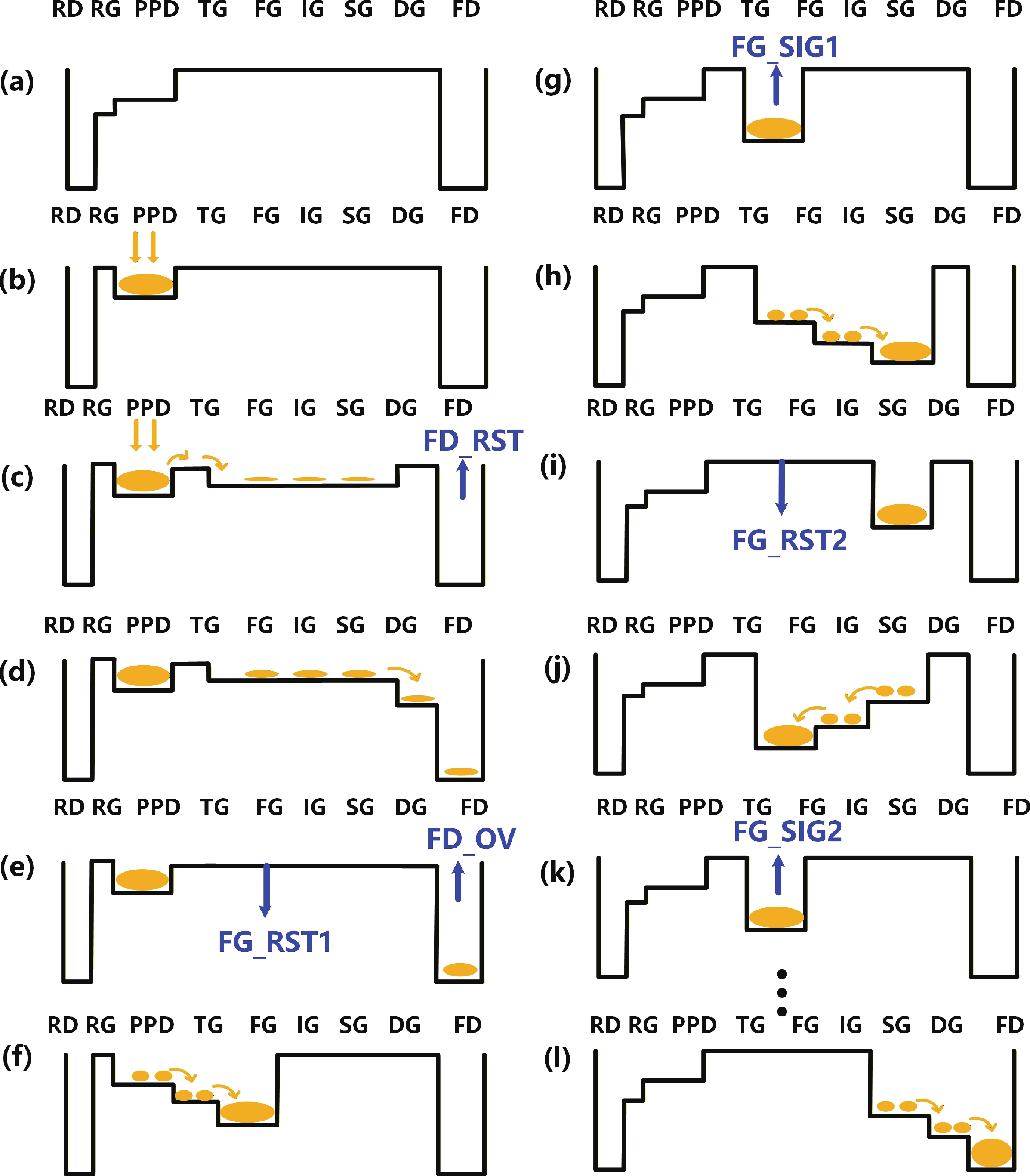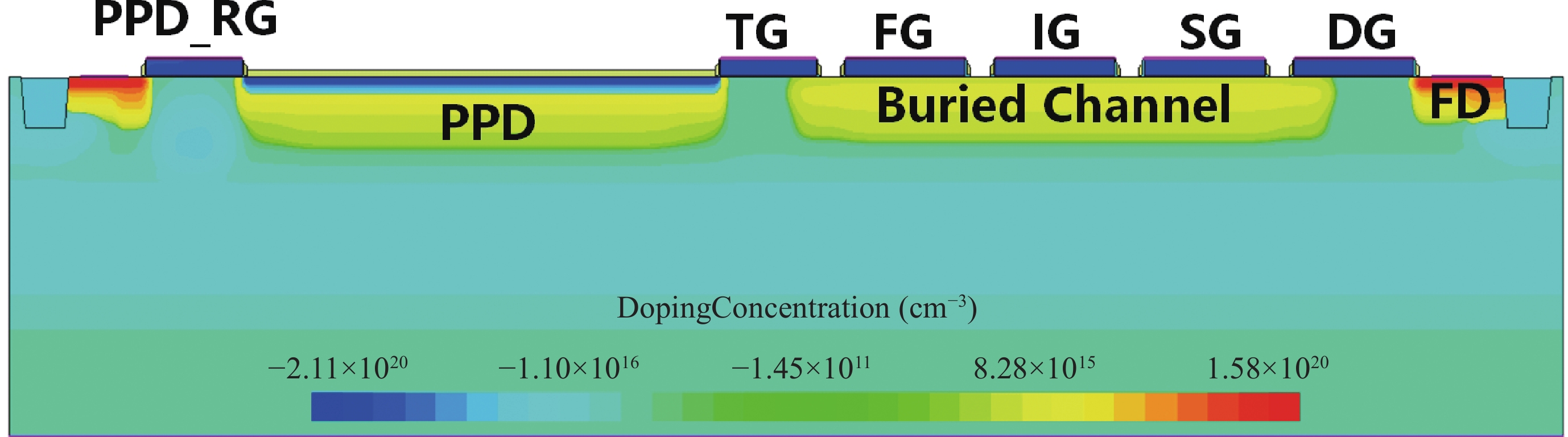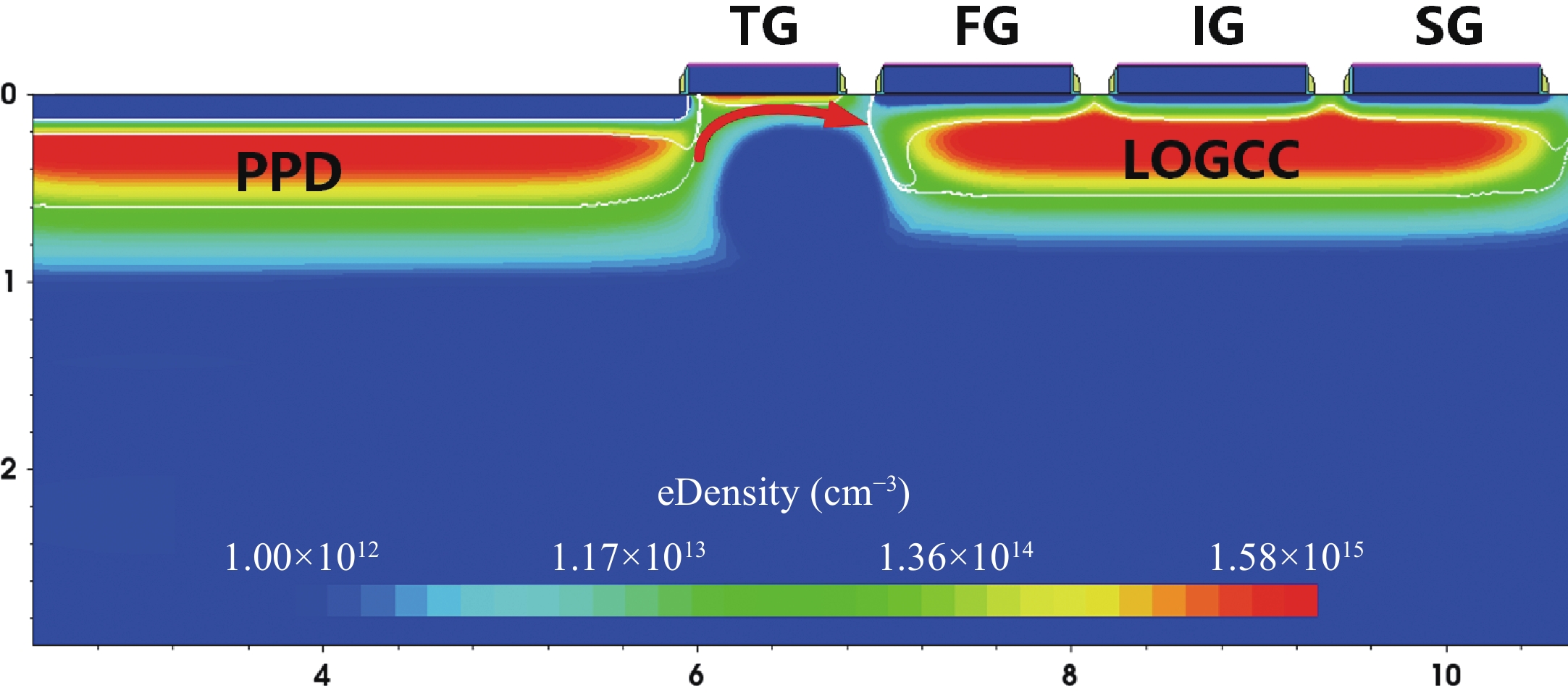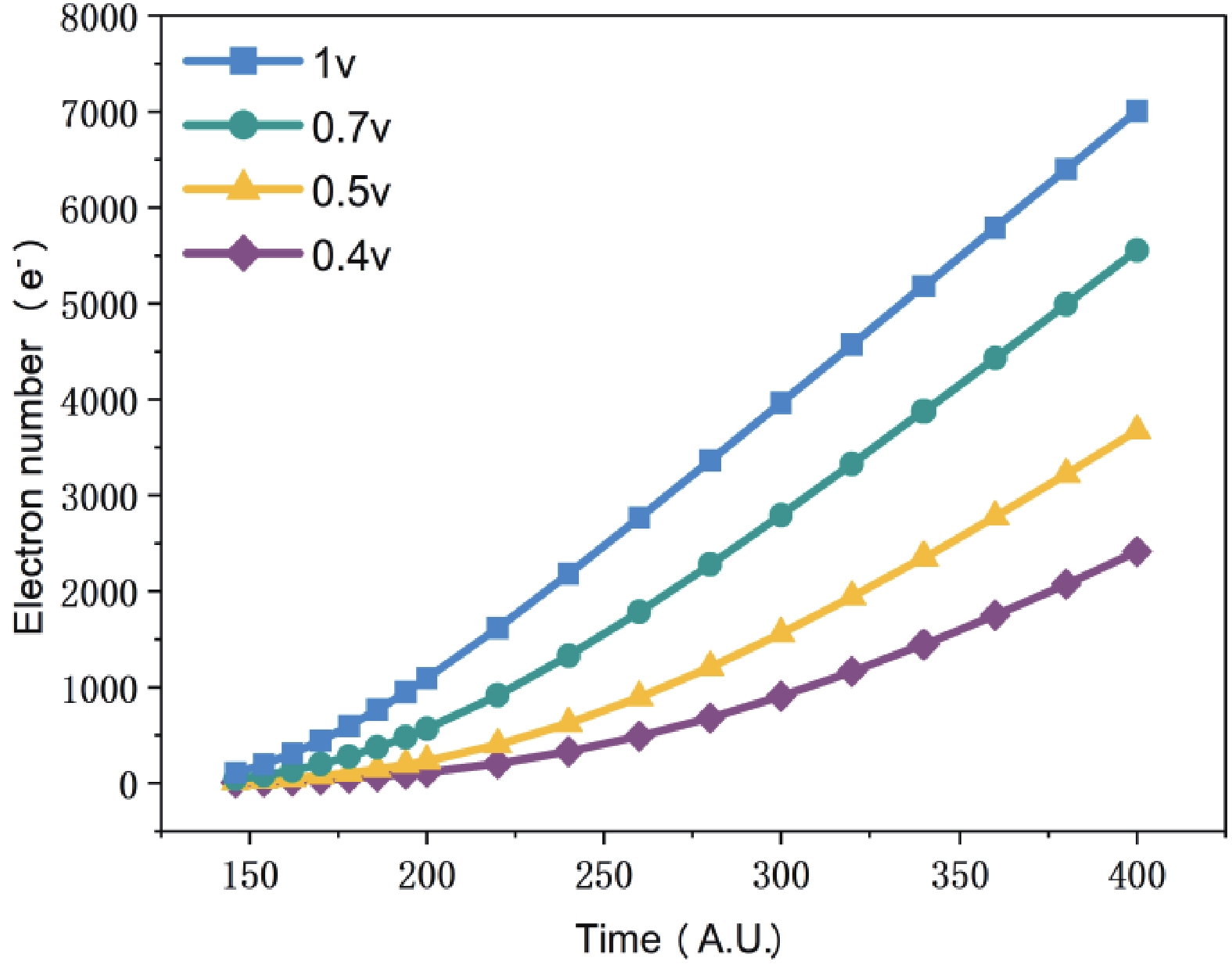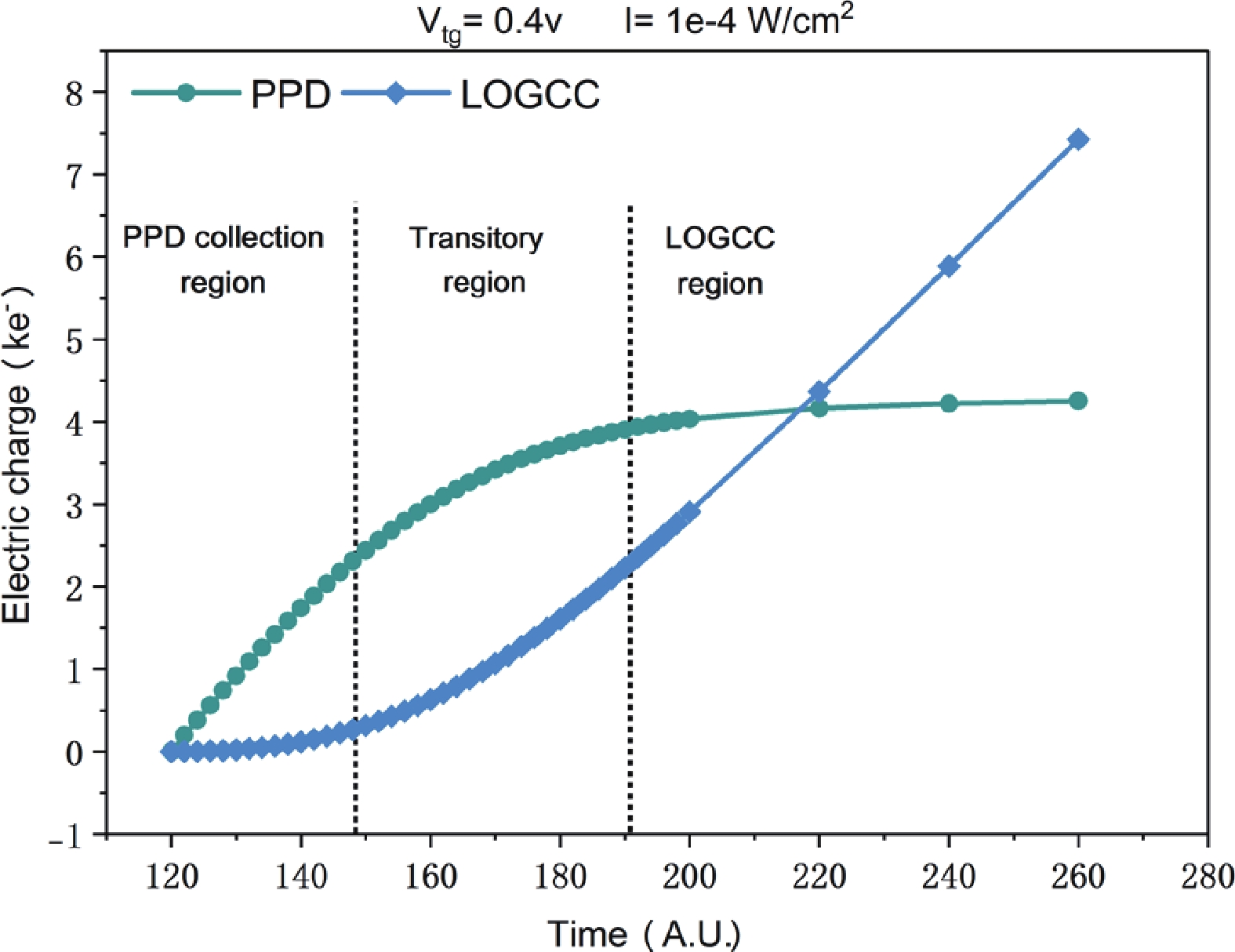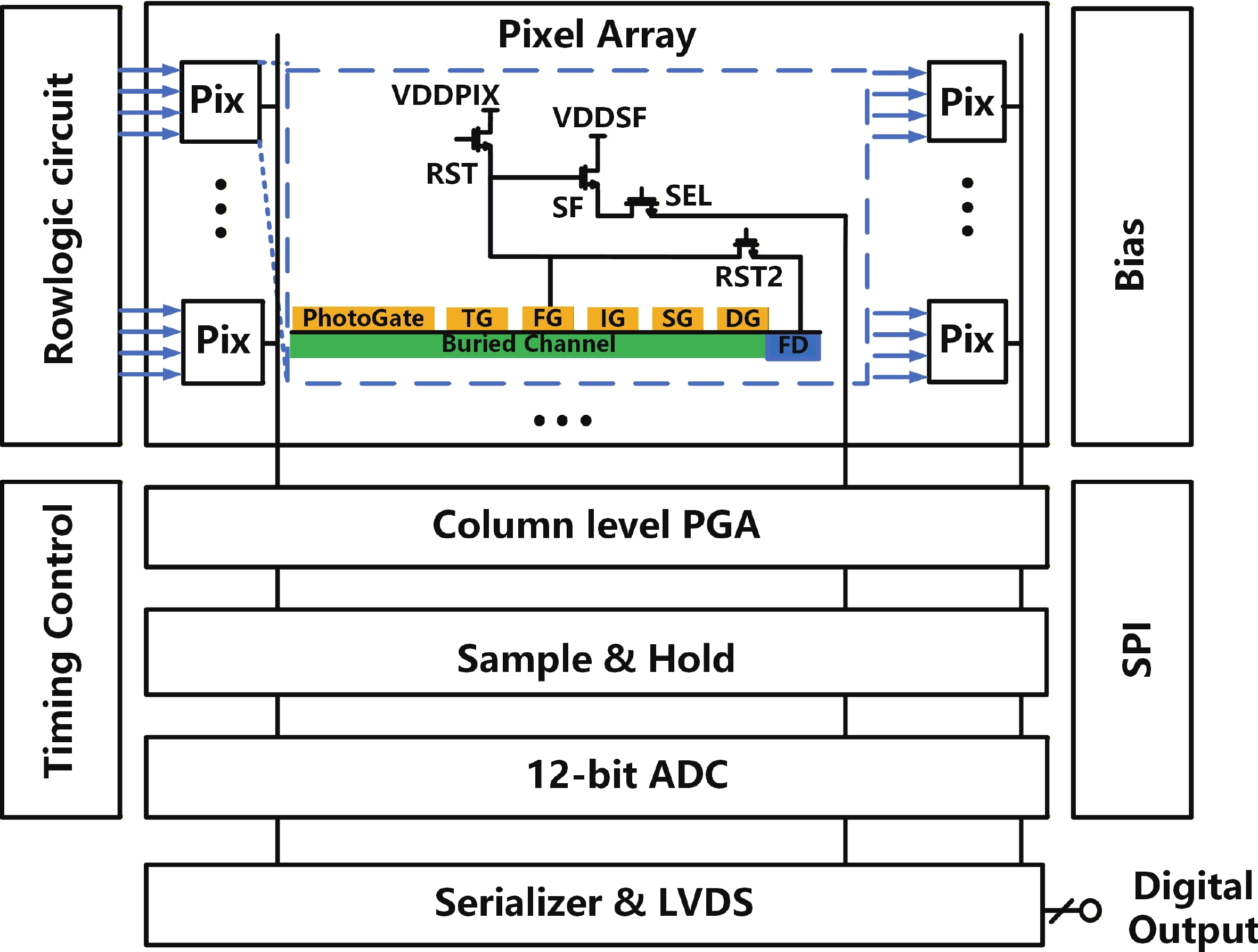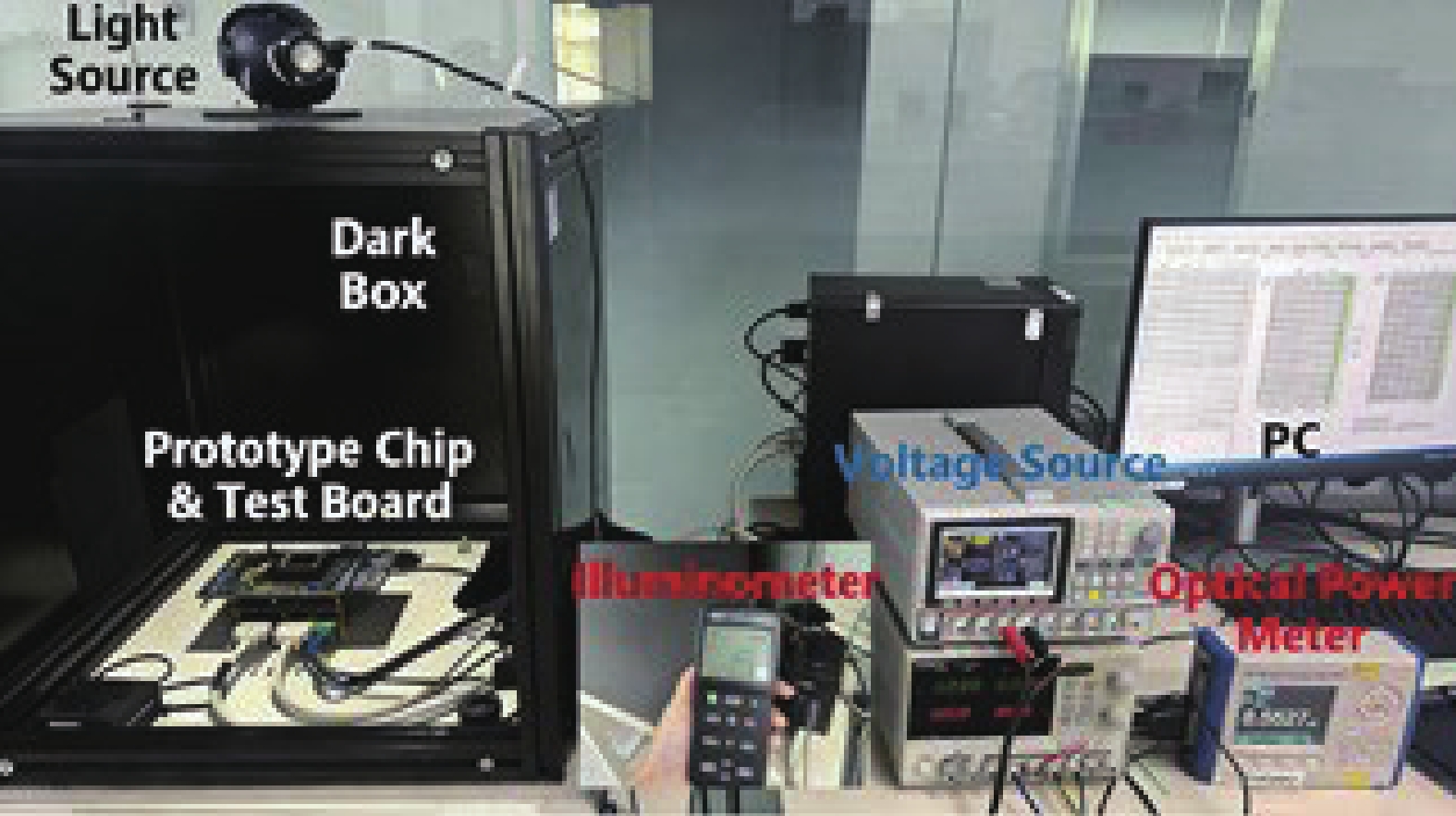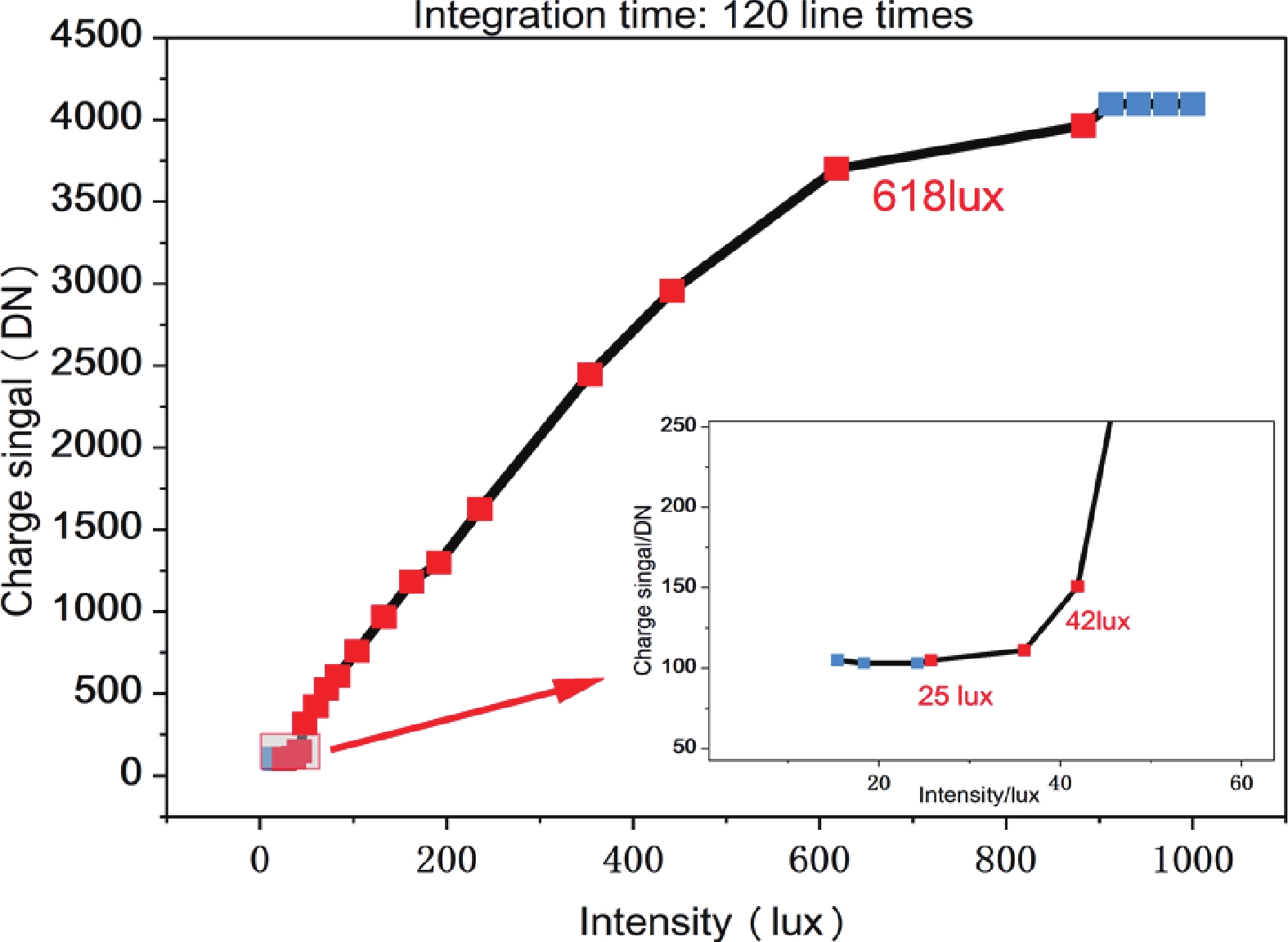


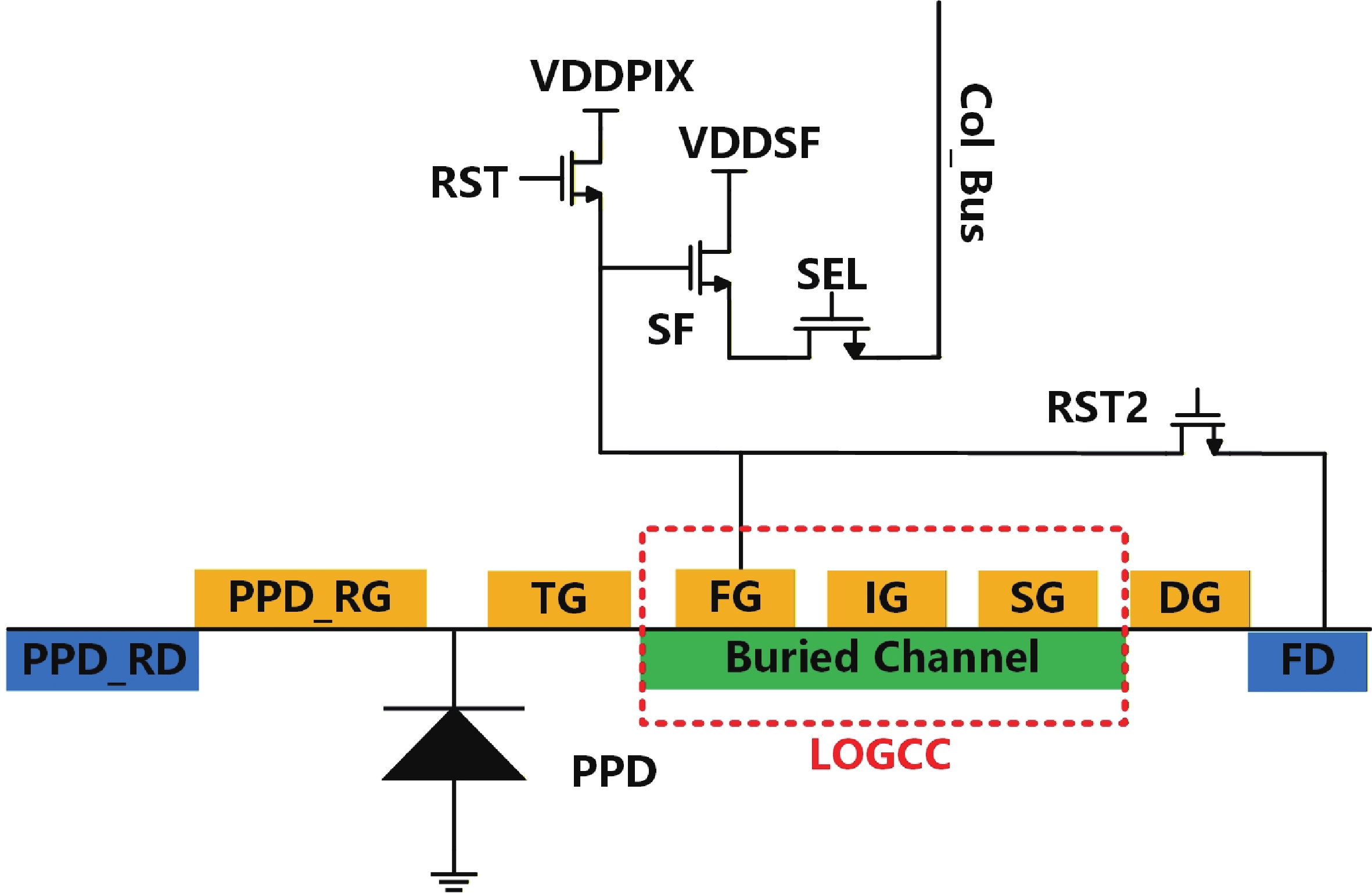
Fig. 1.
(Color online) Proposed HDR skipper pixel architecture.
ARTICLES
Jiayi Shi1, Yang Qu2, , Zehao Li2, Zhongxue Qi3, Ning Cui3, Yang Li3 and Yuchun Chang1,
Corresponding author: Yang Qu, yang.qu@zymec.cn; Yuchun Chang, cyc@dlut.edu.cn
Abstract: A skipper image sensor (SIS) with lateral overflow gate-coupled capacitor (LOGCC) is proposed in this work. During the integration period, the transfer gates after TG are switched on to construct a LOGCC with specific operation timing. Once high light illumination fully charges the pinned photodiode (PPD), the extra photogenerated electrons will overflow to LOGCC, which effectively improve the dynamic range (DR) of SIS. Before the readout of signal in PPD, the electrons stored in LOGCC are sampled and then reset through the floating diffusion (FD). In the end, the electrons in PPD are sampled by the method of the conventional skipper pixels. According to TCAD simulation results, the extra electrons are transferred to LOGCC through the TG effectively. Measurement of prototype chip shows that the DR is extended to 89.3 dB. As contrast, the DR is 66 dB when switching off the transfer gates, i.e. LOGCC. Compared with traditional SIS, the proposed architecture achieved DR extension by introducing LOGCC which is constructed with transfer gates. Therefore, this study proposes the introduction of LOGCC to expand the application scenarios of SIS, providing a new approach for its use in conditions requiring stronger light.
Keywords: skipper image sensor (SIS), lateral overflow gate-coupled capacitor (LOGCC), high dynamic range (HDR), technology computer aided design (TCAD)
| [1] |
Moroni G F, Estrada J, Paolini E E, et al. Achieving sub-electron readout noise in skipper CCDs. 2011 Argentine School of Micro-Nanoelectronics, Technology and Applications, 2011: 1
|
| [2] |
Smith G E. The invention and early history of the CCD. Nucl Instrum Meth Phys Res Sect A Accel Spectrometers Detect Assoc Equip, 2009, 607(1): 1 doi: 10.1364/biomed.2012.jm1a.1
|
| [3] |
Arnquist I, Avalos N, Bailly P, et al. The DAMIC-M low background chamber. J Instrum, 2024, 19(11): T11010 doi: 10.1088/1748-0221/19/11/T11010
|
| [4] |
Barak L, Bloch I M, Cababie M, et al. SENSEI: Direct-detection results on sub-GeV dark matter from a new skipper CCD. Phys Rev Lett, 2020, 125(17): 171802 doi: 10.1103/PhysRevLett.125.171802
|
| [5] |
Janesick J R, Elliott T S, Dingiziam A, et al. New advancements in charge-coupled device technology: Subelectron noise and 4096 x 4096 pixel CCDs. Charge Coupled Devices Solid State Opt Sens, 1990, 1242: 223 doi: 10.1117/12.19452
|
| [6] |
Botti A M, Chavez C, Sofo-Haro M, et al. A multichannel silicon package for large-scale skipper-CCD experiments. IEEE Sens J, 2025, 25(5): 8813 doi: 10.1109/JSEN.2025.3529769
|
| [7] |
Tiffenberg J, Sofo-Haro M, Drlica-Wagner A, et al. Single-electron and single-photon sensitivity with a silicon skipper CCD. Phys Rev Lett, 2017, 119(13): 131802 doi: 10.1103/PhysRevLett.119.131802
|
| [8] |
Drlica-Wagner A, Marrufo Villalpando E, O’Neil J, et al. Characterization of skipper CCDs for cosmological applications. Society of Photo-Optical Instrumentation Engineers (SPIE) Conference Series, 2020: 11454(A14) doi: 10.1117/12.2562403
|
| [9] |
Chierchie F, Moroni G F, Stefanazzi L, et al. Smart readout of nondestructive image sensors with single photon-electron sensitivity. Phys Rev Lett, 2021, 127(24): 241101 doi: 10.1103/PhysRevLett.127.241101
|
| [10] |
Fossum E R. Active pixel sensors: Are CCDs dinosaurs? International Society for Optics and Photonics, 1993: 2 doi: 10.1117/12.148585
|
| [11] |
Mendis S K, Pain B, Nixon R H, et al. Design of a low-light-level image sensor with on-chip sigma-delta analog-to-digital conversion. Charge Coupled Devices Solid State Opt Sens III, 1993, 1900: 31 doi: 10.1117/12.148606
|
| [12] |
Stefanov K D, Prest M J, Downing M, et al. Simulations and design of a single-photon CMOS imaging pixel using multiple non-destructive signal sampling. Sensors, 2020, 20(7): 2031 doi: 10.3390/s20072031
|
| [13] |
Zhou Y X, Qu Y, Zang Q, et al. A low readout noise CMOS pixel based on the skipper technology. 2022 23rd International Conference on Electronic Packaging Technology (ICEPT), 2022: 1 doi: 10.1109/ICEPT56209.2022.9873295
|
| [14] |
Guo S Y, Lahav A, Zhou Q, et al. Design of TDI imaging sensor pixel for low power consumption and high-speed applications. IEEE Electron Device Lett, 2025, 46(6): 940 doi: 10.1109/LED.2025.3556414
|
| [15] |
Crooks J, Marsh B, Turchetta R, et al. Kirana: A solid-state megapixel uCMOS image sensor for ultrahigh speed imaging. Sens Cameras Syst Ind Sci Appl XIV, 2013, 8659: 865903 doi: 10.1117/12.2011762
|
| [16] |
Marcelot O, Estribeau M, Goiffon V, et al. Study of CCD transport on CMOS imaging technology: Comparison between SCCD and BCCD, and ramp effect on the CTI. IEEE Trans Electron Devices, 2014, 61(3): 844 doi: 10.1109/TED.2014.2298693
|
| [17] |
Fife K, Gamal A E, Wong H S P. Design and characterization of submicron CCDs in CMOS. Int Image Sens Workshop, 2009: 1
|
| [18] |
Lapi A J, Sofo-Haro M, Parpillon B C, et al. Skipper-in-CMOS: Nondestructive readout with subelectron noise performance for pixel detectors. IEEE Trans Electron Devices, 2024, 71(11): 6843 doi: 10.1109/TED.2024.3463631
|
| [19] |
Yadid-Pecht O, Mansoorian K, Fossum E R, et al. Optimization of noise and responsivity in CMOS active pixel sensors for detection of ultralow-light levels. Solid State Sens Arrays Dev Appl, 1997: 125 doi: 10.1117/12.275185
|
| [20] |
Scheffer D, Dierickx B, Meynants G. Random addressable 2048/spl times/2048 active pixel image sensor. IEEE Trans Electron Devices, 1997, 44(10): 1716 doi: 10.1109/16.628827
|
| [21] |
Mase M, Kawahito S, Sasaki M, et al. A wide dynamic range CMOS image sensor with multiple exposure-time signal outputs and 12-bit column-parallel cyclic A/D converters. IEEE J Solid State Circuits, 2005, 40(12): 2787 doi: 10.1109/JSSC.2005.858477
|
| [22] |
Lou S S, Qu Y, Zhong G Q, et al. An over 140 dB dynamic range CMOS image sensor combined DCG and logarithmic response. IEEE Trans Electron Devices, 2023, 70(9): 4719 doi: 10.1109/TED.2023.3299907
|
| [23] |
Shike H, Kuroda R, Kobayashi R, et al. A global shutter wide dynamic range soft X-ray CMOS image sensor with backside- illuminated pinned photodiode, two-stage lateral overflow integration capacitor, and voltage domain memory bank. IEEE Trans Electron Devices, 2021, 68(4): 2056 doi: 10.1109/TED.2021.3062576
|
| [24] |
Oikawa T, Kuroda R, Takahashi K, et al. A 70-dB SNR high-speed global shutter CMOS image sensor for in situ fluid concentration distribution measurements. IEEE Trans Electron Devices, 2022, 69(6): 2965 doi: 10.1109/TED.2022.3165520
|
| [25] |
Qu Y, Zang Q, Li Z H, et al. A dual-channel readout low-noise CMOS image sensor based on skipper technology. IEEE Sens J, 2025, 25(2): 2830 doi: 10.1109/JSEN.2024.3507922
|
| [26] |
Fujihara Y, Murata M, Nakayama S, et al. An over 120 dB single exposure wide dynamic range CMOS image sensor with two-stage lateral overflow integration capacitor. IEEE Trans Electron Devices, 2021, 68(1): 152 doi: 10.1109/TED.2020.3038621
|
| [27] |
Han L Q, Yao S Y, Theuwissen A J P. A charge transfer model for CMOS image sensors. IEEE Trans Electron Devices, 2016, 63(1): 32 doi: 10.1109/TED.2015.2451593
|
| [1] |
Moroni G F, Estrada J, Paolini E E, et al. Achieving sub-electron readout noise in skipper CCDs. 2011 Argentine School of Micro-Nanoelectronics, Technology and Applications, 2011: 1
|
| [2] |
Smith G E. The invention and early history of the CCD. Nucl Instrum Meth Phys Res Sect A Accel Spectrometers Detect Assoc Equip, 2009, 607(1): 1 doi: 10.1364/biomed.2012.jm1a.1
|
| [3] |
Arnquist I, Avalos N, Bailly P, et al. The DAMIC-M low background chamber. J Instrum, 2024, 19(11): T11010 doi: 10.1088/1748-0221/19/11/T11010
|
| [4] |
Barak L, Bloch I M, Cababie M, et al. SENSEI: Direct-detection results on sub-GeV dark matter from a new skipper CCD. Phys Rev Lett, 2020, 125(17): 171802 doi: 10.1103/PhysRevLett.125.171802
|
| [5] |
Janesick J R, Elliott T S, Dingiziam A, et al. New advancements in charge-coupled device technology: Subelectron noise and 4096 x 4096 pixel CCDs. Charge Coupled Devices Solid State Opt Sens, 1990, 1242: 223 doi: 10.1117/12.19452
|
| [6] |
Botti A M, Chavez C, Sofo-Haro M, et al. A multichannel silicon package for large-scale skipper-CCD experiments. IEEE Sens J, 2025, 25(5): 8813 doi: 10.1109/JSEN.2025.3529769
|
| [7] |
Tiffenberg J, Sofo-Haro M, Drlica-Wagner A, et al. Single-electron and single-photon sensitivity with a silicon skipper CCD. Phys Rev Lett, 2017, 119(13): 131802 doi: 10.1103/PhysRevLett.119.131802
|
| [8] |
Drlica-Wagner A, Marrufo Villalpando E, O’Neil J, et al. Characterization of skipper CCDs for cosmological applications. Society of Photo-Optical Instrumentation Engineers (SPIE) Conference Series, 2020: 11454(A14) doi: 10.1117/12.2562403
|
| [9] |
Chierchie F, Moroni G F, Stefanazzi L, et al. Smart readout of nondestructive image sensors with single photon-electron sensitivity. Phys Rev Lett, 2021, 127(24): 241101 doi: 10.1103/PhysRevLett.127.241101
|
| [10] |
Fossum E R. Active pixel sensors: Are CCDs dinosaurs? International Society for Optics and Photonics, 1993: 2 doi: 10.1117/12.148585
|
| [11] |
Mendis S K, Pain B, Nixon R H, et al. Design of a low-light-level image sensor with on-chip sigma-delta analog-to-digital conversion. Charge Coupled Devices Solid State Opt Sens III, 1993, 1900: 31 doi: 10.1117/12.148606
|
| [12] |
Stefanov K D, Prest M J, Downing M, et al. Simulations and design of a single-photon CMOS imaging pixel using multiple non-destructive signal sampling. Sensors, 2020, 20(7): 2031 doi: 10.3390/s20072031
|
| [13] |
Zhou Y X, Qu Y, Zang Q, et al. A low readout noise CMOS pixel based on the skipper technology. 2022 23rd International Conference on Electronic Packaging Technology (ICEPT), 2022: 1 doi: 10.1109/ICEPT56209.2022.9873295
|
| [14] |
Guo S Y, Lahav A, Zhou Q, et al. Design of TDI imaging sensor pixel for low power consumption and high-speed applications. IEEE Electron Device Lett, 2025, 46(6): 940 doi: 10.1109/LED.2025.3556414
|
| [15] |
Crooks J, Marsh B, Turchetta R, et al. Kirana: A solid-state megapixel uCMOS image sensor for ultrahigh speed imaging. Sens Cameras Syst Ind Sci Appl XIV, 2013, 8659: 865903 doi: 10.1117/12.2011762
|
| [16] |
Marcelot O, Estribeau M, Goiffon V, et al. Study of CCD transport on CMOS imaging technology: Comparison between SCCD and BCCD, and ramp effect on the CTI. IEEE Trans Electron Devices, 2014, 61(3): 844 doi: 10.1109/TED.2014.2298693
|
| [17] |
Fife K, Gamal A E, Wong H S P. Design and characterization of submicron CCDs in CMOS. Int Image Sens Workshop, 2009: 1
|
| [18] |
Lapi A J, Sofo-Haro M, Parpillon B C, et al. Skipper-in-CMOS: Nondestructive readout with subelectron noise performance for pixel detectors. IEEE Trans Electron Devices, 2024, 71(11): 6843 doi: 10.1109/TED.2024.3463631
|
| [19] |
Yadid-Pecht O, Mansoorian K, Fossum E R, et al. Optimization of noise and responsivity in CMOS active pixel sensors for detection of ultralow-light levels. Solid State Sens Arrays Dev Appl, 1997: 125 doi: 10.1117/12.275185
|
| [20] |
Scheffer D, Dierickx B, Meynants G. Random addressable 2048/spl times/2048 active pixel image sensor. IEEE Trans Electron Devices, 1997, 44(10): 1716 doi: 10.1109/16.628827
|
| [21] |
Mase M, Kawahito S, Sasaki M, et al. A wide dynamic range CMOS image sensor with multiple exposure-time signal outputs and 12-bit column-parallel cyclic A/D converters. IEEE J Solid State Circuits, 2005, 40(12): 2787 doi: 10.1109/JSSC.2005.858477
|
| [22] |
Lou S S, Qu Y, Zhong G Q, et al. An over 140 dB dynamic range CMOS image sensor combined DCG and logarithmic response. IEEE Trans Electron Devices, 2023, 70(9): 4719 doi: 10.1109/TED.2023.3299907
|
| [23] |
Shike H, Kuroda R, Kobayashi R, et al. A global shutter wide dynamic range soft X-ray CMOS image sensor with backside- illuminated pinned photodiode, two-stage lateral overflow integration capacitor, and voltage domain memory bank. IEEE Trans Electron Devices, 2021, 68(4): 2056 doi: 10.1109/TED.2021.3062576
|
| [24] |
Oikawa T, Kuroda R, Takahashi K, et al. A 70-dB SNR high-speed global shutter CMOS image sensor for in situ fluid concentration distribution measurements. IEEE Trans Electron Devices, 2022, 69(6): 2965 doi: 10.1109/TED.2022.3165520
|
| [25] |
Qu Y, Zang Q, Li Z H, et al. A dual-channel readout low-noise CMOS image sensor based on skipper technology. IEEE Sens J, 2025, 25(2): 2830 doi: 10.1109/JSEN.2024.3507922
|
| [26] |
Fujihara Y, Murata M, Nakayama S, et al. An over 120 dB single exposure wide dynamic range CMOS image sensor with two-stage lateral overflow integration capacitor. IEEE Trans Electron Devices, 2021, 68(1): 152 doi: 10.1109/TED.2020.3038621
|
| [27] |
Han L Q, Yao S Y, Theuwissen A J P. A charge transfer model for CMOS image sensors. IEEE Trans Electron Devices, 2016, 63(1): 32 doi: 10.1109/TED.2015.2451593
|





Article views: 441 Times PDF downloads: 71 Times Cited by: 0 Times
Received: 06 February 2026 Revised: 23 April 2026 Online: Accepted Manuscript: 21 May 2026Uncorrected proof: 09 July 2026Published: 12 September 2026
| Citation: |
Jiayi Shi, Yang Qu, Zehao Li, Zhongxue Qi, Ning Cui, Yang Li, Yuchun Chang. An HDR skipper image sensor with lateral overflow gate-coupled capacitor[J]. Journal of Semiconductors, 2026, 47(9): 092305. doi: 10.1088/1674-4926/26020014
****
J Y Shi, Y Qu, Z H Li, Z X Qi, N Cui, Y Li, and Y C Chang, An HDR skipper image sensor with lateral overflow gate-coupled capacitor[J]. J. Semicond., 2026, 47(9): 092305 doi: 10.1088/1674-4926/26020014

|
 Jiayi Shi received her B.S. degree from Liaoning University in 2022. Currently, she is a Master’s student at Dalian University of Technology under the super-vision of Prof. Yuchun Chang. Her research focuses on high dynamic range and low noise image sensors
 Yang Qu received the B.E. degree from the School of Computer and Information Engineering, Beijing Technology and Business University, Beijing, China, in 2016, the M.S. degree from Changchun Institute of Optics, Fine Mechanics and Physics (CIOMP), Chinese Academy of Sciences, Changchun, China, in 2020, and the Ph.D. degree from Dalian University of Technology, Dalian, China, in 2025. Since July 2025, he has been a Product Design Engineer with Changchun Changguang Zhengyuan Microelectronics Technology Co., Ltd. (Zymec), Changchun, China. His current research interests include low-noise CMOS image sensors and SPAD devices
 Yuchun Chang received the B.E., M.S., and Ph.D. degrees in the microelectronics and solid-state electronics, Jilin University, Changchun, China, in 1995, 1998, and 2002, respectively. From 1998 to 2021, he has been with Jilin University. Since 2021, he has been a Professor with the School of Integrated Circuits, Dalian University of Technology, Dalian, China. His research interests include mixed-mode integrated circuits design, image sensors and artificial intelligence circuits and system
| [1] |
Moroni G F, Estrada J, Paolini E E, et al. Achieving sub-electron readout noise in skipper CCDs. 2011 Argentine School of Micro-Nanoelectronics, Technology and Applications, 2011: 1
|
| [2] |
Smith G E. The invention and early history of the CCD. Nucl Instrum Meth Phys Res Sect A Accel Spectrometers Detect Assoc Equip, 2009, 607(1): 1 doi: 10.1364/biomed.2012.jm1a.1
|
| [3] |
Arnquist I, Avalos N, Bailly P, et al. The DAMIC-M low background chamber. J Instrum, 2024, 19(11): T11010 doi: 10.1088/1748-0221/19/11/T11010
|
| [4] |
Barak L, Bloch I M, Cababie M, et al. SENSEI: Direct-detection results on sub-GeV dark matter from a new skipper CCD. Phys Rev Lett, 2020, 125(17): 171802 doi: 10.1103/PhysRevLett.125.171802
|
| [5] |
Janesick J R, Elliott T S, Dingiziam A, et al. New advancements in charge-coupled device technology: Subelectron noise and 4096 x 4096 pixel CCDs. Charge Coupled Devices Solid State Opt Sens, 1990, 1242: 223 doi: 10.1117/12.19452
|
| [6] |
Botti A M, Chavez C, Sofo-Haro M, et al. A multichannel silicon package for large-scale skipper-CCD experiments. IEEE Sens J, 2025, 25(5): 8813 doi: 10.1109/JSEN.2025.3529769
|
| [7] |
Tiffenberg J, Sofo-Haro M, Drlica-Wagner A, et al. Single-electron and single-photon sensitivity with a silicon skipper CCD. Phys Rev Lett, 2017, 119(13): 131802 doi: 10.1103/PhysRevLett.119.131802
|
| [8] |
Drlica-Wagner A, Marrufo Villalpando E, O’Neil J, et al. Characterization of skipper CCDs for cosmological applications. Society of Photo-Optical Instrumentation Engineers (SPIE) Conference Series, 2020: 11454(A14) doi: 10.1117/12.2562403
|
| [9] |
Chierchie F, Moroni G F, Stefanazzi L, et al. Smart readout of nondestructive image sensors with single photon-electron sensitivity. Phys Rev Lett, 2021, 127(24): 241101 doi: 10.1103/PhysRevLett.127.241101
|
| [10] |
Fossum E R. Active pixel sensors: Are CCDs dinosaurs? International Society for Optics and Photonics, 1993: 2 doi: 10.1117/12.148585
|
| [11] |
Mendis S K, Pain B, Nixon R H, et al. Design of a low-light-level image sensor with on-chip sigma-delta analog-to-digital conversion. Charge Coupled Devices Solid State Opt Sens III, 1993, 1900: 31 doi: 10.1117/12.148606
|
| [12] |
Stefanov K D, Prest M J, Downing M, et al. Simulations and design of a single-photon CMOS imaging pixel using multiple non-destructive signal sampling. Sensors, 2020, 20(7): 2031 doi: 10.3390/s20072031
|
| [13] |
Zhou Y X, Qu Y, Zang Q, et al. A low readout noise CMOS pixel based on the skipper technology. 2022 23rd International Conference on Electronic Packaging Technology (ICEPT), 2022: 1 doi: 10.1109/ICEPT56209.2022.9873295
|
| [14] |
Guo S Y, Lahav A, Zhou Q, et al. Design of TDI imaging sensor pixel for low power consumption and high-speed applications. IEEE Electron Device Lett, 2025, 46(6): 940 doi: 10.1109/LED.2025.3556414
|
| [15] |
Crooks J, Marsh B, Turchetta R, et al. Kirana: A solid-state megapixel uCMOS image sensor for ultrahigh speed imaging. Sens Cameras Syst Ind Sci Appl XIV, 2013, 8659: 865903 doi: 10.1117/12.2011762
|
| [16] |
Marcelot O, Estribeau M, Goiffon V, et al. Study of CCD transport on CMOS imaging technology: Comparison between SCCD and BCCD, and ramp effect on the CTI. IEEE Trans Electron Devices, 2014, 61(3): 844 doi: 10.1109/TED.2014.2298693
|
| [17] |
Fife K, Gamal A E, Wong H S P. Design and characterization of submicron CCDs in CMOS. Int Image Sens Workshop, 2009: 1
|
| [18] |
Lapi A J, Sofo-Haro M, Parpillon B C, et al. Skipper-in-CMOS: Nondestructive readout with subelectron noise performance for pixel detectors. IEEE Trans Electron Devices, 2024, 71(11): 6843 doi: 10.1109/TED.2024.3463631
|
| [19] |
Yadid-Pecht O, Mansoorian K, Fossum E R, et al. Optimization of noise and responsivity in CMOS active pixel sensors for detection of ultralow-light levels. Solid State Sens Arrays Dev Appl, 1997: 125 doi: 10.1117/12.275185
|
| [20] |
Scheffer D, Dierickx B, Meynants G. Random addressable 2048/spl times/2048 active pixel image sensor. IEEE Trans Electron Devices, 1997, 44(10): 1716 doi: 10.1109/16.628827
|
| [21] |
Mase M, Kawahito S, Sasaki M, et al. A wide dynamic range CMOS image sensor with multiple exposure-time signal outputs and 12-bit column-parallel cyclic A/D converters. IEEE J Solid State Circuits, 2005, 40(12): 2787 doi: 10.1109/JSSC.2005.858477
|
| [22] |
Lou S S, Qu Y, Zhong G Q, et al. An over 140 dB dynamic range CMOS image sensor combined DCG and logarithmic response. IEEE Trans Electron Devices, 2023, 70(9): 4719 doi: 10.1109/TED.2023.3299907
|
| [23] |
Shike H, Kuroda R, Kobayashi R, et al. A global shutter wide dynamic range soft X-ray CMOS image sensor with backside- illuminated pinned photodiode, two-stage lateral overflow integration capacitor, and voltage domain memory bank. IEEE Trans Electron Devices, 2021, 68(4): 2056 doi: 10.1109/TED.2021.3062576
|
| [24] |
Oikawa T, Kuroda R, Takahashi K, et al. A 70-dB SNR high-speed global shutter CMOS image sensor for in situ fluid concentration distribution measurements. IEEE Trans Electron Devices, 2022, 69(6): 2965 doi: 10.1109/TED.2022.3165520
|
| [25] |
Qu Y, Zang Q, Li Z H, et al. A dual-channel readout low-noise CMOS image sensor based on skipper technology. IEEE Sens J, 2025, 25(2): 2830 doi: 10.1109/JSEN.2024.3507922
|
| [26] |
Fujihara Y, Murata M, Nakayama S, et al. An over 120 dB single exposure wide dynamic range CMOS image sensor with two-stage lateral overflow integration capacitor. IEEE Trans Electron Devices, 2021, 68(1): 152 doi: 10.1109/TED.2020.3038621
|
| [27] |
Han L Q, Yao S Y, Theuwissen A J P. A charge transfer model for CMOS image sensors. IEEE Trans Electron Devices, 2016, 63(1): 32 doi: 10.1109/TED.2015.2451593
|

 WeChat ID
Journal of Semiconductors © 2017 All Rights Reserved 京ICP备05085259号-2

 DownLoad: