J. Semicond. >  Just Accepted

RESEARCH HIGHLIGHTS

Wavelength-extended Te-rich ZnSeTe quantum dots: progress, challenges, and perspectives

Qianqian Wu1, Fan Cao2, , Kaiwei Sun1, Zhixin Chen1, Yuankun Wang1, Shizheng Zhang1, Yukang Yi1, Sheng Wang1 and Xuyong Yang1,

+ Author Affiliations

 Corresponding author: Fan Cao, fancao@tongji.edu.cn; Xuyong Yang, yangxy@shu.edu.cn

DOI: 10.1088/1674-4926/26020024CSTR: 32376.14.1674-4926.26020024

PDF

Turn off MathJax


[1]
Shirasaki Y, Supran G J, Bawendi M G, et al. Emergence of colloidal quantum-dot light-emitting technologies. Nat Photonics, 2013, 7(1): 13 doi: 10.1038/nphoton.2012.328
[2]
Dai X L, Zhang Z X, Jin Y Z, et al. Solution-processed, high-performance light-emitting diodes based on quantum dots. Nature, 2014, 515(7525): 96 doi: 10.1038/nature13829
[3]
Li Q H, Jin X, Yang Y, et al. Photovoltaic-targeted photoluminescence lifetime engineering in bright type-II alloy quantum dots. Sol Energy, 2018, 169: 75 doi: 10.1016/j.solener.2018.04.034
[4]
Lee S H, Song S W, Yoon S Y, et al. Heterostructural tailoring of blue ZnSeTe quantum dots toward high-color purity and high-efficiency electroluminescence. Chem Eng J, 2022, 429: 132464 doi: 10.1016/j.cej.2021.132464
[5]
Won Y H, Cho O, Kim T, et al. Highly efficient and stable InP/ZnSe/ZnS quantum dot light-emitting diodes. Nature, 2019, 575(7784): 634 doi: 10.1038/s41586-019-1771-5
[6]
Lee Y J, Kim S, Lee J, et al. Crystallographic and photophysical analysis on facet-controlled defect-free blue-emitting quantum dots. Adv Mater, 2024, 36(16): 2311719
[7]
Kim T, Kim K H, Kim S, et al. Efficient and stable blue quantum dot light-emitting diode. Nature, 2020, 586(7829): 385 doi: 10.1038/s41586-020-2791-x
[8]
Wu Q Q, Cao F, Yu W K, et al. Homogeneous ZnSeTeS quantum dots for efficient and stable pure-blue LEDs. Nature, 2025, 639(8055): 633 doi: 10.1038/s41586-025-08645-4
[9]
Tsukuda S, Kita M, Omata T. Zn(Te1-xSex) quantum dots synthesized through a facile route and their band-edge and surface state driven visible-light emission. J Lumin, 2021, 231: 117829 doi: 10.1016/j.jlumin.2020.117829
[10]
Cai W B, Ren Y J, Huang Z G, et al. Emission mechanism of bright and eco-friendly ZnSeTe quantum dots. Adv Opt Mater, 2024, 12(6): 2301970 doi: 10.1002/adom.202301970
[11]
Kim Y H, Yoon S Y, Yang H. Blue-emissive ZnSeTe quantum dots and their electroluminescent devices. J Phys Chem Lett, 2024, 15(8): 2142 doi: 10.1021/acs.jpclett.4c00070
[12]
Asano H, Omata T. Design of cadmium-free colloidal II–VI semiconductor quantum dots exhibiting RGB emission. AIP Adv, 2017, 7(4): 045309 doi: 10.1063/1.4982256
[13]
Kim Y H, Yoon S Y, Lee Y J, et al. Compositional and heterostructural tuning in red-emissive ternary ZnSeTe quantum dots for display applications. ACS Appl Nano Mater, 2023, 6(21): 19947 doi: 10.1021/acsanm.3c03749
[14]
Imran M, Paritmongkol W, Mills H A, et al. Molecular-additive-assisted tellurium homogenization in ZnSeTe quantum dots. Adv Mater, 2023, 35(45): 2303528
[15]
Lee S H, Han C Y, Song S W, et al. ZnSeTe quantum dots as an alternative to InP and their high-efficiency electroluminescence. Chem Mater, 2020, 32(13): 5768 doi: 10.1021/acs.chemmater.0c01596
[16]
Yoon S Y, Han J N, Lee Y J, et al. Highly emissive green ZnSeTe quantum dots: effects of core size on their optical properties and comparison with InP counterparts. ACS Energy Lett, 2023, 8(2): 1131 doi: 10.1021/acsenergylett.2c02924
[17]
Heo H S, Shin G J, Lee S A, et al. Enhanced fluorescence in green ZnSeTe quantum dots using gradient layer technique. Adv Opt Mater, 2025, 13(3): 2402215 doi: 10.1002/adom.202402215
[18]
Bi Y H, Sun J H, Cao S, et al. Highly efficient and eco-friendly green quantum dot light-emitting diodes through interfacial potential grading. Nat Commun, 2025, 16: 1945 doi: 10.1038/s41467-025-57304-9
[19]
Deng X Z, Zhao Q L, Zhang H, et al. Bright and efficient green ZnSeTe-based quantum-dot light-emitting diodes with EQE exceeding 20%. Sci Bull, 2025, 70(10): 1619 doi: 10.1016/j.scib.2025.02.042
[20]
Kim Y H, Kim Y W, Choi S, et al. Efficient, operation-stable green ZnSeTe quantum dot-light-emitting diodes: Impacts of shell dimension and Al incorporation. Chem Eng J, 2025, 522: 167742 doi: 10.1016/j.cej.2025.167742
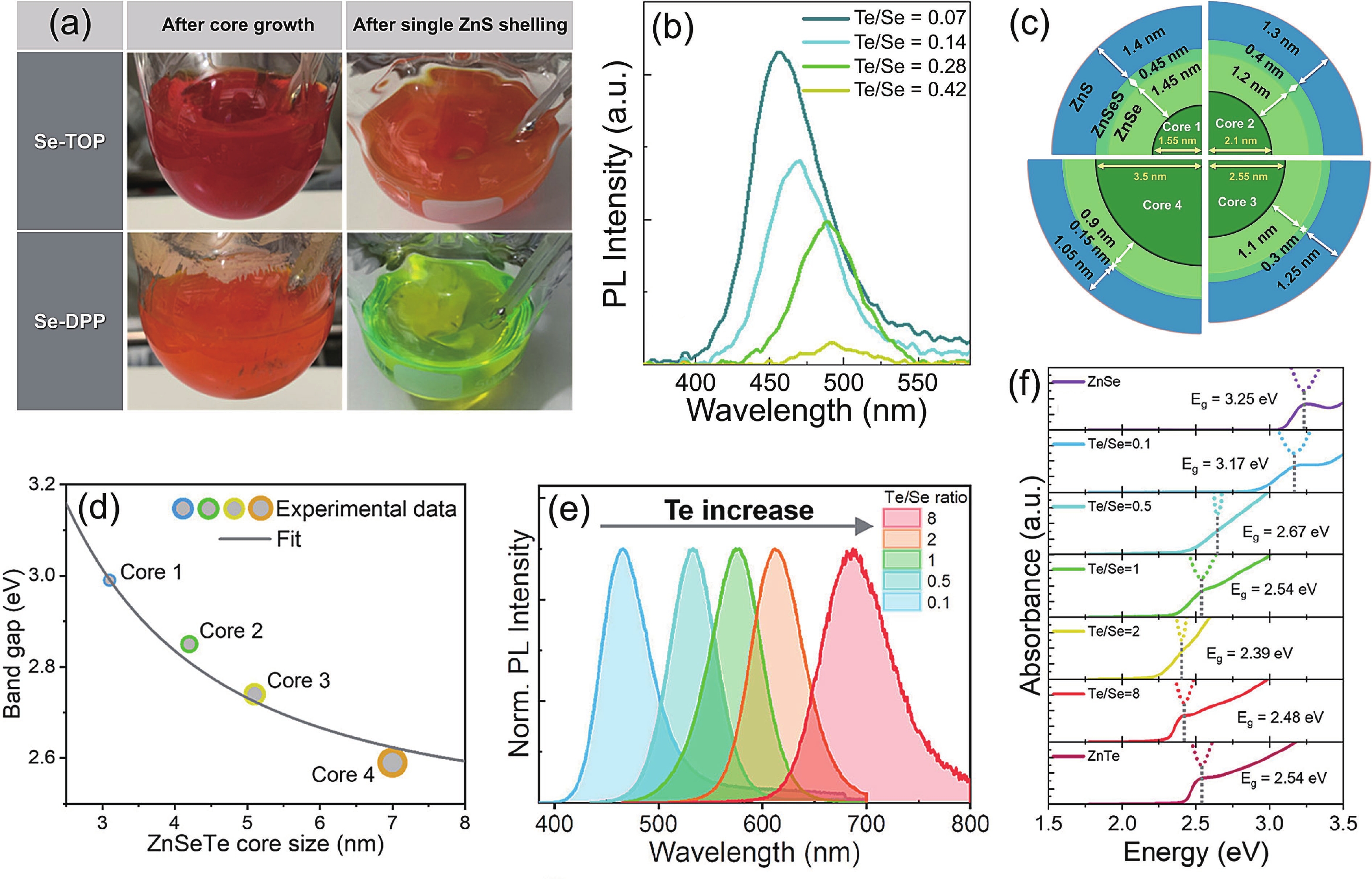
Fig. 1.  (Color online) (a) Visual comparison of QDs prepared with Se-TOP versus Se-DPP and (b) PL spectral evolutions of ZnSeTe alloy cores with varied Te/Se feed molar ratios (0.07–0.42). Reproduced with permission[15]. Copyright 2023, American Chemical Society. (c) Schematic of individual shell thicknesses upon sequential shelling for ZnSeTe cores 1 to 4 and (d) empirically fitted sizing curve derived from optical band gaps of four different-sized ZnSeTe cores, which reflects the quantum confinement effect in ZnSeTe QDs. Reproduced with permission[16]. Copyright 2020, American Chemical Society. (e) Normalized PL spectra of a series of ZnSeTe QDs with nominal Te/Se ratios of 0.1-8 and (f) original absorption spectra and Eg values determined from their second-derivative forms. Reproduced with permission[13]. Copyright 2023, American Chemical Society.

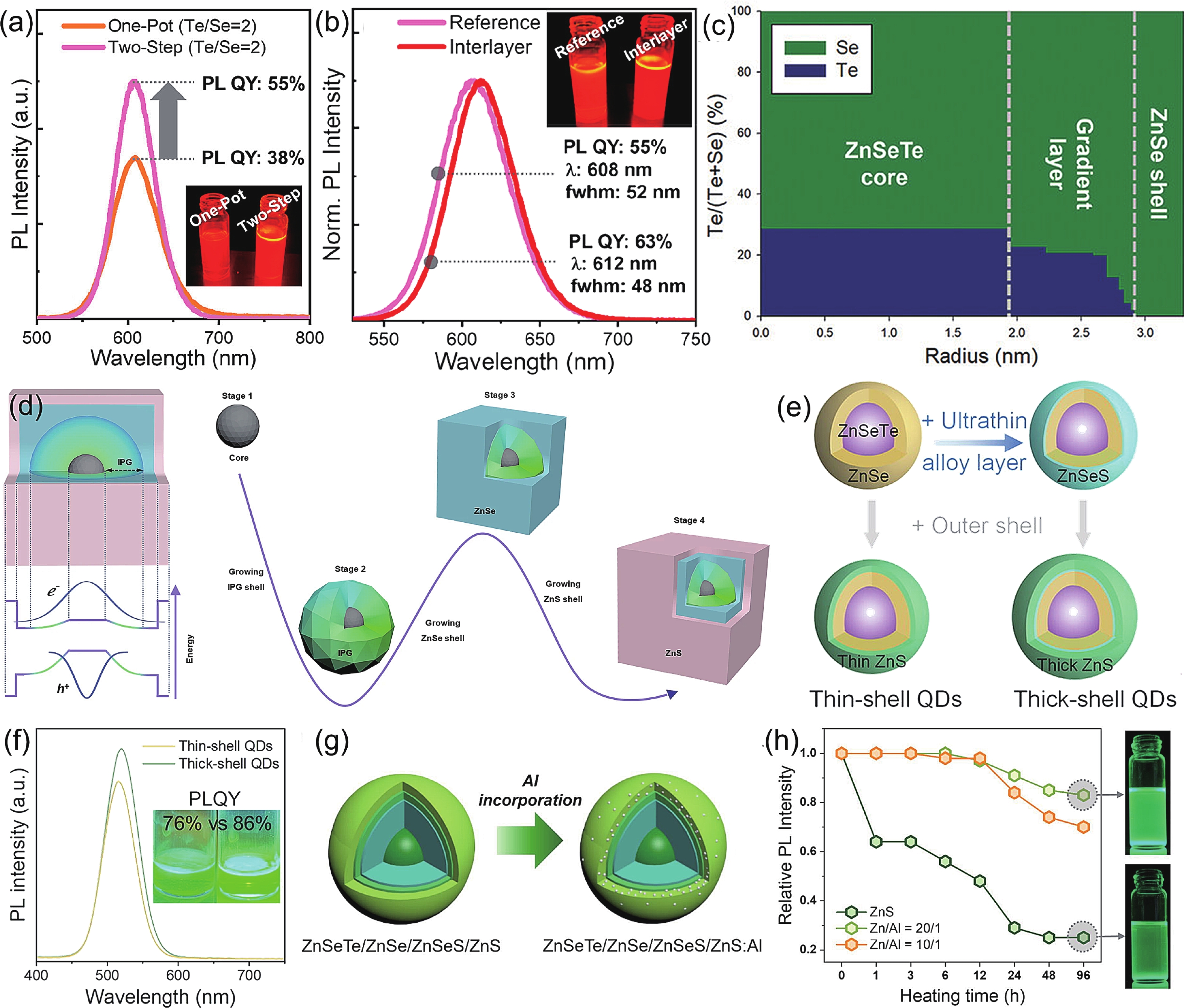
Fig. 2.  (Color online) PL spectra of (a) Te/Se=2-based ZnSeTe core-shell QDs synthesized via one-pot versus two-step approach and (b) the reference versus interlayer-grown ZnSeTe QDs. Inset: fluorescent images of core/shell QDs. Reproduced with permission[13]. Copyright 2023, American Chemical Society. (c) Te/(Te+Se) molar ratio as a function of green-core’s radius, the Te/(Te+Se) ratio in the gradient layer of the core decreases gradually with increasing radius up to 2.7 nm and then drops sharply to 1.9% due to Te precursor depletion. Reproduced with permission[17]. Copyright 2025, Wiley-VCH. (d) Schematic illustration of the interfacial potential-gradient QDs and interfacial potential structure. Reproduced with permission[18]. Copyright 2025, Springer Nature. (e) Synthetic route of ZnSeTe core-shell QDs and (f) the corresponding PL spectra of QDs. Inset: the photograph of the QD solutions under UV light. Reproduced with permission[19]. Copyright 2025, Elsevier. (g) Schematic diagram of Al incorporation into ZnS shell and (h) comparison of thermal stability of corresponding core-shell QDs. Reproduced with permission[20]. Copyright 2025, Elsevier.

[1]
Shirasaki Y, Supran G J, Bawendi M G, et al. Emergence of colloidal quantum-dot light-emitting technologies. Nat Photonics, 2013, 7(1): 13 doi: 10.1038/nphoton.2012.328
[2]
Dai X L, Zhang Z X, Jin Y Z, et al. Solution-processed, high-performance light-emitting diodes based on quantum dots. Nature, 2014, 515(7525): 96 doi: 10.1038/nature13829
[3]
Li Q H, Jin X, Yang Y, et al. Photovoltaic-targeted photoluminescence lifetime engineering in bright type-II alloy quantum dots. Sol Energy, 2018, 169: 75 doi: 10.1016/j.solener.2018.04.034
[4]
Lee S H, Song S W, Yoon S Y, et al. Heterostructural tailoring of blue ZnSeTe quantum dots toward high-color purity and high-efficiency electroluminescence. Chem Eng J, 2022, 429: 132464 doi: 10.1016/j.cej.2021.132464
[5]
Won Y H, Cho O, Kim T, et al. Highly efficient and stable InP/ZnSe/ZnS quantum dot light-emitting diodes. Nature, 2019, 575(7784): 634 doi: 10.1038/s41586-019-1771-5
[6]
Lee Y J, Kim S, Lee J, et al. Crystallographic and photophysical analysis on facet-controlled defect-free blue-emitting quantum dots. Adv Mater, 2024, 36(16): 2311719
[7]
Kim T, Kim K H, Kim S, et al. Efficient and stable blue quantum dot light-emitting diode. Nature, 2020, 586(7829): 385 doi: 10.1038/s41586-020-2791-x
[8]
Wu Q Q, Cao F, Yu W K, et al. Homogeneous ZnSeTeS quantum dots for efficient and stable pure-blue LEDs. Nature, 2025, 639(8055): 633 doi: 10.1038/s41586-025-08645-4
[9]
Tsukuda S, Kita M, Omata T. Zn(Te1-xSex) quantum dots synthesized through a facile route and their band-edge and surface state driven visible-light emission. J Lumin, 2021, 231: 117829 doi: 10.1016/j.jlumin.2020.117829
[10]
Cai W B, Ren Y J, Huang Z G, et al. Emission mechanism of bright and eco-friendly ZnSeTe quantum dots. Adv Opt Mater, 2024, 12(6): 2301970 doi: 10.1002/adom.202301970
[11]
Kim Y H, Yoon S Y, Yang H. Blue-emissive ZnSeTe quantum dots and their electroluminescent devices. J Phys Chem Lett, 2024, 15(8): 2142 doi: 10.1021/acs.jpclett.4c00070
[12]
Asano H, Omata T. Design of cadmium-free colloidal II–VI semiconductor quantum dots exhibiting RGB emission. AIP Adv, 2017, 7(4): 045309 doi: 10.1063/1.4982256
[13]
Kim Y H, Yoon S Y, Lee Y J, et al. Compositional and heterostructural tuning in red-emissive ternary ZnSeTe quantum dots for display applications. ACS Appl Nano Mater, 2023, 6(21): 19947 doi: 10.1021/acsanm.3c03749
[14]
Imran M, Paritmongkol W, Mills H A, et al. Molecular-additive-assisted tellurium homogenization in ZnSeTe quantum dots. Adv Mater, 2023, 35(45): 2303528
[15]
Lee S H, Han C Y, Song S W, et al. ZnSeTe quantum dots as an alternative to InP and their high-efficiency electroluminescence. Chem Mater, 2020, 32(13): 5768 doi: 10.1021/acs.chemmater.0c01596
[16]
Yoon S Y, Han J N, Lee Y J, et al. Highly emissive green ZnSeTe quantum dots: effects of core size on their optical properties and comparison with InP counterparts. ACS Energy Lett, 2023, 8(2): 1131 doi: 10.1021/acsenergylett.2c02924
[17]
Heo H S, Shin G J, Lee S A, et al. Enhanced fluorescence in green ZnSeTe quantum dots using gradient layer technique. Adv Opt Mater, 2025, 13(3): 2402215 doi: 10.1002/adom.202402215
[18]
Bi Y H, Sun J H, Cao S, et al. Highly efficient and eco-friendly green quantum dot light-emitting diodes through interfacial potential grading. Nat Commun, 2025, 16: 1945 doi: 10.1038/s41467-025-57304-9
[19]
Deng X Z, Zhao Q L, Zhang H, et al. Bright and efficient green ZnSeTe-based quantum-dot light-emitting diodes with EQE exceeding 20%. Sci Bull, 2025, 70(10): 1619 doi: 10.1016/j.scib.2025.02.042
[20]
Kim Y H, Kim Y W, Choi S, et al. Efficient, operation-stable green ZnSeTe quantum dot-light-emitting diodes: Impacts of shell dimension and Al incorporation. Chem Eng J, 2025, 522: 167742 doi: 10.1016/j.cej.2025.167742
  • Search

    Advanced Search >>

    GET CITATION

    shu

    Export: BibTex EndNote

    Article Metrics

    Article views: 16 Times PDF downloads: 6 Times Cited by: 0 Times

    History

    Received: 08 February 2026 Revised: 20 March 2026 Online: Accepted Manuscript: 26 April 2026

    Catalog

      Email This Article

      User name:
      Email:*请输入正确邮箱
      Code:*验证码错误
      Qianqian Wu, Fan Cao, Kaiwei Sun, Zhixin Chen, Yuankun Wang, Shizheng Zhang, Yukang Yi, Sheng Wang, Xuyong Yang. Wavelength-extended Te-rich ZnSeTe quantum dots: progress, challenges, and perspectives[J]. Journal of Semiconductors, 2026, In Press. doi: 10.1088/1674-4926/26020024 ****Q Q Wu, F Cao, K W Sun, Z X Chen, Y K Wang, S Z Zhang, Y K Yi, S Wang, and X Y Yang, Wavelength-extended Te-rich ZnSeTe quantum dots: progress, challenges, and perspectives[J]. J. Semicond., 2026, accepted doi: 10.1088/1674-4926/26020024
      Citation:
      Qianqian Wu, Fan Cao, Kaiwei Sun, Zhixin Chen, Yuankun Wang, Shizheng Zhang, Yukang Yi, Sheng Wang, Xuyong Yang. Wavelength-extended Te-rich ZnSeTe quantum dots: progress, challenges, and perspectives[J]. Journal of Semiconductors, 2026, In Press. doi: 10.1088/1674-4926/26020024 ****
      Q Q Wu, F Cao, K W Sun, Z X Chen, Y K Wang, S Z Zhang, Y K Yi, S Wang, and X Y Yang, Wavelength-extended Te-rich ZnSeTe quantum dots: progress, challenges, and perspectives[J]. J. Semicond., 2026, accepted doi: 10.1088/1674-4926/26020024

      Wavelength-extended Te-rich ZnSeTe quantum dots: progress, challenges, and perspectives

      DOI: 10.1088/1674-4926/26020024
      CSTR: 32376.14.1674-4926.26020024
      More Information
      • Qianqian Wu is a postdoctoral fellow at Shanghai University, with her research focusing on luminescent nanomaterials and the performance optimization of light-emitting diodes
      • Fan Cao received his Ph.D. degree (2023) in Optical Engineering from the National University of Defense Technology. He is currently a professor of School of Materials Science and Engineering, Tongji University. His research interests relate to the controlled synthesis of nanoscale luminescent materials, as well as the fabrication and performance investigation of optoelectronic devices including light-emitting diodes and photodetectors
      • Xuyong Yang obtained his Ph.D. degree (2012) from Nanyang Technological University, Singapore. Currently, he is a Professor at the Key Laboratory of Advanced Display and System Applications, Ministry of Education, Shanghai University. His research focuses on optoelectronic materials and devices, particularly the synthesis of low-dimensional semiconductor luminescent materials and the technological development of quantum dot light-emitting diodes
      • Corresponding author: fancao@tongji.edu.cnyangxy@shu.edu.cn
      • Received Date: 2026-02-08
      • Revised Date: 2026-03-20
      • Available Online: 2026-04-26

      Catalog

        /

        DownLoad:  Full-Size Img  PowerPoint
        Return
        Return