
J. Semicond. >  Just Accepted

NEWS AND VIEWS

Improved Solvent Systems for the Commercialization of Perovskite Photovoltaic Modules

Zhaoyang Chu, Xiaotian Hu and Yiwang Chen

+ Author Affiliations

 Corresponding author: Xiaotian Hu, happyhu@ncu.edu.cn; Yiwang Chen, ywchen@ncu.edu.cn

DOI: 10.1088/1674-4926/26020044CSTR: 32376.14.1674-4926.26020044

PDF

Turn off MathJax


[1]
National Renewable Energy Laboratory, Best Research-Cell Efficiency Chart (2026); https://www.nrel.gov/pv/cell-efficiency.
[2]
Xing Z, Meng X C, Li D X, et al. Multi-environment phase stabilization by lattice reinforcement for efficient perovskite solar cells. Sci China Mater, 2023, 66(7): 2573 doi: 10.1007/s40843-022-2400-9
[3]
Li Z Q, Zhao Y Z, Wang X, et al. Cost analysis of perovskite tandem photovoltaics. Joule, 2018, 2(8): 1559 doi: 10.1016/j.joule.2018.05.001
[4]
Meng L, You J B, Yang Y. Addressing the stability issue of perovskite solar cells for commercial applications. Nat Commun, 2018, 9: 5265 doi: 10.1038/s41467-018-07255-1
[5]
Bu T L, Ono L K, Li J, et al. Modulating crystal growth of formamidinium–caesium perovskites for over 200 Cm2 photovoltaic sub-modules. Nat Energy, 2022, 7(6): 528 doi: 10.1038/s41560-022-01039-0
[6]
Chu Z Y, Fan B J, Zhao Y, et al. Laser annealing enables rapid, degradation-free ambient processing of perovskite solar modules. Science, 2025, 390(6776): 905 doi: 10.1126/science.adx9650
[7]
Wang H F, Su S J, Chen Y T, et al. Impurity-healing interface engineering for efficient perovskite submodules. Nature 2024, 634: 1091
[8]
Wang Y K, Liu Y, Luo X, et al. Improved solvent systems for commercially viable perovskite photovoltaic modules. Science, 2025, 390: 1021 doi: 10.1126/science.adz0091
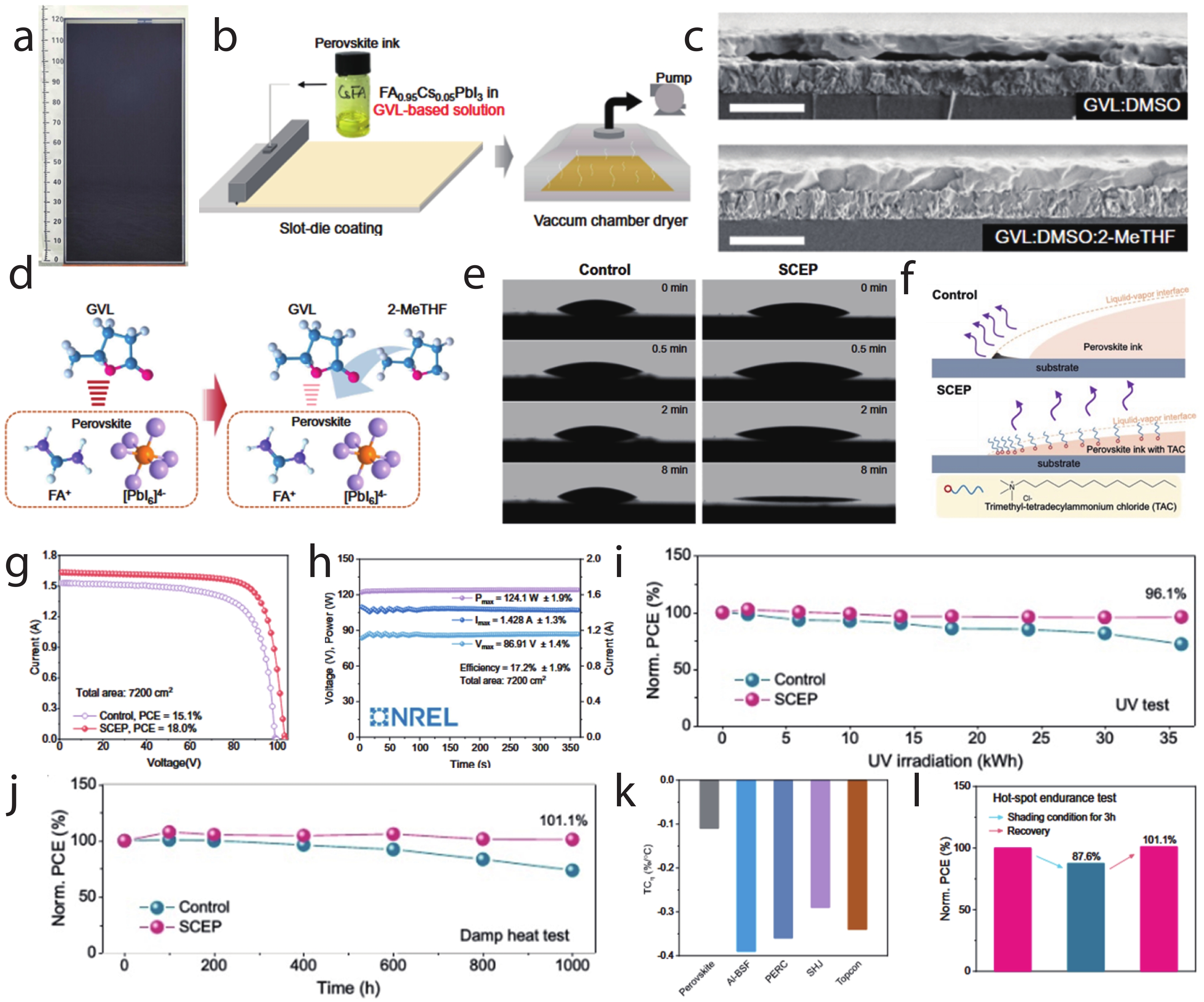
Fig. 1.  (Color online) (a) Image of a module. (b) Schematic demonstrating large-scale fabrication of perovskite films with slot-die coating and VCD. Digital image of a perovskite ink composed of FA0.95Cs0.05PbI3 dissolved in GVL/DMSO mixture. (c) Cross-sectional SEM of the perovskite films fabricated from GVL/DMSO (top panel) and GVL/DMSO/2-MeTHF mixtures (bottom panel). The scale bars represent a length of 1 μm. (d) Schematic showing coordination of GVL and 2-MeTHF to perovskite. (e) Contact-angle images of the control and SCEP perovskite ink droplets. (f) Schematic illustrating solvent evaporation of the perovskite wet film. (g) J-V curves of the best-performing control and SCEP modules with a total area of 7200 cm2. (h) NREL-certified stabilized Pmax, Imax, and Vmax plots within 360 s for a module. (i) UV preconditioning test with a cumulative UV irradiation of 36 kWh/m2. (j) Damp heat test at 85°C and 85% RH conditions. RH, relative humidity. (k) TC comparison between perovskite modules and various types of crystalline silicon modules. Al-BSF, aluminum back surface field; PERC, passivated emitter and rear cell; SHJ, silicon heterojunction; TC, temperature coefficient. (l) Hot-spot endurance test of commercial-scale perovskite modules[8].

[1]
National Renewable Energy Laboratory, Best Research-Cell Efficiency Chart (2026); https://www.nrel.gov/pv/cell-efficiency.
[2]
Xing Z, Meng X C, Li D X, et al. Multi-environment phase stabilization by lattice reinforcement for efficient perovskite solar cells. Sci China Mater, 2023, 66(7): 2573 doi: 10.1007/s40843-022-2400-9
[3]
Li Z Q, Zhao Y Z, Wang X, et al. Cost analysis of perovskite tandem photovoltaics. Joule, 2018, 2(8): 1559 doi: 10.1016/j.joule.2018.05.001
[4]
Meng L, You J B, Yang Y. Addressing the stability issue of perovskite solar cells for commercial applications. Nat Commun, 2018, 9: 5265 doi: 10.1038/s41467-018-07255-1
[5]
Bu T L, Ono L K, Li J, et al. Modulating crystal growth of formamidinium–caesium perovskites for over 200 Cm2 photovoltaic sub-modules. Nat Energy, 2022, 7(6): 528 doi: 10.1038/s41560-022-01039-0
[6]
Chu Z Y, Fan B J, Zhao Y, et al. Laser annealing enables rapid, degradation-free ambient processing of perovskite solar modules. Science, 2025, 390(6776): 905 doi: 10.1126/science.adx9650
[7]
Wang H F, Su S J, Chen Y T, et al. Impurity-healing interface engineering for efficient perovskite submodules. Nature 2024, 634: 1091
[8]
Wang Y K, Liu Y, Luo X, et al. Improved solvent systems for commercially viable perovskite photovoltaic modules. Science, 2025, 390: 1021 doi: 10.1126/science.adz0091
  • Search

    Advanced Search >>

    GET CITATION

    shu

    Export: BibTex EndNote

    Article Metrics

    Article views: 8 Times PDF downloads: 0 Times Cited by: 0 Times

    History

    Received: 11 February 2026 Revised: Online: Accepted Manuscript: 18 March 2026

    Catalog

      Email This Article

      User name:
      Email:*请输入正确邮箱
      Code:*验证码错误
      Zhaoyang Chu, Xiaotian Hu, Yiwang Chen. Improved Solvent Systems for the Commercialization of Perovskite Photovoltaic Modules[J]. Journal of Semiconductors, 2026, In Press. doi: 10.1088/1674-4926/26020044 ****Z Y Chu, X T Hu, and Y W Chen, Improved Solvent Systems for the Commercialization of Perovskite Photovoltaic Modules[J]. J. Semicond., 2026, accepted doi: 10.1088/1674-4926/26020044
      Citation:
      Zhaoyang Chu, Xiaotian Hu, Yiwang Chen. Improved Solvent Systems for the Commercialization of Perovskite Photovoltaic Modules[J]. Journal of Semiconductors, 2026, In Press. doi: 10.1088/1674-4926/26020044 ****
      Z Y Chu, X T Hu, and Y W Chen, Improved Solvent Systems for the Commercialization of Perovskite Photovoltaic Modules[J]. J. Semicond., 2026, accepted doi: 10.1088/1674-4926/26020044

      Improved Solvent Systems for the Commercialization of Perovskite Photovoltaic Modules

      DOI: 10.1088/1674-4926/26020044
      CSTR: 32376.14.1674-4926.26020044
      More Information
      • Zhaoyang Chu is a doctoral candidate at the School of Chemistry and Chemical Engineering at Nanchang University. His research interest lies in printing perovskite solar modules in the environment
      • Xiaotian Hu received his Ph.D. degree (2019) from the Institute of Chemistry, Chinese Academy of Sciences. He is currently a professor in the School of Chemistry and Chemical Engineering at Nanchang University. His research focuses on flexible printed solar cells, where he has systematically addressed critical challenges spanning flexible device design, interface engineering, and large-area printing fabrication
      • Yiwang Chen received his Ph.D. degree (1999) from Peking University. He is currently the Party Secretary of Gannan Normal University. His main research areas include the design and printing processing of polymer and perovskite flexible solar cells, zinc-ion batteries, sodium-ion batteries, zinc-air batteries, fuel cells, electrocatalytic synthesis, and organosilicon elastomers and fibers
      • Corresponding author: happyhu@ncu.edu.cnywchen@ncu.edu.cn
      • Received Date: 2026-02-11
        Available Online: 2026-03-18

      Catalog

        /

        DownLoad:  Full-Size Img  PowerPoint
        Return
        Return