


 Zhaoyang Chu is a doctoral candidate at the School of Chemistry and Chemical Engineering at Nanchang University. His research interest lies in printing perovskite solar modules in the environment.
 Xiaotian Hu received his Ph.D. degree (2019) from the Institute of Chemistry, Chinese Academy of Sciences. He is currently a professor in the School of Chemistry and Chemical Engineering at Nanchang University. His research focuses on flexible printed solar cells, where he has systematically addressed critical challenges spanning flexible device design, interface engineering, and large-area printing fabrication.
 Yiwang Chen received his Ph.D. degree (1999) from Peking University. He is currently the Party Secretary of Gannan Normal University. His main research areas include the design and printing processing of polymer and perovskite flexible solar cells, zinc-ion batteries, sodium-ion batteries, zinc-air batteries, fuel cells, electrocatalytic synthesis, and organosilicon elastomers and fibers.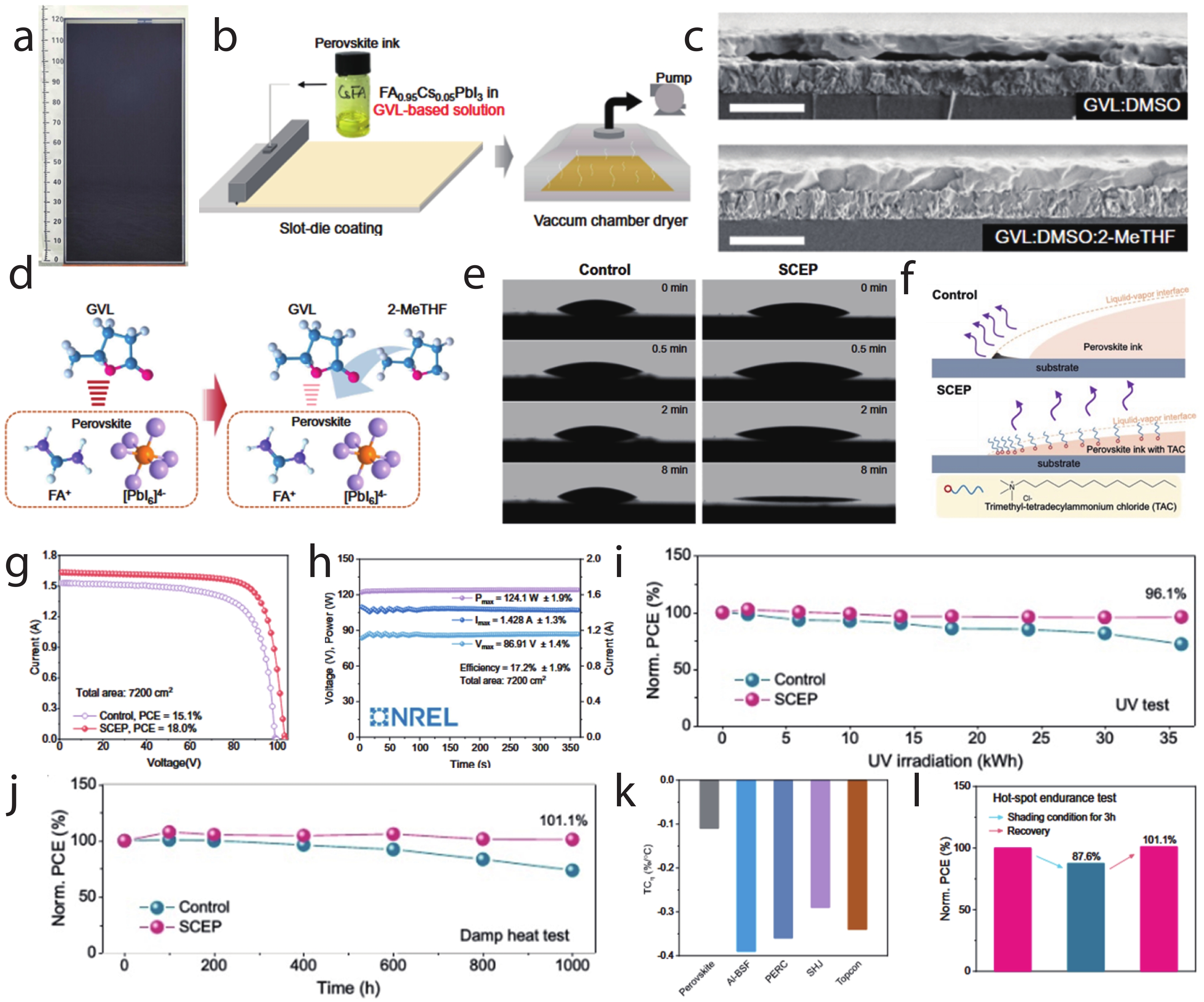
Fig. 1.
(Color online) (a) Image of a module. (b) Schematic demonstrating large-scale fabrication of perovskite films with slot-die coating and VCD. Digital image of a perovskite ink composed of FA0.95Cs0.05PbI3 dissolved in GVL/DMSO mixture. (c) Cross-sectional SEM of the perovskite films fabricated from GVL/DMSO (top panel) and GVL/DMSO/2-MeTHF mixtures (bottom panel). The scale bars represent a length of 1 μm. (d) Schematic showing coordination of GVL and 2-MeTHF to perovskite. (e) Contact-angle images of the control and SCEP perovskite ink droplets. (f) Schematic illustrating solvent evaporation of the perovskite wet film. (g) J−V curves of the best-performing control and SCEP modules with a total area of 7200 cm2. (h) NREL-certified stabilized Pmax, Imax, and Vmax plots within 360 s for a module. (i) UV preconditioning test with a cumulative UV irradiation of 36 kWh/m2. (j) Damp heat test at 85 °C and 85% RH conditions. RH, relative humidity. (k) TC comparison between perovskite modules and various types of crystalline silicon modules. Al-BSF, aluminum back surface field; PERC, passivated emitter and rear cell; SHJ, silicon heterojunction; TC, temperature coefficient. (l) Hot-spot endurance test of commercial-scale perovskite modules[8].
 DownLoad: