


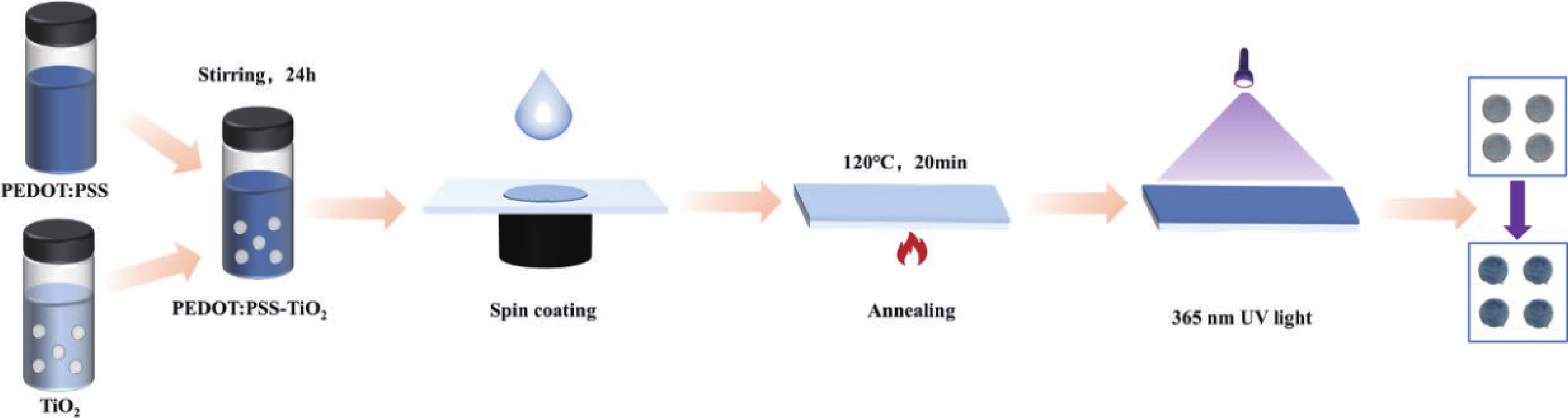
Fig. 1.
(Color online) Schematic illustration of the preparation and photochromic properties of the composite films.
ARTICLES
Xiangyu Ren1, 2, Shudi Lu2, 4, Kaige Huang2, 3, Jingteng Ma2, 3, Runkang Lin2, 3, Dong Hu5, Xiaobao Li5, , Jie Yu1, Yuhan Wu1, , Shizhong Yue2, 3, and Zhijie Wang2, 3,
Corresponding author: Xiaobao Li, xiaobaoli@hfut.edu.cn; Yuhan Wu, yuhanwu@sut.edu.cn; Shizhong Yue, yueshizhong@semi.ac.cn; Zhijie Wang, wangzj@semi.ac.cn
Abstract: Integrating electrochromic (EC) and photochromic (PC) functions within a single material system holds great significance for the development of next-generation intelligent responsive materials. Traditional organic photochromic materials are all small molecules and oligomers, which require the photochemical response of specific photosensitive groups. However, PEDOT:PSS, a classic electrochromic polymer, has never been reported to exhibit photochromic properties due to the absence of photosensitive groups. Herein, we report for the first time the photochromic properties of PEDOT:PSS films, demonstrating their simultaneous capability of multi-field coupling response in the aspects of light, electricity and chemistry. The composite film undergoes a rapid color change from light blue to dark blue under ultraviolet light irradiation. This is attributed to the transformation process from the bipolarons state to the polarons state in the PEDOT:PSS, induced by photogenerated electrons as confirmed by EPR and Raman analyses. Furthermore, the developed hydrogel system enhances charge separation, yielding a 30.1% relative transmittance change and month-long stability. This work fills the long-standing gap in the understanding of the photochromic and electrochromic mechanisms of PEDOT:PSS, providing fundamental insights into carrier dynamics at organic−inorganic interfaces and laying the foundation for the development of multi-mode stimuli-responsive devices.
Keywords: photochromic, PEDOT:PSS, dedoping, bleaching
| [1] |
Zhang J J, Zou Q, Tian H. Photochromic materials: More than meets the eye. Adv Mater, 2013, 25(3): 378 doi: 10.1002/adma.201201521
|
| [2] |
Fihey A, Perrier A, Browne W R, et al. Multiphotochromic molecular systems. Chem Soc Rev, 2015, 44(11): 3719 doi: 10.1039/C5CS00137D
|
| [3] |
Pardo R, Zayat M, Levy D. Photochromic organic–inorganic hybrid materials. Chem Soc Rev, 2011, 40(2): 672 doi: 10.1039/c0cs00065e
|
| [4] |
Kim J, Kim D, Jang H, et al. Transparent photo-electrochromic capacitive windows with a bi-dopant redox ionic liquids. Chem Eng J, 2022, 450: 138081 doi: 10.1016/j.cej.2022.138081
|
| [5] |
Liu R, Li Y Y, Hu B, et al. Organic ligand-free scalable dual-band electrochromic smart windows. Adv Funct Mater, 2025, 35(1): 2409914 doi: 10.1016/j.cej.2022.1380816
|
| [6] |
Pham H H, Rim M, Wi Y, et al. Polarization-dependent and color-tunable electrochromic smart windows: Uniaxially oriented and polymer-stabilized viologen-based liquid crystal networks. Adv Funct Mater, 2024, 34(39): 2470224 doi: 10.1002/adfm.20247022412
|
| [7] |
Wu W W, Guo S L, Bian J, et al. Viologen-based flexible electrochromic devices. J Energy Chem, 2024, 93: 453 doi: 10.1016/j.jechem.2024.02.027
|
| [8] |
Gao K, Ju S D, Li S N, et al. Decoupling electrochromism and energy storage for flexible quasi-solid-state aqueous electrochromic batteries with high energy density. ACS Nano, 2023, 17(18): 18359 doi: 10.1021/acsnano.3c05702
|
| [9] |
Smith A T, Shen K Y, Hou Z L, et al. Dual photo- and mechanochromisms of graphitic carbon nitride/polyvinyl alcohol film. Adv Funct Mater, 2022, 32(12): 2110285 doi: 10.1002/adfm.202110285
|
| [10] |
Wang W S, Xie N, He L, et al. Photocatalytic colour switching of redox dyes for ink-free light-printable rewritable paper. Nat Commun, 2014, 5: 5459 doi: 10.1038/ncomms6459
|
| [11] |
Wang F K, Song Y H, Xie R Y, et al. TiO2/PVA based composites: Visible light activated rapid dual-mode optical response. Chem Eng J, 2023, 475: 146306 doi: 10.1016/j.cej.2023.146306
|
| [12] |
Li X T, Li M J, Tian Y L, et al. A reversible photochromic covalent organic framework. Nat Commun, 2024, 15(1): 8484 doi: 10.1038/s41467-024-52788-3
|
| [13] |
Li B R, Yue S Z, Cheng H L, et al. Visible light-induced enhancement in the Seebeck coefficient of PEDOT: PSS composites with two-dimensional potassium poly-(heptazine imide). J Mater Chem A, 2022, 10(2): 862 doi: 10.1039/D1TA09310J
|
| [14] |
Sun K, Zhang S P, Li P C, et al. Review on application of PEDOTs and PEDOT: PSS in energy conversion and storage devices. J Mater Sci Mater Electron, 2015, 26(7): 4438 doi: 10.1007/s10854-015-2895-5
|
| [15] |
Singh R, Tharion J, Murugan S, et al. ITO-free solution-processed flexible electrochromic devices based on PEDOT: PSS as transparent conducting electrode. ACS Appl Mater Interfaces, 2017, 9(23): 19427 doi: 10.1021/acsami.6b09476
|
| [16] |
Gu S F, Liu W L, Yin X M, et al. Effects of ion valence states and radii on the performance of solid-state PEDOT: PSS electrochromic devices. ACS Appl Mater Interfaces, 2024, 16(46): 63978 doi: 10.1021/acsami.4c11215
|
| [17] |
Tao M X, Liu G D, Wang Y L, et al. Performance enhancement of self-powered electrochromic device via a PEDOT: PSS electrode inherited with intrinsic roughness of substrate. ACS Appl Mater Interfaces, 2024, 16(40): 54316 doi: 10.1021/acsami.4c14196
|
| [18] |
Nguyen T T A, Soram B S, Tran D T, et al. Enhanced electrochromic capacity performances of hierarchical MnO2-polyaniline/PEDOT: PSS/Ag@Ni nanowires cathode for flexible and rechargeable electrochromic Zn-ion battery. Chem Eng J, 2023, 452: 139555 doi: 10.1016/j.cej.2022.139555
|
| [19] |
Preston C, Dobashi Y, Nguyen N T, et al. Intrinsically stretchable integrated passive matrix electrochromic display using PEDOT: PSS ionic liquid composite. ACS Appl Mater Interfaces, 2023, 15(23): 28288 doi: 10.1021/acsami.3c02902
|
| [20] |
Bequet-Ermoy E, Silvestre V, Cuenot S, et al. Reversible light-triggered stretching of small-molecule photochromic organic nanoparticles. Small, 2024, 20(44): 2403912 doi: 10.1002/smll.20240391242
|
| [21] |
Zhao Z H, Cai Y S, Zhang Q, et al. Photochromic luminescence of organic crystals arising from subtle molecular rearrangement. Nat Commun, 2024, 15: 5054 doi: 10.1038/s41467-024-48728-w
|
| [22] |
Ma T T, Huang G Z, Wang X H, et al. Photochromic radical states in 3D covalent organic frameworks with zyg topology for enhanced photocatalysis. Natl Sci Rev, 2024, 11(7): nwae177 doi: 10.1093/nsr/nwae177
|
| [23] |
Wu R J, Hsu Y L, Chou W Y, et al. Enhancing functionalities of organic ultraviolet-visible phototransistors incorporating spiropyran-merocyanine photochromic materials. J Mater Chem A, 2021, 9(39): 22522 doi: 10.1039/D1TA05707C
|
| [24] |
Chen R, Chen S S, Zhou Y L, et al. Unsubstituted polythiophene film deposited via in-situ sequential solution polymerization for chemo-/electrochromism. Macromolecules, 2020, 53(11): 4247 doi: 10.1021/acs.macromol.0c00297
|
| [25] |
Chen R, Zhang L P, Zhou Y L, et al. In-situ synthesis of large-area PANI films via sequential solution polymerization technique for electrochromic applications. Giant, 2021, 8: 100072 doi: 10.1016/j.giant.2021.100072
|
| [26] |
Lv X J, Xu H F, Yang Y Y, et al. Flexible laterally-configured electrochromic supercapacitor with feasible patterned display. Chem Eng J, 2023, 458: 141453 doi: 10.1016/j.cej.2023.141453
|
| [27] |
Cheng C Y, Chiang Y J, Yu H F, et al. Designing a hybrid type photoelectrochromic device with dual coloring modes for realizing ultrafast response/high optical contrast self-powered smart windows. Nano Energy, 2021, 90: 106575 doi: 10.1016/j.nanoen.2021.106575
|
| [28] |
Wang J L, Zhao K, Ye C Q, et al. Emerging interactively stretchable electronics with optical and electrical dual-signal feedbacks based on structural color materials. Nano Res, 2024, 17(3): 1837 doi: 10.1007/s12274-023-5920-7
|
| [29] |
Bai Z Y, Li R, Ping L, et al. Photo-induced self-reduction enabling ultralow threshold voltage energy-conservation electrochromism. Chem Eng J, 2023, 452: 139645 doi: 10.1016/j.cej.2022.139645
|
| [30] |
Li Q C, Yue S Z, Huang Z T, et al. Dissociation of singlet excitons dominates photocurrent improvement in high-efficiency non-fullerene organic solar cells. Nano Res Energy, 2024, 3: e9120099 doi: 10.26599/NRE.2023.9120099
|
| [31] |
Mitraka E, Jafari M J, Vagin M, et al. Oxygen-induced doping on reduced PEDOT. J Mater Chem A, 2017, 5(9): 4404 doi: 10.1039/C6TA10521A
|
| [32] |
Muro K, Watanabe M, Tamai T, et al. PEDOT/PSS nanoparticles: Synthesis and properties. RSC Adv, 2016, 6(90): 87147 doi: 10.1039/C6RA16829A
|
| [33] |
Wang X D, Wu Z X, Liu Y J, et al. PEDOT: PSS: Smart infrared rewritable materials. Adv Funct Mater, 2023, 33(32): 2300886 doi: 10.1002/adfm.202300886
|
| [34] |
Yue S Z, Cheng H L, He H, et al. Photo-enhanced seebeck effect of a highly conductive thermoelectric material. J Mater Chem A, 2021, 9(31): 16725 doi: 10.1039/D1TA04366H
|
| [35] |
Paulraj I, Lourdhusamy V, Yang Z R, et al. Enhanced thermoelectric properties of porous hybrid ZnSb/EG-treated PEDOT: PSS composites. J Power Sources, 2023, 572: 233096 doi: 10.1016/j.jpowsour.2023.233096
|
| [36] |
Toto E, Botti S, Laurenzi S, et al. UV-induced modification of PEDOT: PSS-based nanocomposite films investigated by Raman microscopy mapping. Appl Surf Sci, 2020, 513: 145839 doi: 10.1016/j.apsusc.2020.145839
|
| [37] |
Alessandri I, Torricelli F, Cerea B, et al. Why PEDOT: PSS should not be used for Raman sensing of redox states (and how it could be). ACS Appl Mater Interfaces, 2022, 14(50): 56363 doi: 10.1021/acsami.2c17147
|
| [38] |
Zhao Z Q, Liu Q, Zhang W F, et al. Conductivity enhancement of PEDOT: PSS film via sulfonic acid modification: Application as transparent electrode for ITO-free polymer solar cells. Sci China Chem, 2018, 61(9): 1179 doi: 10.1007/s11426-017-9205-x
|
| [39] |
Xiong W T, Tang W D, Zhang G, et al. Controllable p- and n-type behaviours in emissive perovskite semiconductors. Nature, 2024, 633(8029): 344 doi: 10.1038/s41586-024-07792-4
|
| [40] |
Chen Q L, Xu X J, Bo Z S. Application of n-type or p-type dopants in organic photovoltaics. ChemSusChem, 2025, 18(10): e202402525 doi: 10.1002/cssc.202402525
|
| [41] |
Sun X W, Chen B, Xu J B, et al. Controllable polarity takes a leap forward in emissive perovskite semiconductors. Sci Bull, 2025, 70(6): 808 doi: 10.1016/j.scib.2025.01.019
|
| [42] |
Žerjav G, Žižek K, Zavašnik J, et al. Brookite vs. rutile vs. anatase: What`s behind their various photocatalytic activities? J Environ Chem Eng, 2022, 10(3): 107722 doi: 10.1016/j.jece.2022.107722
|
| [43] |
Günnemann C, Haisch C, Fleisch M, et al. Insights into different photocatalytic oxidation activities of anatase, brookite, and rutile single-crystal facets. ACS Catal, 2019, 9(2): 1001 doi: 10.1021/acscatal.8b04115
|
| [44] |
Yamakata A, Vequizo J J M. Curious behaviors of photogenerated electrons and holes at the defects on anatase, rutile, and brookite TiO2 powders: A review. J Photochem Photobiol C Photochem Rev, 2019, 40: 234 doi: 10.1016/j.jphotochemrev.2018.12.001
|
| [1] |
Zhang J J, Zou Q, Tian H. Photochromic materials: More than meets the eye. Adv Mater, 2013, 25(3): 378 doi: 10.1002/adma.201201521
|
| [2] |
Fihey A, Perrier A, Browne W R, et al. Multiphotochromic molecular systems. Chem Soc Rev, 2015, 44(11): 3719 doi: 10.1039/C5CS00137D
|
| [3] |
Pardo R, Zayat M, Levy D. Photochromic organic–inorganic hybrid materials. Chem Soc Rev, 2011, 40(2): 672 doi: 10.1039/c0cs00065e
|
| [4] |
Kim J, Kim D, Jang H, et al. Transparent photo-electrochromic capacitive windows with a bi-dopant redox ionic liquids. Chem Eng J, 2022, 450: 138081 doi: 10.1016/j.cej.2022.138081
|
| [5] |
Liu R, Li Y Y, Hu B, et al. Organic ligand-free scalable dual-band electrochromic smart windows. Adv Funct Mater, 2025, 35(1): 2409914 doi: 10.1016/j.cej.2022.1380816
|
| [6] |
Pham H H, Rim M, Wi Y, et al. Polarization-dependent and color-tunable electrochromic smart windows: Uniaxially oriented and polymer-stabilized viologen-based liquid crystal networks. Adv Funct Mater, 2024, 34(39): 2470224 doi: 10.1002/adfm.20247022412
|
| [7] |
Wu W W, Guo S L, Bian J, et al. Viologen-based flexible electrochromic devices. J Energy Chem, 2024, 93: 453 doi: 10.1016/j.jechem.2024.02.027
|
| [8] |
Gao K, Ju S D, Li S N, et al. Decoupling electrochromism and energy storage for flexible quasi-solid-state aqueous electrochromic batteries with high energy density. ACS Nano, 2023, 17(18): 18359 doi: 10.1021/acsnano.3c05702
|
| [9] |
Smith A T, Shen K Y, Hou Z L, et al. Dual photo- and mechanochromisms of graphitic carbon nitride/polyvinyl alcohol film. Adv Funct Mater, 2022, 32(12): 2110285 doi: 10.1002/adfm.202110285
|
| [10] |
Wang W S, Xie N, He L, et al. Photocatalytic colour switching of redox dyes for ink-free light-printable rewritable paper. Nat Commun, 2014, 5: 5459 doi: 10.1038/ncomms6459
|
| [11] |
Wang F K, Song Y H, Xie R Y, et al. TiO2/PVA based composites: Visible light activated rapid dual-mode optical response. Chem Eng J, 2023, 475: 146306 doi: 10.1016/j.cej.2023.146306
|
| [12] |
Li X T, Li M J, Tian Y L, et al. A reversible photochromic covalent organic framework. Nat Commun, 2024, 15(1): 8484 doi: 10.1038/s41467-024-52788-3
|
| [13] |
Li B R, Yue S Z, Cheng H L, et al. Visible light-induced enhancement in the Seebeck coefficient of PEDOT: PSS composites with two-dimensional potassium poly-(heptazine imide). J Mater Chem A, 2022, 10(2): 862 doi: 10.1039/D1TA09310J
|
| [14] |
Sun K, Zhang S P, Li P C, et al. Review on application of PEDOTs and PEDOT: PSS in energy conversion and storage devices. J Mater Sci Mater Electron, 2015, 26(7): 4438 doi: 10.1007/s10854-015-2895-5
|
| [15] |
Singh R, Tharion J, Murugan S, et al. ITO-free solution-processed flexible electrochromic devices based on PEDOT: PSS as transparent conducting electrode. ACS Appl Mater Interfaces, 2017, 9(23): 19427 doi: 10.1021/acsami.6b09476
|
| [16] |
Gu S F, Liu W L, Yin X M, et al. Effects of ion valence states and radii on the performance of solid-state PEDOT: PSS electrochromic devices. ACS Appl Mater Interfaces, 2024, 16(46): 63978 doi: 10.1021/acsami.4c11215
|
| [17] |
Tao M X, Liu G D, Wang Y L, et al. Performance enhancement of self-powered electrochromic device via a PEDOT: PSS electrode inherited with intrinsic roughness of substrate. ACS Appl Mater Interfaces, 2024, 16(40): 54316 doi: 10.1021/acsami.4c14196
|
| [18] |
Nguyen T T A, Soram B S, Tran D T, et al. Enhanced electrochromic capacity performances of hierarchical MnO2-polyaniline/PEDOT: PSS/Ag@Ni nanowires cathode for flexible and rechargeable electrochromic Zn-ion battery. Chem Eng J, 2023, 452: 139555 doi: 10.1016/j.cej.2022.139555
|
| [19] |
Preston C, Dobashi Y, Nguyen N T, et al. Intrinsically stretchable integrated passive matrix electrochromic display using PEDOT: PSS ionic liquid composite. ACS Appl Mater Interfaces, 2023, 15(23): 28288 doi: 10.1021/acsami.3c02902
|
| [20] |
Bequet-Ermoy E, Silvestre V, Cuenot S, et al. Reversible light-triggered stretching of small-molecule photochromic organic nanoparticles. Small, 2024, 20(44): 2403912 doi: 10.1002/smll.20240391242
|
| [21] |
Zhao Z H, Cai Y S, Zhang Q, et al. Photochromic luminescence of organic crystals arising from subtle molecular rearrangement. Nat Commun, 2024, 15: 5054 doi: 10.1038/s41467-024-48728-w
|
| [22] |
Ma T T, Huang G Z, Wang X H, et al. Photochromic radical states in 3D covalent organic frameworks with zyg topology for enhanced photocatalysis. Natl Sci Rev, 2024, 11(7): nwae177 doi: 10.1093/nsr/nwae177
|
| [23] |
Wu R J, Hsu Y L, Chou W Y, et al. Enhancing functionalities of organic ultraviolet-visible phototransistors incorporating spiropyran-merocyanine photochromic materials. J Mater Chem A, 2021, 9(39): 22522 doi: 10.1039/D1TA05707C
|
| [24] |
Chen R, Chen S S, Zhou Y L, et al. Unsubstituted polythiophene film deposited via in-situ sequential solution polymerization for chemo-/electrochromism. Macromolecules, 2020, 53(11): 4247 doi: 10.1021/acs.macromol.0c00297
|
| [25] |
Chen R, Zhang L P, Zhou Y L, et al. In-situ synthesis of large-area PANI films via sequential solution polymerization technique for electrochromic applications. Giant, 2021, 8: 100072 doi: 10.1016/j.giant.2021.100072
|
| [26] |
Lv X J, Xu H F, Yang Y Y, et al. Flexible laterally-configured electrochromic supercapacitor with feasible patterned display. Chem Eng J, 2023, 458: 141453 doi: 10.1016/j.cej.2023.141453
|
| [27] |
Cheng C Y, Chiang Y J, Yu H F, et al. Designing a hybrid type photoelectrochromic device with dual coloring modes for realizing ultrafast response/high optical contrast self-powered smart windows. Nano Energy, 2021, 90: 106575 doi: 10.1016/j.nanoen.2021.106575
|
| [28] |
Wang J L, Zhao K, Ye C Q, et al. Emerging interactively stretchable electronics with optical and electrical dual-signal feedbacks based on structural color materials. Nano Res, 2024, 17(3): 1837 doi: 10.1007/s12274-023-5920-7
|
| [29] |
Bai Z Y, Li R, Ping L, et al. Photo-induced self-reduction enabling ultralow threshold voltage energy-conservation electrochromism. Chem Eng J, 2023, 452: 139645 doi: 10.1016/j.cej.2022.139645
|
| [30] |
Li Q C, Yue S Z, Huang Z T, et al. Dissociation of singlet excitons dominates photocurrent improvement in high-efficiency non-fullerene organic solar cells. Nano Res Energy, 2024, 3: e9120099 doi: 10.26599/NRE.2023.9120099
|
| [31] |
Mitraka E, Jafari M J, Vagin M, et al. Oxygen-induced doping on reduced PEDOT. J Mater Chem A, 2017, 5(9): 4404 doi: 10.1039/C6TA10521A
|
| [32] |
Muro K, Watanabe M, Tamai T, et al. PEDOT/PSS nanoparticles: Synthesis and properties. RSC Adv, 2016, 6(90): 87147 doi: 10.1039/C6RA16829A
|
| [33] |
Wang X D, Wu Z X, Liu Y J, et al. PEDOT: PSS: Smart infrared rewritable materials. Adv Funct Mater, 2023, 33(32): 2300886 doi: 10.1002/adfm.202300886
|
| [34] |
Yue S Z, Cheng H L, He H, et al. Photo-enhanced seebeck effect of a highly conductive thermoelectric material. J Mater Chem A, 2021, 9(31): 16725 doi: 10.1039/D1TA04366H
|
| [35] |
Paulraj I, Lourdhusamy V, Yang Z R, et al. Enhanced thermoelectric properties of porous hybrid ZnSb/EG-treated PEDOT: PSS composites. J Power Sources, 2023, 572: 233096 doi: 10.1016/j.jpowsour.2023.233096
|
| [36] |
Toto E, Botti S, Laurenzi S, et al. UV-induced modification of PEDOT: PSS-based nanocomposite films investigated by Raman microscopy mapping. Appl Surf Sci, 2020, 513: 145839 doi: 10.1016/j.apsusc.2020.145839
|
| [37] |
Alessandri I, Torricelli F, Cerea B, et al. Why PEDOT: PSS should not be used for Raman sensing of redox states (and how it could be). ACS Appl Mater Interfaces, 2022, 14(50): 56363 doi: 10.1021/acsami.2c17147
|
| [38] |
Zhao Z Q, Liu Q, Zhang W F, et al. Conductivity enhancement of PEDOT: PSS film via sulfonic acid modification: Application as transparent electrode for ITO-free polymer solar cells. Sci China Chem, 2018, 61(9): 1179 doi: 10.1007/s11426-017-9205-x
|
| [39] |
Xiong W T, Tang W D, Zhang G, et al. Controllable p- and n-type behaviours in emissive perovskite semiconductors. Nature, 2024, 633(8029): 344 doi: 10.1038/s41586-024-07792-4
|
| [40] |
Chen Q L, Xu X J, Bo Z S. Application of n-type or p-type dopants in organic photovoltaics. ChemSusChem, 2025, 18(10): e202402525 doi: 10.1002/cssc.202402525
|
| [41] |
Sun X W, Chen B, Xu J B, et al. Controllable polarity takes a leap forward in emissive perovskite semiconductors. Sci Bull, 2025, 70(6): 808 doi: 10.1016/j.scib.2025.01.019
|
| [42] |
Žerjav G, Žižek K, Zavašnik J, et al. Brookite vs. rutile vs. anatase: What`s behind their various photocatalytic activities? J Environ Chem Eng, 2022, 10(3): 107722 doi: 10.1016/j.jece.2022.107722
|
| [43] |
Günnemann C, Haisch C, Fleisch M, et al. Insights into different photocatalytic oxidation activities of anatase, brookite, and rutile single-crystal facets. ACS Catal, 2019, 9(2): 1001 doi: 10.1021/acscatal.8b04115
|
| [44] |
Yamakata A, Vequizo J J M. Curious behaviors of photogenerated electrons and holes at the defects on anatase, rutile, and brookite TiO2 powders: A review. J Photochem Photobiol C Photochem Rev, 2019, 40: 234 doi: 10.1016/j.jphotochemrev.2018.12.001
|





Article views: 722 Times PDF downloads: 97 Times Cited by: 0 Times
Received: 12 February 2026 Revised: 09 March 2026 Online: Accepted Manuscript: 01 April 2026Uncorrected proof: 28 April 2026Published: 01 July 2026
| Citation: |
Xiangyu Ren, Shudi Lu, Kaige Huang, Jingteng Ma, Runkang Lin, Dong Hu, Xiaobao Li, Jie Yu, Yuhan Wu, Shizhong Yue, Zhijie Wang. Revealing photochromic function and its physical mechanism in electrochromic material PEDOT:PSS[J]. Journal of Semiconductors, 2026, 47(7): 072101. doi: 10.1088/1674-4926/26020053
****
X Y Ren, S D Lu, K G Huang, J T Ma, R K Lin, D Hu, X B Li, J Yu, Y H Wu, S Z Yue, and Z J Wang, Revealing photochromic function and its physical mechanism in electrochromic material PEDOT:PSS[J]. J. Semicond., 2026, 47(7): 072101 doi: 10.1088/1674-4926/26020053

|
 Xiangyu Ren is a master’s candidate at the School of Environmental and Chemical Engineering, Shenyang University of Technology. His research focuses on photochromic materials and photothermal conversion
 Xiaobao Li received his B.E. degree in 2008 from Department of Chemical Engineering and Technology, Hefei University of Technology and Ph.D. degree in 2016 from Mechanical Engineering Department, University of Houston. Currently he is a professor in Department of Engineering Mechanics, Hefei University of Technology. His research interest includes electromechanical coupling, mechelectrochemistry coupling behaviors and energy-related topics in nanomaterials
 Yuhan Wu received his Ph.D. degree in material physics at the Ilmenau University of Technology in 2021. Since 2022, he has been an associate professor at the Shenyang University of Technology. His research interests focus on designing and synthesizing multiscale materials for energy conversion and storage
 Shizhong Yue received his Ph.D. degree from the Institute of Semiconductors, Chinese Academy of Sciences (CAS), in 2018 From 2018 to 2022, he joined the Materials and Science of Engineering, at the National University of Singapore, as a research fellow. In 2022, he moved to the Institute of Semiconductors, CAS as a professor. His current research interests focus on polymer and perovskite solar cells
 Zhijie Wang received his B.S. degree in 2004 from Zhejiang University and Ph.D. degree in 2009 from the Institute of Semiconductors, Chinese Academy of Sciences. After four years of postdoc research in the University of Wyoming and the University of Michigan, he worked as a senior scientist and a junior group leader at the Ilmenau University of Technology (Germany) in the 3D Nano structuring Group of Prof. Yong Lei since 2013. He is currently a professor in the Institute of Semiconductors, Chinese Academy of Sciences. His research interest includes nano materials, nano-devices, energy-related sciences, surface science and photoelectron chemistry
| [1] |
Zhang J J, Zou Q, Tian H. Photochromic materials: More than meets the eye. Adv Mater, 2013, 25(3): 378 doi: 10.1002/adma.201201521
|
| [2] |
Fihey A, Perrier A, Browne W R, et al. Multiphotochromic molecular systems. Chem Soc Rev, 2015, 44(11): 3719 doi: 10.1039/C5CS00137D
|
| [3] |
Pardo R, Zayat M, Levy D. Photochromic organic–inorganic hybrid materials. Chem Soc Rev, 2011, 40(2): 672 doi: 10.1039/c0cs00065e
|
| [4] |
Kim J, Kim D, Jang H, et al. Transparent photo-electrochromic capacitive windows with a bi-dopant redox ionic liquids. Chem Eng J, 2022, 450: 138081 doi: 10.1016/j.cej.2022.138081
|
| [5] |
Liu R, Li Y Y, Hu B, et al. Organic ligand-free scalable dual-band electrochromic smart windows. Adv Funct Mater, 2025, 35(1): 2409914 doi: 10.1016/j.cej.2022.1380816
|
| [6] |
Pham H H, Rim M, Wi Y, et al. Polarization-dependent and color-tunable electrochromic smart windows: Uniaxially oriented and polymer-stabilized viologen-based liquid crystal networks. Adv Funct Mater, 2024, 34(39): 2470224 doi: 10.1002/adfm.20247022412
|
| [7] |
Wu W W, Guo S L, Bian J, et al. Viologen-based flexible electrochromic devices. J Energy Chem, 2024, 93: 453 doi: 10.1016/j.jechem.2024.02.027
|
| [8] |
Gao K, Ju S D, Li S N, et al. Decoupling electrochromism and energy storage for flexible quasi-solid-state aqueous electrochromic batteries with high energy density. ACS Nano, 2023, 17(18): 18359 doi: 10.1021/acsnano.3c05702
|
| [9] |
Smith A T, Shen K Y, Hou Z L, et al. Dual photo- and mechanochromisms of graphitic carbon nitride/polyvinyl alcohol film. Adv Funct Mater, 2022, 32(12): 2110285 doi: 10.1002/adfm.202110285
|
| [10] |
Wang W S, Xie N, He L, et al. Photocatalytic colour switching of redox dyes for ink-free light-printable rewritable paper. Nat Commun, 2014, 5: 5459 doi: 10.1038/ncomms6459
|
| [11] |
Wang F K, Song Y H, Xie R Y, et al. TiO2/PVA based composites: Visible light activated rapid dual-mode optical response. Chem Eng J, 2023, 475: 146306 doi: 10.1016/j.cej.2023.146306
|
| [12] |
Li X T, Li M J, Tian Y L, et al. A reversible photochromic covalent organic framework. Nat Commun, 2024, 15(1): 8484 doi: 10.1038/s41467-024-52788-3
|
| [13] |
Li B R, Yue S Z, Cheng H L, et al. Visible light-induced enhancement in the Seebeck coefficient of PEDOT: PSS composites with two-dimensional potassium poly-(heptazine imide). J Mater Chem A, 2022, 10(2): 862 doi: 10.1039/D1TA09310J
|
| [14] |
Sun K, Zhang S P, Li P C, et al. Review on application of PEDOTs and PEDOT: PSS in energy conversion and storage devices. J Mater Sci Mater Electron, 2015, 26(7): 4438 doi: 10.1007/s10854-015-2895-5
|
| [15] |
Singh R, Tharion J, Murugan S, et al. ITO-free solution-processed flexible electrochromic devices based on PEDOT: PSS as transparent conducting electrode. ACS Appl Mater Interfaces, 2017, 9(23): 19427 doi: 10.1021/acsami.6b09476
|
| [16] |
Gu S F, Liu W L, Yin X M, et al. Effects of ion valence states and radii on the performance of solid-state PEDOT: PSS electrochromic devices. ACS Appl Mater Interfaces, 2024, 16(46): 63978 doi: 10.1021/acsami.4c11215
|
| [17] |
Tao M X, Liu G D, Wang Y L, et al. Performance enhancement of self-powered electrochromic device via a PEDOT: PSS electrode inherited with intrinsic roughness of substrate. ACS Appl Mater Interfaces, 2024, 16(40): 54316 doi: 10.1021/acsami.4c14196
|
| [18] |
Nguyen T T A, Soram B S, Tran D T, et al. Enhanced electrochromic capacity performances of hierarchical MnO2-polyaniline/PEDOT: PSS/Ag@Ni nanowires cathode for flexible and rechargeable electrochromic Zn-ion battery. Chem Eng J, 2023, 452: 139555 doi: 10.1016/j.cej.2022.139555
|
| [19] |
Preston C, Dobashi Y, Nguyen N T, et al. Intrinsically stretchable integrated passive matrix electrochromic display using PEDOT: PSS ionic liquid composite. ACS Appl Mater Interfaces, 2023, 15(23): 28288 doi: 10.1021/acsami.3c02902
|
| [20] |
Bequet-Ermoy E, Silvestre V, Cuenot S, et al. Reversible light-triggered stretching of small-molecule photochromic organic nanoparticles. Small, 2024, 20(44): 2403912 doi: 10.1002/smll.20240391242
|
| [21] |
Zhao Z H, Cai Y S, Zhang Q, et al. Photochromic luminescence of organic crystals arising from subtle molecular rearrangement. Nat Commun, 2024, 15: 5054 doi: 10.1038/s41467-024-48728-w
|
| [22] |
Ma T T, Huang G Z, Wang X H, et al. Photochromic radical states in 3D covalent organic frameworks with zyg topology for enhanced photocatalysis. Natl Sci Rev, 2024, 11(7): nwae177 doi: 10.1093/nsr/nwae177
|
| [23] |
Wu R J, Hsu Y L, Chou W Y, et al. Enhancing functionalities of organic ultraviolet-visible phototransistors incorporating spiropyran-merocyanine photochromic materials. J Mater Chem A, 2021, 9(39): 22522 doi: 10.1039/D1TA05707C
|
| [24] |
Chen R, Chen S S, Zhou Y L, et al. Unsubstituted polythiophene film deposited via in-situ sequential solution polymerization for chemo-/electrochromism. Macromolecules, 2020, 53(11): 4247 doi: 10.1021/acs.macromol.0c00297
|
| [25] |
Chen R, Zhang L P, Zhou Y L, et al. In-situ synthesis of large-area PANI films via sequential solution polymerization technique for electrochromic applications. Giant, 2021, 8: 100072 doi: 10.1016/j.giant.2021.100072
|
| [26] |
Lv X J, Xu H F, Yang Y Y, et al. Flexible laterally-configured electrochromic supercapacitor with feasible patterned display. Chem Eng J, 2023, 458: 141453 doi: 10.1016/j.cej.2023.141453
|
| [27] |
Cheng C Y, Chiang Y J, Yu H F, et al. Designing a hybrid type photoelectrochromic device with dual coloring modes for realizing ultrafast response/high optical contrast self-powered smart windows. Nano Energy, 2021, 90: 106575 doi: 10.1016/j.nanoen.2021.106575
|
| [28] |
Wang J L, Zhao K, Ye C Q, et al. Emerging interactively stretchable electronics with optical and electrical dual-signal feedbacks based on structural color materials. Nano Res, 2024, 17(3): 1837 doi: 10.1007/s12274-023-5920-7
|
| [29] |
Bai Z Y, Li R, Ping L, et al. Photo-induced self-reduction enabling ultralow threshold voltage energy-conservation electrochromism. Chem Eng J, 2023, 452: 139645 doi: 10.1016/j.cej.2022.139645
|
| [30] |
Li Q C, Yue S Z, Huang Z T, et al. Dissociation of singlet excitons dominates photocurrent improvement in high-efficiency non-fullerene organic solar cells. Nano Res Energy, 2024, 3: e9120099 doi: 10.26599/NRE.2023.9120099
|
| [31] |
Mitraka E, Jafari M J, Vagin M, et al. Oxygen-induced doping on reduced PEDOT. J Mater Chem A, 2017, 5(9): 4404 doi: 10.1039/C6TA10521A
|
| [32] |
Muro K, Watanabe M, Tamai T, et al. PEDOT/PSS nanoparticles: Synthesis and properties. RSC Adv, 2016, 6(90): 87147 doi: 10.1039/C6RA16829A
|
| [33] |
Wang X D, Wu Z X, Liu Y J, et al. PEDOT: PSS: Smart infrared rewritable materials. Adv Funct Mater, 2023, 33(32): 2300886 doi: 10.1002/adfm.202300886
|
| [34] |
Yue S Z, Cheng H L, He H, et al. Photo-enhanced seebeck effect of a highly conductive thermoelectric material. J Mater Chem A, 2021, 9(31): 16725 doi: 10.1039/D1TA04366H
|
| [35] |
Paulraj I, Lourdhusamy V, Yang Z R, et al. Enhanced thermoelectric properties of porous hybrid ZnSb/EG-treated PEDOT: PSS composites. J Power Sources, 2023, 572: 233096 doi: 10.1016/j.jpowsour.2023.233096
|
| [36] |
Toto E, Botti S, Laurenzi S, et al. UV-induced modification of PEDOT: PSS-based nanocomposite films investigated by Raman microscopy mapping. Appl Surf Sci, 2020, 513: 145839 doi: 10.1016/j.apsusc.2020.145839
|
| [37] |
Alessandri I, Torricelli F, Cerea B, et al. Why PEDOT: PSS should not be used for Raman sensing of redox states (and how it could be). ACS Appl Mater Interfaces, 2022, 14(50): 56363 doi: 10.1021/acsami.2c17147
|
| [38] |
Zhao Z Q, Liu Q, Zhang W F, et al. Conductivity enhancement of PEDOT: PSS film via sulfonic acid modification: Application as transparent electrode for ITO-free polymer solar cells. Sci China Chem, 2018, 61(9): 1179 doi: 10.1007/s11426-017-9205-x
|
| [39] |
Xiong W T, Tang W D, Zhang G, et al. Controllable p- and n-type behaviours in emissive perovskite semiconductors. Nature, 2024, 633(8029): 344 doi: 10.1038/s41586-024-07792-4
|
| [40] |
Chen Q L, Xu X J, Bo Z S. Application of n-type or p-type dopants in organic photovoltaics. ChemSusChem, 2025, 18(10): e202402525 doi: 10.1002/cssc.202402525
|
| [41] |
Sun X W, Chen B, Xu J B, et al. Controllable polarity takes a leap forward in emissive perovskite semiconductors. Sci Bull, 2025, 70(6): 808 doi: 10.1016/j.scib.2025.01.019
|
| [42] |
Žerjav G, Žižek K, Zavašnik J, et al. Brookite vs. rutile vs. anatase: What`s behind their various photocatalytic activities? J Environ Chem Eng, 2022, 10(3): 107722 doi: 10.1016/j.jece.2022.107722
|
| [43] |
Günnemann C, Haisch C, Fleisch M, et al. Insights into different photocatalytic oxidation activities of anatase, brookite, and rutile single-crystal facets. ACS Catal, 2019, 9(2): 1001 doi: 10.1021/acscatal.8b04115
|
| [44] |
Yamakata A, Vequizo J J M. Curious behaviors of photogenerated electrons and holes at the defects on anatase, rutile, and brookite TiO2 powders: A review. J Photochem Photobiol C Photochem Rev, 2019, 40: 234 doi: 10.1016/j.jphotochemrev.2018.12.001
|
 26020053_Supporting_Information.pdf
|

|

 WeChat ID
Journal of Semiconductors © 2017 All Rights Reserved 京ICP备05085259号-2

 DownLoad: