


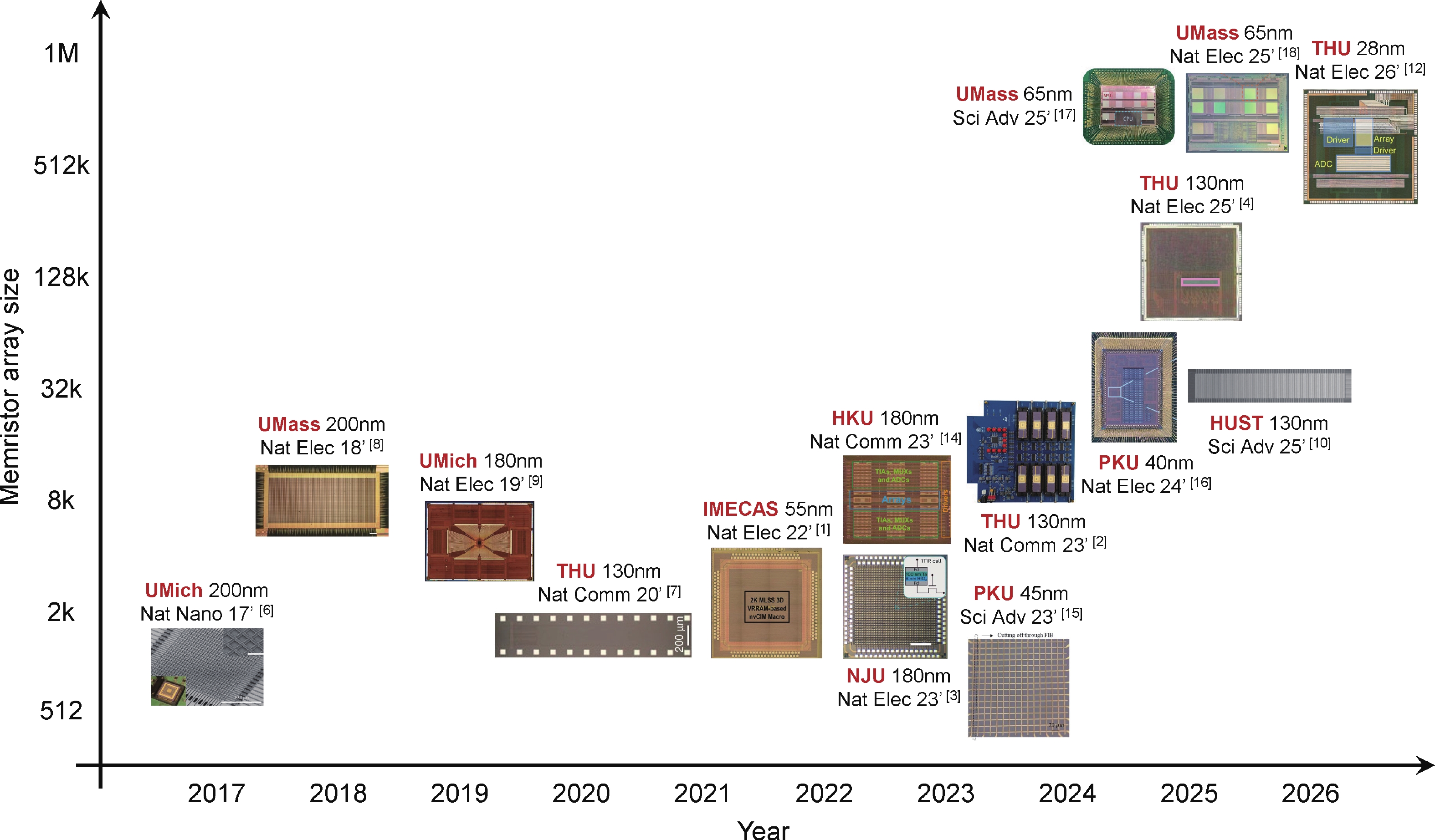
Fig. 1.
(Color online) Evolution of memristor-based signal processing in the past decade.
RESEARCH HIGHLIGHTS
Jingyuan Huang§, Yunrui Jiao§, Han Zhao, Xingchu Li, Bin Gao, He Qian, Jianshi Tang and Huaqiang Wu
Corresponding author: Jianshi Tang, jtang@tsinghua.edu.cn
| [1] |
Huo Q, Yang Y M, Wang Y M, et al. A computing-in-memory macro based on three-dimensional resistive random-access memory. Nat Electron, 2022, 5(7): 469 doi: 10.1038/s41928-022-00795-x
|
| [2] |
Zhao H, Liu Z W, Tang J S, et al. Energy-efficient high-fidelity image reconstruction with memristor arrays for medical diagnosis. Nat Commun, 2023, 14: 2276 doi: 10.1038/s41467-023-38021-7
|
| [3] |
Wang C, Ruan G J, Yang Z Z, et al. Parallel in-memory wireless computing. Nat Electron, 2023, 6(5): 381 doi: 10.1038/s41928-023-00965-5
|
| [4] |
Liu Z W, Mei J, Tang J S, et al. A memristor-based adaptive neuromorphic decoder for brain–computer interfaces. Nat Electron, 2025, 8(4): 362 doi: 10.1038/s41928-025-01340-2
|
| [5] |
Christensen D V, Dittmann R, Linares-Barranco B, et al. 2022 roadmap on neuromorphic computing and engineering. Neuromorph Comput Eng, 2022, 2(2): 022501 doi: 10.1088/2634-4386/ac4a83
|
| [6] |
Sheridan P M, Cai F X, Du C, et al. Sparse coding with memristor networks. Nat Nanotechnol, 2017, 12(8): 784 doi: 10.1038/nnano.2017.83
|
| [7] |
Liu Z W, Tang J S, Gao B, et al. Neural signal analysis with memristor arrays towards high-efficiency brain–machine interfaces. Nat Commun, 2020, 11: 4234 doi: 10.1038/s41467-020-18105-4
|
| [8] |
Li C, Hu M, Li Y N, et al. Analogue signal and image processing with large memristor crossbars. Nat Electron, 2018, 1(1): 52 doi: 10.1038/s41928-017-0002-z
|
| [9] |
Cai F X, Correll J M, Lee S H, et al. A fully integrated reprogrammable memristor–CMOS system for efficient multiply–accumulate operations. Nat Electron, 2019, 2(7): 290 doi: 10.1038/s41928-019-0270-x
|
| [10] |
Li J C, Tian J, Lin Y D, et al. Memristive floating-point Fourier neural operator network for efficient scientific modeling. Sci Adv, 2025, 11(25): eadv4446 doi: 10.1126/sciadv.adv4446
|
| [11] |
Zuo P S, Wang Q S, Luo Y B, et al. Precise and scalable analogue matrix equation solving using resistive random-access memory chips. Nat Electron, 2025, 8(12): 1222 doi: 10.1038/s41928-025-01477-0
|
| [12] |
Zhao H, Wang L, Zhou Y Z, et al. In situ spectral reconstruction based on a memristor chip for energy-efficient computational spectrometry. Nat Electron, 2026: 1222
|
| [13] |
Jiao Y R, Zhao H, Tang J S, et al. A memristor-based energy-efficient compressed sensing accelerator with hardware–software co-optimization for edge computing. Natl Sci Rev, 2026, 13(1): nwaf499 doi: 10.1093/nsr/nwaf499
|
| [14] |
Jiang M R, Shan K Y, He C P, et al. Efficient combinatorial optimization by quantum-inspired parallel annealing in analogue memristor crossbar. Nat Commun, 2023, 14: 5927 doi: 10.1038/s41467-023-41647-2
|
| [15] |
Wang S Q, Luo Y B, Zuo P S, et al. In-memory analog solution of compressed sensing recovery in one step. Sci Adv, 2023, 9(50): eadj2908 doi: 10.1126/sciadv.adj2908
|
| [16] |
Yue W S, Zhang T, Jing Z K, et al. A scalable universal Ising machine based on interaction-centric storage and compute-in-memory. Nat Electron, 2024, 7(10): 904 doi: 10.1038/s41928-024-01228-7
|
| [17] |
Wang Z X, Song W H, Wang T, et al. Real-time signal processing enabled by fused networks on a memristor-based system on a chip. Sci Adv, 2025, 11(30): eadv3436 doi: 10.1126/sciadv.adv3436
|
| [18] |
Huang Y, He C Y, Ling Y Z, et al. Radiofrequency signal processing with a memristive system-on-a-chip. Nat Electron, 2025, 8(7): 587 doi: 10.1038/s41928-025-01409-y
|
| [19] |
Mannocci P, Zucchelli C, Andreoli I, et al. A fully integrated analogue closed-loop in-memory computing accelerator based on static random-access memory. Nat Electron, 2026, 9(2): 200 doi: 10.1038/s41928-025-01549-1
|
| [20] |
Chen J H, Zheng X J, Tang J S, et al. Microscopic modeling and optimization of NbOx Mott memristor for artificial neuron applications. IEEE Trans Electron Devices, 2022, 69(12): 6686 doi: 10.1109/TED.2022.3212325
|
| [21] |
Yuan R, Tiw P J, Cai L, et al. A neuromorphic physiological signal processing system based on VO(2) memristor for next-generation human-machine interface. Nat Commun, 2023, 14(1): 3695 doi: 10.1038/s41467-023-39430-4
|
| [22] |
Park W, Song H C, Kim E Y, et al. Frequency switching neuristor for realizing intrinsic plasticity and enabling robust neuromorphic computing. Adv Mater, 2025, 37(44): e02255 doi: 10.1002/adma.202502255
|
| [23] |
Li C, Graves C E, Sheng X, et al. Analog content-addressable memories with memristors. Nat Commun, 2020, 11: 1638 doi: 10.1038/s41467-020-15254-4
|
| [24] |
Pedretti G, Graves C E, Serebryakov S, et al. Tree-based machine learning performed in-memory with memristive analog CAM. Nat Commun, 2021, 12: 5806 doi: 10.1038/s41467-021-25873-0
|
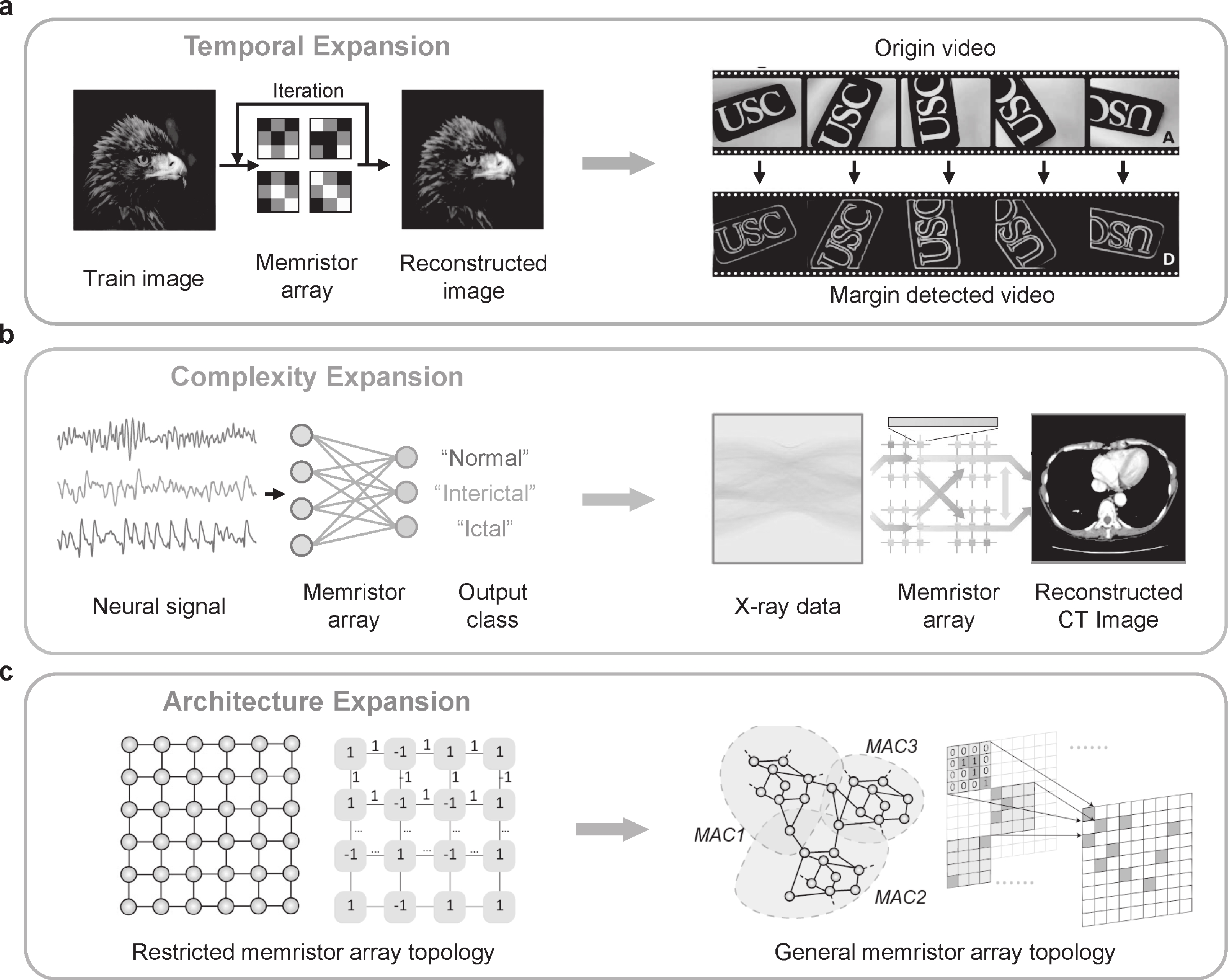
Table 1. Summary of key specifications and performance benchmarks of representative memristor-based signal processing systems.
| Reference | Array size |
Technology node |
Implemented algorithms | Applications | Computing accuracy | Performance benchmark |
| Nat. Nano. 2017[6] | 1 kb | 40 nm | LCA | Sparse coding | MSE:1.93×10⁻³/ 2.23×10⁻³ (4bit) |
~16× lower in energy consumption |
| Nat. Elec. 2018[8] | 8 kb | 40 nm | DCT and filtering | Image compression and filtering | STD: 0.46% (5~8bit) | Energy efficiency: 119.7 TOPS/W |
| Nat. Elec. 2019[9] | 5.5 kb | 180 nm | LCA | Breast cancer identification | Accuracy: 94.6%/96.8% | Power dissipation: 0.27 μW/feature |
| Nat. Comm. 2020[7] | 1 kb | 130 nm | FIR filtering | Epilepsy-related neural signal analysis | Accuracy: 93.46%/96.41% | 400× higher in power efficiency |
| Nat. Elec. 2022[1] | 2 kb | 55 nm | Filtering | MRI edge detection | Accuracy: 90.54%/91.92% | Energy efficiency 62.11 TOPS/W (IN1bit-W2bit) |
| Nat. Comm. 2023[14] | 4 kb | 180 nm | Simulate annealing | Combinatorial optimization | Time to Solution: 10.8 μs | 24.8 nJ /solution |
| Nat. Comm. 2023[2] | 2 kb×8 | 130 nm | DFT | Medical image reconstruction | PSNR: 22.38 dB/22.52 dB | 153× higher in energy efficiency |
| Nat. Elec. 2023[3] | 1 kb | 180 nm | Analog MVM | MIMO | bit error rate: 0/480 | Energy efficiency 222 TOPS/W |
| Sci. Adv. 2023[15] | 0.25 kb | 45 nm | LCA | Image reconstruction of 2D image | PSNR: 26.83 dB/30.71 dB | ~0.1 mJ/iteration |
| Nat. Elec. 2024[16] | 16 kb | 40 nm | Interaction-centric storage | Combinatorial optimization | Speed: 442–1450× | 4.1 × 10⁵–6.0 × 10⁵× lower in energy consumption |
| Sci. Adv. 2025[10] | 4 kb×8 | 130 nm | FNO | Scientific modeling (1D burger's eq/3D thermal conductivity) | Accuracy: 99.6%/99.8% (1D) | Energy efficiency 78 GOPS/W (FP32) |
| Nat. Elec. 2025[4] | 128 kb | 130 nm | TRCA | Brain-computer interface for drone control | Accuracy: 85.17%/86.08% | 1643× higher in power efficiency |
| Sci. Adv. 2025[17] | 64 kb×10 | 65 nm | DFT and MLP | Real-time video processing and classification | PSNR: 33.49 dB | 49× higher in power efficiency |
| Nat. Elec. 2025[18] | 64 kb×10 | 65 nm | DFT and CNN | RF spectrum analysis & transmitter identification & anomaly detection | Accuracy: 90.44%/92.29% | Energy efficiency 21 TOPS/W |
| Nat. Elec. 2025[11] | 64 b& 1 Mb |
40 nm | Inverse solver | MIMO | Residual error: 1× 10⁻⁷ (9 iters 24 bits) |
Energy efficiency 50 GOPS/W (N=16) |
| Nat. Elec. 2026[12] | 576 kb | 28 nm | Pseudo-inverse calculation | Computational spectrometry | PSNR: 30.87 dB | 126× higher in power efficiency |
 DownLoad: CSV
| [1] |
Huo Q, Yang Y M, Wang Y M, et al. A computing-in-memory macro based on three-dimensional resistive random-access memory. Nat Electron, 2022, 5(7): 469 doi: 10.1038/s41928-022-00795-x
|
| [2] |
Zhao H, Liu Z W, Tang J S, et al. Energy-efficient high-fidelity image reconstruction with memristor arrays for medical diagnosis. Nat Commun, 2023, 14: 2276 doi: 10.1038/s41467-023-38021-7
|
| [3] |
Wang C, Ruan G J, Yang Z Z, et al. Parallel in-memory wireless computing. Nat Electron, 2023, 6(5): 381 doi: 10.1038/s41928-023-00965-5
|
| [4] |
Liu Z W, Mei J, Tang J S, et al. A memristor-based adaptive neuromorphic decoder for brain–computer interfaces. Nat Electron, 2025, 8(4): 362 doi: 10.1038/s41928-025-01340-2
|
| [5] |
Christensen D V, Dittmann R, Linares-Barranco B, et al. 2022 roadmap on neuromorphic computing and engineering. Neuromorph Comput Eng, 2022, 2(2): 022501 doi: 10.1088/2634-4386/ac4a83
|
| [6] |
Sheridan P M, Cai F X, Du C, et al. Sparse coding with memristor networks. Nat Nanotechnol, 2017, 12(8): 784 doi: 10.1038/nnano.2017.83
|
| [7] |
Liu Z W, Tang J S, Gao B, et al. Neural signal analysis with memristor arrays towards high-efficiency brain–machine interfaces. Nat Commun, 2020, 11: 4234 doi: 10.1038/s41467-020-18105-4
|
| [8] |
Li C, Hu M, Li Y N, et al. Analogue signal and image processing with large memristor crossbars. Nat Electron, 2018, 1(1): 52 doi: 10.1038/s41928-017-0002-z
|
| [9] |
Cai F X, Correll J M, Lee S H, et al. A fully integrated reprogrammable memristor–CMOS system for efficient multiply–accumulate operations. Nat Electron, 2019, 2(7): 290 doi: 10.1038/s41928-019-0270-x
|
| [10] |
Li J C, Tian J, Lin Y D, et al. Memristive floating-point Fourier neural operator network for efficient scientific modeling. Sci Adv, 2025, 11(25): eadv4446 doi: 10.1126/sciadv.adv4446
|
| [11] |
Zuo P S, Wang Q S, Luo Y B, et al. Precise and scalable analogue matrix equation solving using resistive random-access memory chips. Nat Electron, 2025, 8(12): 1222 doi: 10.1038/s41928-025-01477-0
|
| [12] |
Zhao H, Wang L, Zhou Y Z, et al. In situ spectral reconstruction based on a memristor chip for energy-efficient computational spectrometry. Nat Electron, 2026: 1222
|
| [13] |
Jiao Y R, Zhao H, Tang J S, et al. A memristor-based energy-efficient compressed sensing accelerator with hardware–software co-optimization for edge computing. Natl Sci Rev, 2026, 13(1): nwaf499 doi: 10.1093/nsr/nwaf499
|
| [14] |
Jiang M R, Shan K Y, He C P, et al. Efficient combinatorial optimization by quantum-inspired parallel annealing in analogue memristor crossbar. Nat Commun, 2023, 14: 5927 doi: 10.1038/s41467-023-41647-2
|
| [15] |
Wang S Q, Luo Y B, Zuo P S, et al. In-memory analog solution of compressed sensing recovery in one step. Sci Adv, 2023, 9(50): eadj2908 doi: 10.1126/sciadv.adj2908
|
| [16] |
Yue W S, Zhang T, Jing Z K, et al. A scalable universal Ising machine based on interaction-centric storage and compute-in-memory. Nat Electron, 2024, 7(10): 904 doi: 10.1038/s41928-024-01228-7
|
| [17] |
Wang Z X, Song W H, Wang T, et al. Real-time signal processing enabled by fused networks on a memristor-based system on a chip. Sci Adv, 2025, 11(30): eadv3436 doi: 10.1126/sciadv.adv3436
|
| [18] |
Huang Y, He C Y, Ling Y Z, et al. Radiofrequency signal processing with a memristive system-on-a-chip. Nat Electron, 2025, 8(7): 587 doi: 10.1038/s41928-025-01409-y
|
| [19] |
Mannocci P, Zucchelli C, Andreoli I, et al. A fully integrated analogue closed-loop in-memory computing accelerator based on static random-access memory. Nat Electron, 2026, 9(2): 200 doi: 10.1038/s41928-025-01549-1
|
| [20] |
Chen J H, Zheng X J, Tang J S, et al. Microscopic modeling and optimization of NbOx Mott memristor for artificial neuron applications. IEEE Trans Electron Devices, 2022, 69(12): 6686 doi: 10.1109/TED.2022.3212325
|
| [21] |
Yuan R, Tiw P J, Cai L, et al. A neuromorphic physiological signal processing system based on VO(2) memristor for next-generation human-machine interface. Nat Commun, 2023, 14(1): 3695 doi: 10.1038/s41467-023-39430-4
|
| [22] |
Park W, Song H C, Kim E Y, et al. Frequency switching neuristor for realizing intrinsic plasticity and enabling robust neuromorphic computing. Adv Mater, 2025, 37(44): e02255 doi: 10.1002/adma.202502255
|
| [23] |
Li C, Graves C E, Sheng X, et al. Analog content-addressable memories with memristors. Nat Commun, 2020, 11: 1638 doi: 10.1038/s41467-020-15254-4
|
| [24] |
Pedretti G, Graves C E, Serebryakov S, et al. Tree-based machine learning performed in-memory with memristive analog CAM. Nat Commun, 2021, 12: 5806 doi: 10.1038/s41467-021-25873-0
|





Article views: 13 Times PDF downloads: 0 Times Cited by: 0 Times
Received: 19 February 2026 Revised: 21 April 2026 Online: Accepted Manuscript: 03 June 2026
| Citation: |
Jingyuan Huang, Yunrui Jiao, Han Zhao, Xingchu Li, Bin Gao, He Qian, Jianshi Tang, Huaqiang Wu. Memristor-based energy-efficient signal processing: recent progress and technology trend[J]. Journal of Semiconductors, 2026, In Press. doi: 10.1088/1674-4926/26020062
****
J Y Huang, Y R Jiao, H Zhao, X C Li, B Gao, H Qian, J S Tang, and H Q Wu, Memristor-based energy-efficient signal processing: recent progress and technology trend[J]. J. Semicond., 2026, accepted doi: 10.1088/1674-4926/26020062

|
 Jingyuan Huang received his bachelor’s degree from Tsinghua University, Beijing, China, in 2022. He is currently pursuing the master’s degree at the School of Integrated Circuits, Tsinghua University, Beijing, China. His research interests include neuromorphic computing systems and computational optics
 Yunrui Jiao received his bachelor’s degree from Tsinghua University, Beijing, China, in 2024. He is currently pursuing the master’s degree at the School of Integrated Circuits, Tsinghua University, Beijing, China. His research interests include neuromorphic computing systems and brain-computer interface
 Prof. Jianshi Tang is currently an Associate Professor and Vice Dean of the School of Integrated Circuits at Tsinghua University, where he received his bachelor’s degree in 2008. He received his PhD degree from UCLA in 2014, and worked at IBM Research in 2015-2019. He has been awarded the First Prize in Natural Science of the Ministry of Education of China, MIT TR35 China, IEEE Brain Best Paper Award, etc. His current research mainly focuses on emerging memory and neuromorphic computing. He has authored over 200 papers, including Nature Electronics, Nature Nanotechnology, Nature Materials, IEDM, VLSI, etc
| [1] |
Huo Q, Yang Y M, Wang Y M, et al. A computing-in-memory macro based on three-dimensional resistive random-access memory. Nat Electron, 2022, 5(7): 469 doi: 10.1038/s41928-022-00795-x
|
| [2] |
Zhao H, Liu Z W, Tang J S, et al. Energy-efficient high-fidelity image reconstruction with memristor arrays for medical diagnosis. Nat Commun, 2023, 14: 2276 doi: 10.1038/s41467-023-38021-7
|
| [3] |
Wang C, Ruan G J, Yang Z Z, et al. Parallel in-memory wireless computing. Nat Electron, 2023, 6(5): 381 doi: 10.1038/s41928-023-00965-5
|
| [4] |
Liu Z W, Mei J, Tang J S, et al. A memristor-based adaptive neuromorphic decoder for brain–computer interfaces. Nat Electron, 2025, 8(4): 362 doi: 10.1038/s41928-025-01340-2
|
| [5] |
Christensen D V, Dittmann R, Linares-Barranco B, et al. 2022 roadmap on neuromorphic computing and engineering. Neuromorph Comput Eng, 2022, 2(2): 022501 doi: 10.1088/2634-4386/ac4a83
|
| [6] |
Sheridan P M, Cai F X, Du C, et al. Sparse coding with memristor networks. Nat Nanotechnol, 2017, 12(8): 784 doi: 10.1038/nnano.2017.83
|
| [7] |
Liu Z W, Tang J S, Gao B, et al. Neural signal analysis with memristor arrays towards high-efficiency brain–machine interfaces. Nat Commun, 2020, 11: 4234 doi: 10.1038/s41467-020-18105-4
|
| [8] |
Li C, Hu M, Li Y N, et al. Analogue signal and image processing with large memristor crossbars. Nat Electron, 2018, 1(1): 52 doi: 10.1038/s41928-017-0002-z
|
| [9] |
Cai F X, Correll J M, Lee S H, et al. A fully integrated reprogrammable memristor–CMOS system for efficient multiply–accumulate operations. Nat Electron, 2019, 2(7): 290 doi: 10.1038/s41928-019-0270-x
|
| [10] |
Li J C, Tian J, Lin Y D, et al. Memristive floating-point Fourier neural operator network for efficient scientific modeling. Sci Adv, 2025, 11(25): eadv4446 doi: 10.1126/sciadv.adv4446
|
| [11] |
Zuo P S, Wang Q S, Luo Y B, et al. Precise and scalable analogue matrix equation solving using resistive random-access memory chips. Nat Electron, 2025, 8(12): 1222 doi: 10.1038/s41928-025-01477-0
|
| [12] |
Zhao H, Wang L, Zhou Y Z, et al. In situ spectral reconstruction based on a memristor chip for energy-efficient computational spectrometry. Nat Electron, 2026: 1222
|
| [13] |
Jiao Y R, Zhao H, Tang J S, et al. A memristor-based energy-efficient compressed sensing accelerator with hardware–software co-optimization for edge computing. Natl Sci Rev, 2026, 13(1): nwaf499 doi: 10.1093/nsr/nwaf499
|
| [14] |
Jiang M R, Shan K Y, He C P, et al. Efficient combinatorial optimization by quantum-inspired parallel annealing in analogue memristor crossbar. Nat Commun, 2023, 14: 5927 doi: 10.1038/s41467-023-41647-2
|
| [15] |
Wang S Q, Luo Y B, Zuo P S, et al. In-memory analog solution of compressed sensing recovery in one step. Sci Adv, 2023, 9(50): eadj2908 doi: 10.1126/sciadv.adj2908
|
| [16] |
Yue W S, Zhang T, Jing Z K, et al. A scalable universal Ising machine based on interaction-centric storage and compute-in-memory. Nat Electron, 2024, 7(10): 904 doi: 10.1038/s41928-024-01228-7
|
| [17] |
Wang Z X, Song W H, Wang T, et al. Real-time signal processing enabled by fused networks on a memristor-based system on a chip. Sci Adv, 2025, 11(30): eadv3436 doi: 10.1126/sciadv.adv3436
|
| [18] |
Huang Y, He C Y, Ling Y Z, et al. Radiofrequency signal processing with a memristive system-on-a-chip. Nat Electron, 2025, 8(7): 587 doi: 10.1038/s41928-025-01409-y
|
| [19] |
Mannocci P, Zucchelli C, Andreoli I, et al. A fully integrated analogue closed-loop in-memory computing accelerator based on static random-access memory. Nat Electron, 2026, 9(2): 200 doi: 10.1038/s41928-025-01549-1
|
| [20] |
Chen J H, Zheng X J, Tang J S, et al. Microscopic modeling and optimization of NbOx Mott memristor for artificial neuron applications. IEEE Trans Electron Devices, 2022, 69(12): 6686 doi: 10.1109/TED.2022.3212325
|
| [21] |
Yuan R, Tiw P J, Cai L, et al. A neuromorphic physiological signal processing system based on VO(2) memristor for next-generation human-machine interface. Nat Commun, 2023, 14(1): 3695 doi: 10.1038/s41467-023-39430-4
|
| [22] |
Park W, Song H C, Kim E Y, et al. Frequency switching neuristor for realizing intrinsic plasticity and enabling robust neuromorphic computing. Adv Mater, 2025, 37(44): e02255 doi: 10.1002/adma.202502255
|
| [23] |
Li C, Graves C E, Sheng X, et al. Analog content-addressable memories with memristors. Nat Commun, 2020, 11: 1638 doi: 10.1038/s41467-020-15254-4
|
| [24] |
Pedretti G, Graves C E, Serebryakov S, et al. Tree-based machine learning performed in-memory with memristive analog CAM. Nat Commun, 2021, 12: 5806 doi: 10.1038/s41467-021-25873-0
|

 WeChat ID
Journal of Semiconductors © 2017 All Rights Reserved 京ICP备05085259号-2