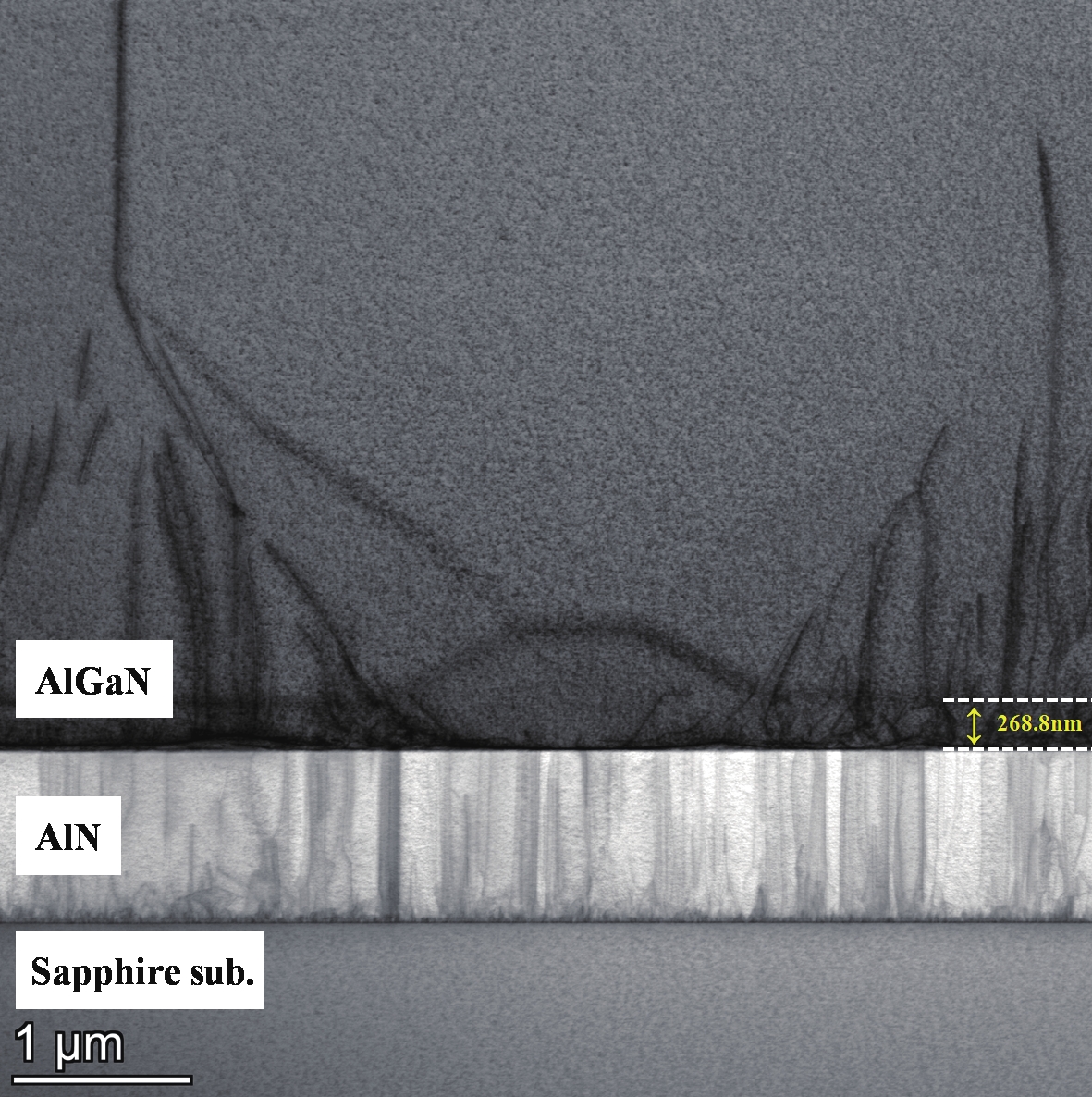


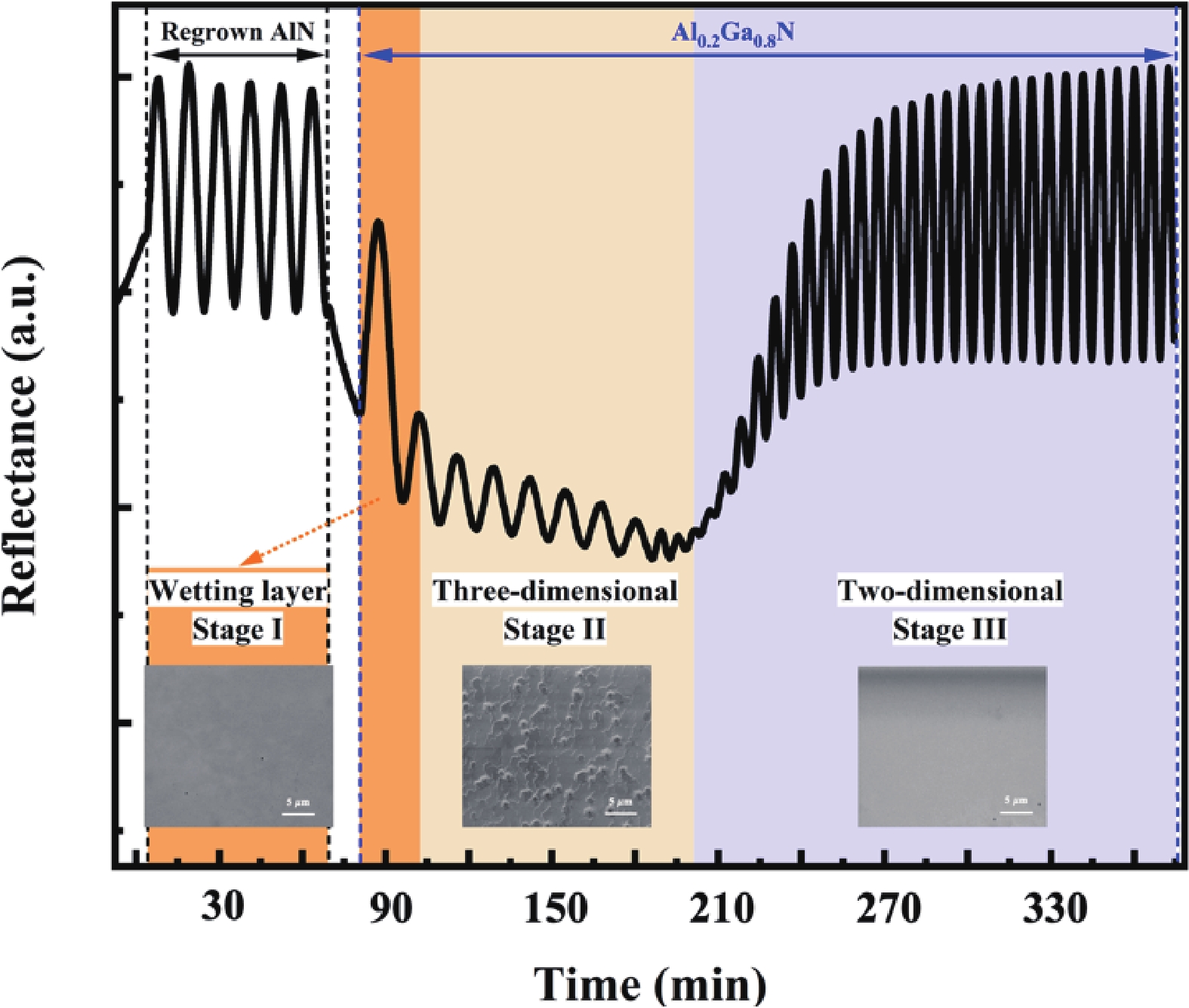
Fig. 1.
(Color online) Measurement results of reflectance intensities by in situ observation of 5 μm Al0.2Ga0.8N using two-step growth method.
ARTICLES
Yaqin Li1, 2, 3, Jianping Liu1, 2, 3, , Aiqin Tian2, 3, , Masao Ikeda2, 3, Wei Zhou2, 3 and Hui Yang1, 2, 3
Corresponding author: Jianping Liu, jpliu2010@sinano.ac.cn; Aiqin Tian, aqtian2012@sinano.ac.cn
Abstract: AlGaN-based ultraviolet (UV) laser diodes (LDs), with emission wavelength in the 280–365 nm range, are promising for applications in medical diagnostics and biological sensing, making them a prominent research focus in both academia and industry in recent years. A key challenge in their development is the large stress induced during the epitaxial growth of LD structures, which arises from the lack of lattice-matched substrates, and severely degrades the quantum efficiency and overall LD performance. This study presents an in-depth investigation into the growth mode and stress evolution of thick Al0.2Ga0.8N template. Firstly, we used the compressive stress between the Al0.2Ga0.8N layer and AlN/Sapphire substrate to form spontaneously three-dimensional growth to annihilate dislocations. Secondly, based on the Nakajima's theory of elasticity, we refined the conventional theoretical models for AlGaN strain relaxation of the S–K growth mode and critical thickness by considering the crucial role of threading dislocations (TDs) in releasing compressive stress. The experimentally measured critical thickness for three-dimensional growth was consistent with the calculated results. Furthermore, a crack-free high-quality 5 μm-thick Al0.2Ga0.8N template was successfully grown on an AlN/sapphire substrate.
Keywords: ultraviolet lasers, strain relaxation, critical thickness
| [1] |
Kneissl M, Rass J. III-nitride ultraviolet emitters: Technology and applications. Cham: Springer International Publishing, 2016
|
| [2] |
Hargis P J Jr, Sobering T J, Tisone G C, et al. Ultraviolet fluorescence identification of protein, DNA, and bacteria. Opt Instrum Gas Emiss Monit Atmos Meas, 1995, 2366: 147 doi: 10.1117/12.205554
|
| [3] |
Xie N, Xu F J, Wang J M, et al. Stress evolution in AlN growth on nano-patterned sapphire substrates. Appl Phys Express, 2020, 13(1): 015504 doi: 10.7567/1882-0786/ab582c
|
| [4] |
Hagedorn S, Mogilatenko A, Walde S, et al. High-temperature annealing and patterned AlN/sapphire interfaces. Phys Status Solidi B, 2021, 258(10): 2100187 doi: 10.1002/pssb.202100187
|
| [5] |
Uesugi K, Miyake H. Fabrication of AlN templates by high-temperature face-to-face annealing for deep UV LEDs. Jpn J Appl Phys, 2021, 60(12): 120502 doi: 10.35848/1347-4065/ac3026
|
| [6] |
Uesugi K, Kuboya S, Shojiki K, et al. 263 nm wavelength UV-C LED on face-to-face annealed sputter-deposited AlN with low screw- and mixed-type dislocation densities. Appl Phys Express, 2022, 15(5): 055501 doi: 10.35848/1882-0786/ac66c2
|
| [7] |
Lu S P, Ben J W, Jiang K, et al. 6-inch AlN epitaxial films with low dislocation densities via MOCVD. J Semicond, 2025, 46(2): 022501 doi: 10.1088/1674-4926/24110030
|
| [8] |
Amano H, Collazo R, De Santi C, et al. The 2020 UV emitter roadmap. J Phys D: Appl Phys, 2020, 53(50): 503001 doi: 10.1088/1361-6463/aba64c
|
| [9] |
Bryan I, Bryan Z, Mita S, et al. The role of surface kinetics on composition and quality of AlGaN. J Cryst Growth, 2016, 451: 65 doi: 10.1016/j.jcrysgro.2016.06.055
|
| [10] |
Sato K, Yasue S, Yamada K, et al. Room-temperature operation of AlGaN ultraviolet-B laser diode at 298 nm on lattice-relaxed Al0.6Ga0.4N/AlN/sapphire. Appl Phys Express, 2020, 13(3): 031004 doi: 10.35848/1882-0786/ab7711
|
| [11] |
Fischer A, Kühne H, Richter H. New approach in equilibrium theory for strained layer relaxation. Phys Rev Lett, 1994, 73(20): 2712 doi: 10.1103/PhysRevLett.73.2712
|
| [12] |
Orr B G, Kessler D, Snyder C W, et al. A model for strain-induced roughening and coherent island growth. Europhys Lett, 1992, 19(1): 33 doi: 10.1209/0295-5075/19/1/006
|
| [13] |
Frank F C, van der Merwe J H. One-dimensional dislocations. I. static theory. Proc R Soc Lond Ser A Math Phys Sci, 1949, 198(1053): 205
|
| [14] |
Volmer M. Nucleus formation in supersaturated systems. Zeitschrift für Physikalische Chemie, 1926, 119: 277
|
| [15] |
Stranski I N, Krastanov L. Theory of orientation separation of ionic crystals. Akad Wiss Let Mainz Math Natur Kl IIb, 1939, 146: 797
|
| [16] |
Nakajima K, Ujihara T, Miyashita S, et al. Effects of misfit dislocations and AlN buffer layer on the GaInN/GaN phase diagram of the growth mode. J Appl Phys, 2001, 89(1): 146 doi: 10.1063/1.1330247
|
| [17] |
Zhao W, Wang L, Wang J X, et al. Theoretical study on critical thicknesses of InGaN grown on (0001) GaN. J Cryst Growth, 2011, 327(1): 202 doi: 10.1016/j.jcrysgro.2011.05.002
|
| [18] |
Harutyunyan V S, Aivazyan A P, Weber E R, et al. High-resolution X-ray diffraction strain-stress analysis of GaN/sapphire heterostructures. J Phys D: Appl Phys, 2001, 34(10A): A35 doi: 10.1088/0022-3727/34/10A/308
|
| [19] |
Huang S Y, Yang J R. A transmission electron microscopy observation of dislocations in GaN grown on (0001) sapphire by metal organic chemical vapor deposition. Jpn J Appl Phys, 2008, 47(10R): 7998 doi: 10.1143/JJAP.47.7998
|
| [20] |
Nakajima K. Equilibrium phase diagrams for stranski-krastanov structure mode of III–V ternary quantum dots. Jpn J Appl Phys, 1999, 38(4R): 1875 doi: 10.1143/JJAP.38.1875
|
| [21] |
Mohamad R, Béré A, Hounkpati V, et al. A theoretical investigation of the miscibility and structural properties of InxAlyGa1−x−yN alloys. Phys Status Solidi B, 2018, 255(5): 1700394 doi: 10.1002/pssb.201700394
|
| [22] |
Vurgaftman I, Meyer J R. Band parameters for nitrogen-containing semiconductors. J Appl Phys, 2003, 94(6): 3675 doi: 10.1063/1.1600519
|
| [23] |
Sohi P, Martin D, Grandjean N. Critical thickness of GaN on AlN: Impact of growth temperature and dislocation density. Semicond Sci Technol, 2017, 32(7): 075010 doi: 10.1088/1361-6641/aa7248
|
| [24] |
Li Y Q, Tian A Q, Liu J P, et al. Two-step growth of crack-free 5 μm-thick Al0.2Ga0.8N on sapphire substrate with sputtered AlN nucleation layer. J Appl Phys, 2025, 137(6): 065703 doi: 10.1063/5.0249836
|
| [25] |
Iwaya M, Tanaka S, Omori T, et al. Recent development of UV-B laser diodes. Jpn J Appl Phys, 2022, 61(4): 040501 doi: 10.35848/1347-4065/ac3be8
|
Table 1. Parameters used in calculation.
| Parameter | AlN | GaN | ||
| Lateral lattice constant of a (nm) | 0.3112 | 0.3189 | ||
| Young’s modulus ${Y} $ (GPa) | 340 | 329 | ||
| Elastic constants Cij | C11/GPa | 396 | 390 | |
| C12/GPa | 137 | 145 | ||
| C13/GPa | 108 | 106 | ||
| C33/GPa | 373 | 398 | ||
 DownLoad: CSV
| [1] |
Kneissl M, Rass J. III-nitride ultraviolet emitters: Technology and applications. Cham: Springer International Publishing, 2016
|
| [2] |
Hargis P J Jr, Sobering T J, Tisone G C, et al. Ultraviolet fluorescence identification of protein, DNA, and bacteria. Opt Instrum Gas Emiss Monit Atmos Meas, 1995, 2366: 147 doi: 10.1117/12.205554
|
| [3] |
Xie N, Xu F J, Wang J M, et al. Stress evolution in AlN growth on nano-patterned sapphire substrates. Appl Phys Express, 2020, 13(1): 015504 doi: 10.7567/1882-0786/ab582c
|
| [4] |
Hagedorn S, Mogilatenko A, Walde S, et al. High-temperature annealing and patterned AlN/sapphire interfaces. Phys Status Solidi B, 2021, 258(10): 2100187 doi: 10.1002/pssb.202100187
|
| [5] |
Uesugi K, Miyake H. Fabrication of AlN templates by high-temperature face-to-face annealing for deep UV LEDs. Jpn J Appl Phys, 2021, 60(12): 120502 doi: 10.35848/1347-4065/ac3026
|
| [6] |
Uesugi K, Kuboya S, Shojiki K, et al. 263 nm wavelength UV-C LED on face-to-face annealed sputter-deposited AlN with low screw- and mixed-type dislocation densities. Appl Phys Express, 2022, 15(5): 055501 doi: 10.35848/1882-0786/ac66c2
|
| [7] |
Lu S P, Ben J W, Jiang K, et al. 6-inch AlN epitaxial films with low dislocation densities via MOCVD. J Semicond, 2025, 46(2): 022501 doi: 10.1088/1674-4926/24110030
|
| [8] |
Amano H, Collazo R, De Santi C, et al. The 2020 UV emitter roadmap. J Phys D: Appl Phys, 2020, 53(50): 503001 doi: 10.1088/1361-6463/aba64c
|
| [9] |
Bryan I, Bryan Z, Mita S, et al. The role of surface kinetics on composition and quality of AlGaN. J Cryst Growth, 2016, 451: 65 doi: 10.1016/j.jcrysgro.2016.06.055
|
| [10] |
Sato K, Yasue S, Yamada K, et al. Room-temperature operation of AlGaN ultraviolet-B laser diode at 298 nm on lattice-relaxed Al0.6Ga0.4N/AlN/sapphire. Appl Phys Express, 2020, 13(3): 031004 doi: 10.35848/1882-0786/ab7711
|
| [11] |
Fischer A, Kühne H, Richter H. New approach in equilibrium theory for strained layer relaxation. Phys Rev Lett, 1994, 73(20): 2712 doi: 10.1103/PhysRevLett.73.2712
|
| [12] |
Orr B G, Kessler D, Snyder C W, et al. A model for strain-induced roughening and coherent island growth. Europhys Lett, 1992, 19(1): 33 doi: 10.1209/0295-5075/19/1/006
|
| [13] |
Frank F C, van der Merwe J H. One-dimensional dislocations. I. static theory. Proc R Soc Lond Ser A Math Phys Sci, 1949, 198(1053): 205
|
| [14] |
Volmer M. Nucleus formation in supersaturated systems. Zeitschrift für Physikalische Chemie, 1926, 119: 277
|
| [15] |
Stranski I N, Krastanov L. Theory of orientation separation of ionic crystals. Akad Wiss Let Mainz Math Natur Kl IIb, 1939, 146: 797
|
| [16] |
Nakajima K, Ujihara T, Miyashita S, et al. Effects of misfit dislocations and AlN buffer layer on the GaInN/GaN phase diagram of the growth mode. J Appl Phys, 2001, 89(1): 146 doi: 10.1063/1.1330247
|
| [17] |
Zhao W, Wang L, Wang J X, et al. Theoretical study on critical thicknesses of InGaN grown on (0001) GaN. J Cryst Growth, 2011, 327(1): 202 doi: 10.1016/j.jcrysgro.2011.05.002
|
| [18] |
Harutyunyan V S, Aivazyan A P, Weber E R, et al. High-resolution X-ray diffraction strain-stress analysis of GaN/sapphire heterostructures. J Phys D: Appl Phys, 2001, 34(10A): A35 doi: 10.1088/0022-3727/34/10A/308
|
| [19] |
Huang S Y, Yang J R. A transmission electron microscopy observation of dislocations in GaN grown on (0001) sapphire by metal organic chemical vapor deposition. Jpn J Appl Phys, 2008, 47(10R): 7998 doi: 10.1143/JJAP.47.7998
|
| [20] |
Nakajima K. Equilibrium phase diagrams for stranski-krastanov structure mode of III–V ternary quantum dots. Jpn J Appl Phys, 1999, 38(4R): 1875 doi: 10.1143/JJAP.38.1875
|
| [21] |
Mohamad R, Béré A, Hounkpati V, et al. A theoretical investigation of the miscibility and structural properties of InxAlyGa1−x−yN alloys. Phys Status Solidi B, 2018, 255(5): 1700394 doi: 10.1002/pssb.201700394
|
| [22] |
Vurgaftman I, Meyer J R. Band parameters for nitrogen-containing semiconductors. J Appl Phys, 2003, 94(6): 3675 doi: 10.1063/1.1600519
|
| [23] |
Sohi P, Martin D, Grandjean N. Critical thickness of GaN on AlN: Impact of growth temperature and dislocation density. Semicond Sci Technol, 2017, 32(7): 075010 doi: 10.1088/1361-6641/aa7248
|
| [24] |
Li Y Q, Tian A Q, Liu J P, et al. Two-step growth of crack-free 5 μm-thick Al0.2Ga0.8N on sapphire substrate with sputtered AlN nucleation layer. J Appl Phys, 2025, 137(6): 065703 doi: 10.1063/5.0249836
|
| [25] |
Iwaya M, Tanaka S, Omori T, et al. Recent development of UV-B laser diodes. Jpn J Appl Phys, 2022, 61(4): 040501 doi: 10.35848/1347-4065/ac3be8
|





Article views: 279 Times PDF downloads: 94 Times Cited by: 0 Times
Received: 03 March 2026 Revised: 27 April 2026 Online: Accepted Manuscript: 03 June 2026Uncorrected proof: 07 August 2026Published: 12 September 2026
| Citation: |
Yaqin Li, Jianping Liu, Aiqin Tian, Masao Ikeda, Wei Zhou, Hui Yang. Research on the critical thickness of Al0.2Ga0.8N template grown on AlN/sapphire substrate[J]. Journal of Semiconductors, 2026, 47(9): 092501. doi: 10.1088/1674-4926/26030007
****
Y Q Li, J P Liu, A Q Tian, M Ikeda, W Zhou, and H Yang, Research on the critical thickness of Al0.2Ga0.8N template grown on AlN/sapphire substrate[J]. J. Semicond., 2026, 47(9): 092501 doi: 10.1088/1674-4926/26030007

|
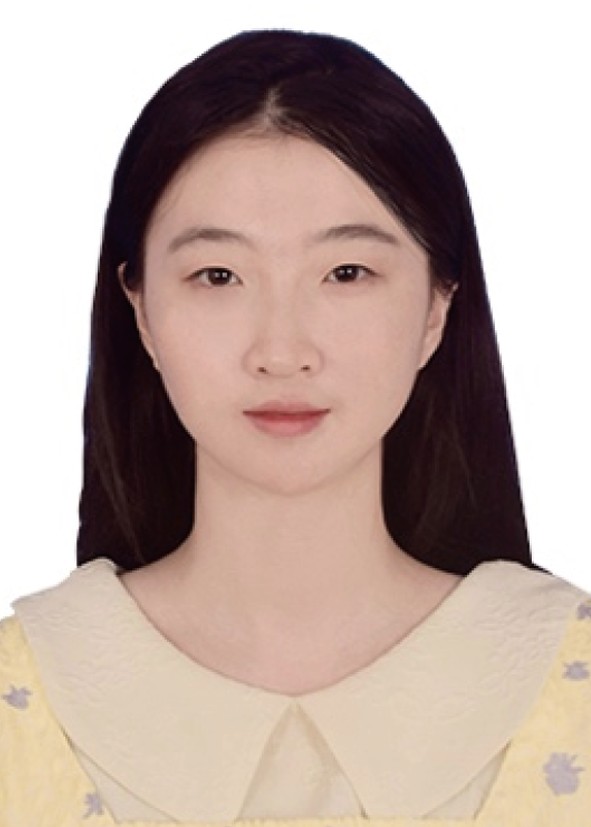 Yaqin Li got her bachelor’s degree in 2016 from Hebei University of Technology. Now she is a doctoral student at University of Science and Technology of China under the supervision of Prof. Jianping Liu. Her research focuses on MOCVD growth and GaN-based laser diodes
 Jianping Liu got his doctoral degree in 2004 from Institute of Semiconductors, Chinese Academy of Sciences. He is currently a Professor with the Suzhou Institute of Nano-Tech and Nano-Bionics, Chinese Academy of Sciences. His current research interests include GaN-based materials and devices, and MOCVD technology
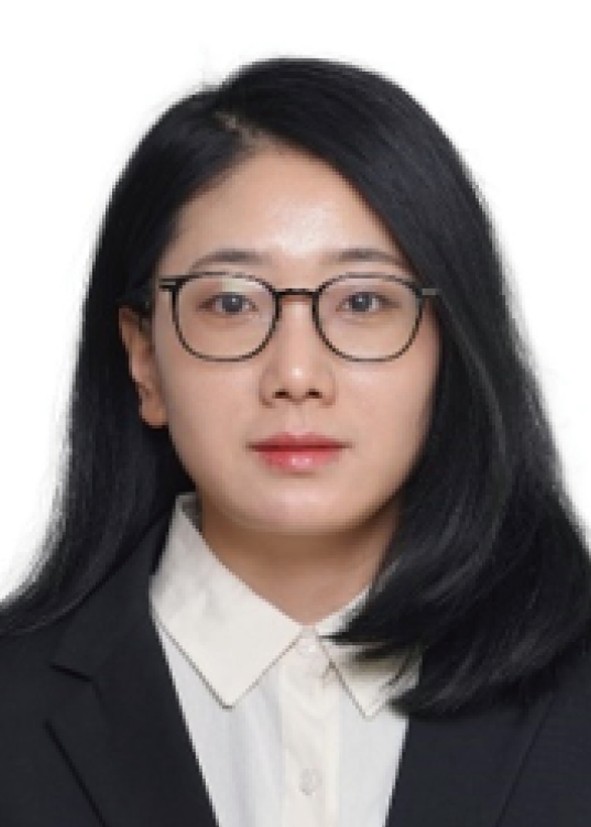 Aiqin Tian got her doctoral degree in 2017 from University of Chinese Academy of Sciences. She is currently a Professor with the Suzhou Institute of Nano-Tech and Nano-Bionics, Chinese Academy of Sciences. Her research focuses on GaN-based optoelectronic materials and devices
| [1] |
Kneissl M, Rass J. III-nitride ultraviolet emitters: Technology and applications. Cham: Springer International Publishing, 2016
|
| [2] |
Hargis P J Jr, Sobering T J, Tisone G C, et al. Ultraviolet fluorescence identification of protein, DNA, and bacteria. Opt Instrum Gas Emiss Monit Atmos Meas, 1995, 2366: 147 doi: 10.1117/12.205554
|
| [3] |
Xie N, Xu F J, Wang J M, et al. Stress evolution in AlN growth on nano-patterned sapphire substrates. Appl Phys Express, 2020, 13(1): 015504 doi: 10.7567/1882-0786/ab582c
|
| [4] |
Hagedorn S, Mogilatenko A, Walde S, et al. High-temperature annealing and patterned AlN/sapphire interfaces. Phys Status Solidi B, 2021, 258(10): 2100187 doi: 10.1002/pssb.202100187
|
| [5] |
Uesugi K, Miyake H. Fabrication of AlN templates by high-temperature face-to-face annealing for deep UV LEDs. Jpn J Appl Phys, 2021, 60(12): 120502 doi: 10.35848/1347-4065/ac3026
|
| [6] |
Uesugi K, Kuboya S, Shojiki K, et al. 263 nm wavelength UV-C LED on face-to-face annealed sputter-deposited AlN with low screw- and mixed-type dislocation densities. Appl Phys Express, 2022, 15(5): 055501 doi: 10.35848/1882-0786/ac66c2
|
| [7] |
Lu S P, Ben J W, Jiang K, et al. 6-inch AlN epitaxial films with low dislocation densities via MOCVD. J Semicond, 2025, 46(2): 022501 doi: 10.1088/1674-4926/24110030
|
| [8] |
Amano H, Collazo R, De Santi C, et al. The 2020 UV emitter roadmap. J Phys D: Appl Phys, 2020, 53(50): 503001 doi: 10.1088/1361-6463/aba64c
|
| [9] |
Bryan I, Bryan Z, Mita S, et al. The role of surface kinetics on composition and quality of AlGaN. J Cryst Growth, 2016, 451: 65 doi: 10.1016/j.jcrysgro.2016.06.055
|
| [10] |
Sato K, Yasue S, Yamada K, et al. Room-temperature operation of AlGaN ultraviolet-B laser diode at 298 nm on lattice-relaxed Al0.6Ga0.4N/AlN/sapphire. Appl Phys Express, 2020, 13(3): 031004 doi: 10.35848/1882-0786/ab7711
|
| [11] |
Fischer A, Kühne H, Richter H. New approach in equilibrium theory for strained layer relaxation. Phys Rev Lett, 1994, 73(20): 2712 doi: 10.1103/PhysRevLett.73.2712
|
| [12] |
Orr B G, Kessler D, Snyder C W, et al. A model for strain-induced roughening and coherent island growth. Europhys Lett, 1992, 19(1): 33 doi: 10.1209/0295-5075/19/1/006
|
| [13] |
Frank F C, van der Merwe J H. One-dimensional dislocations. I. static theory. Proc R Soc Lond Ser A Math Phys Sci, 1949, 198(1053): 205
|
| [14] |
Volmer M. Nucleus formation in supersaturated systems. Zeitschrift für Physikalische Chemie, 1926, 119: 277
|
| [15] |
Stranski I N, Krastanov L. Theory of orientation separation of ionic crystals. Akad Wiss Let Mainz Math Natur Kl IIb, 1939, 146: 797
|
| [16] |
Nakajima K, Ujihara T, Miyashita S, et al. Effects of misfit dislocations and AlN buffer layer on the GaInN/GaN phase diagram of the growth mode. J Appl Phys, 2001, 89(1): 146 doi: 10.1063/1.1330247
|
| [17] |
Zhao W, Wang L, Wang J X, et al. Theoretical study on critical thicknesses of InGaN grown on (0001) GaN. J Cryst Growth, 2011, 327(1): 202 doi: 10.1016/j.jcrysgro.2011.05.002
|
| [18] |
Harutyunyan V S, Aivazyan A P, Weber E R, et al. High-resolution X-ray diffraction strain-stress analysis of GaN/sapphire heterostructures. J Phys D: Appl Phys, 2001, 34(10A): A35 doi: 10.1088/0022-3727/34/10A/308
|
| [19] |
Huang S Y, Yang J R. A transmission electron microscopy observation of dislocations in GaN grown on (0001) sapphire by metal organic chemical vapor deposition. Jpn J Appl Phys, 2008, 47(10R): 7998 doi: 10.1143/JJAP.47.7998
|
| [20] |
Nakajima K. Equilibrium phase diagrams for stranski-krastanov structure mode of III–V ternary quantum dots. Jpn J Appl Phys, 1999, 38(4R): 1875 doi: 10.1143/JJAP.38.1875
|
| [21] |
Mohamad R, Béré A, Hounkpati V, et al. A theoretical investigation of the miscibility and structural properties of InxAlyGa1−x−yN alloys. Phys Status Solidi B, 2018, 255(5): 1700394 doi: 10.1002/pssb.201700394
|
| [22] |
Vurgaftman I, Meyer J R. Band parameters for nitrogen-containing semiconductors. J Appl Phys, 2003, 94(6): 3675 doi: 10.1063/1.1600519
|
| [23] |
Sohi P, Martin D, Grandjean N. Critical thickness of GaN on AlN: Impact of growth temperature and dislocation density. Semicond Sci Technol, 2017, 32(7): 075010 doi: 10.1088/1361-6641/aa7248
|
| [24] |
Li Y Q, Tian A Q, Liu J P, et al. Two-step growth of crack-free 5 μm-thick Al0.2Ga0.8N on sapphire substrate with sputtered AlN nucleation layer. J Appl Phys, 2025, 137(6): 065703 doi: 10.1063/5.0249836
|
| [25] |
Iwaya M, Tanaka S, Omori T, et al. Recent development of UV-B laser diodes. Jpn J Appl Phys, 2022, 61(4): 040501 doi: 10.35848/1347-4065/ac3be8
|
 26030007_Supplementary Information.pdf
|

|

 WeChat ID
Journal of Semiconductors © 2017 All Rights Reserved 京ICP备05085259号-2