


 Wen-Jun Wang is a Master student at the University of the Chinese Academy of Sciences. She obtained her Bachelor degree in Tsinghua University. She is working on Moiré NEMS.
 Ping-Heng Tan is a professor at the Institute of Semiconductors, Chinese Academy of Sciences. He obtained his B.S. degree in Physics from Peking University in 1996 and his Ph.D. from the Institute of Semiconductors, Chinese Academy of Sciences in 2001. From 2001 to 2003, he worked as a postdoctoral research associate at the Walter Schottky Institute of the Technical University of Munich. He was a K. C. Wong Royal Society Fellow at the University of Cambridge from 2006 to 2007. His current research focuses on two-dimensional layered materials, carbon nanomaterials, topological insulators, and other novel low-dimensional semiconductor optoelectronic materials. In 2012, he received the National Science Fund for Distinguished Young Scholars.
 Xin Zhang is a professor at the Institute of Semiconductors, Chinese Academy of Sciences. He received his Ph.D. from the Institute of Semiconductors, Chinese Academy of Sciences in 2015. Then he consecutively worked as a postdoctoral research associate at Centre national de la recherche scientifique (CNRS), Nanyang Technological University and Concordia University. His research interests focus on novel MEMS/NEMS and their valuable applications in quantum measurements and sensing. His publications have received a total of more than 7000 citations with a h index of 23 as of March 2026.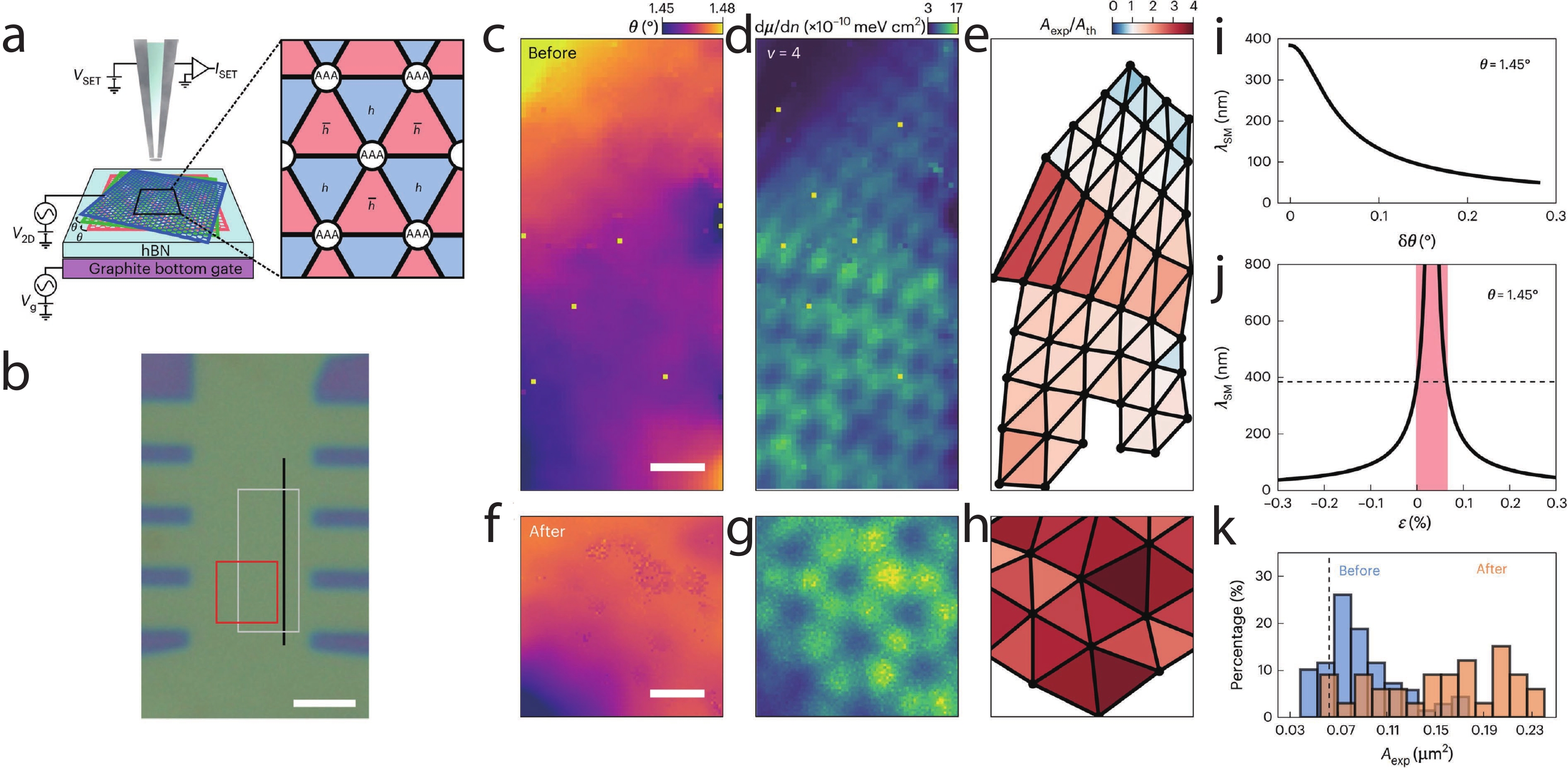
Fig. 1.
(Color online) (a) Schematic of the scanning single-electron transistor (SET) measurement used to probe HTG. The SET tip measures the local inverse compressibility $ \mathrm{d}\mu /\mathrm{d}n $ of an hBN-encapsulated HTG device with a graphite bottom gate (the top hBN is not shown). The inset shows the relaxed supermoiré lattice with triangular $ h $ and $ \overline{h} $ domains meeting at AAA stacking points. (b) Optical micrograph of the device. The black linecut shows the trajectory for inverse compressibility $ \mathrm{d}\mu /\mathrm{d}n $ for Fig. 1(e) in the main text of Ref. [8]. The white box marks the scan region and the red box indicates the area shown in the maps below. (c) and (d) Maps of the local twist angle $ \theta $ and inverse compressibility $ \mathrm{d}\mu /\mathrm{d}n $ before thermal cycling, revealing a triangular supermoiré domain pattern. (e) Reconstructed domain network colored by the ratio of experimental to theoretical domain area $ {A}_{\exp }/{A}_{\text{th}} $. (f) and (g) Corresponding $ \theta $ and $ \mathrm{d}\mu /\mathrm{d}n $ maps after thermal cycling, showing enlarged domains while the local moiré wavelength remains unchanged. (h) Reconstructed domain network after cycling. (i) and (j) Calculated dependence of the supermoiré wavelength $ {\lambda }_{\text{SM}} $ on twist-angle mismatch $ \delta \theta $ and heterostrain $ \varepsilon $. (k) Histogram of domain areas before and after cycling, indicating strain-induced domain growth[8].
 DownLoad: