


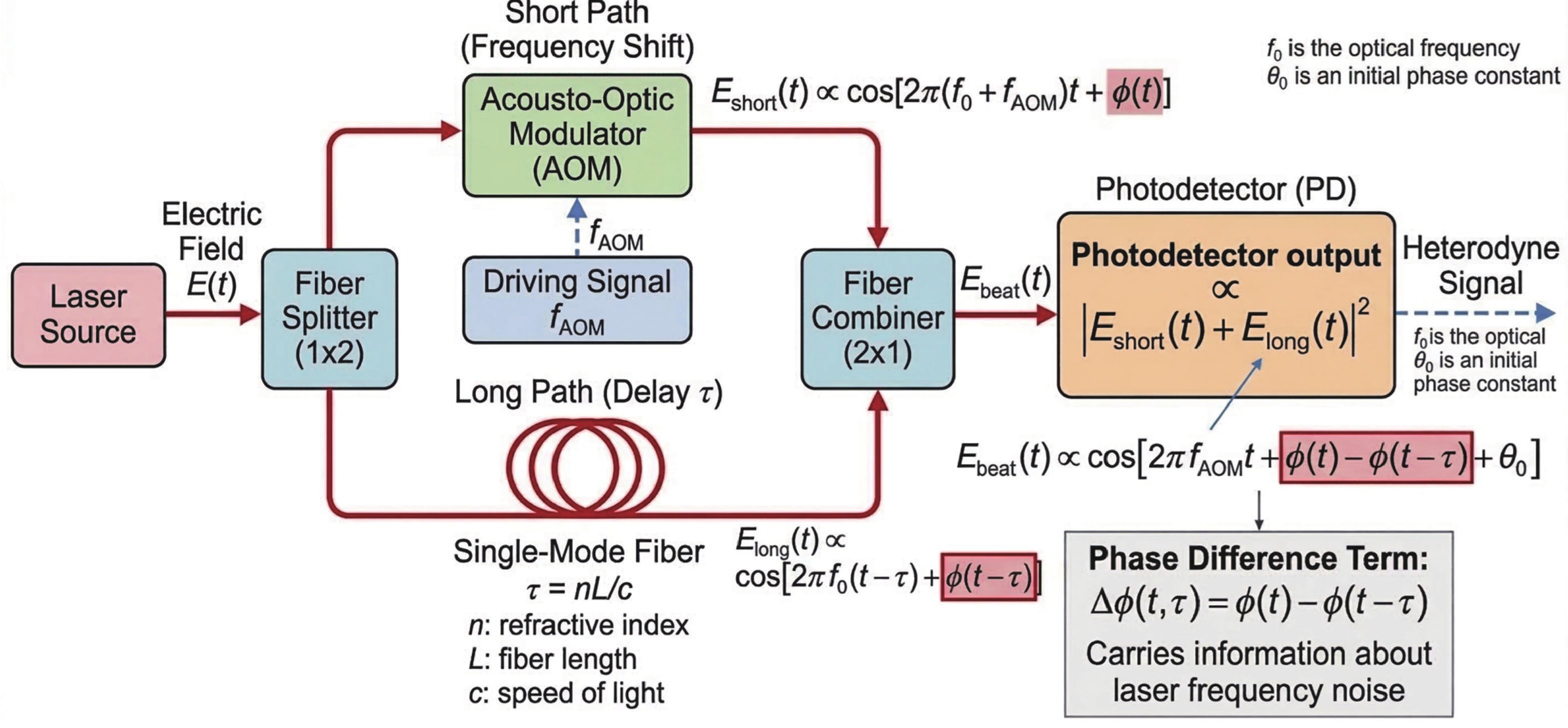
Fig. 1.
(Color online) Schematic diagram of the laser frequency noise measurement principle based on the delayed self-heterodyne (DSH) technique.
ARTICLES
Yiming Wang1, 2, Gang Zhao3, Ruchan Cai1, 2, Peng Chen1, 2, Jia Wang1, 2 and Liang Xie1, 2,
Corresponding author: Liang Xie, xiel@semi.ac.cn
Abstract: Systematic optimization of the delayed self-heterodyne method for laser frequency noise characterization is investigated across an extensive linewidth range (100 Hz to 10 MHz). By evaluating various fiber lengths, window functions, and five demodulation algorithms, we identify a critical trade-off: long fibers enhance sensitivity for narrow-linewidth lasers but exacerbate spectral leakage in broad-linewidth sources. Our findings demonstrate that Hanning and Blackman windows effectively suppress this leakage, ensuring measurement consistency across different delay lengths. Among the evaluated algorithms, the Hilbert transform offers the superior balance of high-frequency accuracy and computational efficiency. Validated under low-power conditions, this optimized framework provides a robust and power-independent methodology for precise FN analysis, offering significant guidance for high-performance laser development.
Key words: laser frequency noise, delayed self-heterodyne, spectral leakage suppression, demodulation algorithms
| [1] |
Chen Z F, Wang K K, Chen Q A, et al. Nano-ITLA based on thermo-optically tuned multi-channel interference widely tunable laser. J Lightwave Technol, 2023, 41(16): 5405 doi: 10.1109/JLT.2023.3261897
|
| [2] |
Chauhan N, Isichenko A, Liu K K, et al. Visible light photonic integrated Brillouin laser. Nat Commun, 2021, 12(1): 4685 doi: 10.1038/s41467-021-24926-8
|
| [3] |
Chen J Q, Chen C, Guo Q, et al. Linear polarization and narrow-linewidth external-cavity semiconductor laser based on birefringent Bragg grating optical feedback. Opt Laser Technol, 2024, 170: 110211 doi: 10.1016/j.optlastec.2023.110211
|
| [4] |
Kikuchi K. Fundamentals of coherent optical fiber communications. J Lightwave Technol, 2016, 34(1): 157 doi: 10.1109/JLT.2015.2463719
|
| [5] |
Okoshi T, Kikuchi K, Nakayama A. Novel method for high resolution measurement of laser output spectrum. Electron Lett (UK), 1980, 16(16): 630
|
| [6] |
Di Domenico G, Schilt S, Thomann P. Simple approach to the relation between laser frequency noise and laser line shape. Appl Opt, 2010, 49(25): 4801 doi: 10.1364/AO.49.004801
|
| [7] |
Horak P, Loh W H. On the delayed self-heterodyne interferometric technique for determining the linewidth of fiber lasers. Opt Express, 2006, 14(9): 3923 doi: 10.1364/oe.14.003923
|
| [8] |
Mercer L B. 1/f frequency noise effects on self-heterodyne linewidth measurements. J Lightwave Technol, 1991, 9(4): 485 doi: 10.1109/50.76663
|
| [9] |
Ma W C, Xiong B, Sun C Z, et al. Laser frequency noise characterization by self-heterodyne with both long and short delay. Appl Opt, 2019, 58(13): 3555 doi: 10.1364/AO.58.003555
|
| [10] |
Zhao Z A, Bai Z X, Jin D, et al. Narrow laser-linewidth measurement using short delay self-heterodyne interferometry. Opt Express, 2022, 30(17): 30600 doi: 10.1364/OE.455028
|
| [11] |
Zhang C Z, Huang L G, Guan T Y, et al. Laser coherence linewidth measurement based on deterioration of coherent envelope. Opt Laser Technol, 2024, 172: 110498 doi: 10.1016/j.optlastec.2023.110498
|
| [12] |
Zhao Z A, Bai Z X, Jin D, et al. The influence of noise floor on the measurement of laser linewidth using short-delay-length self-heterodyne/homodyne techniques. Micromachines, 2022, 13(8): 1311 doi: 10.3390/mi13081311
|
| [13] |
Wang D D, Jiang Y F, Gu H, et al. Improvement and analysis of a recirculating delayed self-heterodyne interferometer for laser linewidth measurement. Opt Fiber Technol, 2022, 71: 102945 doi: 10.1016/j.yofte.2022.102945
|
| [14] |
Tsuchida H. Simple technique for improving the resolution of the delayed self-heterodyne method. Opt Lett, 1990, 15(11): 640 doi: 10.1364/OL.15.000640
|
| [15] |
Daino B, Spano P, Tamburrini M, et al. Phase noise and spectral line shape in semiconductor lasers. IEEE J Quantum Electron, 1983, 19(3): 266 doi: 10.1109/JQE.1983.1071842
|
| [16] |
Zhou Q, Qin J, Xie W L, et al. Dynamic frequency-noise spectrum measurement for a frequency-swept DFB laser with short-delayed self-heterodyne method. Opt Express, 2015, 23(22): 29245 doi: 10.1364/OE.23.029245
|
| [17] |
Shi H B, Chang P Y, Wang Z Y, et al. Frequency stabilization of a cesium faraday laser with a double-layer vapor cell as frequency reference. IEEE Photonics J, 2022, 14(6): 1561006 doi: 10.1109/jphot.2022.3221494
|
| [18] |
Tombez L, Schilt S, Di Francesco J, et al. Linewidth of a quantum-cascade laser assessed from its frequency noise spectrum and impact of the current driver. Appl Phys B, 2012, 109: 407 doi: 10.1007/s00340-012-5005-x
|
| [19] |
Li B H, Yuan Z Q, Jin W, et al. High-coherence hybrid-integrated 780 nm source by self-injection-locked second-harmonic generation in a high-Q silicon-nitride resonator. Optica, 2023, 10(9): 1241 doi: 10.1364/OPTICA.498391
|
| [20] |
Chen J Q, Chen C, Guo Q, et al. A 1-μm-band injection-locked semiconductor laser with a high side-mode suppression ratio and narrow linewidth. Sensors, 2022, 22(23): 9239 doi: 10.3390/s22239239
|
| [21] |
Yuan Z Q, Wang H M, Liu P, et al. Correlated self-heterodyne method for ultra-low-noise laser linewidth measurements. Opt Express, 2022, 30(14): 25147 doi: 10.1364/OE.458109
|
| [22] |
Mertenskötter L, Kantner M. Frequency noise characterization of narrow-linewidth semiconductor lasers: a bayesian approach. IEEE Photonics J, 2024, 16(3): 0601407 doi: 10.1109/jphot.2024.3385184
|
| [23] |
Yao P H, Zhang Z, Zhou J N, et al. Application of sine-cosine demodulation technology in linewidth measurement of narrow linewidth single frequency laser. AOPC 2023: Optic Fiber Gyro, 2023, 1296819
|
| [24] |
Camatel S, Ferrero V. Narrow linewidth CW laser phase noise characterization methods for coherent transmission system applications. J Lightwave Technol, 2008, 26(17): 3048 doi: 10.1109/JLT.2008.925046
|
| [25] |
Zhang Y H, Cao X H, Chen W, et al. Precise linewidths measurement using short delay self-heterodyne interferometry and multiple peak-to-valley differences. AOPC 2023: AI in Optics and Photonics, 2023, 129660Y
|
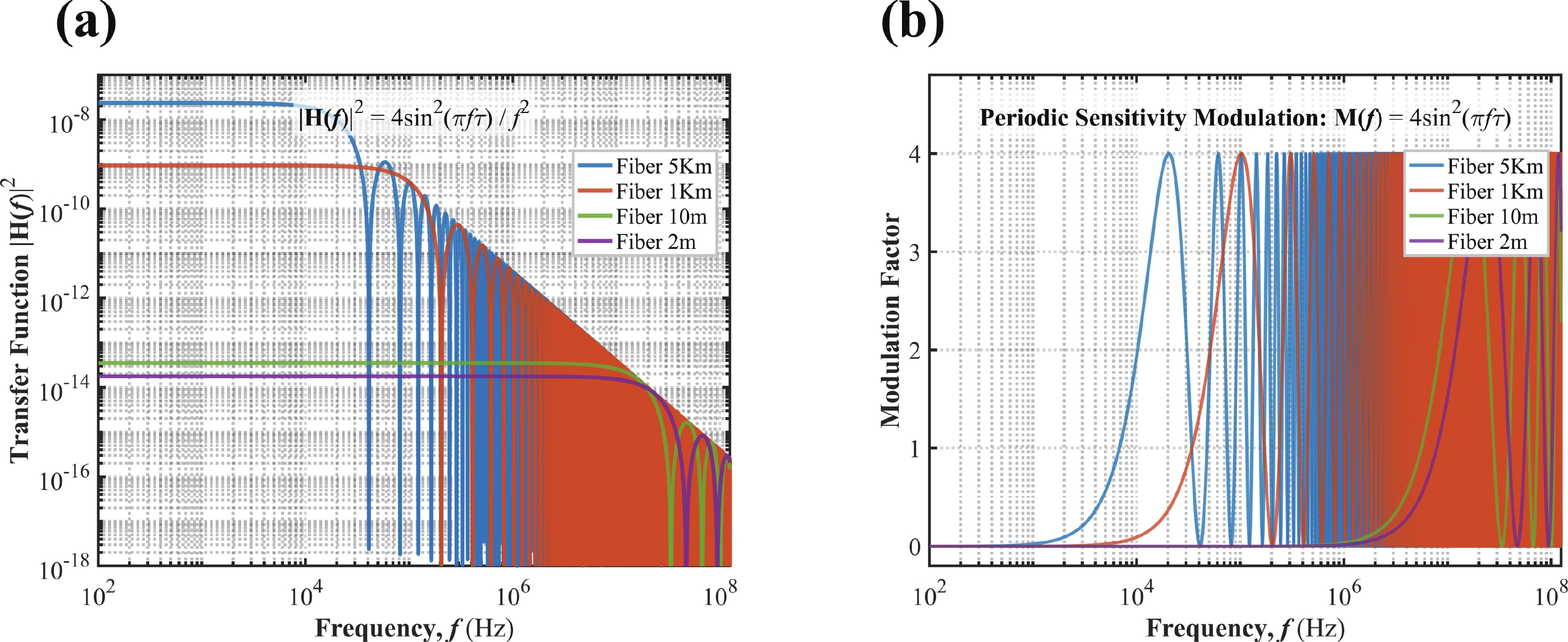
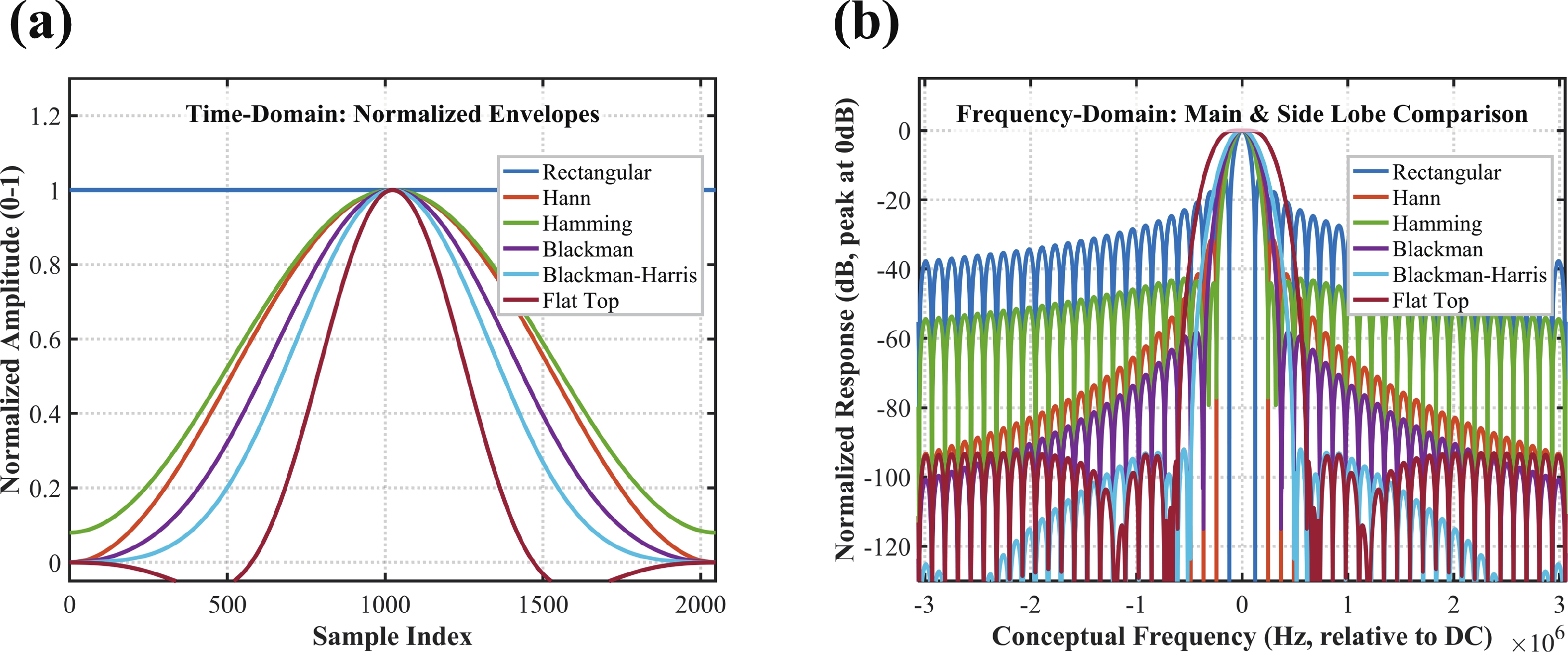
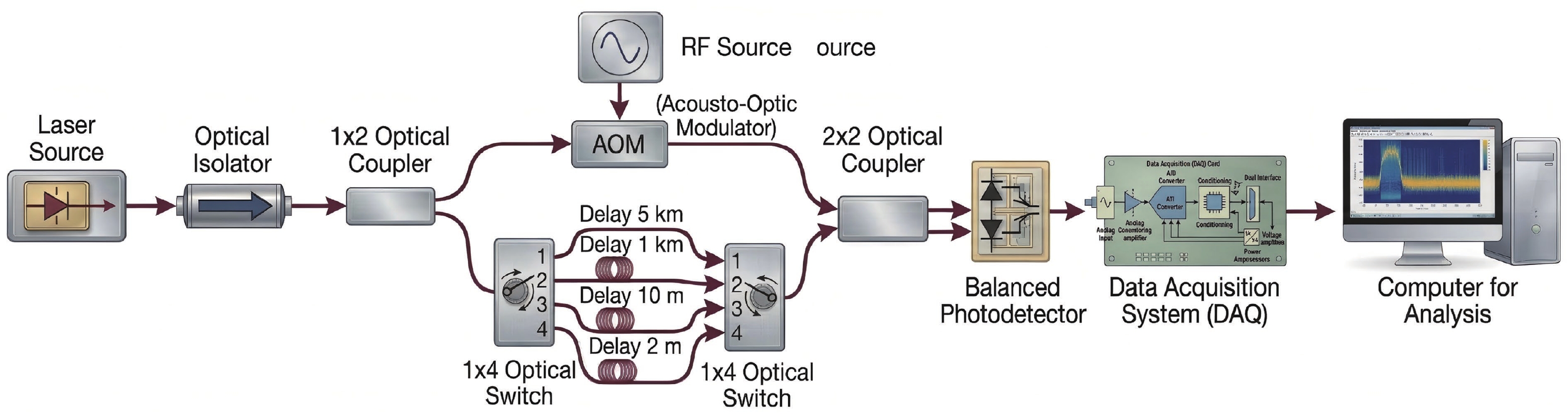
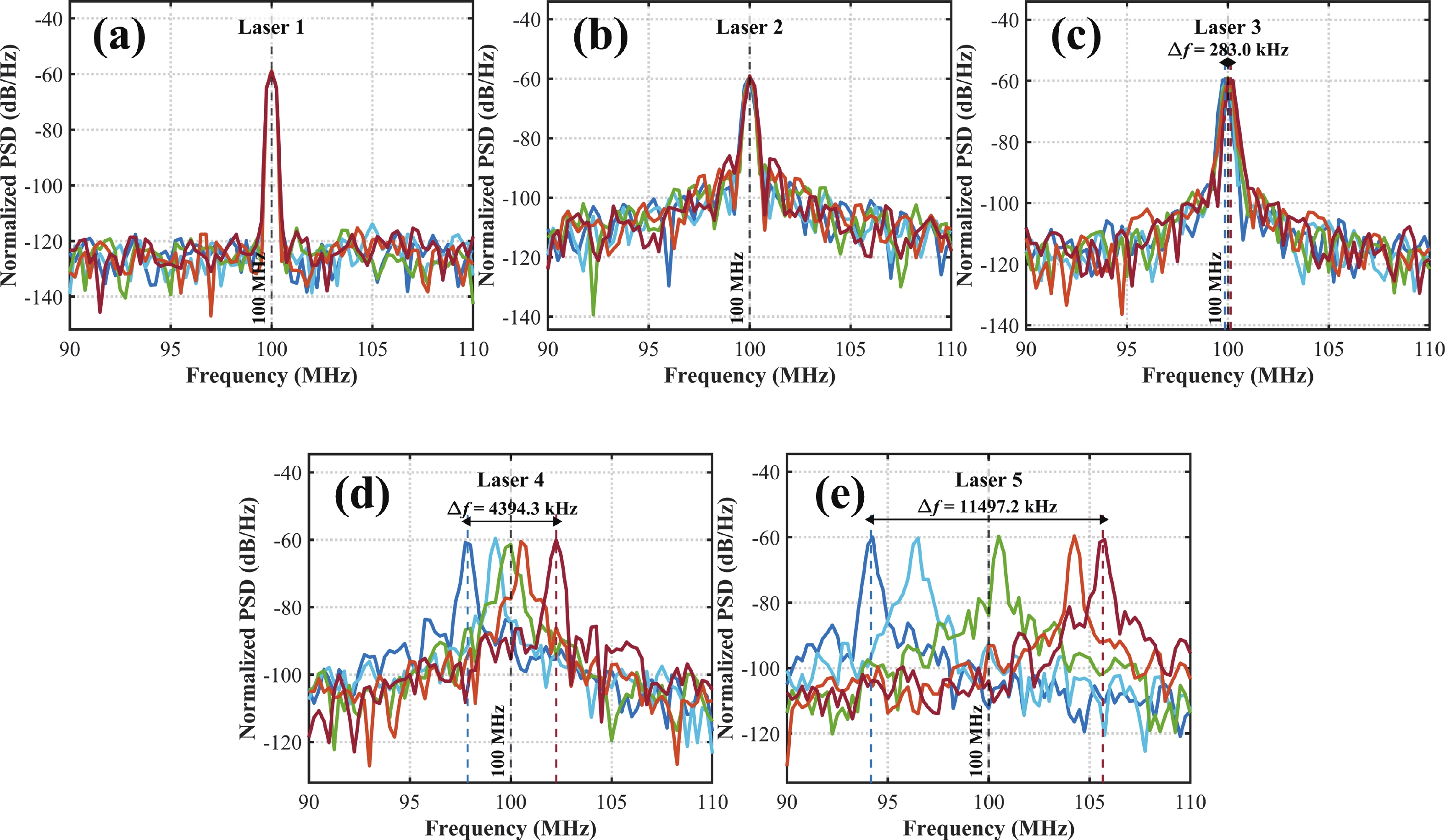
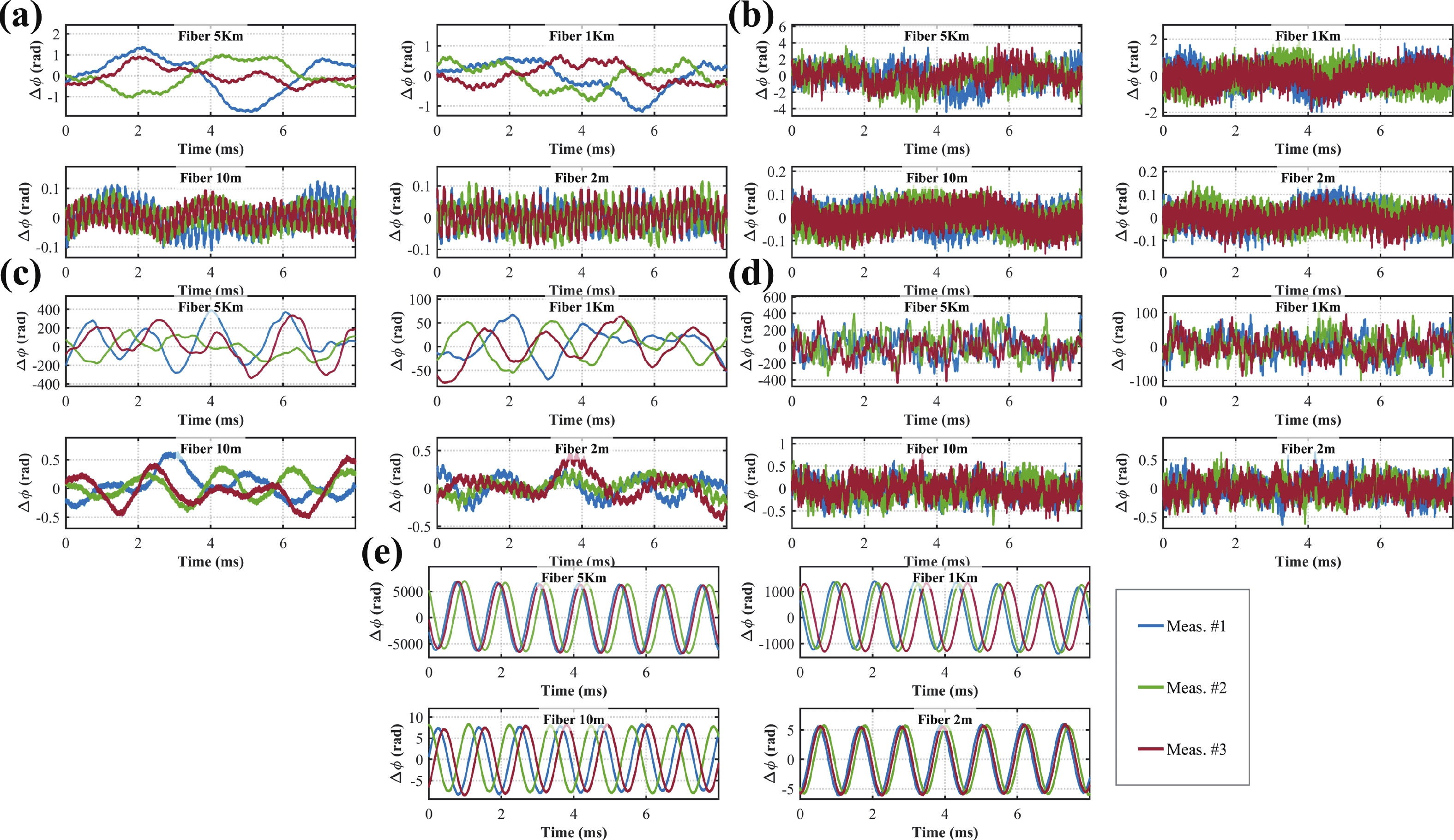
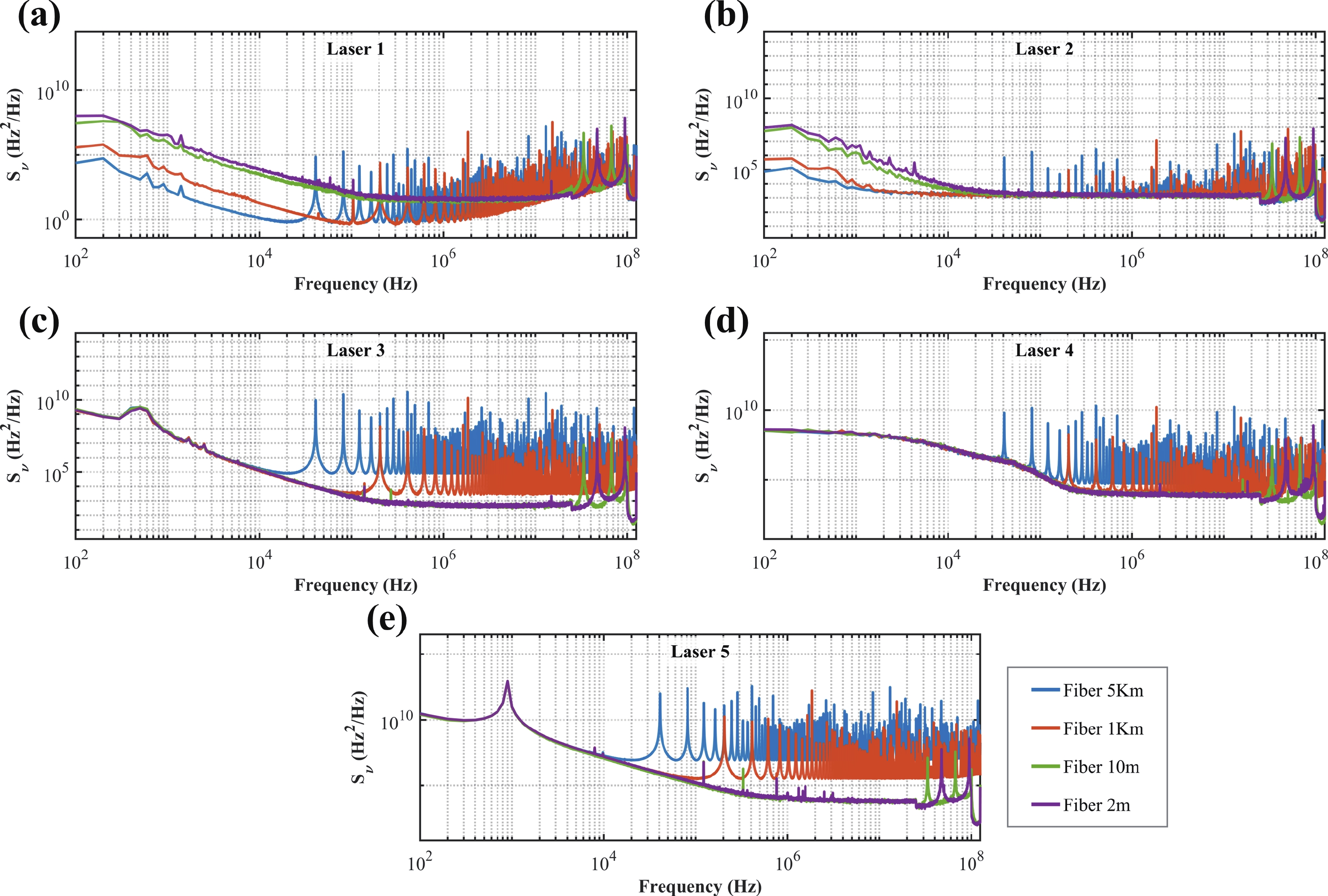
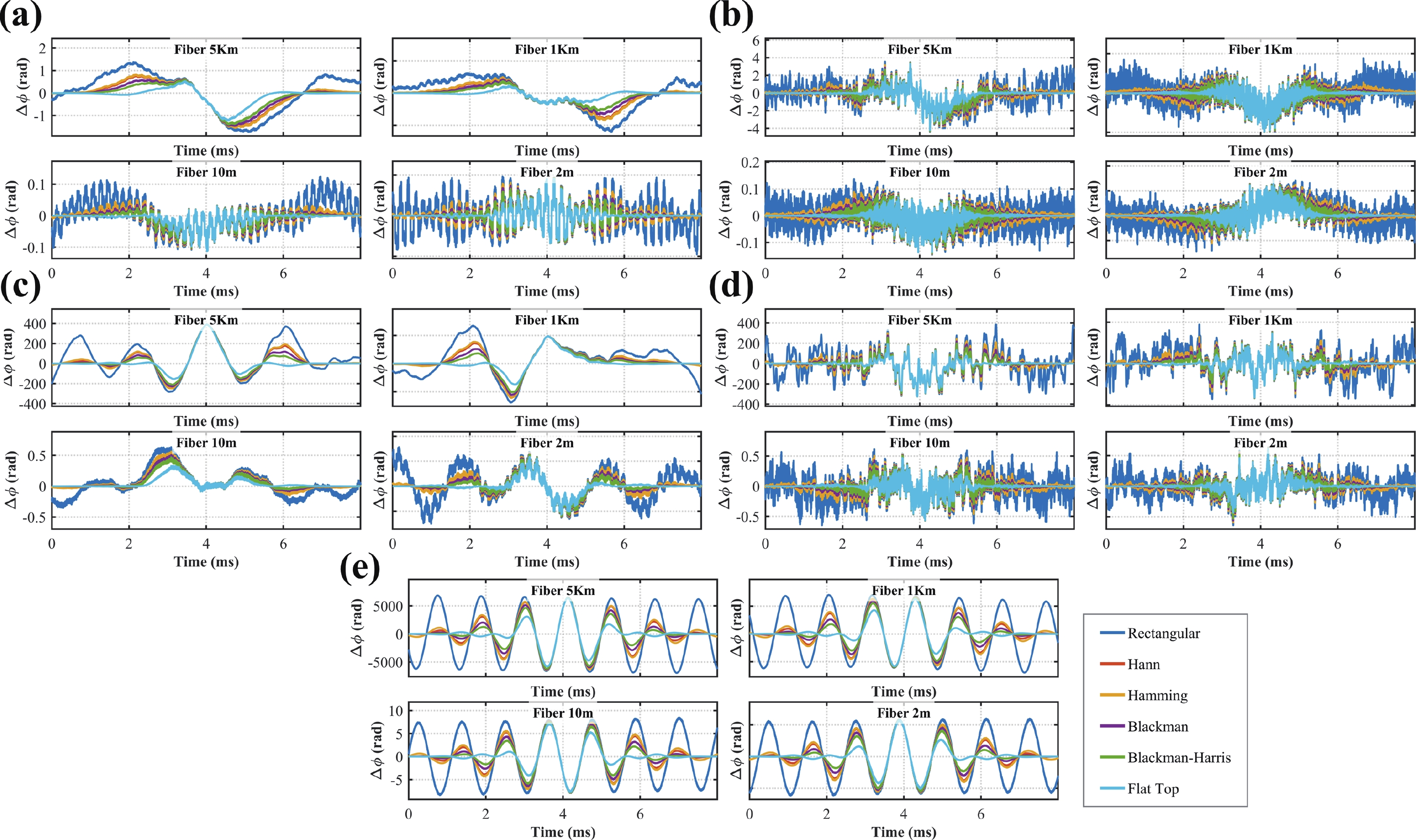
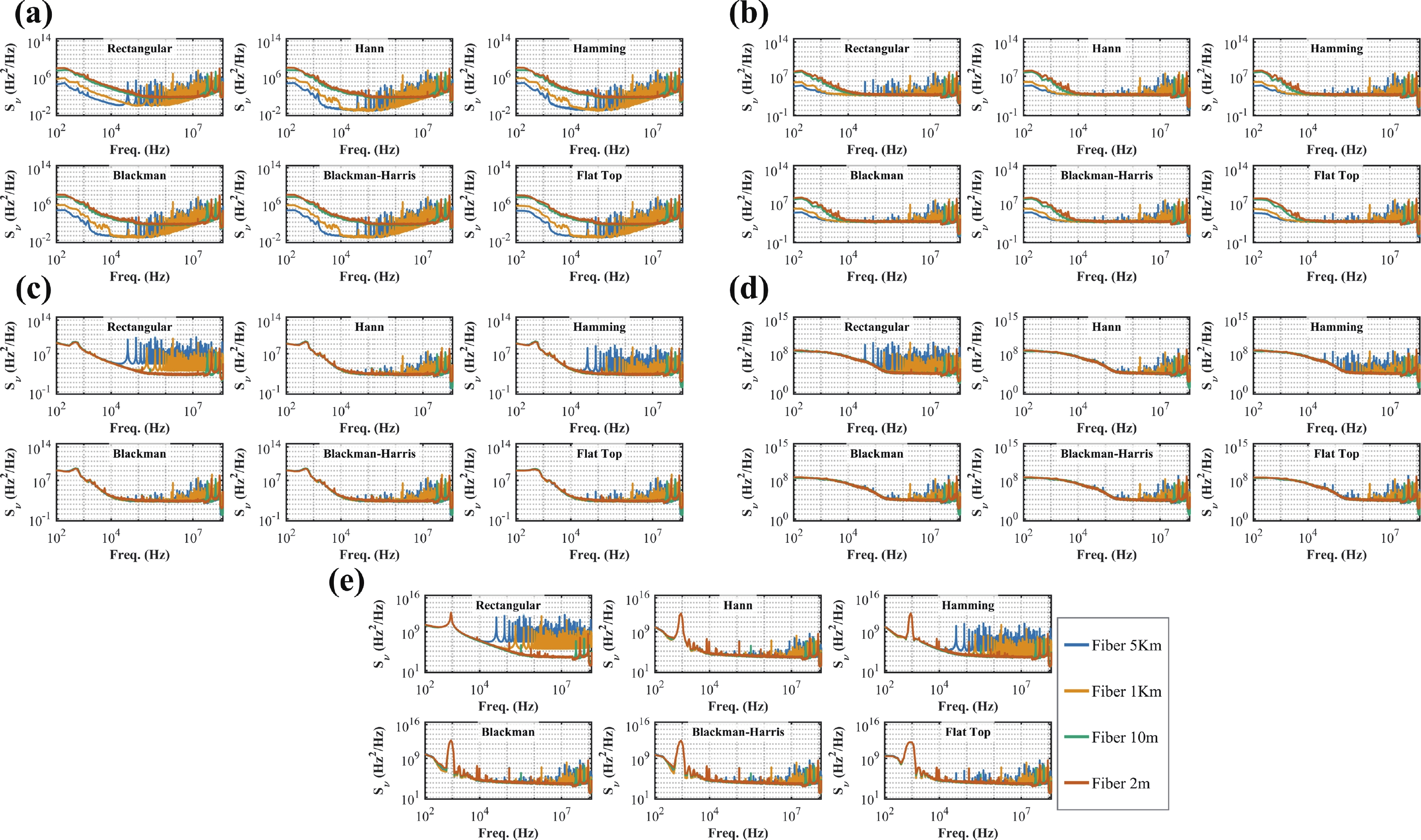
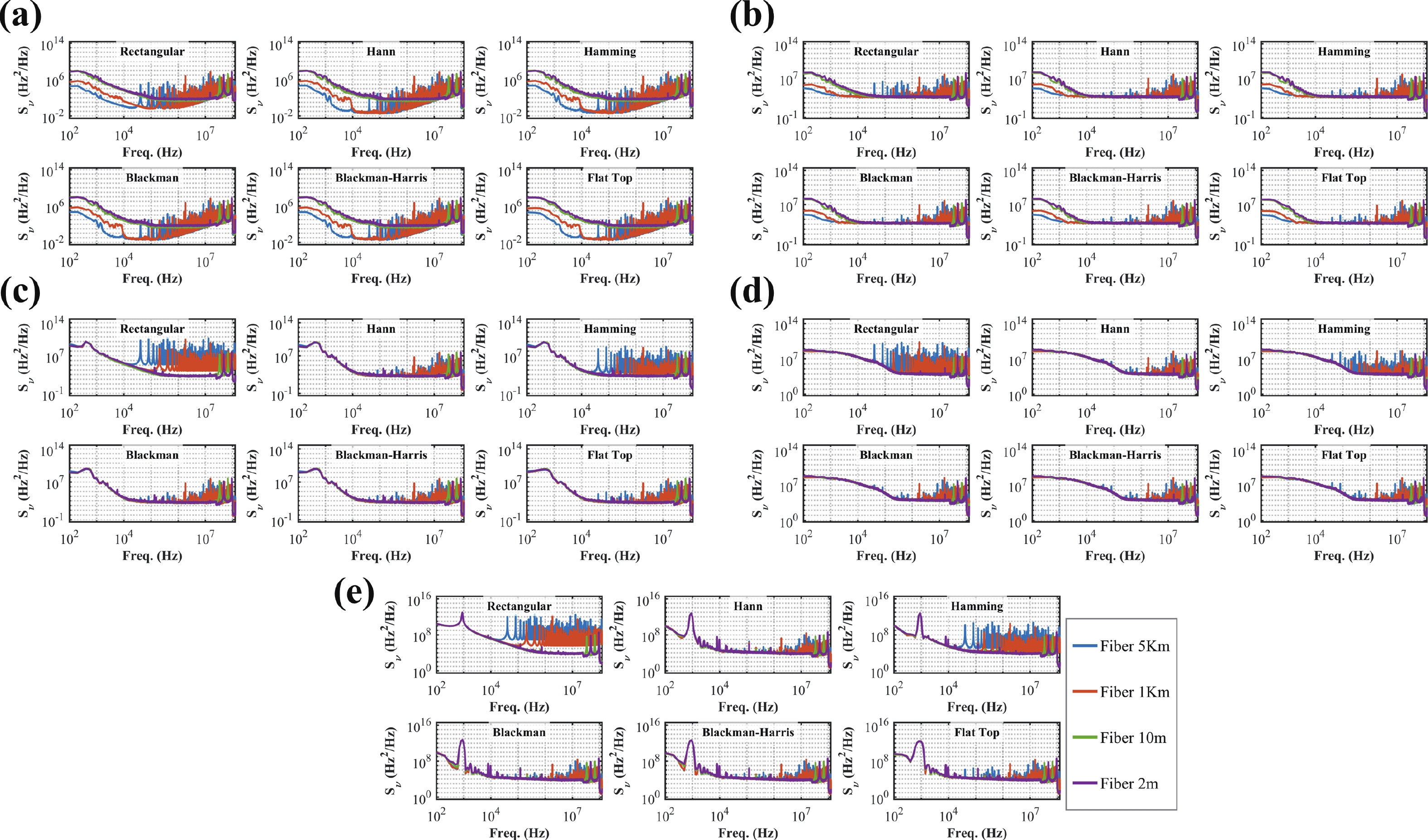
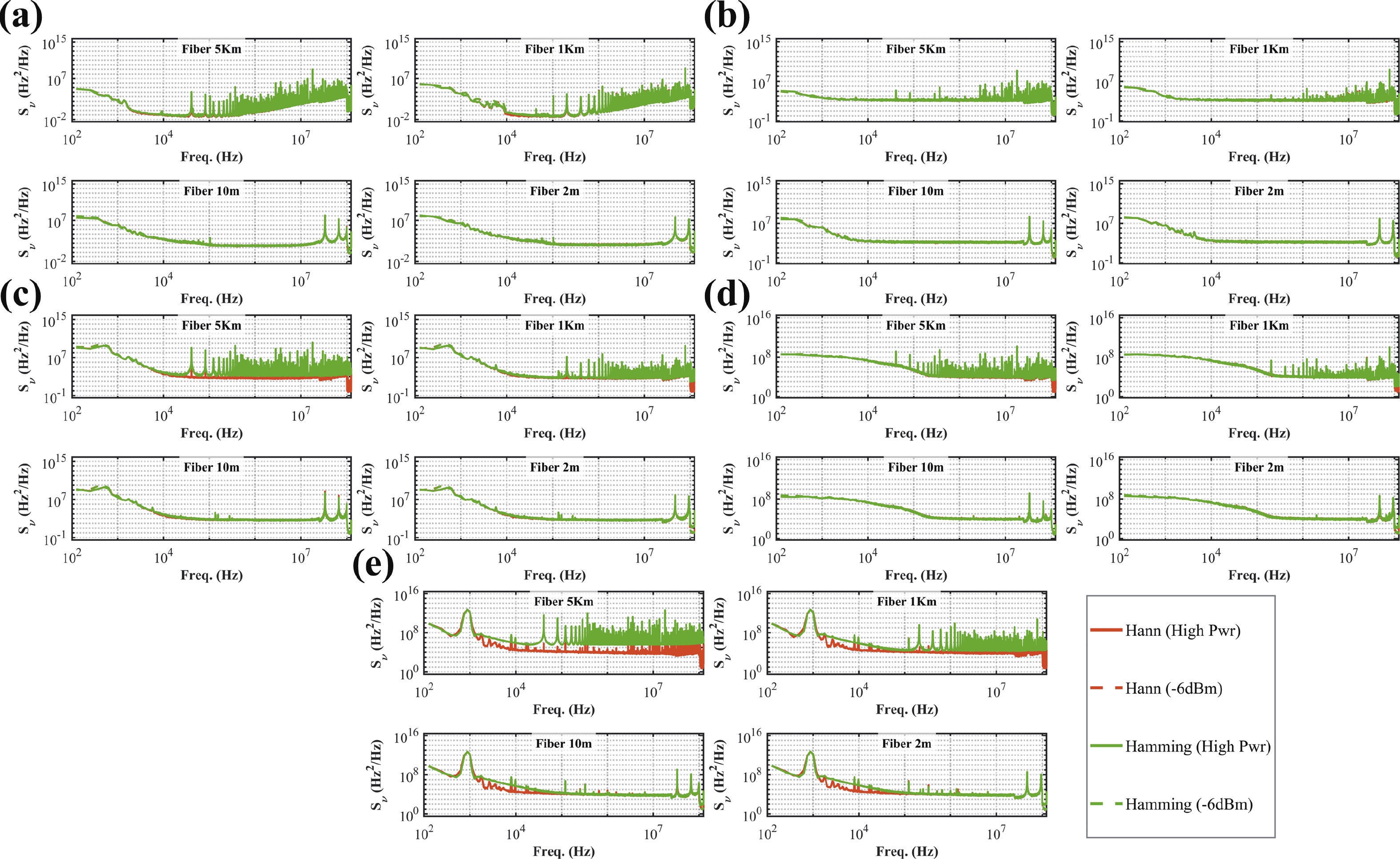
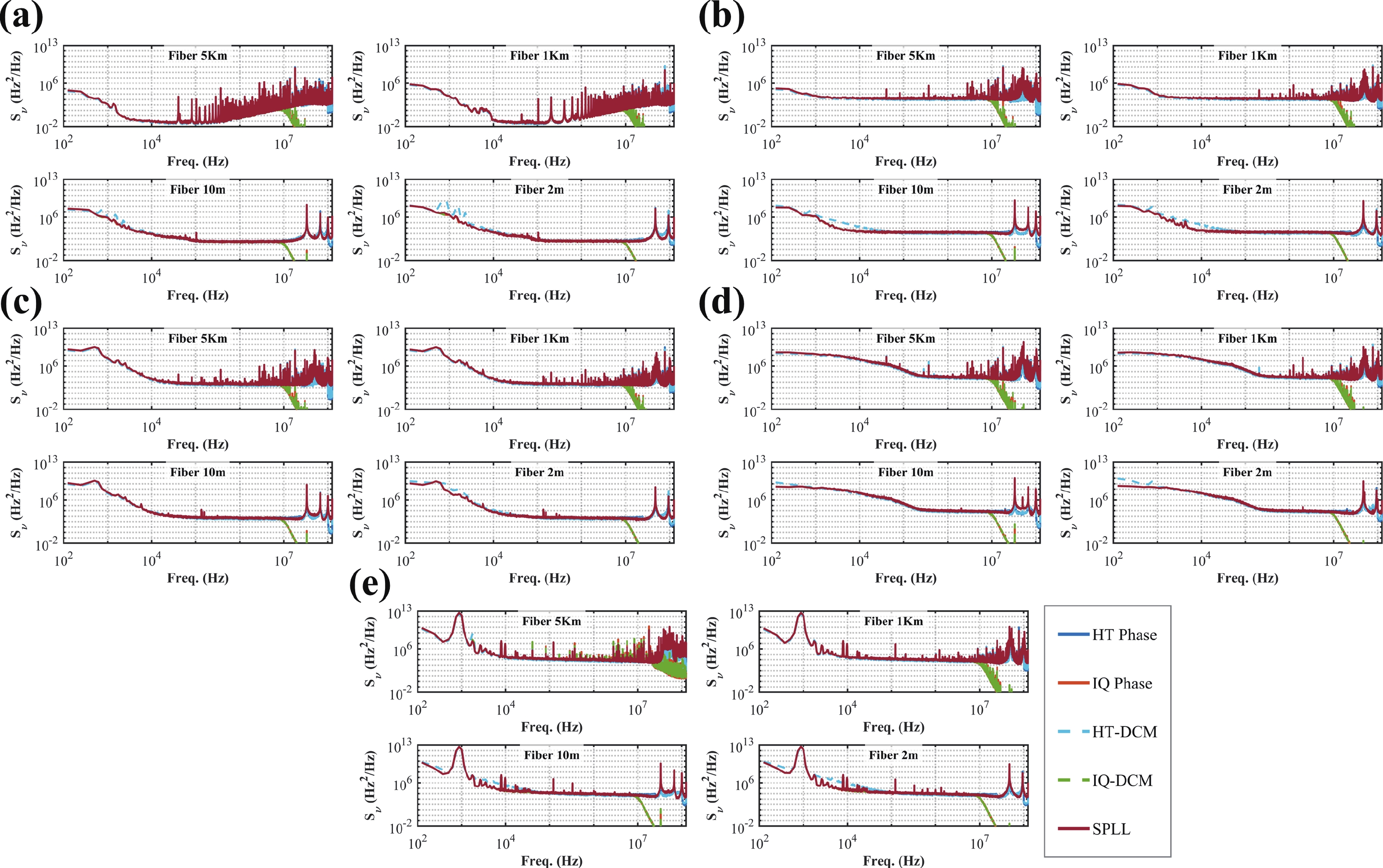
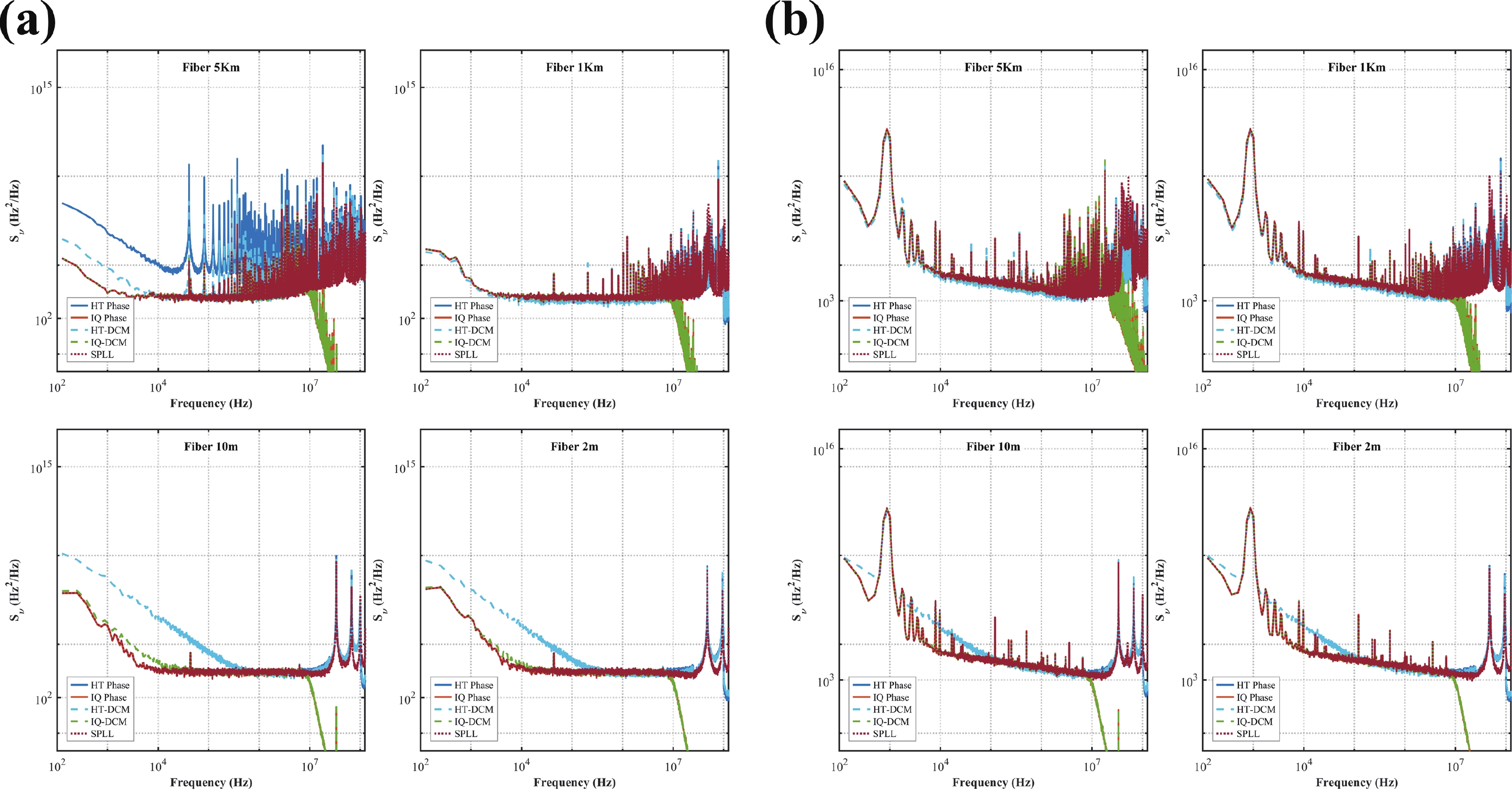
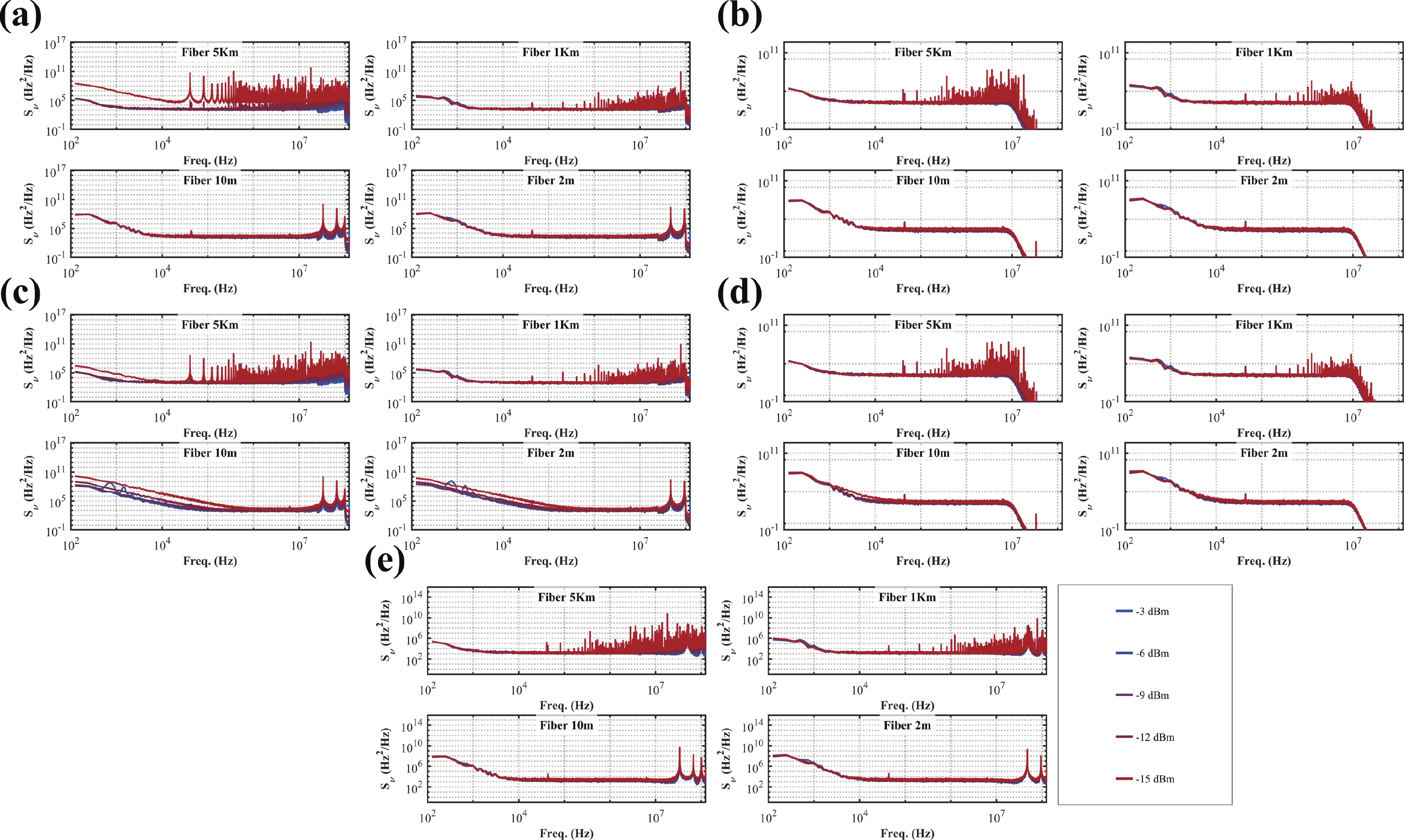
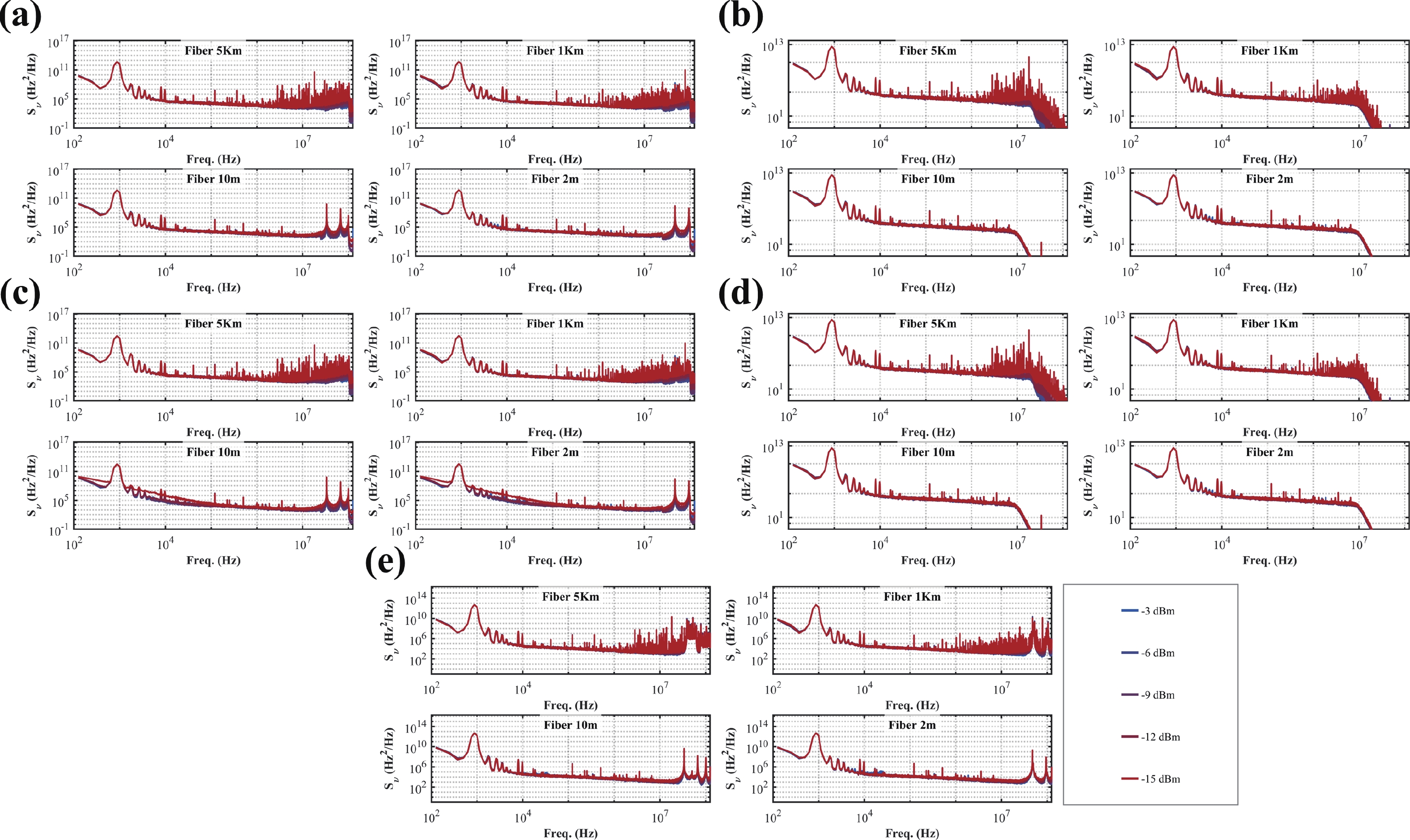
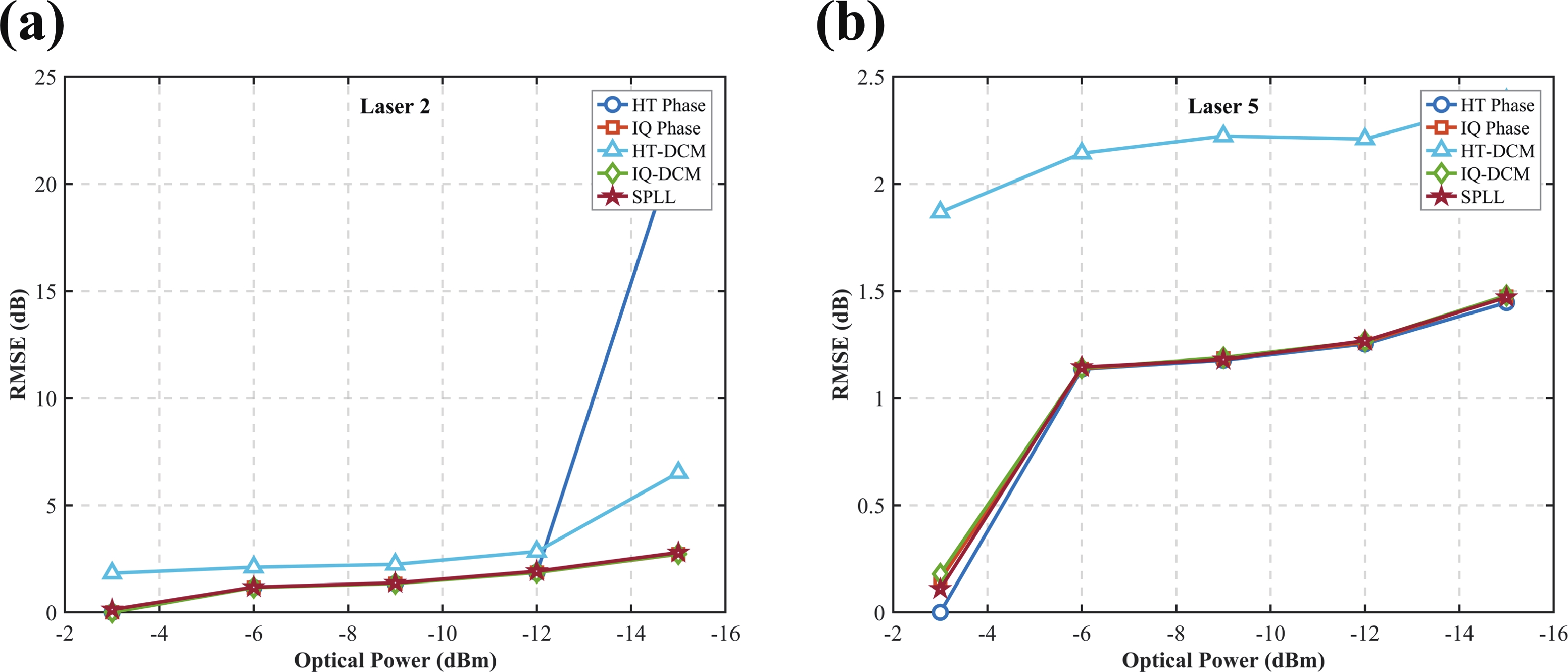
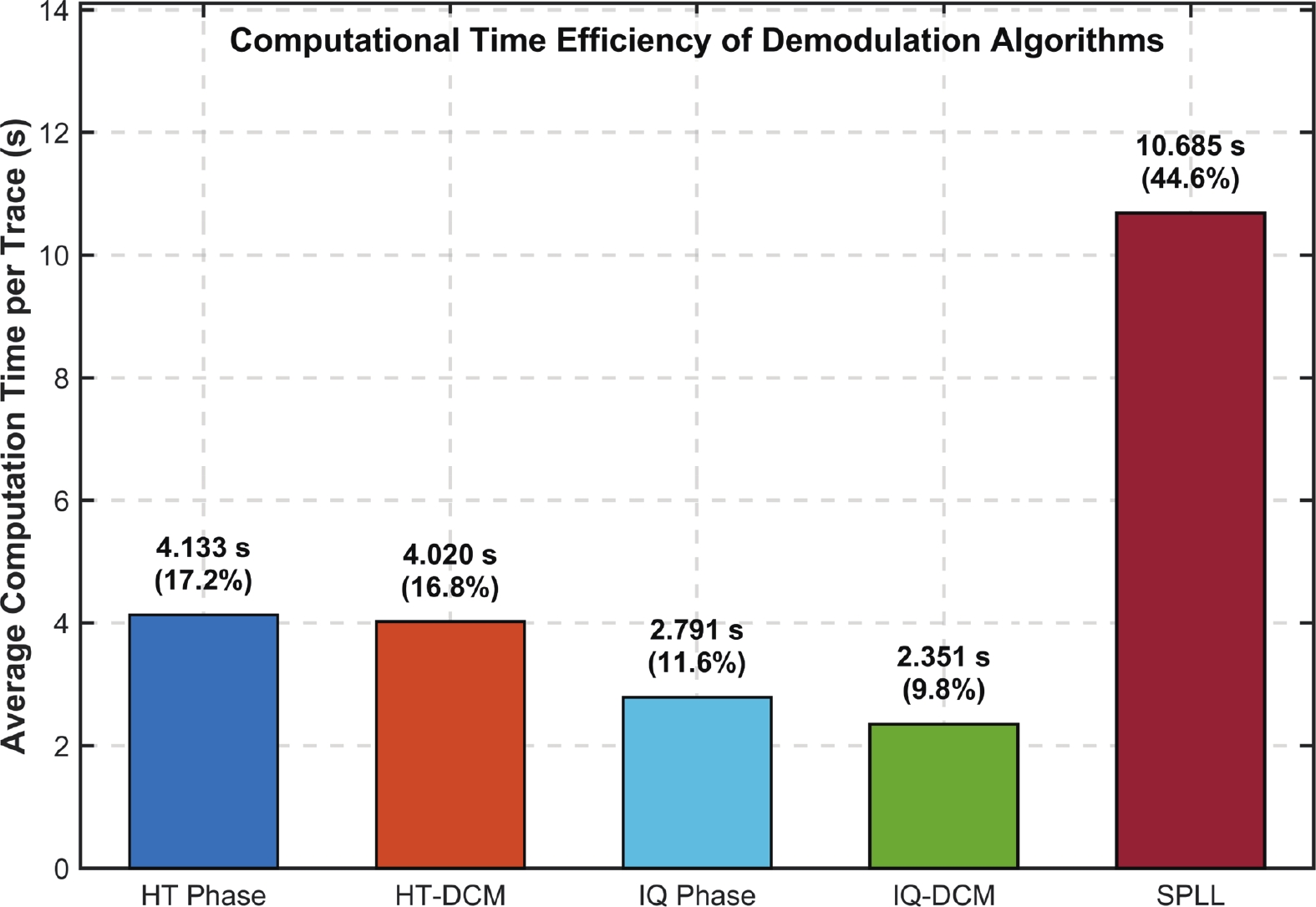
Table 1. Detailed specifications of the lasers evaluated in this study.
| Parameter | Laser 1 | Laser 2 | Laser 3 | Laser4 | Laser5 |
| Laser type | ECDL | ECDL | Santec TSL | Standard DFB | ID Photonics |
| Model | WL-1550-1Hz | PHX-C-F-M | TSL-550 | INP-DCH-1550C | CoBrite Dx4 |
| Wavelength | 1548 nm | 1550 nm | 1550 nm | 1549 nm | 1550 nm |
| Linewidth | ~100 Hz | kHz-range | ~100 kHz | ~MHz-range | 10 MHz-range |
 DownLoad: CSV
Table 2. Summary guidelines for optimal DSH frequency noise measurement configurations.
| Laser linewidth regime | Recommended delay fiber length | Optimal window function | Key physical rationale & pitfalls to avoid |
| Ultra-narrow-linewidth (sub-kHz, e.g., ~100 Hz) | Ultra-long (e.g., 5 km or longer) |
Hanning, Blackman |
Requires maximum quadratic physical amplification ($ \propto {\tau }^{2} $) to boost extremely weak intrinsic phase drifts above the detector noise floor. Pitfall: short fibers will completely bury the true signal. |
| Narrow-linewidth (1 kHz to ~100 kHz) |
Long (e.g., 1 km− 5 km) |
Balances physical amplification for low-frequency $ 1/f $ noise with manageable high-frequency spectral leakage. Strong windowing is necessary to suppress sidelobes. |
|
| Broad-linewidth (1 MHz to 10 MHz+) |
Short (e.g., 2 m−10 m) |
Rapid phase fluctuations cause severe spectral leakage in long fibers, artificially elevating the high-frequency noise floor. Pitfall: strictly avoid rectangular and Hamming windows, as their non-zero boundaries fail to suppress leakage effectively. |
DownLoad: CSV
| [1] |
Chen Z F, Wang K K, Chen Q A, et al. Nano-ITLA based on thermo-optically tuned multi-channel interference widely tunable laser. J Lightwave Technol, 2023, 41(16): 5405 doi: 10.1109/JLT.2023.3261897
|
| [2] |
Chauhan N, Isichenko A, Liu K K, et al. Visible light photonic integrated Brillouin laser. Nat Commun, 2021, 12(1): 4685 doi: 10.1038/s41467-021-24926-8
|
| [3] |
Chen J Q, Chen C, Guo Q, et al. Linear polarization and narrow-linewidth external-cavity semiconductor laser based on birefringent Bragg grating optical feedback. Opt Laser Technol, 2024, 170: 110211 doi: 10.1016/j.optlastec.2023.110211
|
| [4] |
Kikuchi K. Fundamentals of coherent optical fiber communications. J Lightwave Technol, 2016, 34(1): 157 doi: 10.1109/JLT.2015.2463719
|
| [5] |
Okoshi T, Kikuchi K, Nakayama A. Novel method for high resolution measurement of laser output spectrum. Electron Lett (UK), 1980, 16(16): 630
|
| [6] |
Di Domenico G, Schilt S, Thomann P. Simple approach to the relation between laser frequency noise and laser line shape. Appl Opt, 2010, 49(25): 4801 doi: 10.1364/AO.49.004801
|
| [7] |
Horak P, Loh W H. On the delayed self-heterodyne interferometric technique for determining the linewidth of fiber lasers. Opt Express, 2006, 14(9): 3923 doi: 10.1364/oe.14.003923
|
| [8] |
Mercer L B. 1/f frequency noise effects on self-heterodyne linewidth measurements. J Lightwave Technol, 1991, 9(4): 485 doi: 10.1109/50.76663
|
| [9] |
Ma W C, Xiong B, Sun C Z, et al. Laser frequency noise characterization by self-heterodyne with both long and short delay. Appl Opt, 2019, 58(13): 3555 doi: 10.1364/AO.58.003555
|
| [10] |
Zhao Z A, Bai Z X, Jin D, et al. Narrow laser-linewidth measurement using short delay self-heterodyne interferometry. Opt Express, 2022, 30(17): 30600 doi: 10.1364/OE.455028
|
| [11] |
Zhang C Z, Huang L G, Guan T Y, et al. Laser coherence linewidth measurement based on deterioration of coherent envelope. Opt Laser Technol, 2024, 172: 110498 doi: 10.1016/j.optlastec.2023.110498
|
| [12] |
Zhao Z A, Bai Z X, Jin D, et al. The influence of noise floor on the measurement of laser linewidth using short-delay-length self-heterodyne/homodyne techniques. Micromachines, 2022, 13(8): 1311 doi: 10.3390/mi13081311
|
| [13] |
Wang D D, Jiang Y F, Gu H, et al. Improvement and analysis of a recirculating delayed self-heterodyne interferometer for laser linewidth measurement. Opt Fiber Technol, 2022, 71: 102945 doi: 10.1016/j.yofte.2022.102945
|
| [14] |
Tsuchida H. Simple technique for improving the resolution of the delayed self-heterodyne method. Opt Lett, 1990, 15(11): 640 doi: 10.1364/OL.15.000640
|
| [15] |
Daino B, Spano P, Tamburrini M, et al. Phase noise and spectral line shape in semiconductor lasers. IEEE J Quantum Electron, 1983, 19(3): 266 doi: 10.1109/JQE.1983.1071842
|
| [16] |
Zhou Q, Qin J, Xie W L, et al. Dynamic frequency-noise spectrum measurement for a frequency-swept DFB laser with short-delayed self-heterodyne method. Opt Express, 2015, 23(22): 29245 doi: 10.1364/OE.23.029245
|
| [17] |
Shi H B, Chang P Y, Wang Z Y, et al. Frequency stabilization of a cesium faraday laser with a double-layer vapor cell as frequency reference. IEEE Photonics J, 2022, 14(6): 1561006 doi: 10.1109/jphot.2022.3221494
|
| [18] |
Tombez L, Schilt S, Di Francesco J, et al. Linewidth of a quantum-cascade laser assessed from its frequency noise spectrum and impact of the current driver. Appl Phys B, 2012, 109: 407 doi: 10.1007/s00340-012-5005-x
|
| [19] |
Li B H, Yuan Z Q, Jin W, et al. High-coherence hybrid-integrated 780 nm source by self-injection-locked second-harmonic generation in a high-Q silicon-nitride resonator. Optica, 2023, 10(9): 1241 doi: 10.1364/OPTICA.498391
|
| [20] |
Chen J Q, Chen C, Guo Q, et al. A 1-μm-band injection-locked semiconductor laser with a high side-mode suppression ratio and narrow linewidth. Sensors, 2022, 22(23): 9239 doi: 10.3390/s22239239
|
| [21] |
Yuan Z Q, Wang H M, Liu P, et al. Correlated self-heterodyne method for ultra-low-noise laser linewidth measurements. Opt Express, 2022, 30(14): 25147 doi: 10.1364/OE.458109
|
| [22] |
Mertenskötter L, Kantner M. Frequency noise characterization of narrow-linewidth semiconductor lasers: a bayesian approach. IEEE Photonics J, 2024, 16(3): 0601407 doi: 10.1109/jphot.2024.3385184
|
| [23] |
Yao P H, Zhang Z, Zhou J N, et al. Application of sine-cosine demodulation technology in linewidth measurement of narrow linewidth single frequency laser. AOPC 2023: Optic Fiber Gyro, 2023, 1296819
|
| [24] |
Camatel S, Ferrero V. Narrow linewidth CW laser phase noise characterization methods for coherent transmission system applications. J Lightwave Technol, 2008, 26(17): 3048 doi: 10.1109/JLT.2008.925046
|
| [25] |
Zhang Y H, Cao X H, Chen W, et al. Precise linewidths measurement using short delay self-heterodyne interferometry and multiple peak-to-valley differences. AOPC 2023: AI in Optics and Photonics, 2023, 129660Y
|





Article views: 19 Times PDF downloads: 2 Times Cited by: 0 Times
Received: 24 March 2026 Revised: 23 April 2026 Online: Accepted Manuscript: 14 May 2026
| Citation: |
Yiming Wang, Gang Zhao, Ruchan Cai, Peng Chen, Jia Wang, Liang Xie. Optimizing wide-range laser frequency noise characterization via delayed self-heterodyne[J]. Journal of Semiconductors, 2026, In Press. doi: 10.1088/1674-4926/26030039
****
Y M Wang, G Zhao, R C Cai, P Chen, J Wang, and L Xie, Optimizing wide-range laser frequency noise characterization via delayed self-heterodyne[J]. J. Semicond., 2026, accepted doi: 10.1088/1674-4926/26030039

|
 Yiming Wang received his Bachelor of Science degree from the School of Physics and Electronic Engineering, Shanxi University in 2020. He is currently pursuing his Doctor of Philosophy degree at the Institute of Semiconductors, Chinese Academy of Sciences, under the supervision of Professor Liang Xie. His research focuses on laser noise and high-resolution spectroscopy measurement
 Liang Xie received his Doctor of Philosophy degree from Lanzhou University in 1998.He is currently a Professor at the Institute of Semiconductors, Chinese Academy of Sciences. His research interests include high-speed optoelectronic device packaging and testing, instrument development based on optoelectronic technology, optical communication, and optical sensing technology
| [1] |
Chen Z F, Wang K K, Chen Q A, et al. Nano-ITLA based on thermo-optically tuned multi-channel interference widely tunable laser. J Lightwave Technol, 2023, 41(16): 5405 doi: 10.1109/JLT.2023.3261897
|
| [2] |
Chauhan N, Isichenko A, Liu K K, et al. Visible light photonic integrated Brillouin laser. Nat Commun, 2021, 12(1): 4685 doi: 10.1038/s41467-021-24926-8
|
| [3] |
Chen J Q, Chen C, Guo Q, et al. Linear polarization and narrow-linewidth external-cavity semiconductor laser based on birefringent Bragg grating optical feedback. Opt Laser Technol, 2024, 170: 110211 doi: 10.1016/j.optlastec.2023.110211
|
| [4] |
Kikuchi K. Fundamentals of coherent optical fiber communications. J Lightwave Technol, 2016, 34(1): 157 doi: 10.1109/JLT.2015.2463719
|
| [5] |
Okoshi T, Kikuchi K, Nakayama A. Novel method for high resolution measurement of laser output spectrum. Electron Lett (UK), 1980, 16(16): 630
|
| [6] |
Di Domenico G, Schilt S, Thomann P. Simple approach to the relation between laser frequency noise and laser line shape. Appl Opt, 2010, 49(25): 4801 doi: 10.1364/AO.49.004801
|
| [7] |
Horak P, Loh W H. On the delayed self-heterodyne interferometric technique for determining the linewidth of fiber lasers. Opt Express, 2006, 14(9): 3923 doi: 10.1364/oe.14.003923
|
| [8] |
Mercer L B. 1/f frequency noise effects on self-heterodyne linewidth measurements. J Lightwave Technol, 1991, 9(4): 485 doi: 10.1109/50.76663
|
| [9] |
Ma W C, Xiong B, Sun C Z, et al. Laser frequency noise characterization by self-heterodyne with both long and short delay. Appl Opt, 2019, 58(13): 3555 doi: 10.1364/AO.58.003555
|
| [10] |
Zhao Z A, Bai Z X, Jin D, et al. Narrow laser-linewidth measurement using short delay self-heterodyne interferometry. Opt Express, 2022, 30(17): 30600 doi: 10.1364/OE.455028
|
| [11] |
Zhang C Z, Huang L G, Guan T Y, et al. Laser coherence linewidth measurement based on deterioration of coherent envelope. Opt Laser Technol, 2024, 172: 110498 doi: 10.1016/j.optlastec.2023.110498
|
| [12] |
Zhao Z A, Bai Z X, Jin D, et al. The influence of noise floor on the measurement of laser linewidth using short-delay-length self-heterodyne/homodyne techniques. Micromachines, 2022, 13(8): 1311 doi: 10.3390/mi13081311
|
| [13] |
Wang D D, Jiang Y F, Gu H, et al. Improvement and analysis of a recirculating delayed self-heterodyne interferometer for laser linewidth measurement. Opt Fiber Technol, 2022, 71: 102945 doi: 10.1016/j.yofte.2022.102945
|
| [14] |
Tsuchida H. Simple technique for improving the resolution of the delayed self-heterodyne method. Opt Lett, 1990, 15(11): 640 doi: 10.1364/OL.15.000640
|
| [15] |
Daino B, Spano P, Tamburrini M, et al. Phase noise and spectral line shape in semiconductor lasers. IEEE J Quantum Electron, 1983, 19(3): 266 doi: 10.1109/JQE.1983.1071842
|
| [16] |
Zhou Q, Qin J, Xie W L, et al. Dynamic frequency-noise spectrum measurement for a frequency-swept DFB laser with short-delayed self-heterodyne method. Opt Express, 2015, 23(22): 29245 doi: 10.1364/OE.23.029245
|
| [17] |
Shi H B, Chang P Y, Wang Z Y, et al. Frequency stabilization of a cesium faraday laser with a double-layer vapor cell as frequency reference. IEEE Photonics J, 2022, 14(6): 1561006 doi: 10.1109/jphot.2022.3221494
|
| [18] |
Tombez L, Schilt S, Di Francesco J, et al. Linewidth of a quantum-cascade laser assessed from its frequency noise spectrum and impact of the current driver. Appl Phys B, 2012, 109: 407 doi: 10.1007/s00340-012-5005-x
|
| [19] |
Li B H, Yuan Z Q, Jin W, et al. High-coherence hybrid-integrated 780 nm source by self-injection-locked second-harmonic generation in a high-Q silicon-nitride resonator. Optica, 2023, 10(9): 1241 doi: 10.1364/OPTICA.498391
|
| [20] |
Chen J Q, Chen C, Guo Q, et al. A 1-μm-band injection-locked semiconductor laser with a high side-mode suppression ratio and narrow linewidth. Sensors, 2022, 22(23): 9239 doi: 10.3390/s22239239
|
| [21] |
Yuan Z Q, Wang H M, Liu P, et al. Correlated self-heterodyne method for ultra-low-noise laser linewidth measurements. Opt Express, 2022, 30(14): 25147 doi: 10.1364/OE.458109
|
| [22] |
Mertenskötter L, Kantner M. Frequency noise characterization of narrow-linewidth semiconductor lasers: a bayesian approach. IEEE Photonics J, 2024, 16(3): 0601407 doi: 10.1109/jphot.2024.3385184
|
| [23] |
Yao P H, Zhang Z, Zhou J N, et al. Application of sine-cosine demodulation technology in linewidth measurement of narrow linewidth single frequency laser. AOPC 2023: Optic Fiber Gyro, 2023, 1296819
|
| [24] |
Camatel S, Ferrero V. Narrow linewidth CW laser phase noise characterization methods for coherent transmission system applications. J Lightwave Technol, 2008, 26(17): 3048 doi: 10.1109/JLT.2008.925046
|
| [25] |
Zhang Y H, Cao X H, Chen W, et al. Precise linewidths measurement using short delay self-heterodyne interferometry and multiple peak-to-valley differences. AOPC 2023: AI in Optics and Photonics, 2023, 129660Y
|

 WeChat ID
Journal of Semiconductors © 2017 All Rights Reserved 京ICP备05085259号-2