J. Semicond. >  Just Accepted

ARTICLES

Lead-free perovskites using divalent superatom ions with tunable electronic structures and high efficiency

Tingwei Zhou1, 2, Hongling Guan1, 2 and Anlong Kuang1, 2

+ Author Affiliations
DOI: 10.1088/1674-4926/26030042CSTR: 32376.14.1674-4926.26030042

PDF

Turn off MathJax

Abstract: Lead halide perovskites with the ABX3 formula are limited by their small B-site ions, which hinder the incorporation of large ions into their three-dimensional BX3 frame. Through high-throughput computational screening based on first-principle calculations and stringent structural constraints, we identified two promising candidates from 81 initial perovskites. These optimized materials feature a quasi-cubic, lead-free structure with a direct band gap suitable for solar cell applications, and minimal deformation of ions. The quasi-cubic (SCs3)(CLi6)F3 superatom perovskite exhibit the direct band gap, s-p and p-p electron transitions, small carrier effective masses, and high efficiency. Additionally, (SCs3)(CLi6)F3 superatom perovskite demonstrate N-type and P-type characteristics through occupying sulfur vacancies with Cl and P atoms, respectively, indicating that they may be used as electron and hole transport layers. This work implies the potential of superatom perovskites to overcome limitations of traditional perovskites.

Keywords: superatom perovskitesfirst-principle calculationsdivalent superatomsperovskite solar cellsdirect band gap


[1]
Gallop N P, Maslennikov D R, Mondal N, et al. Ultrafast vibrational control of organohalide perovskite optoelectronic devices using vibrationally promoted electronic resonance. Nat Mater, 2024, 23(1): 88 doi: 10.1038/s41563-023-01723-w
[2]
Ghasemi M, Lu J, Jia B, et al. Steady state and transient absorption spectroscopy in metal halide perovskites. Chem Soc Rev, 2025, 54(4): 1644 doi: 10.1039/D4CS00985A
[3]
Zhang W, Eperon G E, Snaith H J. Metal halide perovskites for energy applications. Nat Energy, 2016, 1(6): 16048 doi: 10.1038/nenergy.2016.48
[4]
Wang Y, Wang Y, Doherty T A, et al. Octahedral units in halide perovskites. Nat Rev Chem, 2025, 9(4): 261 doi: 10.1038/s41570-025-00687-6
[5]
Kim J Y, Lee J W, Jung H S, et al. High efficiency perovskite solar cells. Chem Rev, 2020, 120(15): 7867 doi: 10.1021/acs.chemrev.0c00107
[6]
Park J, Kim J, Yun H S, et al. Controlled growth of perovskite layers with volatile alkylammonium chlorides. Nature, 2023, 616(7958): 724 doi: 10.1038/s41586-023-05825-y
[7]
Chen P, Xiao Y, Hu J, et al. Multifunctional ytterbium oxide buffer for perovskite solar cells. Nature, 2024, 625(7995): 516 doi: 10.1038/s41586-023-06892-x
[8]
Singh A, Mitzi D B. Emergence of melt and glass states of halide perovskite semiconductors. Nat Rev Mater, 2025, 10(3): 211 doi: 10.1038/s41578-024-00759-x
[9]
Nazir G, Lee S Y, Lee J H, et al. Stabilization of perovskite solar cells: recent developments and future perspectives. Adv Mater, 2022, 34(50): 2204380 doi: 10.1002/adma.202204380
[10]
Zhu P, Chen C, Dai J, et al. Toward the commercialization of perovskite solar modules. Adv Mater, 2024, 36(15): 2307357 doi: 10.1002/adma.202307357
[11]
Yang M, Tian T, Fang Y, et al. Reducing lead toxicity of perovskite solar cells with a built-in supramolecular complex. Nat Sustain, 2023, 6(11): 1455 doi: 10.1038/s41893-023-01181-x
[12]
Zhang Z, Chen W, Jiang X, et al. Suppression of phase segregation in wide-bandgap perovskites with thiocyanate ions for perovskite/organic tandems with 25.06% efficiency. Nat Energy, 2024, 9(5): 592 doi: 10.1038/s41560-024-01491-0
[13]
Baumann S, Eperon G E, Virtuani A, et al. Stability and reliability of perovskite containing solar cells and modules: degradation mechanisms and mitigation strategies. Energy Environ Sci, 2024, 17(20): 7566 doi: 10.1039/D4EE01898B
[14]
Biçer Ü I, Krebs F C. Lost in transition? Perspective on research versus commercialization of organic and perovskite solar cells. Adv Energy Mater, 2025, 15(45): e02426 doi: 10.1002/aenm.202502426
[15]
Li X, Aftab S, Hussain S, et al. Dimensional diversity (0D, 1D, 2D, and 3D) in perovskite solar cells: exploring the potential of mixed-dimensional integrations. J Mater Chem A, 2024, 12(8): 4421 doi: 10.1039/D3TA06953B
[16]
Zhang S, Jin L, Lu Y, et al. Moiré superlattices in twisted two-dimensional halide perovskites. Nat Mater, 2024, 23(9): 1222 doi: 10.1038/s41563-024-01921-0
[17]
Ghasemi M, Karsili P, Mishra A, et al. Molecular engineering of layered halide double perovskites: challenges and opportunities in optoelectronics and beyond. Adv Energy Mater, 2025, 15(41): 2502693 doi: 10.1002/aenm.202502693
[18]
Li G, Cheng S, Chen X, et al. Erbium-induced boost in self-trapped exciton emission of double perovskites for highly sensitive multimodal and multiplexed optical thermography. Adv Funct Mater, 2024, 34(39): 2403073 doi: 10.1002/adfm.202403073
[19]
Doud E A, Voevodin A, Hochuli T J, et al. Superatoms in materials science. Nat Rev Mater, 2020, 5(5): 371 doi: 10.1038/s41578-019-0175-3
[20]
Zhou T, Wang M, Zang Z, et al. Two-dimensional lead-free hybrid halide perovskite using superatom anions with tunable electronic properties. Sol Energy Mater Sol Cells, 2019, 191: 33 doi: 10.1016/j.solmat.2018.10.021
[21]
Zhou T, Wang M, Zang Z, et al. Stable dynamics performance and high efficiency of ABX3-type super-alkali perovskites first obtained by introducing H5O2 cation. Adv Energy Mater, 2019, 9(29): 1900664 doi: 10.1002/aenm.201900664
[22]
Zhou T, Kuang A. Superalkali halide perovskites with suitable direct band gaps for photovoltaic applications. Nanoscale, 2024, 16(10): 5130 doi: 10.1039/D3NR06132A
[23]
Zhou T, Kuang A. C3N2H5 Superalkali-Enhanced Halide Perovskites for High-Efficiency Photovoltaic Applications. Solar RRL, 2025, 9(8): 2500032 doi: 10.1002/solr.202500032
[24]
Scalon L, Vaynzof Y. Multidimensional Perovskite Solar Cells: What's Next after 3D/2D?. Adv Energy Mater, 2025, 15(44): 2502686 doi: 10.1002/aenm.202502686
[25]
Hautzinger M P, Mihalyi-Koch W, Jin S. A-site cation chemistry in halide perovskites. Chem Mater, 2024, 36(21): 10408 doi: 10.1021/acs.chemmater.4c02043
[26]
Wang H P, Li S, Liu X, et al. Low-dimensional metal halide perovskite photodetectors. Adv Mater, 2021, 33(7): 2003309 doi: 10.1002/adma.202003309
[27]
Cheng Y, Wan H, Sargent E H, et al. Reduced-Dimensional Perovskites: Quantum Well Thickness Distribution and Optoelectronic Properties. Adv Mater, 2025, 37(25): 2410633 doi: 10.1002/adma.202410633
[28]
Goldschmidt V M. Die gesetze der krystallochemie. Naturwissenschaften, 1926, 14(21): 477 doi: 10.1007/bf01507527
[29]
Fu J, Ramesh S, Melvin Lim J W, et al. Carriers, quasi-particles, and collective excitations in halide perovskites. Chem Rev, 2023, 123(13): 8154 doi: 10.1021/acs.chemrev.2c00843
[30]
Blöchl P E. Projector augmented-wave method. Phys Rev B, 1994, 50(24): 17953 doi: 10.1103/PhysRevB.50.17953
[31]
Perdew J P, Burke K, Ernzerhof M. Generalized gradient approximation made simple. Phys. Rev. Lett. 1996, 77(18): 3865
[32]
Grimme S. Semiempirical GGA-type density functional constructed with a long-range dispersion correction. J Comput Chem, 2006, 27(15): 1787 doi: 10.1002/jcc.20495
[33]
Monkhorst H J, Pack J D. Special points for Brillouin-zone integrations. Phys Rev B, 1976, 13(12): 5188 doi: 10.1103/PhysRevB.13.5188
[34]
Heyd J, Scuseria G E, Ernzerhof M. Hybrid functionals based on a screened Coulomb potential. J Chem Phys, 2003, 118(18): 8207 doi: 10.1063/1.1564060
[35]
Andersson M P, Uvdal P. New scale factors for harmonic vibrational frequencies using the B3LYP density functional method with the triple-ζ basis set 6-311+ G (d, p). J Phys Chem A, 2005, 109(12): 2937 doi: 10.1021/jp045733a
[36]
Nagy P R, Samu G, Kállay M. Optimization of the linear-scaling local natural orbital CCSD (T) method: Improved algorithm and benchmark applications. J Chem Theory Comput, 2018, 14(8): 4193 doi: 10.1021/acs.jctc.8b00442
[37]
Inac H, Ashfaq M, Dege N, et al. Synthesis, spectroscopic characterizations, single crystal XRD, supramolecular assembly inspection via hirshfeld surface analysis, and DFT study of a hydroxy functionalized schiff base Cu (II) complex. J Mol Struct, 2024, 1295: 136751 doi: 10.1016/j.molstruc.2023.136751
[38]
Jong U G, Yu C J, Ri J S, et al. Influence of halide composition on the structural, electronic, and optical properties of mixed CH3NH3Pb(I1-xBrx)3 perovskites calculated using the virtual crystal approximation method. Phys Rev B, 2016, 94(12): 125139 doi: 10.1103/PhysRevB.94.125139
[39]
Li C, Lu X, Ding W, et al. Formability of ABX3 (X = F, Cl, Br, I) Halide Perovskites. Acta Cryst B, 2008, 64(6): 702
[40]
Shannon R D. Revised effective ionic radii and systematic studies of interatomic distances in halides and chalcogenides. Acta Crystallogr A, 1976, A32(5): 751
[41]
Travis W, Glover E N K, Bronstein H, et al. On the application of the tolerance factor to inorganic and hybrid halide perovskites: a revised system. Chem Sci, 2016, 7(7): 4548 doi: 10.1039/C5SC04845A
[42]
Rühle S. Tabulated values of the Shockley-Queisser limit for single junction solar cells. Sol Energy, 2016, 130: 139 doi: 10.1016/j.solener.2016.02.015
[43]
Reference Solar Spectral Irradiance: Air Mass 1.5. http://rredc.nrel.gov/solar/spectra/am1.5, accessed February 8th, 2026.
[44]
Kudo H. Observation of hypervalent CLi6 by Knudsen-effusion mass spectrometry. Nature, 1992, 355(6359): 432 doi: 10.1038/355432a0
[45]
Vos A D. Detailed balance limit of the efficiency of tandem solar cells. J Phys D: Appl Phys, 1980, 13(5): 839 doi: 10.1088/0022-3727/13/5/018
[46]
Carlson D E, Wronski C R. Amorphous silicon solar cell. Appl Phys Lett, 1976, 28(11): 671 doi: 10.1063/1.88617
[47]
Hack M, Shur M. Physics of amorphous silicon alloy p-i-n solar cells. J Appl Phys, 1985, 58(2): 997 doi: 10.1063/1.336148
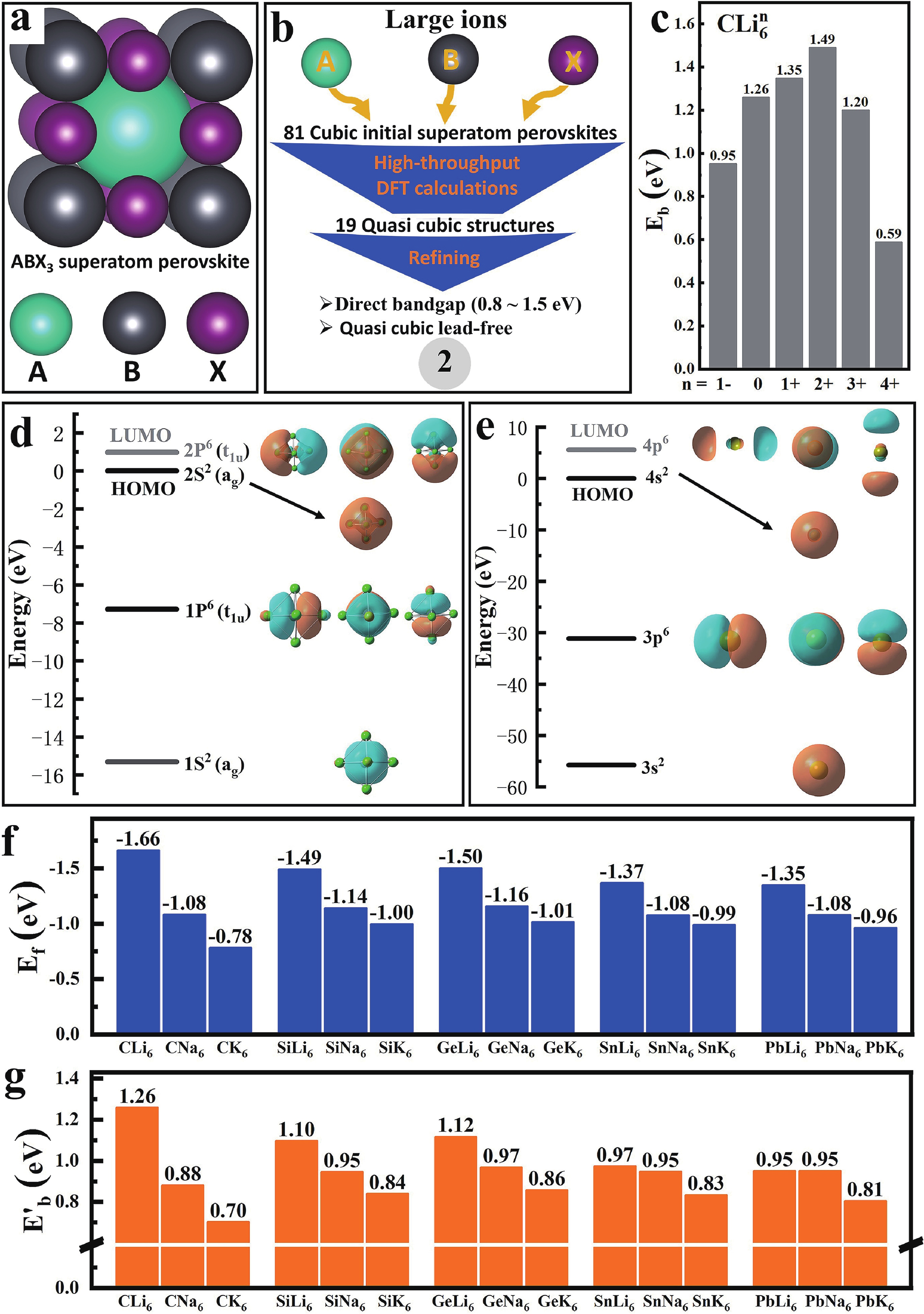
Fig. 1.  (Color online) (a) The cubic superatom perovskite structures (ABX3 type). (b) Two superatom perovskites are identified after high-throughput DFT calculations from 81 cubic initial candidates through the direct bandgap requirements (0.8−1.5 eV), the negligible deformation of A/B/X-site ions, and quasi-cubic lead-free. (c) Binding energies of CLi6 clusters with charge n. (d, e) Orbital shapes of CLi6 cluster and Ca atom, respectively. (f, g) Formation and binding energies of MY6 clusters (M = C, Si, Ge, Sn, Pb; Y = Li, Na, K), respectively.

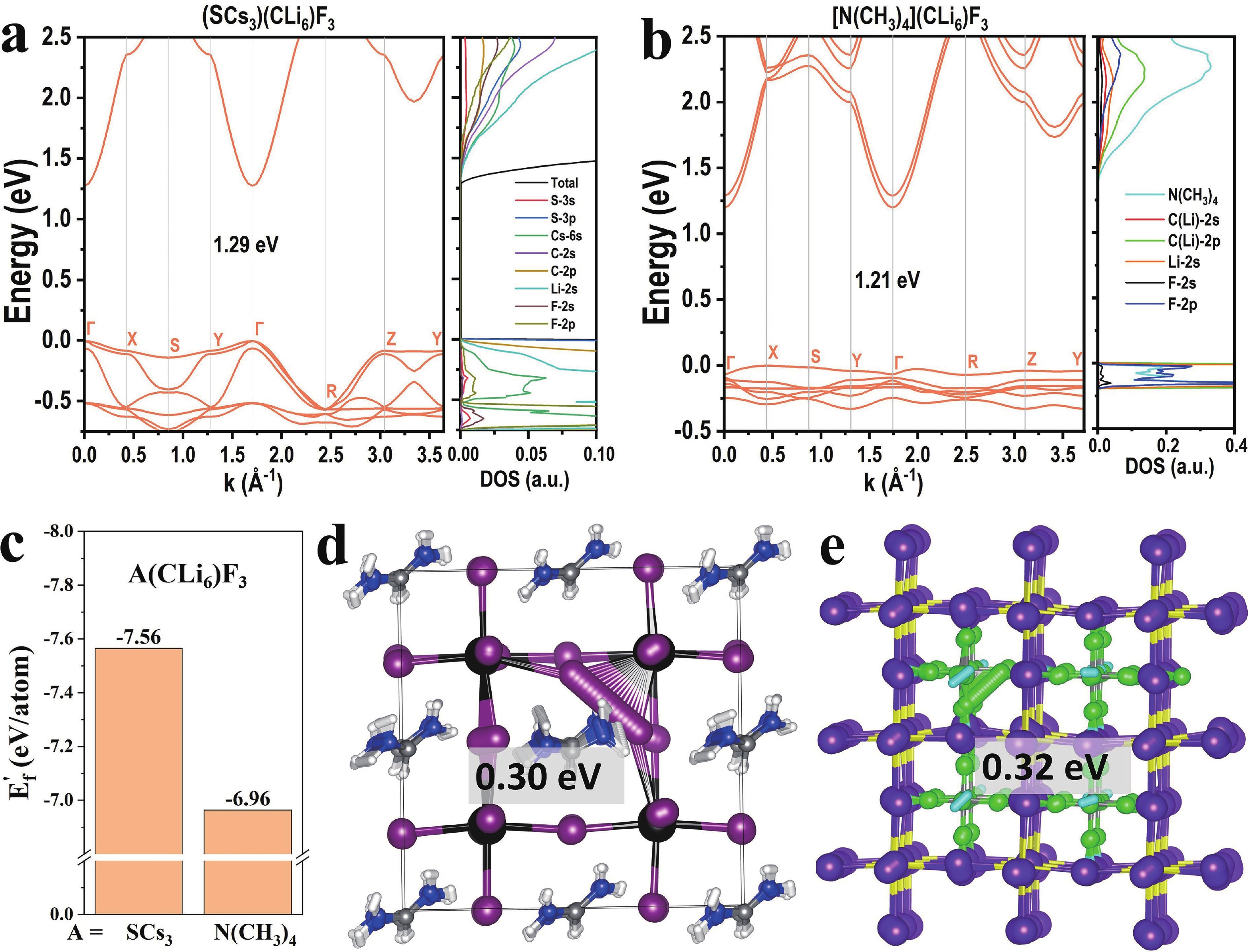
Fig. 2.  (Color online) (a)−(c) The band structures, density of states (DOSs) and formation energies for (SCs3)(CLi6)F3 and [N(CH3)4](CLi6)F3 superatom perovskites calculated using HSE06 method, respectively. Herein, C(Li) represents the C atom of CLi6. Fermi level is set to zero. (d, e) The migration energy barrier and pathway for iodine (I) and lithium (Li) atoms in CH(NH2)2PbI3 and (SCs3)(CLi6)F3, respectively. Atomic colors: H (white), Li (green), C (green), N (blue), F (cyan), S (yellow), I (reddish brown), Cs (violet), Pb (black).

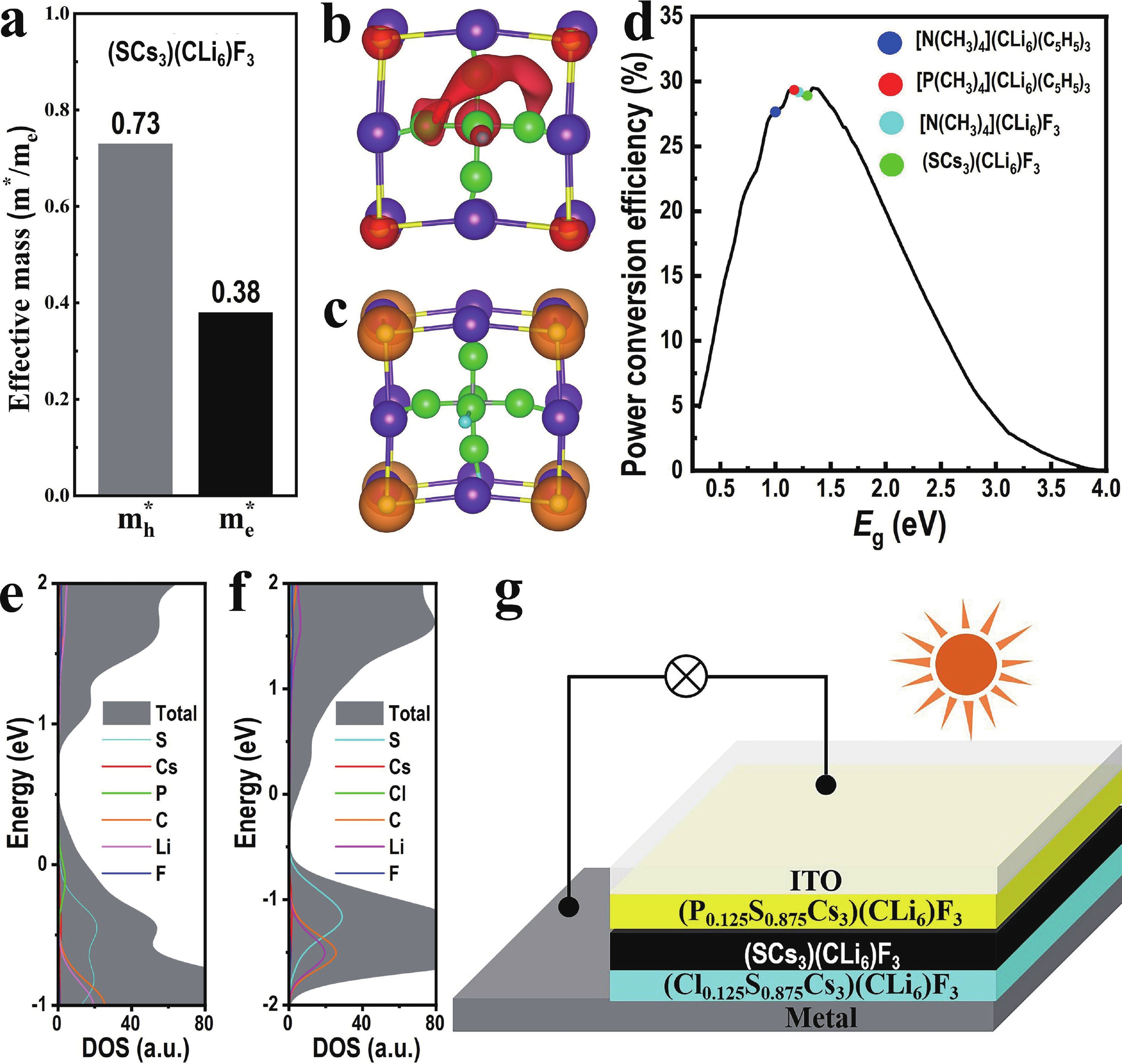
Fig. 3.  (Color online) (a)−(c) Effective hole mass ($ \text{m}_{\text{h}}^{*} $), electron mass ($ \text{m}_{e}^{*} $), the partial charge density of CBM (red) and VBM (orange) states (isovalue = 0.002 e/Å3) for (SCs3)(CLi6)F3 superatom perovskite, respectively. (d) The power conversion efficiencies of the superatom perovskites. (e, f) Partial DOSs for P and Cl doped (SCs3)(CLi6)F3 perovskite using a 2×2×2 supercell, respectively. (g) The model of a single-junction solar cell with (SCs3)(CLi6)F3 as the light absorption layer, where ITO represents indium tin oxide. (P0.125S0.875Cs3)(CLi6)F3 and (Cl0.125S0.875Cs3)(CLi6)F3 are used as hole and electron transporting layers, respectively. Atomic colors: Li (green), C (green), F (cyan), S (yellow), Cs (violet).

[1]
Gallop N P, Maslennikov D R, Mondal N, et al. Ultrafast vibrational control of organohalide perovskite optoelectronic devices using vibrationally promoted electronic resonance. Nat Mater, 2024, 23(1): 88 doi: 10.1038/s41563-023-01723-w
[2]
Ghasemi M, Lu J, Jia B, et al. Steady state and transient absorption spectroscopy in metal halide perovskites. Chem Soc Rev, 2025, 54(4): 1644 doi: 10.1039/D4CS00985A
[3]
Zhang W, Eperon G E, Snaith H J. Metal halide perovskites for energy applications. Nat Energy, 2016, 1(6): 16048 doi: 10.1038/nenergy.2016.48
[4]
Wang Y, Wang Y, Doherty T A, et al. Octahedral units in halide perovskites. Nat Rev Chem, 2025, 9(4): 261 doi: 10.1038/s41570-025-00687-6
[5]
Kim J Y, Lee J W, Jung H S, et al. High efficiency perovskite solar cells. Chem Rev, 2020, 120(15): 7867 doi: 10.1021/acs.chemrev.0c00107
[6]
Park J, Kim J, Yun H S, et al. Controlled growth of perovskite layers with volatile alkylammonium chlorides. Nature, 2023, 616(7958): 724 doi: 10.1038/s41586-023-05825-y
[7]
Chen P, Xiao Y, Hu J, et al. Multifunctional ytterbium oxide buffer for perovskite solar cells. Nature, 2024, 625(7995): 516 doi: 10.1038/s41586-023-06892-x
[8]
Singh A, Mitzi D B. Emergence of melt and glass states of halide perovskite semiconductors. Nat Rev Mater, 2025, 10(3): 211 doi: 10.1038/s41578-024-00759-x
[9]
Nazir G, Lee S Y, Lee J H, et al. Stabilization of perovskite solar cells: recent developments and future perspectives. Adv Mater, 2022, 34(50): 2204380 doi: 10.1002/adma.202204380
[10]
Zhu P, Chen C, Dai J, et al. Toward the commercialization of perovskite solar modules. Adv Mater, 2024, 36(15): 2307357 doi: 10.1002/adma.202307357
[11]
Yang M, Tian T, Fang Y, et al. Reducing lead toxicity of perovskite solar cells with a built-in supramolecular complex. Nat Sustain, 2023, 6(11): 1455 doi: 10.1038/s41893-023-01181-x
[12]
Zhang Z, Chen W, Jiang X, et al. Suppression of phase segregation in wide-bandgap perovskites with thiocyanate ions for perovskite/organic tandems with 25.06% efficiency. Nat Energy, 2024, 9(5): 592 doi: 10.1038/s41560-024-01491-0
[13]
Baumann S, Eperon G E, Virtuani A, et al. Stability and reliability of perovskite containing solar cells and modules: degradation mechanisms and mitigation strategies. Energy Environ Sci, 2024, 17(20): 7566 doi: 10.1039/D4EE01898B
[14]
Biçer Ü I, Krebs F C. Lost in transition? Perspective on research versus commercialization of organic and perovskite solar cells. Adv Energy Mater, 2025, 15(45): e02426 doi: 10.1002/aenm.202502426
[15]
Li X, Aftab S, Hussain S, et al. Dimensional diversity (0D, 1D, 2D, and 3D) in perovskite solar cells: exploring the potential of mixed-dimensional integrations. J Mater Chem A, 2024, 12(8): 4421 doi: 10.1039/D3TA06953B
[16]
Zhang S, Jin L, Lu Y, et al. Moiré superlattices in twisted two-dimensional halide perovskites. Nat Mater, 2024, 23(9): 1222 doi: 10.1038/s41563-024-01921-0
[17]
Ghasemi M, Karsili P, Mishra A, et al. Molecular engineering of layered halide double perovskites: challenges and opportunities in optoelectronics and beyond. Adv Energy Mater, 2025, 15(41): 2502693 doi: 10.1002/aenm.202502693
[18]
Li G, Cheng S, Chen X, et al. Erbium-induced boost in self-trapped exciton emission of double perovskites for highly sensitive multimodal and multiplexed optical thermography. Adv Funct Mater, 2024, 34(39): 2403073 doi: 10.1002/adfm.202403073
[19]
Doud E A, Voevodin A, Hochuli T J, et al. Superatoms in materials science. Nat Rev Mater, 2020, 5(5): 371 doi: 10.1038/s41578-019-0175-3
[20]
Zhou T, Wang M, Zang Z, et al. Two-dimensional lead-free hybrid halide perovskite using superatom anions with tunable electronic properties. Sol Energy Mater Sol Cells, 2019, 191: 33 doi: 10.1016/j.solmat.2018.10.021
[21]
Zhou T, Wang M, Zang Z, et al. Stable dynamics performance and high efficiency of ABX3-type super-alkali perovskites first obtained by introducing H5O2 cation. Adv Energy Mater, 2019, 9(29): 1900664 doi: 10.1002/aenm.201900664
[22]
Zhou T, Kuang A. Superalkali halide perovskites with suitable direct band gaps for photovoltaic applications. Nanoscale, 2024, 16(10): 5130 doi: 10.1039/D3NR06132A
[23]
Zhou T, Kuang A. C3N2H5 Superalkali-Enhanced Halide Perovskites for High-Efficiency Photovoltaic Applications. Solar RRL, 2025, 9(8): 2500032 doi: 10.1002/solr.202500032
[24]
Scalon L, Vaynzof Y. Multidimensional Perovskite Solar Cells: What's Next after 3D/2D?. Adv Energy Mater, 2025, 15(44): 2502686 doi: 10.1002/aenm.202502686
[25]
Hautzinger M P, Mihalyi-Koch W, Jin S. A-site cation chemistry in halide perovskites. Chem Mater, 2024, 36(21): 10408 doi: 10.1021/acs.chemmater.4c02043
[26]
Wang H P, Li S, Liu X, et al. Low-dimensional metal halide perovskite photodetectors. Adv Mater, 2021, 33(7): 2003309 doi: 10.1002/adma.202003309
[27]
Cheng Y, Wan H, Sargent E H, et al. Reduced-Dimensional Perovskites: Quantum Well Thickness Distribution and Optoelectronic Properties. Adv Mater, 2025, 37(25): 2410633 doi: 10.1002/adma.202410633
[28]
Goldschmidt V M. Die gesetze der krystallochemie. Naturwissenschaften, 1926, 14(21): 477 doi: 10.1007/bf01507527
[29]
Fu J, Ramesh S, Melvin Lim J W, et al. Carriers, quasi-particles, and collective excitations in halide perovskites. Chem Rev, 2023, 123(13): 8154 doi: 10.1021/acs.chemrev.2c00843
[30]
Blöchl P E. Projector augmented-wave method. Phys Rev B, 1994, 50(24): 17953 doi: 10.1103/PhysRevB.50.17953
[31]
Perdew J P, Burke K, Ernzerhof M. Generalized gradient approximation made simple. Phys. Rev. Lett. 1996, 77(18): 3865
[32]
Grimme S. Semiempirical GGA-type density functional constructed with a long-range dispersion correction. J Comput Chem, 2006, 27(15): 1787 doi: 10.1002/jcc.20495
[33]
Monkhorst H J, Pack J D. Special points for Brillouin-zone integrations. Phys Rev B, 1976, 13(12): 5188 doi: 10.1103/PhysRevB.13.5188
[34]
Heyd J, Scuseria G E, Ernzerhof M. Hybrid functionals based on a screened Coulomb potential. J Chem Phys, 2003, 118(18): 8207 doi: 10.1063/1.1564060
[35]
Andersson M P, Uvdal P. New scale factors for harmonic vibrational frequencies using the B3LYP density functional method with the triple-ζ basis set 6-311+ G (d, p). J Phys Chem A, 2005, 109(12): 2937 doi: 10.1021/jp045733a
[36]
Nagy P R, Samu G, Kállay M. Optimization of the linear-scaling local natural orbital CCSD (T) method: Improved algorithm and benchmark applications. J Chem Theory Comput, 2018, 14(8): 4193 doi: 10.1021/acs.jctc.8b00442
[37]
Inac H, Ashfaq M, Dege N, et al. Synthesis, spectroscopic characterizations, single crystal XRD, supramolecular assembly inspection via hirshfeld surface analysis, and DFT study of a hydroxy functionalized schiff base Cu (II) complex. J Mol Struct, 2024, 1295: 136751 doi: 10.1016/j.molstruc.2023.136751
[38]
Jong U G, Yu C J, Ri J S, et al. Influence of halide composition on the structural, electronic, and optical properties of mixed CH3NH3Pb(I1-xBrx)3 perovskites calculated using the virtual crystal approximation method. Phys Rev B, 2016, 94(12): 125139 doi: 10.1103/PhysRevB.94.125139
[39]
Li C, Lu X, Ding W, et al. Formability of ABX3 (X = F, Cl, Br, I) Halide Perovskites. Acta Cryst B, 2008, 64(6): 702
[40]
Shannon R D. Revised effective ionic radii and systematic studies of interatomic distances in halides and chalcogenides. Acta Crystallogr A, 1976, A32(5): 751
[41]
Travis W, Glover E N K, Bronstein H, et al. On the application of the tolerance factor to inorganic and hybrid halide perovskites: a revised system. Chem Sci, 2016, 7(7): 4548 doi: 10.1039/C5SC04845A
[42]
Rühle S. Tabulated values of the Shockley-Queisser limit for single junction solar cells. Sol Energy, 2016, 130: 139 doi: 10.1016/j.solener.2016.02.015
[43]
Reference Solar Spectral Irradiance: Air Mass 1.5. http://rredc.nrel.gov/solar/spectra/am1.5, accessed February 8th, 2026.
[44]
Kudo H. Observation of hypervalent CLi6 by Knudsen-effusion mass spectrometry. Nature, 1992, 355(6359): 432 doi: 10.1038/355432a0
[45]
Vos A D. Detailed balance limit of the efficiency of tandem solar cells. J Phys D: Appl Phys, 1980, 13(5): 839 doi: 10.1088/0022-3727/13/5/018
[46]
Carlson D E, Wronski C R. Amorphous silicon solar cell. Appl Phys Lett, 1976, 28(11): 671 doi: 10.1063/1.88617
[47]
Hack M, Shur M. Physics of amorphous silicon alloy p-i-n solar cells. J Appl Phys, 1985, 58(2): 997 doi: 10.1063/1.336148
  • Search

    Advanced Search >>

    GET CITATION

    shu

    Export: BibTex EndNote

    Article Metrics

    Article views: 5 Times PDF downloads: 0 Times Cited by: 0 Times

    History

    Received: 25 March 2026 Revised: 14 May 2026 Online: Accepted Manuscript: 15 June 2026

    Catalog

      Email This Article

      User name:
      Email:*请输入正确邮箱
      Code:*验证码错误
      Tingwei Zhou, Hongling Guan, Anlong Kuang. Lead-free perovskites using divalent superatom ions with tunable electronic structures and high efficiency[J]. Journal of Semiconductors, 2026, In Press. doi: 10.1088/1674-4926/26030042 ****T W Zhou, H L Guan, and A L Kuang, Lead-free perovskites using divalent superatom ions with tunable electronic structures and high efficiency[J]. J. Semicond., 2026, accepted doi: 10.1088/1674-4926/26030042
      Citation:
      Tingwei Zhou, Hongling Guan, Anlong Kuang. Lead-free perovskites using divalent superatom ions with tunable electronic structures and high efficiency[J]. Journal of Semiconductors, 2026, In Press. doi: 10.1088/1674-4926/26030042 ****
      T W Zhou, H L Guan, and A L Kuang, Lead-free perovskites using divalent superatom ions with tunable electronic structures and high efficiency[J]. J. Semicond., 2026, accepted doi: 10.1088/1674-4926/26030042

      Lead-free perovskites using divalent superatom ions with tunable electronic structures and high efficiency

      DOI: 10.1088/1674-4926/26030042
      CSTR: 32376.14.1674-4926.26030042
      More Information
      • Tingwei Zhou is currently an associate professor at the School of Physical Science and Technology, Southwest University. He received his master's degree in 2016 from Southwest University and his PhD in 2019 from Chongqing University. His research interests span theoretical investigations into quantum entanglement, categorical physics, material design, and the optoelectronic and magnetic properties of materials
      • Received Date: 2026-03-25
      • Revised Date: 2026-05-14
      • Available Online: 2026-06-15

      Catalog

        /

        DownLoad:  Full-Size Img  PowerPoint
        Return
        Return