J. Semicond. >  Just Accepted

ARTICLES

Reconfigurable Schottky-barriers in 2D photodiodes via room-temperature Ozone treatment

Yiwen Bian1, Minghang Fan3, Tianxing Wang3 and Caixia Guo2,

+ Author Affiliations

 Corresponding author: Caixia Guo, guocaixia@htu.edu.cn

DOI: 10.1088/1674-4926/26030046CSTR: 32376.14.1674-4926.26030046

PDF

Turn off MathJax

Abstract: The integration of two-dimensional (2D) semiconductors with mainstream complementary metal-oxide-semiconductor (CMOS) technology is hampered by the limited ability to adjust device performance after fabrication. Here, we present a differential Schottky-barrier tuning strategy to post-customize the optoelectronic performance based on a two-dimensional asymmetric Schottky contact WSe2 photodiode, eliminating the need for device re-fabrication. A brief, room-temperature ozone exposure (1.5 min) enables in-situ tuning of the rectification ratio across three orders of magnitude (from 102 to 105) and enhances the peak responsivity at 532 nm by 11.2 times. These effects stem from differential modulation of Schottky barrier height (SBH) at the asymmetric contacts. While the SBH at the WSe2/Au interface is reduced, the SBH at the WSe2/graphene junction is elevated, a phenomenon unlocked by the combination of oxidation-induced Fermi-level lowering in WSe2 and interfacial dipole modification. Our method establishes a "device-after-design" paradigm for 2D material engineering, providing a CMOS-compatible and versatile route toward adaptive optoelectronics for applications in wearable sensing and reconfigurable photonic systems.

Key words: post-customizationozone oxidationasymmetric Schottky contacts2D materialsCMOS-compatible


[1]
Shin Y S, Lee K, Kim Y R, et al. Mobility engineering in vertical field effect transistors based on van der Waals heterostructures. Adv Mater, 2018, 30(9): 1704435 doi: 10.1002/adma.201704435
[2]
Zhang Y, Yao Y Y, Sendeku M G, et al. Recent progress in CVD growth of 2D transition metal dichalcogenides and related heterostructures. Adv Mater, 2019, 31(41): 1901694 doi: 10.1002/adma.201901694
[3]
Pudasaini P R, Oyedele A, Zhang C, et al. High-performance multilayer WSe2 field-effect transistors with carrier type control. Nano Res, 2018, 11(2): 722 doi: 10.1007/s12274-017-1681-5
[4]
Mak K F, Xiao D, Shan J. Light–valley interactions in 2D semiconductors. Nat Photonics, 2018, 12(8): 451 doi: 10.1038/s41566-018-0204-6
[5]
Dai M J, Zhang X R, Wang Q J. 2D materials for photothermoelectric detectors: Mechanisms, materials, and devices. Adv Funct Mater, 2024, 34(21): 2312872 doi: 10.1002/adfm.202312872
[6]
Chen W Y, Li L, Huang T, et al. Extending Schottky–Mott rule to van der Waals heterostructures of 2D Janus materials: Influence of intrinsic dipoles. Appl Phys Lett, 2023, 123(17): 171601 doi: 10.1063/5.0174594
[7]
Nishio K, Shirasawa T, Shimizu K, et al. Tuning the Schottky barrier height at the interfaces of metals and mixed conductors. ACS Appl Mater Interfaces, 2021, 13(13): 15746 doi: 10.1021/acsami.0c18656
[8]
Boehm A, Fonseca J J, Thürmer K, et al. Engineering of nanoscale heterogeneous transition metal dichalcogenide–Au interfaces. Nano Lett, 2023, 23(7): 2792 doi: 10.1021/acs.nanolett.3c00080
[9]
Padilha J E, Fazzio A, da Silva A J R. Van der Waals heterostructure of phosphorene and graphene: Tuning the Schottky barrier and doping by electrostatic gating. Phys Rev Lett, 2015, 114(6): 066803 doi: 10.1103/PhysRevLett.114.066803
[10]
Zhao Z J, Kang J Z, Rakheja S, et al. Control-gate-free reconfigurable transistor based on 2D MoTe2 with asymmetric gating. Appl Phys Lett, 2024, 124(7): 073506 doi: 10.1063/5.0177275
[11]
Guo Y G, Wang F Q, Wang Q. An all-carbon vdW heterojunction composed of penta-graphene and graphene: Tuning the Schottky barrier by electrostatic gating or nitrogen doping. Appl Phys Lett, 2017, 111(7): 073503 doi: 10.1063/1.4986604
[12]
Xu D, Zhang S N, Chen J S, et al. Design of the synergistic rectifying interfaces in Mott–Schottky catalysts. Chem Rev, 2023, 123(1): 1 doi: 10.1021/acs.chemrev.2c00426
[13]
Chen Y K, Wang X Q, Cui W G, et al. Multiple Schottky contacts motivated via defects to tune the response ability of electromagnetic waves. Adv Funct Mater, 2025, 35(11): 2417215 doi: 10.1002/adfm.202417215
[14]
Zhang Z, Qiu Z J, Liu R, et al. Schottky-barrier height tuning by means of ion implantation into preformed silicide films followed by drive-In anneal. IEEE Electron Device Lett, 2007, 28(7): 565 doi: 10.1109/LED.2007.900295
[15]
Aswini K, Kunapalli C K, Munirathnam K, et al. Tuning barrier height and enhancing electrical properties of MOS heterojunctions using Fe2O3 doped MoO3 nanocomposite interlayer on Ni/Cr/n-GaN for optoelectronic devices. Phys B Condens Matter, 2025, 714: 417422 doi: 10.1016/j.physb.2025.417422
[16]
Kaur D, Dahiya R, Shivani, et al. Interface-induced origin of Schottky-to-Ohmic-to-Schottky conversion in non-conventional contact to β-Ga2O3. Appl Phys Lett, 2024, 124(2): 021601 doi: 10.1063/5.0187009
[17]
Zhang G B, Fan X M, Wang Z J, et al. Self-rectifying memristors for beyond-CMOS computing: Mechanisms, materials, and integration prospects. Nano Micro Lett, 2026, 18(1): 188 doi: 10.1007/s40820-025-02035-1
[18]
Fenouillet-Beranger C, Brunet L, Batude P, et al. A review of low temperature process modules leading up to the first (≤500 °C) planar FDSOI CMOS devices for 3-D sequential integration. IEEE Trans Electron Devices, 2021, 68(7): 3142 doi: 10.1109/TED.2021.3084916
[19]
Arora R, Barr A R, Larson D T, et al. Engineering interfacial charge transfer through modulation doping for 2D electronics. Phys Rev Materials, 2025, 9(2): L021601 doi: 10.1103/PhysRevMaterials.9.L021601
[20]
Shinde P A, Mahamiya V, Safarkhani M, et al. Unveiling the nanoarchitectonics of interfacial electronic coupling in atomically thin 2D WO3/WSe2 heterostructure for sodium-ion storage in aqueous system. Adv Funct Mater, 2024, 34(41): 2406333 doi: 10.1002/adfm.202406333
[21]
Martín-Sánchez J, Mariscal A, De Luca M, et al. Effects of dielectric stoichiometry on the photoluminescence properties of encapsulated WSe2 monolayers. Nano Res, 2018, 11(3): 1399 doi: 10.1007/s12274-017-1755-4
[22]
Lu J P, Carvalho A, Chan X K, et al. Atomic healing of defects in transition metal dichalcogenides. Nano Lett, 2015, 15(5): 3524 doi: 10.1021/acs.nanolett.5b00952
[23]
Jiang Y R, Xing W Q, Li H Z, et al. Controllable carrier concentration of two-dimensional TMDs by forming transition-metal suboxide layer for photoelectric devices. Appl Phys Lett, 2022, 121(2): 022101 doi: 10.1063/5.0097392
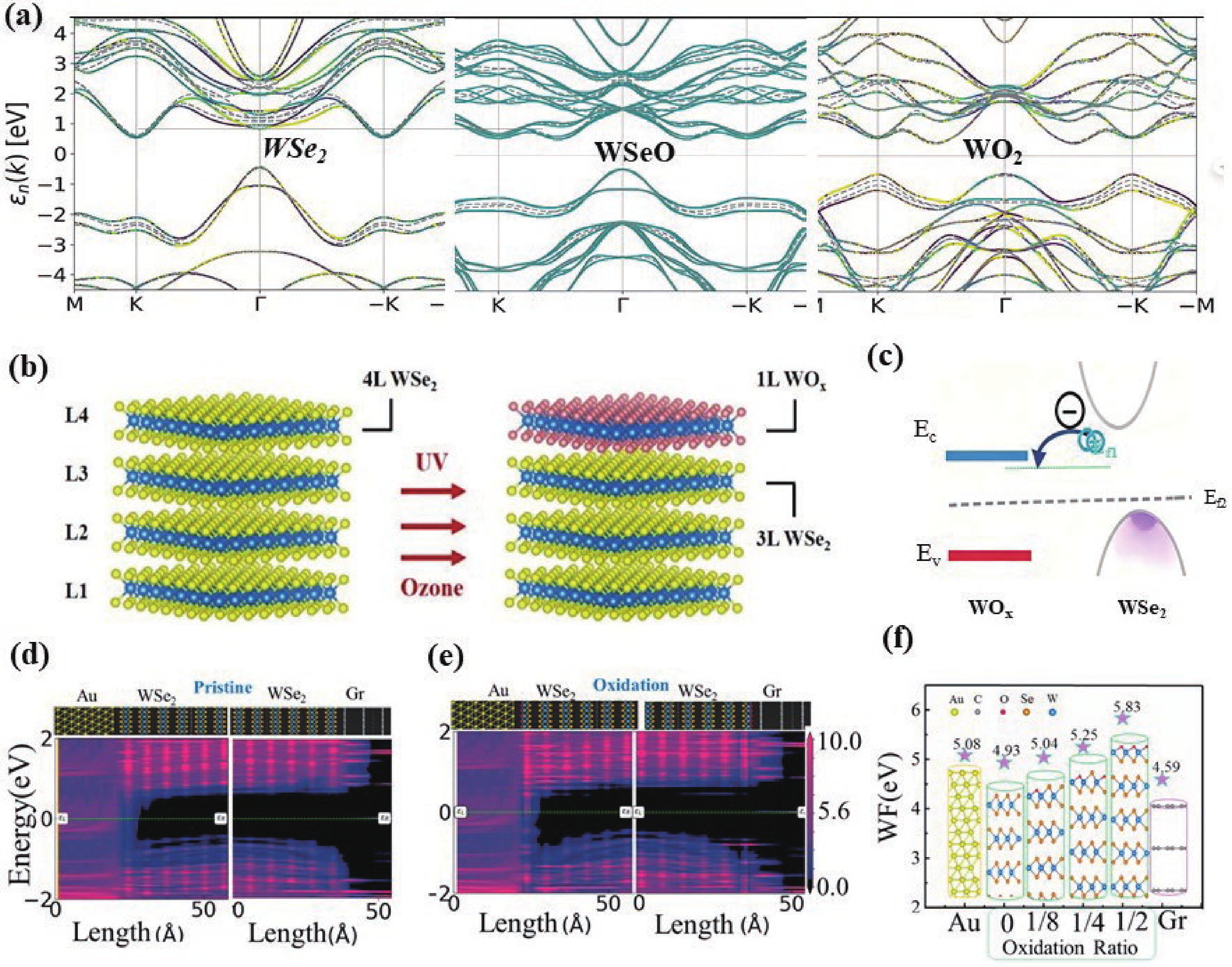
Fig. 1.  (Color online) Theoretical Design for Differential Schottky Barrier Tuning via Oxidation. (a) Calculated band structure evolution from pristine WSe2 to partially oxidized phases and WO2 reference. (b) Schematic illustration of the ozone oxidation process on WSe2 surface. (c) Energy band alignment evolution of WSe2 upon oxidation. (d) Density of states (DOS) at the pristine Au/WSe2 and WSe2/graphene interfaces. (e) DOS at the oxidized Au/WSe2 and WSe2/graphene interfaces. (f) Calculated work function of samples with different oxidation degrees.

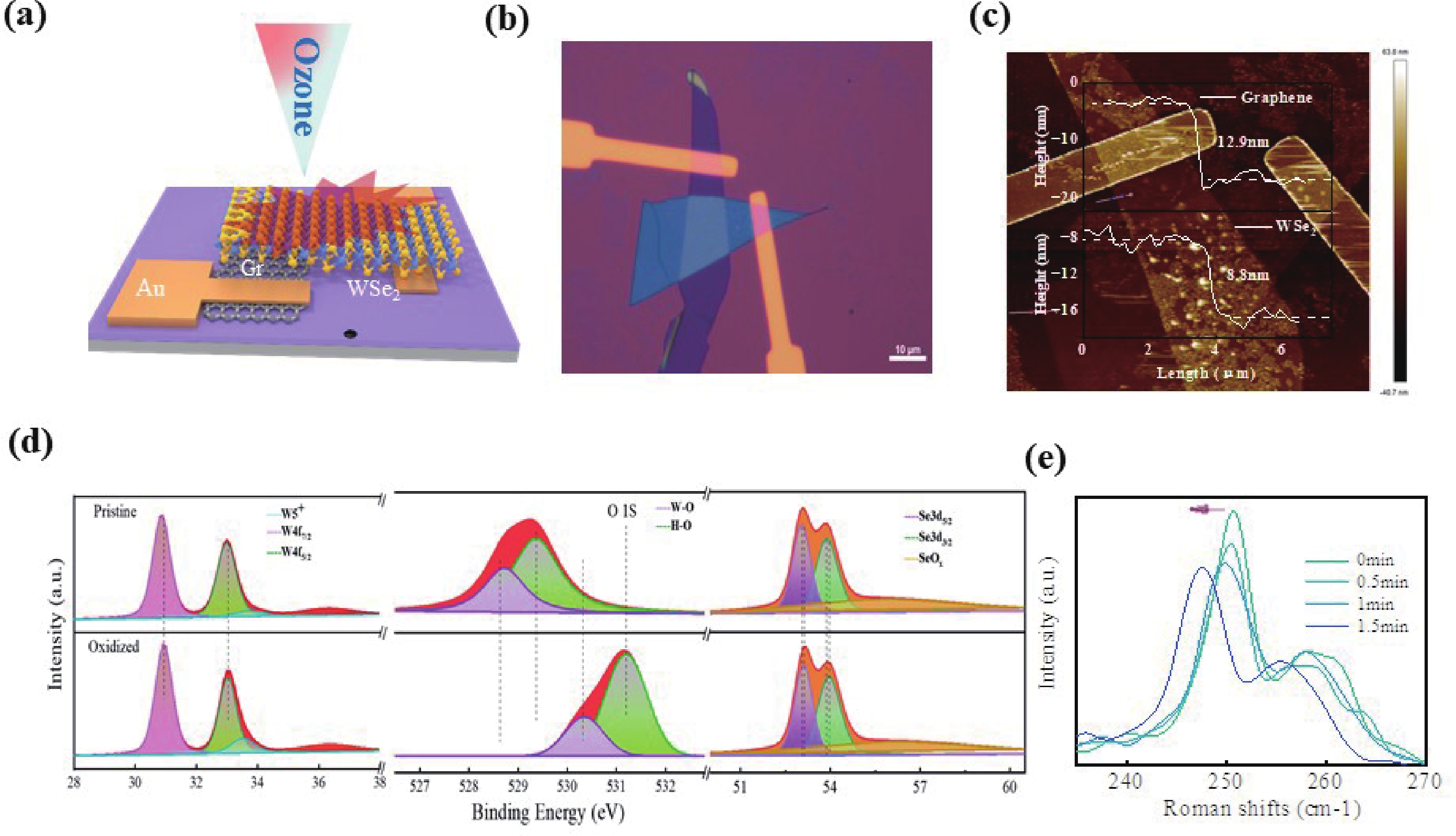
Fig. 2.  (Color online) Device Architecture and Characterization. (a) Schematic of the symmetric bottom-contact WSe2 photodiode with Au and graphene electrodes. (b) Optical microscopy image of the fabricated device. (c) Atom force microscopy image. (d) High-resolution XPS spectra of W 4f, O1S and Se 3d core levels before and after ozone oxidation. (e) Raman spectra evolution as a function of ozone treatment time.

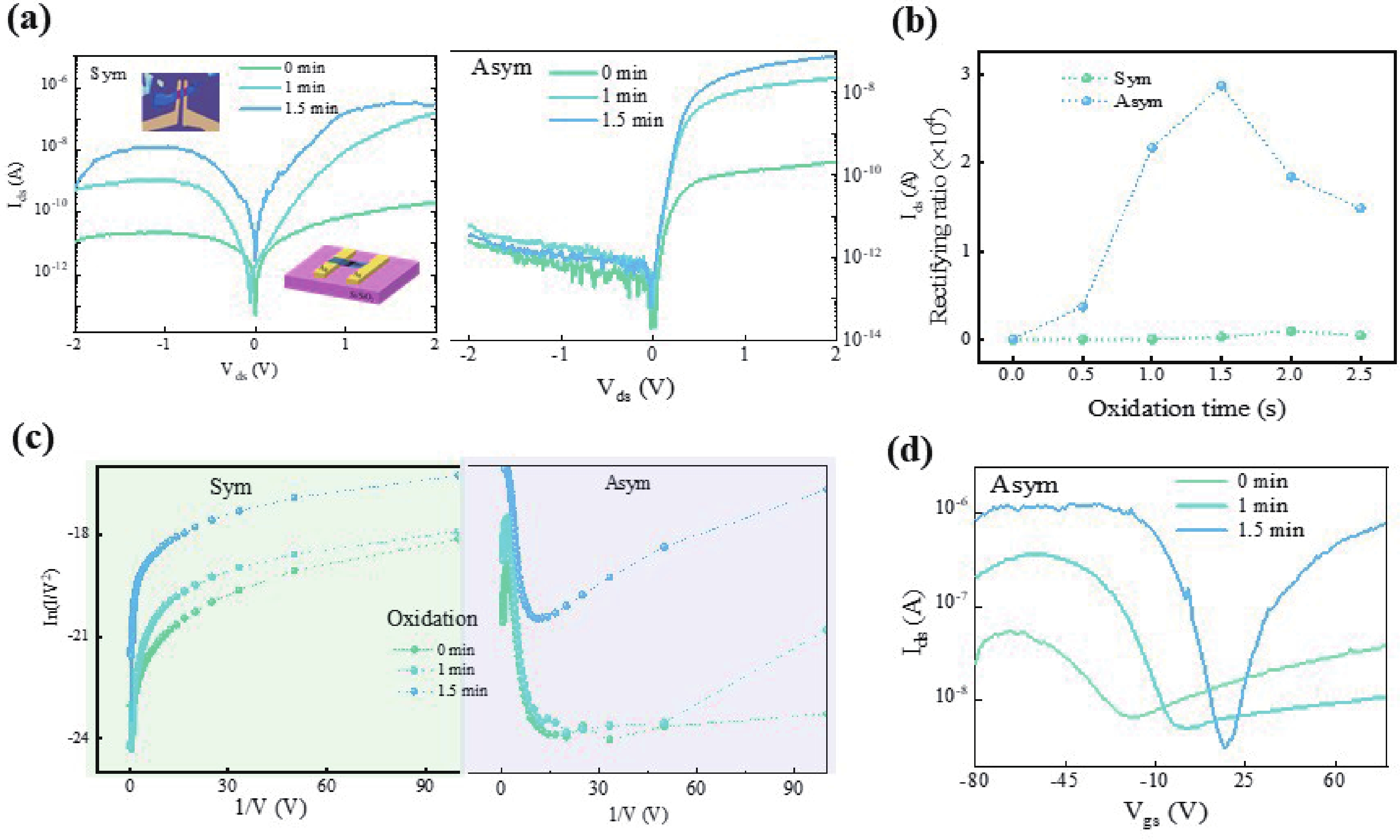
Fig. 3.  (Color online) Post-Customized Electrical Performances. (a) Dark I–V characteristics, inset: photograph of symmetric device. (b) Rectification ratio evolution. (c) Thermionic-emission fitting for SBH extraction. (d) Transfer characteristics evolution.

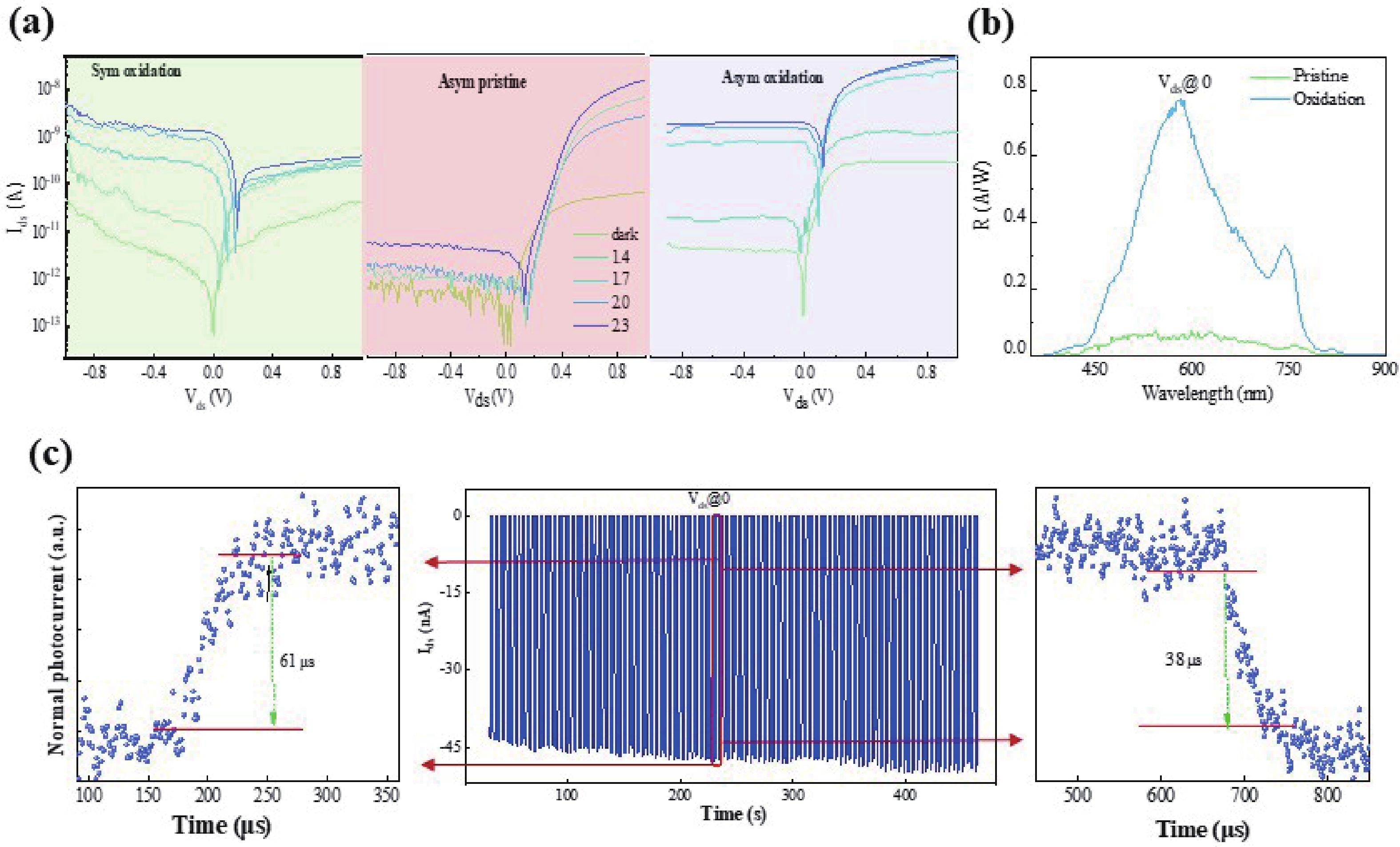
Fig. 4.  (Color online) Post-Customized Optoelectronic Performance. (a) I−V characteristics under dark & 532 nm illumination. (b) Spectral photoresponsivity of different wavelengths at self-powered mode. (c) Self-powered (0 V bias) temporal response and stability.

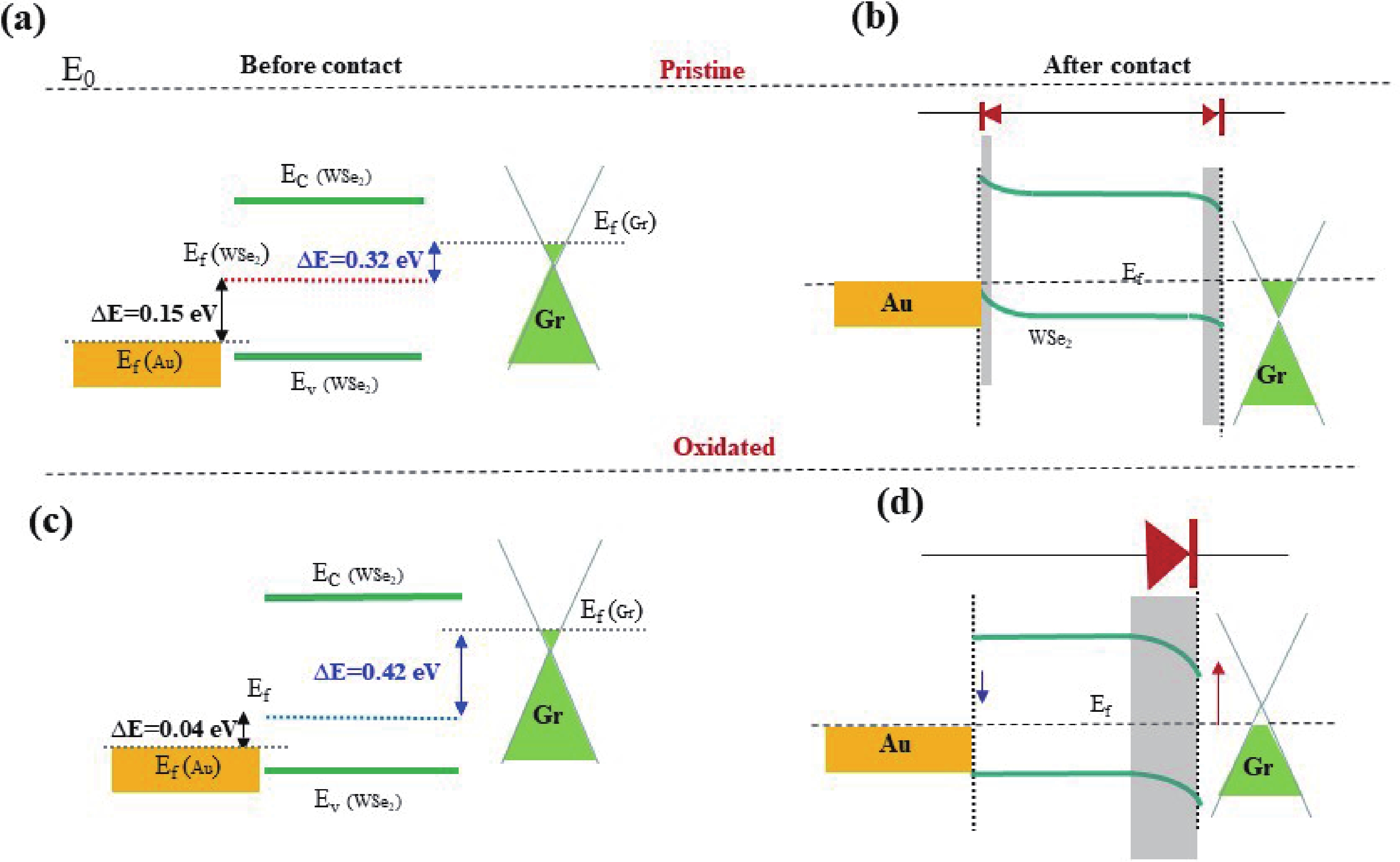
Fig. 5.  (Color online) Schematic diagram of energy band evolution upon oxidation. (a) Energy levels of the isolated materials before contact. (b) Upon contact in the pristine state. (c) Energy levels of oxidized state materials before contact. (d) Upon contact in the oxidized state. Ec: conduction band minimum; Ev: valence band maximum; Ef: Fermi level; Φ: work function.

[1]
Shin Y S, Lee K, Kim Y R, et al. Mobility engineering in vertical field effect transistors based on van der Waals heterostructures. Adv Mater, 2018, 30(9): 1704435 doi: 10.1002/adma.201704435
[2]
Zhang Y, Yao Y Y, Sendeku M G, et al. Recent progress in CVD growth of 2D transition metal dichalcogenides and related heterostructures. Adv Mater, 2019, 31(41): 1901694 doi: 10.1002/adma.201901694
[3]
Pudasaini P R, Oyedele A, Zhang C, et al. High-performance multilayer WSe2 field-effect transistors with carrier type control. Nano Res, 2018, 11(2): 722 doi: 10.1007/s12274-017-1681-5
[4]
Mak K F, Xiao D, Shan J. Light–valley interactions in 2D semiconductors. Nat Photonics, 2018, 12(8): 451 doi: 10.1038/s41566-018-0204-6
[5]
Dai M J, Zhang X R, Wang Q J. 2D materials for photothermoelectric detectors: Mechanisms, materials, and devices. Adv Funct Mater, 2024, 34(21): 2312872 doi: 10.1002/adfm.202312872
[6]
Chen W Y, Li L, Huang T, et al. Extending Schottky–Mott rule to van der Waals heterostructures of 2D Janus materials: Influence of intrinsic dipoles. Appl Phys Lett, 2023, 123(17): 171601 doi: 10.1063/5.0174594
[7]
Nishio K, Shirasawa T, Shimizu K, et al. Tuning the Schottky barrier height at the interfaces of metals and mixed conductors. ACS Appl Mater Interfaces, 2021, 13(13): 15746 doi: 10.1021/acsami.0c18656
[8]
Boehm A, Fonseca J J, Thürmer K, et al. Engineering of nanoscale heterogeneous transition metal dichalcogenide–Au interfaces. Nano Lett, 2023, 23(7): 2792 doi: 10.1021/acs.nanolett.3c00080
[9]
Padilha J E, Fazzio A, da Silva A J R. Van der Waals heterostructure of phosphorene and graphene: Tuning the Schottky barrier and doping by electrostatic gating. Phys Rev Lett, 2015, 114(6): 066803 doi: 10.1103/PhysRevLett.114.066803
[10]
Zhao Z J, Kang J Z, Rakheja S, et al. Control-gate-free reconfigurable transistor based on 2D MoTe2 with asymmetric gating. Appl Phys Lett, 2024, 124(7): 073506 doi: 10.1063/5.0177275
[11]
Guo Y G, Wang F Q, Wang Q. An all-carbon vdW heterojunction composed of penta-graphene and graphene: Tuning the Schottky barrier by electrostatic gating or nitrogen doping. Appl Phys Lett, 2017, 111(7): 073503 doi: 10.1063/1.4986604
[12]
Xu D, Zhang S N, Chen J S, et al. Design of the synergistic rectifying interfaces in Mott–Schottky catalysts. Chem Rev, 2023, 123(1): 1 doi: 10.1021/acs.chemrev.2c00426
[13]
Chen Y K, Wang X Q, Cui W G, et al. Multiple Schottky contacts motivated via defects to tune the response ability of electromagnetic waves. Adv Funct Mater, 2025, 35(11): 2417215 doi: 10.1002/adfm.202417215
[14]
Zhang Z, Qiu Z J, Liu R, et al. Schottky-barrier height tuning by means of ion implantation into preformed silicide films followed by drive-In anneal. IEEE Electron Device Lett, 2007, 28(7): 565 doi: 10.1109/LED.2007.900295
[15]
Aswini K, Kunapalli C K, Munirathnam K, et al. Tuning barrier height and enhancing electrical properties of MOS heterojunctions using Fe2O3 doped MoO3 nanocomposite interlayer on Ni/Cr/n-GaN for optoelectronic devices. Phys B Condens Matter, 2025, 714: 417422 doi: 10.1016/j.physb.2025.417422
[16]
Kaur D, Dahiya R, Shivani, et al. Interface-induced origin of Schottky-to-Ohmic-to-Schottky conversion in non-conventional contact to β-Ga2O3. Appl Phys Lett, 2024, 124(2): 021601 doi: 10.1063/5.0187009
[17]
Zhang G B, Fan X M, Wang Z J, et al. Self-rectifying memristors for beyond-CMOS computing: Mechanisms, materials, and integration prospects. Nano Micro Lett, 2026, 18(1): 188 doi: 10.1007/s40820-025-02035-1
[18]
Fenouillet-Beranger C, Brunet L, Batude P, et al. A review of low temperature process modules leading up to the first (≤500 °C) planar FDSOI CMOS devices for 3-D sequential integration. IEEE Trans Electron Devices, 2021, 68(7): 3142 doi: 10.1109/TED.2021.3084916
[19]
Arora R, Barr A R, Larson D T, et al. Engineering interfacial charge transfer through modulation doping for 2D electronics. Phys Rev Materials, 2025, 9(2): L021601 doi: 10.1103/PhysRevMaterials.9.L021601
[20]
Shinde P A, Mahamiya V, Safarkhani M, et al. Unveiling the nanoarchitectonics of interfacial electronic coupling in atomically thin 2D WO3/WSe2 heterostructure for sodium-ion storage in aqueous system. Adv Funct Mater, 2024, 34(41): 2406333 doi: 10.1002/adfm.202406333
[21]
Martín-Sánchez J, Mariscal A, De Luca M, et al. Effects of dielectric stoichiometry on the photoluminescence properties of encapsulated WSe2 monolayers. Nano Res, 2018, 11(3): 1399 doi: 10.1007/s12274-017-1755-4
[22]
Lu J P, Carvalho A, Chan X K, et al. Atomic healing of defects in transition metal dichalcogenides. Nano Lett, 2015, 15(5): 3524 doi: 10.1021/acs.nanolett.5b00952
[23]
Jiang Y R, Xing W Q, Li H Z, et al. Controllable carrier concentration of two-dimensional TMDs by forming transition-metal suboxide layer for photoelectric devices. Appl Phys Lett, 2022, 121(2): 022101 doi: 10.1063/5.0097392
  • Search

    Advanced Search >>

    GET CITATION

    shu

    Export: BibTex EndNote

    Article Metrics

    Article views: 11 Times PDF downloads: 0 Times Cited by: 0 Times

    History

    Received: 28 March 2026 Revised: 26 April 2026 Online: Accepted Manuscript: 21 May 2026

    Catalog

      Email This Article

      User name:
      Email:*请输入正确邮箱
      Code:*验证码错误
      Yiwen Bian, Minghang Fan, Tianxing Wang, Caixia Guo. Reconfigurable Schottky-barriers in 2D photodiodes via room-temperature Ozone treatment[J]. Journal of Semiconductors, 2026, In Press. doi: 10.1088/1674-4926/26030046 ****Y W Bian, M H Fan, T X Wang, and C X Guo, Reconfigurable Schottky-barriers in 2D photodiodes via room-temperature Ozone treatment[J]. J. Semicond., 2026, accepted doi: 10.1088/1674-4926/26030046
      Citation:
      Yiwen Bian, Minghang Fan, Tianxing Wang, Caixia Guo. Reconfigurable Schottky-barriers in 2D photodiodes via room-temperature Ozone treatment[J]. Journal of Semiconductors, 2026, In Press. doi: 10.1088/1674-4926/26030046 ****
      Y W Bian, M H Fan, T X Wang, and C X Guo, Reconfigurable Schottky-barriers in 2D photodiodes via room-temperature Ozone treatment[J]. J. Semicond., 2026, accepted doi: 10.1088/1674-4926/26030046

      Reconfigurable Schottky-barriers in 2D photodiodes via room-temperature Ozone treatment

      DOI: 10.1088/1674-4926/26030046
      CSTR: 32376.14.1674-4926.26030046
      More Information
      • Yiwen Bian:Bian Yiwen, an undergraduate student of the 2024 batch, is currently studying in the School of International Education at Henan Normal University, majoring in Electrical Engineering and Automation
      • Caixia Guo was born in Yucheng, Henan, China, in 1979. She received the M.S. degree from Nanjing University of Science and Technology, Nanjing, China, in 2005 and the Ph.D. degree from Henan Normal University, Xinxiang, China, in 2018. She is currently an Associate Professor with Henan Normal University, Xinxiang. Her current research interests include 2D semiconductor materials and devices
      • Corresponding author: guocaixia@htu.edu.cn
      • Received Date: 2026-03-28
      • Revised Date: 2026-04-26
      • Available Online: 2026-05-21

      Catalog

        /

        DownLoad:  Full-Size Img  PowerPoint
        Return
        Return