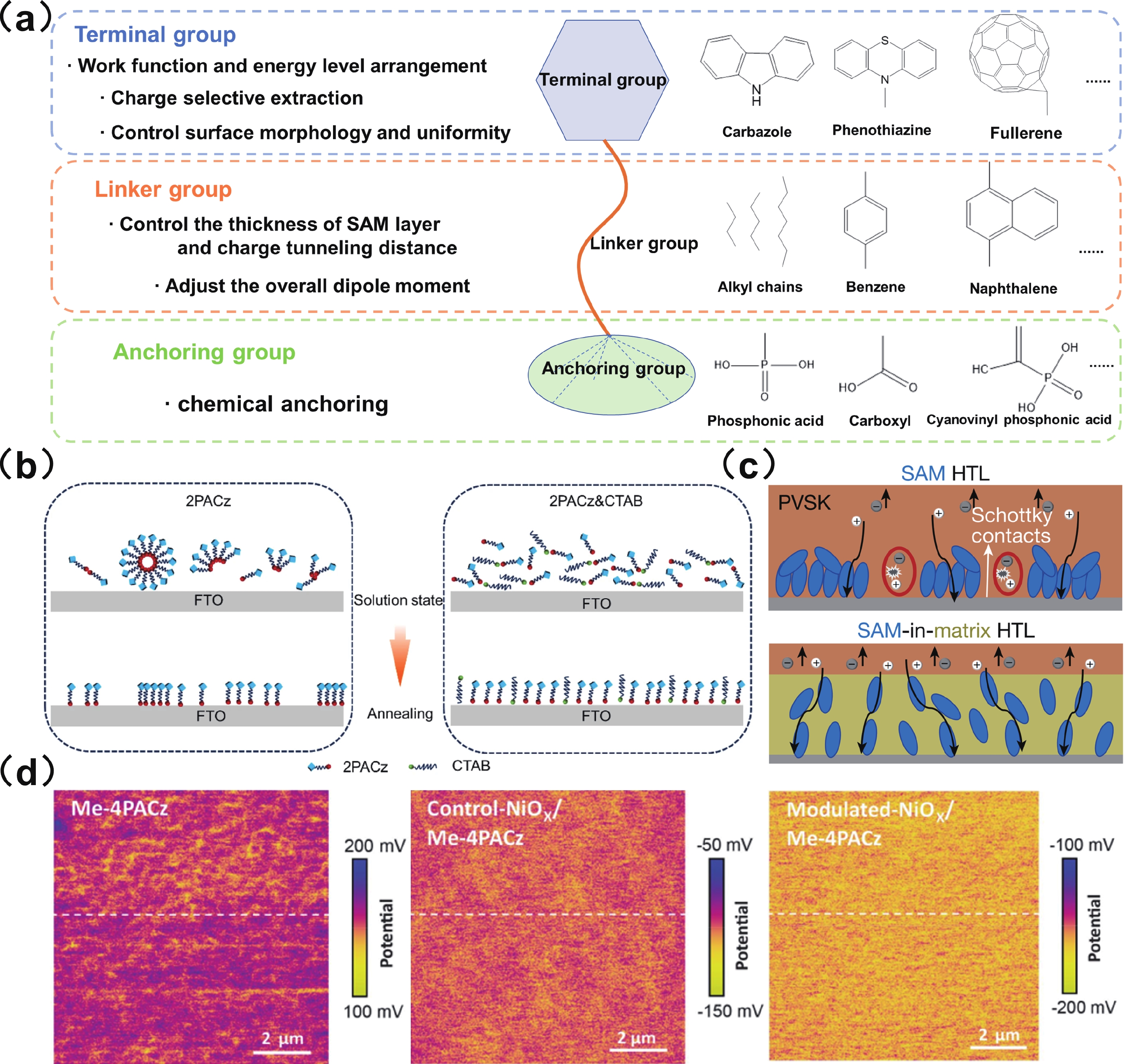
| [1] |
Wang X, Wang X, Wang X, et al. Role of self-assembled molecules in halide perovskite optoelectronics: an atomic-scale perspective. Natl Sci Rev, 2025, 12: nwaf150 doi: 10.1093/nsr/nwaf150 |
| [2] |
Chen X, Yue Z, Yang H, et al. N‐type self‐assembled monolayers (SAMs): the next star materials in the perovskite photovoltaic field. Small, 2025, 21: 2411312 doi: 10.1002/smll.202411312 |
| [3] |
Li L, Shi J, Xiang H, et al. Self-Assembled Monolayers in Inverted Perovskite Solar Cells: A Rising Star with Challenges. Nano-Micro Lett., 2026, 18: 241 doi: 10.1007/s40820-026-02089-9 |
| [4] |
Zhang Z, Xu Y, Chen S, et al. Monodisperse Regulation of Self-Assembled Monolayer Via Dipole Molecules for Efficient Perovskite Solar Cells. Angew Chem Int Ed, 2025, 64: e202512660 doi: 10.1002/anie.202512660 |
| [5] |
Er-Raji O, Lange S, Hartwig C E, et al. Tuning Self-Assembly of Hole-Selective Monolayers for Reproducible Perovskite/Silicon Tandem Solar Cells. Small Methods, 2025, 9: 2401758 doi: 10.1002/smtd.202401758 |
| [6] |
Ying Z, Su S, Li X, et al. Antisolvent seeding of self-assembled monolayers for flexible monolithic perovskite/Cu(In, Ga)Se2 tandem solar cells. Nat Energy, 2025, 10: 737 doi: 10.1038/s41560-025-01760-6 |
| [7] |
Liu M, Bi L, Jiang W, et al. Compact Hole-Selective Self-Assembled Monolayers Enabled by Disassembling Micelles in Solution for Efficient Perovskite Solar Cells. Adv Mater, 2023, 35: 2304415 doi: 10.1002/adma.202304415 |
| [8] |
Luo C, Zhou Q, Wang K, et al. Engineering bonding sites enables uniform and robust self-assembled monolayer for stable perovskite solar cells. Nat Mater, 2025, 24: 1265 doi: 10.1038/s41563-025-02275-x |
| [9] |
Wang J, Yan Y, Wang C, et al. Redox-Mediated Stabilization of the Hole Transport Layer and Buried Interface Toward Stable Perovskite Solar Cells. Angew Chem Int Ed, 2026, 65: e4012708 doi: 10.1002/anie.4012708 |
| [10] |
Tian J, Xie Y, Tian M, et al. Carbazole-Based Self-Assembled Monolayers for Hole Transport in Photovoltaics: A Molecular Engineering Perspective. Aggregate, 2026, 7: e70259 doi: 10.1002/agt2.70259 |
| [11] |
Yang J, Qu G, Qiao Y, et al. Flexibility meets rigidity: a self-assembled monolayer materials strategy for perovskite solar cells. Nat Commun, 2025, 16: 6968 doi: 10.1038/s41467-025-62388-4 |
| [12] |
Jiang W, Qu G, Huang X, et al. Toughened self-assembled monolayers for durable perovskite solar cells. Nature, 2025, 646: 95 doi: 10.1038/s41586-025-09509-7 |
| [13] |
Zhang D, Yan B, Xia R, et al. Perovskite crystallization control via an engineered self-assembled monolayer in perovskite–silicon tandem solar cells. Nat Photonics, 2026, 20: 40 doi: 10.1038/s41566-025-01778-y |
| [14] |
Wu W, Gao H, Jia L, et al. Stable and uniform self-assembled organic diradical molecules for perovskite photovoltaics. Science, 2025, 389: 195 doi: 10.1126/science.adv4551 |
| [15] |
Du K, Huang C, Wang A, et al. Anti-aggregation self-assembled monolayers enable high-performance and scalable perovskite solar cells. Nat Commun, 2026, 17: 1472 doi: 10.1038/s41467-025-68207-0 |
| [16] |
Liu L, Ying Z, Li X, et al. Micelle-Assisted Formation of Self-Assembled Monolayers for Efficient and Stable Perovskite/Silicon Tandem Solar Cells. Adv Energy Mater, 2025, 15: 2570083 doi: 10.1002/aenm.202570083 |
| [17] |
Liang Y, Chen G, Wang Y, et al. A matrix-confined molecular layer for perovskite photovoltaic modules. Nature, 2025, 648: 91 doi: 10.1038/s41586-025-09785-3 |
| [18] |
Yu S, Xiong Z, Zhou H, et al. Homogenized NiOx nanoparticles for improved hole transport in inverted perovskite solar cells. Science, 2023, 382: 1399 doi: 10.1126/science.adj8858 |
| [19] |
Tang H, Shen Z, Shen Y, et al. Reinforcing self-assembly of hole transport molecules for stable inverted perovskite solar cells. Science, 2024, 383: 1236 doi: 10.1126/science.adj9602 |
| [20] |
Wu X, Yang H, Yue Z, et al. Hydroxyl-driven homogeneous and robust SAM anchoring on NiOx for high-performance inverted perovskite solar cells. Chemical Engineering Journal, 2025, 520: 166008 doi: 10.1016/j.cej.2025.166008 |



 Shenchao Li obtained bachelor's degree from Kunming University of Science and Technology in 2023. He is currently a postgraduate student at Kunming University of Science and Technology, and his research mainly focuses on buried interface regulation for inverted perovskite solar cells.
 Xuxia Shai is an associate professor at Faculty of Materials Science and Engineering in Kunming University of Science and Technology. She received her Ph.D. from Huazhong University of Science and Technology. Her current research focuses on perovskite solar cells.
 Jiangzhao Chen is a professor at Faculty of Materials Science and Engineering in Kunming University of Science and Technology. He received his B.S. and Ph.D. degrees from Northeast Forestry University in 2011 and from Huazhong University of Science and Technology in 2016, respectively. From 2016 to 2019, he worked as a postdoctoral researcher at Sungkyunkwan University and at the University of Hong Kong, respectively. From 2019 to 2023, he worked as a professor at Chongqing University. His current research interests focus on perovskite solar cells.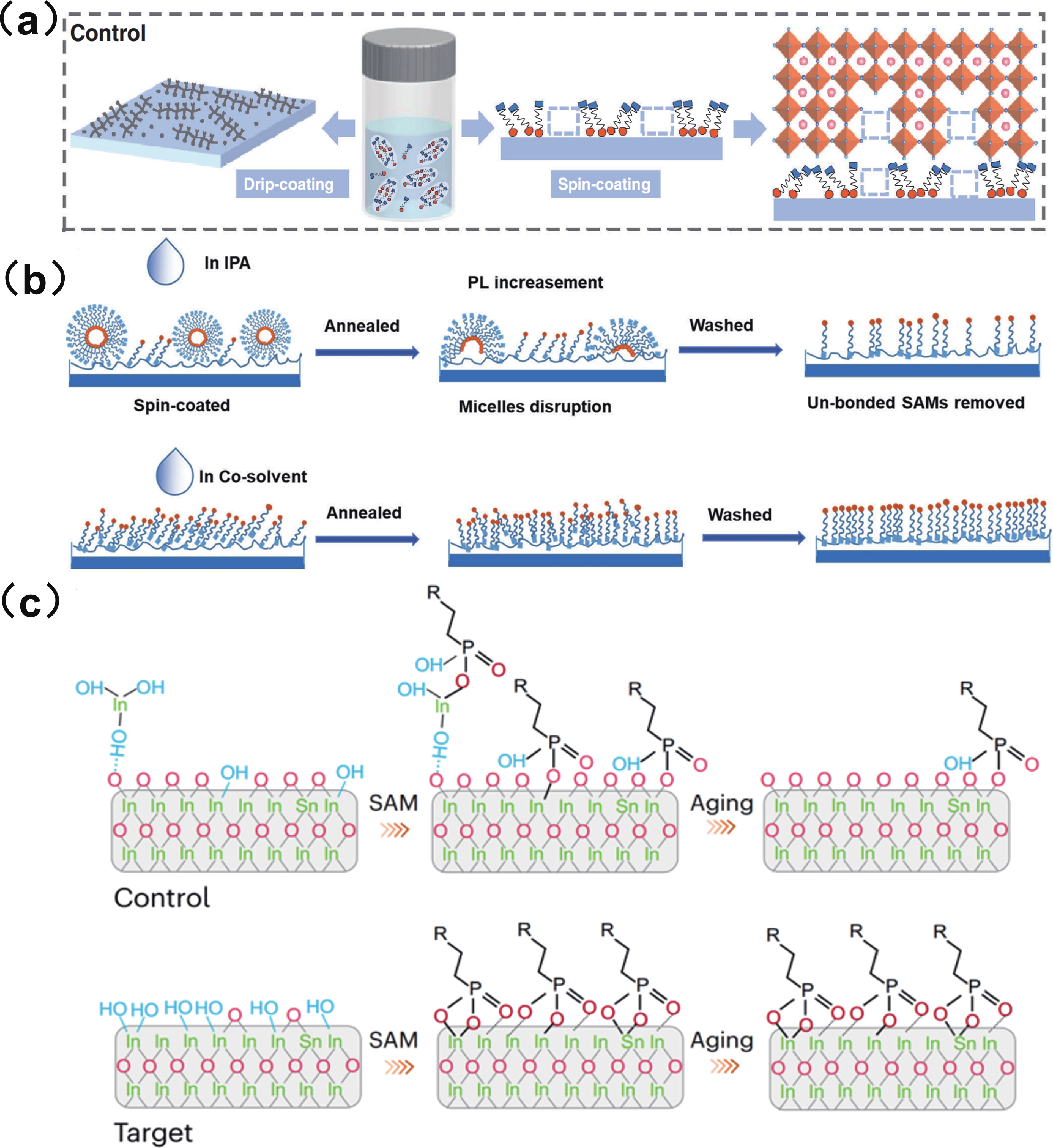
 DownLoad: