


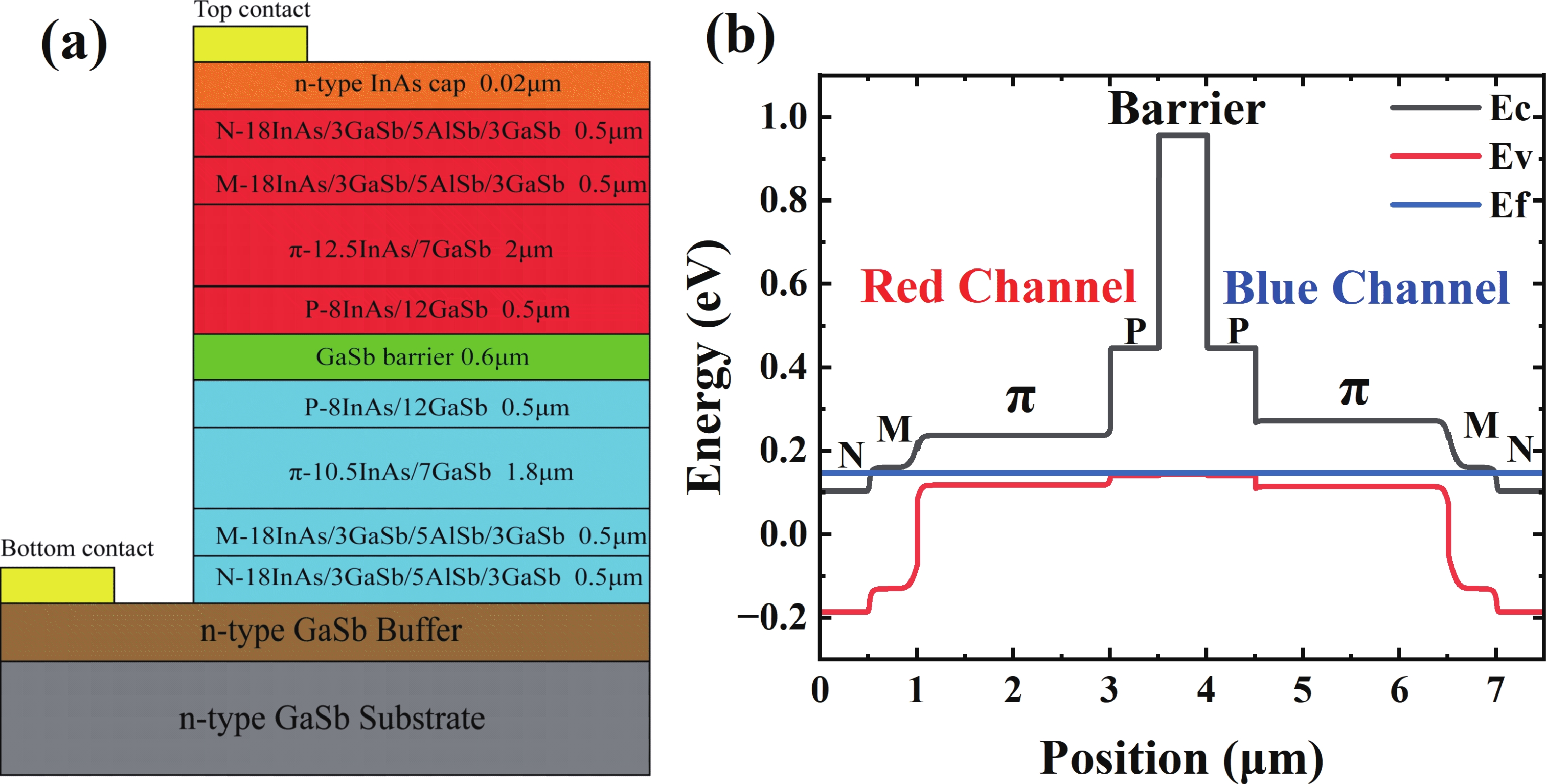
Fig. 1.
(Color online) (a) Schematic structure of the long/long-wavelength dual-band photodetector. (b) Band diagram of the NMπP-B-PπMN structure.
ARTICLES
Dongxu Li1, 2, Peixian Zhang1, 2, Yan Liang3, Ye Zhang1, 2, Chaofeng Yang1, 2, Tao Zhao4, Dongwei Jiang1, 2, Hongyue Hao1, 2, Yingqiang Xu1, 2, Haiqiao Ni1, 2, Zhichuan Niu1, 2, Donghai Wu1, 2, and Guowei Wang1, 2,
Corresponding author: Donghai Wu, dhwu@semi.ac.cn; Guowei Wang, wangguowei@semi.ac.cn
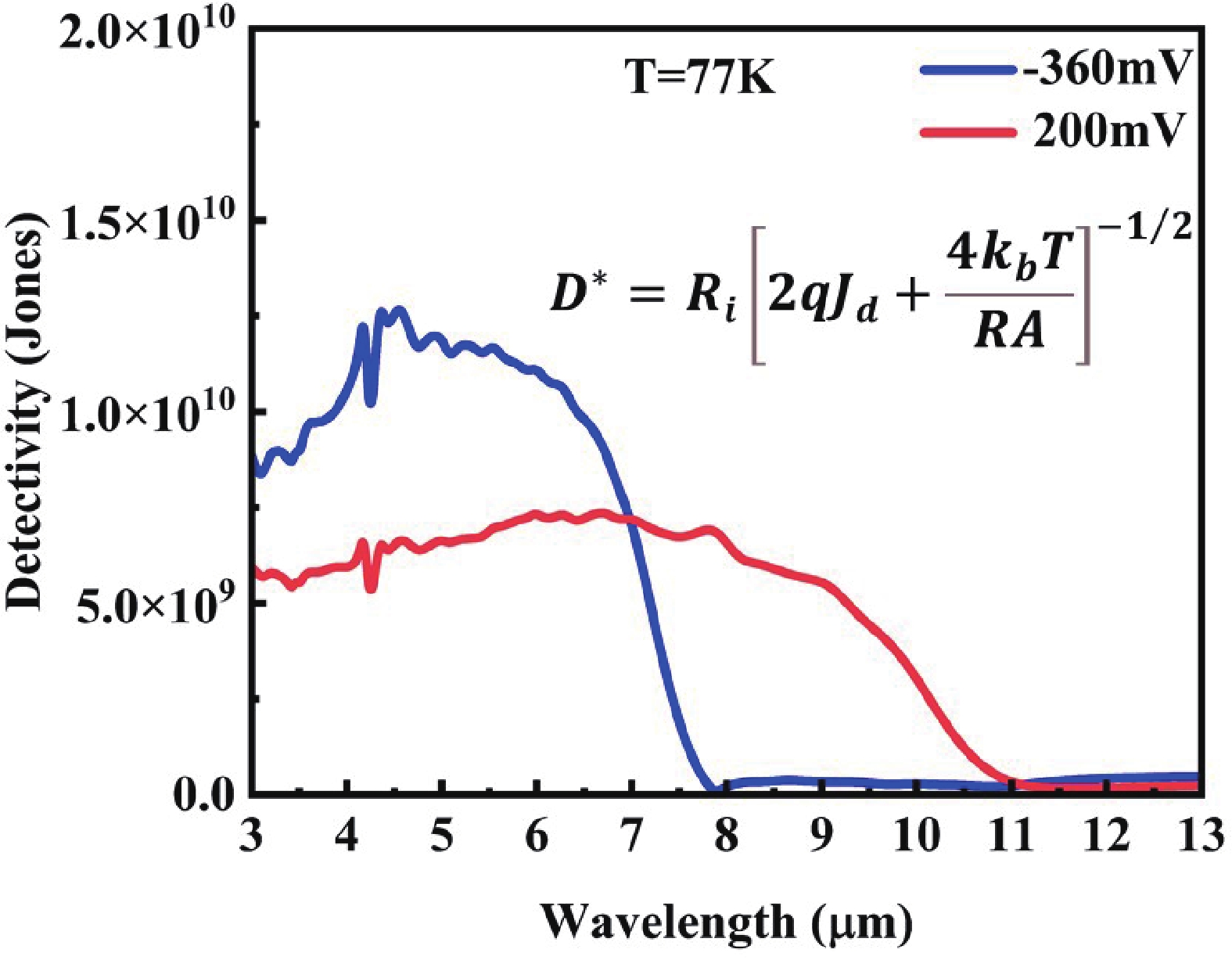
Abstract: Dual-band photodetectors represent one of the important development directions of the third-generation focal plane photodetectors. Type Ⅱ superlattice (T2SL) has emerged as a promising candidate for fabricating long-wavelength dual-band or multi-band infrared photodetectors due to its merits including engineerable band gap, low manufacturing cost and excellent uniformity. In this work, a long/long-wavelength dual-band photodetector with an NMπP-B-PπMN structure based on InAs/GaSb T2SL is reported. The cutoff wavelengths of the two bands are 7.8 and 11.2 μm, respectively. At 77 K, the short long-wavelength channel exhibits a peak quantum efficiency of 20.19%, a peak detectivity of 1.26 × 10¹⁰ Jones and dark current density of 0.91 × 10⁻² A/cm2; the long long-wavelength channel achieves a peak quantum efficiency of 28.94%, a peak detectivity of 7.36 × 10⁹ Jones and dark current density of 6.03 × 10⁻² A/cm2. The device demonstrates high performance, laying a solid foundation for the fabrication of long/long-wavelength dual-band focal plane photodetectors.
Keywords: long/long-wavelength, dual-band, photodetector, InAs/GaSb T2SL
| [1] |
Reibel Y, Chabuel F, Vaz C, et al. Infrared dual-band detectors for next generation. Infrared Technol Appl XXXVII, 2011, 8012: 801238 doi: 10.1117/12.885583
|
| [2] |
Liang Y, Zhou W G, Su X B, et al. InP-based GaAsSb/AlGaAsSb/T2SL barrier-type low-bias tunable dual-band NIR/eSWIR photodetectors. Opt Express, 2024, 32(13): 23822 doi: 10.1364/OE.528762
|
| [3] |
Wang J C, Sun W F, Lv Y Q, et al. Design and passivation of short-/mid-wavelength dual-color infrared detector photodiodes based on InAs/GaSb type II superlattice. Appl Phys A, 2023, 129(4): 301 doi: 10.1007/s00339-023-06604-2
|
| [4] |
Wang X H, Li J Z, Yan Y, et al. Investigation of passivation pretreatment processes for mid-/long-wavelength dual-band infrared focal plane arrays based on type-II InAs/GaSb superlattices. Adv Eng Mater, 2024, 26(10): 2302061 doi: 10.1002/adem.202302061
|
| [5] |
Bai Z Z, Xu Z C, Zhou Y, et al. 320 × 256 dual-color mid-wavelength infrared InAs/GaSb superlattice focal plane arrays. J Infrared Millim Waves, 2015, 34(6): 716 doi: 10.1016/j.infrared.2017.03.008
|
| [6] |
Bai Z Z, Huang M, Xu Z C, et al. 1280*1024 dual-color mid-wavelength infrared InAs/GaSb superlattice focal plane arrays. J Infrared Millim Waves, 2024, 43(4): 437 doi: 10.11972/j.issn.1001-9014.2024.04.001
|
| [7] |
Liu M, Xing W R, Liu J S, et al. Mid wave and long wave dual colour type II superlattice infrared detector technology. Laser infrared, 2022, 52(12): 184 doi: 10.3788/IRLA20250252
|
| [8] |
Liu M, You C Y, Li J F, et al. Research on InAs/GaSb type-II superlattice dual-band long-/long-wavelength infrared photodetector. J Infrared Millim Waves, 2023, 42(5): 574 doi: 10.11972/j.issn.1001-9014.2023.05.002
|
| [9] |
Huang E K, Razeghi M. World’s first demonstration of type-II superlattice dual band 640x512 LWIR focal plane array. Quantum Sens Nanophotonic Devices IX, 2012, 8268: 82680Z doi: 10.1117/12.913662
|
| [10] |
Tang C C, Ikushima K, Ling D C, et al. Quantum Hall dual-band infrared photodetector. Phys Rev Appl, 2017, 8(6): 064001 doi: 10.1103/PhysRevApplied.8.064001
|
| [11] |
Hoang A M, Dehzangi A, Adhikary S, et al. High performance bias-selectable three-color short-wave/mid-wave/long-wave Infrared photodetectors based on type-II InAs/GaSb/AlSb superlattices. Sci Rep, 2016, 6: 24144 doi: 10.1038/srep24144
|
| [12] |
Jiang Z, Sun Y Y, Guo C Y, et al. High quantum efficiency long-/long-wave dual-color type-II InAs/GaSb infrared detector. Chin Phys B, 2019, 28(3): 038504 doi: 10.1088/1674-1056/28/3/038504
|
| [13] |
Huang E K, Hoang M A, Chen G X, et al. Highly selective two-color mid-wave and long-wave infrared detector hybrid based on Type-II superlattices. Opt Lett, 2012, 37(22): 4744 doi: 10.1364/OL.37.004744
|
| [14] |
Delaunay P Y, Nguyen B M, Hoffman D, et al. Background limited performance of long wavelength infrared focal plane arrays fabricated from M-structure InAs–GaSb superlattices. IEEE J Quantum Electron, 2009, 45(2): 157 doi: 10.1109/JQE.2008.2002667
|
| [15] |
Maimon S, Wicks G W. nBn detector, an infrared detector with reduced dark current and higher operating temperature. Appl Phys Lett, 2006, 89(15): 151109 doi: 10.1063/1.2360235
|
| [16] |
Plis E, Myers S, Ramirez D, et al. Dual color longwave InAs/GaSb type-II strained layer superlattice detectors. Infrared Phys Technol, 2015, 70: 93 doi: 10.1016/j.infrared.2014.09.027
|
| [17] |
Huang E K, Haddadi A, Chen G X, et al. Type-II superlattice dual-band LWIR imager with M-barrier and Fabry–Perot resonance. Opt Lett, 2011, 36(13): 2560 doi: 10.1364/OL.36.002560
|
| [18] |
Haddadi A, Dehzangi A, Chevallier R, et al. Bias–selectable nBn dual–band long–/very long–wavelength infrared photodetectors based on InAs/InAs1–xSbx/AlAs1–xSbx type–II superlattices. Sci Rep, 2017, 7: 3379 doi: 10.1038/s41598-017-03238-2
|
| [19] |
Wang X H, Li J Z, Yan Y, et al. Effect of “M” and “B” superlattice barrier layers on dark current of long-wavelength infrared detectors. Mater Sci Semicond Process, 2024, 173: 108143 doi: 10.1016/j.mssp.2024.108143
|
| [20] |
Wei G S, Hao R T, Li X M, et al. Performance and electron radiation damage of InAs/GaSb long-wave infrared detectors based on PπMN design. J Appl Phys, 2021, 130(7): 075104 doi: 10.1063/5.0055058
|
| [21] |
Guo J, Wu D M, Ma X L, et al. InAs/GaSb superlattice-based photodiodes with pπMn structure for bias-selectable mid/long wave dual-color infrared response. J Nanoelectron Optoelectron, 2022, 17(10): 1322 doi: 10.1166/jno.2022.3302
|
| [22] |
Cheng Y F, Li M M, Z G Song, et al. Performance of LWIR to VLWIR barrier photodetectors based on M-structure superlattices. Opt Express, 2024, 32(2): 2804 doi: 10.1364/OE.513610
|
| [23] |
Chang F R, Zhou W G, Li N, et al. Suppression of tunneling dark current through M-region tuning in InAs/GaSb VLWIR photodetectors. J Light Technol, 2025, 43(10): 4865 doi: 10.1109/JLT.2025.3532751
|
| [24] |
Sullivan G J, Ikhlassi A, Bergman J, et al. Molecular beam epitaxy growth of high quantum efficiency InAs/GaSb superlattice detectors. J Vac Sci Technol B Microelectron Nanometer Struct Process Meas Phenom, 2005, 23(3): 1144 doi: 10.1116/1.1928238
|
| [1] |
Reibel Y, Chabuel F, Vaz C, et al. Infrared dual-band detectors for next generation. Infrared Technol Appl XXXVII, 2011, 8012: 801238 doi: 10.1117/12.885583
|
| [2] |
Liang Y, Zhou W G, Su X B, et al. InP-based GaAsSb/AlGaAsSb/T2SL barrier-type low-bias tunable dual-band NIR/eSWIR photodetectors. Opt Express, 2024, 32(13): 23822 doi: 10.1364/OE.528762
|
| [3] |
Wang J C, Sun W F, Lv Y Q, et al. Design and passivation of short-/mid-wavelength dual-color infrared detector photodiodes based on InAs/GaSb type II superlattice. Appl Phys A, 2023, 129(4): 301 doi: 10.1007/s00339-023-06604-2
|
| [4] |
Wang X H, Li J Z, Yan Y, et al. Investigation of passivation pretreatment processes for mid-/long-wavelength dual-band infrared focal plane arrays based on type-II InAs/GaSb superlattices. Adv Eng Mater, 2024, 26(10): 2302061 doi: 10.1002/adem.202302061
|
| [5] |
Bai Z Z, Xu Z C, Zhou Y, et al. 320 × 256 dual-color mid-wavelength infrared InAs/GaSb superlattice focal plane arrays. J Infrared Millim Waves, 2015, 34(6): 716 doi: 10.1016/j.infrared.2017.03.008
|
| [6] |
Bai Z Z, Huang M, Xu Z C, et al. 1280*1024 dual-color mid-wavelength infrared InAs/GaSb superlattice focal plane arrays. J Infrared Millim Waves, 2024, 43(4): 437 doi: 10.11972/j.issn.1001-9014.2024.04.001
|
| [7] |
Liu M, Xing W R, Liu J S, et al. Mid wave and long wave dual colour type II superlattice infrared detector technology. Laser infrared, 2022, 52(12): 184 doi: 10.3788/IRLA20250252
|
| [8] |
Liu M, You C Y, Li J F, et al. Research on InAs/GaSb type-II superlattice dual-band long-/long-wavelength infrared photodetector. J Infrared Millim Waves, 2023, 42(5): 574 doi: 10.11972/j.issn.1001-9014.2023.05.002
|
| [9] |
Huang E K, Razeghi M. World’s first demonstration of type-II superlattice dual band 640x512 LWIR focal plane array. Quantum Sens Nanophotonic Devices IX, 2012, 8268: 82680Z doi: 10.1117/12.913662
|
| [10] |
Tang C C, Ikushima K, Ling D C, et al. Quantum Hall dual-band infrared photodetector. Phys Rev Appl, 2017, 8(6): 064001 doi: 10.1103/PhysRevApplied.8.064001
|
| [11] |
Hoang A M, Dehzangi A, Adhikary S, et al. High performance bias-selectable three-color short-wave/mid-wave/long-wave Infrared photodetectors based on type-II InAs/GaSb/AlSb superlattices. Sci Rep, 2016, 6: 24144 doi: 10.1038/srep24144
|
| [12] |
Jiang Z, Sun Y Y, Guo C Y, et al. High quantum efficiency long-/long-wave dual-color type-II InAs/GaSb infrared detector. Chin Phys B, 2019, 28(3): 038504 doi: 10.1088/1674-1056/28/3/038504
|
| [13] |
Huang E K, Hoang M A, Chen G X, et al. Highly selective two-color mid-wave and long-wave infrared detector hybrid based on Type-II superlattices. Opt Lett, 2012, 37(22): 4744 doi: 10.1364/OL.37.004744
|
| [14] |
Delaunay P Y, Nguyen B M, Hoffman D, et al. Background limited performance of long wavelength infrared focal plane arrays fabricated from M-structure InAs–GaSb superlattices. IEEE J Quantum Electron, 2009, 45(2): 157 doi: 10.1109/JQE.2008.2002667
|
| [15] |
Maimon S, Wicks G W. nBn detector, an infrared detector with reduced dark current and higher operating temperature. Appl Phys Lett, 2006, 89(15): 151109 doi: 10.1063/1.2360235
|
| [16] |
Plis E, Myers S, Ramirez D, et al. Dual color longwave InAs/GaSb type-II strained layer superlattice detectors. Infrared Phys Technol, 2015, 70: 93 doi: 10.1016/j.infrared.2014.09.027
|
| [17] |
Huang E K, Haddadi A, Chen G X, et al. Type-II superlattice dual-band LWIR imager with M-barrier and Fabry–Perot resonance. Opt Lett, 2011, 36(13): 2560 doi: 10.1364/OL.36.002560
|
| [18] |
Haddadi A, Dehzangi A, Chevallier R, et al. Bias–selectable nBn dual–band long–/very long–wavelength infrared photodetectors based on InAs/InAs1–xSbx/AlAs1–xSbx type–II superlattices. Sci Rep, 2017, 7: 3379 doi: 10.1038/s41598-017-03238-2
|
| [19] |
Wang X H, Li J Z, Yan Y, et al. Effect of “M” and “B” superlattice barrier layers on dark current of long-wavelength infrared detectors. Mater Sci Semicond Process, 2024, 173: 108143 doi: 10.1016/j.mssp.2024.108143
|
| [20] |
Wei G S, Hao R T, Li X M, et al. Performance and electron radiation damage of InAs/GaSb long-wave infrared detectors based on PπMN design. J Appl Phys, 2021, 130(7): 075104 doi: 10.1063/5.0055058
|
| [21] |
Guo J, Wu D M, Ma X L, et al. InAs/GaSb superlattice-based photodiodes with pπMn structure for bias-selectable mid/long wave dual-color infrared response. J Nanoelectron Optoelectron, 2022, 17(10): 1322 doi: 10.1166/jno.2022.3302
|
| [22] |
Cheng Y F, Li M M, Z G Song, et al. Performance of LWIR to VLWIR barrier photodetectors based on M-structure superlattices. Opt Express, 2024, 32(2): 2804 doi: 10.1364/OE.513610
|
| [23] |
Chang F R, Zhou W G, Li N, et al. Suppression of tunneling dark current through M-region tuning in InAs/GaSb VLWIR photodetectors. J Light Technol, 2025, 43(10): 4865 doi: 10.1109/JLT.2025.3532751
|
| [24] |
Sullivan G J, Ikhlassi A, Bergman J, et al. Molecular beam epitaxy growth of high quantum efficiency InAs/GaSb superlattice detectors. J Vac Sci Technol B Microelectron Nanometer Struct Process Meas Phenom, 2005, 23(3): 1144 doi: 10.1116/1.1928238
|





Article views: 151 Times PDF downloads: 30 Times Cited by: 0 Times
Received: 16 April 2026 Revised: 31 May 2026 Online: Accepted Manuscript: 26 June 2026Uncorrected proof: 07 August 2026Published: 12 September 2026
| Citation: |
Dongxu Li, Peixian Zhang, Yan Liang, Ye Zhang, Chaofeng Yang, Tao Zhao, Dongwei Jiang, Hongyue Hao, Yingqiang Xu, Haiqiao Ni, Zhichuan Niu, Donghai Wu, Guowei Wang. Bias-selectable LWIR dual-band photodetector based on InAs/GaSb type-Ⅱ superlattice[J]. Journal of Semiconductors, 2026, 47(9): 092402. doi: 10.1088/1674-4926/26040028
****
D X Li, P X Zhang, Y Liang, Y Zhang, C F Yang, T Zhao, D W Jiang, H Y Hao, Y Q Xu, H Q Ni, Z C Niu, D H Wu, and G W Wang, Bias-selectable LWIR dual-band photodetector based on InAs/GaSb type-Ⅱ superlattice[J]. J. Semicond., 2026, 47(9): 092402 doi: 10.1088/1674-4926/26040028

|
 Dongxu Li received his bachelor’s degree from Hefei University of Technology in 2022. He is currently pursuing his master’s degree at the Institute of Semiconductors, Chinese Academy of Sciences, where his main research interest lies in antimonide-based infrared detectors
 Donghai Wu received his Doctor of Engineering degree from the Institute of Semiconductors, Chinese Academy of Sciences in 2008. He joined the National Laboratory for Superlattices and Microstructures of Semiconductors in November 2020. In recent years, his research has been mainly focused on low-dimensional antimonide semiconductor materials and advanced infrared
 Guowei Wang was awarded his Doctor of Science degree from the Institute of Semiconductors, Chinese Academy of Sciences in 2012. He joined the National Laboratory for Superlattices and Microstructures of Semiconductors at the institute in September 2012. Currently, he works at the National Key Laboratory of Optoelectronic Materials and Devices, mainly engaged in the research of mid-infrared optoelectronic materials and high-performance optoelectronic devices
| [1] |
Reibel Y, Chabuel F, Vaz C, et al. Infrared dual-band detectors for next generation. Infrared Technol Appl XXXVII, 2011, 8012: 801238 doi: 10.1117/12.885583
|
| [2] |
Liang Y, Zhou W G, Su X B, et al. InP-based GaAsSb/AlGaAsSb/T2SL barrier-type low-bias tunable dual-band NIR/eSWIR photodetectors. Opt Express, 2024, 32(13): 23822 doi: 10.1364/OE.528762
|
| [3] |
Wang J C, Sun W F, Lv Y Q, et al. Design and passivation of short-/mid-wavelength dual-color infrared detector photodiodes based on InAs/GaSb type II superlattice. Appl Phys A, 2023, 129(4): 301 doi: 10.1007/s00339-023-06604-2
|
| [4] |
Wang X H, Li J Z, Yan Y, et al. Investigation of passivation pretreatment processes for mid-/long-wavelength dual-band infrared focal plane arrays based on type-II InAs/GaSb superlattices. Adv Eng Mater, 2024, 26(10): 2302061 doi: 10.1002/adem.202302061
|
| [5] |
Bai Z Z, Xu Z C, Zhou Y, et al. 320 × 256 dual-color mid-wavelength infrared InAs/GaSb superlattice focal plane arrays. J Infrared Millim Waves, 2015, 34(6): 716 doi: 10.1016/j.infrared.2017.03.008
|
| [6] |
Bai Z Z, Huang M, Xu Z C, et al. 1280*1024 dual-color mid-wavelength infrared InAs/GaSb superlattice focal plane arrays. J Infrared Millim Waves, 2024, 43(4): 437 doi: 10.11972/j.issn.1001-9014.2024.04.001
|
| [7] |
Liu M, Xing W R, Liu J S, et al. Mid wave and long wave dual colour type II superlattice infrared detector technology. Laser infrared, 2022, 52(12): 184 doi: 10.3788/IRLA20250252
|
| [8] |
Liu M, You C Y, Li J F, et al. Research on InAs/GaSb type-II superlattice dual-band long-/long-wavelength infrared photodetector. J Infrared Millim Waves, 2023, 42(5): 574 doi: 10.11972/j.issn.1001-9014.2023.05.002
|
| [9] |
Huang E K, Razeghi M. World’s first demonstration of type-II superlattice dual band 640x512 LWIR focal plane array. Quantum Sens Nanophotonic Devices IX, 2012, 8268: 82680Z doi: 10.1117/12.913662
|
| [10] |
Tang C C, Ikushima K, Ling D C, et al. Quantum Hall dual-band infrared photodetector. Phys Rev Appl, 2017, 8(6): 064001 doi: 10.1103/PhysRevApplied.8.064001
|
| [11] |
Hoang A M, Dehzangi A, Adhikary S, et al. High performance bias-selectable three-color short-wave/mid-wave/long-wave Infrared photodetectors based on type-II InAs/GaSb/AlSb superlattices. Sci Rep, 2016, 6: 24144 doi: 10.1038/srep24144
|
| [12] |
Jiang Z, Sun Y Y, Guo C Y, et al. High quantum efficiency long-/long-wave dual-color type-II InAs/GaSb infrared detector. Chin Phys B, 2019, 28(3): 038504 doi: 10.1088/1674-1056/28/3/038504
|
| [13] |
Huang E K, Hoang M A, Chen G X, et al. Highly selective two-color mid-wave and long-wave infrared detector hybrid based on Type-II superlattices. Opt Lett, 2012, 37(22): 4744 doi: 10.1364/OL.37.004744
|
| [14] |
Delaunay P Y, Nguyen B M, Hoffman D, et al. Background limited performance of long wavelength infrared focal plane arrays fabricated from M-structure InAs–GaSb superlattices. IEEE J Quantum Electron, 2009, 45(2): 157 doi: 10.1109/JQE.2008.2002667
|
| [15] |
Maimon S, Wicks G W. nBn detector, an infrared detector with reduced dark current and higher operating temperature. Appl Phys Lett, 2006, 89(15): 151109 doi: 10.1063/1.2360235
|
| [16] |
Plis E, Myers S, Ramirez D, et al. Dual color longwave InAs/GaSb type-II strained layer superlattice detectors. Infrared Phys Technol, 2015, 70: 93 doi: 10.1016/j.infrared.2014.09.027
|
| [17] |
Huang E K, Haddadi A, Chen G X, et al. Type-II superlattice dual-band LWIR imager with M-barrier and Fabry–Perot resonance. Opt Lett, 2011, 36(13): 2560 doi: 10.1364/OL.36.002560
|
| [18] |
Haddadi A, Dehzangi A, Chevallier R, et al. Bias–selectable nBn dual–band long–/very long–wavelength infrared photodetectors based on InAs/InAs1–xSbx/AlAs1–xSbx type–II superlattices. Sci Rep, 2017, 7: 3379 doi: 10.1038/s41598-017-03238-2
|
| [19] |
Wang X H, Li J Z, Yan Y, et al. Effect of “M” and “B” superlattice barrier layers on dark current of long-wavelength infrared detectors. Mater Sci Semicond Process, 2024, 173: 108143 doi: 10.1016/j.mssp.2024.108143
|
| [20] |
Wei G S, Hao R T, Li X M, et al. Performance and electron radiation damage of InAs/GaSb long-wave infrared detectors based on PπMN design. J Appl Phys, 2021, 130(7): 075104 doi: 10.1063/5.0055058
|
| [21] |
Guo J, Wu D M, Ma X L, et al. InAs/GaSb superlattice-based photodiodes with pπMn structure for bias-selectable mid/long wave dual-color infrared response. J Nanoelectron Optoelectron, 2022, 17(10): 1322 doi: 10.1166/jno.2022.3302
|
| [22] |
Cheng Y F, Li M M, Z G Song, et al. Performance of LWIR to VLWIR barrier photodetectors based on M-structure superlattices. Opt Express, 2024, 32(2): 2804 doi: 10.1364/OE.513610
|
| [23] |
Chang F R, Zhou W G, Li N, et al. Suppression of tunneling dark current through M-region tuning in InAs/GaSb VLWIR photodetectors. J Light Technol, 2025, 43(10): 4865 doi: 10.1109/JLT.2025.3532751
|
| [24] |
Sullivan G J, Ikhlassi A, Bergman J, et al. Molecular beam epitaxy growth of high quantum efficiency InAs/GaSb superlattice detectors. J Vac Sci Technol B Microelectron Nanometer Struct Process Meas Phenom, 2005, 23(3): 1144 doi: 10.1116/1.1928238
|

 WeChat ID
Journal of Semiconductors © 2017 All Rights Reserved 京ICP备05085259号-2

 DownLoad: