J. Semicond. >  Just Accepted

ARTICLES

Stable intermediate phase regulation for high−performance and scalable perovskite solar cells

Kai Cai1, 2, Yibin Jiao1, 2, Zhuang Xiong1, 2, Hui Wang1, 2, Jiaxin Weng1, 2, Qian Zhang1, 2, Zhengchang Xia1, 2, Chen Zhang1, 2, Huixiong Deng1, 2, Xingwang Zhang1, 2, Haitao Zhou1, 2, and Jingbi You1, 2,

+ Author Affiliations

 Corresponding author: Haitao Zhou, haitaozhou@semi.ac.cn; Jingbi You, jyou@semi.ac.cn

DOI: 10.1088/1674-4926/26040046CSTR: 32376.14.1674-4926.26040046

PDF

Turn off MathJax

Abstract: Large−area perovskite solar cell modules efficiency remains lower than small−area devices, perovskite crystallization between small and large areas difference could be one reason. Previously, diluted solution was often used to reduce viscosity to achieve uniform perovskite thin films, but this approach could narrow the crystallization window and leave insufficient time for controlled crystal growth. Meanwhile, insufficient solute supply often results in interrupted material availability for grain growth, leading to the formation of excessive small crystal nuclei and thus poor thin−film quality. Here, we developed a strategy that use a bi−functional group additive to stabilize the δ−FAPbI3 intermediate phase, which delays the direct and rapid conversion of lead iodide into α−FAPbI3 during large−area perovskite film growth. Based on this strategy, the efficiencies of perovskite modules with aperture areas of 14.6, 70.5, and 285.6 cm2 developed in this work are 24.4% (certified steady−state efficiency: 24.4%), 23.1%, and 22.4%, respectively. The efficiency loss per order−of−magnitude increase in area was reduced from 2.0% to 1.3%, which is approaching the state of the art of traditional thin−film CdTe solar cells (0.8%). In addition, the large−area module (155 cm2) retained 86% of its initial efficiency after 1,053 hours of maximum power point (MPP) tracking.


[1]
Xiong Z, Zhang Q, Cai K, et al. Homogenized chlorine distribution for >27% power conversion efficiency in perovskite solar cells. Science, 2025, 390(6773): 638 doi: 10.1126/science.adw8780
[2]
NREL. Best research−cell efficiency chart. Photovoltaic Research. http://dx.doi.org/https://www.nlr.gov/pv/cell−efficiency.html (accessed 16 March 2026)
[3]
Zhang Z H, Zhu R, Li G X, et al. Photoswitchable isomers to improve grain boundary resilience and perovskite solar cells stability under light cycling. Nat Energy, 2026, 11(4): 623 doi: 10.1038/s41560-026-01993-z
[4]
Liu S W, Miao T Y, Wang J N, et al. Solvated−intermediate−driven surface transformation of lead halide perovskites. Nat Energy, 2026, 11(1): 109
[5]
Li G X, Zhang Z H, Agyei−Tuffour B, et al. Stabilizing high−efficiency perovskite solar cells via strategic interfacial contact engineering. Nat Photonics, 2026, 20(1): 55 doi: 10.1038/s41566-025-01791-1
[6]
Green M A, Dunlop E D, Yoshita M, et al. Solar cell efficiency tables (version 67). Progress Photovoltaics, 2026, 34(4): 482 doi: 10.1002/pip.70068
[7]
Ding B, Ding Y, Peng J, et al. Dopant−additive synergism enhances perovskite solar modules. Nature, 2024, 628(8007): 299 doi: 10.1038/s41586-024-07228-z
[8]
Wu W P, Gao H, Jia L B, et al. Stable and uniform self−assembled organic diradical molecules for perovskite photovoltaics. Science, 2025, 389(6756): 195 doi: 10.1126/science.adv4551
[9]
Ding Y, Ding B, Shi P J, et al. Cation reactivity inhibits perovskite degradation in efficient and stable solar modules. Science, 2024, 386(6721): 531 doi: 10.1126/science.ado6619
[10]
Chu Z Y, Fan B J, Zhao Y, et al. Laser annealing enables rapid, degradation−free ambient processing of perovskite solar modules. Science, 2025, 390(6776): 905 doi: 10.1126/science.adx9650
[11]
Jiang W L, Qu G P, Huang X F, et al. Toughened self−assembled monolayers for durable perovskite solar cells. Nature, 2025, 646(8083): 95 doi: 10.1038/s41586-025-09509-7
[12]
Yang Y, Chen H, Liu C, et al. Amidination of ligands for chemical and field−effect passivation stabilizes perovskite solar cells. Science, 2024, 386(6724): 898 doi: 10.1126/science.adr2091
[13]
Chen H, Liu C, Xu J, et al. Improved charge extraction in inverted perovskite solar cells with dual−site−binding ligands. Science, 2024, 384(6692): 189 doi: 10.1126/science.adm9474
[14]
Park J, Kim J, Yun H S, et al. Controlled growth of perovskite layers with volatile alkylammonium chlorides. Nature, 2023, 616(7958): 724 doi: 10.1038/s41586-023-05825-y
[15]
Yu S Q, Xiong Z, Zhou H T, et al. Homogenized NiOxnanoparticles for improved hole transport in inverted perovskite solar cells. Science, 2023, 382(6677): 1399 doi: 10.1126/science.adj8858
[16]
Liu C, Yang Y, Chen H, et al. Bimolecularly passivated interface enables efficient and stable inverted perovskite solar cells. Science, 2023, 382(6672): 810 doi: 10.1126/science.adk1633
[17]
Kim M, Jeong J, Lu H Z, et al. Conformal quantum dot–SnO2 layers as electron transporters for efficient perovskite solar cells. Science, 2022, 375(6578): 302 doi: 10.1126/science.abh1885
[18]
Li Z, Li B, Wu X, et al. Organometallic−functionalized interfaces for highly efficient inverted perovskite solar cells. Science, 2022, 376(6591): 416 doi: 10.1126/science.abm8566
[19]
Jeong J, Kim M, Seo J, et al. Pseudo−halide anion engineering for α−FAPbI3 perovskite solar cells. Nature, 2021, 592(7854): 381
[20]
Liang Z, Zhang Y, Xu H F, et al. Homogenizing out−of−plane cation composition in perovskite solar cells. Nature, 2023, 624(7992): 557 doi: 10.1038/s41586-023-06784-0
[21]
Li S S, Jiang Y Z, Xu J, et al. High−efficiency and thermally stable FACsPbI3 perovskite photovoltaics. Nature, 2024, 635(8037): 82 doi: 10.1038/s41586-024-08103-7
[22]
Bi L Y, Wang J R, Zeng Z X, et al. Temperature−controlled vacuum quenching for perovskite solar modules towards scalable production. Nat Photonics, 2025, 19(9): 968 doi: 10.1038/s41566-025-01703-3
[23]
Yuan S H, Zheng D M, Zhang T, et al. Scalable preparation of perovskite films with homogeneous structure via immobilizing strategy for high−performance solar modules. Nat Commun, 2025, 16: 2052 doi: 10.1038/s41467-025-57303-w
[24]
Wang Y K, Liu Y, Luo X, et al. Improved solvent systems for commercially viable perovskite photovoltaic modules. Science, 2025, 390(6777): 1021 doi: 10.1126/science.adz0091
[25]
Liang Y G, Chen G D, Wang Y, et al. A matrix−confined molecular layer for perovskite photovoltaic modules. Nature, 2025, 648(8092): 91 doi: 10.1038/s41586-025-09785-3
[26]
Yang Y, Liu C, Ding Y, et al. A thermotropic liquid crystal enables efficient and stable perovskite solar modules. Nat Energy, 2024, 9(3): 316 doi: 10.1038/s41560-023-01444-z
[27]
Zhou H T, Cai K, Yu S Q, et al. Efficient and stable perovskite mini−module via high−quality homogeneous perovskite crystallization and improved interconnect. Nat Commun, 2024, 15: 6679
[28]
Fei C B, Li N X, Wang M R, et al. Lead−chelating hole−transport layers for efficient and stable perovskite minimodules. Science, 2023, 380(6647): 823
[29]
Shi P J, Ding Y, Ding B, et al. Oriented nucleation in formamidinium perovskite for photovoltaics. Nature, 2023, 620(7973): 323 doi: 10.1038/s41586-023-06208-z
[30]
Bu T L, Ono L K, Li J, et al. Modulating crystal growth of formamidinium–caesium perovskites for over 200 cm2 photovoltaic sub−modules. Nat Energy, 2022, 7(6): 528 doi: 10.1038/s41560-022-01039-0
[31]
Du M Y, Zhao S, Duan L J, et al. Surface redox engineering of vacuum−deposited NiOx for top−performance perovskite solar cells and modules. Joule, 2022, 6(8): 1931 doi: 10.1016/j.joule.2022.06.026
[32]
Yang Z C, Zhang W J, Wu S H, et al. Slot−die coating large−area formamidinium−cesium perovskite film for efficient and stable parallel solar module. Sci Adv, 2021, 7(18): eabg3749
[33]
Yoo J W, Jang J, Kim U, et al. Efficient perovskite solar mini−modules fabricated via bar−coating using 2−methoxyethanol−based formamidinium lead tri−iodide precursor solution. Joule, 2021, 5(9): 2420
[34]
Deng Y H, Xu S, Chen S S, et al. Defect compensation in formamidinium–caesium perovskites for highly efficient solar mini−modules with improved photostability. Nat Energy, 2021, 6(6): 633 doi: 10.1038/s41560-021-00831-8
[35]
Sun X N, Shi W D, Liu T J, et al. Vapor−assisted surface reconstruction enables outdoor−stable perovskite solar modules. Science, 2025, 388(6750): 957
[36]
Yan B Y, Dai W L, Wang Z, et al. 3D laminar flow–assisted crystallization of perovskites for square meter–sized solar modules. Science, 2025, 388(6749): eadt5001 doi: 10.1126/science.adt5001
[37]
Tao Z H, Song Y X, Wang B C, et al. Chemical vapor deposition for perovskite solar cells and modules. J Semicond, 2024, 45(4): 040201 doi: 10.1088/1674-4926/45/4/040201
[38]
Li F Z, Deng X, Shi Z S, et al. Hydrogen−bond−bridged intermediate for perovskite solar cells with enhanced efficiency and stability. Nat Photonics, 2023, 17(6): 478 doi: 10.1038/s41566-023-01180-6
[39]
Gao H, Xiao K, Lin R X, et al. Homogeneous crystallization and buried interface passivation for perovskite tandem solar modules. Science, 2024, 383(6685): 855 doi: 10.1126/science.adj6088
[40]
Fu S, Sun N N, Chen H, et al. On−demand formation of Lewis bases for efficient and stable perovskite solar cells. Nat Nanotechnol, 2025, 20(6): 772 doi: 10.1038/s41565-025-01900-9
[41]
Bu T L, Li J, Li H Y, et al. Lead halide–templated crystallization of methylamine−free perovskite for efficient photovoltaic modules. Science, 2021, 372(6548): 1327 doi: 10.1126/science.abh1035
[42]
Kresse G, Furthmüller J. Efficient iterative schemes for ab initio total−energy calculations using a plane−wave basis set. Phys Rev B, 1996, 54(16): 11169 doi: 10.1103/PhysRevB.54.11169
[43]
Perdew J P, Burke K, Ernzerhof M. Generalized gradient approximation made simple. Phys Rev Lett, 1996, 77(18): 3865 doi: 10.1103/PhysRevLett.77.3865
[44]
Blöchl P E. Projector augmented−wave method. Phys Rev B, 1994, 50(24): 17953
[45]
Wang V, Xu N, Liu J C, et al. VASPKIT: A user−friendly interface facilitating high−throughput computing and analysis using VASP code. Comput Phys Commun, 2021, 267: 108033
[46]
Momma K, Izumi F. VESTA 3for three−dimensional visualization of crystal, volumetric and morphology data. J Appl Crystallogr, 2011, 44(6): 1272
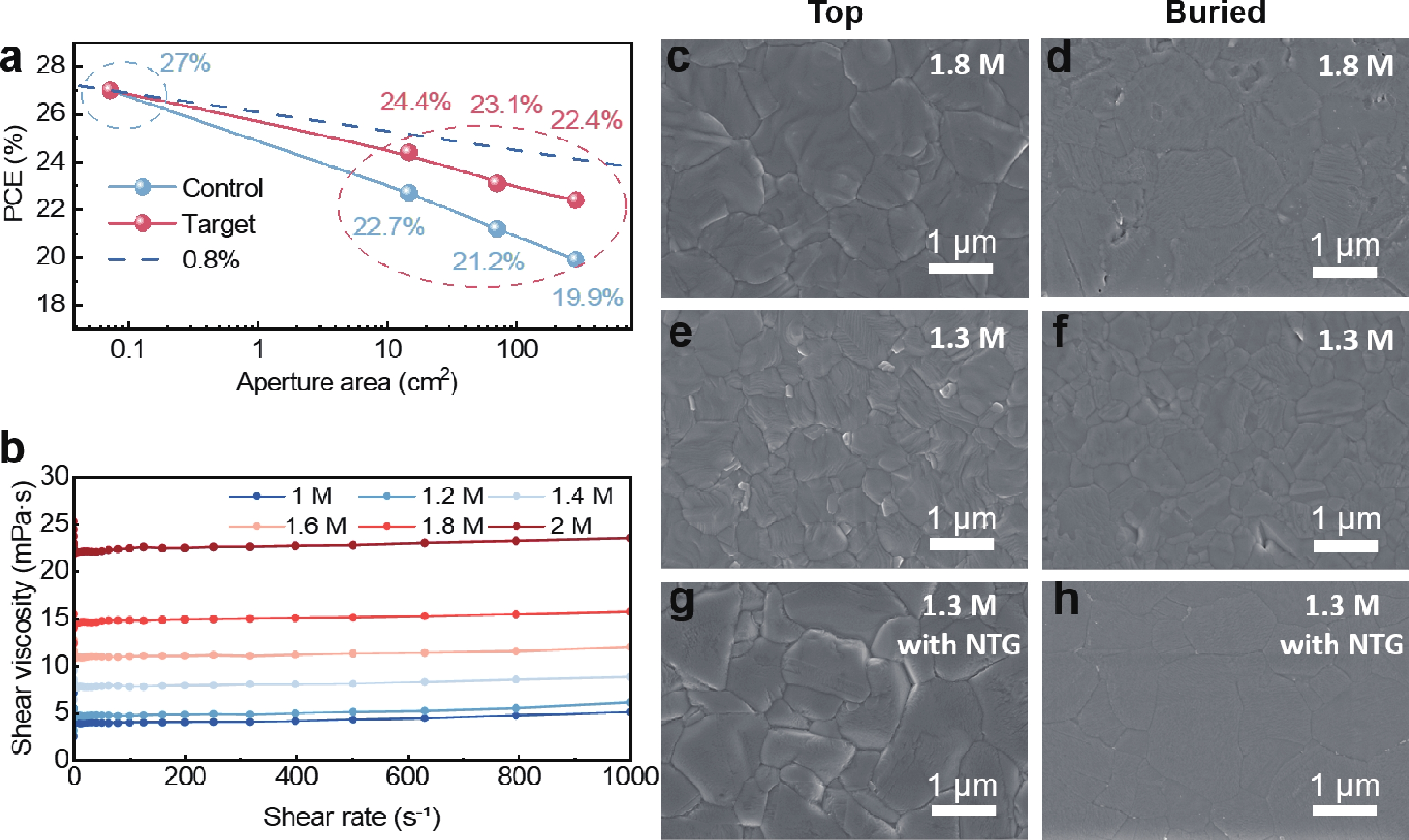
Fig. 1.  (Color online) Efficiency loss in perovskite modules with increasing device area. a, Power conversion efficiency of perovskite solar cells as a function of device area for control and target devices, where the dashed line represents the trend for state−of−the−art CdTe thin−film solar cells. b, Viscosity of the perovskite precursor solution as a function of concentration. c, d, The top and buried morphologies of perovskite films with traditional high concentration (1.8 M) used for small−area devices. e, f, The top and buried morphologies of perovskite films with traditional low concentration (1.3 M) used for large−area devices. g, h, The top and buried morphologies of perovskite films with 1.3 M precursor solution with NTG additive.

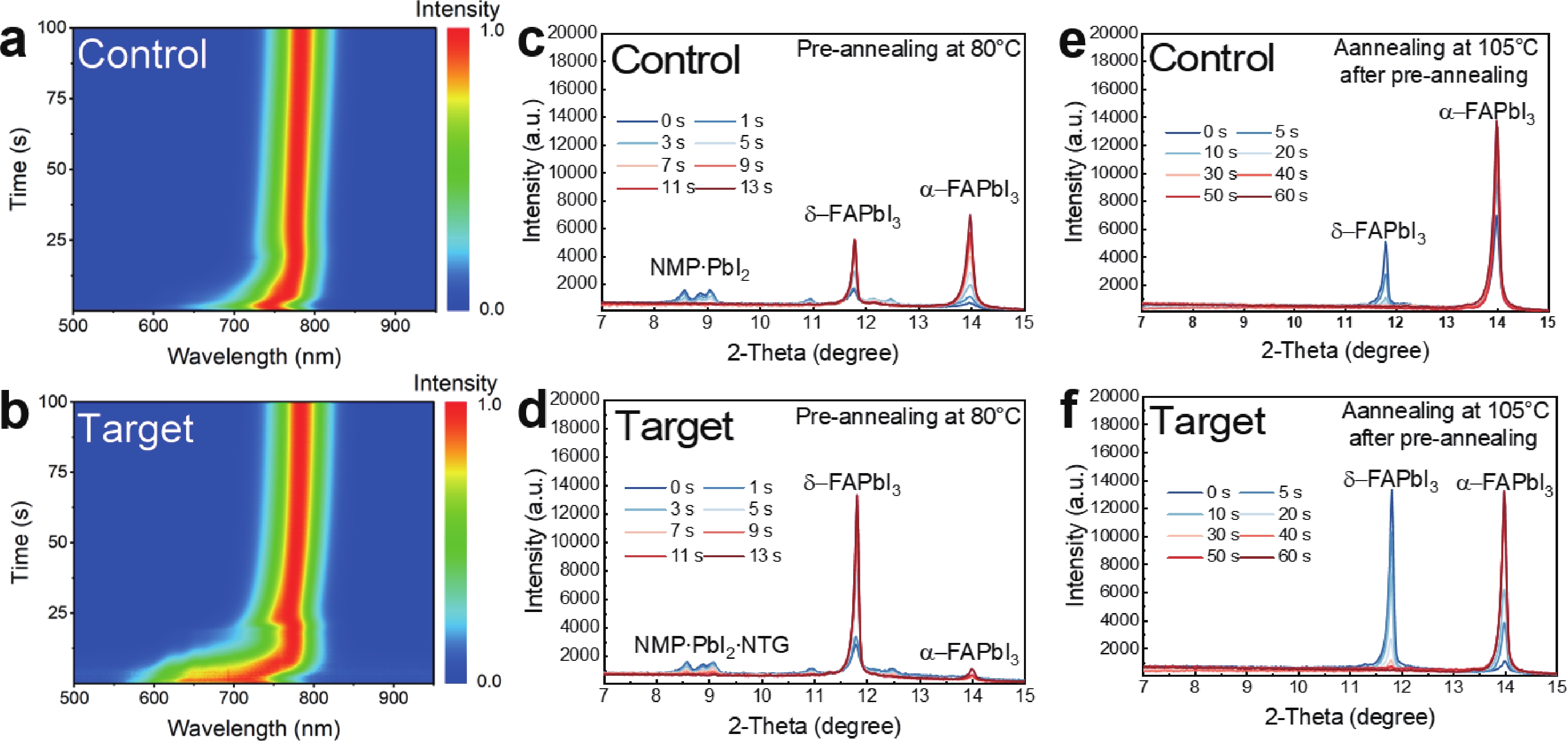
Fig. 2.  (Color online) Mechanism of NTG regulation on the intermediate phase of perovskite films. a, b In−situ photoluminescence (PL) monitoring during the perovskite film growth. c, d X−ray diffraction patterns of control (c) and target (d) perovskite precursor films annealed at 80 °C for different times. e, f, X−ray diffraction patterns of control (e) and target (f) perovskite films annealed at 105 °C after annealing the precursor film at 80 °C.

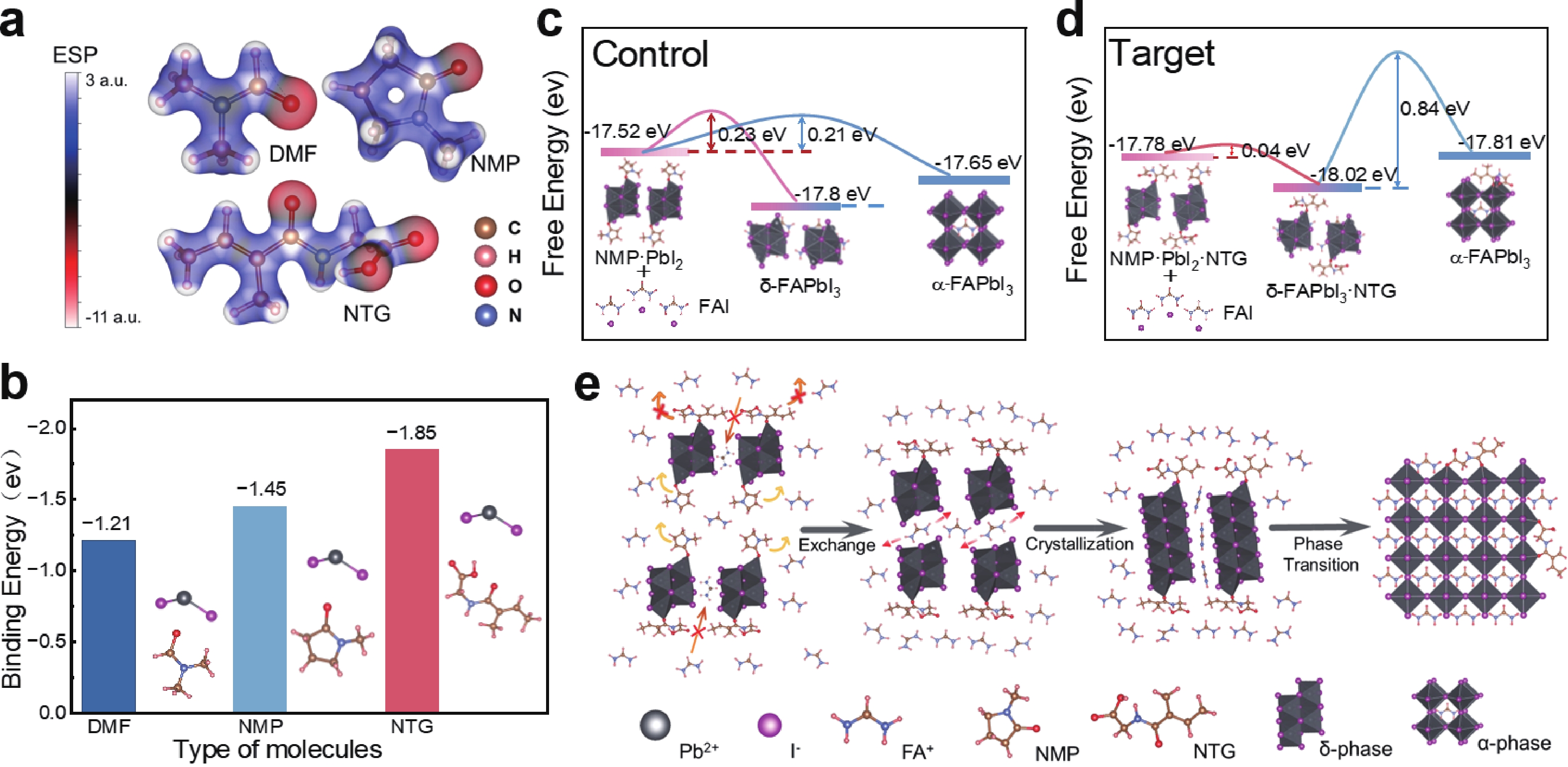
Fig. 3.  (Color online) Mechanism of NTG additive in modulating perovskite crystallization revealed by DFT calculations. a, Electrostatic potential surface maps of the solvents DMF, NMP, and the additive NTG. All results indicate that oxygen−containing groups act as negative charge centers. Notably, NTG contains two oxygen−containing groups. b, Binding energies of PbI2 with DMF, NMP and NTG. c, d, Free energy calculations for FAPbI3 perovskite formation without (c) and with (d) NTG, showing the calculated energy barriers of the different phases. e, Schematic diagram illustrating the crystal structure transformation from the perovskite solution to the final film with the NTG additive.

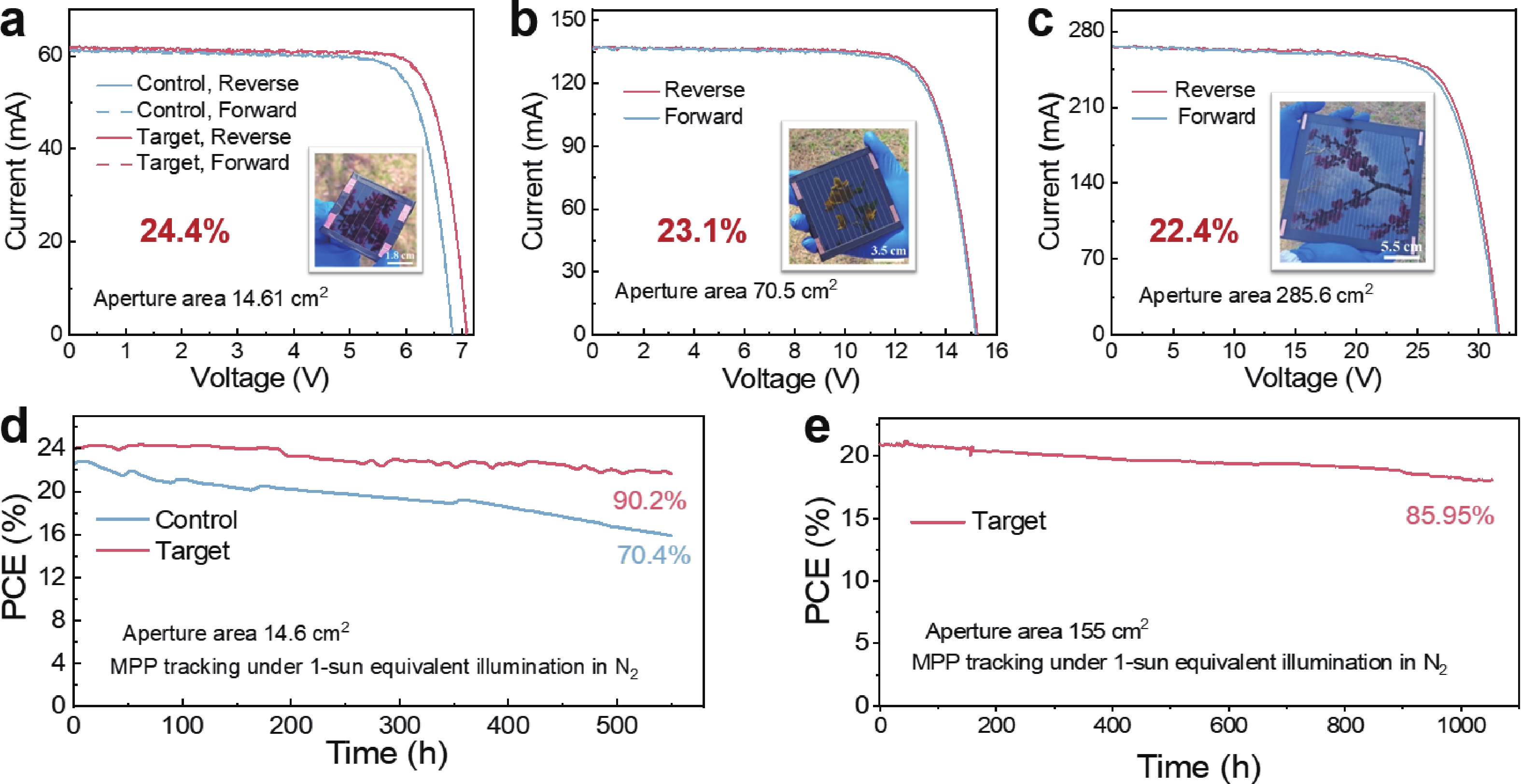
Fig. 4.  (Color online) Photovoltaic performance of perovskite modules. a−c, Current−voltage (I−V) curves of the 5 cm × 5 cm module (active area 14.6 cm2), 10 cm × 10 cm module (active area 70.5 cm2) and 20 cm × 20 cm module (active area 285.6 cm2). d, Maximum power point (MPP) tracking stability of the 5 cm × 5 cm module (active area 14.6 cm2) under continuous 1 sun illumination in a 50 ± 5 °C nitrogen environment for the control and target devices. e, Maximum power point (MPP) tracking stability of the 15 cm × 15 cm module (active area 155 cm2) under continuous 1 sun illumination in a 50 ± 5 °C nitrogen environment for the target device.

[1]
Xiong Z, Zhang Q, Cai K, et al. Homogenized chlorine distribution for >27% power conversion efficiency in perovskite solar cells. Science, 2025, 390(6773): 638 doi: 10.1126/science.adw8780
[2]
NREL. Best research−cell efficiency chart. Photovoltaic Research. http://dx.doi.org/https://www.nlr.gov/pv/cell−efficiency.html (accessed 16 March 2026)
[3]
Zhang Z H, Zhu R, Li G X, et al. Photoswitchable isomers to improve grain boundary resilience and perovskite solar cells stability under light cycling. Nat Energy, 2026, 11(4): 623 doi: 10.1038/s41560-026-01993-z
[4]
Liu S W, Miao T Y, Wang J N, et al. Solvated−intermediate−driven surface transformation of lead halide perovskites. Nat Energy, 2026, 11(1): 109
[5]
Li G X, Zhang Z H, Agyei−Tuffour B, et al. Stabilizing high−efficiency perovskite solar cells via strategic interfacial contact engineering. Nat Photonics, 2026, 20(1): 55 doi: 10.1038/s41566-025-01791-1
[6]
Green M A, Dunlop E D, Yoshita M, et al. Solar cell efficiency tables (version 67). Progress Photovoltaics, 2026, 34(4): 482 doi: 10.1002/pip.70068
[7]
Ding B, Ding Y, Peng J, et al. Dopant−additive synergism enhances perovskite solar modules. Nature, 2024, 628(8007): 299 doi: 10.1038/s41586-024-07228-z
[8]
Wu W P, Gao H, Jia L B, et al. Stable and uniform self−assembled organic diradical molecules for perovskite photovoltaics. Science, 2025, 389(6756): 195 doi: 10.1126/science.adv4551
[9]
Ding Y, Ding B, Shi P J, et al. Cation reactivity inhibits perovskite degradation in efficient and stable solar modules. Science, 2024, 386(6721): 531 doi: 10.1126/science.ado6619
[10]
Chu Z Y, Fan B J, Zhao Y, et al. Laser annealing enables rapid, degradation−free ambient processing of perovskite solar modules. Science, 2025, 390(6776): 905 doi: 10.1126/science.adx9650
[11]
Jiang W L, Qu G P, Huang X F, et al. Toughened self−assembled monolayers for durable perovskite solar cells. Nature, 2025, 646(8083): 95 doi: 10.1038/s41586-025-09509-7
[12]
Yang Y, Chen H, Liu C, et al. Amidination of ligands for chemical and field−effect passivation stabilizes perovskite solar cells. Science, 2024, 386(6724): 898 doi: 10.1126/science.adr2091
[13]
Chen H, Liu C, Xu J, et al. Improved charge extraction in inverted perovskite solar cells with dual−site−binding ligands. Science, 2024, 384(6692): 189 doi: 10.1126/science.adm9474
[14]
Park J, Kim J, Yun H S, et al. Controlled growth of perovskite layers with volatile alkylammonium chlorides. Nature, 2023, 616(7958): 724 doi: 10.1038/s41586-023-05825-y
[15]
Yu S Q, Xiong Z, Zhou H T, et al. Homogenized NiOxnanoparticles for improved hole transport in inverted perovskite solar cells. Science, 2023, 382(6677): 1399 doi: 10.1126/science.adj8858
[16]
Liu C, Yang Y, Chen H, et al. Bimolecularly passivated interface enables efficient and stable inverted perovskite solar cells. Science, 2023, 382(6672): 810 doi: 10.1126/science.adk1633
[17]
Kim M, Jeong J, Lu H Z, et al. Conformal quantum dot–SnO2 layers as electron transporters for efficient perovskite solar cells. Science, 2022, 375(6578): 302 doi: 10.1126/science.abh1885
[18]
Li Z, Li B, Wu X, et al. Organometallic−functionalized interfaces for highly efficient inverted perovskite solar cells. Science, 2022, 376(6591): 416 doi: 10.1126/science.abm8566
[19]
Jeong J, Kim M, Seo J, et al. Pseudo−halide anion engineering for α−FAPbI3 perovskite solar cells. Nature, 2021, 592(7854): 381
[20]
Liang Z, Zhang Y, Xu H F, et al. Homogenizing out−of−plane cation composition in perovskite solar cells. Nature, 2023, 624(7992): 557 doi: 10.1038/s41586-023-06784-0
[21]
Li S S, Jiang Y Z, Xu J, et al. High−efficiency and thermally stable FACsPbI3 perovskite photovoltaics. Nature, 2024, 635(8037): 82 doi: 10.1038/s41586-024-08103-7
[22]
Bi L Y, Wang J R, Zeng Z X, et al. Temperature−controlled vacuum quenching for perovskite solar modules towards scalable production. Nat Photonics, 2025, 19(9): 968 doi: 10.1038/s41566-025-01703-3
[23]
Yuan S H, Zheng D M, Zhang T, et al. Scalable preparation of perovskite films with homogeneous structure via immobilizing strategy for high−performance solar modules. Nat Commun, 2025, 16: 2052 doi: 10.1038/s41467-025-57303-w
[24]
Wang Y K, Liu Y, Luo X, et al. Improved solvent systems for commercially viable perovskite photovoltaic modules. Science, 2025, 390(6777): 1021 doi: 10.1126/science.adz0091
[25]
Liang Y G, Chen G D, Wang Y, et al. A matrix−confined molecular layer for perovskite photovoltaic modules. Nature, 2025, 648(8092): 91 doi: 10.1038/s41586-025-09785-3
[26]
Yang Y, Liu C, Ding Y, et al. A thermotropic liquid crystal enables efficient and stable perovskite solar modules. Nat Energy, 2024, 9(3): 316 doi: 10.1038/s41560-023-01444-z
[27]
Zhou H T, Cai K, Yu S Q, et al. Efficient and stable perovskite mini−module via high−quality homogeneous perovskite crystallization and improved interconnect. Nat Commun, 2024, 15: 6679
[28]
Fei C B, Li N X, Wang M R, et al. Lead−chelating hole−transport layers for efficient and stable perovskite minimodules. Science, 2023, 380(6647): 823
[29]
Shi P J, Ding Y, Ding B, et al. Oriented nucleation in formamidinium perovskite for photovoltaics. Nature, 2023, 620(7973): 323 doi: 10.1038/s41586-023-06208-z
[30]
Bu T L, Ono L K, Li J, et al. Modulating crystal growth of formamidinium–caesium perovskites for over 200 cm2 photovoltaic sub−modules. Nat Energy, 2022, 7(6): 528 doi: 10.1038/s41560-022-01039-0
[31]
Du M Y, Zhao S, Duan L J, et al. Surface redox engineering of vacuum−deposited NiOx for top−performance perovskite solar cells and modules. Joule, 2022, 6(8): 1931 doi: 10.1016/j.joule.2022.06.026
[32]
Yang Z C, Zhang W J, Wu S H, et al. Slot−die coating large−area formamidinium−cesium perovskite film for efficient and stable parallel solar module. Sci Adv, 2021, 7(18): eabg3749
[33]
Yoo J W, Jang J, Kim U, et al. Efficient perovskite solar mini−modules fabricated via bar−coating using 2−methoxyethanol−based formamidinium lead tri−iodide precursor solution. Joule, 2021, 5(9): 2420
[34]
Deng Y H, Xu S, Chen S S, et al. Defect compensation in formamidinium–caesium perovskites for highly efficient solar mini−modules with improved photostability. Nat Energy, 2021, 6(6): 633 doi: 10.1038/s41560-021-00831-8
[35]
Sun X N, Shi W D, Liu T J, et al. Vapor−assisted surface reconstruction enables outdoor−stable perovskite solar modules. Science, 2025, 388(6750): 957
[36]
Yan B Y, Dai W L, Wang Z, et al. 3D laminar flow–assisted crystallization of perovskites for square meter–sized solar modules. Science, 2025, 388(6749): eadt5001 doi: 10.1126/science.adt5001
[37]
Tao Z H, Song Y X, Wang B C, et al. Chemical vapor deposition for perovskite solar cells and modules. J Semicond, 2024, 45(4): 040201 doi: 10.1088/1674-4926/45/4/040201
[38]
Li F Z, Deng X, Shi Z S, et al. Hydrogen−bond−bridged intermediate for perovskite solar cells with enhanced efficiency and stability. Nat Photonics, 2023, 17(6): 478 doi: 10.1038/s41566-023-01180-6
[39]
Gao H, Xiao K, Lin R X, et al. Homogeneous crystallization and buried interface passivation for perovskite tandem solar modules. Science, 2024, 383(6685): 855 doi: 10.1126/science.adj6088
[40]
Fu S, Sun N N, Chen H, et al. On−demand formation of Lewis bases for efficient and stable perovskite solar cells. Nat Nanotechnol, 2025, 20(6): 772 doi: 10.1038/s41565-025-01900-9
[41]
Bu T L, Li J, Li H Y, et al. Lead halide–templated crystallization of methylamine−free perovskite for efficient photovoltaic modules. Science, 2021, 372(6548): 1327 doi: 10.1126/science.abh1035
[42]
Kresse G, Furthmüller J. Efficient iterative schemes for ab initio total−energy calculations using a plane−wave basis set. Phys Rev B, 1996, 54(16): 11169 doi: 10.1103/PhysRevB.54.11169
[43]
Perdew J P, Burke K, Ernzerhof M. Generalized gradient approximation made simple. Phys Rev Lett, 1996, 77(18): 3865 doi: 10.1103/PhysRevLett.77.3865
[44]
Blöchl P E. Projector augmented−wave method. Phys Rev B, 1994, 50(24): 17953
[45]
Wang V, Xu N, Liu J C, et al. VASPKIT: A user−friendly interface facilitating high−throughput computing and analysis using VASP code. Comput Phys Commun, 2021, 267: 108033
[46]
Momma K, Izumi F. VESTA 3for three−dimensional visualization of crystal, volumetric and morphology data. J Appl Crystallogr, 2011, 44(6): 1272

Supplementary Information.pdf

  • Search

    Advanced Search >>

    GET CITATION

    shu

    Export: BibTex EndNote

    Article Metrics

    Article views: 24 Times PDF downloads: 5 Times Cited by: 0 Times

    History

    Received: 28 April 2026 Revised: 13 May 2026 Online: Accepted Manuscript: 19 May 2026

    Catalog

      Email This Article

      User name:
      Email:*请输入正确邮箱
      Code:*验证码错误
      Kai Cai, Yibin Jiao, Zhuang Xiong, Hui Wang, Jiaxin Weng, Qian Zhang, Zhengchang Xia, Chen Zhang, Huixiong Deng, Xingwang Zhang, Haitao Zhou, Jingbi You. Stable intermediate phase regulation for high−performance and scalable perovskite solar cells[J]. Journal of Semiconductors, 2026, In Press. doi: 10.1088/1674-4926/26040046 ****K Cai, Y B Jiao, Z Xiong, H Wang, J X Weng, Q Zhang, Z C Xia, C Zhang, H X Deng, X W Zhang, H T Zhou, and J B You, Stable intermediate phase regulation for high−performance and scalable perovskite solar cells[J]. J. Semicond., 2026, accepted doi: 10.1088/1674-4926/26040046
      Citation:
      Kai Cai, Yibin Jiao, Zhuang Xiong, Hui Wang, Jiaxin Weng, Qian Zhang, Zhengchang Xia, Chen Zhang, Huixiong Deng, Xingwang Zhang, Haitao Zhou, Jingbi You. Stable intermediate phase regulation for high−performance and scalable perovskite solar cells[J]. Journal of Semiconductors, 2026, In Press. doi: 10.1088/1674-4926/26040046 ****
      K Cai, Y B Jiao, Z Xiong, H Wang, J X Weng, Q Zhang, Z C Xia, C Zhang, H X Deng, X W Zhang, H T Zhou, and J B You, Stable intermediate phase regulation for high−performance and scalable perovskite solar cells[J]. J. Semicond., 2026, accepted doi: 10.1088/1674-4926/26040046

      Stable intermediate phase regulation for high−performance and scalable perovskite solar cells

      DOI: 10.1088/1674-4926/26040046
      CSTR: 32376.14.1674-4926.26040046
      More Information
      • Kai Cai is a PhD student under Researcher Jingbi You at the Institute of Semiconductors, Chinese Academy of Sciences, and he is currently focusing on the research of high-efficiency and stable perovskite solar modules
      • Haitao Zhou received his Ph.D. degree from the School of Physics, Northeast Normal University in 2021. He completed his postdoctoral research at the Institute of Semiconductors, Chinese Academy of Sciences in 2025. He currently works at the School of Physics and Optoelectronic Engineering, Ludong University. His research focuses on perovskite/wide-bandgap oxide semiconductor materials and optoelectronic devices
      • Jingbi You is currently a full professor at the Institute of Semiconductors, Chinese Academy of Sciences (ISCAS). He received his Ph.D. degree in Material Sciences from ISCAS in 2010, and later, he did his postdoc at the University of California, Los Angeles, from 2010 to 2015, mainly working in organic tandem solar cells and perovskite solar cells. Since 2015, he joined ISCAS as a full professor. His present research interests are organic/inorganic semiconductor materials and their optoelectronic devices such as solar cells, LEDs, and detectors
      • Corresponding author: haitaozhou@semi.ac.cnjyou@semi.ac.cn
      • Received Date: 2026-04-28
      • Revised Date: 2026-05-13
      • Available Online: 2026-05-19

      Catalog

        /

        DownLoad:  Full-Size Img  PowerPoint
        Return
        Return