J. Semicond. >  Just Accepted

REVIEWS

Application of memristors for efficient neuromorphic computing in tactile sensing

Xintong Liu1, Rongrong Bao2, and Caofeng Pan2

+ Author Affiliations

 Corresponding author: Rongrong Bao, baorongrong@ucas.ac.cn

DOI: 10.1088/1674-4926/26050022CSTR: 32376.14.1674-4926.26050022

PDF

Turn off MathJax

Abstract: With the rapid development of the Internet of Things (IoT) and wearable electronics, tactile sensors play an indispensable role in intelligent sensing systems. However, traditional tactile sensing systems follow the von Neumann architecture, where sensors and processing units are physically separated. This leads to frequent data transfer of large raw data volumes, causing high latency and energy consumption. Such bottlenecks cannot meet the requirements of real-time closed-loop control and edge intelligence. Inspired by the highly integrated “perception-storage-computation” mechanism of biological sensory systems, memristor-based neuromorphic computing offers a groundbreaking solution beyond conventional approaches. Memristors combine non-volatile storage with tunable resistance. They enable in-situ emulation of synaptic plasticity, in-memory computing, and brain-inspired processing, thereby holding the potential to significantly improve the energy efficiency and response speed of tactile systems. This review systematically discusses the physical mechanisms of mainstream memristors, highlights recent progress in memristor-based neuromorphic computing for tactile sensing, and outlines key challenges and future directions for neuromorphic tactile perception systems.

Keywords: memristorflexible tactile sensingartificial synapseartificial neuron


[1]
Tang J S, Yuan F, Shen X K, et al. Bridging biological and artificial neural networks with emerging neuromorphic devices: fundamentals, progress, and challenges. Adv Mater, 2019, 31(49): 1902761 doi: 10.1002/adma.201902761
[2]
Gokmen T, Vlasov Y. Acceleration of deep neural network training with resistive cross-point devices: Design considerations. Front in Neurosci, 2016, 10: 333 doi: 10.3389/fnins.2016.00333
[3]
Mao Q Y, Zhu Z Q, Meng J L, et al. Intelligent flexible memristors for artificial synapses and neuromorphic computing. FlexMat, 2025, 2(2): 188 doi: 10.1002/flm2.45
[4]
Xu H C, Liu Y, Mo Y P, et al. All-fiber anti-jamming capacitive pressure sensors based on liquid metals. Rare Met, 2025, 44(7): 4839 doi: 10.1007/s12598-024-03071-3
[5]
He J Q, Wei R L, Ma X L, et al. Contactless user-interactive sensing display for human–human and human–machine interactions. Adv Mater, 2024, 36(25): 2401931 doi: 10.1002/adma.202401931
[6]
Zhu Z M, Chen K Y, Lin W E, et al. Recent advances in spike-based neural coding for tactile perception. Microsyst Nanoeng, 2025, 11: 212 doi: 10.1038/s41378-025-01074-3
[7]
Zimmerman A, Bai L, Ginty D D. The gentle touch receptors of mammalian skin. Science, 2014, 346(6212): 950 doi: 10.1126/science.1254229
[8]
Zhao Y, Gao W C, Dai K, et al. Bioinspired multifunctional photonic-electronic smart skin for ultrasensitive health monitoring, for visual and self-powered sensing. Adv Mater, 2021, 33(45): 2102332 doi: 10.1002/adma.202102332
[9]
Liu Y, Tao J, Mo Y P, et al. Ultrasensitive touch sensor for simultaneous tactile and slip sensing. Adv Mater, 2024, 36(21): 2313857 doi: 10.1002/adma.202313857
[10]
Abraira V E, Ginty D D. The sensory neurons of touch. Neuron, 2013, 79(4): 618 doi: 10.1016/j.neuron.2013.07.051
[11]
Pan C, Zhai J, Wang Z L. Piezotronics and Piezo-phototronics of Third Generation Semiconductor Nanowires. Chem Rev, 2019, 119(15): 9303 doi: 10.1021/acs.chemrev.8b00599
[12]
He J, Xiao P, Lu W, et al. A universal high accuracy wearable pulse monitoring system via high sensitivity and large linearity graphene pressure sensor. Nano Energy, 2019, 59: 422 doi: 10.1016/j.nanoen.2019.02.036
[13]
Gao G R, Yang F J, Zhou F H, et al. Bioinspired self-healing human–machine interactive touch pad with pressure-sensitive adhesiveness on targeted substrates. Adv Mater, 2020, 32(50): 2004290 doi: 10.1002/adma.202004290
[14]
Zhang Y-Q, Wang J-J, Lü Z-Y, et al. Multimode modulated memristors for in-sensor computing system. Acta Phys Sin, 2022, 71(14): 148502
[15]
Li X, Lin Y X, Cui L, et al. Stretchable and lithography-compatible interconnects enabled by self-assembled nanofilms with interlocking interfaces. ACS Appl Mater Interfaces, 2023, 15(48): 56233 doi: 10.1021/acsami.3c11760
[16]
Li X, Wu G C, Pan C F, et al. Recent progress in flexible sensors based on 2D materials. J Semicond, 2025, 46(1): 011607 doi: 10.1088/1674-4926/24090044
[17]
Li X, Wu G C, Gao C F, et al. Flexible electronic devices and wearable sensors based on liquid metals. MetalMat, 2025, 2(1): e70000 doi: 10.1002/metm.70000
[18]
Chen J Q, Liu X Q, Liu C, et al. Reconfigurable Ag/HfO2/NiO/Pt memristors with stable synchronous synaptic and neuronal functions for renewable homogeneous neuromorphic computing system. Nano Lett, 2024, 24(17): 5371 doi: 10.1021/acs.nanolett.4c01319
[19]
Lim E, Ismail R. Conduction mechanism of valence change resistive switching memory: A survey. Electronics, 2015, 4(3): 586 doi: 10.3390/electronics4030586
[20]
Chen J Y, Hsin C L, Huang C W, et al. Dynamic evolution of conducting nanofilament in resistive switching memories. Nano Lett, 2013, 13(8): 3671 doi: 10.1021/nl4015638
[21]
Chiu F C, Mondal S, Pan T M. Structural and electrical characteristics of alternative high‐ k dielectrics for CMOS applications. High‐k Gate Dielectrics for CMOS Technology, 2012, 111
[22]
Chiu F C. A review on conduction mechanisms in dielectric films. Adv Mater Sci Eng, 2014, 2014(1): 578168
[23]
Liu Y Z, Zhao J Y, Xiao Y, et al. Variation-resilient spike-timing-dependent plasticity in memristors using bursting neuron circuit. Neuromorph Comput and Eng, 2025, 5(2): 024013 doi: 10.1088/2634-4386/add9c0
[24]
Lee S H, Park H L, Kim M H, et al. Interfacial triggering of conductive filament growth in organic flexible memristor for high reliability and uniformity. ACS Appl Mater Interfaces, 2019, 11(33): 30108 doi: 10.1021/acsami.9b10491
[25]
Zhu M M, Ouyang H, Chen L Y, et al. Enhancement of stability and durability in MXene/TaOx bilayer memristor through hetero-interface engineering for neuromorphic computing. Carbon, 2026, 250: 121273 doi: 10.1016/j.carbon.2026.121273
[26]
Yin S Q, Luo Z C, Li Q, et al. Emulation of learning and memory behaviors by memristor based on Ag migration on 2D MoS2 surface. Phys Status Solidi A, 2019, 216(14): 1900104 doi: 10.1002/pssa.201900104
[27]
Waser R, Aono M. Nanoionics-based resistive switching memories. Nat Mater, 2007, 6(11): 833 doi: 10.1038/nmat2023
[28]
Valov I, Waser R, Jameson J R, et al. Electrochemical metallization memories: Fundamentals, applications, prospects. Nanotechnology, 2011, 22(25): 254003
[29]
Jang M, Song H C, Kim H J, et al. Multielement filament memristor enabling multifunctional neuromorphic device. Adv Funct Mater, 2025, 35(24): 2423273 doi: 10.1002/adfm.202423273
[30]
Park S O, Hong S, Sung S J, et al. Phase-change memory via a phase-changeable self-confined nano-filament. Nature, 2024, 628(8007): 293 doi: 10.1038/s41586-024-07230-5
[31]
Zhang W, Mazzarello R, Wuttig M, et al. Designing crystallization in phase-change materials for universal memory and neuro-inspired computing. Nat Rev Mater, 2019, 4(3): 150 doi: 10.1038/s41578-018-0076-x
[32]
Karpov I, Savransky S, Karpov V. Mechanism of threshold switching in chalcogenide phase change memory devices. 2007 22nd IEEE Non-Volatile Semiconductor Memory Workshop, 2007: 56
[33]
Le Gallo M, Sebastian A. Phase-change memory. Memristive Devices for Brain-Inspired Computing. Amsterdam: Elsevier. 2020: 223
[34]
Ballmaier J, Walfort S, Salinga M. Resistance drift of phase change materials beyond the power law. Adv Electron Mater, 2025, 11(11): 2400905 doi: 10.1002/aelm.202400905
[35]
Nandakumar S R, Boybat I, Han J P, et al. Precision of synaptic weights programmed in phase-change memory devices for deep learning inference. 2020 IEEE International Electron Devices Meeting (IEDM). San Francisco, CA, USA. IEEE, 2020: 29.4. 1
[36]
Walfort S, Vu X T, Ballmaier J, et al. A free energy landscape analysis of resistance fluctuations in a memristive device. Nat Mater, 2026, 25(4): 643 doi: 10.1038/s41563-026-02487-9
[37]
Lim D H, Wu S, Zhao R, et al. Spontaneous sparse learning for PCM-based memristor neural networks. Nat Commun, 2021, 12: 319 doi: 10.1038/s41467-020-20519-z
[38]
Ambrogio S, Narayanan P, Okazaki A, et al. An analog-AI chip for energy-efficient speech recognition and transcription. Nature, 2023, 620(7975): 768 doi: 10.1038/s41586-023-06337-5
[39]
Ren H H, Li F F, Wang M, et al. An ion‐mediated spiking chemical neuron based on Mott memristor. Adv Mater, 2024, 36(33): 2403678 doi: 10.1002/adma.202403678
[40]
Zhou Y, Ramanathan S. Mott memory and neuromorphic devices. Proc IEEE, 2015, 103(8): 1289 doi: 10.1109/JPROC.2015.2431914
[41]
Cavalleri A, Dekorsy T, Chong H H W, et al. Evidence for a structurally-driven insulator-to-metal transition in VO2: A view from the ultrafast timescale. Phys Rev, B, 2004(16): 161102
[42]
Peronaci F, Ameli S, Takayoshi S, et al. Mott memristors based on field-induced carrier avalanche multiplication. Phys Review B, 2023, 107(7): 075154 doi: 10.1103/PhysRevB.107.075154
[43]
Humbert V, El Hage R, Krieger G, et al. An oxygen vacancy memristor ruled by electron correlations. Adv Sci, 2022, 9(27): 2201753 doi: 10.1002/advs.202201753
[44]
Yi W. Nonlinear dynamics and stability analysis of locally active Mott memristors using a physics-based compact model. Front Mater, 2025, 12: 1465852 doi: 10.3389/fmats.2025.1465852
[45]
Maji P, Rahaman A, Dey J K, et al. Ultra-low electric field induced volatile resistive switching in hole-doped MgTi2O4. Adv Mater, 2026, 38(12): e18981 doi: 10.1002/adma.202518981
[46]
Stoliar P, Tranchant J, Corraze B, et al. A leaky-integrate-and-fire neuron analog realized with a Mott insulator. Adv Funct Mater, 2017, 27(11): 1604740 doi: 10.1002/adfm.201604740
[47]
Zhao L, Fang H, Wang J, et al. Ferroelectric artificial synapses for high-performance neuromorphic computing: Status, prospects, and challenges. Appl Phys Lett, 2024, 124(3): 030501 doi: 10.1063/5.0165029
[48]
Xue F, He X, Ma Y C, et al. Unraveling the origin of ferroelectric resistance switching through the interfacial engineering of layered ferroelectric-metal junctions. Nat Commun, 2021, 12: 7291 doi: 10.1038/s41467-021-27617-6
[49]
Du J M, Sun B, Yang C, et al. Ferroelectric memristor and its neuromorphic computing applications. Mater Today Phys, 2025, 50: 101607 doi: 10.1016/j.mtphys.2024.101607
[50]
Chen A P, Zhang W R, Dedon L R, et al. Couplings of polarization with interfacial deep trap and Schottky interface controlled ferroelectric memristive switching. Adv Funct Mater, 2020, 30(43): 2000664 doi: 10.1002/adfm.202000664
[51]
Yue Z Y, Zhang Z D, Wang Z J. Enhanced memristor performance via coupling effect of oxygen vacancy and ferroelectric polarization. J Mater Sci Technol, 2024, 171: 139 doi: 10.1016/j.jmst.2023.07.007
[52]
Liu K Q, Bao L, Wang J R, et al. A dual-ferroelectric gate-tunable memristor for physically-implemented nonlinear computing. InfoMat, 2026, 8(1): e70083 doi: 10.1002/inf2.70083
[53]
Nirmal K A, Kumbhar D D, Kesavan A V, et al. Advancements in 2D layered material memristors: Unleashing their potential beyond memory. npj 2D Mater Appl, 2024, 8: 83 doi: 10.1038/s41699-024-00522-4
[54]
Qiu X Y, Zhu J X, Liu L Y. Uncertain leaky integrate-and-fire neuron equation. J Uncert Sys, 2024, 17(4): 2450006 doi: 10.1142/S1752890924500065
[55]
Zhang X M, Zhuo Y, Luo Q, et al. An artificial spiking afferent nerve based on Mott memristors for neurorobotics. Nat Commun, 2020, 11: 51 doi: 10.1038/s41467-019-13827-6
[56]
Jang J, Park W. Demonstration of Pavlov associative memory by implementation of rate coding using magnetic tunnel junction neurons. 2023 IEEE International Magnetic Conference - Short Papers (INTERMAG Short Papers). Sendai, Japan. IEEE, 2023: 1
[57]
Zhang X M, Wu Z H, Lu J K, et al. Fully memristive SNNs with temporal coding for fast and low-power edge computing. 2020 IEEE International Electron Devices Meeting (IEDM). San Francisco, CA, USA. IEEE, 2020: 29.6. 1
[58]
You S X, Hong S J, Chen K T, et al. Self-rectifying dynamic memristor circuits for periodic LIF refractory period emulation and TTFS/rate signal encoding. Small, 2025, 21(15): 2408233 doi: 10.1002/smll.202408233
[59]
Xiao Y, Liu Y Z, Zhang B H, et al. Bio-plausible reconfigurable spiking neuron for neuromorphic computing. Sci Adv, 2025, 11(6): eadr6733 doi: 10.1126/sciadv.adr6733
[60]
Duan Q X, Jing Z K, Zou X L, et al. Spiking neurons with spatiotemporal dynamics and gain modulation for monolithically integrated memristive neural networks. Nat Commun, 2020, 11: 3399 doi: 10.1038/s41467-020-17215-3
[61]
Kim S, Shin D H, Choi W, et al. Spatiotemporal reservoir computing with a reconfigurable multifunctional memristor array. Adv Mater, 2026, 38(3): e10635 doi: 10.1002/adma.202510635
[62]
Kim S J, Kim S, Jang H W. Competing memristors for brain-inspired computing. iScience, 2021, 24(1): 101889 doi: 10.1016/j.isci.2020.101889
[63]
Zhang Y, Wang Z R, Zhu J D, et al. Brain-inspired computing with memristors: Challenges in devices, circuits, and systems. Appl Phys Rev, 2020, 7: 011308 doi: 10.1063/1.5124027
[64]
Kumar A, Preeti K, Singh S P, et al. ZnO-based hybrid nanocomposite for high-performance resistive switching devices: Way to smart electronic synapses. Mater Today, 2023, 69: 262 doi: 10.1016/j.mattod.2023.09.003
[65]
Liu J X, Song H J, Yao L Y, et al. Bidirectional optimization of STDP conductance update characteristics for neural computing. J Mater Chem C, 2026, 14(5): 1851 doi: 10.1039/D5TC03580E
[66]
Roy K, Jaiswal A, Panda P. Towards spike-based machine intelligence with neuromorphic computing. Nature, 2019, 575(7784): 607 doi: 10.1038/s41586-019-1677-2
[67]
Song H C, Park W, Kim G, et al. Memristive explainable artificial intelligence hardware. Adv Mater, 2024, 36(25): 2400977 doi: 10.1002/adma.202400977
[68]
Xu J S, Xue P Y, Song J C, et al. HLML-SNN: Fast continual learning in spiking neural networks achieved via hebbian learning-driven meta-learning. Proc AAAI Conf Artif Intell, 2026, 40(32): 27260 doi: 10.1609/aaai.v40i32.39942
[69]
Abraham W C. Metaplasticity: Tuning synapses and networks for plasticity. Nat Rev Neurosci, 2008, 9(5): 387 doi: 10.1038/nrn2356
[70]
Fan X M, Chen A Z, Li Z W, et al. Metaplasticity-enabled graphene quantum dot devices for mitigating catastrophic forgetting in artificial neural networks. Adv Mater, 2025, 37(6): 2570051 doi: 10.1002/adma.202570051
[71]
Kim Y, Li Y H, Moitra A, et al. Sharing leaky-integrate-and-fire neurons for memory-efficient spiking neural networks. Front Neurosci, 2023, 17: 1230002 doi: 10.3389/fnins.2023.1230002
[72]
Li B, Liu Y Q, Wan C J, et al. Mediating short-term plasticity in an artificial memristive synapse by the orientation of silica mesopores. Adv Mater, 2018, 30(16): 1706395 doi: 10.1002/adma.201706395
[73]
Kim Y, Kwon Y J, Kwon D E, et al. Nociceptive Memristor. Adv Mater, 2018, 30(8): 1704320 doi: 10.1002/adma.201704320
[74]
Weilenmann C, Ziogas A N, Zellweger T, et al. Single neuromorphic memristor closely emulates multiple synaptic mechanisms for energy efficient neural networks. Nat Commun, 2024, 15: 6898 doi: 10.1038/s41467-024-51093-3
[75]
Xia X W, Huang W, Hang P J, et al. 2D-material-based volatile and nonvolatile memristive devices for neuromorphic computing. ACS Mater Lett, 2023, 5(4): 1109 doi: 10.1021/acsmaterialslett.2c01026
[76]
Tiw P J, Yuan R, Zhang T, et al. An end-to-end memristive hardware system based on single-spike coding for human–machine interfaces. Nat Electron, 2026, 9(2): 225 doi: 10.1038/s41928-025-01544-6
[77]
Dang B J, Zhang T, Meng F Q, et al. Spiking neural networks with fatigue spike-timing-dependent plasticity learning using hybrid memristor arrays. Nat Electron, 2026, 9(2): 213 doi: 10.1038/s41928-025-01554-4
[78]
Wang Z R, Joshi S, Savel’ev S E, et al. Memristors with diffusive dynamics as synaptic emulators for neuromorphic computing. Nat Mater, 2017, 16(1): 101 doi: 10.1038/nmat4756
[79]
Shi L Y, Zheng G H, Tian B B, et al. Research progress on solutions to the sneak path issue in memristor crossbar arrays. Nanoscale Adv, 2020, 2(5): 1811 doi: 10.1039/D0NA00100G
[80]
Zhao Z X, Tang J S, Yuan J, et al. Large-scale integrated flexible tactile sensor array for sensitive smart robotic touch. ACS Nano, 2022, 16(10): 16784 doi: 10.1021/acsnano.2c06432
[81]
Chaurasiya R, Shih L C, Chen K-T, et al. Emerging higher-order memristors for bio-realistic neuromorphic computing: A review. Mater Today, 2023, 68: 356 doi: 10.1016/j.mattod.2023.08.002
[82]
Park S O, Jeong H, Seo S, et al. Experimental demonstration of third-order memristor-based artificial sensory nervous system for neuro-inspired robotics. Nat Commun, 2025, 16: 5754 doi: 10.1038/s41467-025-60818-x
[83]
Kim S, Du C, Sheridan P, et al. Experimental Demonstration of a second-order memristor and its ability to biorealistically implement synaptic plasticity. Nano Letters, 2015, 15(3): 2203 doi: 10.1021/acs.nanolett.5b00697
[84]
Cho J Y, Kim S E, Beak C J, et al. Tactile near-sensor computing systems incorporating hourglass-shaped microstructured capacitive sensors for bio-realistic energy efficiency. npj Flex Electron, 2025, 9: 34 doi: 10.1038/s41528-025-00415-6
[85]
Xie Y, Kundu S C, Fan S, et al. Memristor-based artificial tactile perception systems with integrated functions of sensing, storage and computing. Sci China Mater, 2024, 67(11): 3675 doi: 10.1007/s40843-024-3072-4
[86]
Li Z Y, Li Z S, Tang W, et al. Crossmodal sensory neurons based on high-performance flexible memristors for human-machine in-sensor computing system. Nat Commun, 2024, 15: 7275 doi: 10.1038/s41467-024-51609-x
[87]
Kim K K, Bang J, Kim M, et al. Unisensory processing of interleaving memristive nanowires enabling multimodal sensing at human-scale resolution. Nat Mater, 2026, 25(3): 463 doi: 10.1038/s41563-025-02373-w
[88]
Chen Z F, Chen C Y, Huang Y F. Tactile and visual artificial synaptic devices: Progress and challenges. Electron Mater, 2026, 7(2): 8 doi: 10.3390/electronicmat7020008
[89]
Liu X S, Qiu J, Li B, et al. Highly flexible and robust HfOx-based memristor for wearable in-memory computing. Appl. Phys. Lett. 18, 2023, 123(25): 253502 doi: 10.1063/5.0169341
[90]
Zhong S, Su L R, Xu M K, et al. Recent advances in artificial sensory neurons: Biological fundamentals, devices, applications, and challenges. Nano Micro Lett, 2024, 17(1): 61 doi: 10.1007/s40820-024-01550-x
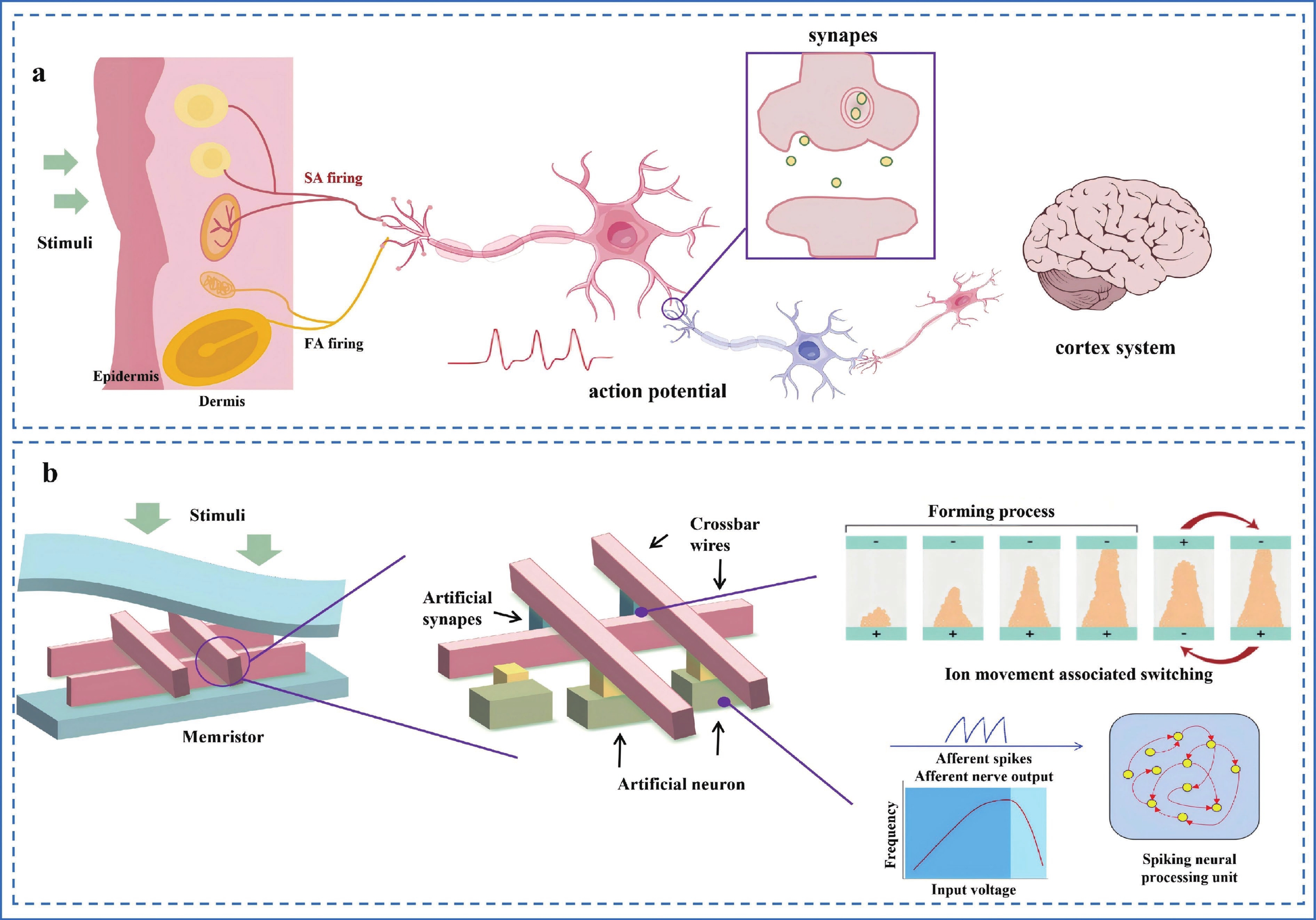
Fig. 1.  (Color online) Memristors can mimic human tactile sensing systems and are applicable to artificial neurons and artificial synapses. (a) Human tactile sensing system. (b) Different types of neural networks architectures.These neural networks can be mapped to the intersection matrix of artificial synapses and neurons. Copyright 2019, Wiley. Copyright 2020, Nature Publishing Group.

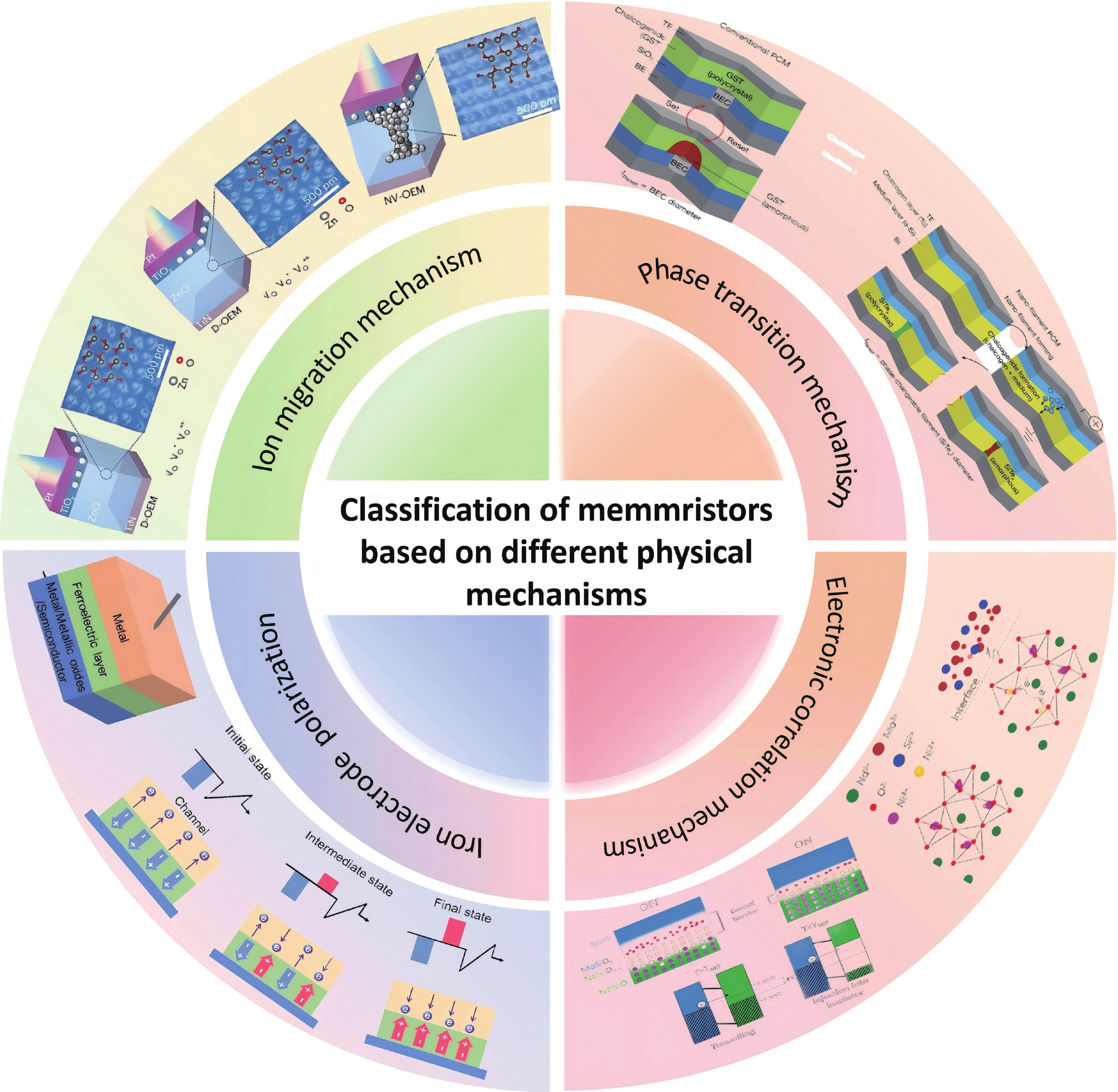
Fig. 2.  (Color online) Classification of memristors based on different physical mechanisms. Copyright 2024, American Institute of Physics. Copyright 2024, Springer Nature. Copyright 2022, Wiley.

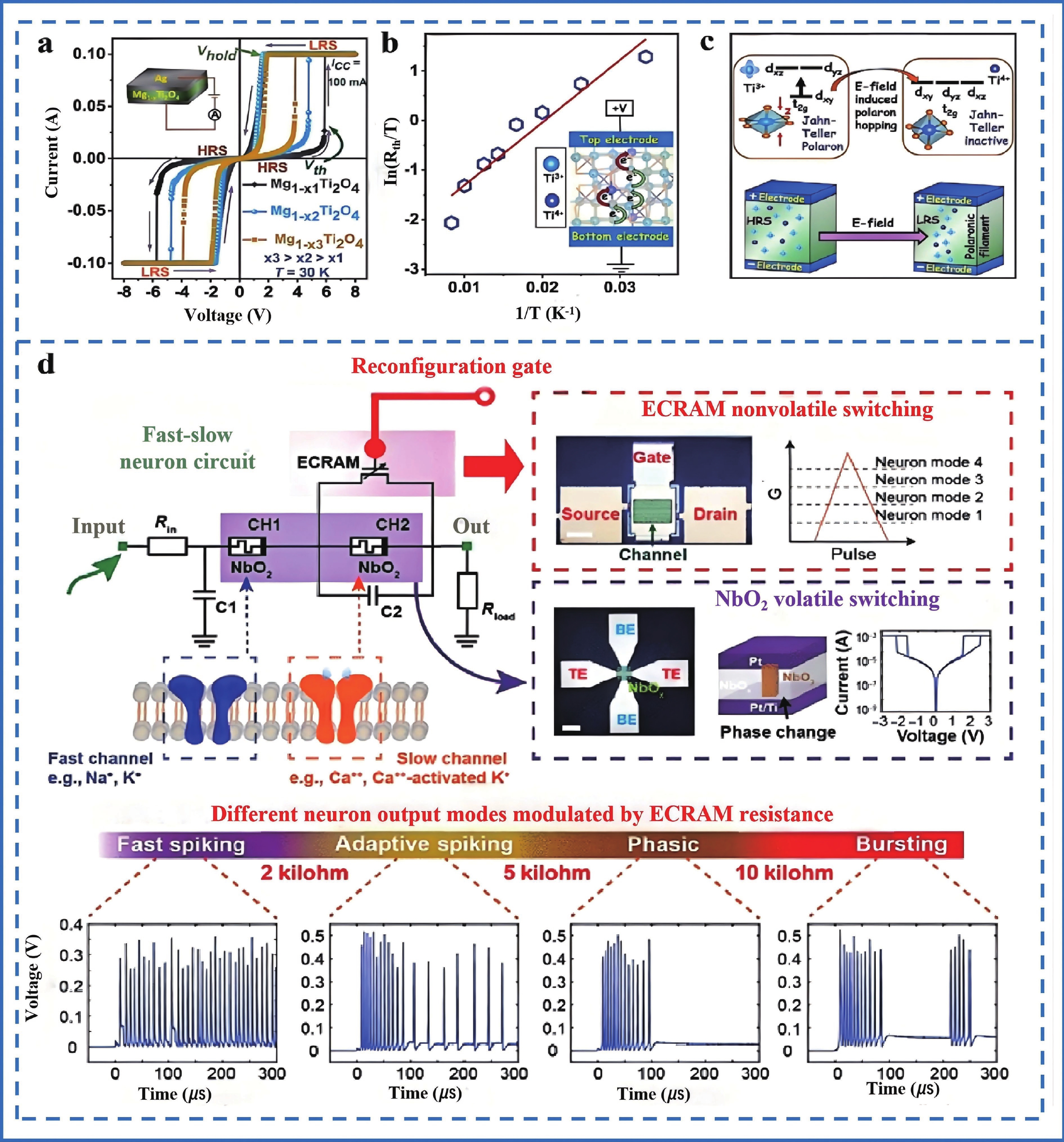
Fig. 3.  (Color online) LIF neuron model with time encoding mechanism. (a–c) Realization of single-device LIF neuronal functionality in the MgTi2O4 system[45]. Copyright 2026, Wiley. (a) Threshold-driven resistance switching at different magnesium vacancy concentrations; (b) Schematic diagram of the driving mechanism for resistance transition phenomena; (c) Electric field-induced Jahn-Teller polarons jumping from Ti3+ sites to Ti4+ sites, followed by polarization filament formation along the electric field direction, resulting in resistance switching. (d) Spike-element neural systems with reconfigurable properties[59]. Copyright 2026, Wiley.

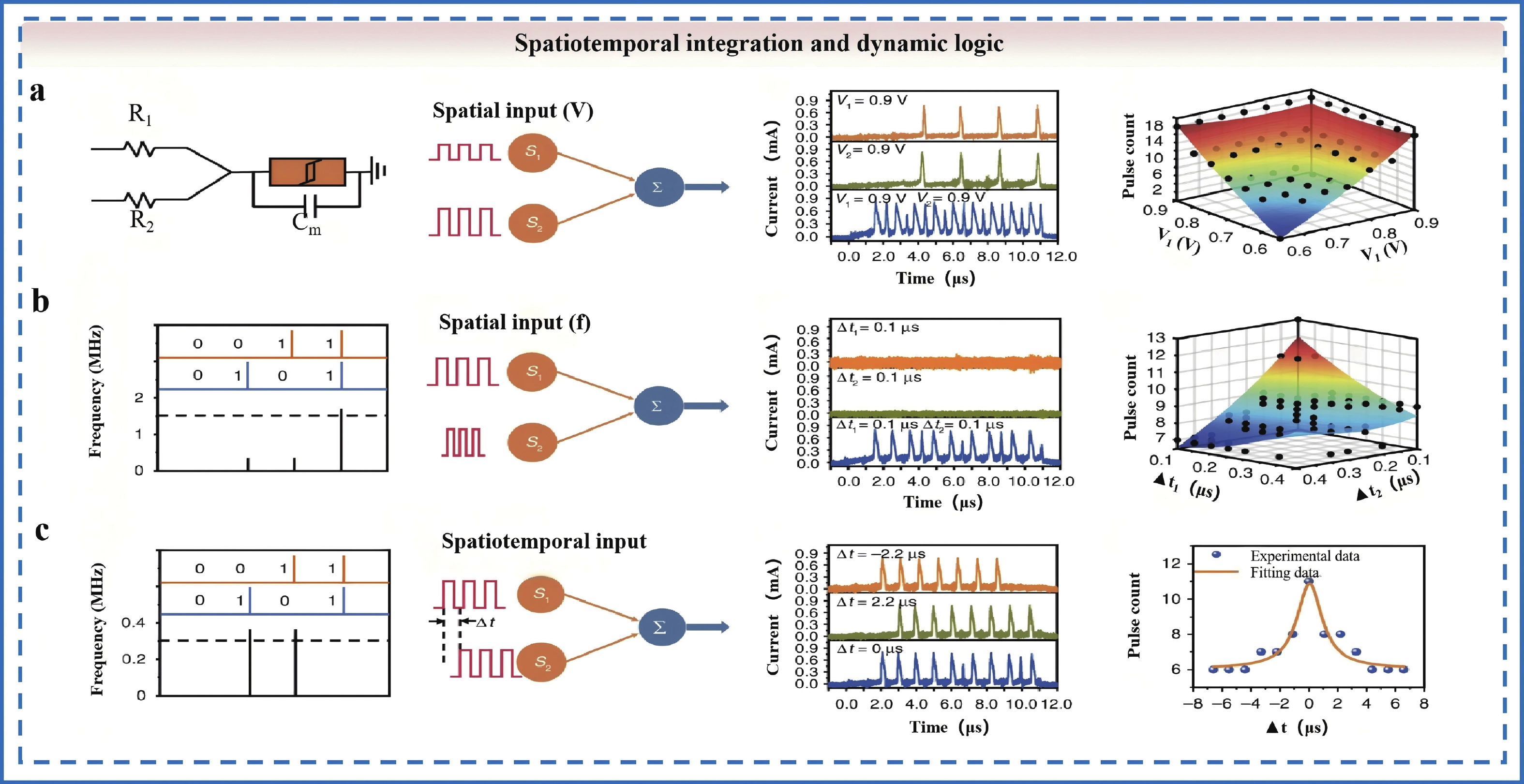
Fig. 4.  (Color online) LIF neuron model with spatiotemporal encoding mechanism[60]. (a) Spatial Summation. (b) AND logic and temporal regulation of spatial summation. (c) XOR logic and spatiotemporal summation. Copyright 2020, Springer Nature.

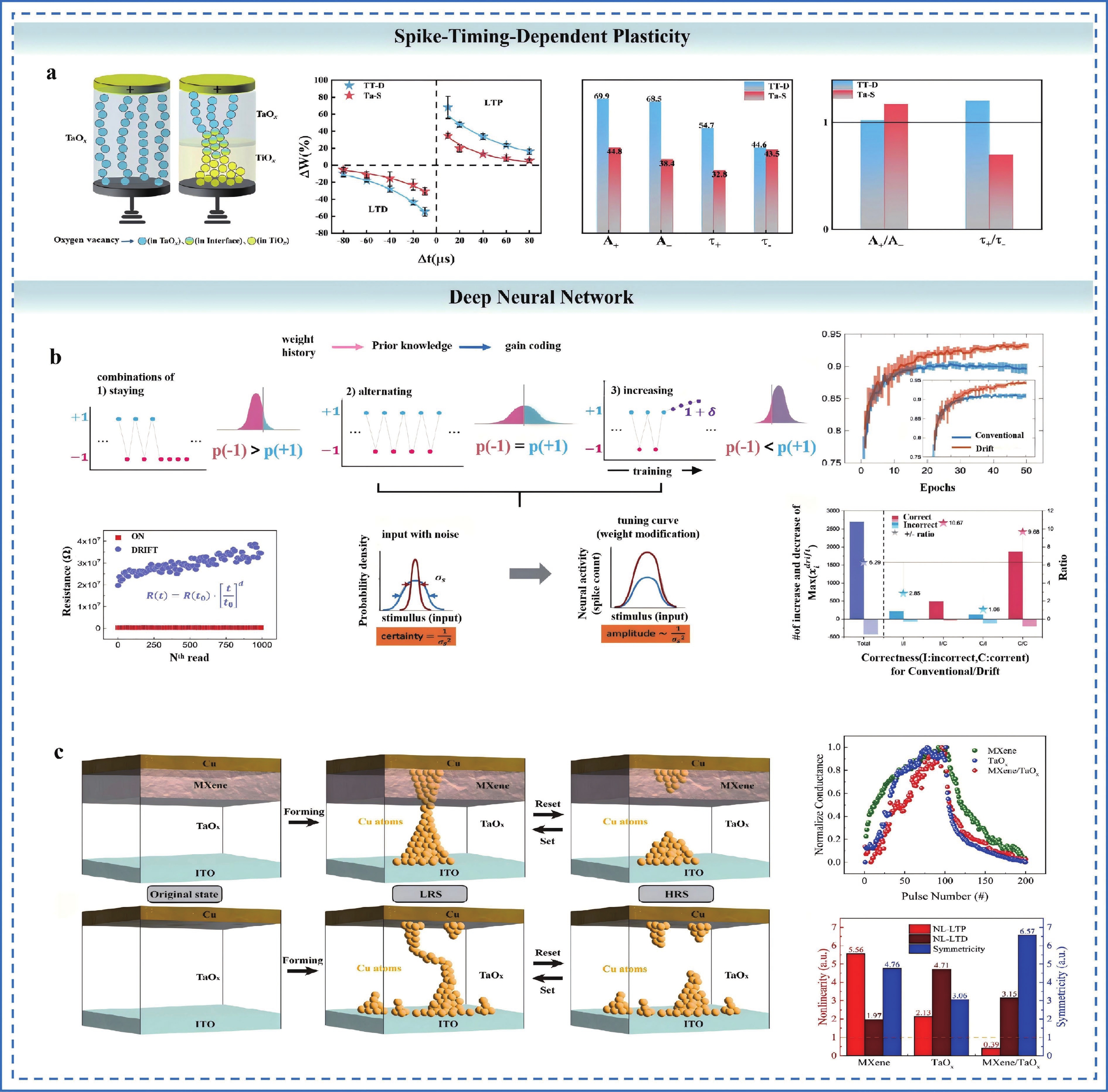
Fig. 5.  (Color online) (a) Memristive synapses dependent on local learning rules such as spike-timing-dependent plasticity (STDP). Pulse-time-varying plasticity of Ta-S and TT-D devices; Fitting parameters of STDP for Ta-S and TT-D devices; Ratio of STDP fitting parameters for Ta-S and TT-D devices[65]. Copyright 2026, Royal Society of Chemistry. (b–c) Memristive synapses via backpropagation algorithm. (b) Utilizing PCM resistance drift as a learning mechanism to enhance supervised learning performance[37]. Comparison of classification accuracy between traditional neural networks and drifting neural networks. Copyright 2021, Springer Nature. (c) Enhancing synaptic plasticity of memristors in supervised learning tasks through interface modification. The conductivity gradients of the three devices under bipolar pulse sequences and the nonlinearity and symmetry of LTP/LTD curves were compared. Copyright 2026, Elsevier.

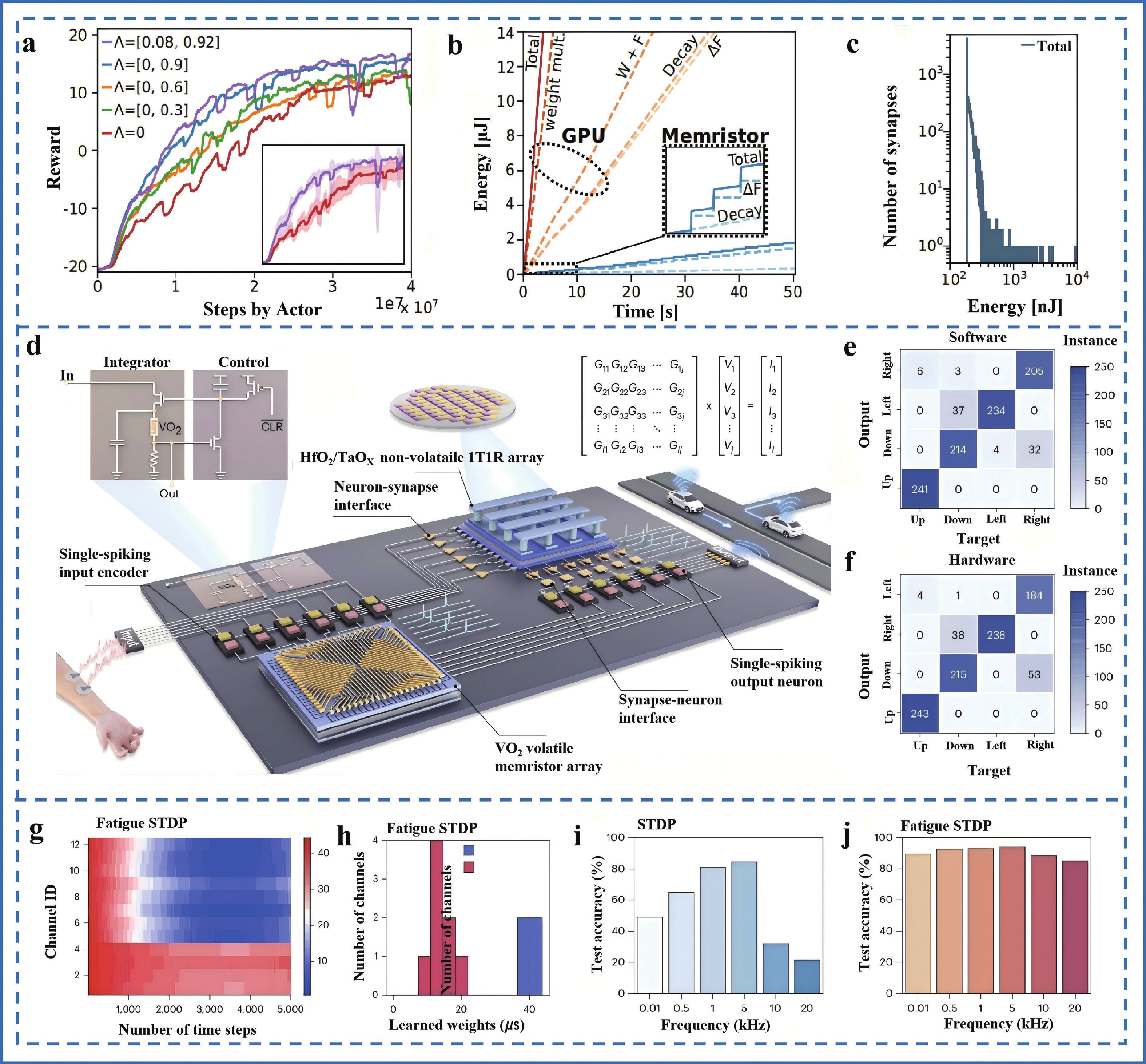
Fig. 6.  (Color online) (a–c) Exploits the short-term (volatile) plasticity of the device to enhance the performance of deep neural networks in dynamic environments[74]. Copyright 2024, Springer Nature. (a) The average reward curve under different parameter ranges (Λ). (b) Comparison of synaptic energy consumption, cumulative energy consumption curves for pure GPU implementation versus the memristor-based implementation described in this paper. (c) Total energy histogram. (d–f) Achieving ultra-high energy efficiency and low latency in end-to-end systems through high-precision encoding of volatile devices and high-reliability computation of non-volatile devices[76]. Copyright 2026, Springer Nature. (d)Conceptual diagram of all-memory-resistive single-pulse HMI. (e) Confusion matrix based on software-based classification. (f) Confusion matrix of hardware-based classification, demonstrating the minimal accuracy degradation. (g–j) Enhancing the learning capability of SNNs in complex spatiotemporal information through fatigue dynamics of volatile devices[77]. Copyright 2026, Springer Nature. (g) Displaying the evolution of resistance weight (W) for presynaptic spikes. (h) Fatigue STDP can clearly separate correlated and uncorrelated synapses, enhancing the former while inhibiting the latter. The comparison between the accuracy of (i) STDP testing and (j) fatigue STDP learning at input frequencies ranging from 10 Hz to 500 kHz demonstrates that traditional STDP exhibits frequency sensitivity, whereas fatigue STDP remains stable.

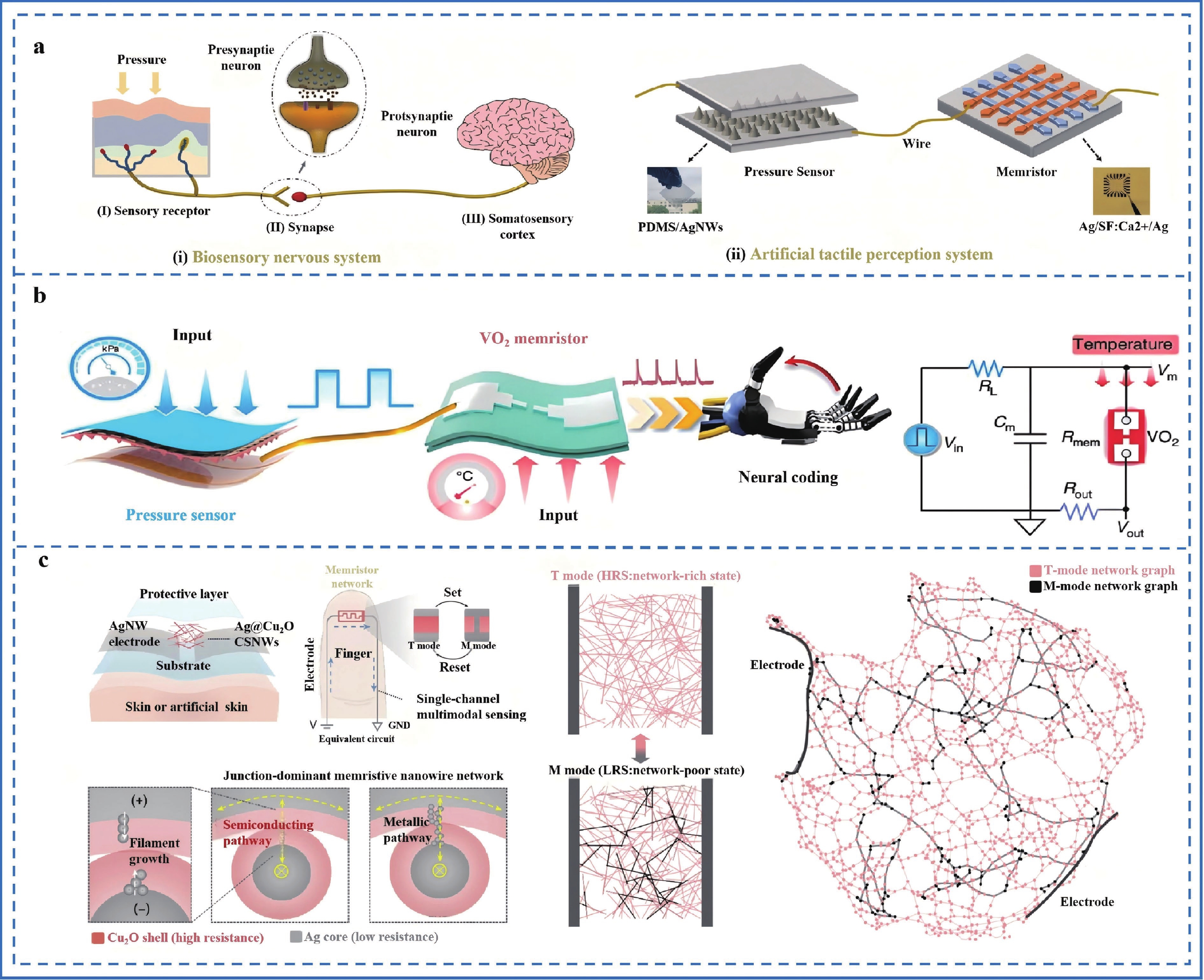
Fig. 7.  (Color online) (a) A piezoresistive pressure sensor and silk fibroin-based composite memristor are connected in series to simulate the human tactile system. Copyright 2024, Science China Press. (b) Schematic diagram of neural encoding and feedback artificial CSSN within multimodal sensors, along with a circuit diagram of artificial peak temperature sensing neurons. Copyright 2024, Springer Nature. (c) Dynamic switching of sensing modes for single-material systems. Multimodal receptors and hierarchical assembly of core-shell nanowires (CSNWs). The equivalent circuit representation enables the acquisition of multimodal information through a single-channel architecture. Copyright 2025, Springer Nature.

[1]
Tang J S, Yuan F, Shen X K, et al. Bridging biological and artificial neural networks with emerging neuromorphic devices: fundamentals, progress, and challenges. Adv Mater, 2019, 31(49): 1902761 doi: 10.1002/adma.201902761
[2]
Gokmen T, Vlasov Y. Acceleration of deep neural network training with resistive cross-point devices: Design considerations. Front in Neurosci, 2016, 10: 333 doi: 10.3389/fnins.2016.00333
[3]
Mao Q Y, Zhu Z Q, Meng J L, et al. Intelligent flexible memristors for artificial synapses and neuromorphic computing. FlexMat, 2025, 2(2): 188 doi: 10.1002/flm2.45
[4]
Xu H C, Liu Y, Mo Y P, et al. All-fiber anti-jamming capacitive pressure sensors based on liquid metals. Rare Met, 2025, 44(7): 4839 doi: 10.1007/s12598-024-03071-3
[5]
He J Q, Wei R L, Ma X L, et al. Contactless user-interactive sensing display for human–human and human–machine interactions. Adv Mater, 2024, 36(25): 2401931 doi: 10.1002/adma.202401931
[6]
Zhu Z M, Chen K Y, Lin W E, et al. Recent advances in spike-based neural coding for tactile perception. Microsyst Nanoeng, 2025, 11: 212 doi: 10.1038/s41378-025-01074-3
[7]
Zimmerman A, Bai L, Ginty D D. The gentle touch receptors of mammalian skin. Science, 2014, 346(6212): 950 doi: 10.1126/science.1254229
[8]
Zhao Y, Gao W C, Dai K, et al. Bioinspired multifunctional photonic-electronic smart skin for ultrasensitive health monitoring, for visual and self-powered sensing. Adv Mater, 2021, 33(45): 2102332 doi: 10.1002/adma.202102332
[9]
Liu Y, Tao J, Mo Y P, et al. Ultrasensitive touch sensor for simultaneous tactile and slip sensing. Adv Mater, 2024, 36(21): 2313857 doi: 10.1002/adma.202313857
[10]
Abraira V E, Ginty D D. The sensory neurons of touch. Neuron, 2013, 79(4): 618 doi: 10.1016/j.neuron.2013.07.051
[11]
Pan C, Zhai J, Wang Z L. Piezotronics and Piezo-phototronics of Third Generation Semiconductor Nanowires. Chem Rev, 2019, 119(15): 9303 doi: 10.1021/acs.chemrev.8b00599
[12]
He J, Xiao P, Lu W, et al. A universal high accuracy wearable pulse monitoring system via high sensitivity and large linearity graphene pressure sensor. Nano Energy, 2019, 59: 422 doi: 10.1016/j.nanoen.2019.02.036
[13]
Gao G R, Yang F J, Zhou F H, et al. Bioinspired self-healing human–machine interactive touch pad with pressure-sensitive adhesiveness on targeted substrates. Adv Mater, 2020, 32(50): 2004290 doi: 10.1002/adma.202004290
[14]
Zhang Y-Q, Wang J-J, Lü Z-Y, et al. Multimode modulated memristors for in-sensor computing system. Acta Phys Sin, 2022, 71(14): 148502
[15]
Li X, Lin Y X, Cui L, et al. Stretchable and lithography-compatible interconnects enabled by self-assembled nanofilms with interlocking interfaces. ACS Appl Mater Interfaces, 2023, 15(48): 56233 doi: 10.1021/acsami.3c11760
[16]
Li X, Wu G C, Pan C F, et al. Recent progress in flexible sensors based on 2D materials. J Semicond, 2025, 46(1): 011607 doi: 10.1088/1674-4926/24090044
[17]
Li X, Wu G C, Gao C F, et al. Flexible electronic devices and wearable sensors based on liquid metals. MetalMat, 2025, 2(1): e70000 doi: 10.1002/metm.70000
[18]
Chen J Q, Liu X Q, Liu C, et al. Reconfigurable Ag/HfO2/NiO/Pt memristors with stable synchronous synaptic and neuronal functions for renewable homogeneous neuromorphic computing system. Nano Lett, 2024, 24(17): 5371 doi: 10.1021/acs.nanolett.4c01319
[19]
Lim E, Ismail R. Conduction mechanism of valence change resistive switching memory: A survey. Electronics, 2015, 4(3): 586 doi: 10.3390/electronics4030586
[20]
Chen J Y, Hsin C L, Huang C W, et al. Dynamic evolution of conducting nanofilament in resistive switching memories. Nano Lett, 2013, 13(8): 3671 doi: 10.1021/nl4015638
[21]
Chiu F C, Mondal S, Pan T M. Structural and electrical characteristics of alternative high‐ k dielectrics for CMOS applications. High‐k Gate Dielectrics for CMOS Technology, 2012, 111
[22]
Chiu F C. A review on conduction mechanisms in dielectric films. Adv Mater Sci Eng, 2014, 2014(1): 578168
[23]
Liu Y Z, Zhao J Y, Xiao Y, et al. Variation-resilient spike-timing-dependent plasticity in memristors using bursting neuron circuit. Neuromorph Comput and Eng, 2025, 5(2): 024013 doi: 10.1088/2634-4386/add9c0
[24]
Lee S H, Park H L, Kim M H, et al. Interfacial triggering of conductive filament growth in organic flexible memristor for high reliability and uniformity. ACS Appl Mater Interfaces, 2019, 11(33): 30108 doi: 10.1021/acsami.9b10491
[25]
Zhu M M, Ouyang H, Chen L Y, et al. Enhancement of stability and durability in MXene/TaOx bilayer memristor through hetero-interface engineering for neuromorphic computing. Carbon, 2026, 250: 121273 doi: 10.1016/j.carbon.2026.121273
[26]
Yin S Q, Luo Z C, Li Q, et al. Emulation of learning and memory behaviors by memristor based on Ag migration on 2D MoS2 surface. Phys Status Solidi A, 2019, 216(14): 1900104 doi: 10.1002/pssa.201900104
[27]
Waser R, Aono M. Nanoionics-based resistive switching memories. Nat Mater, 2007, 6(11): 833 doi: 10.1038/nmat2023
[28]
Valov I, Waser R, Jameson J R, et al. Electrochemical metallization memories: Fundamentals, applications, prospects. Nanotechnology, 2011, 22(25): 254003
[29]
Jang M, Song H C, Kim H J, et al. Multielement filament memristor enabling multifunctional neuromorphic device. Adv Funct Mater, 2025, 35(24): 2423273 doi: 10.1002/adfm.202423273
[30]
Park S O, Hong S, Sung S J, et al. Phase-change memory via a phase-changeable self-confined nano-filament. Nature, 2024, 628(8007): 293 doi: 10.1038/s41586-024-07230-5
[31]
Zhang W, Mazzarello R, Wuttig M, et al. Designing crystallization in phase-change materials for universal memory and neuro-inspired computing. Nat Rev Mater, 2019, 4(3): 150 doi: 10.1038/s41578-018-0076-x
[32]
Karpov I, Savransky S, Karpov V. Mechanism of threshold switching in chalcogenide phase change memory devices. 2007 22nd IEEE Non-Volatile Semiconductor Memory Workshop, 2007: 56
[33]
Le Gallo M, Sebastian A. Phase-change memory. Memristive Devices for Brain-Inspired Computing. Amsterdam: Elsevier. 2020: 223
[34]
Ballmaier J, Walfort S, Salinga M. Resistance drift of phase change materials beyond the power law. Adv Electron Mater, 2025, 11(11): 2400905 doi: 10.1002/aelm.202400905
[35]
Nandakumar S R, Boybat I, Han J P, et al. Precision of synaptic weights programmed in phase-change memory devices for deep learning inference. 2020 IEEE International Electron Devices Meeting (IEDM). San Francisco, CA, USA. IEEE, 2020: 29.4. 1
[36]
Walfort S, Vu X T, Ballmaier J, et al. A free energy landscape analysis of resistance fluctuations in a memristive device. Nat Mater, 2026, 25(4): 643 doi: 10.1038/s41563-026-02487-9
[37]
Lim D H, Wu S, Zhao R, et al. Spontaneous sparse learning for PCM-based memristor neural networks. Nat Commun, 2021, 12: 319 doi: 10.1038/s41467-020-20519-z
[38]
Ambrogio S, Narayanan P, Okazaki A, et al. An analog-AI chip for energy-efficient speech recognition and transcription. Nature, 2023, 620(7975): 768 doi: 10.1038/s41586-023-06337-5
[39]
Ren H H, Li F F, Wang M, et al. An ion‐mediated spiking chemical neuron based on Mott memristor. Adv Mater, 2024, 36(33): 2403678 doi: 10.1002/adma.202403678
[40]
Zhou Y, Ramanathan S. Mott memory and neuromorphic devices. Proc IEEE, 2015, 103(8): 1289 doi: 10.1109/JPROC.2015.2431914
[41]
Cavalleri A, Dekorsy T, Chong H H W, et al. Evidence for a structurally-driven insulator-to-metal transition in VO2: A view from the ultrafast timescale. Phys Rev, B, 2004(16): 161102
[42]
Peronaci F, Ameli S, Takayoshi S, et al. Mott memristors based on field-induced carrier avalanche multiplication. Phys Review B, 2023, 107(7): 075154 doi: 10.1103/PhysRevB.107.075154
[43]
Humbert V, El Hage R, Krieger G, et al. An oxygen vacancy memristor ruled by electron correlations. Adv Sci, 2022, 9(27): 2201753 doi: 10.1002/advs.202201753
[44]
Yi W. Nonlinear dynamics and stability analysis of locally active Mott memristors using a physics-based compact model. Front Mater, 2025, 12: 1465852 doi: 10.3389/fmats.2025.1465852
[45]
Maji P, Rahaman A, Dey J K, et al. Ultra-low electric field induced volatile resistive switching in hole-doped MgTi2O4. Adv Mater, 2026, 38(12): e18981 doi: 10.1002/adma.202518981
[46]
Stoliar P, Tranchant J, Corraze B, et al. A leaky-integrate-and-fire neuron analog realized with a Mott insulator. Adv Funct Mater, 2017, 27(11): 1604740 doi: 10.1002/adfm.201604740
[47]
Zhao L, Fang H, Wang J, et al. Ferroelectric artificial synapses for high-performance neuromorphic computing: Status, prospects, and challenges. Appl Phys Lett, 2024, 124(3): 030501 doi: 10.1063/5.0165029
[48]
Xue F, He X, Ma Y C, et al. Unraveling the origin of ferroelectric resistance switching through the interfacial engineering of layered ferroelectric-metal junctions. Nat Commun, 2021, 12: 7291 doi: 10.1038/s41467-021-27617-6
[49]
Du J M, Sun B, Yang C, et al. Ferroelectric memristor and its neuromorphic computing applications. Mater Today Phys, 2025, 50: 101607 doi: 10.1016/j.mtphys.2024.101607
[50]
Chen A P, Zhang W R, Dedon L R, et al. Couplings of polarization with interfacial deep trap and Schottky interface controlled ferroelectric memristive switching. Adv Funct Mater, 2020, 30(43): 2000664 doi: 10.1002/adfm.202000664
[51]
Yue Z Y, Zhang Z D, Wang Z J. Enhanced memristor performance via coupling effect of oxygen vacancy and ferroelectric polarization. J Mater Sci Technol, 2024, 171: 139 doi: 10.1016/j.jmst.2023.07.007
[52]
Liu K Q, Bao L, Wang J R, et al. A dual-ferroelectric gate-tunable memristor for physically-implemented nonlinear computing. InfoMat, 2026, 8(1): e70083 doi: 10.1002/inf2.70083
[53]
Nirmal K A, Kumbhar D D, Kesavan A V, et al. Advancements in 2D layered material memristors: Unleashing their potential beyond memory. npj 2D Mater Appl, 2024, 8: 83 doi: 10.1038/s41699-024-00522-4
[54]
Qiu X Y, Zhu J X, Liu L Y. Uncertain leaky integrate-and-fire neuron equation. J Uncert Sys, 2024, 17(4): 2450006 doi: 10.1142/S1752890924500065
[55]
Zhang X M, Zhuo Y, Luo Q, et al. An artificial spiking afferent nerve based on Mott memristors for neurorobotics. Nat Commun, 2020, 11: 51 doi: 10.1038/s41467-019-13827-6
[56]
Jang J, Park W. Demonstration of Pavlov associative memory by implementation of rate coding using magnetic tunnel junction neurons. 2023 IEEE International Magnetic Conference - Short Papers (INTERMAG Short Papers). Sendai, Japan. IEEE, 2023: 1
[57]
Zhang X M, Wu Z H, Lu J K, et al. Fully memristive SNNs with temporal coding for fast and low-power edge computing. 2020 IEEE International Electron Devices Meeting (IEDM). San Francisco, CA, USA. IEEE, 2020: 29.6. 1
[58]
You S X, Hong S J, Chen K T, et al. Self-rectifying dynamic memristor circuits for periodic LIF refractory period emulation and TTFS/rate signal encoding. Small, 2025, 21(15): 2408233 doi: 10.1002/smll.202408233
[59]
Xiao Y, Liu Y Z, Zhang B H, et al. Bio-plausible reconfigurable spiking neuron for neuromorphic computing. Sci Adv, 2025, 11(6): eadr6733 doi: 10.1126/sciadv.adr6733
[60]
Duan Q X, Jing Z K, Zou X L, et al. Spiking neurons with spatiotemporal dynamics and gain modulation for monolithically integrated memristive neural networks. Nat Commun, 2020, 11: 3399 doi: 10.1038/s41467-020-17215-3
[61]
Kim S, Shin D H, Choi W, et al. Spatiotemporal reservoir computing with a reconfigurable multifunctional memristor array. Adv Mater, 2026, 38(3): e10635 doi: 10.1002/adma.202510635
[62]
Kim S J, Kim S, Jang H W. Competing memristors for brain-inspired computing. iScience, 2021, 24(1): 101889 doi: 10.1016/j.isci.2020.101889
[63]
Zhang Y, Wang Z R, Zhu J D, et al. Brain-inspired computing with memristors: Challenges in devices, circuits, and systems. Appl Phys Rev, 2020, 7: 011308 doi: 10.1063/1.5124027
[64]
Kumar A, Preeti K, Singh S P, et al. ZnO-based hybrid nanocomposite for high-performance resistive switching devices: Way to smart electronic synapses. Mater Today, 2023, 69: 262 doi: 10.1016/j.mattod.2023.09.003
[65]
Liu J X, Song H J, Yao L Y, et al. Bidirectional optimization of STDP conductance update characteristics for neural computing. J Mater Chem C, 2026, 14(5): 1851 doi: 10.1039/D5TC03580E
[66]
Roy K, Jaiswal A, Panda P. Towards spike-based machine intelligence with neuromorphic computing. Nature, 2019, 575(7784): 607 doi: 10.1038/s41586-019-1677-2
[67]
Song H C, Park W, Kim G, et al. Memristive explainable artificial intelligence hardware. Adv Mater, 2024, 36(25): 2400977 doi: 10.1002/adma.202400977
[68]
Xu J S, Xue P Y, Song J C, et al. HLML-SNN: Fast continual learning in spiking neural networks achieved via hebbian learning-driven meta-learning. Proc AAAI Conf Artif Intell, 2026, 40(32): 27260 doi: 10.1609/aaai.v40i32.39942
[69]
Abraham W C. Metaplasticity: Tuning synapses and networks for plasticity. Nat Rev Neurosci, 2008, 9(5): 387 doi: 10.1038/nrn2356
[70]
Fan X M, Chen A Z, Li Z W, et al. Metaplasticity-enabled graphene quantum dot devices for mitigating catastrophic forgetting in artificial neural networks. Adv Mater, 2025, 37(6): 2570051 doi: 10.1002/adma.202570051
[71]
Kim Y, Li Y H, Moitra A, et al. Sharing leaky-integrate-and-fire neurons for memory-efficient spiking neural networks. Front Neurosci, 2023, 17: 1230002 doi: 10.3389/fnins.2023.1230002
[72]
Li B, Liu Y Q, Wan C J, et al. Mediating short-term plasticity in an artificial memristive synapse by the orientation of silica mesopores. Adv Mater, 2018, 30(16): 1706395 doi: 10.1002/adma.201706395
[73]
Kim Y, Kwon Y J, Kwon D E, et al. Nociceptive Memristor. Adv Mater, 2018, 30(8): 1704320 doi: 10.1002/adma.201704320
[74]
Weilenmann C, Ziogas A N, Zellweger T, et al. Single neuromorphic memristor closely emulates multiple synaptic mechanisms for energy efficient neural networks. Nat Commun, 2024, 15: 6898 doi: 10.1038/s41467-024-51093-3
[75]
Xia X W, Huang W, Hang P J, et al. 2D-material-based volatile and nonvolatile memristive devices for neuromorphic computing. ACS Mater Lett, 2023, 5(4): 1109 doi: 10.1021/acsmaterialslett.2c01026
[76]
Tiw P J, Yuan R, Zhang T, et al. An end-to-end memristive hardware system based on single-spike coding for human–machine interfaces. Nat Electron, 2026, 9(2): 225 doi: 10.1038/s41928-025-01544-6
[77]
Dang B J, Zhang T, Meng F Q, et al. Spiking neural networks with fatigue spike-timing-dependent plasticity learning using hybrid memristor arrays. Nat Electron, 2026, 9(2): 213 doi: 10.1038/s41928-025-01554-4
[78]
Wang Z R, Joshi S, Savel’ev S E, et al. Memristors with diffusive dynamics as synaptic emulators for neuromorphic computing. Nat Mater, 2017, 16(1): 101 doi: 10.1038/nmat4756
[79]
Shi L Y, Zheng G H, Tian B B, et al. Research progress on solutions to the sneak path issue in memristor crossbar arrays. Nanoscale Adv, 2020, 2(5): 1811 doi: 10.1039/D0NA00100G
[80]
Zhao Z X, Tang J S, Yuan J, et al. Large-scale integrated flexible tactile sensor array for sensitive smart robotic touch. ACS Nano, 2022, 16(10): 16784 doi: 10.1021/acsnano.2c06432
[81]
Chaurasiya R, Shih L C, Chen K-T, et al. Emerging higher-order memristors for bio-realistic neuromorphic computing: A review. Mater Today, 2023, 68: 356 doi: 10.1016/j.mattod.2023.08.002
[82]
Park S O, Jeong H, Seo S, et al. Experimental demonstration of third-order memristor-based artificial sensory nervous system for neuro-inspired robotics. Nat Commun, 2025, 16: 5754 doi: 10.1038/s41467-025-60818-x
[83]
Kim S, Du C, Sheridan P, et al. Experimental Demonstration of a second-order memristor and its ability to biorealistically implement synaptic plasticity. Nano Letters, 2015, 15(3): 2203 doi: 10.1021/acs.nanolett.5b00697
[84]
Cho J Y, Kim S E, Beak C J, et al. Tactile near-sensor computing systems incorporating hourglass-shaped microstructured capacitive sensors for bio-realistic energy efficiency. npj Flex Electron, 2025, 9: 34 doi: 10.1038/s41528-025-00415-6
[85]
Xie Y, Kundu S C, Fan S, et al. Memristor-based artificial tactile perception systems with integrated functions of sensing, storage and computing. Sci China Mater, 2024, 67(11): 3675 doi: 10.1007/s40843-024-3072-4
[86]
Li Z Y, Li Z S, Tang W, et al. Crossmodal sensory neurons based on high-performance flexible memristors for human-machine in-sensor computing system. Nat Commun, 2024, 15: 7275 doi: 10.1038/s41467-024-51609-x
[87]
Kim K K, Bang J, Kim M, et al. Unisensory processing of interleaving memristive nanowires enabling multimodal sensing at human-scale resolution. Nat Mater, 2026, 25(3): 463 doi: 10.1038/s41563-025-02373-w
[88]
Chen Z F, Chen C Y, Huang Y F. Tactile and visual artificial synaptic devices: Progress and challenges. Electron Mater, 2026, 7(2): 8 doi: 10.3390/electronicmat7020008
[89]
Liu X S, Qiu J, Li B, et al. Highly flexible and robust HfOx-based memristor for wearable in-memory computing. Appl. Phys. Lett. 18, 2023, 123(25): 253502 doi: 10.1063/5.0169341
[90]
Zhong S, Su L R, Xu M K, et al. Recent advances in artificial sensory neurons: Biological fundamentals, devices, applications, and challenges. Nano Micro Lett, 2024, 17(1): 61 doi: 10.1007/s40820-024-01550-x
  • Search

    Advanced Search >>

    GET CITATION

    shu

    Export: BibTex EndNote

    Article Metrics

    Article views: 3 Times PDF downloads: 0 Times Cited by: 0 Times

    History

    Received: 13 May 2026 Revised: 12 June 2026 Online: Accepted Manuscript: 14 July 2026

    Catalog

      Email This Article

      User name:
      Email:*请输入正确邮箱
      Code:*验证码错误
      Xintong Liu, Rongrong Bao, Caofeng Pan. Application of memristors for efficient neuromorphic computing in tactile sensing[J]. Journal of Semiconductors, 2026, In Press. doi: 10.1088/1674-4926/26050022 ****X T Liu, R R Bao, and C F Pan, Application of memristors for efficient neuromorphic computing in tactile sensing[J]. J. Semicond., 2026, accepted doi: 10.1088/1674-4926/26050022
      Citation:
      Xintong Liu, Rongrong Bao, Caofeng Pan. Application of memristors for efficient neuromorphic computing in tactile sensing[J]. Journal of Semiconductors, 2026, In Press. doi: 10.1088/1674-4926/26050022 ****
      X T Liu, R R Bao, and C F Pan, Application of memristors for efficient neuromorphic computing in tactile sensing[J]. J. Semicond., 2026, accepted doi: 10.1088/1674-4926/26050022

      Application of memristors for efficient neuromorphic computing in tactile sensing

      DOI: 10.1088/1674-4926/26050022
      CSTR: 32376.14.1674-4926.26050022
      More Information
      • Xintong Liu received her BE degree from SouthWest JiaoTong University in 2025. She is currently pursuing her MS degree at Beihang University. Her research focuses on flexible sensors, flexible electronics and intelligent sensing systems
      • Rongrong Bao received her B.S. degree from Tianjin University in 2007 and Ph.D. degree from Technical Institute of Physics and Chemistry, Chinese Academy of Science (CAS) in 2012. She was a postdoc fellow in the same institute. She has been a Professor in the group of Prof. Caofeng Pan at Beihang University. Her main research interests focus on the fields of the production and characterization of organic-inorganic composite nanodevices and flexible pressure sensors
      • Corresponding author: baorongrong@ucas.ac.cn
      • Received Date: 2026-05-13
      • Revised Date: 2026-06-12
      • Available Online: 2026-07-14

      Catalog

        /

        DownLoad:  Full-Size Img  PowerPoint
        Return
        Return