J. Semicond. >  Just Accepted

ARTICLES

Suppression of imprint effect in AlScN-based ferroelectric capacitors and dynamic response for image recognition acceleration

Haiming Qin1, 2, 3, Ping Xue2, Cong Han1, 2, 3, Rui Hu2, Weijing Shao2, Nan He1, Hao Zhang2, Yunzhou Shi2, Dayu Zhou4, Yu Wang2, , Xinpeng Wang2, 3, and Yi Tong2,

+ Author Affiliations

 Corresponding author: Yu Wang, wangy02@szlab.ac.cn; Xinpeng Wang, wangxinpeng2020@gusulab.ac.cn; Yi Tong, tongy@szlab.ac.cn

DOI: 10.1088/1674-4926/26050048CSTR: 32376.14.1674-4926.26050048

PDF

Turn off MathJax

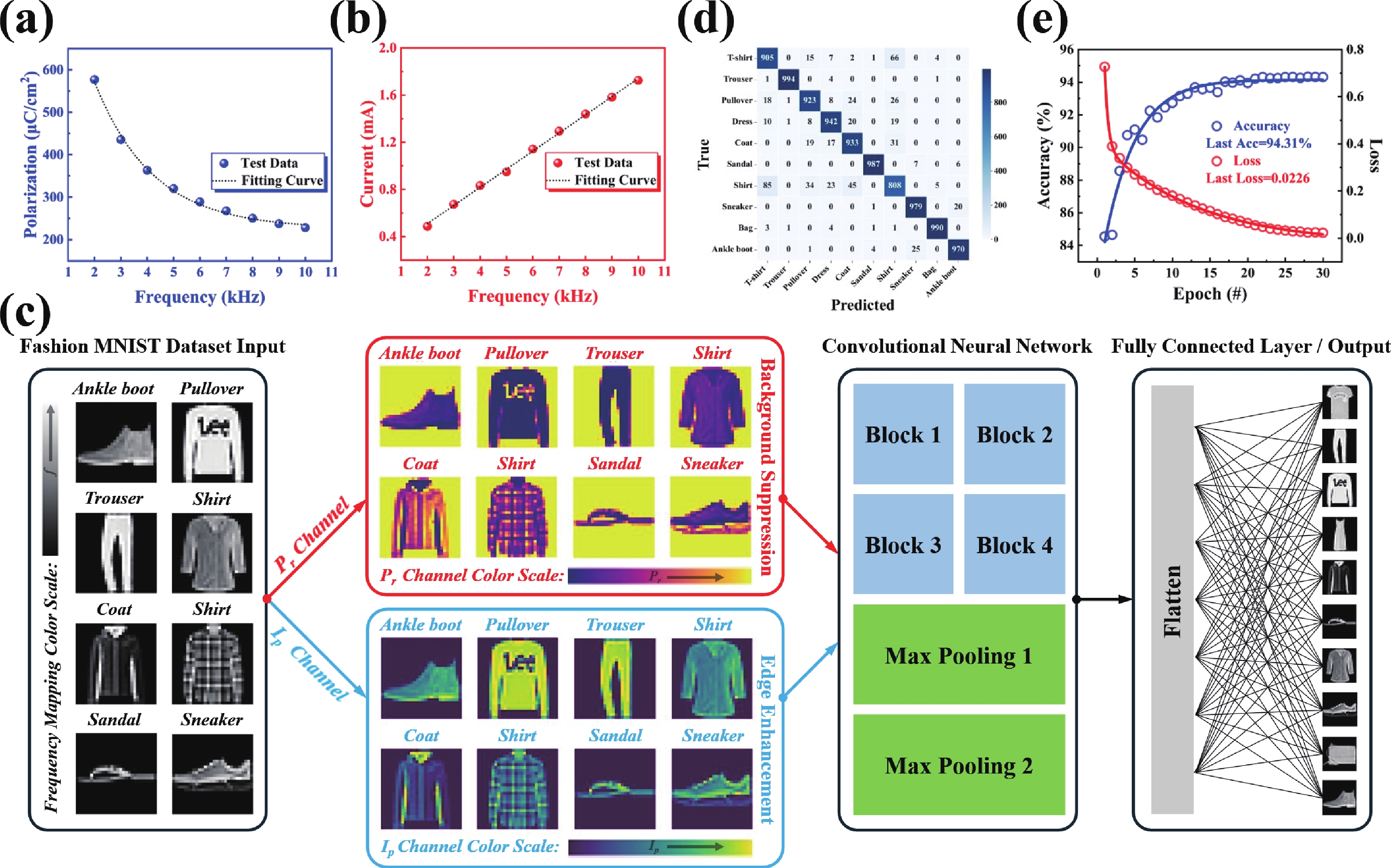
Abstract: Aluminum scandium nitride (AlScN) features large remanent polarization (Pr) and high Curie temperature (TC), making it highly promising for next-generation nonvolatile memory and neuromorphic devices. However, the imprint-induced electrical asymmetry severely limits their practical application. Here, we fabricate Mo/Al0.8Sc0.2N/Mo ferroelectric capacitors (FeCap) via continuous in-situ magnetron sputtering. Characterization and measurements reveal a pronounced imprint effect, which is closely related to the lattice mismatch near the bottom electrode (BE). A serial configuration with shared BE was proposed that naturally forms a differential pair, compensating for the built-in voltage (Vbi). Then devices can achieve symmetric consecutive cycles, with the retention time of 105 s, and the breakdown-to-coercive-voltage ratio (VBD/VC) of 1.20. Leveraging their dynamic response, we design an architecture of FeCap integrated with a shallow convolutional neural network (CNN). It can achieve background suppression and edge enhancement of the Fashion MNIST dataset at FeCap. CNN only undertakes feature fusion and classification tasks, thus significantly reducing the computational complexity. The recognition accuracy of 94.31% can be achieved after only 30 epochs. This work provides an effective approach for imprint suppression and demonstrates the potential of AlScN-based FeCap for image recognition acceleration.

Keywords: AlScNFeCapImprint effect


[1]
Legtchenko S, Stefanovici I, Black R, et al. Managed-retention memory: A new class of memory for the AI era. 2025: arXiv: 2501.09605. https://arxiv.org/abs/2501.09605
[2]
Molas G, Nowak E. Advances in emerging memory technologies: From data storage to artificial intelligence. Appl Sci, 2021, 11(23): 11254 doi: 10.3390/app112311254
[3]
Bhati I, Chang M T, Chishti Z, et al. DRAM refresh mechanisms, penalties, and trade-offs. IEEE Trans Comput, 2016, 65(1): 108 doi: 10.1109/TC.2015.2417540
[4]
Kim S S, Yong S K, Kim W, et al. Review of semiconductor flash memory devices for material and process issues. Adv Mater, 2023, 35(43): 2370310 doi: 10.1002/adma.202370310
[5]
Mikolajick T, Schroeder U, Slesazeck S. The past, the present, and the future of ferroelectric memories. IEEE Trans Electron Devices, 2020, 67(4): 1434 doi: 10.1109/TED.2020.2976148
[6]
Qin H M, He N, Han C, et al. Perspectives of ferroelectric wurtzite AlScN: Material characteristics, preparation, and applications in advanced memory devices. Nanomaterials, 2024, 14(11): 986 doi: 10.3390/nano14110986
[7]
Davenport T, Mitra S. Process variations in use for the first generations of FRAM® memory products. Integr Ferroelectr, 2000, 31(1−4), 213
[8]
Bouregba R, le Rhun G, Poullain G, et al. Analysis of size effect in PZT thin film capacitors. 2007 Sixteenth IEEE International Symposium on the Applications of Ferroelectrics. Nara, Japan. IEEE, 2007: 472
[9]
Böscke T S, Müller J, Bräeuhaus D, et al. Ferroelectricity in hafnium oxide thin films. Appl Phys Lett, 2011, 99(10): 102903 doi: 10.1063/1.3634052
[10]
Wu Y C, Wei C Y. Review of recent HZO-based ferroelectric transistors for non-volatile memory applications. IEEE Electron Devices Rev, 2025, 2: 361 doi: 10.1109/EDR.2025.3646143
[11]
Fichtner S, Wolff N, et al. AlScN: A III-V semiconductor based ferroelectric. J Appl Phys, 2019, 125(11): 114103 doi: 10.1063/1.5084945
[12]
Sui J Y, Zhang B, Zhao W J, et al. Impact of bottom electrode materials on the crystallographic orientation and ferroelectric performance of Al0.8Sc0.2N thin films. Nanoscale, 2025, 17(48): 28176 doi: 10.1039/D5NR03449C
[13]
Do Kim K D, Ryoo S K, Yeom M K, et al. Influence of bottom electrodes on the ferroelectric stability of AlScN film at high temperatures. Adv Electron Mater, 2026, 12(13): e00602 doi: 10.1002/aelm.202500602
[14]
Wang J L, Li Y Q, Wang R, et al. Unveiling interfacial dead layer in wurtzite ferroelectrics. Nat Commun, 2025, 16: 6069 doi: 10.1038/s41467-025-61291-2
[15]
Sandu C S, Parsapour F, Mertin S, et al. Abnormal grain growth in AlScN thin films induced by complexion formation at crystallite interfaces. Phys Status Solidi A, 2019, 216(2): 1800569 doi: 10.1002/pssa.201800569
[16]
Cao Y K, Xu X H, Sun C, et al. Segment any anomaly without training via hybrid prompt regularization. 2023: arXiv: 2305.10724. https://arxiv.org/abs/2305.10724
[17]
Pal S, Palladino E, Yuan H Z, et al. Determination of imprint effects in ferroelectrics from the quantified phase and amplitude response. ACS Appl Electron Mater, 2024, 6(9): 6401 doi: 10.1021/acsaelm.4c00875
[18]
Zhang Y C, Dai Y B, Qin H M, et al. First-principles-augmented KAI model bridging nucleation to domain-wall in ferroelectric AlScN. 2025 IEEE International Electron Devices Meeting (IEDM). San Francisco, CA, USA. IEEE, 2026: 1
[19]
Wang Q, Go S X, Liu C, et al. Understanding effect of distortions and vacancies in wurtzite AlScN ferroelectric memory materials: Vacancy-induced multiple defect state types and relaxation dependence in transition energy levels. AIP Adv, 2022, 12(12): 125303 doi: 10.1063/5.0126651
[20]
Yang W W, Chen L, Li M H, et al. Stress effect on the leakage current distribution of ferroelectric Al0.7Sc0.3N across the wafer. Appl Phys Lett, 2023, 123(13): 132903 doi: 10.1063/5.0159599
[21]
Gu Y D, Shi S, Su H X, et al. Mutable polarization switching characteristics in wurtzite Al1-xScxN ferroelectric films enabled by Sc-doping. Small, 2025, 21(34): 2502865 doi: 10.1002/smll.202502865
[22]
Cho H, Wang Y B, Leblanc C, et al. Write cycling endurance exceeding 1010 in sub-50 nm ferroelectric AlScN. Nat Commun, 2026, 17: 1507 doi: 10.1038/s41467-025-68221-2
[23]
Liu M R, Lu S P, Jia Y P, et al. AlScN/n-GaN ferroelectric memristors with controllable on/off ratios and reversible bipolar resistive switching characteristics. IEEE Electron Device Lett, 2024, 45(3): 356 doi: 10.1109/LED.2023.3347233
[24]
Bao K Y, Wang Z P, Liao J J, et al. The imprint failure and suppression of the multi‐level memory in HfAlOx ferroelectric capacitor. Adv Funct Mater, 2025, 35(51): e09227 doi: 10.1002/adfm.202509227
[25]
Ding S, Jia J H, Xu B, et al. Overrated energy storage performances of dielectrics seriously affected by fringing effect and parasitic capacitance. Nat Commun, 2025, 16: 608 doi: 10.1038/s41467-025-55855-5
[26]
Chen L, Wang Q, Liu C, et al. Leakage mechanism and cycling behavior of ferroelectric Al0.7Sc0.3N. Materials, 2024, 17(2): 397 doi: 10.3390/ma17020397
[27]
Castan S, Zhao J, Shen J. New edge detection methods based on exponential filter. [1990] Proceedings. 10th International Conference on Pattern Recognition. Atlantic City, NJ, USA. IEEE, 2002: 709
[28]
Xhaferra E, Cina E, Toti L. Classification of standard FASHION MNIST dataset using deep learning based CNN algorithms. 2022 International Symposium on Multidisciplinary Studies and Innovative Technologies (ISMSIT). Ankara, Turkey. IEEE, 2022: 494
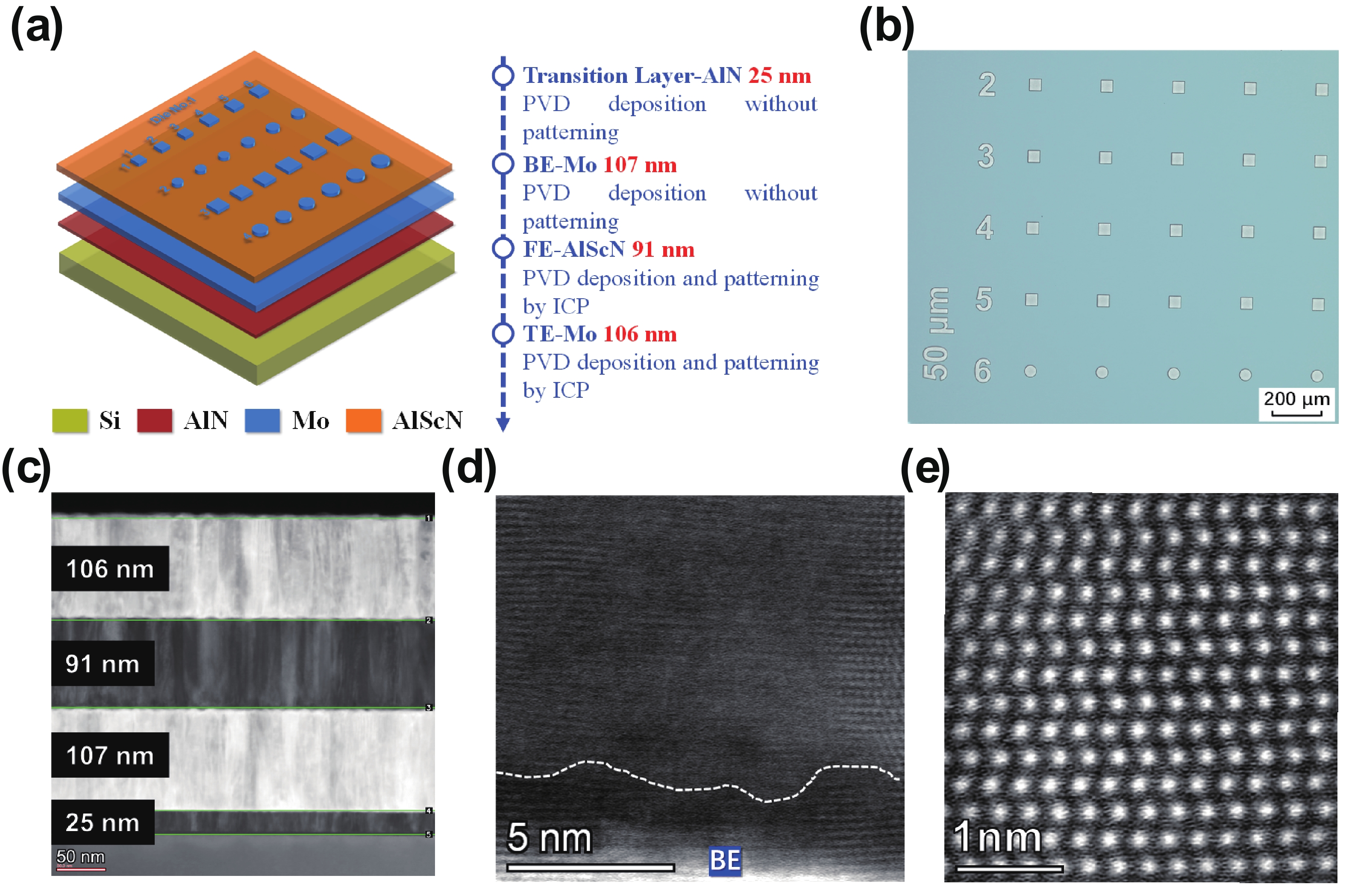
Fig. 1.  (Color online) (a) Schematic diagram and fabrication process of AlScN-based FeCap. (b) Optical microscope observation image. (c) Cross-sectional image processed by computer vision. HAADF results of AlScN (d) near BE and (e) in the bulk.

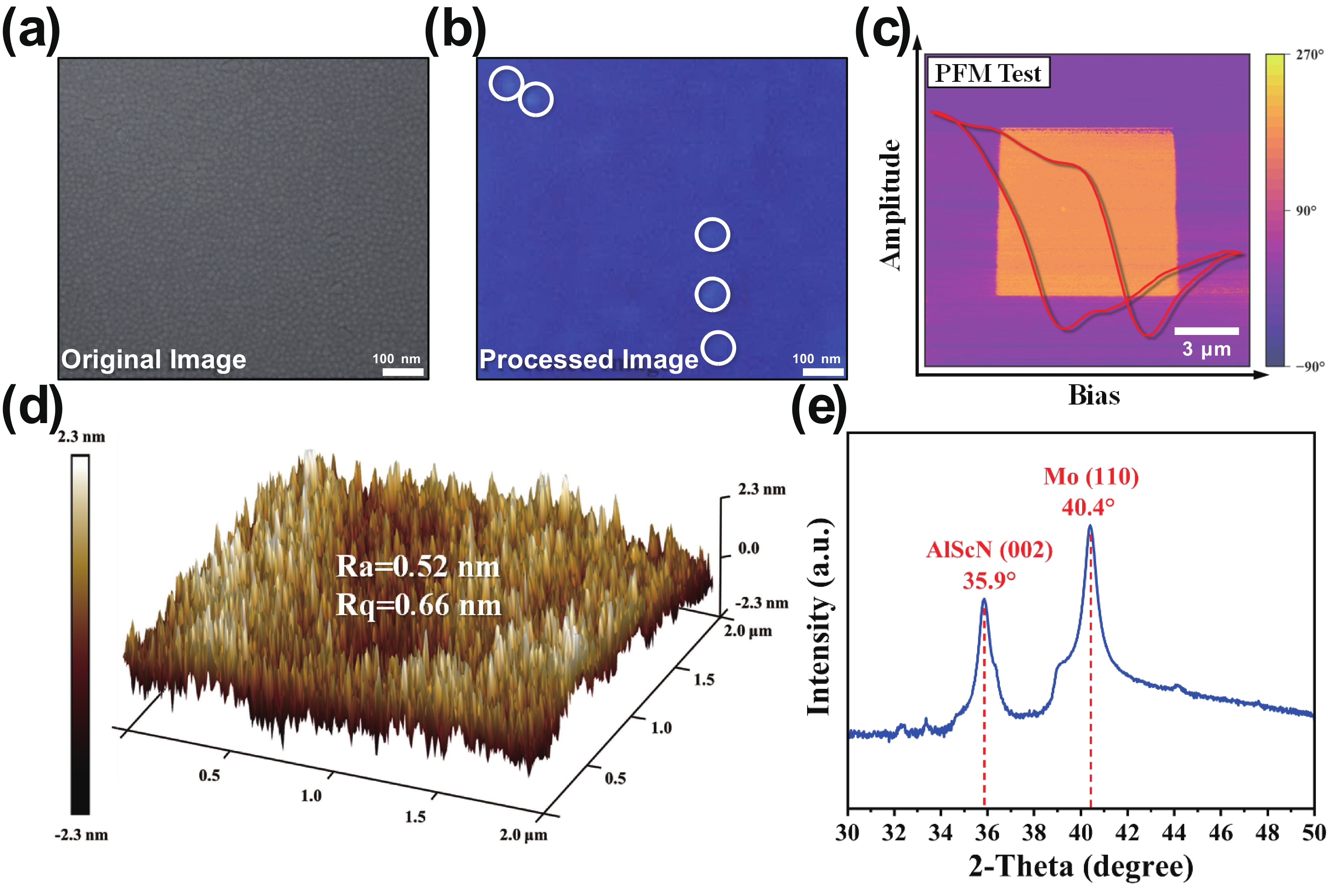
Fig. 2.  (Color online) (a) Original SEM image of AlScN surface. (b) Image processed by the SAA+ AI model. (c) PFM measurements of the phase and amplitude. (d) AFM measurements of surface roughness. (e) XRD spectrum of the device.

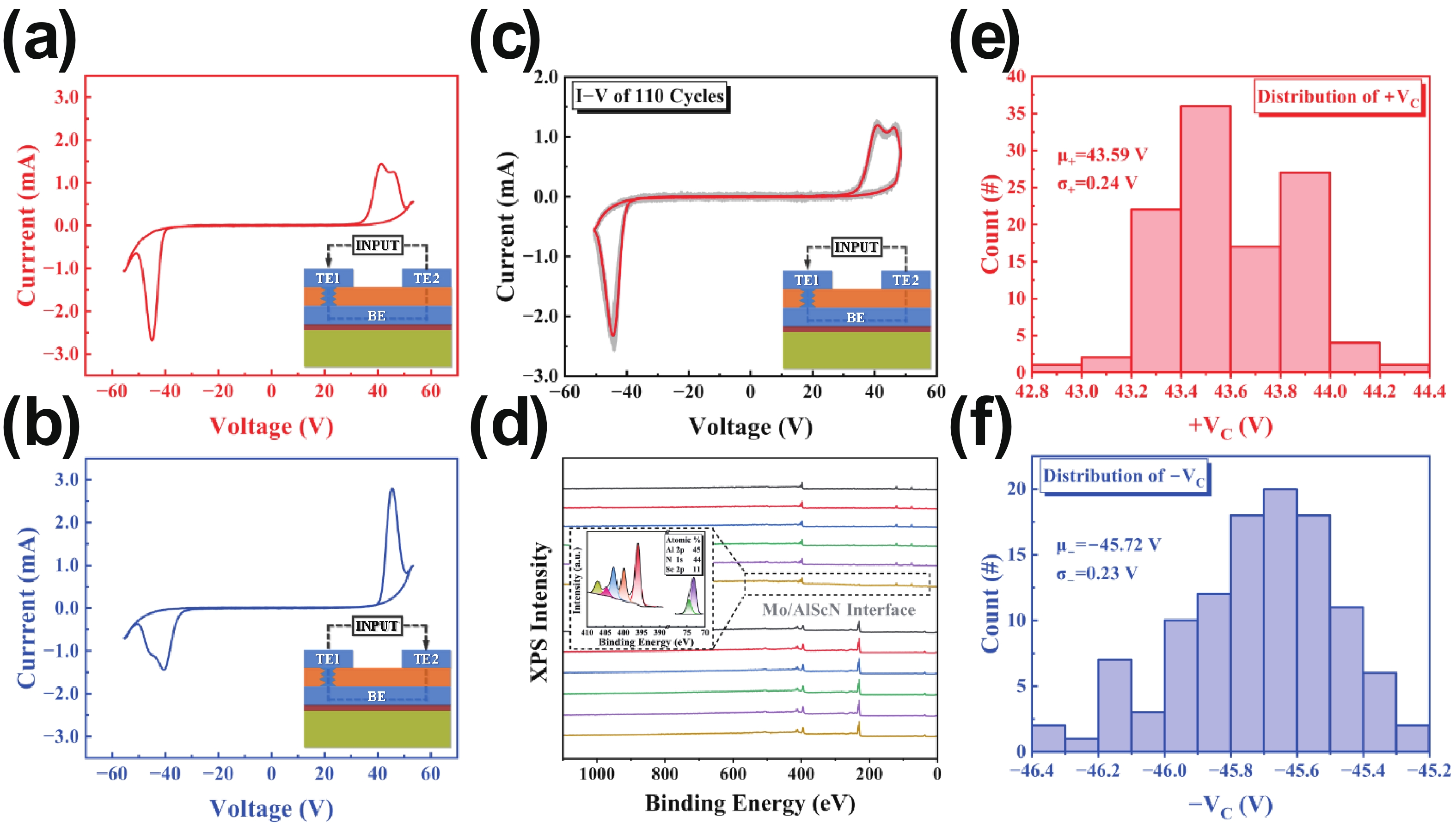
Fig. 3.  (Color online) Schematic diagrams of the measurement methods for input signals at (a) TE1 and (b) TE2, along with their IV curves. (c) The continuous 110 IV cycles of the input signal from TE1. (d) XPS depth profiling. Includes fine spectral fitting and quantitative analysis at the Mo/AlScN interface. Distribution of (e) +VC and (f) −VC in 110 consecutive cycles.

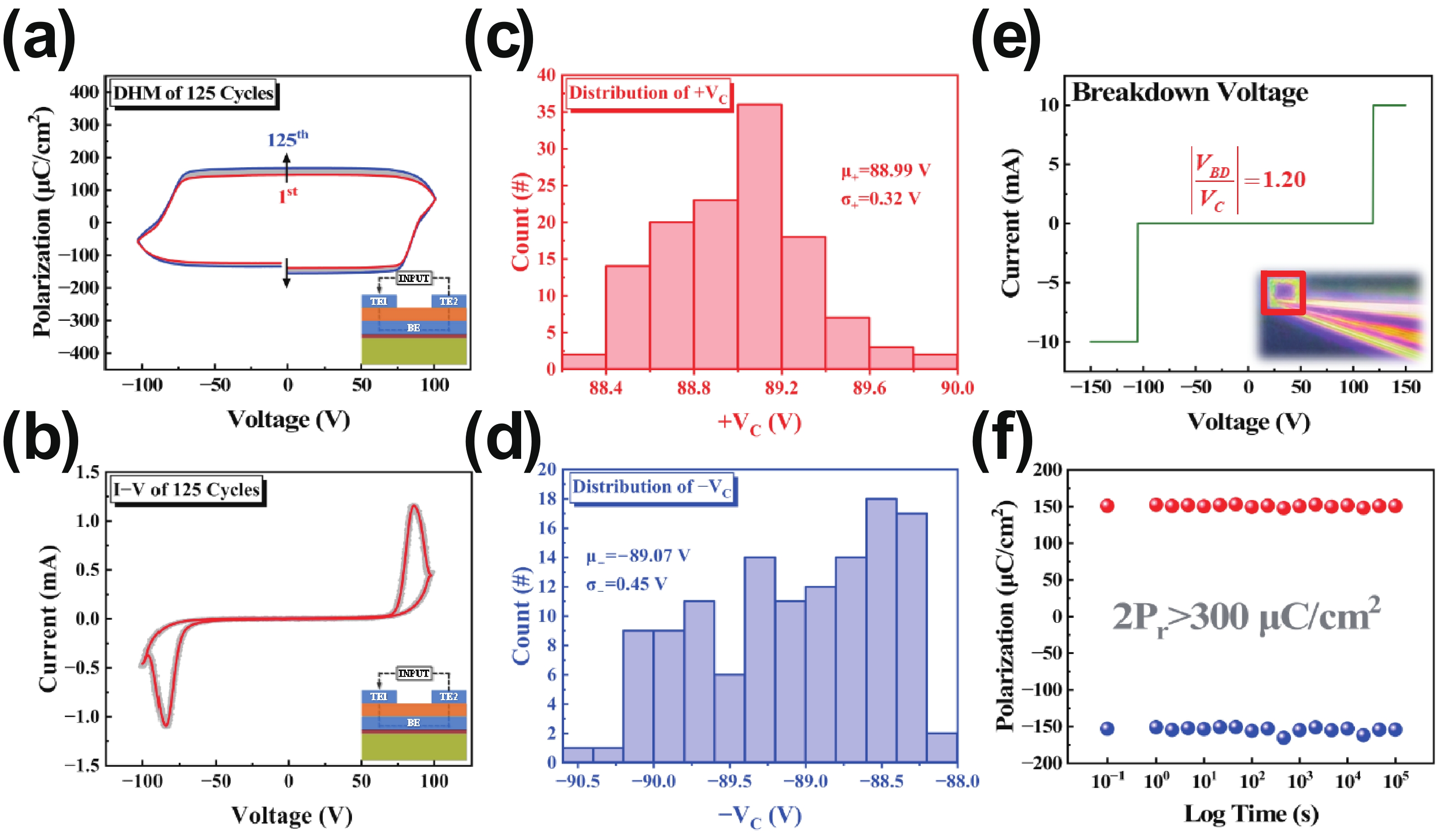
Fig. 4.  (Color online) Schematic diagram of the series measurement method and 125 consecutive cycles of (a) Hysteresis curves and (b) IV curves. Distribution of (c) +VC and (d) −VC in 125 consecutive cycles. (e) The breakdown measurement and breakdown location image. (f) The retention time of Pr.

Fig. 5.  (Color online) The frequency-dependent (a) exponential decay characteristics of Pr and (b) linear enhancement characteristics of Ip, including test data and fitting curves. (c) Schematic diagram of the Fashion MNIST image recognition architecture. (d) Confusion matrix and (e) training curves of the Fashion MNIST test dataset.

Table 1.   Performance comparison with other AlScN-based FeCap.

This Work[21][22][23]
StructureMo/AlScN/MoPt/AlScN/PtAl/AlScN/AlGaN/AlScN/Au
AlScN Thickness91 nm90 nm45 nm170 nm
Sc Component20%25%36%25%
2Pr>300 μC/cm2~256 μC/cm2~200 μC/cm2220 μC/cm2
||EC+|−|EC||0.006 MV/cm~0.67 MV/cm~0.28 MV/cm~0.5 MV/cm
Retention105 s>105 s104 s103 s
DownLoad: CSV
[1]
Legtchenko S, Stefanovici I, Black R, et al. Managed-retention memory: A new class of memory for the AI era. 2025: arXiv: 2501.09605. https://arxiv.org/abs/2501.09605
[2]
Molas G, Nowak E. Advances in emerging memory technologies: From data storage to artificial intelligence. Appl Sci, 2021, 11(23): 11254 doi: 10.3390/app112311254
[3]
Bhati I, Chang M T, Chishti Z, et al. DRAM refresh mechanisms, penalties, and trade-offs. IEEE Trans Comput, 2016, 65(1): 108 doi: 10.1109/TC.2015.2417540
[4]
Kim S S, Yong S K, Kim W, et al. Review of semiconductor flash memory devices for material and process issues. Adv Mater, 2023, 35(43): 2370310 doi: 10.1002/adma.202370310
[5]
Mikolajick T, Schroeder U, Slesazeck S. The past, the present, and the future of ferroelectric memories. IEEE Trans Electron Devices, 2020, 67(4): 1434 doi: 10.1109/TED.2020.2976148
[6]
Qin H M, He N, Han C, et al. Perspectives of ferroelectric wurtzite AlScN: Material characteristics, preparation, and applications in advanced memory devices. Nanomaterials, 2024, 14(11): 986 doi: 10.3390/nano14110986
[7]
Davenport T, Mitra S. Process variations in use for the first generations of FRAM® memory products. Integr Ferroelectr, 2000, 31(1−4), 213
[8]
Bouregba R, le Rhun G, Poullain G, et al. Analysis of size effect in PZT thin film capacitors. 2007 Sixteenth IEEE International Symposium on the Applications of Ferroelectrics. Nara, Japan. IEEE, 2007: 472
[9]
Böscke T S, Müller J, Bräeuhaus D, et al. Ferroelectricity in hafnium oxide thin films. Appl Phys Lett, 2011, 99(10): 102903 doi: 10.1063/1.3634052
[10]
Wu Y C, Wei C Y. Review of recent HZO-based ferroelectric transistors for non-volatile memory applications. IEEE Electron Devices Rev, 2025, 2: 361 doi: 10.1109/EDR.2025.3646143
[11]
Fichtner S, Wolff N, et al. AlScN: A III-V semiconductor based ferroelectric. J Appl Phys, 2019, 125(11): 114103 doi: 10.1063/1.5084945
[12]
Sui J Y, Zhang B, Zhao W J, et al. Impact of bottom electrode materials on the crystallographic orientation and ferroelectric performance of Al0.8Sc0.2N thin films. Nanoscale, 2025, 17(48): 28176 doi: 10.1039/D5NR03449C
[13]
Do Kim K D, Ryoo S K, Yeom M K, et al. Influence of bottom electrodes on the ferroelectric stability of AlScN film at high temperatures. Adv Electron Mater, 2026, 12(13): e00602 doi: 10.1002/aelm.202500602
[14]
Wang J L, Li Y Q, Wang R, et al. Unveiling interfacial dead layer in wurtzite ferroelectrics. Nat Commun, 2025, 16: 6069 doi: 10.1038/s41467-025-61291-2
[15]
Sandu C S, Parsapour F, Mertin S, et al. Abnormal grain growth in AlScN thin films induced by complexion formation at crystallite interfaces. Phys Status Solidi A, 2019, 216(2): 1800569 doi: 10.1002/pssa.201800569
[16]
Cao Y K, Xu X H, Sun C, et al. Segment any anomaly without training via hybrid prompt regularization. 2023: arXiv: 2305.10724. https://arxiv.org/abs/2305.10724
[17]
Pal S, Palladino E, Yuan H Z, et al. Determination of imprint effects in ferroelectrics from the quantified phase and amplitude response. ACS Appl Electron Mater, 2024, 6(9): 6401 doi: 10.1021/acsaelm.4c00875
[18]
Zhang Y C, Dai Y B, Qin H M, et al. First-principles-augmented KAI model bridging nucleation to domain-wall in ferroelectric AlScN. 2025 IEEE International Electron Devices Meeting (IEDM). San Francisco, CA, USA. IEEE, 2026: 1
[19]
Wang Q, Go S X, Liu C, et al. Understanding effect of distortions and vacancies in wurtzite AlScN ferroelectric memory materials: Vacancy-induced multiple defect state types and relaxation dependence in transition energy levels. AIP Adv, 2022, 12(12): 125303 doi: 10.1063/5.0126651
[20]
Yang W W, Chen L, Li M H, et al. Stress effect on the leakage current distribution of ferroelectric Al0.7Sc0.3N across the wafer. Appl Phys Lett, 2023, 123(13): 132903 doi: 10.1063/5.0159599
[21]
Gu Y D, Shi S, Su H X, et al. Mutable polarization switching characteristics in wurtzite Al1-xScxN ferroelectric films enabled by Sc-doping. Small, 2025, 21(34): 2502865 doi: 10.1002/smll.202502865
[22]
Cho H, Wang Y B, Leblanc C, et al. Write cycling endurance exceeding 1010 in sub-50 nm ferroelectric AlScN. Nat Commun, 2026, 17: 1507 doi: 10.1038/s41467-025-68221-2
[23]
Liu M R, Lu S P, Jia Y P, et al. AlScN/n-GaN ferroelectric memristors with controllable on/off ratios and reversible bipolar resistive switching characteristics. IEEE Electron Device Lett, 2024, 45(3): 356 doi: 10.1109/LED.2023.3347233
[24]
Bao K Y, Wang Z P, Liao J J, et al. The imprint failure and suppression of the multi‐level memory in HfAlOx ferroelectric capacitor. Adv Funct Mater, 2025, 35(51): e09227 doi: 10.1002/adfm.202509227
[25]
Ding S, Jia J H, Xu B, et al. Overrated energy storage performances of dielectrics seriously affected by fringing effect and parasitic capacitance. Nat Commun, 2025, 16: 608 doi: 10.1038/s41467-025-55855-5
[26]
Chen L, Wang Q, Liu C, et al. Leakage mechanism and cycling behavior of ferroelectric Al0.7Sc0.3N. Materials, 2024, 17(2): 397 doi: 10.3390/ma17020397
[27]
Castan S, Zhao J, Shen J. New edge detection methods based on exponential filter. [1990] Proceedings. 10th International Conference on Pattern Recognition. Atlantic City, NJ, USA. IEEE, 2002: 709
[28]
Xhaferra E, Cina E, Toti L. Classification of standard FASHION MNIST dataset using deep learning based CNN algorithms. 2022 International Symposium on Multidisciplinary Studies and Innovative Technologies (ISMSIT). Ankara, Turkey. IEEE, 2022: 494
  • Search

    Advanced Search >>

    GET CITATION

    shu

    Export: BibTex EndNote

    Article Metrics

    Article views: 5 Times PDF downloads: 4 Times Cited by: 0 Times

    History

    Received: Revised: Online: Accepted Manuscript: 05 August 2026

    Catalog

      Email This Article

      User name:
      Email:*请输入正确邮箱
      Code:*验证码错误
      Haiming Qin, Ping Xue, Cong Han, Rui Hu, Weijing Shao, Nan He, Hao Zhang, Yunzhou Shi, Dayu Zhou, Yu Wang, Xinpeng Wang, Yi Tong. Suppression of imprint effect in AlScN-based ferroelectric capacitors and dynamic response for image recognition acceleration[J]. Journal of Semiconductors, 2026, In Press. doi: 10.1088/1674-4926/26050048 ****H M Qin, P Xue, C Han, R Hu, W J Shao, N He, H Zhang, Y Z Shi, D Y Zhou, Y Wang, X P Wang, and Y Tong, Suppression of imprint effect in AlScN-based ferroelectric capacitors and dynamic response for image recognition acceleration[J]. J. Semicond., 2026, accepted doi: 10.1088/1674-4926/26050048
      Citation:
      Haiming Qin, Ping Xue, Cong Han, Rui Hu, Weijing Shao, Nan He, Hao Zhang, Yunzhou Shi, Dayu Zhou, Yu Wang, Xinpeng Wang, Yi Tong. Suppression of imprint effect in AlScN-based ferroelectric capacitors and dynamic response for image recognition acceleration[J]. Journal of Semiconductors, 2026, In Press. doi: 10.1088/1674-4926/26050048 ****
      H M Qin, P Xue, C Han, R Hu, W J Shao, N He, H Zhang, Y Z Shi, D Y Zhou, Y Wang, X P Wang, and Y Tong, Suppression of imprint effect in AlScN-based ferroelectric capacitors and dynamic response for image recognition acceleration[J]. J. Semicond., 2026, accepted doi: 10.1088/1674-4926/26050048

      Suppression of imprint effect in AlScN-based ferroelectric capacitors and dynamic response for image recognition acceleration

      DOI: 10.1088/1674-4926/26050048
      CSTR: 32376.14.1674-4926.26050048
      More Information

      Catalog

        /

        DownLoad:  Full-Size Img  PowerPoint
        Return
        Return