J. Semicond. >  Just Accepted

ARTICLES

Enhancement of self-polarized electric field in BaTiO3 thin film via europium doping and its application in improving the performance of ZnO thin film photoconductive detectors

Peiqin Hong, Xinyu Cui, Nan Li, Peng Hu, Haibo Fan, Qiujie Li and Feng Teng

+ Author Affiliations

 Corresponding author: Feng Teng, tengfeng@nwu.edu.cn

DOI: 10.1088/1674-4926/26060005CSTR: 32376.14.1674-4926.26060005

PDF

Turn off MathJax

Abstract: Optical detectors based on metal oxide semiconductor thin films have always been a research hotspot in the field of optoelectronic detection due to their advantages of simple structure and convenient preparation. However, due to the characteristics of the material itself and the inherent working mechanism of the device, these devices often have their own shortcomings. In this work, Eu doped BaTiO3 thin film was introduced as a buffer layer to enhance the performance of photoconductive detector based on ZnO thin film. Compared with the un-doped BaTiO3 buffer layer, the Eu:BTO buffer layer can further enhance the photodetection performance of detector based on ZnO film. The detector on Eu:BTO buffer layer exhibits larger photocurrent (450 nA) and smaller dark current (1.01 nA) compared with that on un-doped BTO buffer layer (100 nA and 10 nA), leading to larger on/off ratio. Meanwhile, the response speed of the device can reach 0.51 s and 1.04 s, respectively, which is much superior than the device based on original ZnO film (10.55s and 14.98 s). At the appropriate doping concentration (1% Eu:BTO), the increased polarization electric field is the main reason for achieving performance enhancement.

Keywords: ZnO filmphotoconductiveEu dopedself-polarizationBaTiO3


[1]
Soci C, Zhang A, Xiang B, et al. ZnO nanowire UV photodetectors with high internal gain. Nano Lett, 2007, 7(4): 1003 doi: 10.1021/nl070111x
[2]
Ha H J, Kang S J, Jeong J H, et al. Real-time ultraviolet monitoring system with low-temperature solution-processed high-transparent p-n junction photodiode with a fast responsive and high rectification ratio. ACS Appl Mater Interfaces, 2024, 16(30): 40139 doi: 10.1021/acsami.4c05494
[3]
Hwang T-Y, Choi Y, Song Y, et al. A noble gas sensor platform: linear dense assemblies of single-walled carbon nanotubes (LACNTs) in a multi-layered ceramic/metal electrode system (MLES). J Mater Chem C, 2018, 6(5): 972 doi: 10.1039/C7TC03576D
[4]
Zhu J, Yu L, Wang Z, et al. High-performance and stable sb2S3 thin-film photodetectors for potential application in visible light communication. ACS Appl Mater Interfaces, 2023, 15(23): 28175 doi: 10.1021/acsami.3c03671
[5]
Brooke R, Edberg J, Iandolo D, et al. Controlling the electrochromic properties of conductive polymers using UV-light. J Mater Chem C, 2018, 6(17): 4663 doi: 10.1039/C7TC05833K
[6]
Wu C, Wu F, Hu H, et al. Review of self-powered solar-blind photodetectors based on Ga2O3, Mat. Today Phys., 2022, 28: 100883
[7]
Lee B, Zhang X, Kang J, et al. A negative photoconductivity photodetector based on two-dimensional Nb3Cl8. Nanoscale, 2024, 16(43): 20312 doi: 10.1039/D4NR03376K
[8]
Jiang T, Wu X, He Z, et al. Two-dimensional SnSe films on paper substrates for flexible broadband photodetectors. ACS Appl Nano Mater, 2024, 7(3): 2992 doi: 10.1021/acsanm.3c05369
[9]
Aldalbahi A, Feng P. Development of 2-D boron nitride nanosheets UV photoconductive detectors. IEEE Trans on Electron Devices, 2015, 62(6): 1885 doi: 10.1109/TED.2015.2423253
[10]
Wang F, Mei J, Wang Y, et al. Fast photoconductive responses in organometal halide perovskite photodetectors. ACS Appl Mater Interfaces, 2016, 8(4): 2840 doi: 10.1021/acsami.5b11621
[11]
Zhang S, Li Z, Li J, et al. Organic near-infrared photodetectors with photoconductivity-enhanced performance. Aggregate, 2023, 4(5): e345 doi: 10.1002/agt2.345
[12]
Guan S, Cheng C, Ning Y, et al. Effect of metal–organic frameworks with different ligand structures (ZIF-11 & ZIF-23) on the optoelectronic performance of perovskite photodetectors. ACS Appl Mater Interfaces, 2024, 16(31): 41341 doi: 10.1021/acsami.4c08576
[13]
D’Agostino D, Di Giorgio C, Bobba F, et al. Effects of cobalt substitution on ZnO surface reactivity and electronic structure. J Mater Chem C, 2019, 7(27): 8364 doi: 10.1039/C8TC06188B
[14]
Chinnasamy M, Paul S, Balagopalan S, et al. Cr-Doping-Induced fano resonance of ZnO-layered nanoporous structures and UV photodetector application. ACS Appl Opt Mater, 2023, 1(4): 852 doi: 10.1021/acsaom.3c00016
[15]
Karaca A, Yıldız D E, Hussaini A A, et al. Optoelectrical characterization of a UV–Vis–NIR broadband photodetector based on Tm-doped ZnO. Phys B Condens Matte, 2025, 706: 417131 doi: 10.1016/j.physb.2025.417131
[16]
Jalal R, Ozel K, Atilgan A, et al. UV photodetectors based on W-doped ZnO thin films. Nanotechnology, 2024, 35(26): 265705 doi: 10.1088/1361-6528/ad373b
[17]
Poul Raj I L, Valanarasu S, Hariprasad K, et al. Enhancement of optoelectronic parameters of Nd-doped ZnO nanowires for photodetector applications. Opt Mater, 2020, 109: 110396 doi: 10.1016/j.optmat.2020.110396
[18]
Nurfani E, Nulhakim L, Muhammad D M, et al. The enhanced sensing performance of ZnO-based photodetector by Mg doping. Opt Mater, 2024, 148: 114948 doi: 10.1016/j.optmat.2024.114948
[19]
Wang N, Li B, Chen Y, et al. Self-powered ZnO/NiO dual-band photodetector based on surface plasmon enhancement. Mater Des, 2025, 260: 115079 doi: 10.1016/j.matdes.2025.115079
[20]
Li G, Yan Q, Zhao X, et al. The influence of surface processing on the surface plasmonic enhancement of an Al-nanoparticles-enhanced ZnO UV photodectector. Nanomaterials, 2023, 13(12): 1877 doi: 10.3390/nano13121877
[21]
Huynh H N D, Nguyen B G M, Dinh T M, et al. Enhancing the performance of ZnO-based photodetectors by forming ZnO/(Cu: ZnO) core/shell nanorods. ACS Applied Electronic Materials, 2024, 6(3): 1894 doi: 10.1021/acsaelm.3c01789
[22]
Rana V S, Rajput J K, Pathak T K, et al. Multilayer MgZnO/ZnO thin films for UV photodetectors. J Alloys Compd, 2018, 764: 724 doi: 10.1016/j.jallcom.2018.06.139
[23]
Yu M, Wang G, Zhao R, et al. Improved interfacial wetability in Cu/ZnO and its role in ZnO/Cu/ZnO sandwiched transparent electrodes. J Mater Sci Technol, 2020, 37: 123 doi: 10.1016/j.jmst.2019.06.019
[24]
Hakkoum H, Moumen A, Ghougali M, et al. The effect of structural characteristics of ZnO and NiO thin films on the performance of NiO/ZnO photodetectors. J Mater Sci Mater Electron, 2022, 33(35): 26604 doi: 10.1007/s10854-022-09336-w
[25]
Hong P, Wu L, Shi X, et al. Influence of buffer layer on the performance of ZnO film based photoconductive detectors. J Appl Phys, 2025, 138(5): 055304 doi: 10.1063/5.0273458
[26]
Zhang Y, Zhao X, Chen J, et al. Self‐polarized BaTiO3 for greatly enhanced performance of ZnO UV ohotodetector by regulating the distribution of electron concentration. Adv Funct Mater, 2019, 30(5): 1907650 doi: 10.1002/adfm.201907650
[27]
Meng J, Di X, Liu Y. Ferroelectric polarization field enhanced CsPbBr3/ZnO heterojunction broadband photodetector. Adv Mater Technol, 2026: 71028
[28]
Aminirastabi H, Xue H, Mitić V V, et al. Novel fractal analysis of nanograin growth in BaTiO3 thin film. Mater Chem Phys, 2020, 239: 122261 doi: 10.1016/j.matchemphys.2019.122261
[29]
Zhao K, Ouyang B, Bowen C R, et al. Enhanced photocurrent via ferro-pyro-phototronic effect in ferroelectric BaTiO3 materials for a self-powered flexible photodetector system. Nano Energy, 2020, 77: 105152 doi: 10.1016/j.nanoen.2020.105152
[30]
Su L, Yan T, Liu X, et al. A tunable polarization field for enhanced performance of flexible BaTiO3@TiO2 nanofiber photodetector by suppressing dark current to pA Level. Adv Funct Mater, 2023, 33(15): 2214533 doi: 10.1002/adfm.202214533
[31]
Hong P, Cui X, Li N, et al. Performance enhancement of photoconductive detector based on ZnO film via the synergistic effect of heterojunction and polarization electric field. Phys B Condens Matte, 2026, 726: 418264 doi: 10.1016/j.physb.2026.418264
[32]
Yu P, Wang W, Zheng T, et al. Pyro-phototronic effect-enhanced photocurrent of a self-powered photodetector based on ZnO nanofiber arrays/BaTiO3 films. ACS Appl Mater Interfaces, 2023, 15(39): 46031 doi: 10.1021/acsami.3c08880
[33]
Du X, Kang Z, Wu M, et al. A first-principles study on the ferroelectric and optical properties of (Zn, Co)-doped barium titanate. Phys Chem Chem Phys, 2026, 28(8): 5468 doi: 10.1039/D5CP03634H
[34]
Cavanagh A E, Little L B, Zhang Y, et al. Effect of stoichiometry on the structure and polarization of BaTiO3. Adv Opt Mater, 2025, 13(22): 2195
[35]
Huang L, Dai Y, Wu Y, et al. Enhanced ferroelectric and piezoelectric properties of (1-x)BaZr0.2Ti0.8O3–xBa0.7Ca0.3TiO3 thin films by sol–gel process. Appl Surf Sci, 2016, 388: 35 doi: 10.1016/j.apsusc.2016.05.030
[36]
Huang L, Dai Y, Xiao H, et al. Structure and ferroelectric property of low concentration iron-doped sol–gel BaTiO3 thin films. Ceram Int, 2016, 42(7): 9046 doi: 10.1016/j.ceramint.2016.02.162
[37]
Padalia D, Kumar U, Bhandari P, et al. Tuning the structural, optical, and dielectric properties of europium-doped barium titanate ceramics. J Mater Sci Mater Electron, 2024, 35(19): 1375 doi: 10.1007/s10854-024-12984-9
[38]
Sharma S, Tomar M, Puri N K, et al. Ultraviolet radiation detection by barium titanate thin films grown by sol–gel hydrothermal method. Sensors and Actuators A: Physical, 2015, 230: 175 doi: 10.1016/j.sna.2015.04.019
[39]
Xiao S H, Jiang W F, Luo K, et al. Structure and ferroelectric properties of barium titanate films synthesized by sol–gel method. Mater Chem Phys, 2011, 127(3): 420 doi: 10.1016/j.matchemphys.2011.01.006
[40]
Chen X, Huang S, Nasiri N. Facile fabrication of UV photodetectors using spin-coating flame-synthesized ZnO nanoparticles. ACS Appl Nano Mater, 2024, 7(4): 3589 doi: 10.1021/acsanm.3c04403
[41]
Su L, Li Z, Cao F, et al. Tailoring the interface assembly of mesoporous TiO2 on BTO film toward high-performance UV photodetectors. J Mater Chem C, 2022, 10(23): 9035 doi: 10.1039/D2TC01559E
[42]
Vinita V S, Ravikumar D, Lakshmanan D, et al. Role of Sn doping on the structural, morphological, optical and magnetic properties of BaTiO3 nanostructures. J Mater Sci Mater Electron, 2023, 34(20): 1539 doi: 10.1007/s10854-023-10950-5
[43]
Siemek K, Olejniczak A, Korotkov L N, et al. Investigation of surface defects in BaTiO3 nanopowders studied by XPS and positron annihilation lifetime spectroscopy. Appl Surf Sci, 2022, 578: 151807 doi: 10.1016/j.apsusc.2021.151807
[44]
Jiménez J A, Fachini E R, Zhao C. XPS and 31P NMR inquiry of Eu3+-induced structural modification in SnO-containing phosphate glass. J Mol Struct, 2018, 1164: 470 doi: 10.1016/j.molstruc.2018.03.095
[45]
Yang Y, Zhang P, Miao X, et al. Color-tunable emission via site-selective occupation of Eu2+ activators in silicate phosphors. Laser Photonics Rev, 2025, 19(2): 2400982 doi: 10.1002/lpor.202400982
[46]
Barreca D, Gasparotto A, Maccato C, et al. ZnO nanoplatelets obtained by chemical bapor deposition, studied by XPS. Surf Sci Spectra, 2009, 14(1): 19 doi: 10.1116/11.20071001
[47]
Li J, Nolan M, Detavernier C. A step toward correct interpretation of XPS results in metal oxides: A case study aided by first-principles method in ZnO. J Chem Phys, 2023, 159(3): 034702 doi: 10.1063/5.0154926
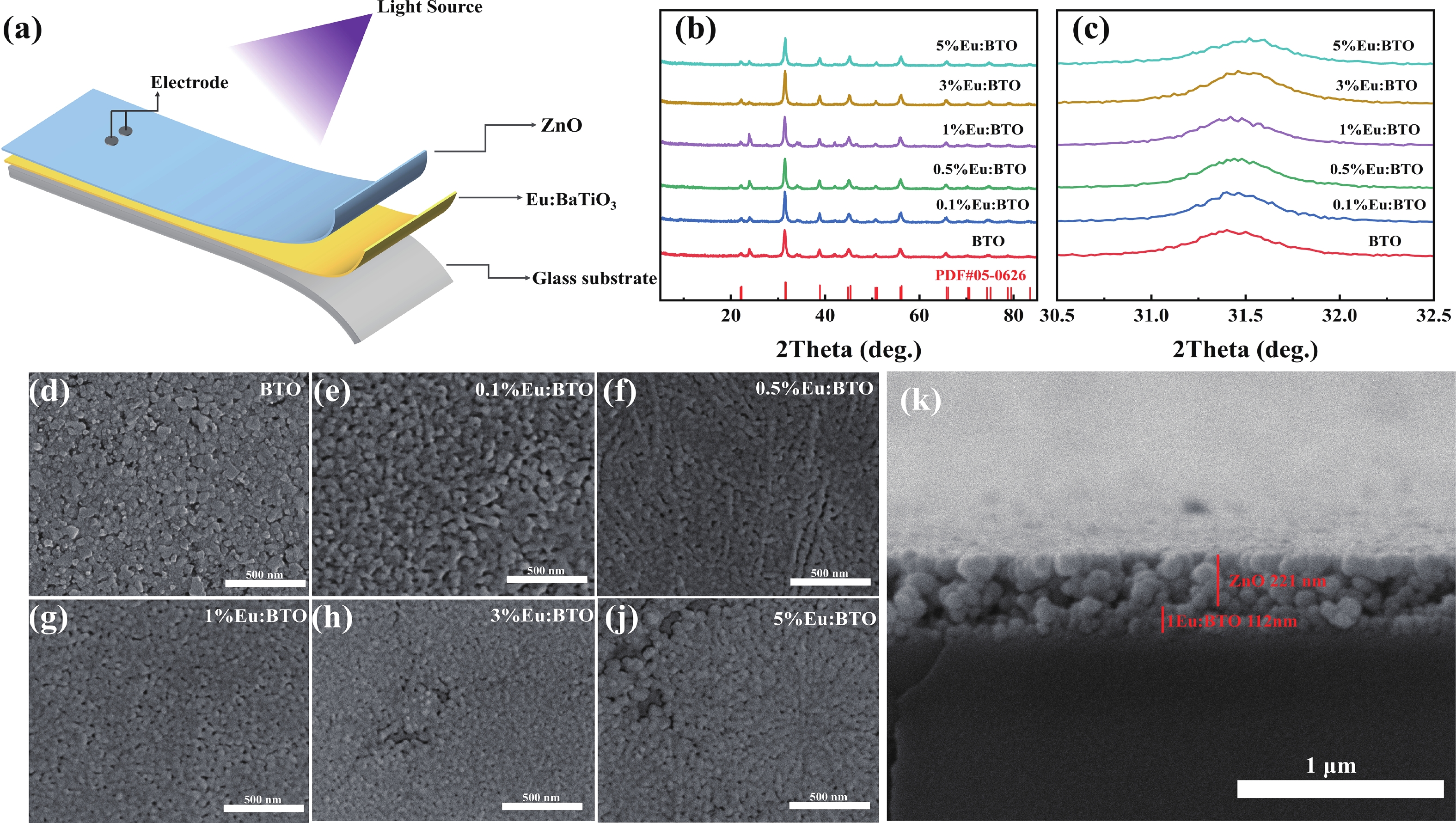
Fig. 1.  (Color online) (a) Schematic diagram of photoconductive detector based on Eu:BTO/ZnO film, the XRD patterns of Eu:BTO film with different Eu concentrations (b) and (110) crystal orientation (c), SEM images of Eu:BTO films (d-i) and the cross-section SEM image of 1% Eu:BTO film (j).

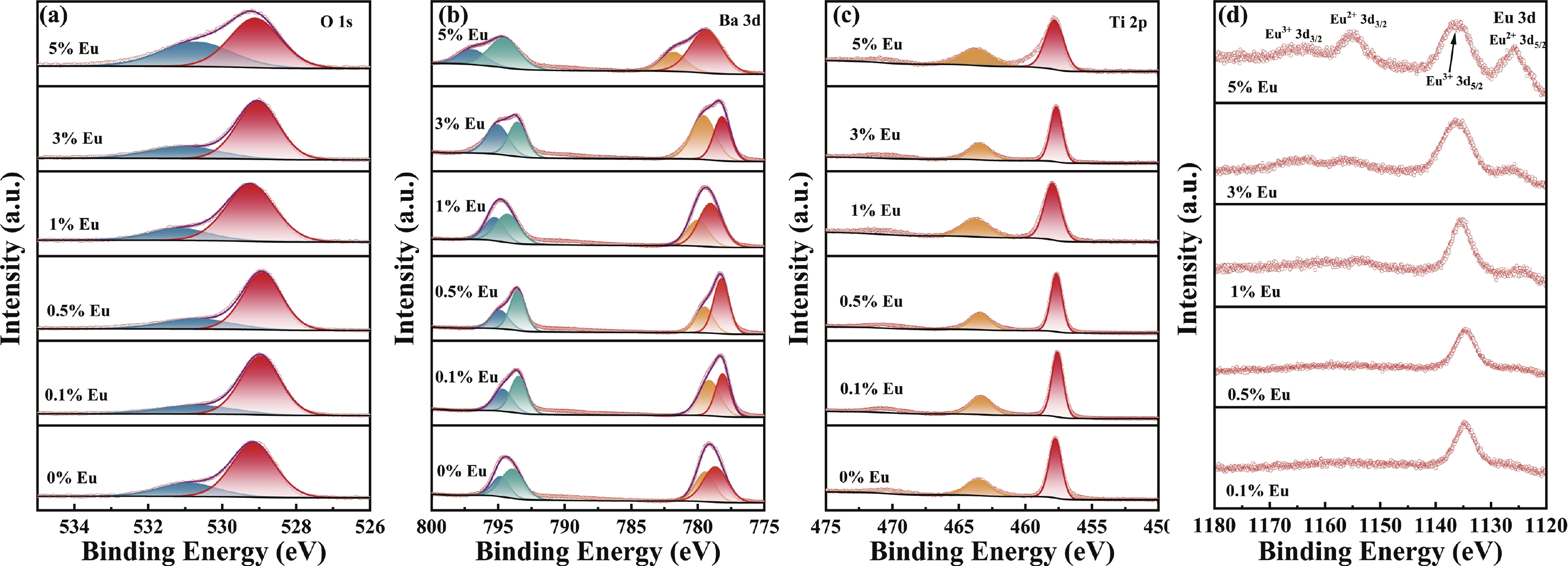
Fig. 2.  (Color online) XPS spectra of different Eu concentration BTO film, and the corresponding fine spectra, (a) O 1s, (b) Ba 3d, (c) Ti 2p and (d) Eu 3d.

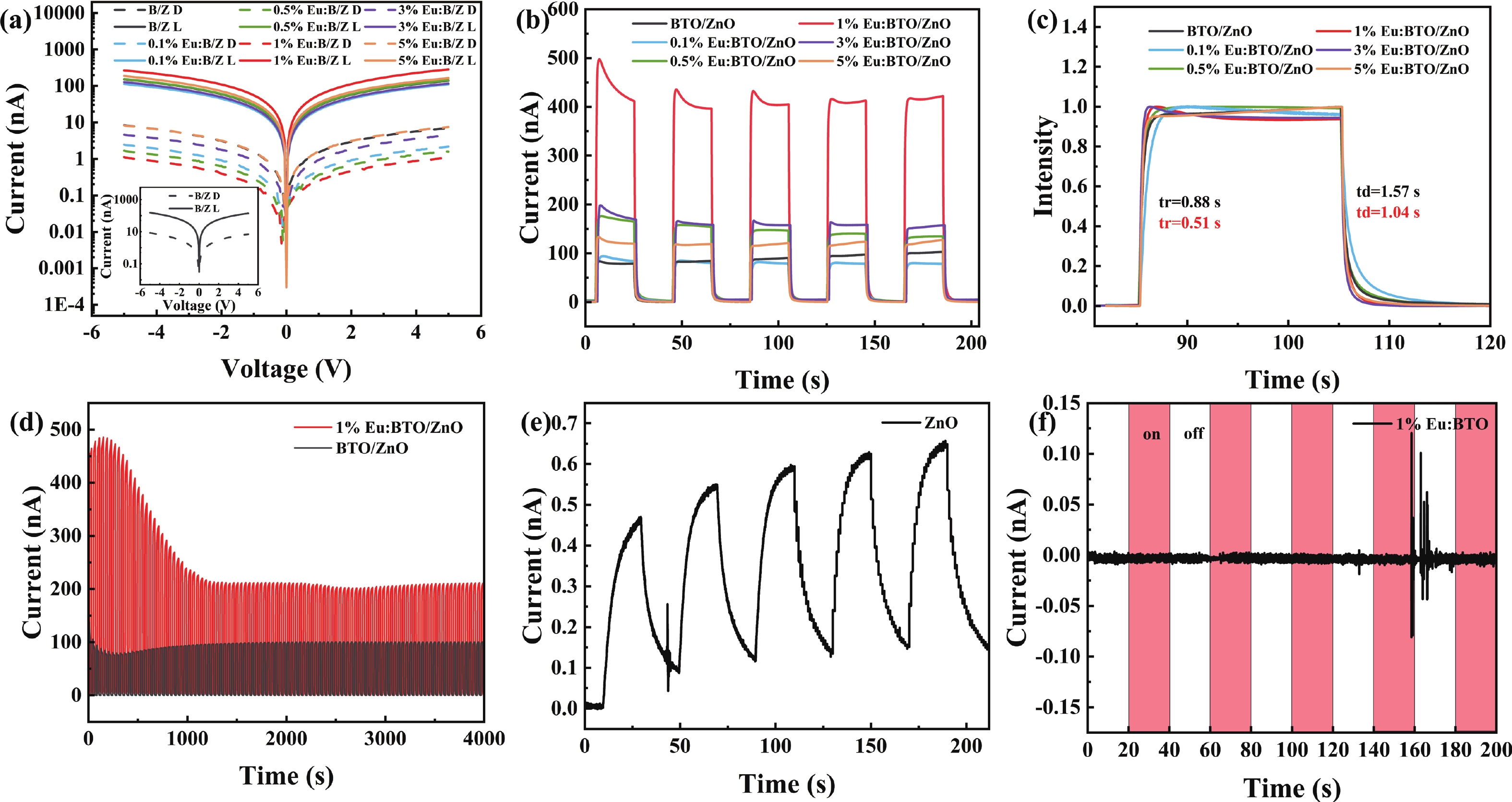
Fig. 3.  (Color online) (a) I-V curve of devices based on Eu:BTO/ZnO film in darkness and under 365 nm illumination, (b) I-t curve of devices based on Eu:BTO/ZnO film at 5 V bias, (c) corresponding single period I-t curve of devices on Eu:BTO/ZnO film. (d) Stability of 1% Eu:BTO/ZnO thin film devices with 100 switching light source cycles. (e) I-t curve of pure ZnO film photoconductive detector under 365 nm illumination. (f) I-t curve of 1% Eu:BTO film under 365 nm illumination.

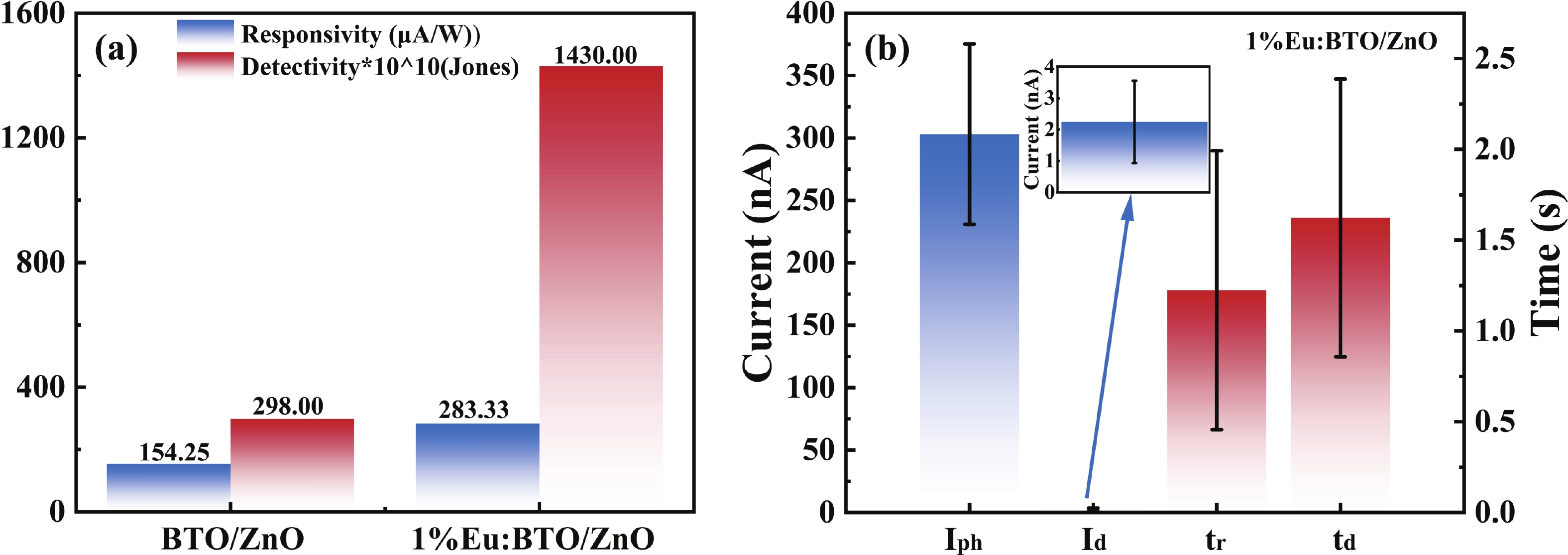
Fig. 4.  (Color online) (a)The responsivity and specific detectivity of devices based on 1% Eu:BTO/ZnO and BTO/ZnO (b) the photo/dark current and rise/fall times for these two devices with Error bar.

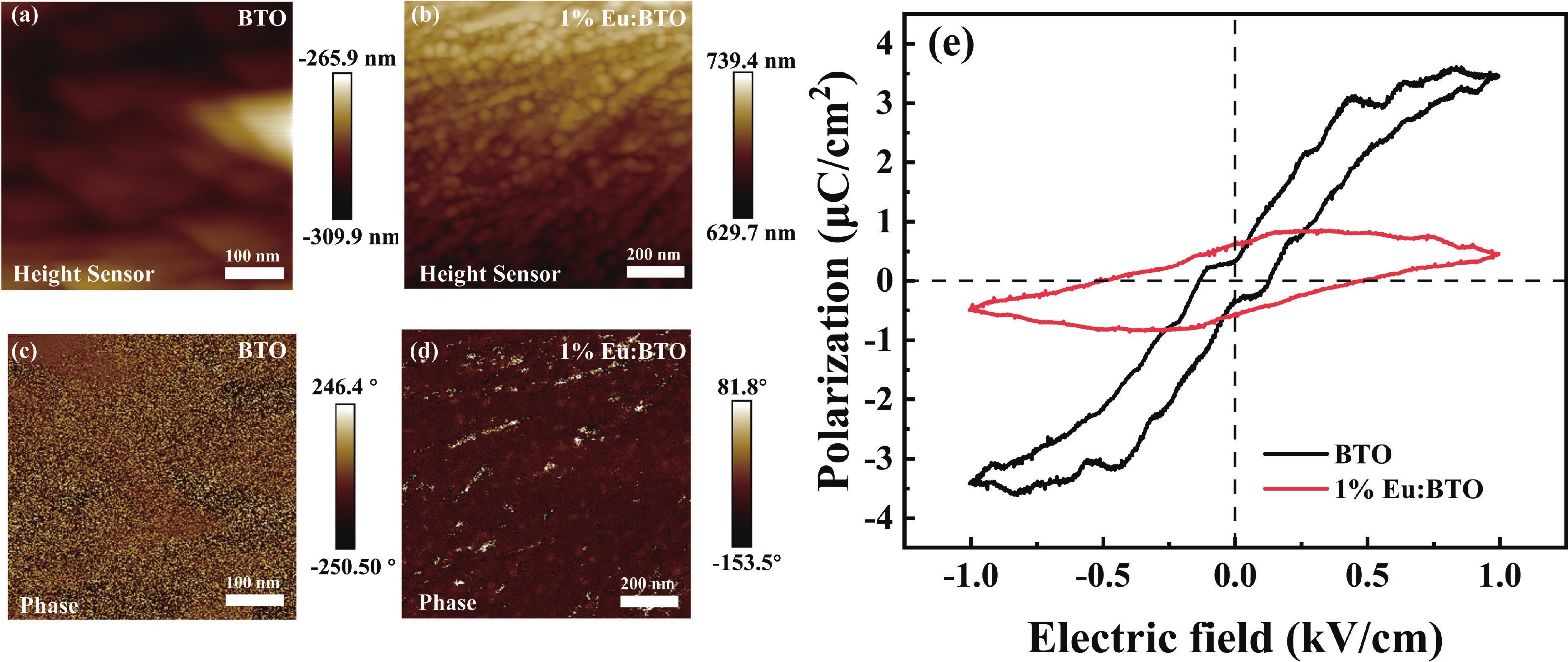
Fig. 5.  (Color online) AFM images of (a) pure BTO and (b) 1% Eu:BTO, PFM images of (c) BTO and (d) 1% Eu:BTO, (e) P-E hysteresis loops of BTO and 1% Eu:BTO film.

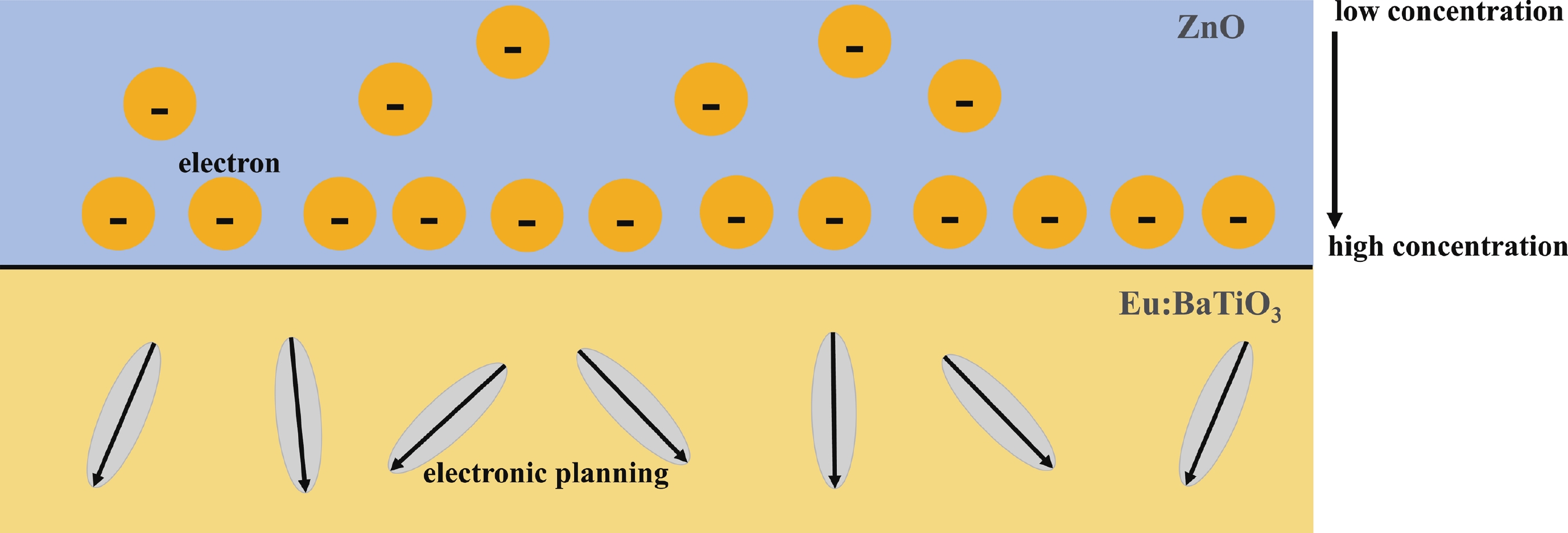
Fig. 6.  (Color online) Schematic diagram of the influence of BTO substrate on the distribution of carriers in ZnO film.

[1]
Soci C, Zhang A, Xiang B, et al. ZnO nanowire UV photodetectors with high internal gain. Nano Lett, 2007, 7(4): 1003 doi: 10.1021/nl070111x
[2]
Ha H J, Kang S J, Jeong J H, et al. Real-time ultraviolet monitoring system with low-temperature solution-processed high-transparent p-n junction photodiode with a fast responsive and high rectification ratio. ACS Appl Mater Interfaces, 2024, 16(30): 40139 doi: 10.1021/acsami.4c05494
[3]
Hwang T-Y, Choi Y, Song Y, et al. A noble gas sensor platform: linear dense assemblies of single-walled carbon nanotubes (LACNTs) in a multi-layered ceramic/metal electrode system (MLES). J Mater Chem C, 2018, 6(5): 972 doi: 10.1039/C7TC03576D
[4]
Zhu J, Yu L, Wang Z, et al. High-performance and stable sb2S3 thin-film photodetectors for potential application in visible light communication. ACS Appl Mater Interfaces, 2023, 15(23): 28175 doi: 10.1021/acsami.3c03671
[5]
Brooke R, Edberg J, Iandolo D, et al. Controlling the electrochromic properties of conductive polymers using UV-light. J Mater Chem C, 2018, 6(17): 4663 doi: 10.1039/C7TC05833K
[6]
Wu C, Wu F, Hu H, et al. Review of self-powered solar-blind photodetectors based on Ga2O3, Mat. Today Phys., 2022, 28: 100883
[7]
Lee B, Zhang X, Kang J, et al. A negative photoconductivity photodetector based on two-dimensional Nb3Cl8. Nanoscale, 2024, 16(43): 20312 doi: 10.1039/D4NR03376K
[8]
Jiang T, Wu X, He Z, et al. Two-dimensional SnSe films on paper substrates for flexible broadband photodetectors. ACS Appl Nano Mater, 2024, 7(3): 2992 doi: 10.1021/acsanm.3c05369
[9]
Aldalbahi A, Feng P. Development of 2-D boron nitride nanosheets UV photoconductive detectors. IEEE Trans on Electron Devices, 2015, 62(6): 1885 doi: 10.1109/TED.2015.2423253
[10]
Wang F, Mei J, Wang Y, et al. Fast photoconductive responses in organometal halide perovskite photodetectors. ACS Appl Mater Interfaces, 2016, 8(4): 2840 doi: 10.1021/acsami.5b11621
[11]
Zhang S, Li Z, Li J, et al. Organic near-infrared photodetectors with photoconductivity-enhanced performance. Aggregate, 2023, 4(5): e345 doi: 10.1002/agt2.345
[12]
Guan S, Cheng C, Ning Y, et al. Effect of metal–organic frameworks with different ligand structures (ZIF-11 & ZIF-23) on the optoelectronic performance of perovskite photodetectors. ACS Appl Mater Interfaces, 2024, 16(31): 41341 doi: 10.1021/acsami.4c08576
[13]
D’Agostino D, Di Giorgio C, Bobba F, et al. Effects of cobalt substitution on ZnO surface reactivity and electronic structure. J Mater Chem C, 2019, 7(27): 8364 doi: 10.1039/C8TC06188B
[14]
Chinnasamy M, Paul S, Balagopalan S, et al. Cr-Doping-Induced fano resonance of ZnO-layered nanoporous structures and UV photodetector application. ACS Appl Opt Mater, 2023, 1(4): 852 doi: 10.1021/acsaom.3c00016
[15]
Karaca A, Yıldız D E, Hussaini A A, et al. Optoelectrical characterization of a UV–Vis–NIR broadband photodetector based on Tm-doped ZnO. Phys B Condens Matte, 2025, 706: 417131 doi: 10.1016/j.physb.2025.417131
[16]
Jalal R, Ozel K, Atilgan A, et al. UV photodetectors based on W-doped ZnO thin films. Nanotechnology, 2024, 35(26): 265705 doi: 10.1088/1361-6528/ad373b
[17]
Poul Raj I L, Valanarasu S, Hariprasad K, et al. Enhancement of optoelectronic parameters of Nd-doped ZnO nanowires for photodetector applications. Opt Mater, 2020, 109: 110396 doi: 10.1016/j.optmat.2020.110396
[18]
Nurfani E, Nulhakim L, Muhammad D M, et al. The enhanced sensing performance of ZnO-based photodetector by Mg doping. Opt Mater, 2024, 148: 114948 doi: 10.1016/j.optmat.2024.114948
[19]
Wang N, Li B, Chen Y, et al. Self-powered ZnO/NiO dual-band photodetector based on surface plasmon enhancement. Mater Des, 2025, 260: 115079 doi: 10.1016/j.matdes.2025.115079
[20]
Li G, Yan Q, Zhao X, et al. The influence of surface processing on the surface plasmonic enhancement of an Al-nanoparticles-enhanced ZnO UV photodectector. Nanomaterials, 2023, 13(12): 1877 doi: 10.3390/nano13121877
[21]
Huynh H N D, Nguyen B G M, Dinh T M, et al. Enhancing the performance of ZnO-based photodetectors by forming ZnO/(Cu: ZnO) core/shell nanorods. ACS Applied Electronic Materials, 2024, 6(3): 1894 doi: 10.1021/acsaelm.3c01789
[22]
Rana V S, Rajput J K, Pathak T K, et al. Multilayer MgZnO/ZnO thin films for UV photodetectors. J Alloys Compd, 2018, 764: 724 doi: 10.1016/j.jallcom.2018.06.139
[23]
Yu M, Wang G, Zhao R, et al. Improved interfacial wetability in Cu/ZnO and its role in ZnO/Cu/ZnO sandwiched transparent electrodes. J Mater Sci Technol, 2020, 37: 123 doi: 10.1016/j.jmst.2019.06.019
[24]
Hakkoum H, Moumen A, Ghougali M, et al. The effect of structural characteristics of ZnO and NiO thin films on the performance of NiO/ZnO photodetectors. J Mater Sci Mater Electron, 2022, 33(35): 26604 doi: 10.1007/s10854-022-09336-w
[25]
Hong P, Wu L, Shi X, et al. Influence of buffer layer on the performance of ZnO film based photoconductive detectors. J Appl Phys, 2025, 138(5): 055304 doi: 10.1063/5.0273458
[26]
Zhang Y, Zhao X, Chen J, et al. Self‐polarized BaTiO3 for greatly enhanced performance of ZnO UV ohotodetector by regulating the distribution of electron concentration. Adv Funct Mater, 2019, 30(5): 1907650 doi: 10.1002/adfm.201907650
[27]
Meng J, Di X, Liu Y. Ferroelectric polarization field enhanced CsPbBr3/ZnO heterojunction broadband photodetector. Adv Mater Technol, 2026: 71028
[28]
Aminirastabi H, Xue H, Mitić V V, et al. Novel fractal analysis of nanograin growth in BaTiO3 thin film. Mater Chem Phys, 2020, 239: 122261 doi: 10.1016/j.matchemphys.2019.122261
[29]
Zhao K, Ouyang B, Bowen C R, et al. Enhanced photocurrent via ferro-pyro-phototronic effect in ferroelectric BaTiO3 materials for a self-powered flexible photodetector system. Nano Energy, 2020, 77: 105152 doi: 10.1016/j.nanoen.2020.105152
[30]
Su L, Yan T, Liu X, et al. A tunable polarization field for enhanced performance of flexible BaTiO3@TiO2 nanofiber photodetector by suppressing dark current to pA Level. Adv Funct Mater, 2023, 33(15): 2214533 doi: 10.1002/adfm.202214533
[31]
Hong P, Cui X, Li N, et al. Performance enhancement of photoconductive detector based on ZnO film via the synergistic effect of heterojunction and polarization electric field. Phys B Condens Matte, 2026, 726: 418264 doi: 10.1016/j.physb.2026.418264
[32]
Yu P, Wang W, Zheng T, et al. Pyro-phototronic effect-enhanced photocurrent of a self-powered photodetector based on ZnO nanofiber arrays/BaTiO3 films. ACS Appl Mater Interfaces, 2023, 15(39): 46031 doi: 10.1021/acsami.3c08880
[33]
Du X, Kang Z, Wu M, et al. A first-principles study on the ferroelectric and optical properties of (Zn, Co)-doped barium titanate. Phys Chem Chem Phys, 2026, 28(8): 5468 doi: 10.1039/D5CP03634H
[34]
Cavanagh A E, Little L B, Zhang Y, et al. Effect of stoichiometry on the structure and polarization of BaTiO3. Adv Opt Mater, 2025, 13(22): 2195
[35]
Huang L, Dai Y, Wu Y, et al. Enhanced ferroelectric and piezoelectric properties of (1-x)BaZr0.2Ti0.8O3–xBa0.7Ca0.3TiO3 thin films by sol–gel process. Appl Surf Sci, 2016, 388: 35 doi: 10.1016/j.apsusc.2016.05.030
[36]
Huang L, Dai Y, Xiao H, et al. Structure and ferroelectric property of low concentration iron-doped sol–gel BaTiO3 thin films. Ceram Int, 2016, 42(7): 9046 doi: 10.1016/j.ceramint.2016.02.162
[37]
Padalia D, Kumar U, Bhandari P, et al. Tuning the structural, optical, and dielectric properties of europium-doped barium titanate ceramics. J Mater Sci Mater Electron, 2024, 35(19): 1375 doi: 10.1007/s10854-024-12984-9
[38]
Sharma S, Tomar M, Puri N K, et al. Ultraviolet radiation detection by barium titanate thin films grown by sol–gel hydrothermal method. Sensors and Actuators A: Physical, 2015, 230: 175 doi: 10.1016/j.sna.2015.04.019
[39]
Xiao S H, Jiang W F, Luo K, et al. Structure and ferroelectric properties of barium titanate films synthesized by sol–gel method. Mater Chem Phys, 2011, 127(3): 420 doi: 10.1016/j.matchemphys.2011.01.006
[40]
Chen X, Huang S, Nasiri N. Facile fabrication of UV photodetectors using spin-coating flame-synthesized ZnO nanoparticles. ACS Appl Nano Mater, 2024, 7(4): 3589 doi: 10.1021/acsanm.3c04403
[41]
Su L, Li Z, Cao F, et al. Tailoring the interface assembly of mesoporous TiO2 on BTO film toward high-performance UV photodetectors. J Mater Chem C, 2022, 10(23): 9035 doi: 10.1039/D2TC01559E
[42]
Vinita V S, Ravikumar D, Lakshmanan D, et al. Role of Sn doping on the structural, morphological, optical and magnetic properties of BaTiO3 nanostructures. J Mater Sci Mater Electron, 2023, 34(20): 1539 doi: 10.1007/s10854-023-10950-5
[43]
Siemek K, Olejniczak A, Korotkov L N, et al. Investigation of surface defects in BaTiO3 nanopowders studied by XPS and positron annihilation lifetime spectroscopy. Appl Surf Sci, 2022, 578: 151807 doi: 10.1016/j.apsusc.2021.151807
[44]
Jiménez J A, Fachini E R, Zhao C. XPS and 31P NMR inquiry of Eu3+-induced structural modification in SnO-containing phosphate glass. J Mol Struct, 2018, 1164: 470 doi: 10.1016/j.molstruc.2018.03.095
[45]
Yang Y, Zhang P, Miao X, et al. Color-tunable emission via site-selective occupation of Eu2+ activators in silicate phosphors. Laser Photonics Rev, 2025, 19(2): 2400982 doi: 10.1002/lpor.202400982
[46]
Barreca D, Gasparotto A, Maccato C, et al. ZnO nanoplatelets obtained by chemical bapor deposition, studied by XPS. Surf Sci Spectra, 2009, 14(1): 19 doi: 10.1116/11.20071001
[47]
Li J, Nolan M, Detavernier C. A step toward correct interpretation of XPS results in metal oxides: A case study aided by first-principles method in ZnO. J Chem Phys, 2023, 159(3): 034702 doi: 10.1063/5.0154926
  • Search

    Advanced Search >>

    GET CITATION

    shu

    Export: BibTex EndNote

    Article Metrics

    Article views: 5 Times PDF downloads: 2 Times Cited by: 0 Times

    History

    Received: 02 June 2026 Revised: 02 July 2026 Online: Accepted Manuscript: 28 July 2026

    Catalog

      Email This Article

      User name:
      Email:*请输入正确邮箱
      Code:*验证码错误
      Peiqin Hong, Xinyu Cui, Nan Li, Peng Hu, Haibo Fan, Qiujie Li, Feng Teng. Enhancement of self-polarized electric field in BaTiO3 thin film via europium doping and its application in improving the performance of ZnO thin film photoconductive detectors[J]. Journal of Semiconductors, 2026, In Press. doi: 10.1088/1674-4926/26060005 ****P Q Hong, X Y Cui, N Li, P Hu, H B Fan, Q J Li, and F Teng, Enhancement of self-polarized electric field in BaTiO3 thin film via europium doping and its application in improving the performance of ZnO thin film photoconductive detectors[J]. J. Semicond., 2026, accepted doi: 10.1088/1674-4926/26060005
      Citation:
      Peiqin Hong, Xinyu Cui, Nan Li, Peng Hu, Haibo Fan, Qiujie Li, Feng Teng. Enhancement of self-polarized electric field in BaTiO3 thin film via europium doping and its application in improving the performance of ZnO thin film photoconductive detectors[J]. Journal of Semiconductors, 2026, In Press. doi: 10.1088/1674-4926/26060005 ****
      P Q Hong, X Y Cui, N Li, P Hu, H B Fan, Q J Li, and F Teng, Enhancement of self-polarized electric field in BaTiO3 thin film via europium doping and its application in improving the performance of ZnO thin film photoconductive detectors[J]. J. Semicond., 2026, accepted doi: 10.1088/1674-4926/26060005

      Enhancement of self-polarized electric field in BaTiO3 thin film via europium doping and its application in improving the performance of ZnO thin film photoconductive detectors

      DOI: 10.1088/1674-4926/26060005
      CSTR: 32376.14.1674-4926.26060005
      More Information
      • Peiqin Hong was born in Yunan, China, in May 2002. He received the bachelor’s degree from Northwest University, Xi’an, China, in 2024. His is pursuing the master’s degree with the Physics College, Northwest University, Xi’an, China. Her research interests include the preparation and application of nanomaterials, particularly the fabrication and study of ZnO-based photodetectors
      • Feng Teng received the Ph.D. degree from the School of Physical Science and Technology, Lanzhou University, Lanzhou, China, in 2015. After that, he followed Prof. Xiaosheng Fang for his Postdoctoral Research at Fudan University, Shanghai, China. Currently, he is a Professor with the School of Physics, Northwest University, Xi’an, China. His research interests include the photodetectors based on metal oxides and silicon, and flexible, and wearable optoelectronic devices
      • Corresponding author: tengfeng@nwu.edu.cn
      • Received Date: 2026-06-02
      • Revised Date: 2026-07-02
      • Available Online: 2026-07-28

      Catalog

        /

        DownLoad:  Full-Size Img  PowerPoint
        Return
        Return