


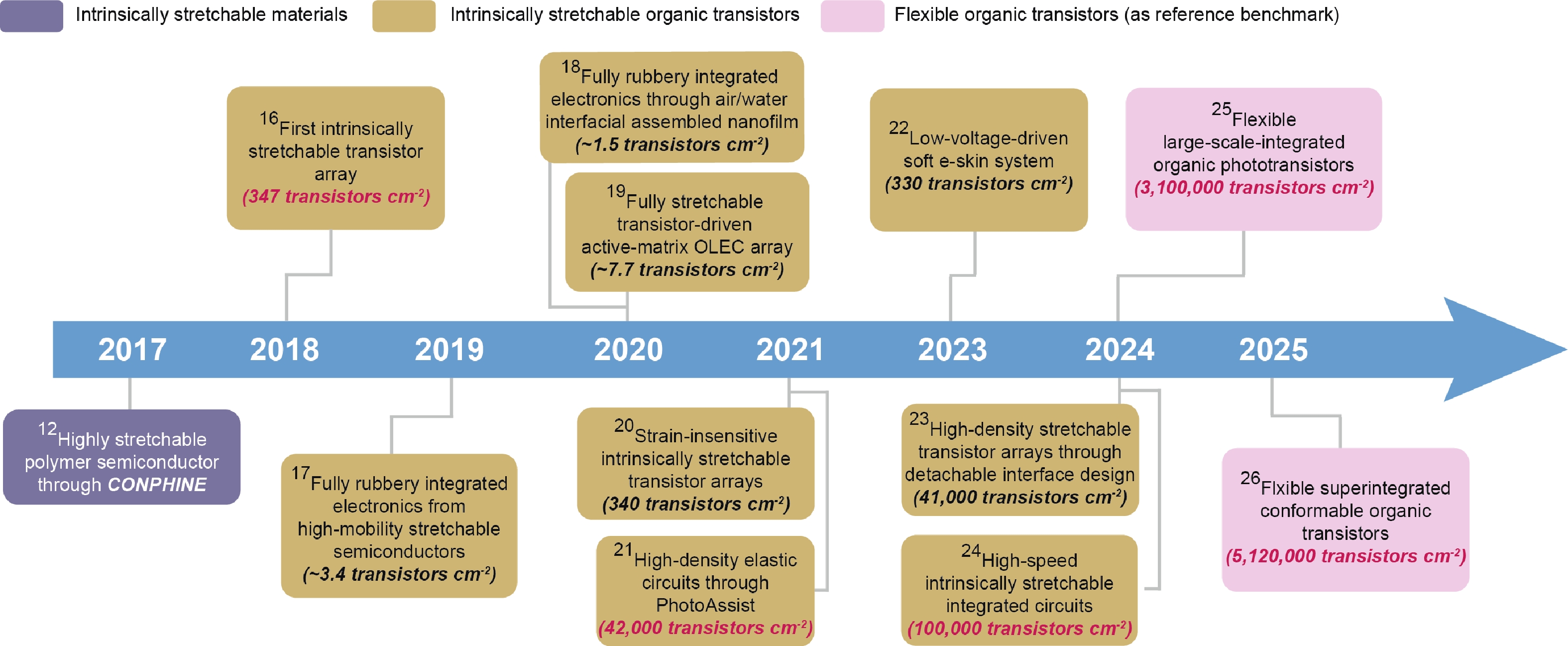
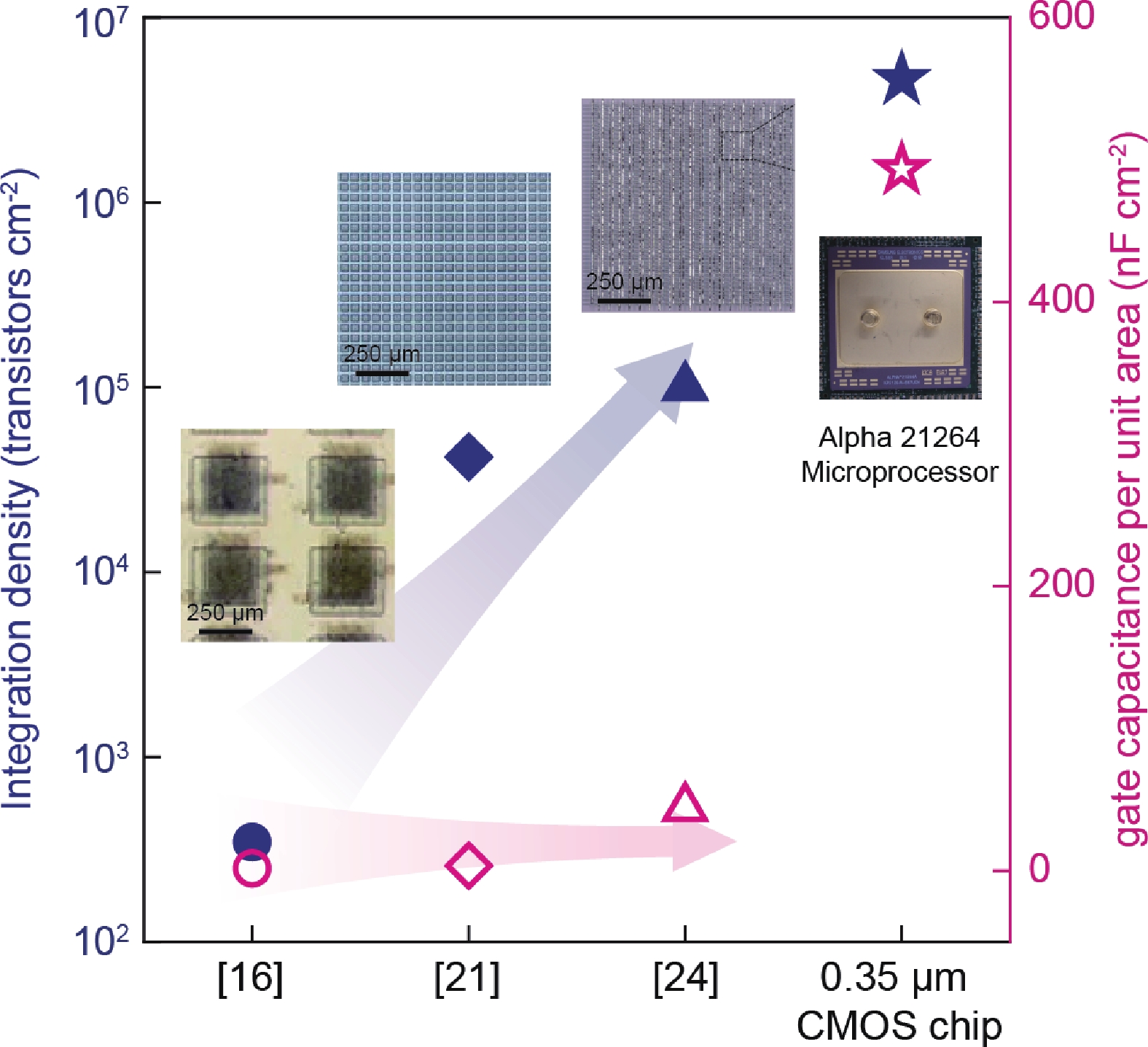
Fig. 1.
(Color online) Moore’s law in stretchable transistors.
RESEARCH HIGHLIGHTS
Zeyu Zhong, Shengyuan Liu and Yu-Qing Zheng
Corresponding author: Yu-Qing Zheng, zhengyq@pku.edu.cn
| [1] |
Zhao C Z, Park J, Root S E, et al. Skin-inspired soft bioelectronic materials, devices and systems. Nat Rev Bioeng, 2024, 2(8): 671 doi: 10.1038/s44222-024-00194-1
|
| [2] |
Zhou W, Jiang Y W, Xu Q, et al. Soft and stretchable organic bioelectronics for continuous intraoperative neurophysiological monitoring during microsurgery. Nat Biomed Eng, 2023, 7(10): 1270 doi: 10.1038/s41551-023-01069-3
|
| [3] |
Sun J, Zhao G D, Zhang M X, et al. Intrinsically stretchable organic field-effect transistors: Progress and challenges. J Mater Chem C, 2024, 12(17): 6011 doi: 10.1039/D3TC04821G
|
| [4] |
Liu K, Guo Y L, Liu Y Q. Recent progress in stretchable organic field-effect transistors. Sci China Technol Sci, 2019, 62(8): 1255 doi: 10.1007/s11431-018-9503-8
|
| [5] |
Schaller R R. Moore’s law: Past, present and future. IEEE Spectr, 1997, 34(6): 52 doi: 10.1109/6.591665
|
| [6] |
Ando T, Frank M M, Choi K, et al. (Invited) ultimate EOT scaling (< 5 Å) using Hf-based high-κ gate dielectrics and impact on carrier mobility. ECS Trans, 2010, 28(1): 115
|
| [7] |
Ratnesh R K, Goel A, Kaushik G, et al. Advancement and challenges in MOSFET scaling. Mater Sci Semicond Process, 2021, 134: 106002 doi: 10.1016/j.mssp.2021.106002
|
| [8] |
Usui T, Donnelly C A, Logar M, et al. Approaching the limits of dielectric breakdown for SiO2 films deposited by plasma-enhanced atomic layer deposition. Acta Mater, 2013, 61(20): 7660 doi: 10.1016/j.actamat.2013.09.003
|
| [9] |
Chortos A, Lim J, To J W F, et al. Highly stretchable transistors using a microcracked organic semiconductor. Adv Mater, 2014, 26(25): 4253 doi: 10.1002/adma.201305462
|
| [10] |
Roth B, Savagatrup S, de los Santos N V, et al. Mechanical properties of a library of low-band-gap polymers. Chem Mater, 2016, 28(7): 2363 doi: 10.1021/acs.chemmater.6b00525
|
| [11] |
Oh J Y, Rondeau-Gagné S, Chiu Y C, et al. Intrinsically stretchable and healable semiconducting polymer for organic transistors. Nature, 2016, 539(7629): 411 doi: 10.1038/nature20102
|
| [12] |
Xu J, Wang S H, Wang G N, et al. Highly stretchable polymer semiconductor films through the nanoconfinement effect. Science, 2017, 355(6320): 59 doi: 10.1126/science.aah4496
|
| [13] |
Wang G N, Zheng Y, Zhang S, et al. Tuning the cross-linker crystallinity of a stretchable polymer semiconductor. Chem Mater, 2019, 31(17): 6465 doi: 10.1021/acs.chemmater.8b04314
|
| [14] |
Wang G N, Gasperini A, Bao Z N. Stretchable polymer semiconductors for plastic electronics. Adv Electron Mater, 2018, 4(2): 1700429 doi: 10.1002/aelm.201700429
|
| [15] |
Kim Y, Yoo S, Kim J H. Water-based highly stretchable PEDOT: PSS/nonionic WPU transparent electrode. Polymers, 2022, 14(5): 949 doi: 10.3390/polym14050949
|
| [16] |
Wang S H, Xu J, Wang W C, et al. Skin electronics from scalable fabrication of an intrinsically stretchable transistor array. Nature, 2018, 555(7694): 83 doi: 10.1038/nature25494
|
| [17] |
Sim K, Rao Z L, Kim H J, et al. Fully rubbery integrated electronics from high effective mobility intrinsically stretchable semiconductors. Sci Adv, 2019, 5(2): eaav5749 doi: 10.1126/sciadv.aav5749
|
| [18] |
Guan Y S, Thukral A, Zhang S, et al. Air/water interfacial assembled rubbery semiconducting nanofilm for fully rubbery integrated electronics. Sci Adv, 2020, 6(38): eabb3656 doi: 10.1126/sciadv.abb3656
|
| [19] |
Liu J, Wang J C, Zhang Z T, et al. Fully stretchable active-matrix organic light-emitting electrochemical cell array. Nat Commun, 2020, 11: 3362 doi: 10.1038/s41467-020-17084-w
|
| [20] |
Wang W C, Wang S H, Rastak R, et al. Strain-insensitive intrinsically stretchable transistors and circuits. Nat Electron, 2021, 4(2): 143 doi: 10.1038/s41928-020-00525-1
|
| [21] |
Zheng Y Q, Liu Y X, Zhong D L, et al. Monolithic optical microlithography of high-density elastic circuits. Science, 2021, 373(6550): 88 doi: 10.1126/science.abh3551
|
| [22] |
Wang W C, Jiang Y W, Zhong D L, et al. Neuromorphic sensorimotor loop embodied by monolithically integrated, low-voltage, soft e-skin. Science, 2023, 380(6646): 735 doi: 10.1126/science.ade0086
|
| [23] |
Bian Y S, Zhu M L, Wang C Y, et al. A detachable interface for stable low-voltage stretchable transistor arrays and high-resolution X-ray imaging. Nat Commun, 2024, 15: 2624 doi: 10.1038/s41467-024-47026-9
|
| [24] |
Zhong D L, Wu C, Jiang Y W, et al. High-speed and large-scale intrinsically stretchable integrated circuits. Nature, 2024, 627(8003): 313 doi: 10.1038/s41586-024-07096-7
|
| [25] |
Zhang S, Chen R Z, Kong D R, et al. Photovoltaic nanocells for high-performance large-scale-integrated organic phototransistors. Nat Nanotechnol, 2024, 19(9): 1323 doi: 10.1038/s41565-024-01707-0
|
| [26] |
Ni Y P, Zhao X L, Xue C, et al. Superintegrated conformable organic transistors based on a universal microlithographic strategy. Nat Commun, 2025, 16: 9246 doi: 10.1038/s41467-025-64284-3
|
| [27] |
Gronowski P E, Bowhill W J, Preston R P, et al. High-performance microprocessor design. IEEE J Solid State Circuits, 1998, 33(5): 676 doi: 10.1109/4.668981
|
| [28] |
Wang H F, Wang Z Y, Yang J, et al. Ionic gels and their applications in stretchable electronics. Macromol Rapid Commun, 2018, 39(16): 1800246 doi: 10.1002/marc.201800246
|
| [29] |
Wang B H, Huang W, et al. High-k gate dielectrics for emerging flexible and stretchable electronics. Chem Rev, 2018, 118(11): 5690 doi: 10.1021/acs.chemrev.8b00045
|
| [30] |
Sirringhaus H. Device physics of solution-processed organic field-effect transistors. Adv Mater, 2005, 17(20): 2411 doi: 10.1002/adma.200501152
|
| [31] |
Zhao C B, Chen H M, Ali M U, et al. Improving the performance of red organic light-emitting transistors by utilizing a high-k organic/inorganic bilayer dielectric. ACS Appl Mater Interfaces, 2022, 14(32): 36902 doi: 10.1021/acsami.2c07216
|
| [32] |
Artbauer J. Electric strength of polymers. J Phys D: Appl Phys, 1996, 29(2): 446 doi: 10.1088/0022-3727/29/2/024
|
| [33] |
Teyssedre G, Laurent C. Charge transport modeling in insulating polymers: From molecular to macroscopic scale. IEEE Trans Dielectr Electr Insul, 2005, 12(5): 857 doi: 10.1109/TDEI.2005.1522182
|
| [34] |
Garton A, Groeger J H, Henry J L. Ionic impurities in crosslinked polyethylene cable insulation. IEEE Trans Electr Insul, 1990, 25(2): 427 doi: 10.1109/14.52394
|
| [35] |
Fasolt B, Albuquerque F B, Hubertus J, et al. Electrode impact on the electrical breakdown of dielectric elastomer thin films. Polymers, 2023, 15(20): 4071 doi: 10.3390/polym15204071
|
| [36] |
Kim S H, Na S W, Lee N E, et al. Effect of surface roughness on the adhesion properties of Cu/Cr films on polyimide substrate treated by inductively coupled oxygen plasma. Surf Coat Technol, 2005, 200(7): 2072 doi: 10.1016/j.surfcoat.2005.05.021
|
| [37] |
Nimbalkar P, Bhaskar P, Kathaperumal M, et al. A review of polymer dielectrics for redistribution layers in interposers and package substrates. Polymers, 2023, 15(19): 3895 doi: 10.3390/polym15193895
|
| [38] |
Fan X H, Liu Z G, Man G A, et al. Electric breakdown of dielectric polymers is strongly correlated to mechanical toughness. Adv Mater, 2026, 38(46): e74050 doi: 10.1002/adma.74050
|
| [39] |
Koo J H, Kang J, Lee S, et al. A vacuum-deposited polymer dielectric for wafer-scale stretchable electronics. Nat Electron, 2023, 6(2): 137 doi: 10.1038/s41928-023-00918-y
|
| [40] |
Wang T Y, Mao J, Zhang B Y, et al. Polymeric insulating materials characteristics for high-voltage applications. Nat Rev Electr Eng, 2024, 1(8): 516 doi: 10.1038/s44287-024-00070-5
|
| [41] |
Lee J, Hassan S Z, Lee S, et al. Azide-functionalized ligand enabling organic-inorganic hybrid dielectric for high-performance solution-processed oxide transistors. Nat Commun, 2022, 13(1): 7021 doi: 10.1038/s41467-022-34772-x
|
| [42] |
Zhong Z Y, Cui Z P, Zhang Z T, et al. Ultrathin and robust elastomeric dielectrics using a crosslinking-assisted trap creation method for miniaturized stretchable electronics. Nat Electron, 2026, 9(4): 389 doi: 10.1038/s41928-026-01579-3
|
| [43] |
Lee J H, Chung J Y, Stafford C M. Effect of confinement on stiffness and fracture of thin amorphous polymer films. ACS Macro Lett, 2012, 1(1): 122 doi: 10.1021/mz200090a
|
| [1] |
Zhao C Z, Park J, Root S E, et al. Skin-inspired soft bioelectronic materials, devices and systems. Nat Rev Bioeng, 2024, 2(8): 671 doi: 10.1038/s44222-024-00194-1
|
| [2] |
Zhou W, Jiang Y W, Xu Q, et al. Soft and stretchable organic bioelectronics for continuous intraoperative neurophysiological monitoring during microsurgery. Nat Biomed Eng, 2023, 7(10): 1270 doi: 10.1038/s41551-023-01069-3
|
| [3] |
Sun J, Zhao G D, Zhang M X, et al. Intrinsically stretchable organic field-effect transistors: Progress and challenges. J Mater Chem C, 2024, 12(17): 6011 doi: 10.1039/D3TC04821G
|
| [4] |
Liu K, Guo Y L, Liu Y Q. Recent progress in stretchable organic field-effect transistors. Sci China Technol Sci, 2019, 62(8): 1255 doi: 10.1007/s11431-018-9503-8
|
| [5] |
Schaller R R. Moore’s law: Past, present and future. IEEE Spectr, 1997, 34(6): 52 doi: 10.1109/6.591665
|
| [6] |
Ando T, Frank M M, Choi K, et al. (Invited) ultimate EOT scaling (< 5 Å) using Hf-based high-κ gate dielectrics and impact on carrier mobility. ECS Trans, 2010, 28(1): 115
|
| [7] |
Ratnesh R K, Goel A, Kaushik G, et al. Advancement and challenges in MOSFET scaling. Mater Sci Semicond Process, 2021, 134: 106002 doi: 10.1016/j.mssp.2021.106002
|
| [8] |
Usui T, Donnelly C A, Logar M, et al. Approaching the limits of dielectric breakdown for SiO2 films deposited by plasma-enhanced atomic layer deposition. Acta Mater, 2013, 61(20): 7660 doi: 10.1016/j.actamat.2013.09.003
|
| [9] |
Chortos A, Lim J, To J W F, et al. Highly stretchable transistors using a microcracked organic semiconductor. Adv Mater, 2014, 26(25): 4253 doi: 10.1002/adma.201305462
|
| [10] |
Roth B, Savagatrup S, de los Santos N V, et al. Mechanical properties of a library of low-band-gap polymers. Chem Mater, 2016, 28(7): 2363 doi: 10.1021/acs.chemmater.6b00525
|
| [11] |
Oh J Y, Rondeau-Gagné S, Chiu Y C, et al. Intrinsically stretchable and healable semiconducting polymer for organic transistors. Nature, 2016, 539(7629): 411 doi: 10.1038/nature20102
|
| [12] |
Xu J, Wang S H, Wang G N, et al. Highly stretchable polymer semiconductor films through the nanoconfinement effect. Science, 2017, 355(6320): 59 doi: 10.1126/science.aah4496
|
| [13] |
Wang G N, Zheng Y, Zhang S, et al. Tuning the cross-linker crystallinity of a stretchable polymer semiconductor. Chem Mater, 2019, 31(17): 6465 doi: 10.1021/acs.chemmater.8b04314
|
| [14] |
Wang G N, Gasperini A, Bao Z N. Stretchable polymer semiconductors for plastic electronics. Adv Electron Mater, 2018, 4(2): 1700429 doi: 10.1002/aelm.201700429
|
| [15] |
Kim Y, Yoo S, Kim J H. Water-based highly stretchable PEDOT: PSS/nonionic WPU transparent electrode. Polymers, 2022, 14(5): 949 doi: 10.3390/polym14050949
|
| [16] |
Wang S H, Xu J, Wang W C, et al. Skin electronics from scalable fabrication of an intrinsically stretchable transistor array. Nature, 2018, 555(7694): 83 doi: 10.1038/nature25494
|
| [17] |
Sim K, Rao Z L, Kim H J, et al. Fully rubbery integrated electronics from high effective mobility intrinsically stretchable semiconductors. Sci Adv, 2019, 5(2): eaav5749 doi: 10.1126/sciadv.aav5749
|
| [18] |
Guan Y S, Thukral A, Zhang S, et al. Air/water interfacial assembled rubbery semiconducting nanofilm for fully rubbery integrated electronics. Sci Adv, 2020, 6(38): eabb3656 doi: 10.1126/sciadv.abb3656
|
| [19] |
Liu J, Wang J C, Zhang Z T, et al. Fully stretchable active-matrix organic light-emitting electrochemical cell array. Nat Commun, 2020, 11: 3362 doi: 10.1038/s41467-020-17084-w
|
| [20] |
Wang W C, Wang S H, Rastak R, et al. Strain-insensitive intrinsically stretchable transistors and circuits. Nat Electron, 2021, 4(2): 143 doi: 10.1038/s41928-020-00525-1
|
| [21] |
Zheng Y Q, Liu Y X, Zhong D L, et al. Monolithic optical microlithography of high-density elastic circuits. Science, 2021, 373(6550): 88 doi: 10.1126/science.abh3551
|
| [22] |
Wang W C, Jiang Y W, Zhong D L, et al. Neuromorphic sensorimotor loop embodied by monolithically integrated, low-voltage, soft e-skin. Science, 2023, 380(6646): 735 doi: 10.1126/science.ade0086
|
| [23] |
Bian Y S, Zhu M L, Wang C Y, et al. A detachable interface for stable low-voltage stretchable transistor arrays and high-resolution X-ray imaging. Nat Commun, 2024, 15: 2624 doi: 10.1038/s41467-024-47026-9
|
| [24] |
Zhong D L, Wu C, Jiang Y W, et al. High-speed and large-scale intrinsically stretchable integrated circuits. Nature, 2024, 627(8003): 313 doi: 10.1038/s41586-024-07096-7
|
| [25] |
Zhang S, Chen R Z, Kong D R, et al. Photovoltaic nanocells for high-performance large-scale-integrated organic phototransistors. Nat Nanotechnol, 2024, 19(9): 1323 doi: 10.1038/s41565-024-01707-0
|
| [26] |
Ni Y P, Zhao X L, Xue C, et al. Superintegrated conformable organic transistors based on a universal microlithographic strategy. Nat Commun, 2025, 16: 9246 doi: 10.1038/s41467-025-64284-3
|
| [27] |
Gronowski P E, Bowhill W J, Preston R P, et al. High-performance microprocessor design. IEEE J Solid State Circuits, 1998, 33(5): 676 doi: 10.1109/4.668981
|
| [28] |
Wang H F, Wang Z Y, Yang J, et al. Ionic gels and their applications in stretchable electronics. Macromol Rapid Commun, 2018, 39(16): 1800246 doi: 10.1002/marc.201800246
|
| [29] |
Wang B H, Huang W, et al. High-k gate dielectrics for emerging flexible and stretchable electronics. Chem Rev, 2018, 118(11): 5690 doi: 10.1021/acs.chemrev.8b00045
|
| [30] |
Sirringhaus H. Device physics of solution-processed organic field-effect transistors. Adv Mater, 2005, 17(20): 2411 doi: 10.1002/adma.200501152
|
| [31] |
Zhao C B, Chen H M, Ali M U, et al. Improving the performance of red organic light-emitting transistors by utilizing a high-k organic/inorganic bilayer dielectric. ACS Appl Mater Interfaces, 2022, 14(32): 36902 doi: 10.1021/acsami.2c07216
|
| [32] |
Artbauer J. Electric strength of polymers. J Phys D: Appl Phys, 1996, 29(2): 446 doi: 10.1088/0022-3727/29/2/024
|
| [33] |
Teyssedre G, Laurent C. Charge transport modeling in insulating polymers: From molecular to macroscopic scale. IEEE Trans Dielectr Electr Insul, 2005, 12(5): 857 doi: 10.1109/TDEI.2005.1522182
|
| [34] |
Garton A, Groeger J H, Henry J L. Ionic impurities in crosslinked polyethylene cable insulation. IEEE Trans Electr Insul, 1990, 25(2): 427 doi: 10.1109/14.52394
|
| [35] |
Fasolt B, Albuquerque F B, Hubertus J, et al. Electrode impact on the electrical breakdown of dielectric elastomer thin films. Polymers, 2023, 15(20): 4071 doi: 10.3390/polym15204071
|
| [36] |
Kim S H, Na S W, Lee N E, et al. Effect of surface roughness on the adhesion properties of Cu/Cr films on polyimide substrate treated by inductively coupled oxygen plasma. Surf Coat Technol, 2005, 200(7): 2072 doi: 10.1016/j.surfcoat.2005.05.021
|
| [37] |
Nimbalkar P, Bhaskar P, Kathaperumal M, et al. A review of polymer dielectrics for redistribution layers in interposers and package substrates. Polymers, 2023, 15(19): 3895 doi: 10.3390/polym15193895
|
| [38] |
Fan X H, Liu Z G, Man G A, et al. Electric breakdown of dielectric polymers is strongly correlated to mechanical toughness. Adv Mater, 2026, 38(46): e74050 doi: 10.1002/adma.74050
|
| [39] |
Koo J H, Kang J, Lee S, et al. A vacuum-deposited polymer dielectric for wafer-scale stretchable electronics. Nat Electron, 2023, 6(2): 137 doi: 10.1038/s41928-023-00918-y
|
| [40] |
Wang T Y, Mao J, Zhang B Y, et al. Polymeric insulating materials characteristics for high-voltage applications. Nat Rev Electr Eng, 2024, 1(8): 516 doi: 10.1038/s44287-024-00070-5
|
| [41] |
Lee J, Hassan S Z, Lee S, et al. Azide-functionalized ligand enabling organic-inorganic hybrid dielectric for high-performance solution-processed oxide transistors. Nat Commun, 2022, 13(1): 7021 doi: 10.1038/s41467-022-34772-x
|
| [42] |
Zhong Z Y, Cui Z P, Zhang Z T, et al. Ultrathin and robust elastomeric dielectrics using a crosslinking-assisted trap creation method for miniaturized stretchable electronics. Nat Electron, 2026, 9(4): 389 doi: 10.1038/s41928-026-01579-3
|
| [43] |
Lee J H, Chung J Y, Stafford C M. Effect of confinement on stiffness and fracture of thin amorphous polymer films. ACS Macro Lett, 2012, 1(1): 122 doi: 10.1021/mz200090a
|





Article views: 35 Times PDF downloads: 7 Times Cited by: 0 Times
Received: 09 June 2026 Revised: 12 August 2026 Online: Accepted Manuscript: 10 September 2026Uncorrected proof: 14 September 2026
| Citation: |
Zeyu Zhong, Shengyuan Liu, Yu-Qing Zheng. Dielectric material basis for Moore's law in stretchable transistors[J]. Journal of Semiconductors, 2026, In Press. doi: 10.1088/1674-4926/26060019
****
Z Y Zhong, S Y Liu, and Y Q Zheng, Dielectric material basis for Moore's law in stretchable transistors[J]. J. Semicond., 2026, 47(10): 100201 doi: 10.1088/1674-4926/26060019

|
 Zeyu Zhong received a bachelor’s degree in Hunan Normal University. He is currently pursuing a Ph.D. in Integrated Circuit Science and Engineering at the School of Integrated Circuits, Peking University, under the supervision of Prof. Yuqing Zheng. His research focuses on flexible electronics and brain–computer interfaces
 Shengyuan Liu received a bachelor’s degree in Applied Physics from the School of Electronics Engineering and Computer Science, Peking University. He is currently pursuing a Ph.D. in Integrated Circuit Science and Engineering at the School of Integrated Circuits, Peking University, under the supervision of Prof. Yuqing Zheng. His research focuses on flexible electronics and brain–computer interfaces
 Yu-Qing Zheng received her B.S. and Ph.D. degrees from Peking University and was a postdoctoral scholar at Stanford University before joining Peking University in 2021. She is currently an Assistant Professor and principal investigator in the School of Integrated Circuits. Her research focuses on flexible bioelectronics, particularly the development of high-performance soft materials and novel integration strategies
| [1] |
Zhao C Z, Park J, Root S E, et al. Skin-inspired soft bioelectronic materials, devices and systems. Nat Rev Bioeng, 2024, 2(8): 671 doi: 10.1038/s44222-024-00194-1
|
| [2] |
Zhou W, Jiang Y W, Xu Q, et al. Soft and stretchable organic bioelectronics for continuous intraoperative neurophysiological monitoring during microsurgery. Nat Biomed Eng, 2023, 7(10): 1270 doi: 10.1038/s41551-023-01069-3
|
| [3] |
Sun J, Zhao G D, Zhang M X, et al. Intrinsically stretchable organic field-effect transistors: Progress and challenges. J Mater Chem C, 2024, 12(17): 6011 doi: 10.1039/D3TC04821G
|
| [4] |
Liu K, Guo Y L, Liu Y Q. Recent progress in stretchable organic field-effect transistors. Sci China Technol Sci, 2019, 62(8): 1255 doi: 10.1007/s11431-018-9503-8
|
| [5] |
Schaller R R. Moore’s law: Past, present and future. IEEE Spectr, 1997, 34(6): 52 doi: 10.1109/6.591665
|
| [6] |
Ando T, Frank M M, Choi K, et al. (Invited) ultimate EOT scaling (< 5 Å) using Hf-based high-κ gate dielectrics and impact on carrier mobility. ECS Trans, 2010, 28(1): 115
|
| [7] |
Ratnesh R K, Goel A, Kaushik G, et al. Advancement and challenges in MOSFET scaling. Mater Sci Semicond Process, 2021, 134: 106002 doi: 10.1016/j.mssp.2021.106002
|
| [8] |
Usui T, Donnelly C A, Logar M, et al. Approaching the limits of dielectric breakdown for SiO2 films deposited by plasma-enhanced atomic layer deposition. Acta Mater, 2013, 61(20): 7660 doi: 10.1016/j.actamat.2013.09.003
|
| [9] |
Chortos A, Lim J, To J W F, et al. Highly stretchable transistors using a microcracked organic semiconductor. Adv Mater, 2014, 26(25): 4253 doi: 10.1002/adma.201305462
|
| [10] |
Roth B, Savagatrup S, de los Santos N V, et al. Mechanical properties of a library of low-band-gap polymers. Chem Mater, 2016, 28(7): 2363 doi: 10.1021/acs.chemmater.6b00525
|
| [11] |
Oh J Y, Rondeau-Gagné S, Chiu Y C, et al. Intrinsically stretchable and healable semiconducting polymer for organic transistors. Nature, 2016, 539(7629): 411 doi: 10.1038/nature20102
|
| [12] |
Xu J, Wang S H, Wang G N, et al. Highly stretchable polymer semiconductor films through the nanoconfinement effect. Science, 2017, 355(6320): 59 doi: 10.1126/science.aah4496
|
| [13] |
Wang G N, Zheng Y, Zhang S, et al. Tuning the cross-linker crystallinity of a stretchable polymer semiconductor. Chem Mater, 2019, 31(17): 6465 doi: 10.1021/acs.chemmater.8b04314
|
| [14] |
Wang G N, Gasperini A, Bao Z N. Stretchable polymer semiconductors for plastic electronics. Adv Electron Mater, 2018, 4(2): 1700429 doi: 10.1002/aelm.201700429
|
| [15] |
Kim Y, Yoo S, Kim J H. Water-based highly stretchable PEDOT: PSS/nonionic WPU transparent electrode. Polymers, 2022, 14(5): 949 doi: 10.3390/polym14050949
|
| [16] |
Wang S H, Xu J, Wang W C, et al. Skin electronics from scalable fabrication of an intrinsically stretchable transistor array. Nature, 2018, 555(7694): 83 doi: 10.1038/nature25494
|
| [17] |
Sim K, Rao Z L, Kim H J, et al. Fully rubbery integrated electronics from high effective mobility intrinsically stretchable semiconductors. Sci Adv, 2019, 5(2): eaav5749 doi: 10.1126/sciadv.aav5749
|
| [18] |
Guan Y S, Thukral A, Zhang S, et al. Air/water interfacial assembled rubbery semiconducting nanofilm for fully rubbery integrated electronics. Sci Adv, 2020, 6(38): eabb3656 doi: 10.1126/sciadv.abb3656
|
| [19] |
Liu J, Wang J C, Zhang Z T, et al. Fully stretchable active-matrix organic light-emitting electrochemical cell array. Nat Commun, 2020, 11: 3362 doi: 10.1038/s41467-020-17084-w
|
| [20] |
Wang W C, Wang S H, Rastak R, et al. Strain-insensitive intrinsically stretchable transistors and circuits. Nat Electron, 2021, 4(2): 143 doi: 10.1038/s41928-020-00525-1
|
| [21] |
Zheng Y Q, Liu Y X, Zhong D L, et al. Monolithic optical microlithography of high-density elastic circuits. Science, 2021, 373(6550): 88 doi: 10.1126/science.abh3551
|
| [22] |
Wang W C, Jiang Y W, Zhong D L, et al. Neuromorphic sensorimotor loop embodied by monolithically integrated, low-voltage, soft e-skin. Science, 2023, 380(6646): 735 doi: 10.1126/science.ade0086
|
| [23] |
Bian Y S, Zhu M L, Wang C Y, et al. A detachable interface for stable low-voltage stretchable transistor arrays and high-resolution X-ray imaging. Nat Commun, 2024, 15: 2624 doi: 10.1038/s41467-024-47026-9
|
| [24] |
Zhong D L, Wu C, Jiang Y W, et al. High-speed and large-scale intrinsically stretchable integrated circuits. Nature, 2024, 627(8003): 313 doi: 10.1038/s41586-024-07096-7
|
| [25] |
Zhang S, Chen R Z, Kong D R, et al. Photovoltaic nanocells for high-performance large-scale-integrated organic phototransistors. Nat Nanotechnol, 2024, 19(9): 1323 doi: 10.1038/s41565-024-01707-0
|
| [26] |
Ni Y P, Zhao X L, Xue C, et al. Superintegrated conformable organic transistors based on a universal microlithographic strategy. Nat Commun, 2025, 16: 9246 doi: 10.1038/s41467-025-64284-3
|
| [27] |
Gronowski P E, Bowhill W J, Preston R P, et al. High-performance microprocessor design. IEEE J Solid State Circuits, 1998, 33(5): 676 doi: 10.1109/4.668981
|
| [28] |
Wang H F, Wang Z Y, Yang J, et al. Ionic gels and their applications in stretchable electronics. Macromol Rapid Commun, 2018, 39(16): 1800246 doi: 10.1002/marc.201800246
|
| [29] |
Wang B H, Huang W, et al. High-k gate dielectrics for emerging flexible and stretchable electronics. Chem Rev, 2018, 118(11): 5690 doi: 10.1021/acs.chemrev.8b00045
|
| [30] |
Sirringhaus H. Device physics of solution-processed organic field-effect transistors. Adv Mater, 2005, 17(20): 2411 doi: 10.1002/adma.200501152
|
| [31] |
Zhao C B, Chen H M, Ali M U, et al. Improving the performance of red organic light-emitting transistors by utilizing a high-k organic/inorganic bilayer dielectric. ACS Appl Mater Interfaces, 2022, 14(32): 36902 doi: 10.1021/acsami.2c07216
|
| [32] |
Artbauer J. Electric strength of polymers. J Phys D: Appl Phys, 1996, 29(2): 446 doi: 10.1088/0022-3727/29/2/024
|
| [33] |
Teyssedre G, Laurent C. Charge transport modeling in insulating polymers: From molecular to macroscopic scale. IEEE Trans Dielectr Electr Insul, 2005, 12(5): 857 doi: 10.1109/TDEI.2005.1522182
|
| [34] |
Garton A, Groeger J H, Henry J L. Ionic impurities in crosslinked polyethylene cable insulation. IEEE Trans Electr Insul, 1990, 25(2): 427 doi: 10.1109/14.52394
|
| [35] |
Fasolt B, Albuquerque F B, Hubertus J, et al. Electrode impact on the electrical breakdown of dielectric elastomer thin films. Polymers, 2023, 15(20): 4071 doi: 10.3390/polym15204071
|
| [36] |
Kim S H, Na S W, Lee N E, et al. Effect of surface roughness on the adhesion properties of Cu/Cr films on polyimide substrate treated by inductively coupled oxygen plasma. Surf Coat Technol, 2005, 200(7): 2072 doi: 10.1016/j.surfcoat.2005.05.021
|
| [37] |
Nimbalkar P, Bhaskar P, Kathaperumal M, et al. A review of polymer dielectrics for redistribution layers in interposers and package substrates. Polymers, 2023, 15(19): 3895 doi: 10.3390/polym15193895
|
| [38] |
Fan X H, Liu Z G, Man G A, et al. Electric breakdown of dielectric polymers is strongly correlated to mechanical toughness. Adv Mater, 2026, 38(46): e74050 doi: 10.1002/adma.74050
|
| [39] |
Koo J H, Kang J, Lee S, et al. A vacuum-deposited polymer dielectric for wafer-scale stretchable electronics. Nat Electron, 2023, 6(2): 137 doi: 10.1038/s41928-023-00918-y
|
| [40] |
Wang T Y, Mao J, Zhang B Y, et al. Polymeric insulating materials characteristics for high-voltage applications. Nat Rev Electr Eng, 2024, 1(8): 516 doi: 10.1038/s44287-024-00070-5
|
| [41] |
Lee J, Hassan S Z, Lee S, et al. Azide-functionalized ligand enabling organic-inorganic hybrid dielectric for high-performance solution-processed oxide transistors. Nat Commun, 2022, 13(1): 7021 doi: 10.1038/s41467-022-34772-x
|
| [42] |
Zhong Z Y, Cui Z P, Zhang Z T, et al. Ultrathin and robust elastomeric dielectrics using a crosslinking-assisted trap creation method for miniaturized stretchable electronics. Nat Electron, 2026, 9(4): 389 doi: 10.1038/s41928-026-01579-3
|
| [43] |
Lee J H, Chung J Y, Stafford C M. Effect of confinement on stiffness and fracture of thin amorphous polymer films. ACS Macro Lett, 2012, 1(1): 122 doi: 10.1021/mz200090a
|

 WeChat ID
Journal of Semiconductors © 2017 All Rights Reserved 京ICP备05085259号-2

 DownLoad: