J. Semicond. >  Just Accepted

NEWS AND VIEWS

Composable neural emulators for accelerated device design and accurate performance prediction of thermoelectric generators

Xuan Zhang1, Feifei Lin1, Le Yao1 and Weiwei Zhao1,

+ Author Affiliations

 Corresponding author: Weiwei Zhao, iamwwzhao@njupt.edu.cn

DOI: 10.1088/1674-4926/26070018CSTR: 32376.14.1674-4926.26070018

PDF

Turn off MathJax

Abstract: Neural networks have provided a feasible and efficient solution for accurately predicting and maximizing the performance of materials and devices. In this perspective, we highlight a neural emulator termed TEGNet, which achieves exceptional physical fidelity (>99%) and ultra-low latency (merely 0.01% of commercial solvers) while transcending the limitations of existing artificial intelligence (AI) models through a composable architecture. This is expected to provide an efficient solution for addressing the simulation failure of flexible TEGs caused by interface slip under deformation.


[1]
Madika B, Saha A, Kang C, et al. Artificial intelligence for materials discovery, development, and optimization. ACS Nano, 2025, 19(30): 27116 doi: 10.1021/acsnano.5c04200
[2]
Wang T, Shao M, Guo R, et al. Surrogate model via artificial intelligence method for accelerating screening materials and performance prediction. Adv Funct Mater, 2021, 31(8): 2006245 doi: 10.1002/adfm.202006245
[3]
Irie K, Lake B M. Overcoming classic challenges for artificial neural networks by providing incentives and practice. Nat Mach Intell, 2025, 7(10): 1602 doi: 10.1038/s42256-025-01121-8
[4]
Yin L, Li X, Bao X, et al. CALPHAD accelerated design of advanced full-Zintl thermoelectric device. Nat Commun, 2024, 15(1): 1468 doi: 10.1038/s41467-024-45869-w
[5]
Song W, Wang Z, Yang J J. Solving finite element methods with spiking networks: Neuromorphic computing. Nat Mach Intell, 2025, 7(12): 1891 doi: 10.1038/s42256-025-01158-9
[6]
Mritunjay K, Sturm J C, Fu T M. A three-dimensional micro-instrumented neural network device. Nat Electron, 2026, 9(5): 532 doi: 10.1038/s41928-026-01608-1
[7]
Yan Q, Kanatzidis M G. High-performance thermoelectrics and challenges for practical devices. Nat Mater, 2022, 21(5): 503 doi: 10.1038/s41563-021-01109-w
[8]
Theja V C, Karthikeyan V, Nayak S, et al. Tellurium-free, sustainable thermoelectric device for mid-temperature waste heat recovery. Carbon Energy, 2025, 7(5): e689 doi: 10.1002/cey2.689
[9]
Hao X, Wang J, Wang H. High power output density organic thermoelectric devices for practical applications in waste heat harvesting. Chem Soc Rev, 2025, 54(4): 1957 doi: 10.1039/D4CS01045K
[10]
Wang Y, Li A, Hong Y, et al. Iterative sublattice amorphization facilitates exceptional processability in inorganic semiconductors. Nat Mater, 2025, 24(10): 1545 doi: 10.1038/s41563-024-02112-7
[11]
Liu D, Bai S, Wen Y, et al. Lattice plainification and band engineering lead to high thermoelectric cooling and power generation in n-type Bi2Te3 with mass production. Natl Sci Rev, 2025, 12(2): nwae448 doi: 10.1093/nsr/nwae448
[12]
Zhang Q, Liu G Q, Jiang J. Quadruple-band synglisis in SnS crystals: a pathway to high ZT in earth-abundant thermoelectric material. Sci Bull, 2025, 70(8): 1191 doi: 10.1016/j.scib.2025.02.015
[13]
Wan D, Bai S, Fan S, et al. Machine learning-guided design of high-performance Mg-based thermoelectrics: insights into thermal expansion effects. Sci Bull, 2025, 70(22): 3764 doi: 10.1016/j.scib.2025.07.041
[14]
Wang Z Y, Guo J, Zhang Y X, et al. Porous Bi2S3 bulk with excellent thermoelectric performance by solid states replacement and low melting-point metal volatilization. Adv Mater, 2026, 38(11): e21215 doi: 10.1002/adma.202521215
[15]
Li L, Shi X L, Zhang M, et al. Rare-earth yttrium doping advances high-performance AgSbTe2 thermoelectrics. Adv Energy Mater, 2026, e05258
[16]
Xie L, Ming C, Song Q, et al. Lead-free and scalable GeTe-based thermoelectric module with an efficiency of 12%. Sci Adv, 2023, 9(27): eadg7919 doi: 10.1126/sciadv.adg7919
[17]
Li A, Wu X, Wang L, et al. Composable neural emulators accelerate thermoelectric generator design. Nature, 2026, 652(8110): 643 doi: 10.1038/s41586-026-10223-1
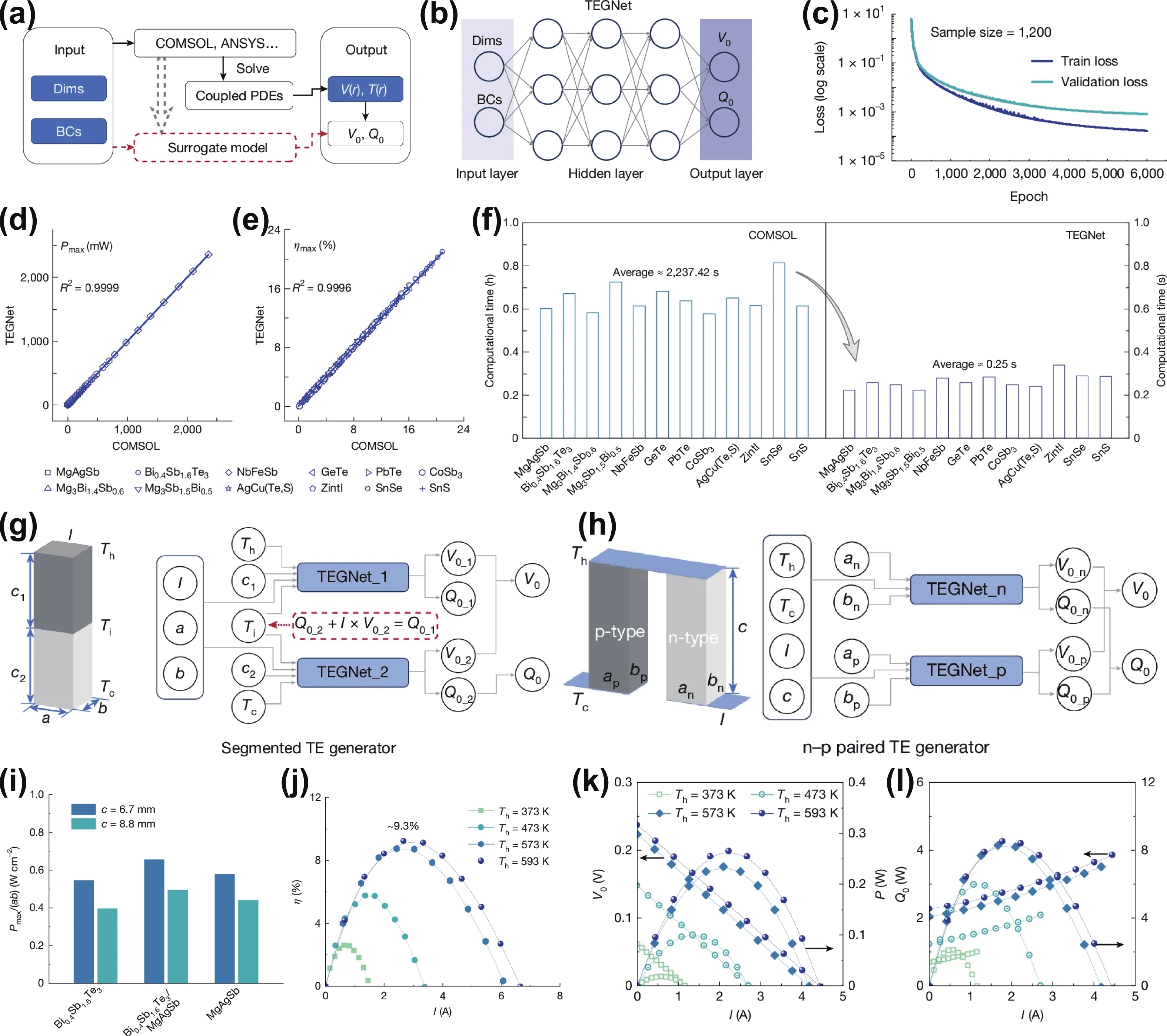
Fig. 1.  (Color online) The design concept, performance parameters of the TEGNet neural emulator and its application in complex TE systems. (a) Workflow of conventional simulation and the concept of a surrogate model. (b) Schematic diagram of TEGNet with simplified neurons. (c) Epoch-dependent mean training and validation loss over five independent data splits when the sample size is 1200. Scatter plots of Pmax (d) and ηmax (e) from TEGNet versus COMSOL for various TE materials under different Th. (f) Computational time required to obtain Pmax and ηmax under different Th using COMSOL and TEGNet for different TE materials. The design framework of typical segmented (g) and n-p paired (h) TEGs. (i) Experimental power density of Bi0.4Sb1.6Te3, segmented MgAgSb/Bi0.4Sb1.6Te3 and MgAgSb under different total lengths. (j) Experimental I-dependent η of segmented MgAgSb/Bi0.4Sb1.6Te3 under different Th. I-dependent V0 and P (h) and Q0 and η (i) for the fabricated Mg3Bi1.4Sb0.6-MgAgSb two n-p paired TE generator under different Th.

[1]
Madika B, Saha A, Kang C, et al. Artificial intelligence for materials discovery, development, and optimization. ACS Nano, 2025, 19(30): 27116 doi: 10.1021/acsnano.5c04200
[2]
Wang T, Shao M, Guo R, et al. Surrogate model via artificial intelligence method for accelerating screening materials and performance prediction. Adv Funct Mater, 2021, 31(8): 2006245 doi: 10.1002/adfm.202006245
[3]
Irie K, Lake B M. Overcoming classic challenges for artificial neural networks by providing incentives and practice. Nat Mach Intell, 2025, 7(10): 1602 doi: 10.1038/s42256-025-01121-8
[4]
Yin L, Li X, Bao X, et al. CALPHAD accelerated design of advanced full-Zintl thermoelectric device. Nat Commun, 2024, 15(1): 1468 doi: 10.1038/s41467-024-45869-w
[5]
Song W, Wang Z, Yang J J. Solving finite element methods with spiking networks: Neuromorphic computing. Nat Mach Intell, 2025, 7(12): 1891 doi: 10.1038/s42256-025-01158-9
[6]
Mritunjay K, Sturm J C, Fu T M. A three-dimensional micro-instrumented neural network device. Nat Electron, 2026, 9(5): 532 doi: 10.1038/s41928-026-01608-1
[7]
Yan Q, Kanatzidis M G. High-performance thermoelectrics and challenges for practical devices. Nat Mater, 2022, 21(5): 503 doi: 10.1038/s41563-021-01109-w
[8]
Theja V C, Karthikeyan V, Nayak S, et al. Tellurium-free, sustainable thermoelectric device for mid-temperature waste heat recovery. Carbon Energy, 2025, 7(5): e689 doi: 10.1002/cey2.689
[9]
Hao X, Wang J, Wang H. High power output density organic thermoelectric devices for practical applications in waste heat harvesting. Chem Soc Rev, 2025, 54(4): 1957 doi: 10.1039/D4CS01045K
[10]
Wang Y, Li A, Hong Y, et al. Iterative sublattice amorphization facilitates exceptional processability in inorganic semiconductors. Nat Mater, 2025, 24(10): 1545 doi: 10.1038/s41563-024-02112-7
[11]
Liu D, Bai S, Wen Y, et al. Lattice plainification and band engineering lead to high thermoelectric cooling and power generation in n-type Bi2Te3 with mass production. Natl Sci Rev, 2025, 12(2): nwae448 doi: 10.1093/nsr/nwae448
[12]
Zhang Q, Liu G Q, Jiang J. Quadruple-band synglisis in SnS crystals: a pathway to high ZT in earth-abundant thermoelectric material. Sci Bull, 2025, 70(8): 1191 doi: 10.1016/j.scib.2025.02.015
[13]
Wan D, Bai S, Fan S, et al. Machine learning-guided design of high-performance Mg-based thermoelectrics: insights into thermal expansion effects. Sci Bull, 2025, 70(22): 3764 doi: 10.1016/j.scib.2025.07.041
[14]
Wang Z Y, Guo J, Zhang Y X, et al. Porous Bi2S3 bulk with excellent thermoelectric performance by solid states replacement and low melting-point metal volatilization. Adv Mater, 2026, 38(11): e21215 doi: 10.1002/adma.202521215
[15]
Li L, Shi X L, Zhang M, et al. Rare-earth yttrium doping advances high-performance AgSbTe2 thermoelectrics. Adv Energy Mater, 2026, e05258
[16]
Xie L, Ming C, Song Q, et al. Lead-free and scalable GeTe-based thermoelectric module with an efficiency of 12%. Sci Adv, 2023, 9(27): eadg7919 doi: 10.1126/sciadv.adg7919
[17]
Li A, Wu X, Wang L, et al. Composable neural emulators accelerate thermoelectric generator design. Nature, 2026, 652(8110): 643 doi: 10.1038/s41586-026-10223-1
  • Search

    Advanced Search >>

    GET CITATION

    shu

    Export: BibTex EndNote

    Article Metrics

    Article views: 3 Times PDF downloads: 2 Times Cited by: 0 Times

    History

    Received: 09 July 2026 Revised: Online: Accepted Manuscript: 13 August 2026

    Catalog

      Email This Article

      User name:
      Email:*请输入正确邮箱
      Code:*验证码错误
      Xuan Zhang, Feifei Lin, Le Yao, Weiwei Zhao. Composable neural emulators for accelerated device design and accurate performance prediction of thermoelectric generators[J]. Journal of Semiconductors, 2026, In Press. doi: 10.1088/1674-4926/26070018 ****X Zhang, F F Lin, L Yao, and W W Zhao, Composable neural emulators for accelerated device design and accurate performance prediction of thermoelectric generators[J]. J. Semicond., 2026, accepted doi: 10.1088/1674-4926/26070018
      Citation:
      Xuan Zhang, Feifei Lin, Le Yao, Weiwei Zhao. Composable neural emulators for accelerated device design and accurate performance prediction of thermoelectric generators[J]. Journal of Semiconductors, 2026, In Press. doi: 10.1088/1674-4926/26070018 ****
      X Zhang, F F Lin, L Yao, and W W Zhao, Composable neural emulators for accelerated device design and accurate performance prediction of thermoelectric generators[J]. J. Semicond., 2026, accepted doi: 10.1088/1674-4926/26070018

      Composable neural emulators for accelerated device design and accurate performance prediction of thermoelectric generators

      DOI: 10.1088/1674-4926/26070018
      CSTR: 32376.14.1674-4926.26070018
      More Information
      • Xuan Zhang received her B.S. degree in Polymer Materials and Science from Nanjing University of Posts and Telecommunications (NJUPT) in 2023. Currently, she is pursuing her Doctor degree under the supervision of Prof. Weiwei Zhao at NJUPT. Her recent research interests focused on flexible electronic materials and devices
      • Weiwei Zhao obtained her PhD degree from Tianjin University in 2015. She is now a professor at State Key Laboratory of Flexible Electronics (LoFE) and Institute of Advanced Materials (IAM), Nanjing University of Posts & Telecommunications. Her research mainly focuses on flexible electromagnetic materials for communication electronics
      • Corresponding author: iamwwzhao@njupt.edu.cn
      • Received Date: 2026-07-09
        Available Online: 2026-08-13

      Catalog

        /

        DownLoad:  Full-Size Img  PowerPoint
        Return
        Return