J. Semicond. >  Just Accepted

ARTICLES

Ultra-stable multi-shell blue-emissive CsPbBr3 nanoplatelets with enhanced performance through chelating ligand and silica passivation

Yating Fan1, Tianfeng Li1, , Mengyao Kou1, Zihao Song1, Lizhen Gao2, , Yanmin Kuang1, Xiaojuan Wang1 and Lijun Guo2

+ Author Affiliations

 Corresponding author: Tianfeng Li, litianfeng@henu.edu.cn; Lizhen Gao, gaolizhen@henu.edu.cn

DOI: 10.1088/1674-4926/26080001CSTR: 32376.14.1674-4926.26080001

PDF

Turn off MathJax

Abstract: Perovskite quantum-confined nanoplatelets (NPLs) show great potential for high-color-purity light-emitting diodes (LEDs) due to their narrow line width and high exciton binding energy. However, the performance of perovskite NPLs lags far behind perovskite quantum dots/films, owing to their material instability and undesirable emission redshifts. Here, we achieved efficient and stable pure blue-emitting CsPbBr3 NPLs with outstanding optical properties by using a multidentate ligand, diethylenetriaminepentaacetic acid (DTPA), and silica passivation. DTPA allows for strong coordination to the surface [PbBr6]4− octahedron via its multiple chelation sites, culminating in near-perfect octahedral structures with significantly fewer vacancies. The as-prepared silica-passivated multi-shell CsPbBr3 NPLs achieve a significantly enhanced photoluminescence quantum yield of 90.6%. Stored in solution at room temperature in the dark, they maintain stable blue emission for up to 20 days, and exhibit robust stability against water, light, and heat. Moreover, a pure-blue and white light-emitting diode incorporating these multi-shell NPLs demonstrates stable luminescence performance under varying driving currents. This work presents an effective strategy for developing efficient and stable blue perovskite emitters, demonstrating significant potential for the commercialization of perovskite nanomaterials in next-generation ultra-high-definition displays.

Keywords: perovskite, CsPbBr3 nanoplatelets, DTPA, silica passivation


[1]
Shi D, Adinolfi V, Comin R, et al. Low trap-state density and long carrier diffusion in organolead trihalide perovskite single crystals. Science, 2015, 347(6221): 519 doi: 10.1126/science.aaa2725
[2]
Kovalenko M V, Protesescu L, Bodnarchuk M I. Properties and potential optoelectronic applications of lead halide perovskite nanocrystals. Science, 2017, 358(6364): 745 doi: 10.1126/science.aam7093
[3]
Quintero-Bermudez R, Gold-Parker A, Proppe A H, et al. Compositional and orientational control in metal halide perovskites of reduced dimensionality. Nature Mater, 2018, 17(10): 900 doi: 10.1038/s41563-018-0154-x
[4]
Ding S, Wang Q Q, Gu W C, et al. Phase dimensions resolving of efficient and stable perovskite light-emitting diodes at high brightness. Nat Photonics, 2024, 18(4): 363 doi: 10.1038/s41566-023-01372-0
[5]
Jiang J, Chu Z M, Yin Z G, et al. Red perovskite light-emitting diodes with efficiency exceeding 25% realized by co-spacer cations. Adv Mater, 2022, 34(36): 2204460 doi: 10.1002/adma.202204460
[6]
Min H, Wang N N, Chen N N, et al. Spin coating epitaxial heterodimensional tin perovskites for light-emitting diodes. Nat Nanotechnol, 2024, 19(5): 632 doi: 10.1038/s41565-023-01588-9
[7]
Chiba T, Hayashi Y, Ebe H, et al. Anion-exchange red perovskite quantum dots with ammonium iodine salts for highly efficient light-emitting devices. Nat Photonics, 2018, 12(11): 681 doi: 10.1038/s41566-018-0260-y
[8]
Yuan M J, Quan L N, Comin R, et al. Perovskite energy funnels for efficient light-emitting diodes. Nat Nanotechnol, 2016, 11(10): 872 doi: 10.1038/nnano.2016.110
[9]
Li X M, Wu Y, Zhang S L, et al. CsPbX3 quantum dots for lighting and displays: Room-temperature synthesis, photoluminescence superiorities, underlying origins and white light-emitting diodes. Adv Funct Mater, 2016, 26(15): 2435 doi: 10.1002/adfm.201600109
[10]
Song J Z, Li J H, Li X M, et al. Quantum dot light-emitting diodes based on inorganic perovskite cesium lead halides (CsPbX3). Adv Mater, 2015, 27(44): 7162 doi: 10.1002/adma.201502567
[11]
Liu X K, Xu W D, Bai S, et al. Metal halide perovskites for light-emitting diodes. Nat Mater, 2021, 20(1): 10 doi: 10.1038/s41563-020-0784-7
[12]
Li G R, Rivarola F W R, Davis N J L K, et al. Highly efficient perovskite nanocrystal light-emitting diodes enabled by a universal crosslinking method. Adv Mater, 2016, 28(18): 3528 doi: 10.1002/adma.201600064
[13]
Karlsson M, Yi Z Y, Reichert S, et al. Mixed halide perovskites for spectrally stable and high-efficiency blue light-emitting diodes. Nat Commun, 2021, 12: 361 doi: 10.1038/s41467-020-20582-6
[14]
Wang L, Liu J C, Gong Y Q, et al. Efficient, color-stable, pure-blue light-emitting diodes based on aromatic ligand-engineered perovskite nanoplatelets. Nano Lett, 2024, 24(23): 7004 doi: 10.1021/acs.nanolett.4c01396
[15]
Otero-Martínez C, Ye J Z, Sung J, et al. Colloidal metal-halide perovskite nanoplatelets: Thickness-controlled synthesis, properties, and application in light-emitting diodes. Adv Mater, 2022, 34(10): 2107105 doi: 10.1002/adma.202107105
[16]
Knight A J, Herz L M. Preventing phase segregation in mixed-halide perovskites: A perspective. Energy Environ Sci, 2020, 13(7): 2024 doi: 10.1039/D0EE00788A
[17]
Bohn B J, Tong Y, et al. Boosting tunable blue luminescence of halide perovskite nanoplatelets through postsynthetic surface trap repair. Nano Lett, 2018, 18(8): 5231 doi: 10.1021/acs.nanolett.8b02190
[18]
Weidman M C, Seitz M, Stranks S D, et al. Highly tunable colloidal perovskite nanoplatelets through variable cation, metal, and halide composition. ACS Nano, 2016, 10(8): 7830 doi: 10.1021/acsnano.6b03496
[19]
Litvin A P, Margaryan I V, Yin W X, et al. B-site doping of metal halide perovskite nanoplatelets influences their optical properties. Adv Opt Mater, 2024, 12(8): 2301001 doi: 10.1002/adom.202301001
[20]
Bonato L G, Moral R F, Nagamine G, et al. Revealing the role of tin(IV) halides in the anisotropic growth of CsPbX3 perovskite nanoplates. Angew Chem Int Ed, 2020, 59(28): 11501 doi: 10.1002/anie.202002641
[21]
Protesescu L, Yakunin S, Bodnarchuk M I, et al. Nanocrystals of cesium lead halide perovskites (CsPbX3, X = Cl, Br, and I): Novel optoelectronic materials showing bright emission with wide color gamut. Nano Lett, 2015, 15(6): 3692 doi: 10.1021/nl5048779
[22]
Smock S R, Chen Y H, Rossini A J, et al. The surface chemistry and structure of colloidal lead halide perovskite nanocrystals. Acc Chem Res, 2021, 54(3): 707 doi: 10.1021/acs.accounts.0c00741
[23]
Bodnarchuk M I, Boehme S C, ten Brinck S, et al. Rationalizing and controlling the surface structure and electronic passivation of cesium lead halide nanocrystals. ACS Energy Lett, 2019, 4(1): 63 doi: 10.1021/acsenergylett.8b01669
[24]
Krieg F, Ochsenbein S T, et al. Colloidal CsPbX3 (X = CI, Br, I) Nanocrystals2.0: Zwitterionic capping ligands for improved durability and stability. ACS Energy Lett, 2018, 3(3): 641 doi: 10.1021/acsenergylett.8b00035
[25]
Bai Y Q, Zhou Z S, Xue Q F, et al. Dopant-free bithiophene-imide-based polymeric hole-transporting materials for efficient and stable perovskite solar cells. Adv Mater, 2022, 34(49): 2110587 doi: 10.1002/adma.202110587
[26]
Krieg F, Ong Q K, Burian M, et al. Stable ultraconcentrated and ultradilute colloids of CsPbX3 (X = Cl, Br) nanocrystals using natural lecithin as a capping ligand. J Am Chem Soc, 2019, 141(50): 19839 doi: 10.1021/jacs.9b09969
[27]
Lin H, Gao P L, Dong J Y, et al. Bi-functional chelating ligand enables ultra-stable blue emissive CsPbBr3 nanoplatelets film. Adv Opt Mater, 2024, 12(19): 2400214 doi: 10.1002/adom.202400214
[28]
Hu H C, Wu L Z, Tan Y S, et al. Interfacial synthesis of highly stable CsPbX3/oxide Janus nanoparticles. J Am Chem Soc, 2018, 140(1): 406 doi: 10.1021/jacs.7b11003
[29]
Chen D Q, Fang G L, Chen X. Silica-coated Mn-doped CsPb(Cl/Br)3 inorganic perovskite quantum dots: Exciton-to-Mn energy transfer and blue-excitable solid-state lighting. ACS Appl Mater Interfaces, 2017, 9(46): 40477 doi: 10.1021/acsami.7b14471
[30]
Xu L M, Chen J W, Song J Z, et al. Double-protected all-inorganic perovskite nanocrystals by crystalline matrix and silica for triple-modal anti-counterfeiting codes. ACS Appl Mater Interfaces, 2017, 9(31): 26556 doi: 10.1021/acsami.7b06436
[31]
Mo Q H, Shi T C, Cai W S, et al. Room temperature synthesis of stable silica-coated CsPbBr3 quantum dots for amplified spontaneous emission. Photon Res, 2020, 8(10): 1605 doi: 10.1364/PRJ.399845
[32]
Liu J, Zhang L, Yang Q H, et al. Structural control of mesoporous silicas with large nanopores in a mild buffer solution. Microporous Mesoporous Mater, 2008, 116(1/2/3): 330 doi: 10.1016/j.micromeso.2008.04.030
[33]
Huang S Q, Li Z C, Kong L, et al. Enhancing the stability of CH3NH3PbBr3 quantum dots by embedding in silica spheres derived from tetramethyl orthosilicate in "waterless" toluene. J Am Chem Soc, 2016, 138(18): 5749 doi: 10.1021/jacs.5b13101
[34]
Shao H, Bai X, Pan G C, et al. Highly efficient and stable blue-emitting CsPbBr3@SiO2 nanospheres through low temperature synthesis for nanoprinting and WLED. Nanotechnology, 2018, 29(28): 285706 doi: 10.1088/1361-6528/aac00b
[35]
Zhong Q X, Cao M H, Hu H C, et al. One-pot synthesis of highly stable CsPbBr3@SiO2 Core-Shell nanoparticles. ACS Nano, 2018, 12(8): 8579 doi: 10.1021/acsnano.8b04209
[36]
Tang X S, Chen W W, Liu Z Z, et al. Ultrathin, core-Shell Structured SiO2 coated Mn2+-doped perovskite quantum dots for bright white light-emitting diodes. Small, 2019, 15(19): 1900484 doi: 10.1002/smll.201900484
[37]
Shamsi J, Kubicki D, Anaya M, et al. Stable hexylphosphonate-capped blue-emitting quantum-confined CsPbBr(3) nanoplatelets. ACS Energy Lett, 2020, 5(6): 1900 doi: 10.1021/acsenergylett.0c00935
[38]
Yang S, Chen S S, Mosconi E, et al. Stabilizing halide perovskite surfaces for solar cell operation with wide-bandgap lead oxysalts. Science, 2019, 365(6452): 473 doi: 10.1126/science.aax3294
[39]
Chen D Z, Ko P K, Li C A, et al. Amino acid-passivated pure red CsPbI3 quantum dot LEDs. ACS Energy Lett, 2023, 8(1): 410 doi: 10.1021/acsenergylett.2c02243
[40]
Wang Y K, Yuan F L, Dong Y T, et al. All-inorganic quantum-dot LEDs based on a phase-stabilized α-CsPbI3 perovskite. Angew Chem Int Ed, 2021, 60(29): 16164 doi: 10.1002/anie.202104812
[41]
Wang Y K, Singh K, Li J Y, et al. In situ inorganic ligand replenishment enables bandgap stability in mixed-halide perovskite quantum dot solids. Adv Mater, 2022, 34(21): 2200854 doi: 10.1002/adma.202200854
[42]
Dang Z Y, Dhanabalan B, Castelli A, et al. Temperature-driven transformation of CsPbBr3 Nanoplatelets into mosaic nanotiles in solution through self-assembly. Nano Lett, 2020, 20(3): 1808 doi: 10.1021/acs.nanolett.9b05036
[43]
Liu Y F, Shao X W, Gao Z J, et al. In situ and general multidentate ligand passivation achieves efficient and ultra-stable CsPbX3 perovskite quantum dots for white light-emitting diodes. Small, 2024, 20(3): 2305664 doi: 10.1002/smll.202305664
[44]
Choi J H, Kim J Y, Lee Y M, et al. In situdual-site passivation of all-inorganic perovskite quantum dots using zwitterionic taurine for enhanced defect resistance. Inorg Chem Front, 2026, 13(12): 5210 doi: 10.1039/D6QI00251J
[45]
Pan J, Quan L N, Zhao Y B, et al. Highly efficient perovskite-quantum-dot light-emitting diodes by surface engineering. Adv Mater, 2016, 28(39): 8718 doi: 10.1002/adma.201600784
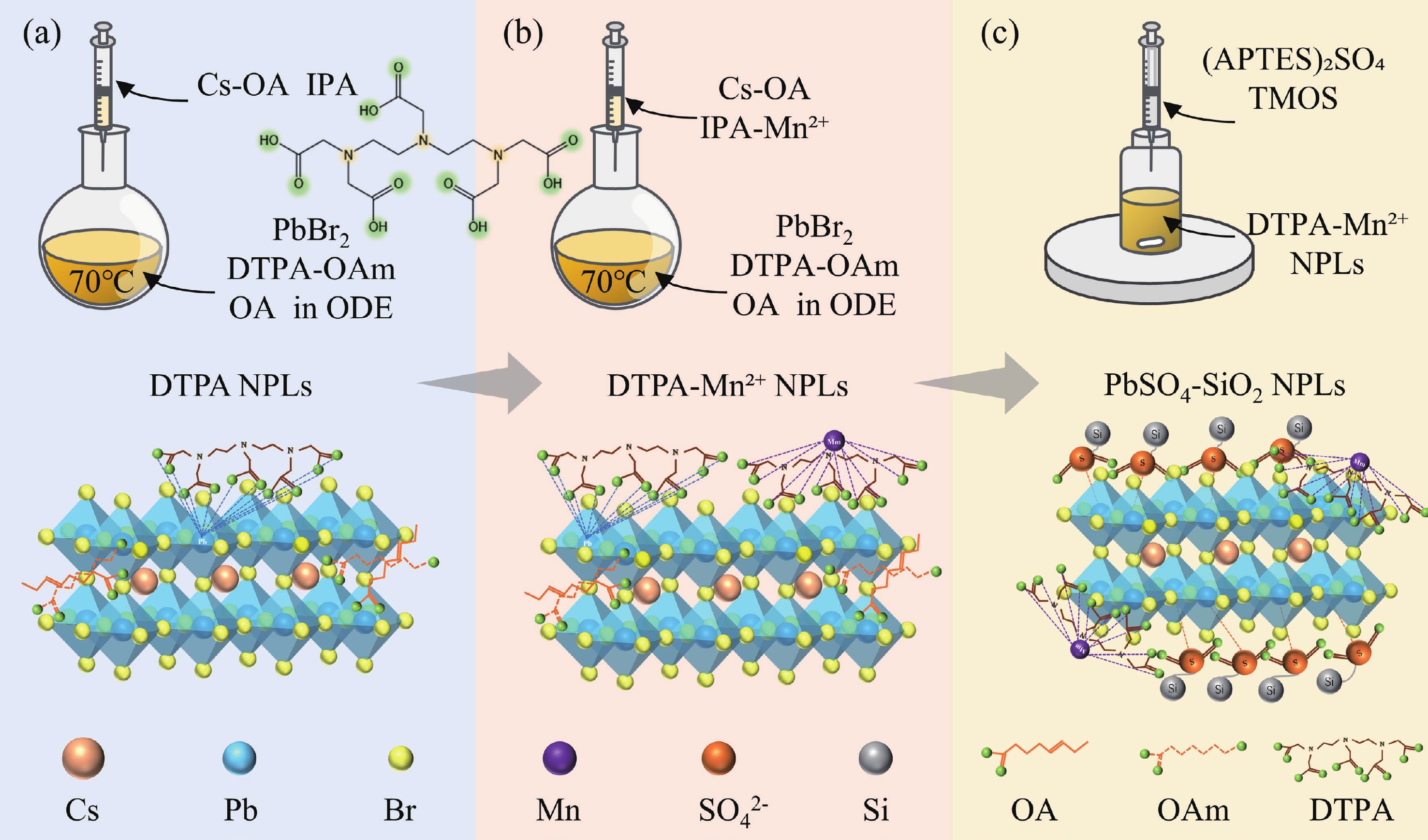
Fig. 1.  (Color online) Schematic illustration showing the fabrication of multi-shell CsPbBr3 NPLs: (a) modification with DTPA chelating ligand, (b) DTPA-Mn2+ co-chelating treatment, and (c) silica passivation. The inset depicts the molecular structure of DTPA.

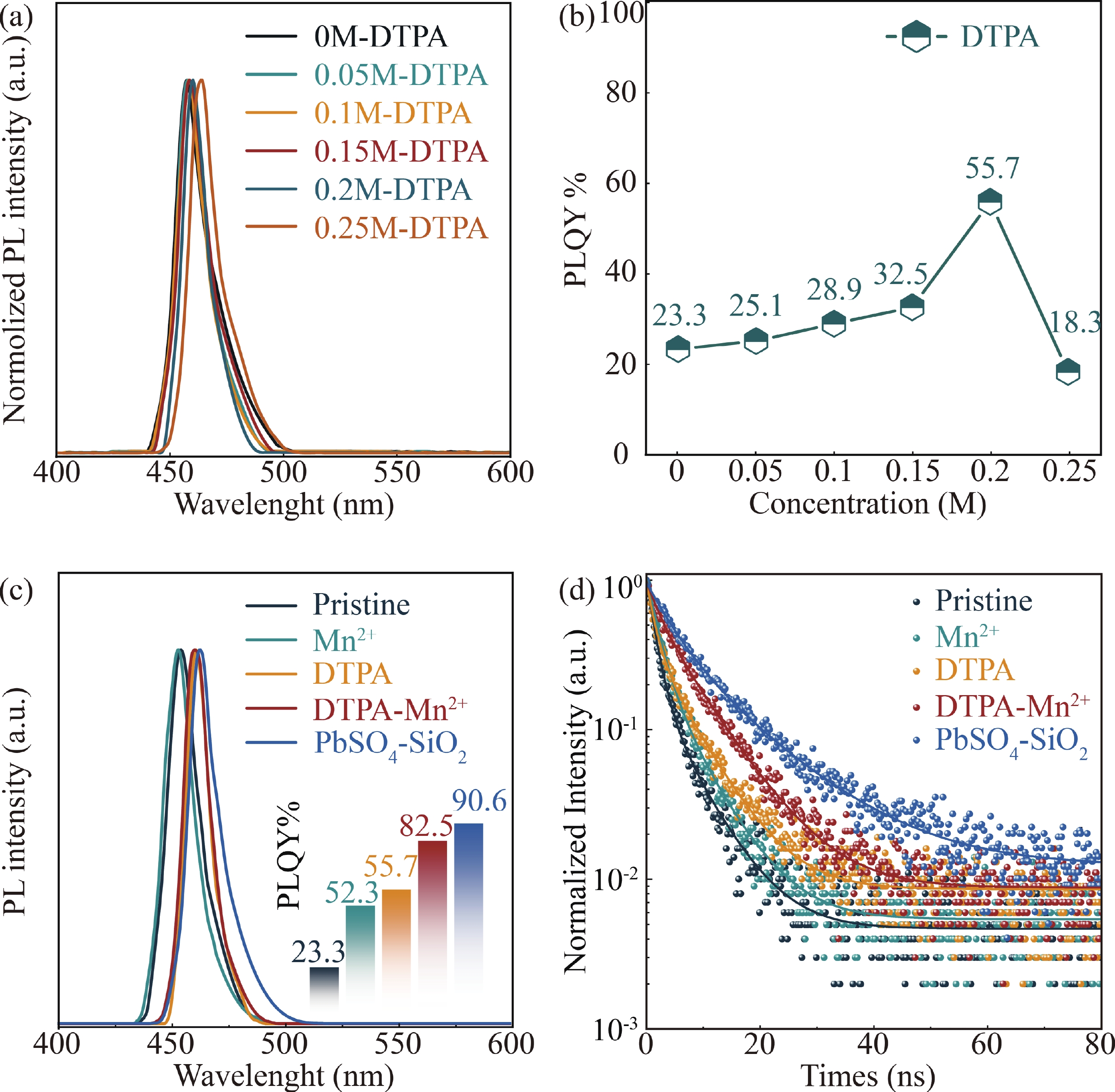
Fig. 2.  (Color online) (a) PL spectra and (b) PLQY of the CsPbBr3 NPL solutions with varying DTPA concentrations. (c) PL spectra and PLQY, and (d) time-resolved PL decay curves for pristine NPLs, Mn2+-NPLs, DTPA-NPLs, DTPA-Mn2+-NPLs and PbSO4-SiO2-NPLs solutions.

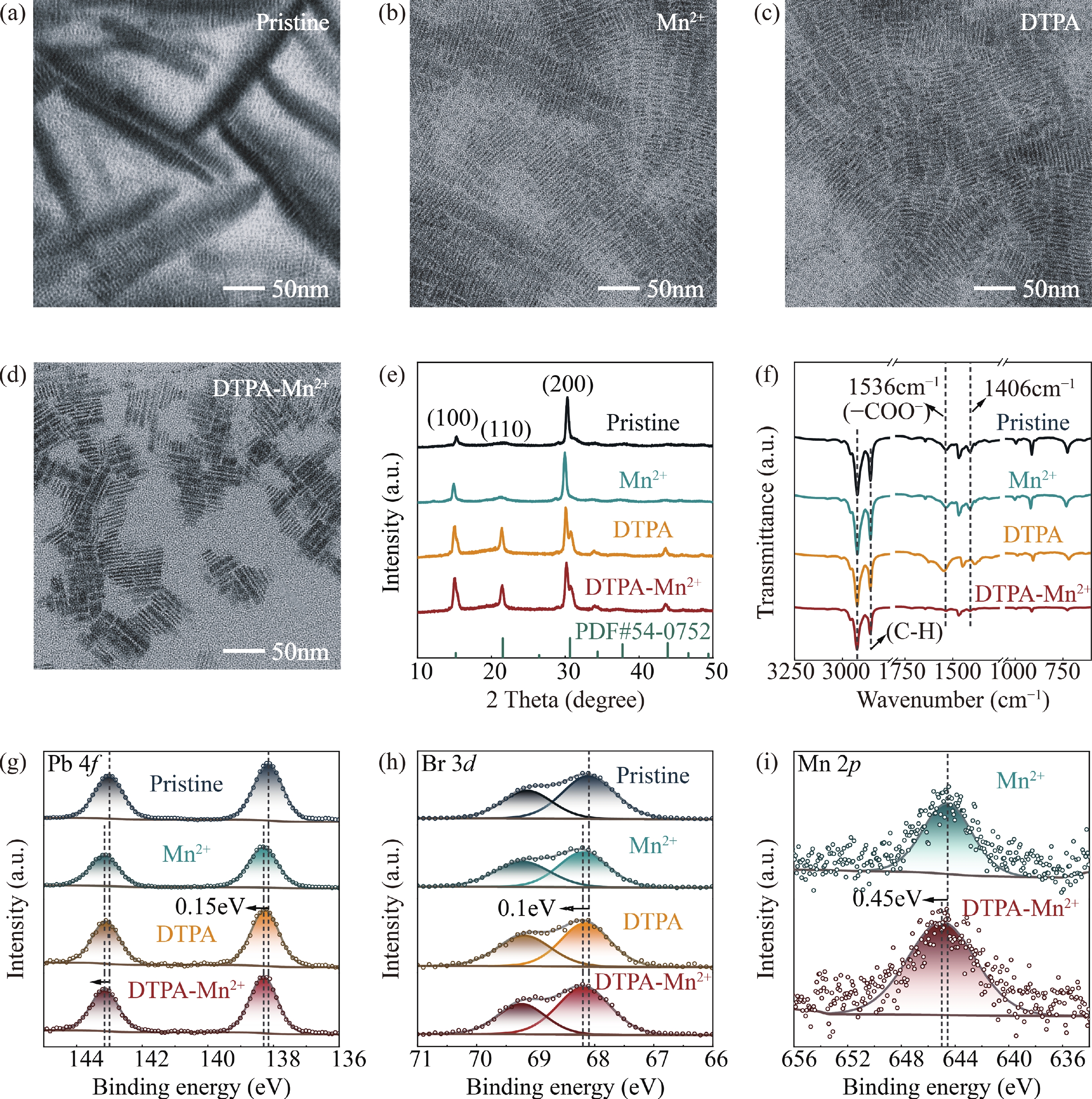
Fig. 3.  (Color online) (a-d) TEM micrographs of pristine NPLs, Mn2+-NPLs, DTPA-NPLs, and DTPA-Mn2+-NPLs;(e) XRD patterns and (f) FTIR spectra for these samples; high-resolution XPS spectra of the as-prepared CsPbBr3 NPLs: (g) Pb 4f, (h) Br 3d, and (i) Mn 2p.

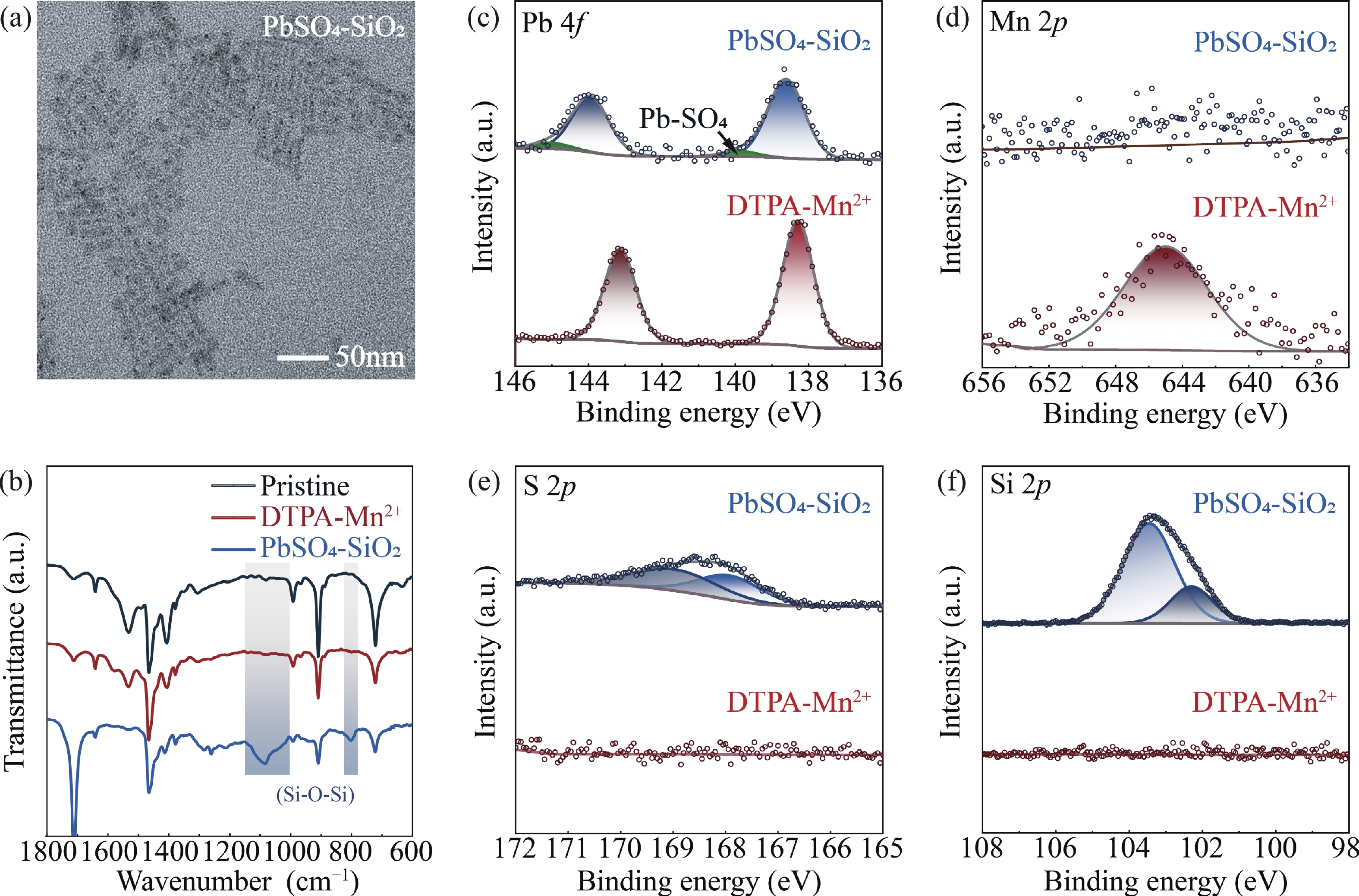
Fig. 4.  (Color online) (a) TEM micrograph of PbSO4-SiO2-NPLs, (b) FTIR spectra of the pristine NPLs, DTPA-Mn2+-NPLs and PbSO4-SiO2-NPLs; high-resolution XPS spectra of the as-prepared CsPbBr3 NPLs: (c) Pb 4f, (d) Mn 2p, (e) S 2p, and (f) Si 2p.

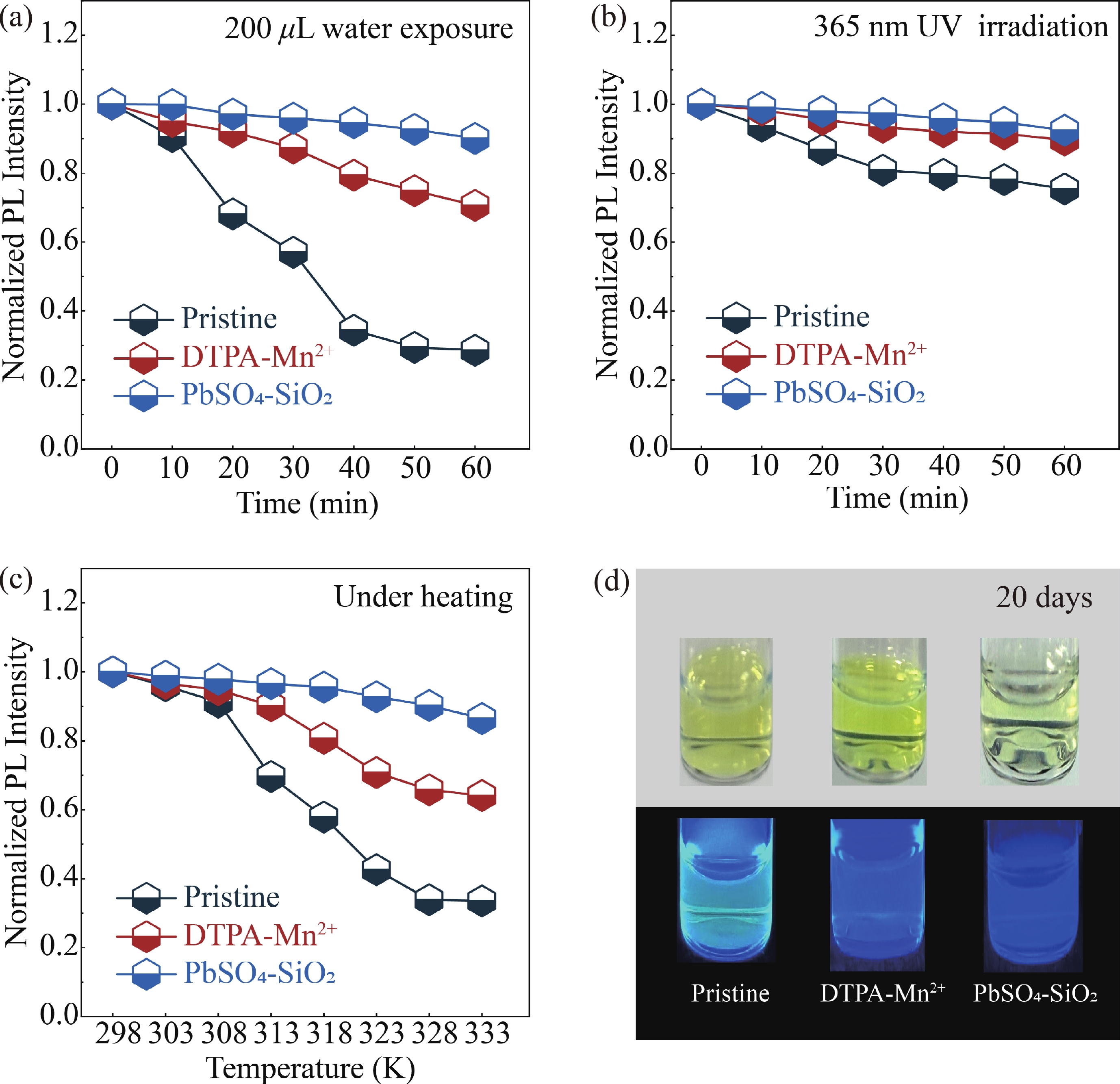
Fig. 5.  (Color online) Stability evolution of Pristine NPLs, DTPA-Mn2+-NPLs and PbSO4-SiO2-NPLs. (a) Water-resistance test of samples dispersed in a mixture of 2 mL n-hexane and 200 μL deionized water, (b) photostability test under 4 W, 365 nm UV irradiation, (c) thermal stability test with continuous heating from 298 K to 333 K, and (d) optical photographs of the samples stored at room temperature for 20 days under dark conditions, captured under natural light and 365 nm UV excitation.

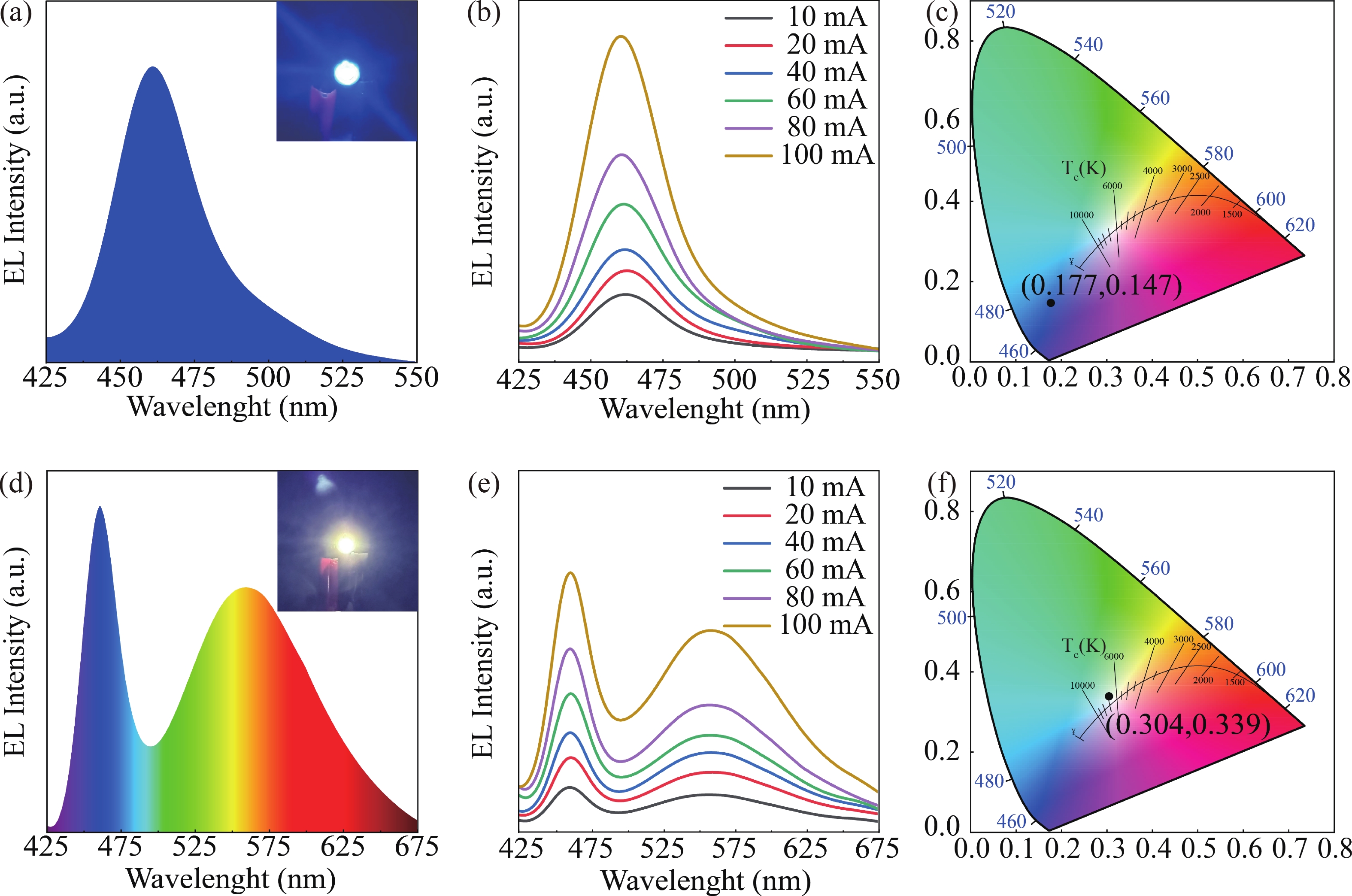
Fig. 6.  (Color online) (a) EL spectra of pure-blue LEDs based on PbSO4-SiO2-NPLs (inset: photograph of the operating LED under 20 mA), (b) emission spectra measured at currents ranging from 10 to 100 mA, and (c) CIE chromaticity coordinates. (d) EL spectra of white LEDs based on PbSO4-SiO2-NPLs and yellow phosphor (inset: photograph of the operating LED under 20 mA), (e) emission spectra measured at currents ranging from 10 to 100 mA, and (f) CIE chromaticity coordinates.

[1]
Shi D, Adinolfi V, Comin R, et al. Low trap-state density and long carrier diffusion in organolead trihalide perovskite single crystals. Science, 2015, 347(6221): 519 doi: 10.1126/science.aaa2725
[2]
Kovalenko M V, Protesescu L, Bodnarchuk M I. Properties and potential optoelectronic applications of lead halide perovskite nanocrystals. Science, 2017, 358(6364): 745 doi: 10.1126/science.aam7093
[3]
Quintero-Bermudez R, Gold-Parker A, Proppe A H, et al. Compositional and orientational control in metal halide perovskites of reduced dimensionality. Nature Mater, 2018, 17(10): 900 doi: 10.1038/s41563-018-0154-x
[4]
Ding S, Wang Q Q, Gu W C, et al. Phase dimensions resolving of efficient and stable perovskite light-emitting diodes at high brightness. Nat Photonics, 2024, 18(4): 363 doi: 10.1038/s41566-023-01372-0
[5]
Jiang J, Chu Z M, Yin Z G, et al. Red perovskite light-emitting diodes with efficiency exceeding 25% realized by co-spacer cations. Adv Mater, 2022, 34(36): 2204460 doi: 10.1002/adma.202204460
[6]
Min H, Wang N N, Chen N N, et al. Spin coating epitaxial heterodimensional tin perovskites for light-emitting diodes. Nat Nanotechnol, 2024, 19(5): 632 doi: 10.1038/s41565-023-01588-9
[7]
Chiba T, Hayashi Y, Ebe H, et al. Anion-exchange red perovskite quantum dots with ammonium iodine salts for highly efficient light-emitting devices. Nat Photonics, 2018, 12(11): 681 doi: 10.1038/s41566-018-0260-y
[8]
Yuan M J, Quan L N, Comin R, et al. Perovskite energy funnels for efficient light-emitting diodes. Nat Nanotechnol, 2016, 11(10): 872 doi: 10.1038/nnano.2016.110
[9]
Li X M, Wu Y, Zhang S L, et al. CsPbX3 quantum dots for lighting and displays: Room-temperature synthesis, photoluminescence superiorities, underlying origins and white light-emitting diodes. Adv Funct Mater, 2016, 26(15): 2435 doi: 10.1002/adfm.201600109
[10]
Song J Z, Li J H, Li X M, et al. Quantum dot light-emitting diodes based on inorganic perovskite cesium lead halides (CsPbX3). Adv Mater, 2015, 27(44): 7162 doi: 10.1002/adma.201502567
[11]
Liu X K, Xu W D, Bai S, et al. Metal halide perovskites for light-emitting diodes. Nat Mater, 2021, 20(1): 10 doi: 10.1038/s41563-020-0784-7
[12]
Li G R, Rivarola F W R, Davis N J L K, et al. Highly efficient perovskite nanocrystal light-emitting diodes enabled by a universal crosslinking method. Adv Mater, 2016, 28(18): 3528 doi: 10.1002/adma.201600064
[13]
Karlsson M, Yi Z Y, Reichert S, et al. Mixed halide perovskites for spectrally stable and high-efficiency blue light-emitting diodes. Nat Commun, 2021, 12: 361 doi: 10.1038/s41467-020-20582-6
[14]
Wang L, Liu J C, Gong Y Q, et al. Efficient, color-stable, pure-blue light-emitting diodes based on aromatic ligand-engineered perovskite nanoplatelets. Nano Lett, 2024, 24(23): 7004 doi: 10.1021/acs.nanolett.4c01396
[15]
Otero-Martínez C, Ye J Z, Sung J, et al. Colloidal metal-halide perovskite nanoplatelets: Thickness-controlled synthesis, properties, and application in light-emitting diodes. Adv Mater, 2022, 34(10): 2107105 doi: 10.1002/adma.202107105
[16]
Knight A J, Herz L M. Preventing phase segregation in mixed-halide perovskites: A perspective. Energy Environ Sci, 2020, 13(7): 2024 doi: 10.1039/D0EE00788A
[17]
Bohn B J, Tong Y, et al. Boosting tunable blue luminescence of halide perovskite nanoplatelets through postsynthetic surface trap repair. Nano Lett, 2018, 18(8): 5231 doi: 10.1021/acs.nanolett.8b02190
[18]
Weidman M C, Seitz M, Stranks S D, et al. Highly tunable colloidal perovskite nanoplatelets through variable cation, metal, and halide composition. ACS Nano, 2016, 10(8): 7830 doi: 10.1021/acsnano.6b03496
[19]
Litvin A P, Margaryan I V, Yin W X, et al. B-site doping of metal halide perovskite nanoplatelets influences their optical properties. Adv Opt Mater, 2024, 12(8): 2301001 doi: 10.1002/adom.202301001
[20]
Bonato L G, Moral R F, Nagamine G, et al. Revealing the role of tin(IV) halides in the anisotropic growth of CsPbX3 perovskite nanoplates. Angew Chem Int Ed, 2020, 59(28): 11501 doi: 10.1002/anie.202002641
[21]
Protesescu L, Yakunin S, Bodnarchuk M I, et al. Nanocrystals of cesium lead halide perovskites (CsPbX3, X = Cl, Br, and I): Novel optoelectronic materials showing bright emission with wide color gamut. Nano Lett, 2015, 15(6): 3692 doi: 10.1021/nl5048779
[22]
Smock S R, Chen Y H, Rossini A J, et al. The surface chemistry and structure of colloidal lead halide perovskite nanocrystals. Acc Chem Res, 2021, 54(3): 707 doi: 10.1021/acs.accounts.0c00741
[23]
Bodnarchuk M I, Boehme S C, ten Brinck S, et al. Rationalizing and controlling the surface structure and electronic passivation of cesium lead halide nanocrystals. ACS Energy Lett, 2019, 4(1): 63 doi: 10.1021/acsenergylett.8b01669
[24]
Krieg F, Ochsenbein S T, et al. Colloidal CsPbX3 (X = CI, Br, I) Nanocrystals2.0: Zwitterionic capping ligands for improved durability and stability. ACS Energy Lett, 2018, 3(3): 641 doi: 10.1021/acsenergylett.8b00035
[25]
Bai Y Q, Zhou Z S, Xue Q F, et al. Dopant-free bithiophene-imide-based polymeric hole-transporting materials for efficient and stable perovskite solar cells. Adv Mater, 2022, 34(49): 2110587 doi: 10.1002/adma.202110587
[26]
Krieg F, Ong Q K, Burian M, et al. Stable ultraconcentrated and ultradilute colloids of CsPbX3 (X = Cl, Br) nanocrystals using natural lecithin as a capping ligand. J Am Chem Soc, 2019, 141(50): 19839 doi: 10.1021/jacs.9b09969
[27]
Lin H, Gao P L, Dong J Y, et al. Bi-functional chelating ligand enables ultra-stable blue emissive CsPbBr3 nanoplatelets film. Adv Opt Mater, 2024, 12(19): 2400214 doi: 10.1002/adom.202400214
[28]
Hu H C, Wu L Z, Tan Y S, et al. Interfacial synthesis of highly stable CsPbX3/oxide Janus nanoparticles. J Am Chem Soc, 2018, 140(1): 406 doi: 10.1021/jacs.7b11003
[29]
Chen D Q, Fang G L, Chen X. Silica-coated Mn-doped CsPb(Cl/Br)3 inorganic perovskite quantum dots: Exciton-to-Mn energy transfer and blue-excitable solid-state lighting. ACS Appl Mater Interfaces, 2017, 9(46): 40477 doi: 10.1021/acsami.7b14471
[30]
Xu L M, Chen J W, Song J Z, et al. Double-protected all-inorganic perovskite nanocrystals by crystalline matrix and silica for triple-modal anti-counterfeiting codes. ACS Appl Mater Interfaces, 2017, 9(31): 26556 doi: 10.1021/acsami.7b06436
[31]
Mo Q H, Shi T C, Cai W S, et al. Room temperature synthesis of stable silica-coated CsPbBr3 quantum dots for amplified spontaneous emission. Photon Res, 2020, 8(10): 1605 doi: 10.1364/PRJ.399845
[32]
Liu J, Zhang L, Yang Q H, et al. Structural control of mesoporous silicas with large nanopores in a mild buffer solution. Microporous Mesoporous Mater, 2008, 116(1/2/3): 330 doi: 10.1016/j.micromeso.2008.04.030
[33]
Huang S Q, Li Z C, Kong L, et al. Enhancing the stability of CH3NH3PbBr3 quantum dots by embedding in silica spheres derived from tetramethyl orthosilicate in "waterless" toluene. J Am Chem Soc, 2016, 138(18): 5749 doi: 10.1021/jacs.5b13101
[34]
Shao H, Bai X, Pan G C, et al. Highly efficient and stable blue-emitting CsPbBr3@SiO2 nanospheres through low temperature synthesis for nanoprinting and WLED. Nanotechnology, 2018, 29(28): 285706 doi: 10.1088/1361-6528/aac00b
[35]
Zhong Q X, Cao M H, Hu H C, et al. One-pot synthesis of highly stable CsPbBr3@SiO2 Core-Shell nanoparticles. ACS Nano, 2018, 12(8): 8579 doi: 10.1021/acsnano.8b04209
[36]
Tang X S, Chen W W, Liu Z Z, et al. Ultrathin, core-Shell Structured SiO2 coated Mn2+-doped perovskite quantum dots for bright white light-emitting diodes. Small, 2019, 15(19): 1900484 doi: 10.1002/smll.201900484
[37]
Shamsi J, Kubicki D, Anaya M, et al. Stable hexylphosphonate-capped blue-emitting quantum-confined CsPbBr(3) nanoplatelets. ACS Energy Lett, 2020, 5(6): 1900 doi: 10.1021/acsenergylett.0c00935
[38]
Yang S, Chen S S, Mosconi E, et al. Stabilizing halide perovskite surfaces for solar cell operation with wide-bandgap lead oxysalts. Science, 2019, 365(6452): 473 doi: 10.1126/science.aax3294
[39]
Chen D Z, Ko P K, Li C A, et al. Amino acid-passivated pure red CsPbI3 quantum dot LEDs. ACS Energy Lett, 2023, 8(1): 410 doi: 10.1021/acsenergylett.2c02243
[40]
Wang Y K, Yuan F L, Dong Y T, et al. All-inorganic quantum-dot LEDs based on a phase-stabilized α-CsPbI3 perovskite. Angew Chem Int Ed, 2021, 60(29): 16164 doi: 10.1002/anie.202104812
[41]
Wang Y K, Singh K, Li J Y, et al. In situ inorganic ligand replenishment enables bandgap stability in mixed-halide perovskite quantum dot solids. Adv Mater, 2022, 34(21): 2200854 doi: 10.1002/adma.202200854
[42]
Dang Z Y, Dhanabalan B, Castelli A, et al. Temperature-driven transformation of CsPbBr3 Nanoplatelets into mosaic nanotiles in solution through self-assembly. Nano Lett, 2020, 20(3): 1808 doi: 10.1021/acs.nanolett.9b05036
[43]
Liu Y F, Shao X W, Gao Z J, et al. In situ and general multidentate ligand passivation achieves efficient and ultra-stable CsPbX3 perovskite quantum dots for white light-emitting diodes. Small, 2024, 20(3): 2305664 doi: 10.1002/smll.202305664
[44]
Choi J H, Kim J Y, Lee Y M, et al. In situdual-site passivation of all-inorganic perovskite quantum dots using zwitterionic taurine for enhanced defect resistance. Inorg Chem Front, 2026, 13(12): 5210 doi: 10.1039/D6QI00251J
[45]
Pan J, Quan L N, Zhao Y B, et al. Highly efficient perovskite-quantum-dot light-emitting diodes by surface engineering. Adv Mater, 2016, 28(39): 8718 doi: 10.1002/adma.201600784

26080001-Supporting Information.pdf

  • Search

    Advanced Search >>

    GET CITATION

    shu

    Export: BibTex EndNote

    Article Metrics

    Article views: 6 Times PDF downloads: 2 Times Cited by: 0 Times

    History

    Received: Revised: Online: Accepted Manuscript: 03 November 2026

    Catalog

      Email This Article

      User name:
      Email:*请输入正确邮箱
      Code:*验证码错误
      Yating Fan, Tianfeng Li, Mengyao Kou, Zihao Song, Lizhen Gao, Yanmin Kuang, Xiaojuan Wang, Lijun Guo. Ultra-stable multi-shell blue-emissive CsPbBr3 nanoplatelets with enhanced performance through chelating ligand and silica passivation[J]. Journal of Semiconductors, 2027, In Press. doi: 10.1088/1674-4926/26080001 ****Y T Fan, T F Li, M Y Kou, Z H Song, L Z Gao, Y M Kuang, X J Wang, and L J Guo, Ultra-stable multi-shell blue-emissive CsPbBr3 nanoplatelets with enhanced performance through chelating ligand and silica passivation[J]. J. Semicond., 2027, accepted doi: 10.1088/1674-4926/26080001
      Citation:
      Yating Fan, Tianfeng Li, Mengyao Kou, Zihao Song, Lizhen Gao, Yanmin Kuang, Xiaojuan Wang, Lijun Guo. Ultra-stable multi-shell blue-emissive CsPbBr3 nanoplatelets with enhanced performance through chelating ligand and silica passivation[J]. Journal of Semiconductors, 2027, In Press. doi: 10.1088/1674-4926/26080001 ****
      Y T Fan, T F Li, M Y Kou, Z H Song, L Z Gao, Y M Kuang, X J Wang, and L J Guo, Ultra-stable multi-shell blue-emissive CsPbBr3 nanoplatelets with enhanced performance through chelating ligand and silica passivation[J]. J. Semicond., 2027, accepted doi: 10.1088/1674-4926/26080001

      Ultra-stable multi-shell blue-emissive CsPbBr3 nanoplatelets with enhanced performance through chelating ligand and silica passivation

      DOI: 10.1088/1674-4926/26080001
      CSTR: 32376.14.1674-4926.26080001
      More Information
      • Yating Fan is a master student majoring in Physics at the School of Physics and Electronics, Henan University. Her research involves the preparation and optical characterization of semiconductor luminescent materials and perovskite nanoplatelets for optoelectronic device applications
      • Tianfeng Li received his Ph.D. degree at the Institute of Semiconductors, Chinese Academy of Sciences in 2012. Currently, He is a professor at the School of Physics and Electronics, Henan University. His research interests incluede optical properties and optoelectronic devices based on novel semiconductors and nanocrystalline
      • Lizhen Gao received her Ph.D. degree at the School of Physics and Electronics, Henan University in 2019. Currently, She is a lecturer in Henan University. Her research interests mainly focus on semiconductor quantum dots in the optical properties, photoexcited states and raman spectrum
      • Corresponding author: litianfeng@henu.edu.cn; gaolizhen@henu.edu.cn
      • Available Online: 2026-11-03

      Catalog

        /

        DownLoad:  Full-Size Img  PowerPoint
        Return
        Return