J. Semicond. >  Just Accepted

ARTICLES

High-performance flexible self-powered solar-blind photodetector based on α-Ga2O3/CuSCN heterojunction

Songyan Zhao, Hao Wang, Wanping Su, Pei Wang, Huixin Chen, Luna Yang, Feng Teng, Peng Hu and Haibo Fan

+ Author Affiliations

 Corresponding author: Luna Yang, yln@nwu.edu.cn; Haibo Fan, hbfan@nwu.edu.cn

DOI: 10.1088/1674-4926/26080002CSTR: 32376.14.1674-4926.26080002

PDF

Turn off MathJax

Abstract: Flexible, self-powered, solar-blind ultraviolet (UV) photodetectors hold substantial promise for applications in sensing and wearable optoelectronics. In conventional Ga2O3 based photoelectrochemical (PEC) devices, carrier leakage at the semiconductor/electrolyte interface results in severe carrier recombination, which restricts the responsivity and severely impedes the practical deployment of such photodetectors. In addition to the aforementioned constraints, conventional rigid substrates severely hinder the translation of these materials into flexible and wearable device platforms. In this study, a PEC photodetector based on an n-α-Ga2O3/p-CuSCN heterojunction nanoarray was fabricated on a flexible Ti substrate. Vertically aligned α-Ga2O3 nanorod arrays were first prepared, followed by the introduction of CuSCN with varying loadings via controlled electrodeposition time. Under zero bias and 254 nm UV illumination, the optimized device achieved a photocurrent density of 63.42 μA∙cm-2, which is approximately 4.2 times that of the pristine α-Ga2O3 device. The corresponding responsivity reached 21.14 mA∙W-1, respectively. The intrinsic α-Ga2O3/electrolyte junction provides the baseline zero-bias PEC response, while the α-Ga2O3/CuSCN heterojunction acts as an auxiliary enhancement pathway by promoting photocarrier separation and selective hole transport, which facilitates efficient spatial separation of photogenerated charge carriers. Moreover, bending tests and repeated cycling experiments demonstrated the robust mechanical stability of the device. This work underscores the considerable potential of Ga2O3-based PEC photodetectors for future flexible, self-powered solar-blind UV detection applications.

Keywords: α-Ga2O3, flexible, solar-blind photodetector, self-powered, heterojunction


[1]
Xu J J, Zheng W, Huang F. Gallium oxide solar-blind ultraviolet photodetectors: A review. J Mater Chem C, 2019, 7(29): 8753. doi: 10.1039/C9TC02055A
[2]
Guo D, Guo Q, Chen Z, et al. Review of Ga2O3-based optoelectronic devices. Mater Today Phys, 2019, 11: 100157.
[3]
Chen X H, Ren F F, Gu S L, et al. Review of gallium-oxide-based solar-blind ultraviolet photodetectors. Photon Res, 2019, 7(4): 381.
[4]
Varshney U, Aggarwal N, Gupta G. Current advances in solar-blind photodetection technology: Using Ga2O3 and AlGaN. J Mater Chem C, 2022, 10(5): 1573.
[5]
Cui S J, Mei Z X, Zhang Y H, et al. Room-temperature fabricated amorphous Ga2O3 high-response-speed solar-blind photodetector on rigid and flexible substrates. Adv Opt Mater, 2017, 5(19): 1700454.
[6]
Kumar N, Arora K, Kumar M. High performance, flexible and room temperature grown amorphous Ga2O3 solar-blind photodetector with amorphous indium-zinc-oxide transparent conducting electrodes. J Phys D Appl Phys, 2019, 52(33): 335103.
[7]
Wang S L, Sun H L, Wang Z, et al. In situ synthesis of monoclinic β-Ga2O3 nanowires on flexible substrate and solar-blind photodetector. J Alloys Compd, 2019, 787: 133.
[8]
Tak B R, Yang M M, Lai Y H, et al. Photovoltaic and flexible deep ultraviolet wavelength detector based on novel β-Ga2O3/muscovite heteroepitaxy. Sci Rep, 2020, 10: 16098.
[9]
Sui Y X, Liang H L, Huo W X, et al. A flexible and transparent β-Ga2O3 solar-blind ultraviolet photodetector on mica. J Phys D Appl Phys, 2020, 53(50): 504001.
[10]
Wang Y H, Yang Z B, Li H R, et al. UltrasensitiveFlexible solar-blind PhotodetectorsBased on graphene/amorphous Ga2O3 van der WaalsHeterojunctions. ACS Appl Mater Interfaces, 2020, 12(42): 47714.
[11]
Lu Y, Krishna S, Tang X, et al. Ultrasensitive flexible κ-phase Ga2O3Solar-blind photodetector. ACS Appl Mater Interfaces, 2022, 14(30): 34844.
[12]
Chen Z Y, Han P P, Chen W H, et al. Flexible and self-powered solar-blind UV photodetector based on the Ti/α-Ga2O3/electrolyte heterojunction with high stability. ACS Appl Electron Mater, 2024, 6(1): 496.
[13]
Yu C X, Li H L, Ding K, et al. Flexible and self-powered photoelectrochemical-type solar-blind photodetectors based on Ag nanowires-embedded amorphous Ga2O3 films. Adv Opt Mater, 2024, 12(18): 2400116.
[14]
Pearton S J, Yang J C, Cary P H IV, et al. A review of Ga2O3 materials, processing, and devices. Appl Phys Rev, 2018, 5: 011301.
[15]
Muazzam U U, Chavan P, Raghavan S, et al. Optical properties of mist CVD grown α-Ga2O3. IEEE Photonics Technol Lett, 2020, 32(7): 422.
[16]
Qiao G, Cai Q, Ma T C, et al. Nanoplasmonically enhanced high-performance metastable phase α-Ga2O3 solar-blind photodetectors. ACS Appl Mater Interfaces, 2019, 11(43): 40283.
[17]
Zhang J H, Jiao S J, Wang D B, et al. Solar-blind ultraviolet photodetection of an α-Ga2O3nanorod array based on photoelectrochemical self-powered detectors with a simple, newly-designed structure. J Mater Chem C, 2019, 7(23): 6867.
[18]
Huang L J, Hu Z R, He X W, et al. Self-powered solar-blind ultraviolet photodetector based on α-Ga2O3 nanorod arrays fabricated by the water bath method. Opt Mater Express, 2021, 11(7): 2089.
[19]
Zhang B H, Wu H X, Feng C, et al. Self-powered solar-blind photodetectors based on α-Ga2O3 nanorod arrays. ACS Appl Nano Mater, 2022, 5(8): 11956.
[20]
Hu H Z, Wu C, He C R, et al. Improved photoelectric performance with self-powered characteristics through TiO2 surface passivation in an α-Ga2O3 nanorod array deep ultraviolet photodetector. ACS Appl Electron Mater, 2022, 4(8): 3801.
[21]
Peter L M, Walker A B, Bein T, et al. Interpretation of photocurrent transients at semiconductor electrodes: Effects of band-edge unpinning. J Electroanal Chem, 2020, 872: 114234.
[22]
Zachäus C, Abdi F F, Peter L M, et al. Photocurrent of BiVO4 is limited by surface recombination, not surface catalysis. Chem Sci, 2017, 8(5): 3712.
[23]
Ding K, Zhang H, Jiang J L, et al. Balancing carrier dynamics in oxygen-vacancy-tuned amorphous Ga2O3 thin-film self-powered photoelectrochemical-type solar-blind photodetector arrays for underwater imaging. Adv Sci, 2024, 11(43): 2407822.
[24]
Chen K, Wang S L, He C R, et al. Photoelectrochemical self-powered solar-blind photodetectors based on Ga2O3Nanorod array/electrolyte solid/liquid heterojunctions with a large separation interface of photogenerated carriers. ACS Appl Nano Mater, 2019, 2(10): 6169.
[25]
Huang L J, Hu Z R, Zhang H, et al. A simple, repeatable and highly stable self-powered solar-blind photoelectrochemical-type photodetector using amorphous Ga2O3 films grown on 3D carbon fiber paper. J Mater Chem C, 2021, 9(32): 10354.
[26]
Guo J C, Sun G W, Fan M M, et al. Hydrothermal growth of an Al-doped α-Ga2O3 nanorod array and its application in self-powered solar-blind UV photodetection based on a photoelectrochemical cell. Micromachines, 2023, 14(7): 1336.
[27]
Yue Q C, Ye L J, Yuan L, et al. Optoelectronic logic gates and chaotic encryption optical communication enabled by dual-band optical response in a-Ga2O3/Cr2O3 heterostructures. Mater Today Phys, 2026, 61: 102032.
[28]
Liu C Y, Zhang H, Ding K, et al. Geometry-engineered bipolar photodetectors for multivalued logic-gate encrypted optical communication. Adv Mater, 2026, 38(10): e16019.
[29]
Zhai K, Zhang H, Li S Y, et al. Full-space built-in electric field inside gradient Sn-doped β-Ga2O3 photoanodes for enhanced photoelectrochemical solar-blind UV photodetection. Sci China Mater, 2026, 69(3): 1420.
[30]
He C R, Guo D Y, Chen K, et al. α-Ga2O3 nanorod array–Cu2O microsphere p–n junctions for self-powered spectrum-distinguishable photodetectors. ACS Appl Nano Mater, 2019, 2(7): 4095.
[31]
Han P P, Kang T X, Chen W H, et al. Cu2O quantum dots modified α-Ga2O3 nanorod arrays as a heterojunction for improved sensitivity of self-powered photoelectrochemical detectors. J Alloys Compd, 2023, 952: 170063.
[32]
Ding S, Chen K, Xiu X Q, et al. Self-powered solar-blind photodetectors based on vertically aligned GaN@Ga2O3 core–shell nanowire arrays. ACS Appl Nano Mater, 2022, 5(10): 14470.
[33]
Pattanasattayavong P, Yaacobi-Gross N, Zhao K, et al. Hole-transporting transistors and circuits based on the transparent inorganic semiconductor copper(I) thiocyanate (CuSCN) processed from solution at room temperature. Adv Mater, 2013, 25(10): 1504.
[34]
Pattanasattayavong P, Ndjawa G O N, Zhao K, et al. Electric field-induced hole transport in copper(i) thiocyanate (CuSCN) thin-films processed from solution at room temperature. Chem Commun, 2013, 49(39): 4154.
[35]
Wijeyasinghe N, Regoutz A, Eisner F, et al. Copper(I) thiocyanate (CuSCN) hole-transport layers processed from aqueous precursor solutions and their application in thin-film transistors and highly efficient organic and organometal halide perovskite solar cells. Adv Funct Mater, 2017, 27(35): 1701818.
[36]
Luo B, Banik A, Bohannan E W, et al. Epitaxial electrodeposition of hole transport CuSCN nanorods on Au(111) at the wafer scale and lift-off to produce flexible and transparent foils. Chem Mater, 2022, 34(3): 970.
[37]
Uda K, Tsuda Y, Nakamura T, et al. Tuning of morphological, crystallographic, and optoelectronic properties of CuSCN by electrodeposition. Appl Res, 2023, 2(5): e202200097.
[38]
Li S, Guo D Y, Li P G, et al. Ultrasensitive, superhigh signal-to-noise ratio, self-powered solar-blind photodetector based on n-Ga2O3/p-CuSCN core–shell microwire heterojunction. ACS Appl Mater Interfaces, 2019, 11(38): 35105.
[39]
Vo T G, Chiu J M, Tai Y A, et al. Turnip-inspired BiVO4/CuSCN nanostructure with close to 100% suppression of surface recombination for solar water splitting. Sol Energy Mater Sol Cells, 2018, 185: 415.
[40]
Liu Y, Zhang Z Y, Wang K, et al. Efficient BiVO4 photoanode with an excellent hole transport layer of CuSCN for solar water oxidation. Adv Energy Mater, 2024, 14(17): 2304223.
[41]
Zhao S Y, Su W P, Wang H, et al. Flexible self-powered photoelectrochemical solar-blind light detector based on Ga2O3/NiO core-shell heterojunctions. J Alloys Compd, 2026, 1065: 188191.
Fig. 1.  (Color online) (a) Schematic of the fabrication procedure for the Ga2O3/CuSCN composite photodetector. (b-d) and (j) SEM images of samples with CuSCN deposition times of 280 s, 520 s, 760 s, and 1000 s, respectively. (e) High-magnification SEM image of the GC760. (f–i) EDS elemental maps of Ga, Cu, N, and S in Fig (e).

Fig. 2.  (Color online) (a) XRD patterns of the GC280, GC520, GC760, and GC1000 samples. (b) UV-vis diffuse-reflectance spectrum of α-Ga2O3; (c) UV-vis diffuse-reflectance spectrum of CuSCN; (d) Ga 3d high-resolution spectra of α-Ga2O3 and the heterostructure; (e) Cu 2p high-resolution spectra of CuSCN and the heterostructure; (f) S 2p high-resolution spectra of pure CuSCN and the heterostructure; (g) XPS survey spectra of α-Ga2O3 and CuSCN.

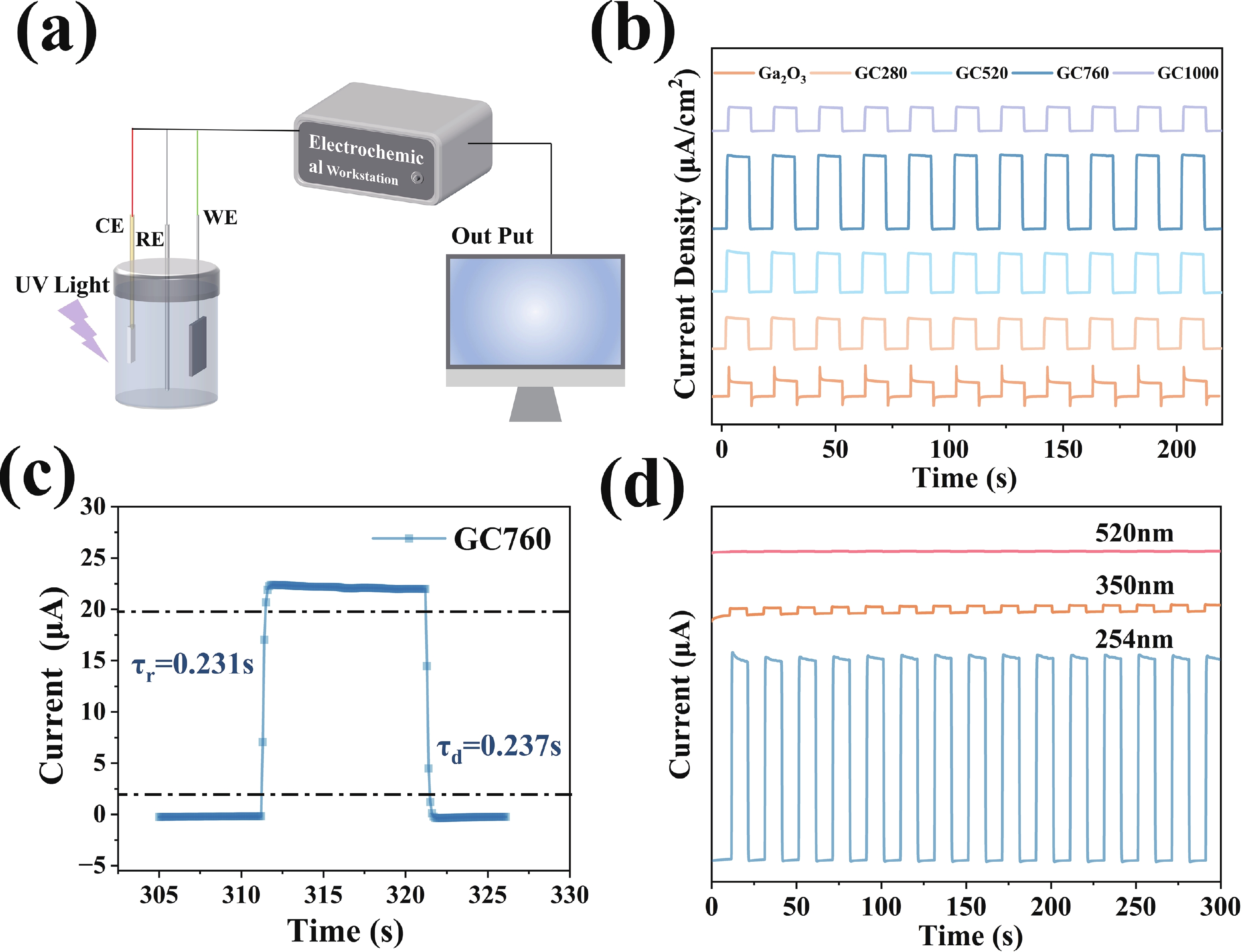
Fig. 3.  (Color online) (a) Schematic of the photoelectrochemical measurement setup. (b) J-t curves of pristine α-Ga2O3, GC280, GC520, GC760, and GC1000. (c) Transient response of GC760 during a single illumination cycle. (d) Transient photocurrent responses of GC760 under periodically switched illumination at 254 nm, 350 nm, and 520 nm.

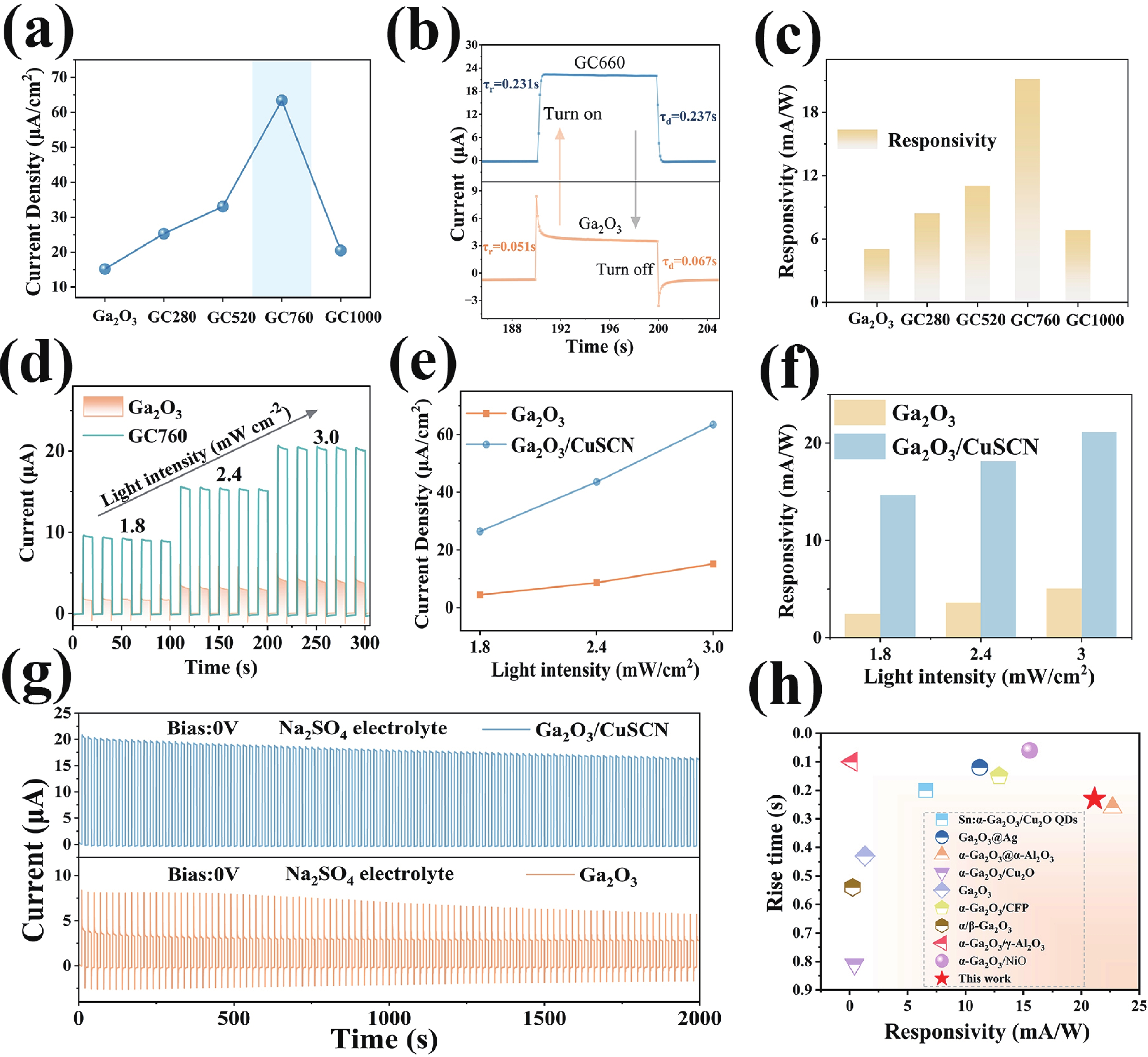
Fig. 4.  (Color online) (a) Photocurrent density comparison of different samples; (b) response-time comparison; (c) responsivity of different samples; (d) I-t curves of pristine α-Ga2O3 and GC760 under different incident irradiances; (e) photocurrent density of pristine α-Ga2O3 and GC760 as a function of incident irradiance; (f) responsivity of pristine α-Ga2O3 and GC760 as a function of incident irradiance; (g) long-term stability of pristine α-Ga2O3 and GC760; (h) comparison of responsivity and rise time with previously reported self-powered solar-blind photodetectors.

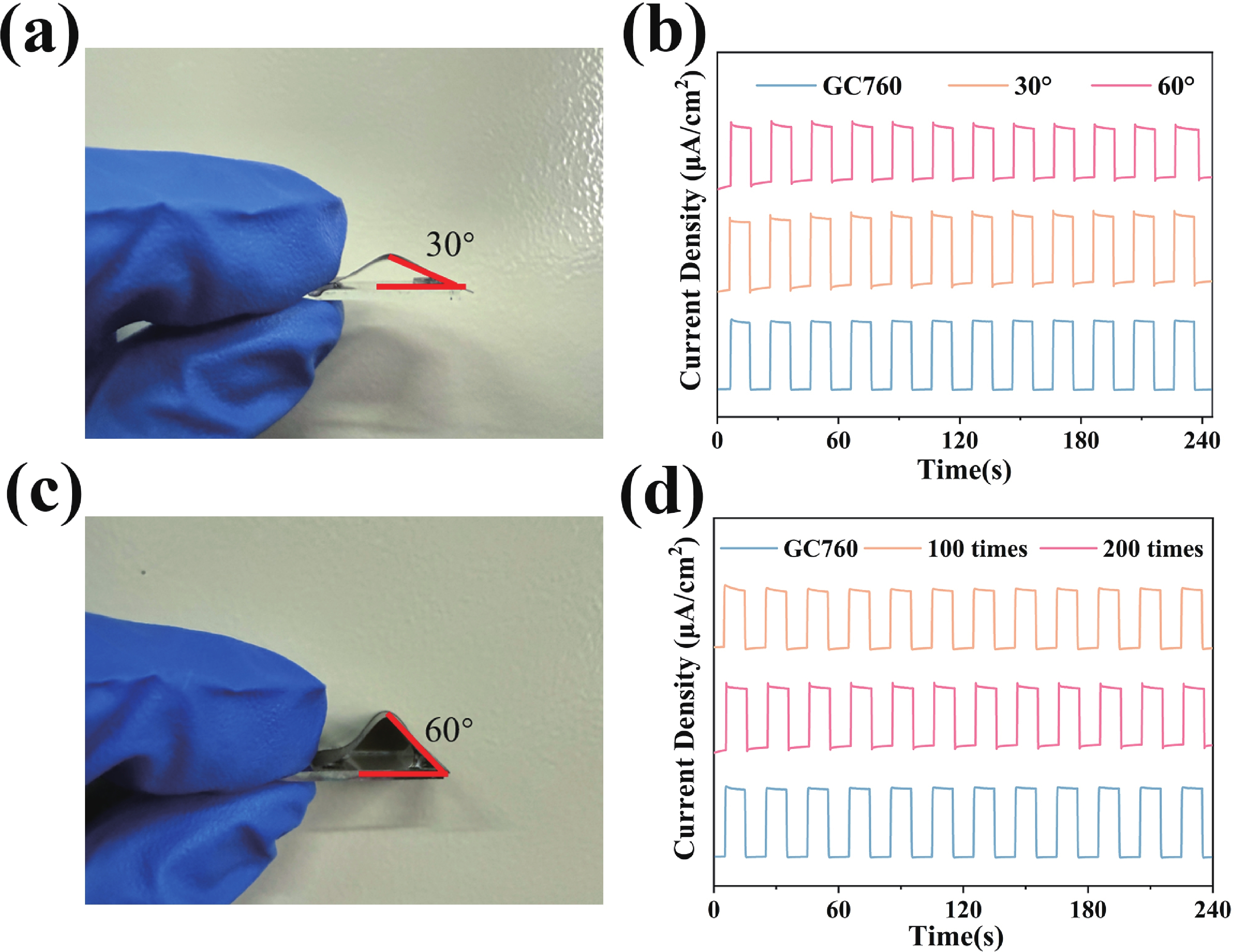
Fig. 5.  (Color online) (a, c) Schematics of the composite device at different bending angles. (b) J-t curves of GC760 at 30° and 60° bending. (d) J-t curves of GC760 after 100 bending cycles and 200 bending cycles at a fixed angle of 30°.

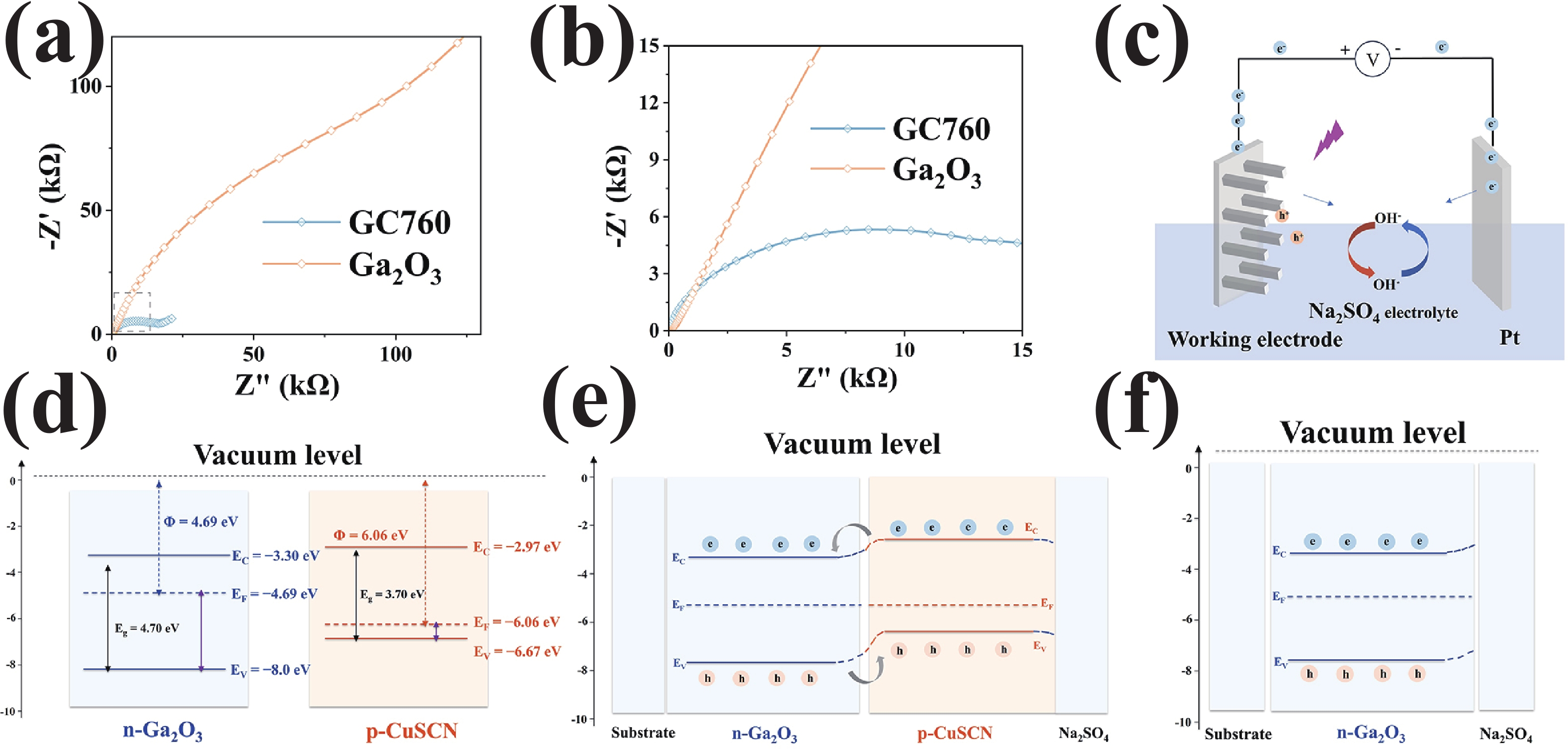
Fig. 6.  (Color online) (a) EIS spectra of Ga2O3 and GC760. (b) Corresponding magnified views. (c) Schematic diagram of PEC. (d–e) Band structure diagrams under dark and UV-irradiated conditions. (f) Schematic diagram of the band structure at the Ga2O3/electrolyte interface.

Table 1.   Performance parameters of all samples

Sample Bending angles Bending Number R (mA∙W–1)
Ga2O3 0 0 5.05
GC280 0 0 8.42
GC520 0 0 11.01
GC760 0 0 21.14
GC1000 0 0 6.82
GC760 30 0 19.51
GC760 60 0 14.95
GC760 30 100 17.68
GC760 30 200 16.58
DownLoad: CSV
[1]
Xu J J, Zheng W, Huang F. Gallium oxide solar-blind ultraviolet photodetectors: A review. J Mater Chem C, 2019, 7(29): 8753. doi: 10.1039/C9TC02055A
[2]
Guo D, Guo Q, Chen Z, et al. Review of Ga2O3-based optoelectronic devices. Mater Today Phys, 2019, 11: 100157.
[3]
Chen X H, Ren F F, Gu S L, et al. Review of gallium-oxide-based solar-blind ultraviolet photodetectors. Photon Res, 2019, 7(4): 381.
[4]
Varshney U, Aggarwal N, Gupta G. Current advances in solar-blind photodetection technology: Using Ga2O3 and AlGaN. J Mater Chem C, 2022, 10(5): 1573.
[5]
Cui S J, Mei Z X, Zhang Y H, et al. Room-temperature fabricated amorphous Ga2O3 high-response-speed solar-blind photodetector on rigid and flexible substrates. Adv Opt Mater, 2017, 5(19): 1700454.
[6]
Kumar N, Arora K, Kumar M. High performance, flexible and room temperature grown amorphous Ga2O3 solar-blind photodetector with amorphous indium-zinc-oxide transparent conducting electrodes. J Phys D Appl Phys, 2019, 52(33): 335103.
[7]
Wang S L, Sun H L, Wang Z, et al. In situ synthesis of monoclinic β-Ga2O3 nanowires on flexible substrate and solar-blind photodetector. J Alloys Compd, 2019, 787: 133.
[8]
Tak B R, Yang M M, Lai Y H, et al. Photovoltaic and flexible deep ultraviolet wavelength detector based on novel β-Ga2O3/muscovite heteroepitaxy. Sci Rep, 2020, 10: 16098.
[9]
Sui Y X, Liang H L, Huo W X, et al. A flexible and transparent β-Ga2O3 solar-blind ultraviolet photodetector on mica. J Phys D Appl Phys, 2020, 53(50): 504001.
[10]
Wang Y H, Yang Z B, Li H R, et al. UltrasensitiveFlexible solar-blind PhotodetectorsBased on graphene/amorphous Ga2O3 van der WaalsHeterojunctions. ACS Appl Mater Interfaces, 2020, 12(42): 47714.
[11]
Lu Y, Krishna S, Tang X, et al. Ultrasensitive flexible κ-phase Ga2O3Solar-blind photodetector. ACS Appl Mater Interfaces, 2022, 14(30): 34844.
[12]
Chen Z Y, Han P P, Chen W H, et al. Flexible and self-powered solar-blind UV photodetector based on the Ti/α-Ga2O3/electrolyte heterojunction with high stability. ACS Appl Electron Mater, 2024, 6(1): 496.
[13]
Yu C X, Li H L, Ding K, et al. Flexible and self-powered photoelectrochemical-type solar-blind photodetectors based on Ag nanowires-embedded amorphous Ga2O3 films. Adv Opt Mater, 2024, 12(18): 2400116.
[14]
Pearton S J, Yang J C, Cary P H IV, et al. A review of Ga2O3 materials, processing, and devices. Appl Phys Rev, 2018, 5: 011301.
[15]
Muazzam U U, Chavan P, Raghavan S, et al. Optical properties of mist CVD grown α-Ga2O3. IEEE Photonics Technol Lett, 2020, 32(7): 422.
[16]
Qiao G, Cai Q, Ma T C, et al. Nanoplasmonically enhanced high-performance metastable phase α-Ga2O3 solar-blind photodetectors. ACS Appl Mater Interfaces, 2019, 11(43): 40283.
[17]
Zhang J H, Jiao S J, Wang D B, et al. Solar-blind ultraviolet photodetection of an α-Ga2O3nanorod array based on photoelectrochemical self-powered detectors with a simple, newly-designed structure. J Mater Chem C, 2019, 7(23): 6867.
[18]
Huang L J, Hu Z R, He X W, et al. Self-powered solar-blind ultraviolet photodetector based on α-Ga2O3 nanorod arrays fabricated by the water bath method. Opt Mater Express, 2021, 11(7): 2089.
[19]
Zhang B H, Wu H X, Feng C, et al. Self-powered solar-blind photodetectors based on α-Ga2O3 nanorod arrays. ACS Appl Nano Mater, 2022, 5(8): 11956.
[20]
Hu H Z, Wu C, He C R, et al. Improved photoelectric performance with self-powered characteristics through TiO2 surface passivation in an α-Ga2O3 nanorod array deep ultraviolet photodetector. ACS Appl Electron Mater, 2022, 4(8): 3801.
[21]
Peter L M, Walker A B, Bein T, et al. Interpretation of photocurrent transients at semiconductor electrodes: Effects of band-edge unpinning. J Electroanal Chem, 2020, 872: 114234.
[22]
Zachäus C, Abdi F F, Peter L M, et al. Photocurrent of BiVO4 is limited by surface recombination, not surface catalysis. Chem Sci, 2017, 8(5): 3712.
[23]
Ding K, Zhang H, Jiang J L, et al. Balancing carrier dynamics in oxygen-vacancy-tuned amorphous Ga2O3 thin-film self-powered photoelectrochemical-type solar-blind photodetector arrays for underwater imaging. Adv Sci, 2024, 11(43): 2407822.
[24]
Chen K, Wang S L, He C R, et al. Photoelectrochemical self-powered solar-blind photodetectors based on Ga2O3Nanorod array/electrolyte solid/liquid heterojunctions with a large separation interface of photogenerated carriers. ACS Appl Nano Mater, 2019, 2(10): 6169.
[25]
Huang L J, Hu Z R, Zhang H, et al. A simple, repeatable and highly stable self-powered solar-blind photoelectrochemical-type photodetector using amorphous Ga2O3 films grown on 3D carbon fiber paper. J Mater Chem C, 2021, 9(32): 10354.
[26]
Guo J C, Sun G W, Fan M M, et al. Hydrothermal growth of an Al-doped α-Ga2O3 nanorod array and its application in self-powered solar-blind UV photodetection based on a photoelectrochemical cell. Micromachines, 2023, 14(7): 1336.
[27]
Yue Q C, Ye L J, Yuan L, et al. Optoelectronic logic gates and chaotic encryption optical communication enabled by dual-band optical response in a-Ga2O3/Cr2O3 heterostructures. Mater Today Phys, 2026, 61: 102032.
[28]
Liu C Y, Zhang H, Ding K, et al. Geometry-engineered bipolar photodetectors for multivalued logic-gate encrypted optical communication. Adv Mater, 2026, 38(10): e16019.
[29]
Zhai K, Zhang H, Li S Y, et al. Full-space built-in electric field inside gradient Sn-doped β-Ga2O3 photoanodes for enhanced photoelectrochemical solar-blind UV photodetection. Sci China Mater, 2026, 69(3): 1420.
[30]
He C R, Guo D Y, Chen K, et al. α-Ga2O3 nanorod array–Cu2O microsphere p–n junctions for self-powered spectrum-distinguishable photodetectors. ACS Appl Nano Mater, 2019, 2(7): 4095.
[31]
Han P P, Kang T X, Chen W H, et al. Cu2O quantum dots modified α-Ga2O3 nanorod arrays as a heterojunction for improved sensitivity of self-powered photoelectrochemical detectors. J Alloys Compd, 2023, 952: 170063.
[32]
Ding S, Chen K, Xiu X Q, et al. Self-powered solar-blind photodetectors based on vertically aligned GaN@Ga2O3 core–shell nanowire arrays. ACS Appl Nano Mater, 2022, 5(10): 14470.
[33]
Pattanasattayavong P, Yaacobi-Gross N, Zhao K, et al. Hole-transporting transistors and circuits based on the transparent inorganic semiconductor copper(I) thiocyanate (CuSCN) processed from solution at room temperature. Adv Mater, 2013, 25(10): 1504.
[34]
Pattanasattayavong P, Ndjawa G O N, Zhao K, et al. Electric field-induced hole transport in copper(i) thiocyanate (CuSCN) thin-films processed from solution at room temperature. Chem Commun, 2013, 49(39): 4154.
[35]
Wijeyasinghe N, Regoutz A, Eisner F, et al. Copper(I) thiocyanate (CuSCN) hole-transport layers processed from aqueous precursor solutions and their application in thin-film transistors and highly efficient organic and organometal halide perovskite solar cells. Adv Funct Mater, 2017, 27(35): 1701818.
[36]
Luo B, Banik A, Bohannan E W, et al. Epitaxial electrodeposition of hole transport CuSCN nanorods on Au(111) at the wafer scale and lift-off to produce flexible and transparent foils. Chem Mater, 2022, 34(3): 970.
[37]
Uda K, Tsuda Y, Nakamura T, et al. Tuning of morphological, crystallographic, and optoelectronic properties of CuSCN by electrodeposition. Appl Res, 2023, 2(5): e202200097.
[38]
Li S, Guo D Y, Li P G, et al. Ultrasensitive, superhigh signal-to-noise ratio, self-powered solar-blind photodetector based on n-Ga2O3/p-CuSCN core–shell microwire heterojunction. ACS Appl Mater Interfaces, 2019, 11(38): 35105.
[39]
Vo T G, Chiu J M, Tai Y A, et al. Turnip-inspired BiVO4/CuSCN nanostructure with close to 100% suppression of surface recombination for solar water splitting. Sol Energy Mater Sol Cells, 2018, 185: 415.
[40]
Liu Y, Zhang Z Y, Wang K, et al. Efficient BiVO4 photoanode with an excellent hole transport layer of CuSCN for solar water oxidation. Adv Energy Mater, 2024, 14(17): 2304223.
[41]
Zhao S Y, Su W P, Wang H, et al. Flexible self-powered photoelectrochemical solar-blind light detector based on Ga2O3/NiO core-shell heterojunctions. J Alloys Compd, 2026, 1065: 188191.

Supporting_information.pdf

  • Search

    Advanced Search >>

    GET CITATION

    shu

    Export: BibTex EndNote

    Article Metrics

    Article views: 6 Times PDF downloads: 0 Times Cited by: 0 Times

    History

    Received: Revised: Online: Accepted Manuscript: 08 October 2026

    Catalog

      Email This Article

      User name:
      Email:*请输入正确邮箱
      Code:*验证码错误
      Songyan Zhao, Hao Wang, Wanping Su, Pei Wang, Huixin Chen, Luna Yang, Feng Teng, Peng Hu, Haibo Fan. High-performance flexible self-powered solar-blind photodetector based on α-Ga2O3/CuSCN heterojunction[J]. Journal of Semiconductors, 2026, In Press. doi: 10.1088/1674-4926/26080002 ****S Y Zhao, H Wang, W P Su, P Wang, H X Chen, L N Yang, F Teng, P Hu, and H B Fan, High-performance flexible self-powered solar-blind photodetector based on α-Ga2O3/CuSCN heterojunction[J]. J. Semicond., 2026, accepted doi: 10.1088/1674-4926/26080002
      Citation:
      Songyan Zhao, Hao Wang, Wanping Su, Pei Wang, Huixin Chen, Luna Yang, Feng Teng, Peng Hu, Haibo Fan. High-performance flexible self-powered solar-blind photodetector based on α-Ga2O3/CuSCN heterojunction[J]. Journal of Semiconductors, 2026, In Press. doi: 10.1088/1674-4926/26080002 ****
      S Y Zhao, H Wang, W P Su, P Wang, H X Chen, L N Yang, F Teng, P Hu, and H B Fan, High-performance flexible self-powered solar-blind photodetector based on α-Ga2O3/CuSCN heterojunction[J]. J. Semicond., 2026, accepted doi: 10.1088/1674-4926/26080002

      High-performance flexible self-powered solar-blind photodetector based on α-Ga2O3/CuSCN heterojunction

      DOI: 10.1088/1674-4926/26080002
      CSTR: 32376.14.1674-4926.26080002
      More Information
      • Songyan Zhao was born in Shaanxi, China, in July 2002. He is currently pursuing the master’s degree with the School of Physics, Northwest University, Xi’an, China. His research interests include the preparation and application of wide-bandgap semiconductor photodetectors, particularly the fabrication and study of Ga2O3-based photodetectors
      • Luna Yang received the bachelor’s degree in Optical Information Science and Technology from Northwest University, Xi’an, China, in 2004, and the master’s degree in Optics from Northwest University, Xi’an, China, in 2009. She is currently an Engineer with the Experimental Teaching Center, School of Physics, Northwest University, Xi’an, China. Her research interests include the preparation of new materials such as perovskites and Ga2O3, as well as the research and application of novel optoelectronic materials and devices
      • Haibo Fan received the bachelor’s degree in Materials Science and Engineering from Zhejiang University in 2003, and the Ph.D. degree in Materials Physics and Chemistry from the Institute of Semiconductors, Chinese Academy of Sciences, in 2008. He is currently a Professor with the School of Physics, Northwest University, Xi’an, China. His research interests include Ga2O3-based photodetectors, photoelectrocatalytic hydrogen production, and supercapacitors
      • Corresponding author: yln@nwu.edu.cn; hbfan@nwu.edu.cn
      • Available Online: 2026-10-08

      Catalog

        /

        DownLoad:  Full-Size Img  PowerPoint
        Return
        Return