| [1] |
Oh J, Kim S, Yim Y, et al. Global, regional, and national burden of chronic respiratory diseases and impact of the COVID-19 pandemic, 1990-2023: a Global Burden of Disease study. Nat Med 2026, 32: 197
|
| [2] |
Berry R B, Quan S F, Abreu A R, et al. The AASM manual for the scoring of sleep and associated events: rules, terminology and technical specifications. Version 2.6. Darien, IL: American Academy of Sleep Medicine, 2020.
|
| [3] |
Vicente B A, Sebastião R, Sencadas V. Wearable devices for respiratory monitoring. Adv Funct Mater, 2024, 34(45): 2404348 doi: 10.1002/adfm.202404348 |
| [4] |
Amjadi M, Kyung K U, Park I, et al. Stretchable, skin-mountable, and wearable strain sensors and their potential applications: A review. Adv Funct Mater, 2016, 26(11): 1678 doi: 10.1002/adfm.201504755 |
| [5] |
Zhao S Q, Liu D P, Yan F. Wearable resistive-type stretchable strain sensors: Materials and applications. Adv Mater, 2025, 37(5): 2413929 doi: 10.1002/adma.202413929 |
| [6] |
Dickey M D. Stretchable and soft electronics using liquid metals. Adv Mater, 2017, 29(27): 1606425 doi: 10.1002/adma.201606425 |
| [7] |
Wang Y R, Xie Y B. Interfacial interaction-induced super-wettability of gallium-based liquid metals: A review. J Mater Chem A, 2024, 12(13): 7396 doi: 10.1039/D3TA07297E |
| [8] |
Guan Z X, Jiang Y C, Zhou Y K, et al. Liquid metal-based electrodes for flexible electronics. Rare Met, 2025, 44(10): 6897 doi: 10.1007/s12598-025-03466-w |
| [9] |
Zhuang Q N, Yao K M, Wu M G, et al. Wafer-patterned, permeable, and stretchable liquid metal microelectrodes for implantable bioelectronics with chronic biocompatibility. Sci Adv, 2023, 9(22): eadg8602 doi: 10.1126/sciadv.adg8602 |
| [10] |
Sun X D, An J Y, Sun Y Q, et al. Liquid–metal microgrid stretchable electronics based on bionic leaf veins with ultra-stretchability and high conductivity. Rare Met, 2024, 43(6): 2747 doi: 10.1007/s12598-024-02636-6 |
| [11] |
Li Y, Lin Y-C, He A W, et al. Intermetallic-anchored epidermal EGaIn patch with analog constriction gates for cardiorespiratory monitoring. Sci Adv, 2026, 12(26): eaee5907 doi: 10.1126/sciadv.aee5907 |
| [12] |
Yao B, Lü X Z, Wang Y W, et al. Ultrasensitive, highly stable, and stretchable strain sensor using gated liquid metal channel. Adv Funct Mater, 2024, 34(28): 2314298 doi: 10.1002/adfm.202314298 |
| [13] |
Yao B, Zhu Y X, Jin F D, et al. Stretchable strain sensors based on liquid metal channels with simultaneous significant improvements in linearity and sensitivity. Adv Funct Mater, 2026, 36(12): e17648 doi: 10.1002/adfm.202517648 |
| [14] |
Luo Y L, Fan H, Lai X J, et al. Flexible liquid metal-based microfluidic strain sensors with fractal-designed microchannels for monitoring human motion and physiological signals. Biosens Bioelectron, 2024, 246: 115905 doi: 10.1016/j.bios.2023.115905 |
| [15] |
Xue F H, Peng Q Y, Ding R J, et al. Ultra-sensitive, highly linear, and hysteresis-free strain sensors enabled by gradient stiffness sliding strategy. npj Flex Electron, 2024, 8: 14 doi: 10.1038/s41528-024-00301-7 |
| [16] |
Zhai K K, Wang H, Ding Q L, et al. High-performance strain sensors based on organohydrogel microsphere film for wearable human–computer interfacing. Adv Sci, 2023, 10(6): 2205632 doi: 10.1002/advs.202205632 |
| [17] |
Lee J, Kim T, Kim H, et al. Ultrasensitive ultrasoft buckled crack-based sensor for respiration measurement and enhanced human–machine interface. Adv Intell Syst, 2025, 7(7): 2400624 doi: 10.1002/aisy.202400624 |
| [18] |
Wang W Y, Yao D J, Wang H, et al. A breathable, stretchable, and self-calibrated multimodal electronic skin based on hydrogel microstructures for wireless wearables. Adv Funct Mater, 2024, 34(32): 2316339 doi: 10.1002/adfm.202316339 |
| [19] |
Du D R, Zhang G Y, Xu D, et al. Prevalence and clinical characteristics of sleep disorders in chronic obstructive pulmonary disease: A systematic review and meta-analysis. Sleep Med, 2023, 112: 282 doi: 10.1016/j.sleep.2023.10.034 |
| [20] |
Dang T B, Nguyen C C, Heo S Y, et al. Wearable, broadband auscultation patch with cantilever pressure transducer for remote healthcare monitoring. Nat Commun, 2026, 17: 4918 doi: 10.1038/s41467-026-73636-6 |
| [21] |
Botonis O K, Mendley J, Aalla S, et al. Feasibility of snapshot testing using wearable sensors to detect cardiorespiratory illness (COVID infection in India). npj Digit Med, 2024, 7: 289 doi: 10.1038/s41746-024-01287-2 |
| [22] |
Woehrle H, Viniol C, Galetke W, et al. Clinical validation of respiratory outcomes for a patch-based polysomnography system. ERJ Open Res, 2026, 12(3): 00857 doi: 10.1183/23120541.00857-2025 |



 Qianrui Zhou is expected to receive the B.S. degree in Polymer Materials and Engineering from Nanjing University of Posts & Telecommunications, Nanjing, China, in 2028. He is currently an undergraduate student at Nanjing University of Posts & Telecommunications. His research interests include flexible electronics, wearable sensors, polymer-based functional materials.
 Weiwei Zhao obtained her PhD degree from Tianjin University in 2015. She is now a professor at State Key Laboratory of Flexible Electronics (LoFE) and Institute of Advanced Materials (IAM), Nanjing University of Posts & Telecommunications. Her research mainly focuses on flexible electromagnetic materials for communication electronics.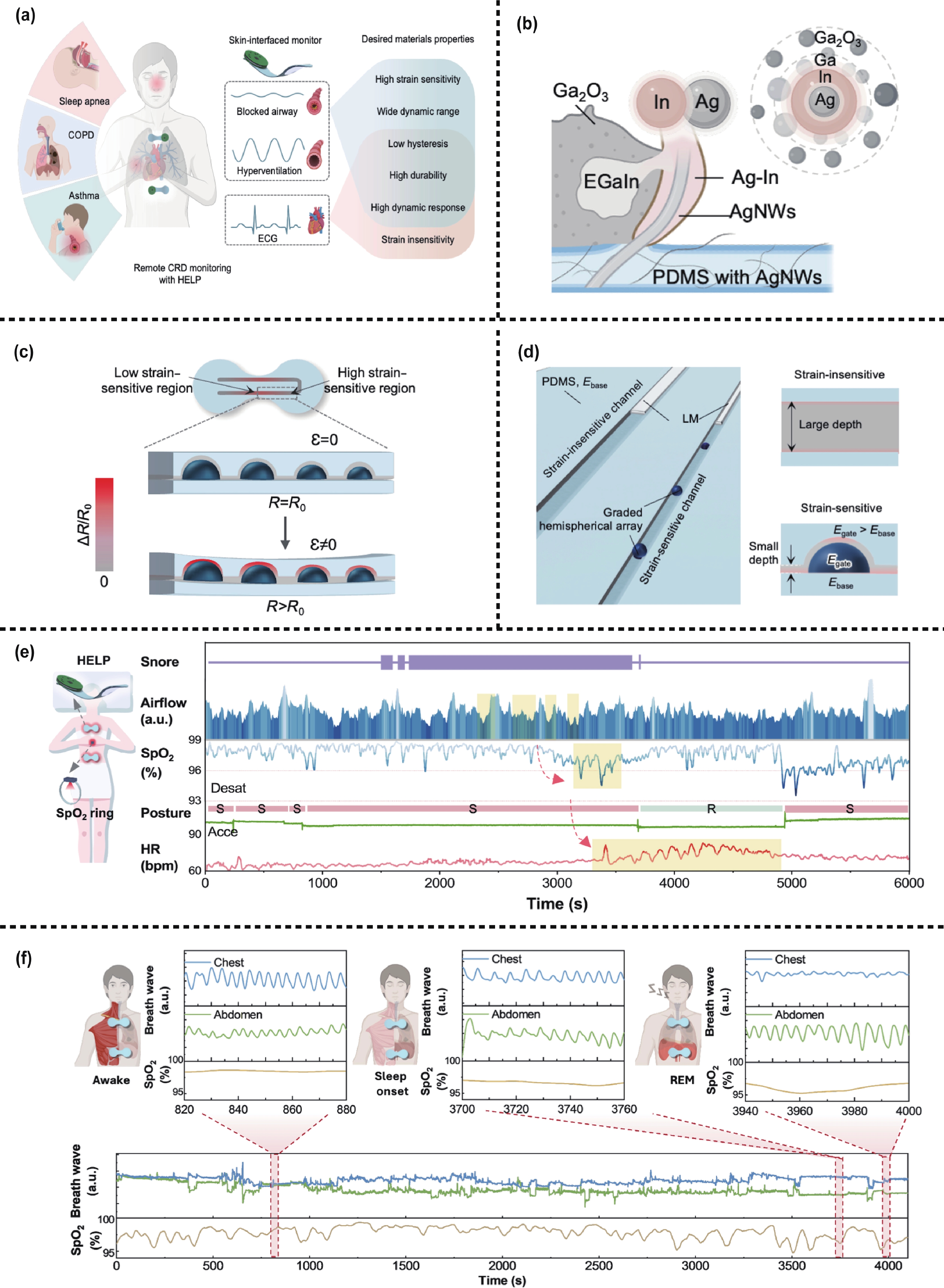
 DownLoad: