


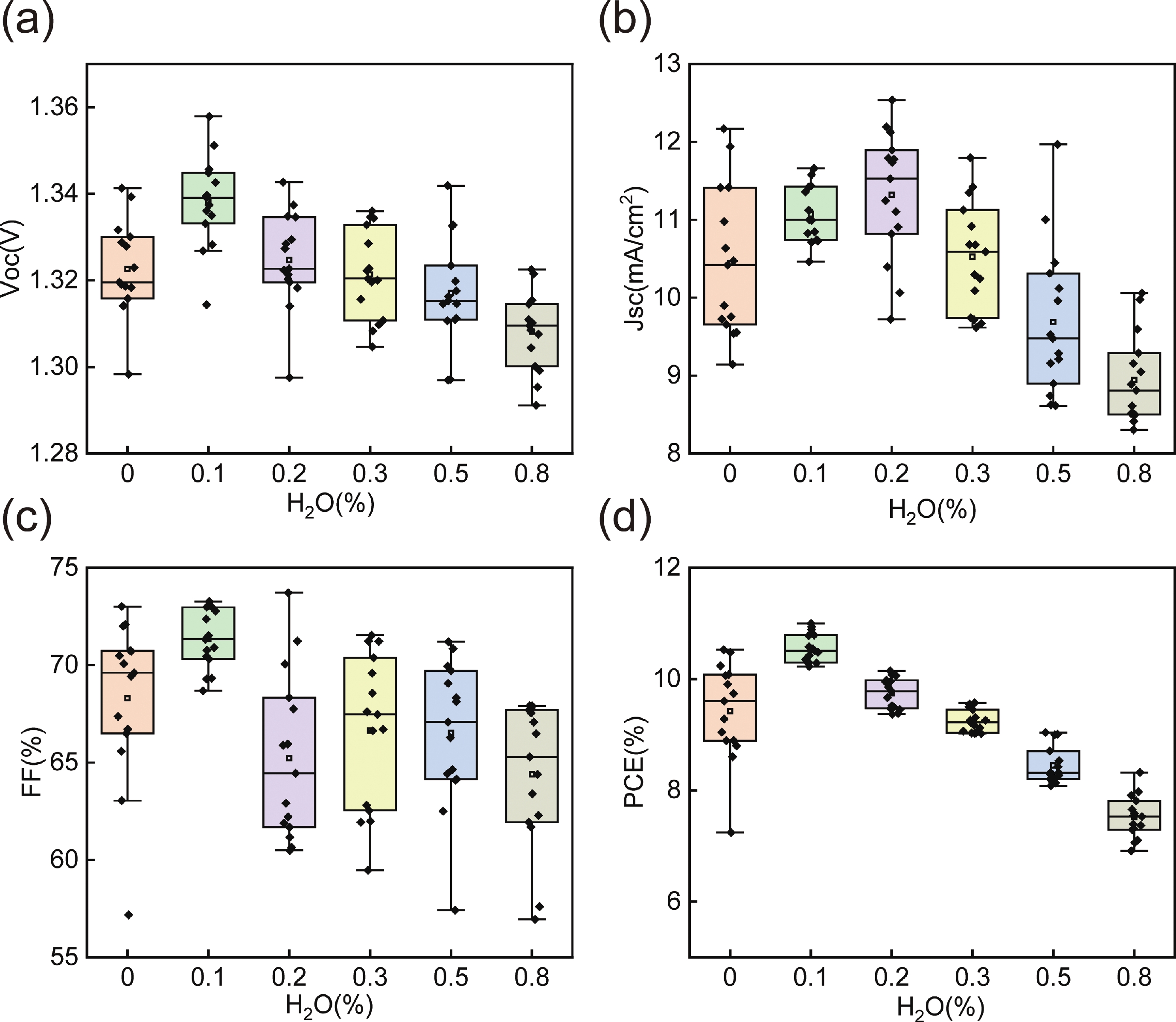
Fig. 1.
(Color online) (a) VOC, (b) JSC, (c) FF, and (d) PCE of 90 devices fabricated under different H2O concentrations.
ARTICLES
Wendong Zhao1, Tao Dong1, Hongji Song1, Chenyuan Ding1, Licheng Mao1, Yingge Xing1, Hengkang Zhang1, Feng Ye3, Qiufeng Ye1, and Zebo Fang2,
Corresponding author: Qiufeng Ye, yeqiufeng21@usx.edu.cn; Zebo Fang, csfzb@usx.edu.cn
Abstract: All-inorganic perovskite solar cells have attracted extensive attention due to their excellent thermal stability and environmental durability. However, CsPbIBr2 perovskite films still suffer from rapid crystallization, high defect density, and severe non-radiative recombination during solution processing, which limit further improvements in device performance. Here, we propose a water-assisted antisolvent engineering strategy by introducing trace water into the isopropanol antisolvent to regulate the crystallization kinetics of CsPbIBr2 films. The effects of different water concentrations (0–0.8 vol%) on the film morphology, optoelectronic properties, and photovoltaic performance were systematically investigated. The results show that an appropriate water content improves film morphology and crystallinity, with complementary characterization suggesting reduced defect-related losses. The device fabricated using an antisolvent containing 0.1 vol% H2O achieves a power conversion efficiency (PCE) of 11.44%, with a high open-circuit voltage (VOC) of 1.350 V, a short-circuit current density (JSC) of 11.25 mA/cm2, and a fill factor (FF) of 75.32%, significantly outperforming the control device without water modification (9.88%). Furthermore, the unencapsulated device maintains excellent stability after storage for 400 h in a nitrogen atmosphere.
Keywords: all-inorganic perovskite, CsPbIBr2, antisolvent engineering, water-assisted processing
| [1] |
Kojima A, Teshima K, Shirai Y, et al. Organometal halide perovskites as visible-light sensitizers for photovoltaic cells. J Am Chem Soc, 2009, 131(17): 6050 doi: 10.1021/ja809598r
|
| [2] |
Jia L B, Xia S M, Li J, et al. Efficient perovskite/silicon tandem with asymmetric self-assembly molecule. Nature, 2025, 644(8078): 912 doi: 10.1038/s41586-025-09333-z
|
| [3] |
Shi Y T, Zhang Y X, Guo H Q, et al. Tunable molecular dipole moments and orientations for efficient and stable perovskite solar cells. Joule, 2025, 9(8): 102009 doi: 10.1016/j.joule.2025.102009
|
| [4] |
Hui W, Chao L, Lu H, et al. Stabilizing black-phase formamidinium perovskite formation at room temperature and high humidity. Science, 2021, 371(6536): 1359 doi: 10.1126/science.abf7652
|
| [5] |
Chen S S, Dai X Z, Xu S, et al. Stabilizing perovskite-substrate interfaces for high-performance perovskite modules. Science, 2021, 373(6557): 902 doi: 10.1126/science.abi6323
|
| [6] |
Ho-Baillie A, Zhang M, Lau C F J, et al. Untapped potentials of inorganic metal halide perovskite solar cells. Joule, 2019, 3(4): 938 doi: 10.1016/j.joule.2019.02.002
|
| [7] |
Tang W J, Chen Y, Yang J C, et al. Acetone-assisted precursor engineering enables low-temperature fabrication of CsPbI2Br perovskite for efficient solar cells. J Power Sources, 2021, 482: 228965 doi: 10.1016/j.jpowsour.2020.228965
|
| [8] |
Dong T, Shen C X, Yu B Y, et al. Minimizing solvent residues in CsPbI1.5 Br1.5 perovskite films for efficient ultra-wide bandgap solar cells. Carbon Neutraliz, 2025, 4(6): e70061 doi: 10.1002/cnl2.70061
|
| [9] |
Ye Q F, Hu W Z, Wei Y X, et al. Constructing a surface multi-cationic heterojunction for CsPbI1.5 Br1.5 perovskite solar cells with efficiency beyond 14%. J Phys Chem Lett, 2023, 14(5): 1140 doi: 10.1021/acs.jpclett.2c03876
|
| [10] |
Stewart A W, Bouich A, Soucase B M. Enhancing the stability and crystallinity of CsPbIBr2 through antisolvent engineering. J Mater Sci, 2021, 56(36): 20071 doi: 10.1007/s10853-021-06552-3
|
| [11] |
Wang Q, Xu Y Y, Zhang L, et al. Guanidinium thiocyanate additive engineering for high-performance CsPbIBr2 solar cells with an efficiency of 10.90%. ACS Appl Energy Mater, 2022, 5(3): 3110 doi: 10.1021/acsaem.1c03733
|
| [12] |
Chandrakar N, Kumar M, Singh D P. Hydrophobic PEACl additive for low-temperature processed all-inorganic CsPbIBr2 perovskite solar cells. Mater Lett, 2026, 408: 140113 doi: 10.1016/j.matlet.2026.140113
|
| [13] |
Zhu W D, Zhang Q N, Chen D Z, et al. Intermolecular exchange boosts efficiency of air-stable, carbon-based all-inorganic planar CsPbIBr2 perovskite solar cells to over 9%. Adv Energy Mater, 2018, 8(30): 1802080 doi: 10.1002/aenm.201802080
|
| [14] |
Ullah S, Khan F, Rasheed J F. Prospects for commercialization of CsPbIBr2-based all-inorganic perovskite solar cells: Fabrication, stability, and engineering strategies. Adv Funct Mater, 2025, 35(36): 2503508 doi: 10.1002/adfm.202503508
|
| [15] |
Chang Q Y, An Y D, Cao H M, et al. Precursor engineering enables high-performance all-inorganic CsPbIBr2 perovskite solar cells with a record efficiency approaching 13%. J Energy Chem, 2024, 90: 16 doi: 10.1016/j.jechem.2023.10.021
|
| [16] |
Zhang W, Xiong J, Li J, et al. Seed-assisted growth for low-temperature-processed all-inorganic CsPbIBr2 solar cells with efficiency over 10. Small, 2020, 16(24): e2001535 doi: 10.1002/smll.202001535
|
| [17] |
Qi Z T, Li J B, Zhang X Y, et al. Healing the buried interface by a plant-derived green passivator for carbon-based CsPbIBr2 perovskite solar cells. ACS Appl Mater Interfaces, 2024, 16(12): 14974 doi: 10.1021/acsami.4c01876
|
| [18] |
Jin X D, Li Z Y, Wang S, et al. Water-influenced perovskite materials: Crystal transition, stability regulation, and applications. Adv Opt Mater, 2025, 13(30): e01785 doi: 10.1002/adom.202501785
|
| [19] |
Zhu Z, Hadjiev V G, Rong Y G, et al. Interaction of organic cation with water molecule in perovskite MAPbI3: From dynamic orientational disorder to hydrogen bonding. Chem Mater, 2016, 28(20): 7385 doi: 10.1021/acs.chemmater.6b02883
|
| [20] |
Ling L, Yuan S J, Wang P F, et al. Precisely controlled hydration water for performance improvement of organic–inorganic perovskite solar cells. Adv Funct Mater, 2016, 26(28): 5028 doi: 10.1002/adfm.201601557
|
| [21] |
Lou S Q, Zhou Z, Xuan T T, et al. Chemical transformation of lead halide perovskite into insoluble, less cytotoxic, and brightly luminescent CsPbBr3/CsPb2Br5 composite nanocrystals for cell imaging. ACS Appl Mater Interfaces, 2019, 11(27): 24241 doi: 10.1021/acsami.9b05484
|
| [22] |
Tang X B, Kothalawala N L, Zhang Y L, et al. Water-driven CsPbBr3 nanocrystals and poly(methyl methacrylate)-CsPbBr3 nanocrystal films with bending-endurable photoluminescence. Chem Eng J, 2021, 425: 131456 doi: 10.1016/j.cej.2021.131456
|
| [23] |
Yu X Y, Wu L Z, Yang D, et al. Hydrochromic CsPbBr3 nanocrystals for anti-counterfeiting. Angew Chem, 2020, 132(34): 14635 doi: 10.1002/ange.202005120
|
| [24] |
Zhang C L, Duan J L, Liu N M, et al. Concurrent nucleation of mixed-halide perovskite phase via balancing solvent-PbX 2 interaction for efficient solar cells in air. Angew Chem, 2026, 138(19): e5296449
|
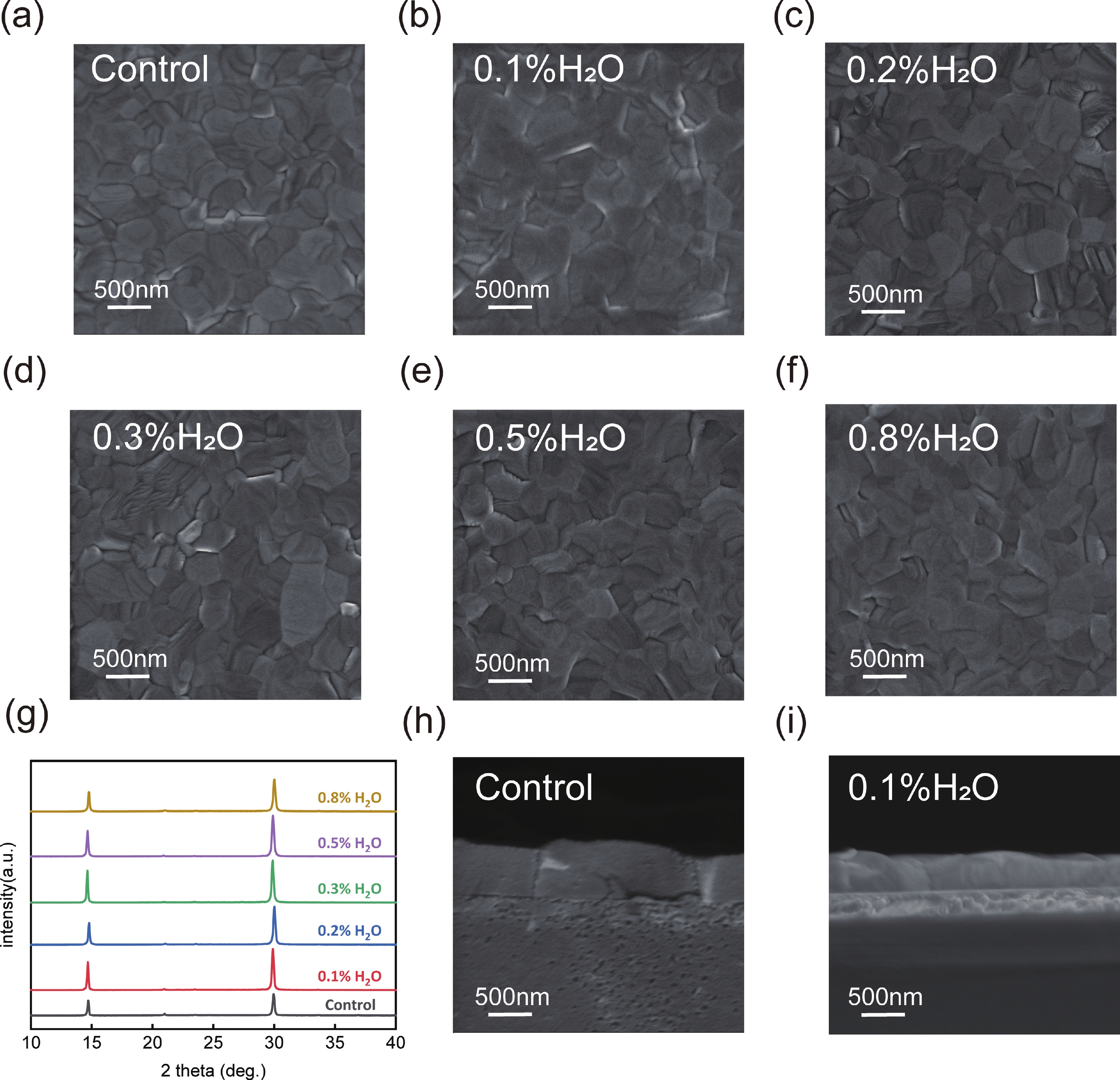
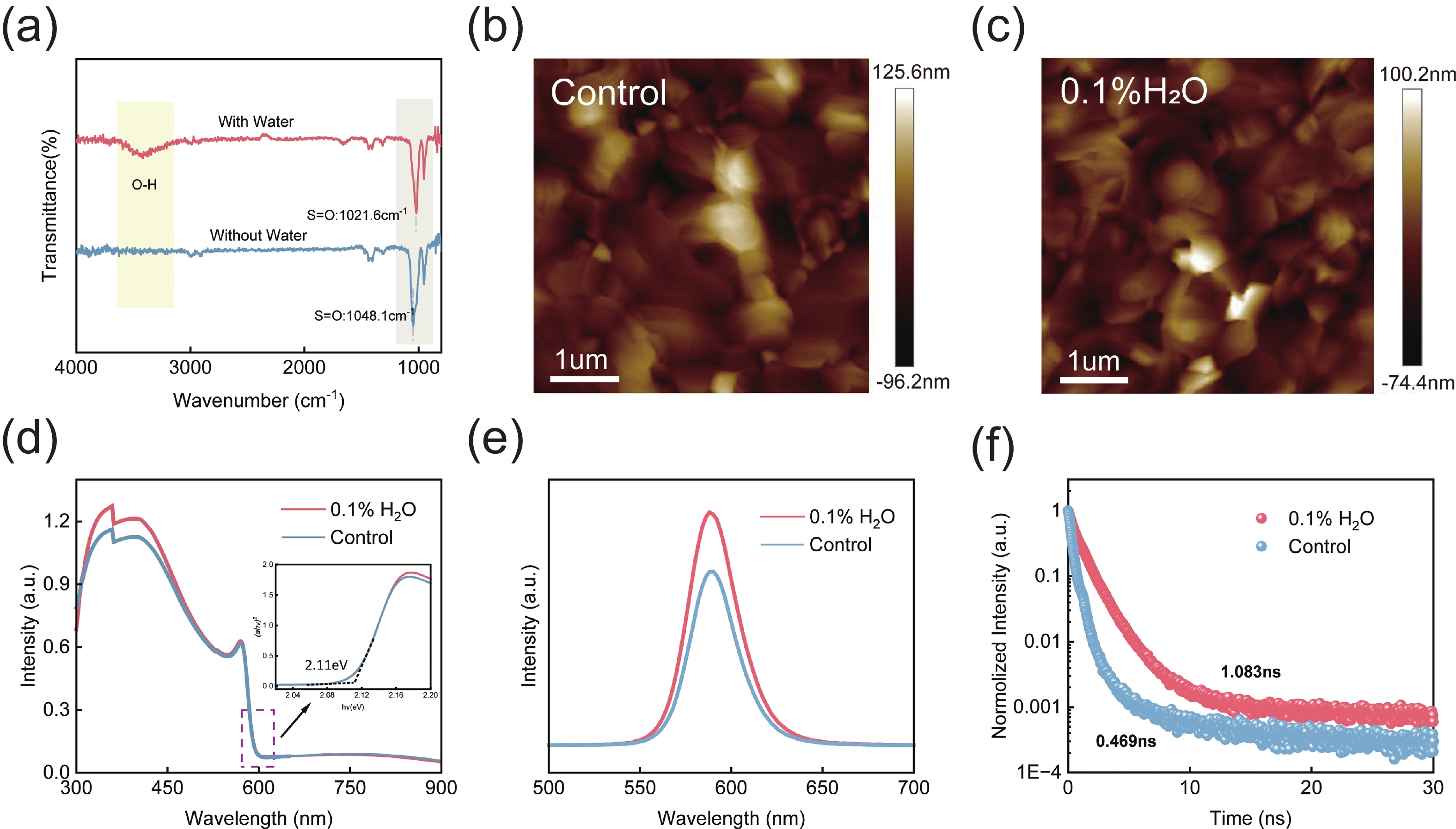
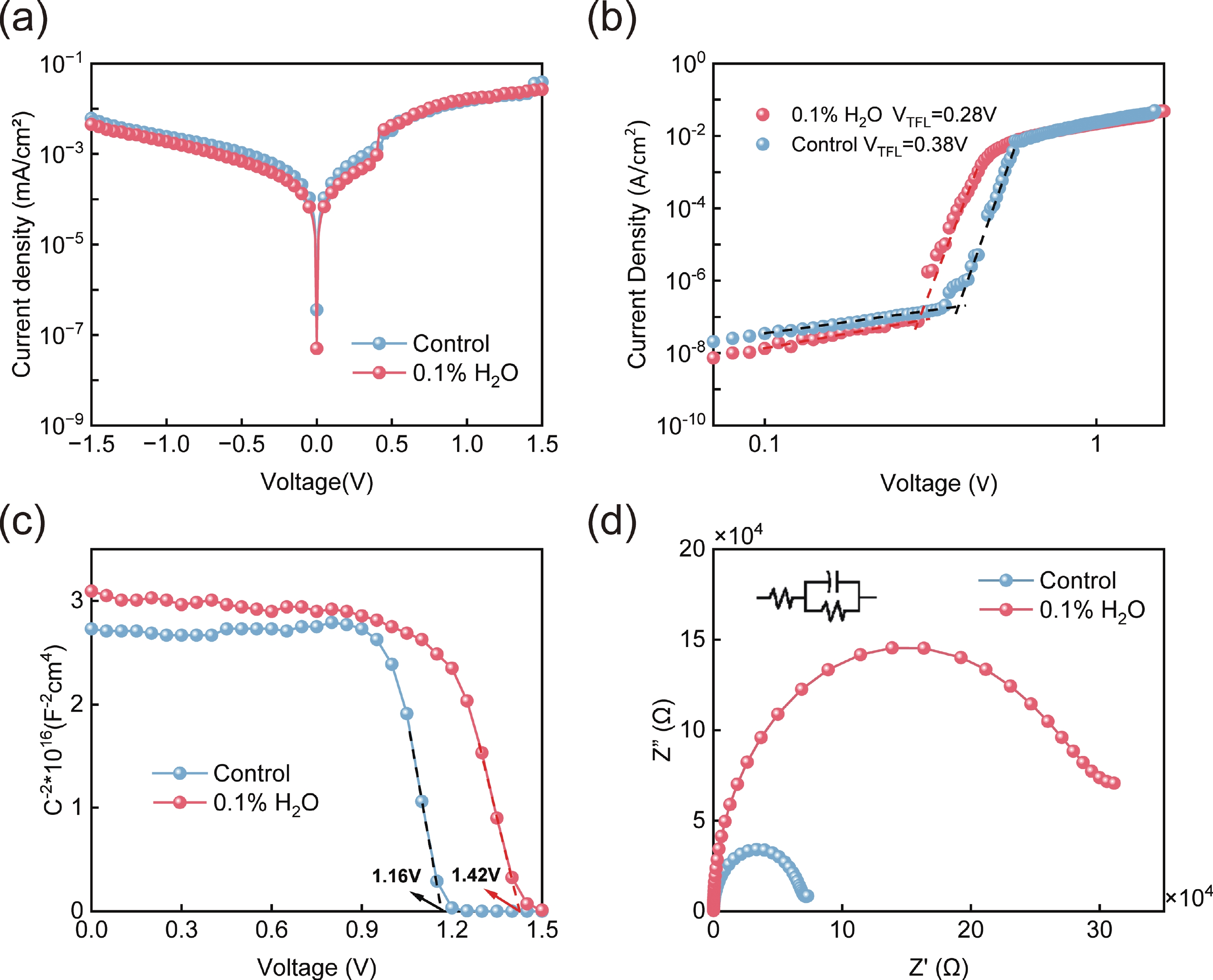
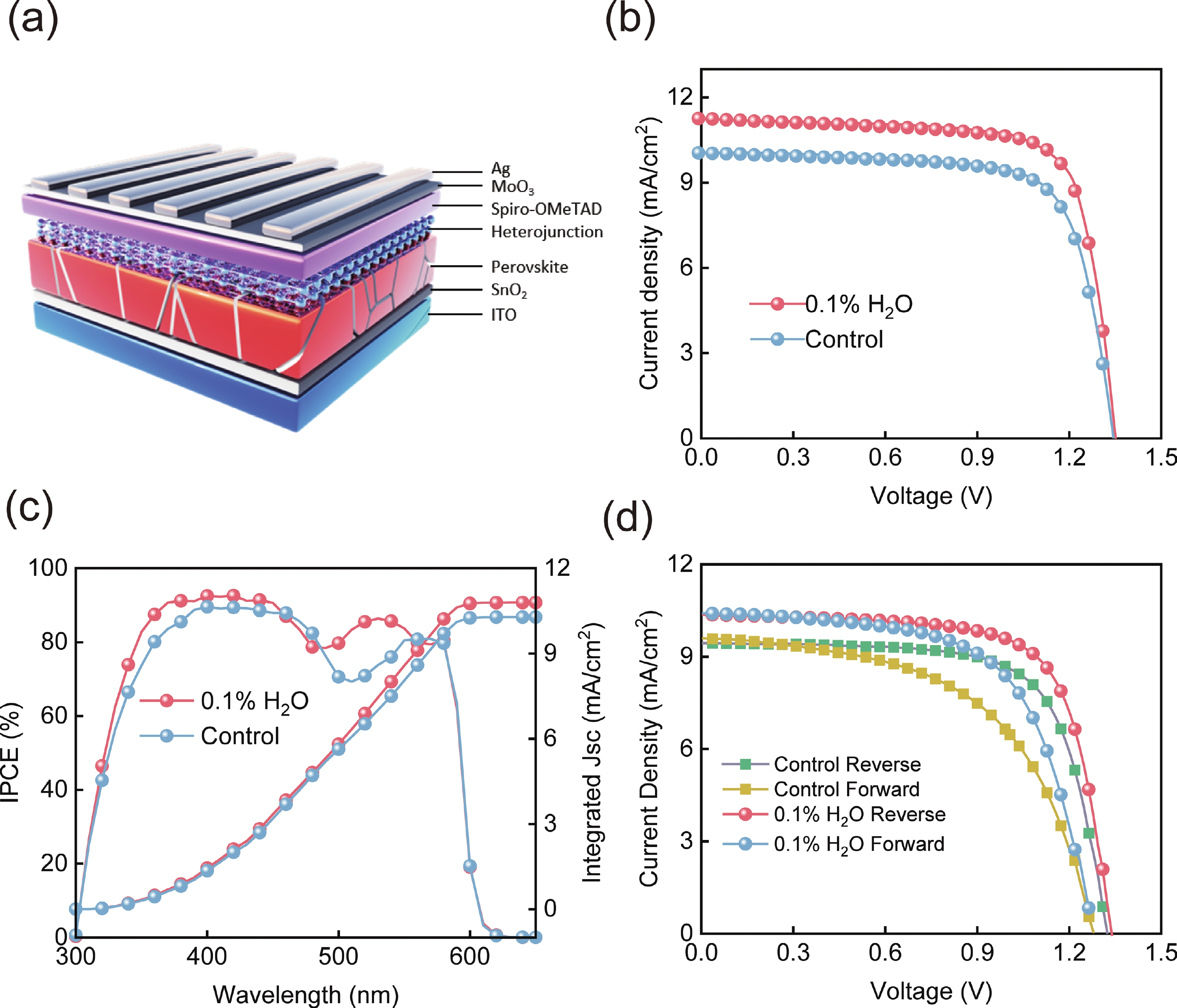
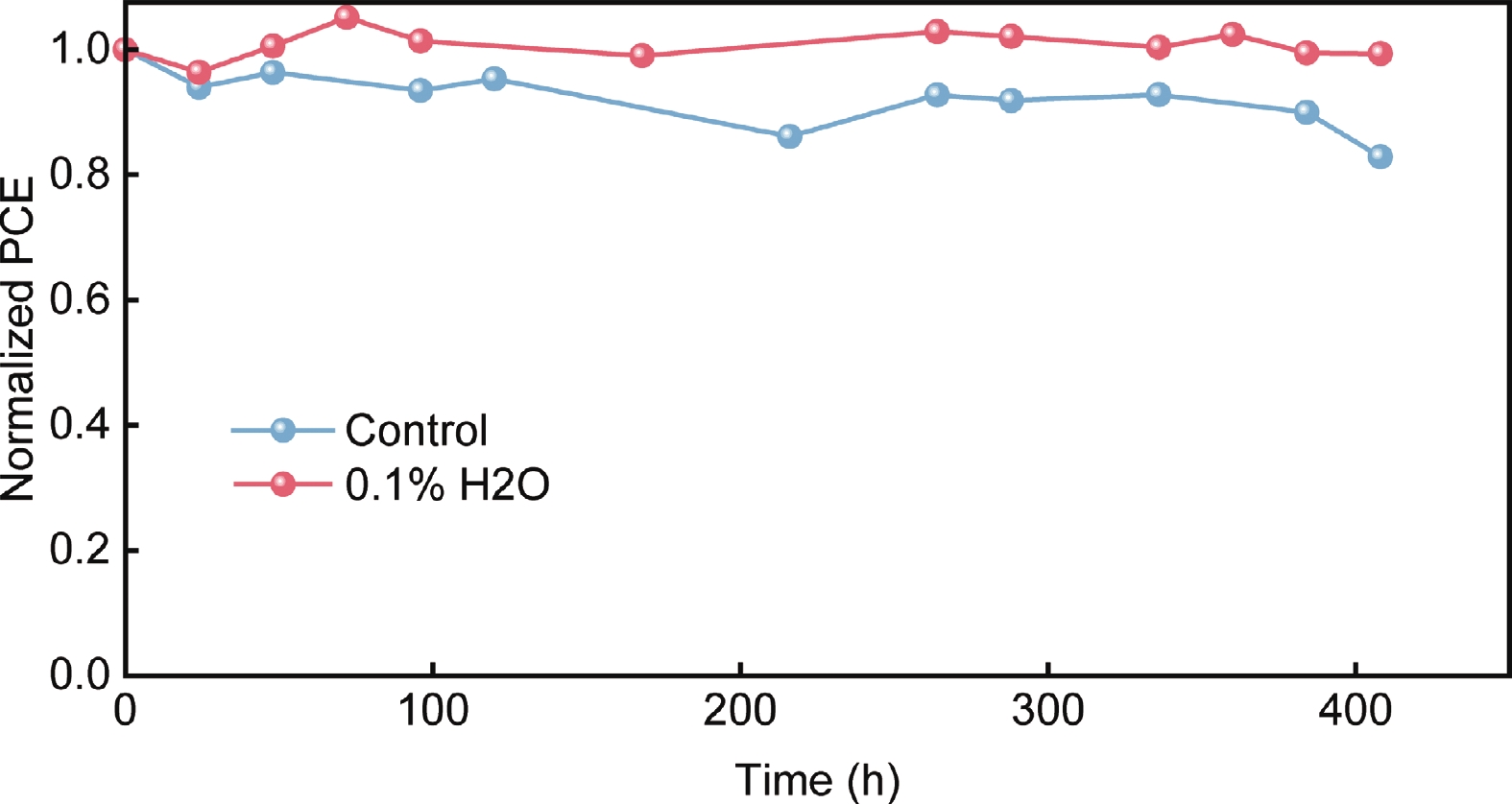
Table 1. Detailed photovoltaic performance of the champion devices.
| Sample | VOC (V) | JSC (mA/cm2) | FF (%) | PCE (%) |
| 0.1% H2O | 1.350 | 11.25 | 75.32 | 11.44 |
| Control | 1.344 | 10.05 | 73.21 | 9.88 |
 DownLoad: CSV
| [1] |
Kojima A, Teshima K, Shirai Y, et al. Organometal halide perovskites as visible-light sensitizers for photovoltaic cells. J Am Chem Soc, 2009, 131(17): 6050 doi: 10.1021/ja809598r
|
| [2] |
Jia L B, Xia S M, Li J, et al. Efficient perovskite/silicon tandem with asymmetric self-assembly molecule. Nature, 2025, 644(8078): 912 doi: 10.1038/s41586-025-09333-z
|
| [3] |
Shi Y T, Zhang Y X, Guo H Q, et al. Tunable molecular dipole moments and orientations for efficient and stable perovskite solar cells. Joule, 2025, 9(8): 102009 doi: 10.1016/j.joule.2025.102009
|
| [4] |
Hui W, Chao L, Lu H, et al. Stabilizing black-phase formamidinium perovskite formation at room temperature and high humidity. Science, 2021, 371(6536): 1359 doi: 10.1126/science.abf7652
|
| [5] |
Chen S S, Dai X Z, Xu S, et al. Stabilizing perovskite-substrate interfaces for high-performance perovskite modules. Science, 2021, 373(6557): 902 doi: 10.1126/science.abi6323
|
| [6] |
Ho-Baillie A, Zhang M, Lau C F J, et al. Untapped potentials of inorganic metal halide perovskite solar cells. Joule, 2019, 3(4): 938 doi: 10.1016/j.joule.2019.02.002
|
| [7] |
Tang W J, Chen Y, Yang J C, et al. Acetone-assisted precursor engineering enables low-temperature fabrication of CsPbI2Br perovskite for efficient solar cells. J Power Sources, 2021, 482: 228965 doi: 10.1016/j.jpowsour.2020.228965
|
| [8] |
Dong T, Shen C X, Yu B Y, et al. Minimizing solvent residues in CsPbI1.5 Br1.5 perovskite films for efficient ultra-wide bandgap solar cells. Carbon Neutraliz, 2025, 4(6): e70061 doi: 10.1002/cnl2.70061
|
| [9] |
Ye Q F, Hu W Z, Wei Y X, et al. Constructing a surface multi-cationic heterojunction for CsPbI1.5 Br1.5 perovskite solar cells with efficiency beyond 14%. J Phys Chem Lett, 2023, 14(5): 1140 doi: 10.1021/acs.jpclett.2c03876
|
| [10] |
Stewart A W, Bouich A, Soucase B M. Enhancing the stability and crystallinity of CsPbIBr2 through antisolvent engineering. J Mater Sci, 2021, 56(36): 20071 doi: 10.1007/s10853-021-06552-3
|
| [11] |
Wang Q, Xu Y Y, Zhang L, et al. Guanidinium thiocyanate additive engineering for high-performance CsPbIBr2 solar cells with an efficiency of 10.90%. ACS Appl Energy Mater, 2022, 5(3): 3110 doi: 10.1021/acsaem.1c03733
|
| [12] |
Chandrakar N, Kumar M, Singh D P. Hydrophobic PEACl additive for low-temperature processed all-inorganic CsPbIBr2 perovskite solar cells. Mater Lett, 2026, 408: 140113 doi: 10.1016/j.matlet.2026.140113
|
| [13] |
Zhu W D, Zhang Q N, Chen D Z, et al. Intermolecular exchange boosts efficiency of air-stable, carbon-based all-inorganic planar CsPbIBr2 perovskite solar cells to over 9%. Adv Energy Mater, 2018, 8(30): 1802080 doi: 10.1002/aenm.201802080
|
| [14] |
Ullah S, Khan F, Rasheed J F. Prospects for commercialization of CsPbIBr2-based all-inorganic perovskite solar cells: Fabrication, stability, and engineering strategies. Adv Funct Mater, 2025, 35(36): 2503508 doi: 10.1002/adfm.202503508
|
| [15] |
Chang Q Y, An Y D, Cao H M, et al. Precursor engineering enables high-performance all-inorganic CsPbIBr2 perovskite solar cells with a record efficiency approaching 13%. J Energy Chem, 2024, 90: 16 doi: 10.1016/j.jechem.2023.10.021
|
| [16] |
Zhang W, Xiong J, Li J, et al. Seed-assisted growth for low-temperature-processed all-inorganic CsPbIBr2 solar cells with efficiency over 10. Small, 2020, 16(24): e2001535 doi: 10.1002/smll.202001535
|
| [17] |
Qi Z T, Li J B, Zhang X Y, et al. Healing the buried interface by a plant-derived green passivator for carbon-based CsPbIBr2 perovskite solar cells. ACS Appl Mater Interfaces, 2024, 16(12): 14974 doi: 10.1021/acsami.4c01876
|
| [18] |
Jin X D, Li Z Y, Wang S, et al. Water-influenced perovskite materials: Crystal transition, stability regulation, and applications. Adv Opt Mater, 2025, 13(30): e01785 doi: 10.1002/adom.202501785
|
| [19] |
Zhu Z, Hadjiev V G, Rong Y G, et al. Interaction of organic cation with water molecule in perovskite MAPbI3: From dynamic orientational disorder to hydrogen bonding. Chem Mater, 2016, 28(20): 7385 doi: 10.1021/acs.chemmater.6b02883
|
| [20] |
Ling L, Yuan S J, Wang P F, et al. Precisely controlled hydration water for performance improvement of organic–inorganic perovskite solar cells. Adv Funct Mater, 2016, 26(28): 5028 doi: 10.1002/adfm.201601557
|
| [21] |
Lou S Q, Zhou Z, Xuan T T, et al. Chemical transformation of lead halide perovskite into insoluble, less cytotoxic, and brightly luminescent CsPbBr3/CsPb2Br5 composite nanocrystals for cell imaging. ACS Appl Mater Interfaces, 2019, 11(27): 24241 doi: 10.1021/acsami.9b05484
|
| [22] |
Tang X B, Kothalawala N L, Zhang Y L, et al. Water-driven CsPbBr3 nanocrystals and poly(methyl methacrylate)-CsPbBr3 nanocrystal films with bending-endurable photoluminescence. Chem Eng J, 2021, 425: 131456 doi: 10.1016/j.cej.2021.131456
|
| [23] |
Yu X Y, Wu L Z, Yang D, et al. Hydrochromic CsPbBr3 nanocrystals for anti-counterfeiting. Angew Chem, 2020, 132(34): 14635 doi: 10.1002/ange.202005120
|
| [24] |
Zhang C L, Duan J L, Liu N M, et al. Concurrent nucleation of mixed-halide perovskite phase via balancing solvent-PbX 2 interaction for efficient solar cells in air. Angew Chem, 2026, 138(19): e5296449
|





Article views: 10 Times PDF downloads: 0 Times Cited by: 0 Times
Received: 13 August 2026 Revised: 21 October 2026 Online: Accepted Manuscript: 23 November 2026
| Citation: |
Wendong Zhao, Tao Dong, Hongji Song, Chenyuan Ding, Licheng Mao, Yingge Xing, Hengkang Zhang, Feng Ye, Qiufeng Ye, Zebo Fang. Water-assisted antisolvent engineering for regulating crystallization kinetics and improving performance of CsPbIBr2 perovskite solar cells[J]. Journal of Semiconductors, 2026, In Press. doi: 10.1088/1674-4926/26080010
****
W D Zhao, T Dong, H J Song, C Y Ding, L C Mao, Y G Xing, H K Zhang, F Ye, Q F Ye, and Z B Fang, Water-assisted antisolvent engineering for regulating crystallization kinetics and improving performance of CsPbIBr2 perovskite solar cells[J]. J. Semicond., 2026, accepted doi: 10.1088/1674-4926/26080010

|
 Wendong Zhao got his bachelor’s degree in 2025 from Shaoxing University. Currently, he is a master student in School of Mathematics Information of Shaoxing University under the supervision of the Associate Professor Qiufeng Ye. His research focuses on perovskite solar cells
 Qiufeng Ye received his PhD degree from University of Chinese Academy of Sciences (2021). He is currently a Associate Professor of Shaoxing University. His research is mainly focused on perovskite materials and their applications in photovoltaic
| [1] |
Kojima A, Teshima K, Shirai Y, et al. Organometal halide perovskites as visible-light sensitizers for photovoltaic cells. J Am Chem Soc, 2009, 131(17): 6050 doi: 10.1021/ja809598r
|
| [2] |
Jia L B, Xia S M, Li J, et al. Efficient perovskite/silicon tandem with asymmetric self-assembly molecule. Nature, 2025, 644(8078): 912 doi: 10.1038/s41586-025-09333-z
|
| [3] |
Shi Y T, Zhang Y X, Guo H Q, et al. Tunable molecular dipole moments and orientations for efficient and stable perovskite solar cells. Joule, 2025, 9(8): 102009 doi: 10.1016/j.joule.2025.102009
|
| [4] |
Hui W, Chao L, Lu H, et al. Stabilizing black-phase formamidinium perovskite formation at room temperature and high humidity. Science, 2021, 371(6536): 1359 doi: 10.1126/science.abf7652
|
| [5] |
Chen S S, Dai X Z, Xu S, et al. Stabilizing perovskite-substrate interfaces for high-performance perovskite modules. Science, 2021, 373(6557): 902 doi: 10.1126/science.abi6323
|
| [6] |
Ho-Baillie A, Zhang M, Lau C F J, et al. Untapped potentials of inorganic metal halide perovskite solar cells. Joule, 2019, 3(4): 938 doi: 10.1016/j.joule.2019.02.002
|
| [7] |
Tang W J, Chen Y, Yang J C, et al. Acetone-assisted precursor engineering enables low-temperature fabrication of CsPbI2Br perovskite for efficient solar cells. J Power Sources, 2021, 482: 228965 doi: 10.1016/j.jpowsour.2020.228965
|
| [8] |
Dong T, Shen C X, Yu B Y, et al. Minimizing solvent residues in CsPbI1.5 Br1.5 perovskite films for efficient ultra-wide bandgap solar cells. Carbon Neutraliz, 2025, 4(6): e70061 doi: 10.1002/cnl2.70061
|
| [9] |
Ye Q F, Hu W Z, Wei Y X, et al. Constructing a surface multi-cationic heterojunction for CsPbI1.5 Br1.5 perovskite solar cells with efficiency beyond 14%. J Phys Chem Lett, 2023, 14(5): 1140 doi: 10.1021/acs.jpclett.2c03876
|
| [10] |
Stewart A W, Bouich A, Soucase B M. Enhancing the stability and crystallinity of CsPbIBr2 through antisolvent engineering. J Mater Sci, 2021, 56(36): 20071 doi: 10.1007/s10853-021-06552-3
|
| [11] |
Wang Q, Xu Y Y, Zhang L, et al. Guanidinium thiocyanate additive engineering for high-performance CsPbIBr2 solar cells with an efficiency of 10.90%. ACS Appl Energy Mater, 2022, 5(3): 3110 doi: 10.1021/acsaem.1c03733
|
| [12] |
Chandrakar N, Kumar M, Singh D P. Hydrophobic PEACl additive for low-temperature processed all-inorganic CsPbIBr2 perovskite solar cells. Mater Lett, 2026, 408: 140113 doi: 10.1016/j.matlet.2026.140113
|
| [13] |
Zhu W D, Zhang Q N, Chen D Z, et al. Intermolecular exchange boosts efficiency of air-stable, carbon-based all-inorganic planar CsPbIBr2 perovskite solar cells to over 9%. Adv Energy Mater, 2018, 8(30): 1802080 doi: 10.1002/aenm.201802080
|
| [14] |
Ullah S, Khan F, Rasheed J F. Prospects for commercialization of CsPbIBr2-based all-inorganic perovskite solar cells: Fabrication, stability, and engineering strategies. Adv Funct Mater, 2025, 35(36): 2503508 doi: 10.1002/adfm.202503508
|
| [15] |
Chang Q Y, An Y D, Cao H M, et al. Precursor engineering enables high-performance all-inorganic CsPbIBr2 perovskite solar cells with a record efficiency approaching 13%. J Energy Chem, 2024, 90: 16 doi: 10.1016/j.jechem.2023.10.021
|
| [16] |
Zhang W, Xiong J, Li J, et al. Seed-assisted growth for low-temperature-processed all-inorganic CsPbIBr2 solar cells with efficiency over 10. Small, 2020, 16(24): e2001535 doi: 10.1002/smll.202001535
|
| [17] |
Qi Z T, Li J B, Zhang X Y, et al. Healing the buried interface by a plant-derived green passivator for carbon-based CsPbIBr2 perovskite solar cells. ACS Appl Mater Interfaces, 2024, 16(12): 14974 doi: 10.1021/acsami.4c01876
|
| [18] |
Jin X D, Li Z Y, Wang S, et al. Water-influenced perovskite materials: Crystal transition, stability regulation, and applications. Adv Opt Mater, 2025, 13(30): e01785 doi: 10.1002/adom.202501785
|
| [19] |
Zhu Z, Hadjiev V G, Rong Y G, et al. Interaction of organic cation with water molecule in perovskite MAPbI3: From dynamic orientational disorder to hydrogen bonding. Chem Mater, 2016, 28(20): 7385 doi: 10.1021/acs.chemmater.6b02883
|
| [20] |
Ling L, Yuan S J, Wang P F, et al. Precisely controlled hydration water for performance improvement of organic–inorganic perovskite solar cells. Adv Funct Mater, 2016, 26(28): 5028 doi: 10.1002/adfm.201601557
|
| [21] |
Lou S Q, Zhou Z, Xuan T T, et al. Chemical transformation of lead halide perovskite into insoluble, less cytotoxic, and brightly luminescent CsPbBr3/CsPb2Br5 composite nanocrystals for cell imaging. ACS Appl Mater Interfaces, 2019, 11(27): 24241 doi: 10.1021/acsami.9b05484
|
| [22] |
Tang X B, Kothalawala N L, Zhang Y L, et al. Water-driven CsPbBr3 nanocrystals and poly(methyl methacrylate)-CsPbBr3 nanocrystal films with bending-endurable photoluminescence. Chem Eng J, 2021, 425: 131456 doi: 10.1016/j.cej.2021.131456
|
| [23] |
Yu X Y, Wu L Z, Yang D, et al. Hydrochromic CsPbBr3 nanocrystals for anti-counterfeiting. Angew Chem, 2020, 132(34): 14635 doi: 10.1002/ange.202005120
|
| [24] |
Zhang C L, Duan J L, Liu N M, et al. Concurrent nucleation of mixed-halide perovskite phase via balancing solvent-PbX 2 interaction for efficient solar cells in air. Angew Chem, 2026, 138(19): e5296449
|

 WeChat ID
Journal of Semiconductors © 2017 All Rights Reserved 京ICP备05085259号-2