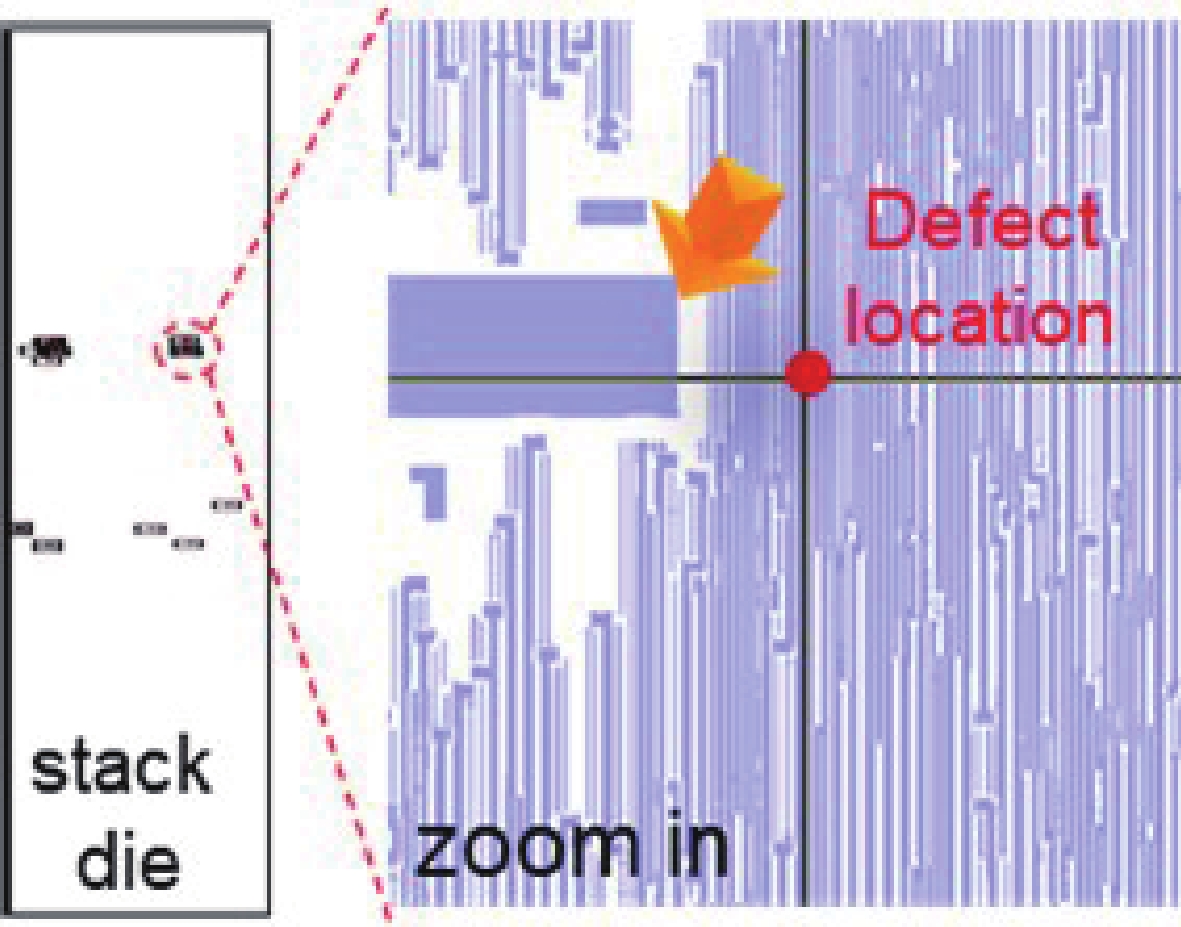


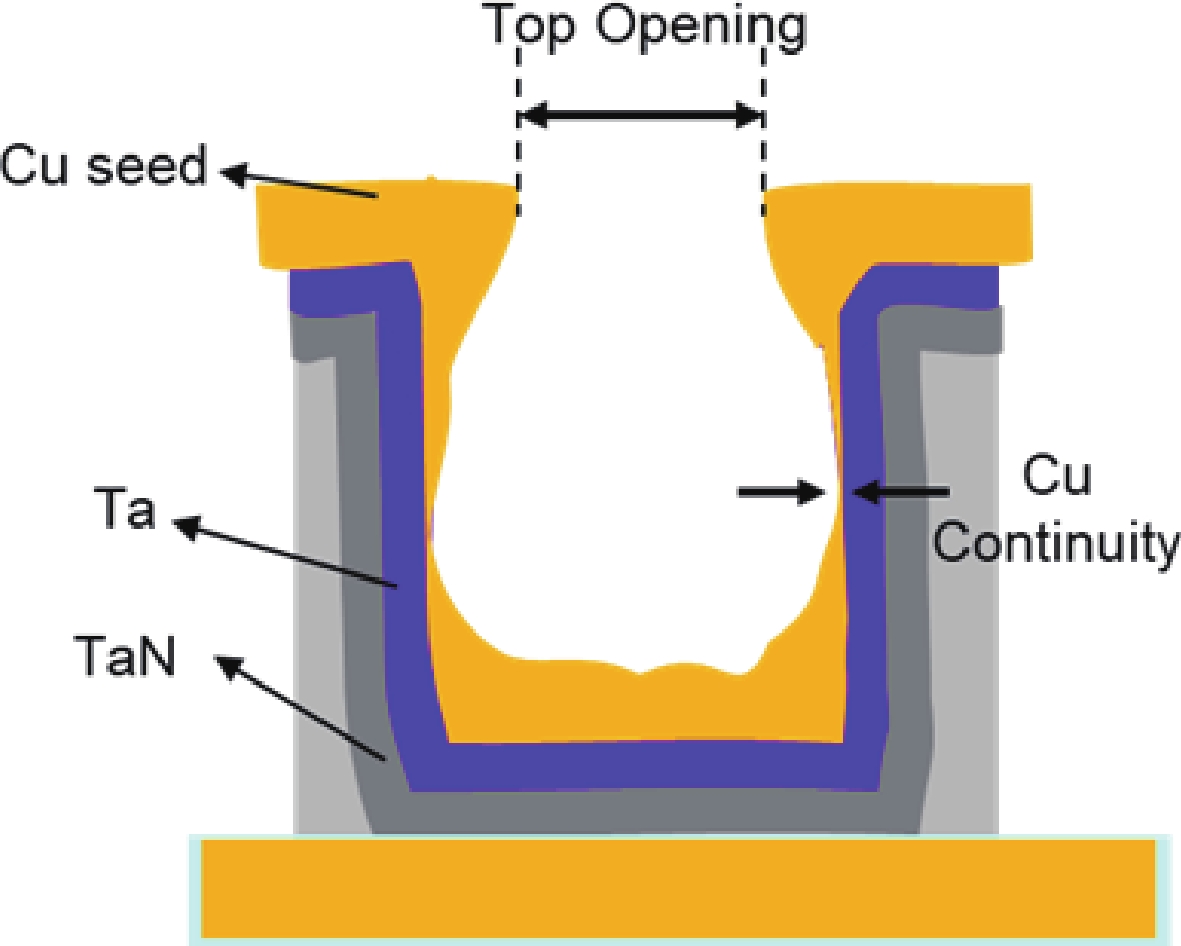
Fig. 1.
(Color online) Failure mode of gap filling.
ARTICLES
Yu Zhang and Zhaoqin Zeng
Corresponding author: Zhaoqin Zeng, zengzhaoqin@hlmc.cn
Abstract: The downscaling of logic devices has posed numerous engineering and manufacturing challenges in copper (Cu) interconnections. The primary failure modes of Cu filling defects are narrow top openings and discontinuous Cu seeds on sidewalls. This study investigates the influence and mechanism of layout on Cu filling defects. Dense line wires with uneven local layouts are prone to defects, which is attributed to the altered distribution of additives in electrochemical plating (ECP), leading to differences in bottom-up filling behavior. It is demonstrated that large-sized metal conductor regions adjacent to dense line wires adsorb substantial amounts of suppressor, resulting in sparse current density in these areas. Given the fixed total local current density, the sparseness of current density in adjacent regions inevitably diverts more current lines to the dense line wire areas. The excessive current density exceeds the local redistribution capacity of additives, causing premature sealing of trench tops and the formation of void defects. A low-current plating process significantly mitigates these defects but may compromise the protective capability of the Cu seed. Additionally, the perimeter density of the layout serves as an effective evaluation index.
Key words: damascene copper process, electrochemical plating, additive, layout, plating current, gap filling, defect
| [1] |
Zeng Z Q, Yu B, Cao Y P, et al. BEOL Cu gap-fill performance improvement for 14nm technology node. 2020 China Semiconductor Technology International Conference (CSTIC), 2020: 1
|
| [2] |
Zhang Y, Zeng Z Q. The challenges and solutions of Damascus copper process. 2025 Conference of Science and Technology of Integrated Circuits (CSTIC), 2025: 1
|
| [3] |
Sinha S, Luo J F, Chiang C. Model based layout pattern dependent metal filling algorithm for improved chip surface uniformity in the copper process. 2007 Asia and South Pacific Design Automation Conference, 2007: 1
|
| [4] |
Fang J X, Mao Z B, Zhang Y, et al. Modeling of Cu-CMP and its application for hotspot prediction. ECS J Solid State Sci Technol, 2014, 3(5): 126 doi: 10.1149/2.014405jss
|
| [5] |
Moffat T P, Wheeler D, Josell D, et al. Superconformal deposition and the CEAC mechanism. ECS Transactions, 2008, 13(2): 129
|
| [6] |
Vereecken P M, Binstead R A, Deligianni H, et al. The chemistry of additives in damascene copper plating. IBM J Res Dev, 2005, 49(1): 3 doi: 10.1147/rd.491.0003
|
| [7] |
Wang D F, Miao X Y, Ling H Q, et al. Competitive adsorption between suppressor and accelerator in copper methanesulfonic acid bath for electrodeposition. 2017 18th International Conference on Electronic Packaging Technology (ICEPT), 2017: 76
|


| [1] |
Zeng Z Q, Yu B, Cao Y P, et al. BEOL Cu gap-fill performance improvement for 14nm technology node. 2020 China Semiconductor Technology International Conference (CSTIC), 2020: 1
|
| [2] |
Zhang Y, Zeng Z Q. The challenges and solutions of Damascus copper process. 2025 Conference of Science and Technology of Integrated Circuits (CSTIC), 2025: 1
|
| [3] |
Sinha S, Luo J F, Chiang C. Model based layout pattern dependent metal filling algorithm for improved chip surface uniformity in the copper process. 2007 Asia and South Pacific Design Automation Conference, 2007: 1
|
| [4] |
Fang J X, Mao Z B, Zhang Y, et al. Modeling of Cu-CMP and its application for hotspot prediction. ECS J Solid State Sci Technol, 2014, 3(5): 126 doi: 10.1149/2.014405jss
|
| [5] |
Moffat T P, Wheeler D, Josell D, et al. Superconformal deposition and the CEAC mechanism. ECS Transactions, 2008, 13(2): 129
|
| [6] |
Vereecken P M, Binstead R A, Deligianni H, et al. The chemistry of additives in damascene copper plating. IBM J Res Dev, 2005, 49(1): 3 doi: 10.1147/rd.491.0003
|
| [7] |
Wang D F, Miao X Y, Ling H Q, et al. Competitive adsorption between suppressor and accelerator in copper methanesulfonic acid bath for electrodeposition. 2017 18th International Conference on Electronic Packaging Technology (ICEPT), 2017: 76
|





Article views: 36 Times PDF downloads: 16 Times Cited by: 0 Times
Received: 11 August 2025 Revised: 09 December 2025 Online: Accepted Manuscript: 06 January 2026Uncorrected proof: 07 January 2026
| Citation: |
Yu Zhang, Zhaoqin Zeng. The improvement of layout dependent Cu filling defect[J]. Journal of Semiconductors, 2026, In Press. doi: 10.1088/1674-4926/25070037
****
Y Zhang and Z Q Zeng, The improvement of layout dependent Cu filling defect[J]. J. Semicond., 2026, accepted doi: 10.1088/1674-4926/25070037

|
 Yu Zhang obtained his Bachelor of Science (BS) from East China Normal University in 2000. He then received his Master’s degree from Fudan University in 2006 and his PhD from the same university in 2024. He has successively worked at Huahong NEC, UMC and HLMC. Currently, he serves as the Vice President of the Advanced Module TD at HLMC
 Zhaoqin Zeng received his Master’s degree from Shanghai University in 2008. He then successively joined SMIC, UMC, and HLMC. He has 17 years of experience in the mass production and R & D of semiconductors. Currently, he serves as the Manager of the TF Department under the Advanced Module TD Division at HLMC
| [1] |
Zeng Z Q, Yu B, Cao Y P, et al. BEOL Cu gap-fill performance improvement for 14nm technology node. 2020 China Semiconductor Technology International Conference (CSTIC), 2020: 1
|
| [2] |
Zhang Y, Zeng Z Q. The challenges and solutions of Damascus copper process. 2025 Conference of Science and Technology of Integrated Circuits (CSTIC), 2025: 1
|
| [3] |
Sinha S, Luo J F, Chiang C. Model based layout pattern dependent metal filling algorithm for improved chip surface uniformity in the copper process. 2007 Asia and South Pacific Design Automation Conference, 2007: 1
|
| [4] |
Fang J X, Mao Z B, Zhang Y, et al. Modeling of Cu-CMP and its application for hotspot prediction. ECS J Solid State Sci Technol, 2014, 3(5): 126 doi: 10.1149/2.014405jss
|
| [5] |
Moffat T P, Wheeler D, Josell D, et al. Superconformal deposition and the CEAC mechanism. ECS Transactions, 2008, 13(2): 129
|
| [6] |
Vereecken P M, Binstead R A, Deligianni H, et al. The chemistry of additives in damascene copper plating. IBM J Res Dev, 2005, 49(1): 3 doi: 10.1147/rd.491.0003
|
| [7] |
Wang D F, Miao X Y, Ling H Q, et al. Competitive adsorption between suppressor and accelerator in copper methanesulfonic acid bath for electrodeposition. 2017 18th International Conference on Electronic Packaging Technology (ICEPT), 2017: 76
|

 WeChat ID
Journal of Semiconductors © 2017 All Rights Reserved 京ICP备05085259号-2

 DownLoad: