


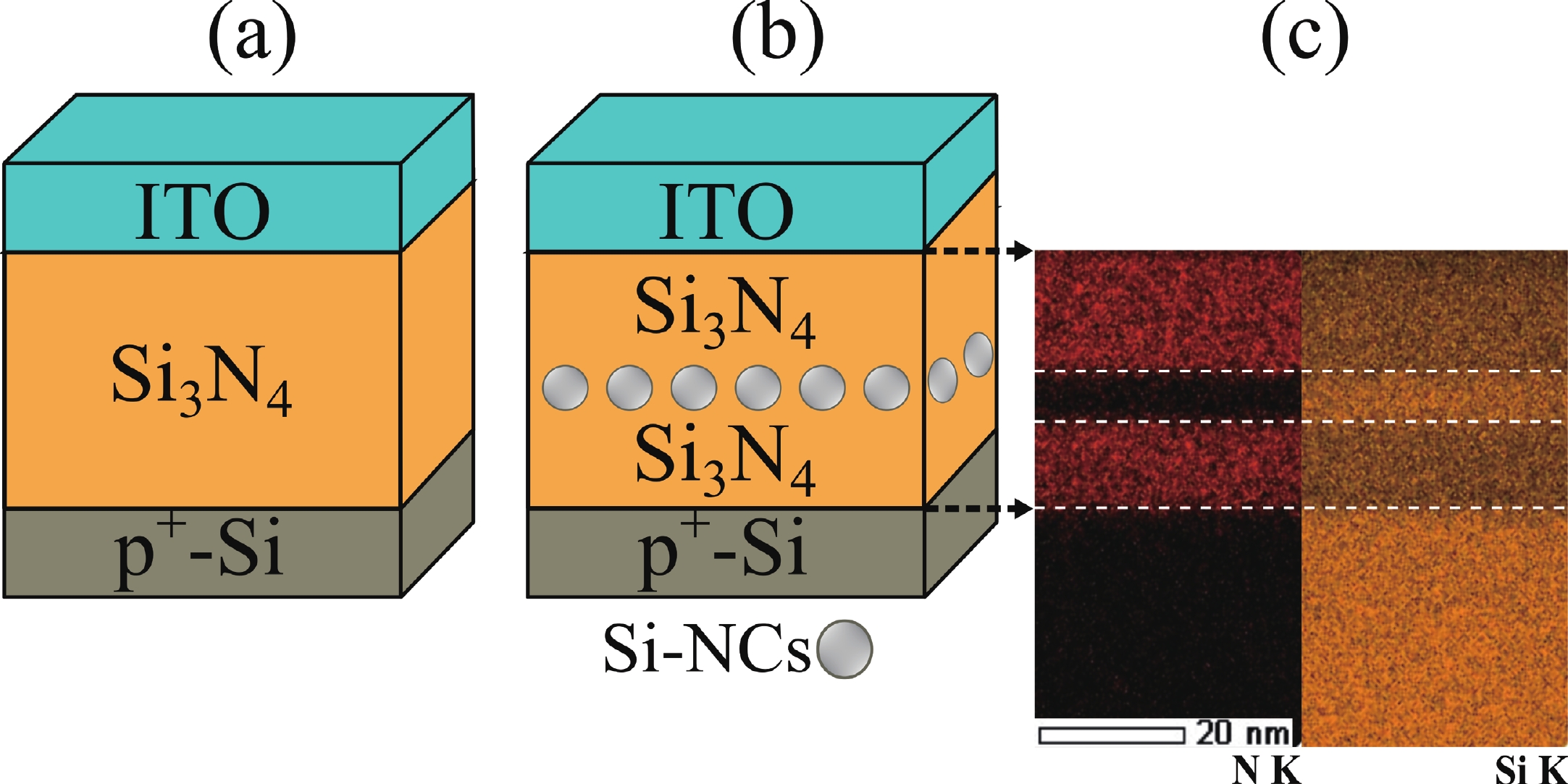
Fig. 1.
(Color online) Schematic representation of (a) Si3N4-based RS device, (b) Si3N4:Si-NCs-based RS device, and (c) EDS elemental mapping of the device shown in (b).
ARTICLES
Arely Vázquez Jiménez1, Mario Moreno Moreno1, Liliana Palacios Huerta2, Pedro Rosales Quintero1 and Alfredo Morales Sánchez1,
Corresponding author: Alfredo Morales Sánchez, alfredom@inaoep.mx
Abstract: This work focuses on the study of the resistive switching (RS) properties of metal−insulator−semiconductor (MIS)-like structures based on silicon nitride (Si3N4) and Si3N4 with embedded silicon nanocrystals (Si-NCs) as the switching layer for the development of memristor devices. The formation of Si-NCs in the Si3N4 matrix, along with its chemical composition, was confirmed by Raman, transmission electron microscope (TEM), and energy-dispersive X-ray spectroscopy (EDS) analyses. The introduction of Si-NCs within the Si3N4 improved the performance of the devices. For Si3N4-based memristor devices, SET and RESET voltages of 2.38 and −1.38 V were obtained, respectively, while these values were reduced to 0.36 V (SET) and −0.11 V (RESET) for Si3N4:Si-NCs-based RS devices. Both RS devices exhibit at least 180 RS cycles, but with an increased ON/OFF ratio from 103 (Si3N4) to 106 when Si-NCs are embedded. The retention time analysis shows that the low resistance state (LRS) and the high resistance state (HRS) are stable for up to 104 s. The analysis of the conduction mechanism indicates that HRS is driven by the space-charge-limited conduction (SCLC), and the LRS by an Ohmic conduction mechanism. A model of the RS mechanism was proposed to understand the role of Si-NCs in the dielectric matrix.
Key words: resistive switching, silicon nanocrystals, silicon nitride, memristor
| [1] |
Zhu C X, Xu Z G, Huo Z L, et al. Investigation on interface related charge trap and loss characteristics of high-k based trapping structures by electrostatic force microscopy. Appl Phys Lett, 2011, 99(22): 223504 doi: 10.1063/1.3664222
|
| [2] |
Pirovano A, Schuegraf K. Memory grows up. Nature Nanotech, 2010, 5(3): 177 doi: 10.1038/nnano.2010.36
|
| [3] |
Chua L. Memristor-the missing circuit element. IEEE Trans Circuit Theory, 1971, 18(5): 507 doi: 10.1109/TCT.1971.1083337
|
| [4] |
Waser R, Dittmann R, Staikov G, et al. Redox-based resistive switching memories–nanoionic mechanisms, prospects, and challenges. Adv Mater, 2009, 21(25/26): 2632
|
| [5] |
Waser R, Aono M. Nanoionics-based resistive switching memories. Nature Mater, 2007, 6(11): 833 doi: 10.1038/nmat2023
|
| [6] |
Pan F, Gao S, Chen C, et al. Recent progress in resistive random access memories: Materials, switching mechanisms, and performance. Mater Sci Eng R Rep, 2014, 83: 1 doi: 10.1016/j.mser.2014.06.002
|
| [7] |
Ielmini D, Bruchhaus R, Waser R. Thermochemical resistive switching: Materials, mechanisms, and scaling projections. Phase Transitions, 2011, 84(7): 570 doi: 10.1080/01411594.2011.561478
|
| [8] |
Wang T Y, Meng J L, Zhou X F, et al. Reconfigurable neuromorphic memristor network for ultralow-power smart textile electronics. Nat Commun, 2022, 13: 7432 doi: 10.1038/s41467-022-35160-1
|
| [9] |
Zhang J H, Zhu Z Q, Meng J L, et al. Fiber memristor-based physical reservoir computing for multimodal sleep monitoring. Research, 2025, 8: 870 doi: 10.34133/research.0870
|
| [10] |
Wang Z, Zhang J H, Zhang Z Y, et al. Near-sensor neuromorphic computing system based on a thermopile infrared detector and a memristor for encrypted visual information transmission. Nano Lett, 2025, 25(19): 8049 doi: 10.1021/acs.nanolett.5c01843
|
| [11] |
Sun B, Zhang J H, Song J R, et al. CMOS compatible multi-state memristor for neuromorphic hardware encryption with low operation voltage. InfoMat, 2025, 7(11): e70044
|
| [12] |
Liu C Y, Tseng T Y. Resistance switching properties of Sol–gel derived SrZrO3 based memory thin films. J Phys D: Appl Phys, 2007, 40(7): 2157
|
| [13] |
Chang W Y, Liao J H, Lo Y S, et al. Resistive switching characteristics in Pr0.7Ca0. 3MnO3 thin films on LaNiO3-electrodized Si substrate. Appl Phys Lett, 2009, 94(17): 172107
|
| [14] |
Seo S, Lee M J, Seo D H, et al. Reproducible resistance switching in polycrystalline NiO films. Appl Phys Lett, 2004, 85(23): 5655 doi: 10.1063/1.1831560
|
| [15] |
Sim H, Choi D, Lee D, et al. Resistance-switching characteristics of polycrystalline Nb2O5for nonvolatile memory application. IEEE Electron Device Lett, 2005, 26(5): 292
|
| [16] |
Xu N, Liu L F, Sun X, et al. Bipolar switching behavior in TiN/ZnO/Pt resistive nonvolatile memory with fast switching and long retention. Semicond Sci Technol, 2008, 23(7): 075019 doi: 10.1088/0268-1242/23/7/075019
|
| [17] |
Germán-Martínez J M, González-Flores K E, Palacios-Márquez B, et al. Analysis of oxide capacitance changes based on the formation–annihilation of conductive filaments in a SiO2/Si-NCs/SiO2 stack layer-based MIS-like capacitor. J Compos Sci, 2024, 8(12): 487 doi: 10.3390/jcs8120487
|
| [18] |
Choi Y J, Kim M H, Bang S, et al. Insertion of Ag layer in TiN/SiNx/TiN RRAM and its effect on filament formation modeled by Monte Carlo simulation. IEEE Access, 2020, 8: 228720
|
| [19] |
Nasyrov K A, Gritsenko V A. Transport mechanisms of electrons and holes in dielectric films. Physics-Uspekhi, 2013, 56(10): 999 doi: 10.3367/UFNe.0183.201310h.1099
|
| [20] |
Kim H D, An H M, Kim T G. Improved reliability of Au/Si3N4/Ti resistive switching memory cells due to a hydrogen postannealing treatment. J Appl Phys, 2011, 109: 016105 doi: 10.1063/1.3525991
|
| [21] |
Kim S, Park B G. Power- and low-resistance-state-dependent, bipolar reset-switching transitions in SiN-based resistive random-access memory. Nanoscale Res Lett, 2016, 11(1): 360 doi: 10.1186/s11671-016-1572-9
|
| [22] |
Kwon D E, Kim Y, Kim H J, et al. Bipolar resistive switching property of Si3N4−x thin films depending on N deficiency. J Mater Chem C, 2020, 8(5): 1755
|
| [23] |
Orlov O M, Gismatulin A A, Gritsenko V A, et al. Charge transport mechanism in a formless memristor based on silicon nitride. Russ Microelectron, 2020, 49(5): 372 doi: 10.1134/S1063739720050078
|
| [24] |
Li D K, Xu J, Zhang P, et al. Doping effect in Si nanocrystals. J Phys D: Appl Phys, 2018, 51(23): 233002 doi: 10.1088/1361-6463/aac1fe
|
| [25] |
Smith J E, Brodsky M H, Crowder B L, et al. Raman spectra of amorphous Si and related tetrahedrally bonded semiconductors. Phys Rev Lett, 1971, 26(11): 642 doi: 10.1103/PhysRevLett.26.642
|
| [26] |
Ding W C, Hu D, Zheng J, et al. Strong visible and infrared photoluminescence from Er-implanted silicon nitride films. J Phys D: Appl Phys, 2008, 41(13): 135101 doi: 10.1088/0022-3727/41/13/135101
|
| [27] |
Liu R, Canonico M. Applications of UV-raman spectroscopy to microelectronic materials and devices. AIP Conference Proc, 2003, 683(1): 738 doi: 10.1063/1.1622552
|
| [28] |
Shrestha K, Whitfield D, Lopes V C, et al. Electrical conductivity and structural order of p-type amorphous silicon thin films. MRS Online Proc Libr, 2014, 1757(1): 1 doi: 10.1557/opl.2014.962
|
| [29] |
Acosta-Enriquez E, Acosta-Enriquez M, Ortega R, et al. Nanostructured fibers of A-Si3N4 deposited by HYSY-CVD. Digest J of Nanomat and Biostruct, 2016, 11: 601
|
| [30] |
Richter H, Wang Z P, Ley L. The one phonon Raman spectrum in microcrystalline silicon. Solid State Commun, 1981, 39(5): 625 doi: 10.1016/0038-1098(81)90337-9
|
| [31] |
Yadav A, Agarwal P, Biswas R. Size control of Si nanocrystal with visible Photoluminescence in a-Si: H/nc-Si multilayer structures. 2020 47th IEEE Photovoltaic Specialists Conference (PVSC), 2020: 786
|
| [32] |
Doğan İ, van de Sanden M C M. Direct characterization of nanocrystal size distribution using Raman spectroscopy. J Appl Phys, 2013, 114(13): 134310 doi: 10.1063/1.4824178
|
| [33] |
Maslova N E, Antonovsky A A, Zhigunov D M, et al. Raman studies of silicon nanocrystals embedded in silicon suboxide layers. Semiconductors, 2010, 44(8): 1040 doi: 10.1134/S1063782610080154
|
| [34] |
Ma D H, Zhang W J, Luo R Y, et al. Effects of nitrogen impurities on the microstructure and electronic properties of P-doped Si nanocrystals emebedded in silicon-rich SiNx films. Superlattices Microstruct, 2016, 93: 269 doi: 10.1016/j.spmi.2016.03.009
|
| [35] |
Bolduc M, Genard G, Yedji M, et al. Influence of nitrogen on the growth and luminescence of silicon nanocrystals embedded in silica. J Appl Phys, 2009, 105: 013108 doi: 10.1063/1.3054561
|
| [36] |
Ficcadenti M, Pinto N, Morresi L, et al. Si nanocrystals embedded in a silicon oxynitride matrix. Nanomater Nanotechnol, 2011, 1: 12 doi: 10.5772/50954
|
| [37] |
Benyahia B, Tiour F, Guerbous L, et al. Evolution of optical and structural properties of silicon nanocrystals embedded in silicon nitride films with annealing temperature. JNanoR, 2017, 49: 163 doi: 10.4028/www.scientific.net/JNanoR.49.163
|
| [38] |
Yen T J, Chin A, Gritsenko V. High performance all nonmetal SiNx resistive random access memory with strong process dependence. Sci Rep, 2020, 10: 2807 doi: 10.1038/s41598-020-59838-y
|
| [39] |
Jena A K, Sahu M C, Sahoo S, et al. Multilevel resistive switching in graphene oxide-multiferroic thin-film-based bilayer RRAM device by interfacial oxygen vacancy engineering. Appl Phys A, 2022, 128(3): 213 doi: 10.1007/s00339-021-05243-9
|
| [40] |
Chakrabarti S, Samanta S, Maikap S, et al. Temperature-dependent non-linear resistive switching characteristics and mechanism using a new W/WO3/WOx/W structure. Nanoscale Res Lett, 2016, 11(1): 389 doi: 10.1186/s11671-016-1602-7
|
| [41] |
Ismail M, Huang C Y, Panda D, et al. Forming-free bipolar resistive switching in nonstoichiometric ceria films. Nanoscale Res Lett, 2014, 9(1): 45 doi: 10.1186/1556-276X-9-45
|
| [42] |
Xiao Z A, Yoong H Y, Cao J, et al. Controlling resistance switching performances of Hf0.5Zr0. 5O2 films by substrate stress and potential in neuromorphic computing. Adv Intell Syst, 2022, 4(8): 2100244
|
| [43] |
Chiu F C. A review on conduction mechanisms in dielectric films. Adv Mater Sci Eng, 2014, 2014: 578168
|
| [44] |
Gismatulin A A, Orlov O M, Gritsenko V A, et al. Charge transport mechanism in the metal–nitride–oxide–silicon forming-free memristor structure. Appl Phys Lett, 2020, 116(20): 203502 doi: 10.1063/5.0001950
|
| [45] |
Kim S, Jung S, Kim M H, et al. Resistive switching characteristics of silicon nitride-based RRAM depending on top electrode metals. IEICE Trans Electron, 2015, E98. C(5): 429 doi: 10.1587/transele.e98.c.429
|
| [46] |
Hong S M, Kim H D, An H M, et al. Effect of work function difference between top and bottom electrodes on the resistive switching properties of SiN films. IEEE Electron Device Lett, 2013, 34(9): 1181 doi: 10.1109/LED.2013.2272631
|
| [47] |
Gismatulin A A, Kamaev G N, Kruchinin V N, et al. Charge transport mechanism in the forming-free memristor based on silicon nitride. Sci Rep, 2021, 11(1): 2417 doi: 10.1038/s41598-021-82159-7
|
| [48] |
Kim H D, An H M, Hong S M, et al. Unipolar resistive switching phenomena in fully transparent SiN-based memory cells. Semicond Sci Technol, 2012, 27(12): 125020 doi: 10.1088/0268-1242/27/12/125020
|
| [49] |
Kim H D, Yun M J, Kim S. Resistive switching characteristics of Al/Si3N4/p-Si MIS-based resistive switching memory devices. J Korean Phys Soc, 2016, 69(3): 435 doi: 10.3938/jkps.69.435
|
| [50] |
Habraken F H P M, Tijhaar R H G, van der Weg W F, et al. Hydrogen in low-pressure chemical-vapor-deposited silicon (oxy)nitride films. J Appl Phys, 1986, 59(2): 447 doi: 10.1063/1.336651
|
| [51] |
Vasileiadis N, Karakolis P, Mandylas P, et al. Understanding the role of defects in silicon nitride-based resistive switching memories through oxygen doping. IEEE Trans Nanotechnol, 2021, 20: 356 doi: 10.1109/tnano.2021.3072974
|
| [52] |
Ramirez-Rios J, Avilés-Bravo J J, Moreno-Moreno M, et al. Three-dimensional simulation of bipolar resistive switching memory with embedded conductive nanocrystals in an oxide matrix. Chips, 2025, 4(1): 11 doi: 10.3390/chips4010011
|


Table 1. RF sputtering deposition parameters of RS layers.
| RS layer | Target | RF power (W) | Pressure (mTorr) |
Gas flow (sccm) | Deposition time (min) | Temperature (°C) |
Thickness (nm) |
| 1 | Si3N4 | 75 | 3 | 12 | 40 | 350 | 20 |
2 |
Si3N4 | 75 | 3 | 12 | 20 | 350 | 10 |
| Si | 50 | 5 | 10 | 7 | 350 | 6 | |
| Si3N4 | 75 | 3 | 12 | 20 | 350 | 10 |
 DownLoad: CSV
| [1] |
Zhu C X, Xu Z G, Huo Z L, et al. Investigation on interface related charge trap and loss characteristics of high-k based trapping structures by electrostatic force microscopy. Appl Phys Lett, 2011, 99(22): 223504 doi: 10.1063/1.3664222
|
| [2] |
Pirovano A, Schuegraf K. Memory grows up. Nature Nanotech, 2010, 5(3): 177 doi: 10.1038/nnano.2010.36
|
| [3] |
Chua L. Memristor-the missing circuit element. IEEE Trans Circuit Theory, 1971, 18(5): 507 doi: 10.1109/TCT.1971.1083337
|
| [4] |
Waser R, Dittmann R, Staikov G, et al. Redox-based resistive switching memories–nanoionic mechanisms, prospects, and challenges. Adv Mater, 2009, 21(25/26): 2632
|
| [5] |
Waser R, Aono M. Nanoionics-based resistive switching memories. Nature Mater, 2007, 6(11): 833 doi: 10.1038/nmat2023
|
| [6] |
Pan F, Gao S, Chen C, et al. Recent progress in resistive random access memories: Materials, switching mechanisms, and performance. Mater Sci Eng R Rep, 2014, 83: 1 doi: 10.1016/j.mser.2014.06.002
|
| [7] |
Ielmini D, Bruchhaus R, Waser R. Thermochemical resistive switching: Materials, mechanisms, and scaling projections. Phase Transitions, 2011, 84(7): 570 doi: 10.1080/01411594.2011.561478
|
| [8] |
Wang T Y, Meng J L, Zhou X F, et al. Reconfigurable neuromorphic memristor network for ultralow-power smart textile electronics. Nat Commun, 2022, 13: 7432 doi: 10.1038/s41467-022-35160-1
|
| [9] |
Zhang J H, Zhu Z Q, Meng J L, et al. Fiber memristor-based physical reservoir computing for multimodal sleep monitoring. Research, 2025, 8: 870 doi: 10.34133/research.0870
|
| [10] |
Wang Z, Zhang J H, Zhang Z Y, et al. Near-sensor neuromorphic computing system based on a thermopile infrared detector and a memristor for encrypted visual information transmission. Nano Lett, 2025, 25(19): 8049 doi: 10.1021/acs.nanolett.5c01843
|
| [11] |
Sun B, Zhang J H, Song J R, et al. CMOS compatible multi-state memristor for neuromorphic hardware encryption with low operation voltage. InfoMat, 2025, 7(11): e70044
|
| [12] |
Liu C Y, Tseng T Y. Resistance switching properties of Sol–gel derived SrZrO3 based memory thin films. J Phys D: Appl Phys, 2007, 40(7): 2157
|
| [13] |
Chang W Y, Liao J H, Lo Y S, et al. Resistive switching characteristics in Pr0.7Ca0. 3MnO3 thin films on LaNiO3-electrodized Si substrate. Appl Phys Lett, 2009, 94(17): 172107
|
| [14] |
Seo S, Lee M J, Seo D H, et al. Reproducible resistance switching in polycrystalline NiO films. Appl Phys Lett, 2004, 85(23): 5655 doi: 10.1063/1.1831560
|
| [15] |
Sim H, Choi D, Lee D, et al. Resistance-switching characteristics of polycrystalline Nb2O5for nonvolatile memory application. IEEE Electron Device Lett, 2005, 26(5): 292
|
| [16] |
Xu N, Liu L F, Sun X, et al. Bipolar switching behavior in TiN/ZnO/Pt resistive nonvolatile memory with fast switching and long retention. Semicond Sci Technol, 2008, 23(7): 075019 doi: 10.1088/0268-1242/23/7/075019
|
| [17] |
Germán-Martínez J M, González-Flores K E, Palacios-Márquez B, et al. Analysis of oxide capacitance changes based on the formation–annihilation of conductive filaments in a SiO2/Si-NCs/SiO2 stack layer-based MIS-like capacitor. J Compos Sci, 2024, 8(12): 487 doi: 10.3390/jcs8120487
|
| [18] |
Choi Y J, Kim M H, Bang S, et al. Insertion of Ag layer in TiN/SiNx/TiN RRAM and its effect on filament formation modeled by Monte Carlo simulation. IEEE Access, 2020, 8: 228720
|
| [19] |
Nasyrov K A, Gritsenko V A. Transport mechanisms of electrons and holes in dielectric films. Physics-Uspekhi, 2013, 56(10): 999 doi: 10.3367/UFNe.0183.201310h.1099
|
| [20] |
Kim H D, An H M, Kim T G. Improved reliability of Au/Si3N4/Ti resistive switching memory cells due to a hydrogen postannealing treatment. J Appl Phys, 2011, 109: 016105 doi: 10.1063/1.3525991
|
| [21] |
Kim S, Park B G. Power- and low-resistance-state-dependent, bipolar reset-switching transitions in SiN-based resistive random-access memory. Nanoscale Res Lett, 2016, 11(1): 360 doi: 10.1186/s11671-016-1572-9
|
| [22] |
Kwon D E, Kim Y, Kim H J, et al. Bipolar resistive switching property of Si3N4−x thin films depending on N deficiency. J Mater Chem C, 2020, 8(5): 1755
|
| [23] |
Orlov O M, Gismatulin A A, Gritsenko V A, et al. Charge transport mechanism in a formless memristor based on silicon nitride. Russ Microelectron, 2020, 49(5): 372 doi: 10.1134/S1063739720050078
|
| [24] |
Li D K, Xu J, Zhang P, et al. Doping effect in Si nanocrystals. J Phys D: Appl Phys, 2018, 51(23): 233002 doi: 10.1088/1361-6463/aac1fe
|
| [25] |
Smith J E, Brodsky M H, Crowder B L, et al. Raman spectra of amorphous Si and related tetrahedrally bonded semiconductors. Phys Rev Lett, 1971, 26(11): 642 doi: 10.1103/PhysRevLett.26.642
|
| [26] |
Ding W C, Hu D, Zheng J, et al. Strong visible and infrared photoluminescence from Er-implanted silicon nitride films. J Phys D: Appl Phys, 2008, 41(13): 135101 doi: 10.1088/0022-3727/41/13/135101
|
| [27] |
Liu R, Canonico M. Applications of UV-raman spectroscopy to microelectronic materials and devices. AIP Conference Proc, 2003, 683(1): 738 doi: 10.1063/1.1622552
|
| [28] |
Shrestha K, Whitfield D, Lopes V C, et al. Electrical conductivity and structural order of p-type amorphous silicon thin films. MRS Online Proc Libr, 2014, 1757(1): 1 doi: 10.1557/opl.2014.962
|
| [29] |
Acosta-Enriquez E, Acosta-Enriquez M, Ortega R, et al. Nanostructured fibers of A-Si3N4 deposited by HYSY-CVD. Digest J of Nanomat and Biostruct, 2016, 11: 601
|
| [30] |
Richter H, Wang Z P, Ley L. The one phonon Raman spectrum in microcrystalline silicon. Solid State Commun, 1981, 39(5): 625 doi: 10.1016/0038-1098(81)90337-9
|
| [31] |
Yadav A, Agarwal P, Biswas R. Size control of Si nanocrystal with visible Photoluminescence in a-Si: H/nc-Si multilayer structures. 2020 47th IEEE Photovoltaic Specialists Conference (PVSC), 2020: 786
|
| [32] |
Doğan İ, van de Sanden M C M. Direct characterization of nanocrystal size distribution using Raman spectroscopy. J Appl Phys, 2013, 114(13): 134310 doi: 10.1063/1.4824178
|
| [33] |
Maslova N E, Antonovsky A A, Zhigunov D M, et al. Raman studies of silicon nanocrystals embedded in silicon suboxide layers. Semiconductors, 2010, 44(8): 1040 doi: 10.1134/S1063782610080154
|
| [34] |
Ma D H, Zhang W J, Luo R Y, et al. Effects of nitrogen impurities on the microstructure and electronic properties of P-doped Si nanocrystals emebedded in silicon-rich SiNx films. Superlattices Microstruct, 2016, 93: 269 doi: 10.1016/j.spmi.2016.03.009
|
| [35] |
Bolduc M, Genard G, Yedji M, et al. Influence of nitrogen on the growth and luminescence of silicon nanocrystals embedded in silica. J Appl Phys, 2009, 105: 013108 doi: 10.1063/1.3054561
|
| [36] |
Ficcadenti M, Pinto N, Morresi L, et al. Si nanocrystals embedded in a silicon oxynitride matrix. Nanomater Nanotechnol, 2011, 1: 12 doi: 10.5772/50954
|
| [37] |
Benyahia B, Tiour F, Guerbous L, et al. Evolution of optical and structural properties of silicon nanocrystals embedded in silicon nitride films with annealing temperature. JNanoR, 2017, 49: 163 doi: 10.4028/www.scientific.net/JNanoR.49.163
|
| [38] |
Yen T J, Chin A, Gritsenko V. High performance all nonmetal SiNx resistive random access memory with strong process dependence. Sci Rep, 2020, 10: 2807 doi: 10.1038/s41598-020-59838-y
|
| [39] |
Jena A K, Sahu M C, Sahoo S, et al. Multilevel resistive switching in graphene oxide-multiferroic thin-film-based bilayer RRAM device by interfacial oxygen vacancy engineering. Appl Phys A, 2022, 128(3): 213 doi: 10.1007/s00339-021-05243-9
|
| [40] |
Chakrabarti S, Samanta S, Maikap S, et al. Temperature-dependent non-linear resistive switching characteristics and mechanism using a new W/WO3/WOx/W structure. Nanoscale Res Lett, 2016, 11(1): 389 doi: 10.1186/s11671-016-1602-7
|
| [41] |
Ismail M, Huang C Y, Panda D, et al. Forming-free bipolar resistive switching in nonstoichiometric ceria films. Nanoscale Res Lett, 2014, 9(1): 45 doi: 10.1186/1556-276X-9-45
|
| [42] |
Xiao Z A, Yoong H Y, Cao J, et al. Controlling resistance switching performances of Hf0.5Zr0. 5O2 films by substrate stress and potential in neuromorphic computing. Adv Intell Syst, 2022, 4(8): 2100244
|
| [43] |
Chiu F C. A review on conduction mechanisms in dielectric films. Adv Mater Sci Eng, 2014, 2014: 578168
|
| [44] |
Gismatulin A A, Orlov O M, Gritsenko V A, et al. Charge transport mechanism in the metal–nitride–oxide–silicon forming-free memristor structure. Appl Phys Lett, 2020, 116(20): 203502 doi: 10.1063/5.0001950
|
| [45] |
Kim S, Jung S, Kim M H, et al. Resistive switching characteristics of silicon nitride-based RRAM depending on top electrode metals. IEICE Trans Electron, 2015, E98. C(5): 429 doi: 10.1587/transele.e98.c.429
|
| [46] |
Hong S M, Kim H D, An H M, et al. Effect of work function difference between top and bottom electrodes on the resistive switching properties of SiN films. IEEE Electron Device Lett, 2013, 34(9): 1181 doi: 10.1109/LED.2013.2272631
|
| [47] |
Gismatulin A A, Kamaev G N, Kruchinin V N, et al. Charge transport mechanism in the forming-free memristor based on silicon nitride. Sci Rep, 2021, 11(1): 2417 doi: 10.1038/s41598-021-82159-7
|
| [48] |
Kim H D, An H M, Hong S M, et al. Unipolar resistive switching phenomena in fully transparent SiN-based memory cells. Semicond Sci Technol, 2012, 27(12): 125020 doi: 10.1088/0268-1242/27/12/125020
|
| [49] |
Kim H D, Yun M J, Kim S. Resistive switching characteristics of Al/Si3N4/p-Si MIS-based resistive switching memory devices. J Korean Phys Soc, 2016, 69(3): 435 doi: 10.3938/jkps.69.435
|
| [50] |
Habraken F H P M, Tijhaar R H G, van der Weg W F, et al. Hydrogen in low-pressure chemical-vapor-deposited silicon (oxy)nitride films. J Appl Phys, 1986, 59(2): 447 doi: 10.1063/1.336651
|
| [51] |
Vasileiadis N, Karakolis P, Mandylas P, et al. Understanding the role of defects in silicon nitride-based resistive switching memories through oxygen doping. IEEE Trans Nanotechnol, 2021, 20: 356 doi: 10.1109/tnano.2021.3072974
|
| [52] |
Ramirez-Rios J, Avilés-Bravo J J, Moreno-Moreno M, et al. Three-dimensional simulation of bipolar resistive switching memory with embedded conductive nanocrystals in an oxide matrix. Chips, 2025, 4(1): 11 doi: 10.3390/chips4010011
|





Article views: 72 Times PDF downloads: 16 Times Cited by: 0 Times
Received: 18 October 2025 Revised: 05 December 2025 Online: Accepted Manuscript: 03 January 2026Uncorrected proof: 05 January 2026
| Citation: |
Arely Vázquez Jiménez, Mario Moreno Moreno, Liliana Palacios Huerta, Pedro Rosales Quintero, Alfredo Morales Sánchez. Low-voltage and high-reliability resistive switching in Si3N4:Si-NCs memristor structures[J]. Journal of Semiconductors, 2025, In Press. doi: 10.1088/1674-4926/25100015
****
A Vázquez Jiménez, M Moreno Moreno, L Palacios Huerta, P Rosales Quintero, and A Morales Sánchez, Low-voltage and high-reliability resistive switching in Si3N4:Si-NCs memristor structures[J]. J. Semicond., 2025, accepted doi: 10.1088/1674-4926/25100015

|
 Arely Vázquez Jiménez got her M. Sc. degree in Electronics from the National Institute of Astrophysics, Optics and Electronics (INAOE), Mexico, in 2023. She is currently pursuing her PhD degree at INAOE, where her research focuses on resistive switching memory devices
 Mario Moreno Moreno was born in Puebla, Mexico, in 1978. He received the B.S. degree in electronics from Electronics School, Meritorious Autonomous University, Puebla, in 2000, and the M.S. and PhD degrees in microelectronics from the National Institute of Astrophysics, Optics and Electronics (INAOE), Puebla, in 2003 and 2008, respectively. He joined the Electronics Group, INAOE, in 2010, as a Researcher
 Liliana Palacios Huerta received her B.S. degree in Electronics Engineering from the Tecnológico Nacional de México in 2008, and the M.S. and PhD degrees in Semiconductor Devices from the Benemérita Universidad Autónoma de Puebla (BUAP), Mexico, in 2011 and 2016, respectively. In 2017, she carried out postdoctoral research at the Instituto Nacional de Astrofísica Óptica y Electrónica (INAOE), Mexico, focused on the development of light-emitting sources for silicon photonics. She is currently a Professor at the Instituto Politécnico Nacional (IPN). Her research focuses on the development and characterization of semiconductor materials and thin films, including silicon-rich oxides, silicon nitride, and nanostructured materials for applications in optoelectronic devices
 Pedro Rosales Quintero earned his Bachelor's Degree in Electronics from BUAP and his Master's and PhD from INAOE. His primary research interests include physics, fabrication, characterization, and modeling of silicon-based semiconductor devices. He also specializes in the growth and analysis of nanostructured semiconductor materials composed of silicon, germanium, and carbon, with applications thin-film transistors (TFTs), solar cells, and other emerging devices
 Alfredo Morales Sánchez is a Researcher at INAOE, Mexico, and a member of the Sistema Nacional de Investigadores (SNI), Level 2. He received his B.S. degree in Electronics Engineering from the BUAP in 2000, the M.S. degree in Electronics from INAOE in 2003, and the Ph.D. degree from the Autonomous University of Barcelona (UAB), Spain, in 2008. In 2010, he conducted a postdoctoral stay at the Center for Nanosciences and Nanotechnology (CNyN-UNAM). His research focuses on the synthesis and characterization of semiconductor nanostructures, resistive switching devices, and light-emitting materials for optoelectronic and neuromorphic applications. He has led several Secihti-funded projects and is the author or co-author of numerous peer-reviewed publications in the fields of semiconductor physics and advanced materials
| [1] |
Zhu C X, Xu Z G, Huo Z L, et al. Investigation on interface related charge trap and loss characteristics of high-k based trapping structures by electrostatic force microscopy. Appl Phys Lett, 2011, 99(22): 223504 doi: 10.1063/1.3664222
|
| [2] |
Pirovano A, Schuegraf K. Memory grows up. Nature Nanotech, 2010, 5(3): 177 doi: 10.1038/nnano.2010.36
|
| [3] |
Chua L. Memristor-the missing circuit element. IEEE Trans Circuit Theory, 1971, 18(5): 507 doi: 10.1109/TCT.1971.1083337
|
| [4] |
Waser R, Dittmann R, Staikov G, et al. Redox-based resistive switching memories–nanoionic mechanisms, prospects, and challenges. Adv Mater, 2009, 21(25/26): 2632
|
| [5] |
Waser R, Aono M. Nanoionics-based resistive switching memories. Nature Mater, 2007, 6(11): 833 doi: 10.1038/nmat2023
|
| [6] |
Pan F, Gao S, Chen C, et al. Recent progress in resistive random access memories: Materials, switching mechanisms, and performance. Mater Sci Eng R Rep, 2014, 83: 1 doi: 10.1016/j.mser.2014.06.002
|
| [7] |
Ielmini D, Bruchhaus R, Waser R. Thermochemical resistive switching: Materials, mechanisms, and scaling projections. Phase Transitions, 2011, 84(7): 570 doi: 10.1080/01411594.2011.561478
|
| [8] |
Wang T Y, Meng J L, Zhou X F, et al. Reconfigurable neuromorphic memristor network for ultralow-power smart textile electronics. Nat Commun, 2022, 13: 7432 doi: 10.1038/s41467-022-35160-1
|
| [9] |
Zhang J H, Zhu Z Q, Meng J L, et al. Fiber memristor-based physical reservoir computing for multimodal sleep monitoring. Research, 2025, 8: 870 doi: 10.34133/research.0870
|
| [10] |
Wang Z, Zhang J H, Zhang Z Y, et al. Near-sensor neuromorphic computing system based on a thermopile infrared detector and a memristor for encrypted visual information transmission. Nano Lett, 2025, 25(19): 8049 doi: 10.1021/acs.nanolett.5c01843
|
| [11] |
Sun B, Zhang J H, Song J R, et al. CMOS compatible multi-state memristor for neuromorphic hardware encryption with low operation voltage. InfoMat, 2025, 7(11): e70044
|
| [12] |
Liu C Y, Tseng T Y. Resistance switching properties of Sol–gel derived SrZrO3 based memory thin films. J Phys D: Appl Phys, 2007, 40(7): 2157
|
| [13] |
Chang W Y, Liao J H, Lo Y S, et al. Resistive switching characteristics in Pr0.7Ca0. 3MnO3 thin films on LaNiO3-electrodized Si substrate. Appl Phys Lett, 2009, 94(17): 172107
|
| [14] |
Seo S, Lee M J, Seo D H, et al. Reproducible resistance switching in polycrystalline NiO films. Appl Phys Lett, 2004, 85(23): 5655 doi: 10.1063/1.1831560
|
| [15] |
Sim H, Choi D, Lee D, et al. Resistance-switching characteristics of polycrystalline Nb2O5for nonvolatile memory application. IEEE Electron Device Lett, 2005, 26(5): 292
|
| [16] |
Xu N, Liu L F, Sun X, et al. Bipolar switching behavior in TiN/ZnO/Pt resistive nonvolatile memory with fast switching and long retention. Semicond Sci Technol, 2008, 23(7): 075019 doi: 10.1088/0268-1242/23/7/075019
|
| [17] |
Germán-Martínez J M, González-Flores K E, Palacios-Márquez B, et al. Analysis of oxide capacitance changes based on the formation–annihilation of conductive filaments in a SiO2/Si-NCs/SiO2 stack layer-based MIS-like capacitor. J Compos Sci, 2024, 8(12): 487 doi: 10.3390/jcs8120487
|
| [18] |
Choi Y J, Kim M H, Bang S, et al. Insertion of Ag layer in TiN/SiNx/TiN RRAM and its effect on filament formation modeled by Monte Carlo simulation. IEEE Access, 2020, 8: 228720
|
| [19] |
Nasyrov K A, Gritsenko V A. Transport mechanisms of electrons and holes in dielectric films. Physics-Uspekhi, 2013, 56(10): 999 doi: 10.3367/UFNe.0183.201310h.1099
|
| [20] |
Kim H D, An H M, Kim T G. Improved reliability of Au/Si3N4/Ti resistive switching memory cells due to a hydrogen postannealing treatment. J Appl Phys, 2011, 109: 016105 doi: 10.1063/1.3525991
|
| [21] |
Kim S, Park B G. Power- and low-resistance-state-dependent, bipolar reset-switching transitions in SiN-based resistive random-access memory. Nanoscale Res Lett, 2016, 11(1): 360 doi: 10.1186/s11671-016-1572-9
|
| [22] |
Kwon D E, Kim Y, Kim H J, et al. Bipolar resistive switching property of Si3N4−x thin films depending on N deficiency. J Mater Chem C, 2020, 8(5): 1755
|
| [23] |
Orlov O M, Gismatulin A A, Gritsenko V A, et al. Charge transport mechanism in a formless memristor based on silicon nitride. Russ Microelectron, 2020, 49(5): 372 doi: 10.1134/S1063739720050078
|
| [24] |
Li D K, Xu J, Zhang P, et al. Doping effect in Si nanocrystals. J Phys D: Appl Phys, 2018, 51(23): 233002 doi: 10.1088/1361-6463/aac1fe
|
| [25] |
Smith J E, Brodsky M H, Crowder B L, et al. Raman spectra of amorphous Si and related tetrahedrally bonded semiconductors. Phys Rev Lett, 1971, 26(11): 642 doi: 10.1103/PhysRevLett.26.642
|
| [26] |
Ding W C, Hu D, Zheng J, et al. Strong visible and infrared photoluminescence from Er-implanted silicon nitride films. J Phys D: Appl Phys, 2008, 41(13): 135101 doi: 10.1088/0022-3727/41/13/135101
|
| [27] |
Liu R, Canonico M. Applications of UV-raman spectroscopy to microelectronic materials and devices. AIP Conference Proc, 2003, 683(1): 738 doi: 10.1063/1.1622552
|
| [28] |
Shrestha K, Whitfield D, Lopes V C, et al. Electrical conductivity and structural order of p-type amorphous silicon thin films. MRS Online Proc Libr, 2014, 1757(1): 1 doi: 10.1557/opl.2014.962
|
| [29] |
Acosta-Enriquez E, Acosta-Enriquez M, Ortega R, et al. Nanostructured fibers of A-Si3N4 deposited by HYSY-CVD. Digest J of Nanomat and Biostruct, 2016, 11: 601
|
| [30] |
Richter H, Wang Z P, Ley L. The one phonon Raman spectrum in microcrystalline silicon. Solid State Commun, 1981, 39(5): 625 doi: 10.1016/0038-1098(81)90337-9
|
| [31] |
Yadav A, Agarwal P, Biswas R. Size control of Si nanocrystal with visible Photoluminescence in a-Si: H/nc-Si multilayer structures. 2020 47th IEEE Photovoltaic Specialists Conference (PVSC), 2020: 786
|
| [32] |
Doğan İ, van de Sanden M C M. Direct characterization of nanocrystal size distribution using Raman spectroscopy. J Appl Phys, 2013, 114(13): 134310 doi: 10.1063/1.4824178
|
| [33] |
Maslova N E, Antonovsky A A, Zhigunov D M, et al. Raman studies of silicon nanocrystals embedded in silicon suboxide layers. Semiconductors, 2010, 44(8): 1040 doi: 10.1134/S1063782610080154
|
| [34] |
Ma D H, Zhang W J, Luo R Y, et al. Effects of nitrogen impurities on the microstructure and electronic properties of P-doped Si nanocrystals emebedded in silicon-rich SiNx films. Superlattices Microstruct, 2016, 93: 269 doi: 10.1016/j.spmi.2016.03.009
|
| [35] |
Bolduc M, Genard G, Yedji M, et al. Influence of nitrogen on the growth and luminescence of silicon nanocrystals embedded in silica. J Appl Phys, 2009, 105: 013108 doi: 10.1063/1.3054561
|
| [36] |
Ficcadenti M, Pinto N, Morresi L, et al. Si nanocrystals embedded in a silicon oxynitride matrix. Nanomater Nanotechnol, 2011, 1: 12 doi: 10.5772/50954
|
| [37] |
Benyahia B, Tiour F, Guerbous L, et al. Evolution of optical and structural properties of silicon nanocrystals embedded in silicon nitride films with annealing temperature. JNanoR, 2017, 49: 163 doi: 10.4028/www.scientific.net/JNanoR.49.163
|
| [38] |
Yen T J, Chin A, Gritsenko V. High performance all nonmetal SiNx resistive random access memory with strong process dependence. Sci Rep, 2020, 10: 2807 doi: 10.1038/s41598-020-59838-y
|
| [39] |
Jena A K, Sahu M C, Sahoo S, et al. Multilevel resistive switching in graphene oxide-multiferroic thin-film-based bilayer RRAM device by interfacial oxygen vacancy engineering. Appl Phys A, 2022, 128(3): 213 doi: 10.1007/s00339-021-05243-9
|
| [40] |
Chakrabarti S, Samanta S, Maikap S, et al. Temperature-dependent non-linear resistive switching characteristics and mechanism using a new W/WO3/WOx/W structure. Nanoscale Res Lett, 2016, 11(1): 389 doi: 10.1186/s11671-016-1602-7
|
| [41] |
Ismail M, Huang C Y, Panda D, et al. Forming-free bipolar resistive switching in nonstoichiometric ceria films. Nanoscale Res Lett, 2014, 9(1): 45 doi: 10.1186/1556-276X-9-45
|
| [42] |
Xiao Z A, Yoong H Y, Cao J, et al. Controlling resistance switching performances of Hf0.5Zr0. 5O2 films by substrate stress and potential in neuromorphic computing. Adv Intell Syst, 2022, 4(8): 2100244
|
| [43] |
Chiu F C. A review on conduction mechanisms in dielectric films. Adv Mater Sci Eng, 2014, 2014: 578168
|
| [44] |
Gismatulin A A, Orlov O M, Gritsenko V A, et al. Charge transport mechanism in the metal–nitride–oxide–silicon forming-free memristor structure. Appl Phys Lett, 2020, 116(20): 203502 doi: 10.1063/5.0001950
|
| [45] |
Kim S, Jung S, Kim M H, et al. Resistive switching characteristics of silicon nitride-based RRAM depending on top electrode metals. IEICE Trans Electron, 2015, E98. C(5): 429 doi: 10.1587/transele.e98.c.429
|
| [46] |
Hong S M, Kim H D, An H M, et al. Effect of work function difference between top and bottom electrodes on the resistive switching properties of SiN films. IEEE Electron Device Lett, 2013, 34(9): 1181 doi: 10.1109/LED.2013.2272631
|
| [47] |
Gismatulin A A, Kamaev G N, Kruchinin V N, et al. Charge transport mechanism in the forming-free memristor based on silicon nitride. Sci Rep, 2021, 11(1): 2417 doi: 10.1038/s41598-021-82159-7
|
| [48] |
Kim H D, An H M, Hong S M, et al. Unipolar resistive switching phenomena in fully transparent SiN-based memory cells. Semicond Sci Technol, 2012, 27(12): 125020 doi: 10.1088/0268-1242/27/12/125020
|
| [49] |
Kim H D, Yun M J, Kim S. Resistive switching characteristics of Al/Si3N4/p-Si MIS-based resistive switching memory devices. J Korean Phys Soc, 2016, 69(3): 435 doi: 10.3938/jkps.69.435
|
| [50] |
Habraken F H P M, Tijhaar R H G, van der Weg W F, et al. Hydrogen in low-pressure chemical-vapor-deposited silicon (oxy)nitride films. J Appl Phys, 1986, 59(2): 447 doi: 10.1063/1.336651
|
| [51] |
Vasileiadis N, Karakolis P, Mandylas P, et al. Understanding the role of defects in silicon nitride-based resistive switching memories through oxygen doping. IEEE Trans Nanotechnol, 2021, 20: 356 doi: 10.1109/tnano.2021.3072974
|
| [52] |
Ramirez-Rios J, Avilés-Bravo J J, Moreno-Moreno M, et al. Three-dimensional simulation of bipolar resistive switching memory with embedded conductive nanocrystals in an oxide matrix. Chips, 2025, 4(1): 11 doi: 10.3390/chips4010011
|

 WeChat ID
Journal of Semiconductors © 2017 All Rights Reserved 京ICP备05085259号-2