


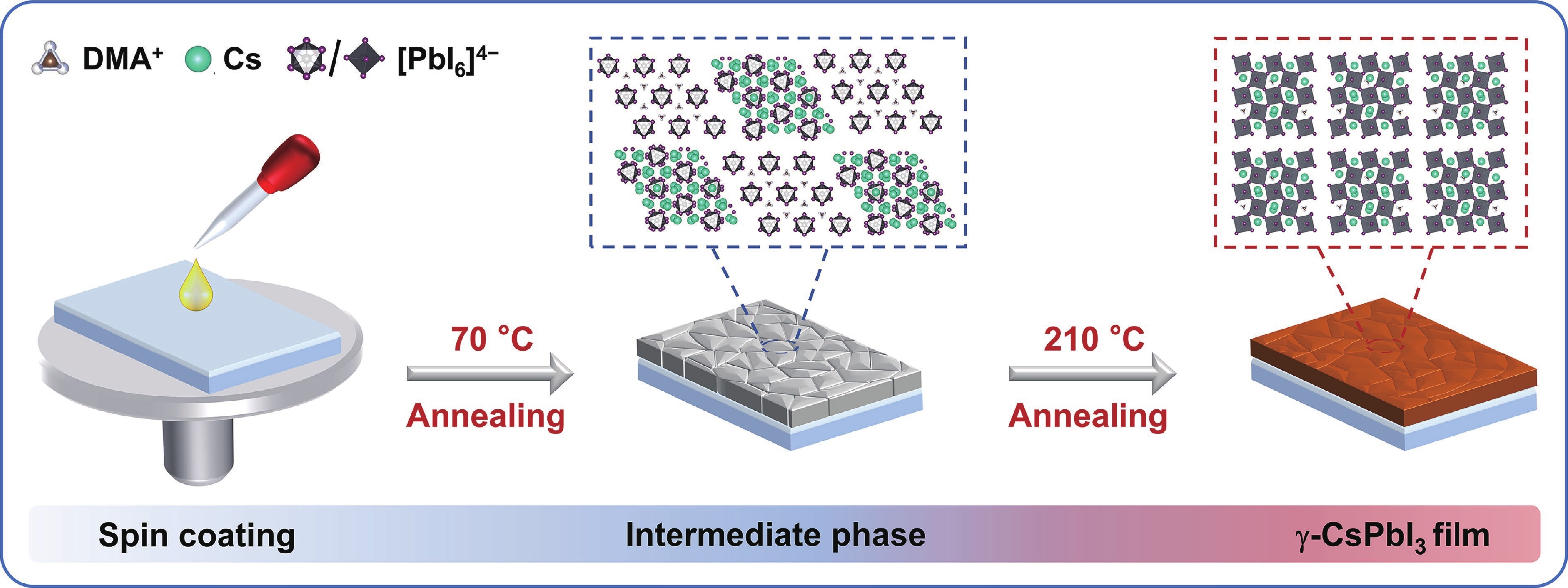
Fig. 1.
(Color online) Schematic diagram of the fabrication process for γ-CsPbI3 films.
ARTICLES
Huifang Han1, 2, Jia Xu1, 2 and Jianxi Yao1, 2,
Corresponding author: Jianxi Yao, jianxiyao@ncepu.edu.cn
Abstract: Inorganic cesium lead iodide (CsPbI3) perovskites are promising photovoltaic materials owing to their excellent thermal stability and optoelectronic properties. However, CsPbI3 film fabricated via solution processing typically suffers from high defect densities and detrimental residual tensile stress due to uncontrolled crystallization and thermal expansion mismatch with the substrate, which impedes its practical application. Herein, we introduce ammonium benzenesulfonate (ABS) as a bifunctional additive to modulate crystallization, thereby passivating defects and regulating residual stress. The sulfonate group of ABS coordinates with undercoordinated Pb2+ ions, while its ammonium group forms hydrogen bonds with iodide ions. The molecular structure of ABS bridges adjacent [PbI6]4− octahedra at grain boundaries. This dual interaction effectively enhanced crystallinity, suppressed non-radiative recombination, and improved structural stability. As a result, ABS-modified CsPbI3-based perovskite solar cells achieve an impressive power conversion efficiency (PCE) of 21.21% under standard illumination. Remarkably, they deliver a PCE of 40.85% under indoor lighting conditions. Moreover, unencapsulated devices retains 91% of their initial PCE after 800 h of storage in ambient air at a relative humidity of 5%.
Keywords: perovskite, additive, CsPbI3, passivation, stability
| [1] |
Liu C, Yang Y, Chen H, et al. Two-dimensional perovskitoids enhance stability in perovskite solar cells. Nature, 2024, 633(8029): 359 doi: 10.1038/s41586-024-07764-8
|
| [2] |
Jeong J, Kim M, Seo J, et al. Pseudo-halide anion engineering for α-FAPbI3 perovskite solar cells. Nature, 2021, 592(7854): 381 doi: 10.1038/s41586-021-03406-5
|
| [3] |
Wang Q R, Zhu J W, Zhao Y Y, et al. Cross-layer all-interface defect passivation with pre-buried additive toward efficient all-inorganic perovskite solar cells. Carbon Energy, 2024, 6(9): e566 doi: 10.1002/cey2.566
|
| [4] |
Kojima A, Teshima K, Shirai Y, et al. Organometal halide perovskites as visible-light sensitizers for photovoltaic cells. J Am Chem Soc, 2009, 131(17): 6050 doi: 10.1021/ja809598r
|
| [5] |
Best Research-Cell Efficiency Chart. https://www.nrel.gov/pv/cell-efficiency.html (accessed January 2025)
|
| [6] |
Rong Y, Hu Y, Mei A, et al. Challenges for commercializing perovskite solar cells. Science, 2018, 361(6408): eaat8235 doi: 10.1126/science.aat8235
|
| [7] |
Xiang W C, Liu S F, Tress W. A review on the stability of inorganic metal halide perovskites: Challenges and opportunities for stable solar cells. Energy Environ Sci, 2021, 14(4): 2090 doi: 10.1039/D1EE00157D
|
| [8] |
Zhou Y Y, Zhao Y X. Chemical stability and instability of inorganic halide perovskites. Energy Environ Sci, 2019, 12(5): 1495 doi: 10.1039/C8EE03559H
|
| [9] |
Zhao Y Y, Gao L, Wang Q R, et al. Reinforced SnO2 tensile-strength and "buffer-spring" interfaces for efficient inorganic perovskite solar cells. Carbon Energy, 2024, 6(6): e468 doi: 10.1002/cey2.468
|
| [10] |
Chu X B, Ye Q F, Wang Z H, et al. Surface in situ reconstruction of inorganic perovskite films enabling long carrier lifetimes and solar cells with 21% efficiency. Nat Energy, 2023, 8(4): 372 doi: 10.1038/s41560-023-01220-z
|
| [11] |
Tan C Y, Cui Y Q, Zhang R, et al. In situ reconstructing the buried interface for efficient CsPbI3 perovskite solar cells. ACS Energy Lett, 2025, 10(2): 703 doi: 10.1021/acsenergylett.4c03282
|
| [12] |
Tan X, Wang S B, Zhang Q X, et al. Stabilizing CsPbI3 perovskite for photovoltaic applications. Matter, 2023, 6(3): 691 doi: 10.1016/j.matt.2022.12.012
|
| [13] |
Li R, Chen Q Y, Zhang H, et al. Simultaneous charge extraction enhancement and defect passivation via a planar conjugated molecular interface enable 22.49%-efficient inorganic perovskite solar cells. Angew Chem Int Ed, 2025, 64(39): e202510925 doi: 10.1002/ange.202510925
|
| [14] |
Wang K L, Lu H Z, Li M, et al. Ion–dipole interaction enabling highly efficient CsPbI3 perovskite indoor photovoltaics. Adv Mater, 2023, 35(31): 2210106 doi: 10.1002/adma.202210106
|
| [15] |
Zhang F, Zhu K. Additive engineering for efficient and stable perovskite solar cells. Adv Energy Mater, 2020, 10(13): 190257 doi: 10.1021/acsami.5c09196.s001
|
| [16] |
Zhang H, Tian Q W, Xiang W C, et al. Tailored cysteine-derived molecular structures toward efficient and stable inorganic perovskite solar cells. Adv Mater, 2023, 35(31): 2301140 doi: 10.1002/adma.202301140
|
| [17] |
Zhao J J, Deng Y H, Wei H T, et al. Strained hybrid perovskite thin films and their impact on the intrinsic stability of perovskite solar cells. Sci Adv, 2017, 3(11): eaao5616 doi: 10.1126/sciadv.aao5616
|
| [18] |
Steele J A, Jin H D, Dovgaliuk I, et al. Thermal unequilibrium of strained black CsPbI3 thin films. Science, 2019, 365(6454): 679 doi: 10.1126/science.aax3878
|
| [19] |
Yang S M, Duan Y W, Liu Z K, et al. Recent advances in CsPbX3 perovskite solar cells: Focus on crystallization characteristics and controlling strategies. Adv Energy Mater, 2023, 13(33): 2201733 doi: 10.1002/aenm.202201733
|
| [20] |
Li R, Zhang S A, Zhang H, et al. Customizing aniline-derived molecular structures to attain beyond 22 % efficient inorganic perovskite solar cells. Angew Chem Int Ed, 2024, 63(42): e202410600 doi: 10.1002/anie.202410600
|
| [21] |
Wang S L, Sun H R, Wang P Y, et al. Small molecule regulatory strategy for inorganic perovskite solar cells with 368 mV of VOC deficit and its application in tandem devices. Adv Energy Mater, 2024, 14(26): 2400151 doi: 10.1002/aenm.202400151
|
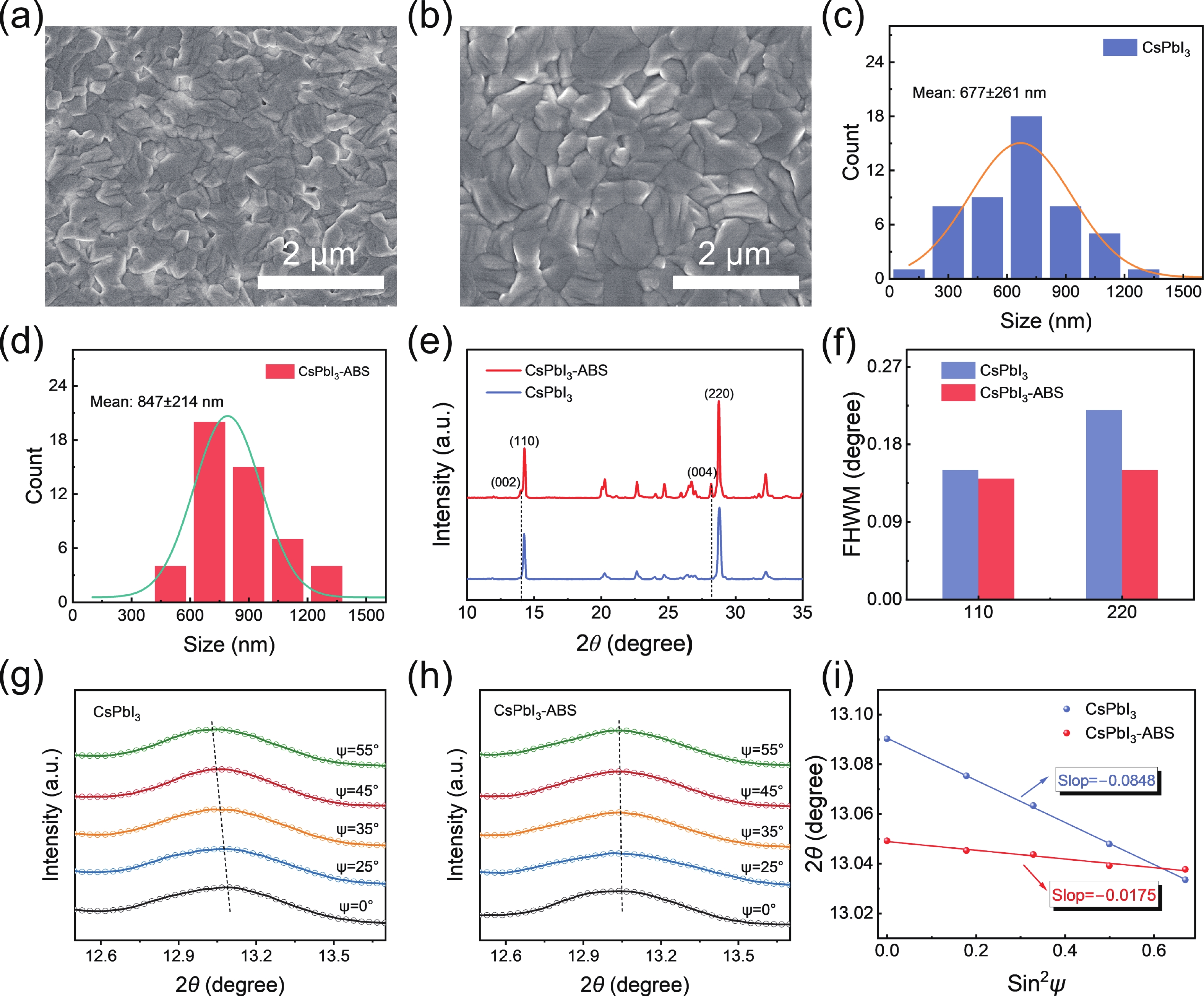
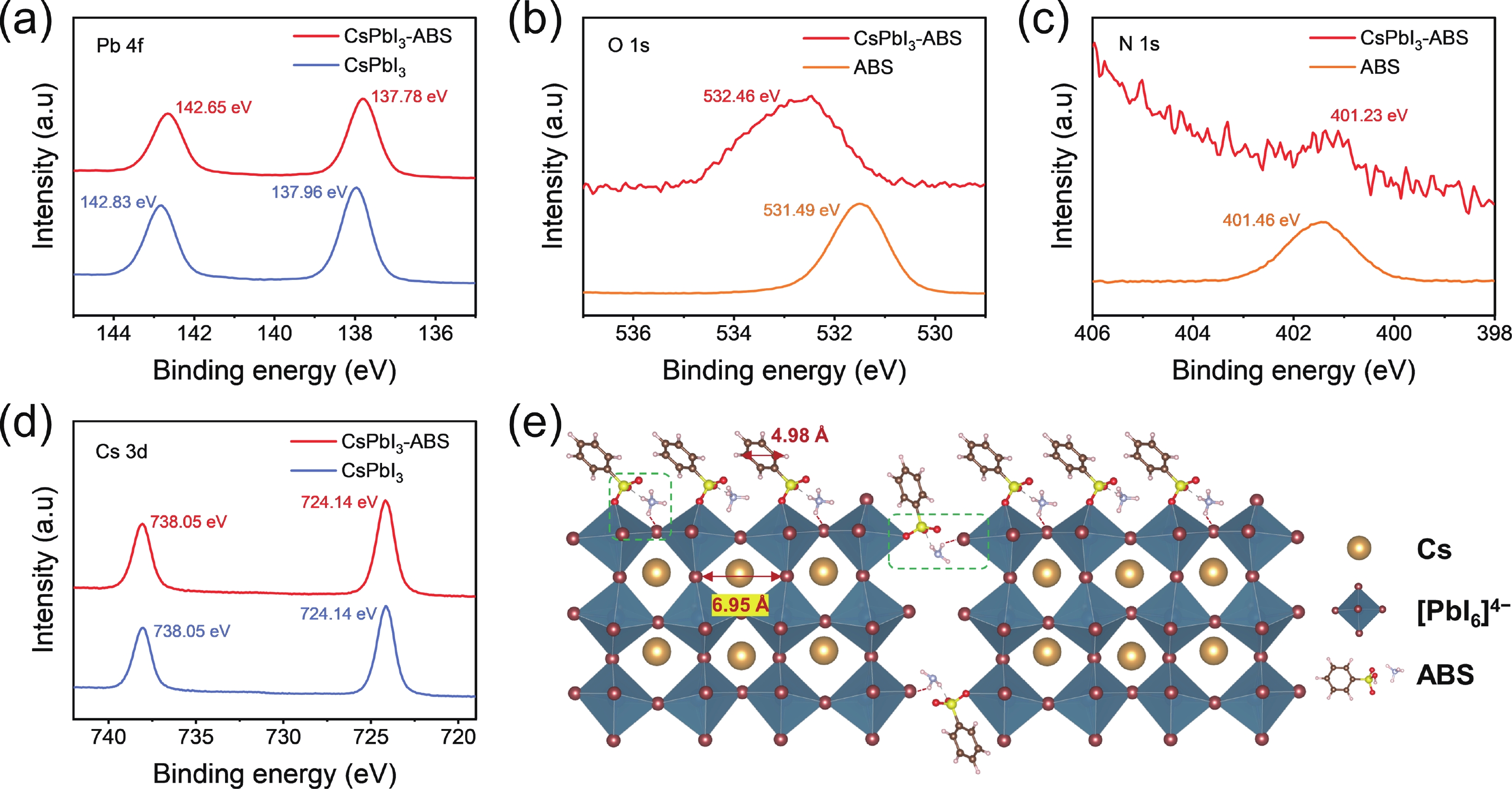
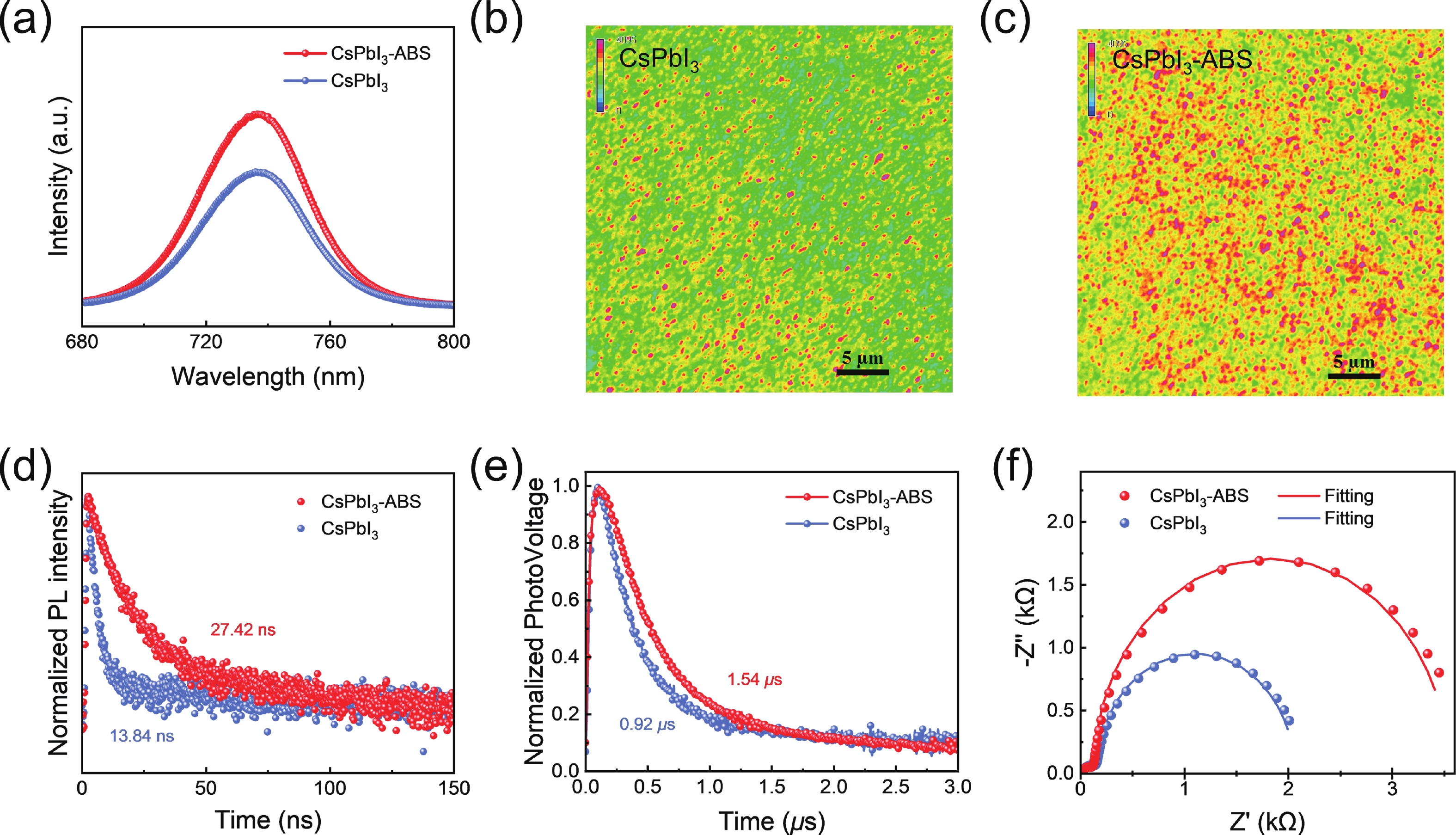
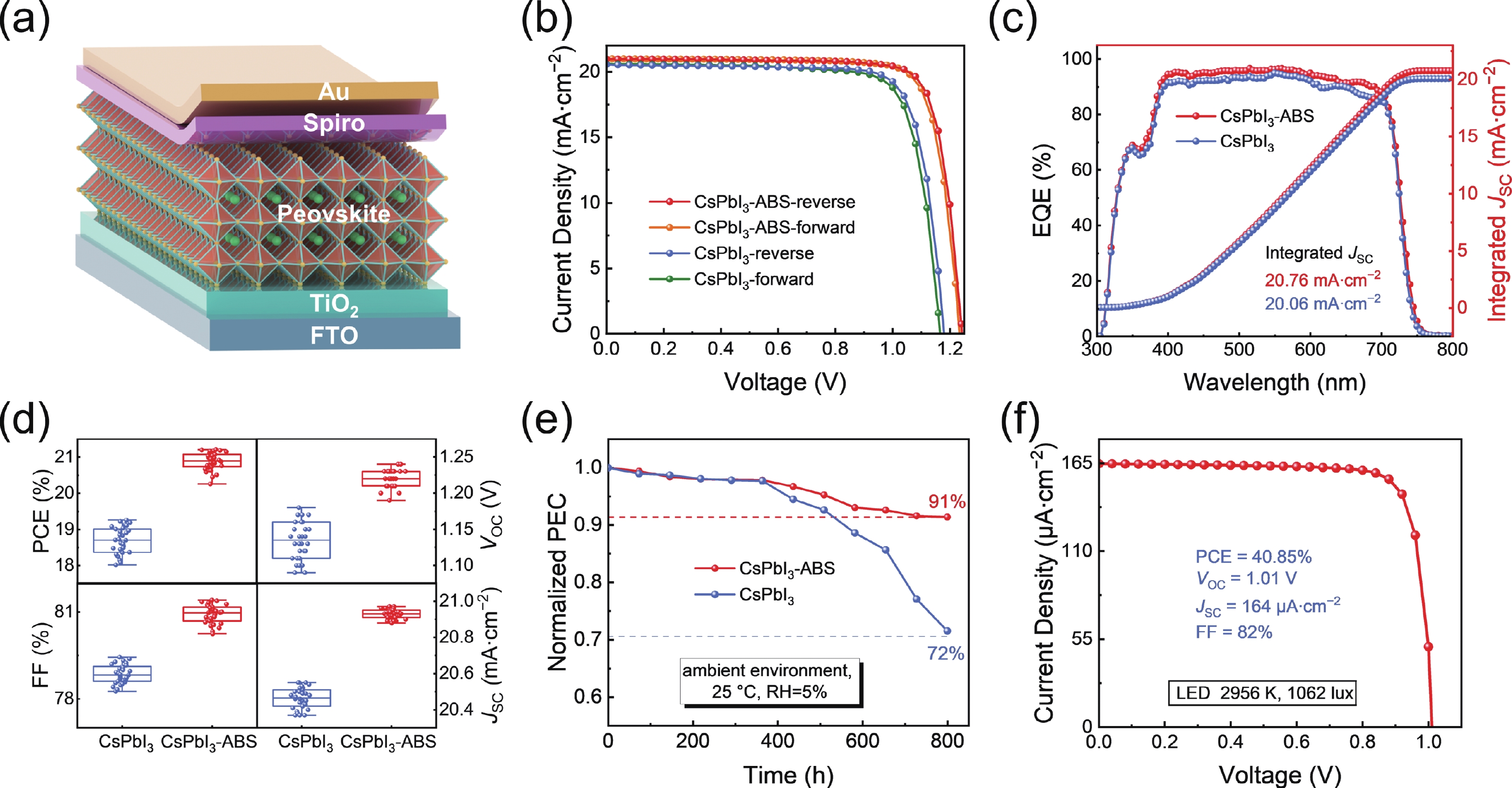
Table 1. Photovoltaic performance parameters of CsPbI3- and CsPbI3-ABS-based PSCs.
| Sample | Scan direction | VOC (V) | JSC (mA∙cm−2) | FF (%) | η (%) |
| CsPbI3 | Reverse | 1.18 | 20.55 | 79.44 | 19.26 |
| Forward | 1.16 | 20.59 | 78.31 | 18.81 | |
| CsPbI3-ABS | Reverse | 1.24 | 20.97 | 81.41 | 21.21 |
| Forward | 1.23 | 20.98 | 81.02 | 20.98 |
 DownLoad: CSV
| [1] |
Liu C, Yang Y, Chen H, et al. Two-dimensional perovskitoids enhance stability in perovskite solar cells. Nature, 2024, 633(8029): 359 doi: 10.1038/s41586-024-07764-8
|
| [2] |
Jeong J, Kim M, Seo J, et al. Pseudo-halide anion engineering for α-FAPbI3 perovskite solar cells. Nature, 2021, 592(7854): 381 doi: 10.1038/s41586-021-03406-5
|
| [3] |
Wang Q R, Zhu J W, Zhao Y Y, et al. Cross-layer all-interface defect passivation with pre-buried additive toward efficient all-inorganic perovskite solar cells. Carbon Energy, 2024, 6(9): e566 doi: 10.1002/cey2.566
|
| [4] |
Kojima A, Teshima K, Shirai Y, et al. Organometal halide perovskites as visible-light sensitizers for photovoltaic cells. J Am Chem Soc, 2009, 131(17): 6050 doi: 10.1021/ja809598r
|
| [5] |
Best Research-Cell Efficiency Chart. https://www.nrel.gov/pv/cell-efficiency.html (accessed January 2025)
|
| [6] |
Rong Y, Hu Y, Mei A, et al. Challenges for commercializing perovskite solar cells. Science, 2018, 361(6408): eaat8235 doi: 10.1126/science.aat8235
|
| [7] |
Xiang W C, Liu S F, Tress W. A review on the stability of inorganic metal halide perovskites: Challenges and opportunities for stable solar cells. Energy Environ Sci, 2021, 14(4): 2090 doi: 10.1039/D1EE00157D
|
| [8] |
Zhou Y Y, Zhao Y X. Chemical stability and instability of inorganic halide perovskites. Energy Environ Sci, 2019, 12(5): 1495 doi: 10.1039/C8EE03559H
|
| [9] |
Zhao Y Y, Gao L, Wang Q R, et al. Reinforced SnO2 tensile-strength and "buffer-spring" interfaces for efficient inorganic perovskite solar cells. Carbon Energy, 2024, 6(6): e468 doi: 10.1002/cey2.468
|
| [10] |
Chu X B, Ye Q F, Wang Z H, et al. Surface in situ reconstruction of inorganic perovskite films enabling long carrier lifetimes and solar cells with 21% efficiency. Nat Energy, 2023, 8(4): 372 doi: 10.1038/s41560-023-01220-z
|
| [11] |
Tan C Y, Cui Y Q, Zhang R, et al. In situ reconstructing the buried interface for efficient CsPbI3 perovskite solar cells. ACS Energy Lett, 2025, 10(2): 703 doi: 10.1021/acsenergylett.4c03282
|
| [12] |
Tan X, Wang S B, Zhang Q X, et al. Stabilizing CsPbI3 perovskite for photovoltaic applications. Matter, 2023, 6(3): 691 doi: 10.1016/j.matt.2022.12.012
|
| [13] |
Li R, Chen Q Y, Zhang H, et al. Simultaneous charge extraction enhancement and defect passivation via a planar conjugated molecular interface enable 22.49%-efficient inorganic perovskite solar cells. Angew Chem Int Ed, 2025, 64(39): e202510925 doi: 10.1002/ange.202510925
|
| [14] |
Wang K L, Lu H Z, Li M, et al. Ion–dipole interaction enabling highly efficient CsPbI3 perovskite indoor photovoltaics. Adv Mater, 2023, 35(31): 2210106 doi: 10.1002/adma.202210106
|
| [15] |
Zhang F, Zhu K. Additive engineering for efficient and stable perovskite solar cells. Adv Energy Mater, 2020, 10(13): 190257 doi: 10.1021/acsami.5c09196.s001
|
| [16] |
Zhang H, Tian Q W, Xiang W C, et al. Tailored cysteine-derived molecular structures toward efficient and stable inorganic perovskite solar cells. Adv Mater, 2023, 35(31): 2301140 doi: 10.1002/adma.202301140
|
| [17] |
Zhao J J, Deng Y H, Wei H T, et al. Strained hybrid perovskite thin films and their impact on the intrinsic stability of perovskite solar cells. Sci Adv, 2017, 3(11): eaao5616 doi: 10.1126/sciadv.aao5616
|
| [18] |
Steele J A, Jin H D, Dovgaliuk I, et al. Thermal unequilibrium of strained black CsPbI3 thin films. Science, 2019, 365(6454): 679 doi: 10.1126/science.aax3878
|
| [19] |
Yang S M, Duan Y W, Liu Z K, et al. Recent advances in CsPbX3 perovskite solar cells: Focus on crystallization characteristics and controlling strategies. Adv Energy Mater, 2023, 13(33): 2201733 doi: 10.1002/aenm.202201733
|
| [20] |
Li R, Zhang S A, Zhang H, et al. Customizing aniline-derived molecular structures to attain beyond 22 % efficient inorganic perovskite solar cells. Angew Chem Int Ed, 2024, 63(42): e202410600 doi: 10.1002/anie.202410600
|
| [21] |
Wang S L, Sun H R, Wang P Y, et al. Small molecule regulatory strategy for inorganic perovskite solar cells with 368 mV of VOC deficit and its application in tandem devices. Adv Energy Mater, 2024, 14(26): 2400151 doi: 10.1002/aenm.202400151
|





Article views: 1540 Times PDF downloads: 76 Times Cited by: 0 Times
Received: 24 December 2025 Revised: 07 January 2026 Online: Accepted Manuscript: 23 January 2026Uncorrected proof: 28 January 2026Published: 14 May 2026
| Citation: |
Huifang Han, Jia Xu, Jianxi Yao. Defect and stress co-management via bifunctional molecular engineering for high-efficiency and stable CsPbI3 perovskite solar cells[J]. Journal of Semiconductors, 2026, 47(5): 052801. doi: 10.1088/1674-4926/25120041
****
H F Han, J Xu, and J X Yao, Defect and stress co-management via bifunctional molecular engineering for high-efficiency and stable CsPbI3 perovskite solar cells[J]. J. Semicond., 2026, 47(5): 052801 doi: 10.1088/1674-4926/25120041

|
 Huifang Han got his master’s degree from Wenzhou University in 2018. Now he is a Ph.D. student at North China Electric Power University under the supervision of Prof. Jianxi Yao. His research focuses on all-inorganic perovskite solar cells
 Jianxi Yao got his Ph.D. degree from Zhejiang University in 2003. He conducted postdoctoral research at Kyoto University in Japan from 2003 to 2005. From 2005 to 2008, he worked at the Institute of Process Engineering, Chinese Academy of Sciences. Since 2008, he has been working at North China Electric Power University. His present interests include perovskite solar cell materials and devices, and nano photoelectric materials and devices
| [1] |
Liu C, Yang Y, Chen H, et al. Two-dimensional perovskitoids enhance stability in perovskite solar cells. Nature, 2024, 633(8029): 359 doi: 10.1038/s41586-024-07764-8
|
| [2] |
Jeong J, Kim M, Seo J, et al. Pseudo-halide anion engineering for α-FAPbI3 perovskite solar cells. Nature, 2021, 592(7854): 381 doi: 10.1038/s41586-021-03406-5
|
| [3] |
Wang Q R, Zhu J W, Zhao Y Y, et al. Cross-layer all-interface defect passivation with pre-buried additive toward efficient all-inorganic perovskite solar cells. Carbon Energy, 2024, 6(9): e566 doi: 10.1002/cey2.566
|
| [4] |
Kojima A, Teshima K, Shirai Y, et al. Organometal halide perovskites as visible-light sensitizers for photovoltaic cells. J Am Chem Soc, 2009, 131(17): 6050 doi: 10.1021/ja809598r
|
| [5] |
Best Research-Cell Efficiency Chart. https://www.nrel.gov/pv/cell-efficiency.html (accessed January 2025)
|
| [6] |
Rong Y, Hu Y, Mei A, et al. Challenges for commercializing perovskite solar cells. Science, 2018, 361(6408): eaat8235 doi: 10.1126/science.aat8235
|
| [7] |
Xiang W C, Liu S F, Tress W. A review on the stability of inorganic metal halide perovskites: Challenges and opportunities for stable solar cells. Energy Environ Sci, 2021, 14(4): 2090 doi: 10.1039/D1EE00157D
|
| [8] |
Zhou Y Y, Zhao Y X. Chemical stability and instability of inorganic halide perovskites. Energy Environ Sci, 2019, 12(5): 1495 doi: 10.1039/C8EE03559H
|
| [9] |
Zhao Y Y, Gao L, Wang Q R, et al. Reinforced SnO2 tensile-strength and "buffer-spring" interfaces for efficient inorganic perovskite solar cells. Carbon Energy, 2024, 6(6): e468 doi: 10.1002/cey2.468
|
| [10] |
Chu X B, Ye Q F, Wang Z H, et al. Surface in situ reconstruction of inorganic perovskite films enabling long carrier lifetimes and solar cells with 21% efficiency. Nat Energy, 2023, 8(4): 372 doi: 10.1038/s41560-023-01220-z
|
| [11] |
Tan C Y, Cui Y Q, Zhang R, et al. In situ reconstructing the buried interface for efficient CsPbI3 perovskite solar cells. ACS Energy Lett, 2025, 10(2): 703 doi: 10.1021/acsenergylett.4c03282
|
| [12] |
Tan X, Wang S B, Zhang Q X, et al. Stabilizing CsPbI3 perovskite for photovoltaic applications. Matter, 2023, 6(3): 691 doi: 10.1016/j.matt.2022.12.012
|
| [13] |
Li R, Chen Q Y, Zhang H, et al. Simultaneous charge extraction enhancement and defect passivation via a planar conjugated molecular interface enable 22.49%-efficient inorganic perovskite solar cells. Angew Chem Int Ed, 2025, 64(39): e202510925 doi: 10.1002/ange.202510925
|
| [14] |
Wang K L, Lu H Z, Li M, et al. Ion–dipole interaction enabling highly efficient CsPbI3 perovskite indoor photovoltaics. Adv Mater, 2023, 35(31): 2210106 doi: 10.1002/adma.202210106
|
| [15] |
Zhang F, Zhu K. Additive engineering for efficient and stable perovskite solar cells. Adv Energy Mater, 2020, 10(13): 190257 doi: 10.1021/acsami.5c09196.s001
|
| [16] |
Zhang H, Tian Q W, Xiang W C, et al. Tailored cysteine-derived molecular structures toward efficient and stable inorganic perovskite solar cells. Adv Mater, 2023, 35(31): 2301140 doi: 10.1002/adma.202301140
|
| [17] |
Zhao J J, Deng Y H, Wei H T, et al. Strained hybrid perovskite thin films and their impact on the intrinsic stability of perovskite solar cells. Sci Adv, 2017, 3(11): eaao5616 doi: 10.1126/sciadv.aao5616
|
| [18] |
Steele J A, Jin H D, Dovgaliuk I, et al. Thermal unequilibrium of strained black CsPbI3 thin films. Science, 2019, 365(6454): 679 doi: 10.1126/science.aax3878
|
| [19] |
Yang S M, Duan Y W, Liu Z K, et al. Recent advances in CsPbX3 perovskite solar cells: Focus on crystallization characteristics and controlling strategies. Adv Energy Mater, 2023, 13(33): 2201733 doi: 10.1002/aenm.202201733
|
| [20] |
Li R, Zhang S A, Zhang H, et al. Customizing aniline-derived molecular structures to attain beyond 22 % efficient inorganic perovskite solar cells. Angew Chem Int Ed, 2024, 63(42): e202410600 doi: 10.1002/anie.202410600
|
| [21] |
Wang S L, Sun H R, Wang P Y, et al. Small molecule regulatory strategy for inorganic perovskite solar cells with 368 mV of VOC deficit and its application in tandem devices. Adv Energy Mater, 2024, 14(26): 2400151 doi: 10.1002/aenm.202400151
|

 WeChat ID
Journal of Semiconductors © 2017 All Rights Reserved 京ICP备05085259号-2