J. Semicond. >  Just Accepted

ARTICLES

Impact ionization in narrow band gap CdHgTe quantum well with “resonant” band structure

V. Ya. Aleshkin1, 2, , A. A. Dubinov1, 2 and V. V. Rumyantsev1, 2

+ Author Affiliations

 Corresponding author: V. Ya. Aleshkin, aleshkin@ipmras.ru

DOI: 10.1088/1674-4926/26010032CSTR: 32376.14.1674-4926.26010032

PDF

Turn off MathJax

Abstract: Impact ionization probabilities were calculated in a CdHgTe quantum well, where the distance between electron subbands is close to the band gap energy. This band structure enables impact ionization with small momentum transfer for electrons in the second subband. The study demonstrates that such processes increase the impact ionization probability by approximately two orders of magnitude compared to the impact ionization probability for electrons in the first subband, for which transitions with small momentum changes are impossible. The probability of single impact ionization during the electron energy loss due to optical phonon emission is estimated. Experimental methods for detecting impact ionization in this structure are discussed.

Key words: narrow band quantum wellimpact ionization


[1]
Sze S M, Ng K K. Physics of Semiconductor Devices. New York: John Wiley and Sons Inc., 2006
[2]
Yuan Y, Tossoun B, Huang Z, et al. Avalanche photodiodes on silicon photonics. J Semicond, 2022, 43(2): 021301 doi: 10.1088/1674-4926/43/2/021301
[3]
Nofriandi A, Hamdi, Ratnawulan, et al. Ultra-sensitive light detection technologies based on single-photon detectors: A review. Sens Technol, 2024, 2(1): 2404268 doi: 10.1080/28361466.2024.2404268
[4]
Tempel S, Winslow M, Kodati S H, et al. A comparative study of impact ionization and avalanche multiplication in InAs, HgCdTe, and InAlAs/InAsSb superlattice. Appl Phys Lett, 2024, 124(13): 131105 doi: 10.1063/5.0189416
[5]
Shen C, Zhang J, Yang L, et al. Study on crystal quality of materials in Zone I of APD P-I-N HgCdTe. J Infrared Millim. Waves, 2024, 43: 174 doi: 10.11972/j.issn.1001-9014.2024.02.005
[6]
Li Q, Xie R, Wang F, et al. SRH suppressed P-G-I design for very long-wavelength infrared HgCdTe photodiodes. Opt Express, 2022, 30(10): 16509 doi: 10.1364/OE.458419
[7]
Dong S, Li N, Chen S, et al. Impact ionization in quantum well infrared photodetectors with different number of periods. J Appl Phys, 2012, 111(3): 034504 doi: 10.1063/1.3681284
[8]
Tao X, Jin X, Gao S, et al. Engineering of impact ionization characteristics in GaAs/GaAsBi multiple quantum well avalanche photodiodes. ACS Photonics, 2024, 11(11): 4846 doi: 10.1021/acsphotonics.4c01343
[9]
Landsberg P T, Nussbaumer H, Willeke G. Band-band impact ionization and solar cell efficiency. J Appl Phys, 1993, 74(2): 1451 doi: 10.1063/1.354886
[10]
Dmitriev A P, Mikhailova M P, Yassievich I N. Impact ionization in AIIIBV semiconductors in high electric fields. Phys Status Solidi B, 1987, 140(1): 9 doi: 10.1002/pssb.2221400102
[11]
Hubmann S, Budkin G V, Urban M, et al. Impact ionization induced by terahertz radiation in HgTe quantum wells of critical thickness. J Infrared Millim Terahertz Waves, 2020, 41(10): 1155 doi: 10.1007/s10762-020-00690-6
[12]
Morozov S V, Rumyantsev V V, Zholudev M S, et al. Coherent emission in the vicinity of 10 THz due to auger-suppressed recombination of Dirac fermions in HgCdTe quantum wells. ACS Photonics, 2021, 8(12): 3526 doi: 10.1021/acsphotonics.1c01111
[13]
Rumyantsev V V, Dubinov A A, Utochkin V V, et al. Stimulated emission in 24–31 μm range and «Reststrahlen» waveguide in HgCdTe structures grown on GaAs. Appl Phys Lett, 2022, 121(18): 182103 doi: 10.1063/5.0128783
[14]
Rumyantsev V V, Mazhukina K A, Utochkin V V, et al. Optically pumped stimulated emission in HgCdTe-based quantum wells: Toward continuous wave lasing in very long-wavelength infrared range. Appl Phys Lett, 2024, 124(16): 161111 doi: 10.1063/5.0186292
[15]
Sotnichuk M K, Ikonnikov A V, Khokhlov D R, et al. Features of persistent photoconductivity in CdHgTe-based single quantum well heterostructures. J Semicond, 2025, 46(4): 042702 doi: 10.1088/1674-4926/24090023
[16]
Razova A A, Rumyantsev V V, Mazhukina K A, et al. Microdisk HgCdTe lasers operating at 22–25 μm under optical pumping. Appl Phys Lett, 2025, 126(12): 121102 doi: 10.1063/5.0253661
[17]
Hildebrand O, Kuebart W, Pilkuhn M H. Resonant enhancement of impact in Ga1-xA1xSb. Appl Phys Lett, 1980, 37(9): 801 doi: 10.1063/1.92086
[18]
Hildebrand O, Kuebart W, Benz K, et al. Ga1-xAlxSb avalanche photodiodes: Resonant impact ionization with very high ratio of ionization coefficients. IEEE J Quantum Electron, 1981, 17(2): 284 doi: 10.1109/JQE.1981.1071068
[19]
Mikhailova M P, Smirnova N N, Slohodchkov S V. Carrier multiplication in InAs and InGaAs p-n junctions and their ionization coefficients. Sov Phys Semicond, 1976, 10: 509
[20]
Zhingarev M Z, Korol’kov V I, Mikhailova M P, et al. Avalanche multiplication and coefficients of impact ionization in p-n homojunctions and heterojunctions made of GaSb and its solid solutions. Sov Phys Semicond, 1980, 14: 802
[21]
Zhinagarev M Z, Korol’kov V I, Mikhailova M P, et al. Dependence of the electron and hole impact-ionization coefficients on the orientation and composition in solid solutions. Sov Tech Phys Lett, 1981, 7: 637
[22]
Stillman G E, Robbins V M, Tabatabaie N. III-V compound semiconductor devices: Optical detectors. IEEE Trans Electron Devices, 1984, 31(11): 1643 doi: 10.1109/T-ED.1984.21765
[23]
Mikhailova M P, Ivanov E V, Danilov L V, et al. Radiative recombination and impact ionization in semiconductor nanostructures (a review). Semiconductors, 2020, 54(12): 1527 doi: 10.1134/S1063782620120210
[24]
Abakumov V N, Perel V I, Yassievich I N. Nonradiative Recombination in Semiconductors. Amsterdam: Elsevier, 1991 https://shop.elsevier.com/books/nonradiative-recombination-in-semiconductors/abakumov/978-0-444-88854-9
[25]
Haug A, Kerkhoff D, Lochmann W. Calculation of auger coefficients for III–V semiconductors with emphasis on GaSb. Phys Status Solidi B, 1978, 89(2): 357 doi: 10.1002/pssb.2220890204
[26]
Takeshima M. Auger recombination in InAs, GaSb, InP, and GaAs. J Appl Phys, 1972, 43(10): 4114 doi: 10.1063/1.1660882
[27]
Benz G, Conradt R. Auger recombination in GaAs and GaSb. Phys Rev B, 1977, 16(2): 843 doi: 10.1103/PhysRevB.16.843
[28]
Gelmont B L, Sokolova Z N, Yassievich I N. Auger recombination in direct-gap p-type semiconductors. Sov Phys Semiconductors, 1982, 16(4): 382
[29]
Rytova N S. Coulomb interaction of electrons in a thin film. Doklady Akademii Nauk SSSR, 1965, 163(5): 1118
[30]
Keldysh L V. Coulomb interaction in thin semiconductor and semimetal films. JETP Lett, 1979, 29: 658 doi: http://jetpletters.ru/ps/1458/article_22207.shtml
[31]
Willatzen M, Lew Yan Voon L C. The k p Method: Electronic Properties of Semiconductors. Berlin, Heidelberg: Springer, 2009 doi: https://link.springer.com/book/10.1007/978-3-540-92872-0
[32]
Polkovnikov A S, Zegrya G G. Auger recombination in semiconductor quantum wells. Phys Rev B, 1998, 58(7): 4039 doi: 10.1103/PhysRevB.58.4039
[33]
Rumyantsev V V, Razova A A, Bovkun L S, et al. Optical studies and transmission electron microscopy of HgCdTe quantum well heterostructures for very long wavelength lasers. Nanomaterials, 2021, 11(7): 1855 doi: 10.3390/nano11071855
[34]
Zholudev M, Teppe F, Orlita M, et al. Magnetospectroscopy of two-dimensional HgTe-based topological insulators around the critical thickness. Phys Rev B, 2012, 86(20): 205420 doi: 10.1103/PhysRevB.86.205420
[35]
Afanasiev A N, Greshnov A A, Zegrya G G. Competition between isotropic and strongly anisotropic terms in the impact ionization rate of narrow- and middle-gap cubic semiconductors. Semiconductors, 2024, 58: 572 doi: https://journals.ioffe.ru/articles/59957
[36]
Huang K, Zhu B F. Dielectric continuum model and Fröhlich interaction in superlattices. Phys Rev B, 1988, 38(18): 13377 doi: 10.1103/PhysRevB.38.13377
[37]
Yu P, Cardona M. Fundamentals of semiconductors. In: Physics and Material Properties. Fourth edition. Heidelberg: Springer 2010
[38]
Zheng R S, Matsuura M. Electron–optical-phonon interaction in quantum wells consisting of mixed crystals. Phys Rev B, 1999, 60(7): 4937 doi: 10.1103/PhysRevB.60.4937
[39]
Talwar D N, Vandevyver M. Vibrational properties of HgCdTe. J Appl Phys, 1984, 56(6): 1601 doi: 10.1063/1.334144
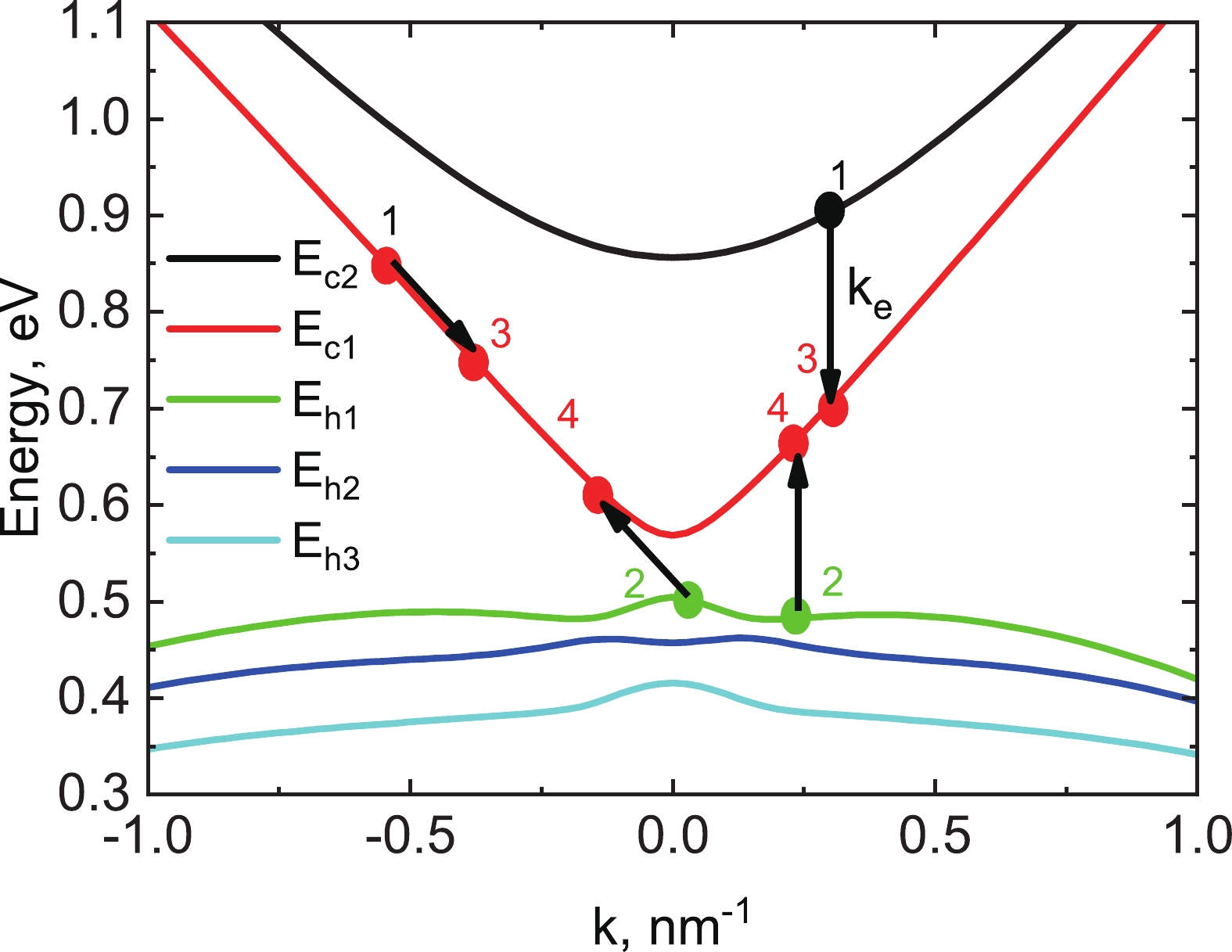
Fig. 1.  (Color online) Band structure of a 6.8 nm Cd0.067Hg0.933Te quantum well surrounded by Cd0.7Hg0.3Te barriers. Arrows indicate possible electron transitions during impact ionization. The left side of the figure shows electronic transitions with a change in the wave vector. The right side of the figure shows electronic transitions without changing the wave vector (vertical transitions). The numbers 1 and 2 correspond to the initial electron states, and the numbers 3 and 4 correspond to the final electron states.

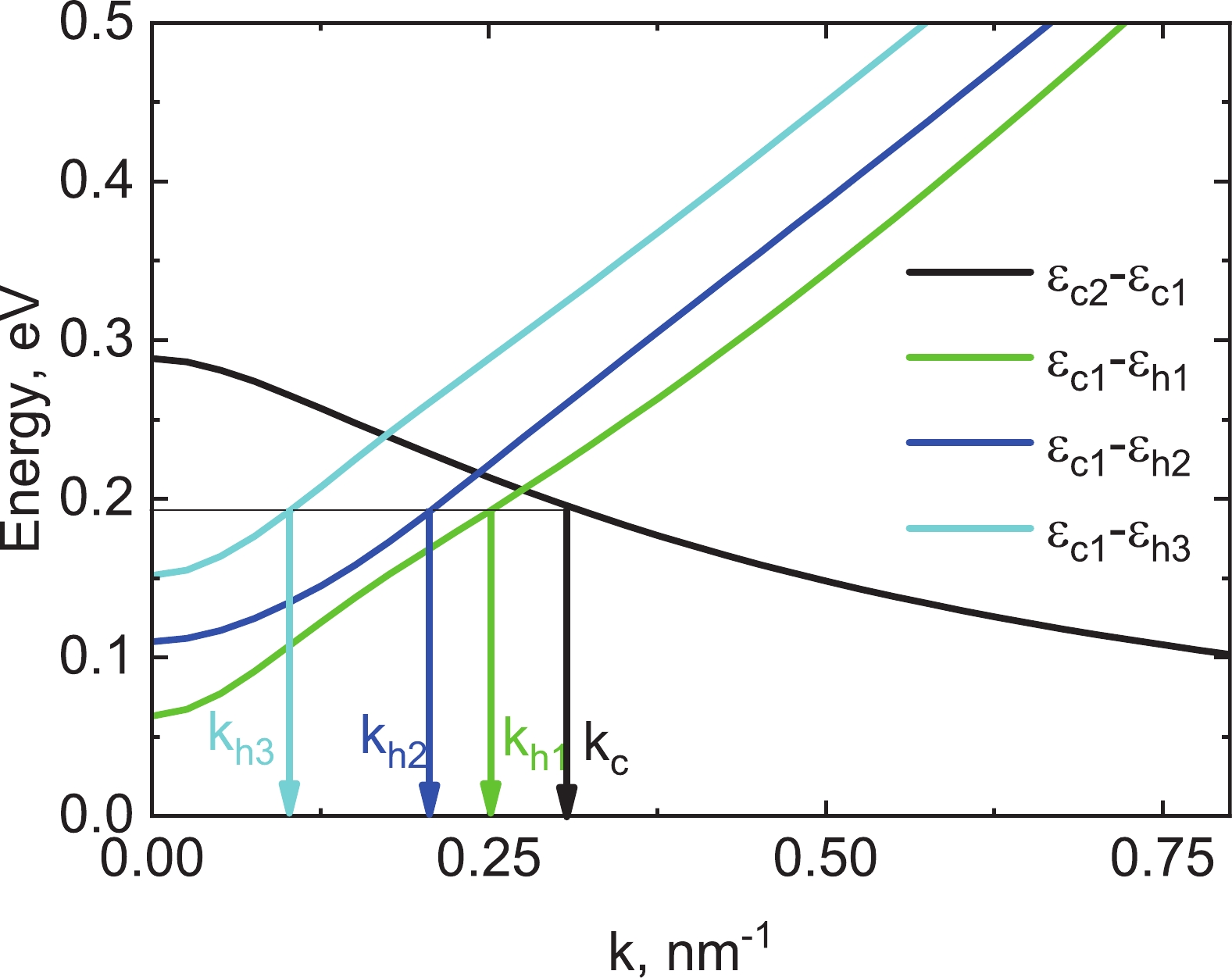
Fig. 2.  (Color online) Dependences of the difference in subband energies on the wave vector. Values of wave vectors khi correspond to vertical electronic transitions from the i-th valence subband to the conduction band at a fixed wave vector kc of the electronic transition from the second subband of the conduction band to the first subband.

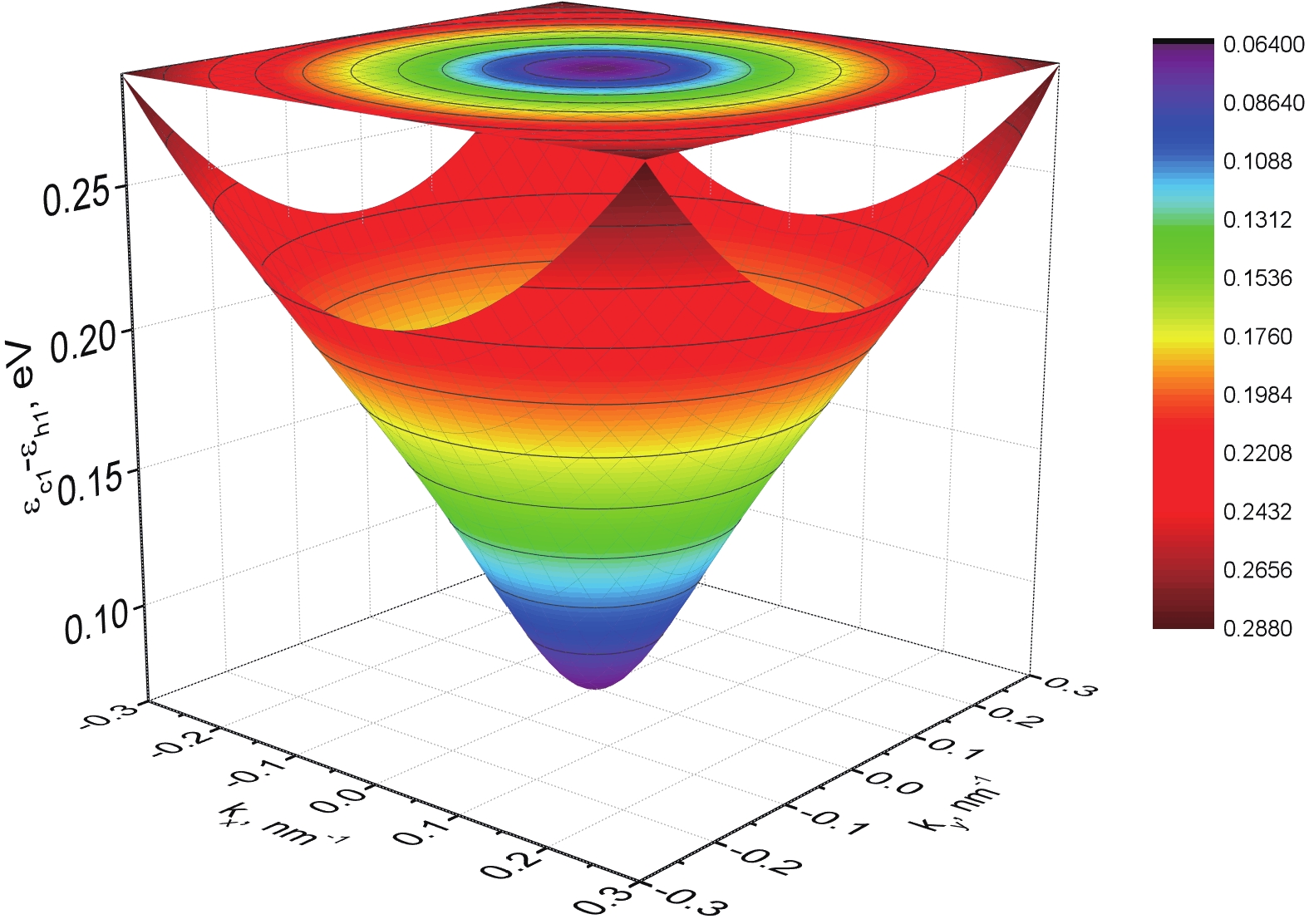
Fig. 3.  (Color online) Dependence $ {\varepsilon }_{\text{c1}}({\boldsymbol{k}}_{\text{h1}})-{\varepsilon }_{\text{h1}}({\boldsymbol{k}}_{\text{h1}}) $ on $ {\boldsymbol{k}}_{\text{h}1} $. The set of wave vectors $ {\boldsymbol{k}}_{\text{h}1} $ corresponding to the vertical electronic transition is located on the isolines of the dependence $ {\varepsilon }_{\text{c1}}({\boldsymbol{k}}_{\text{h1}})-{\varepsilon }_{\text{h1}}({\boldsymbol{k}}_{\text{h1}}) $.

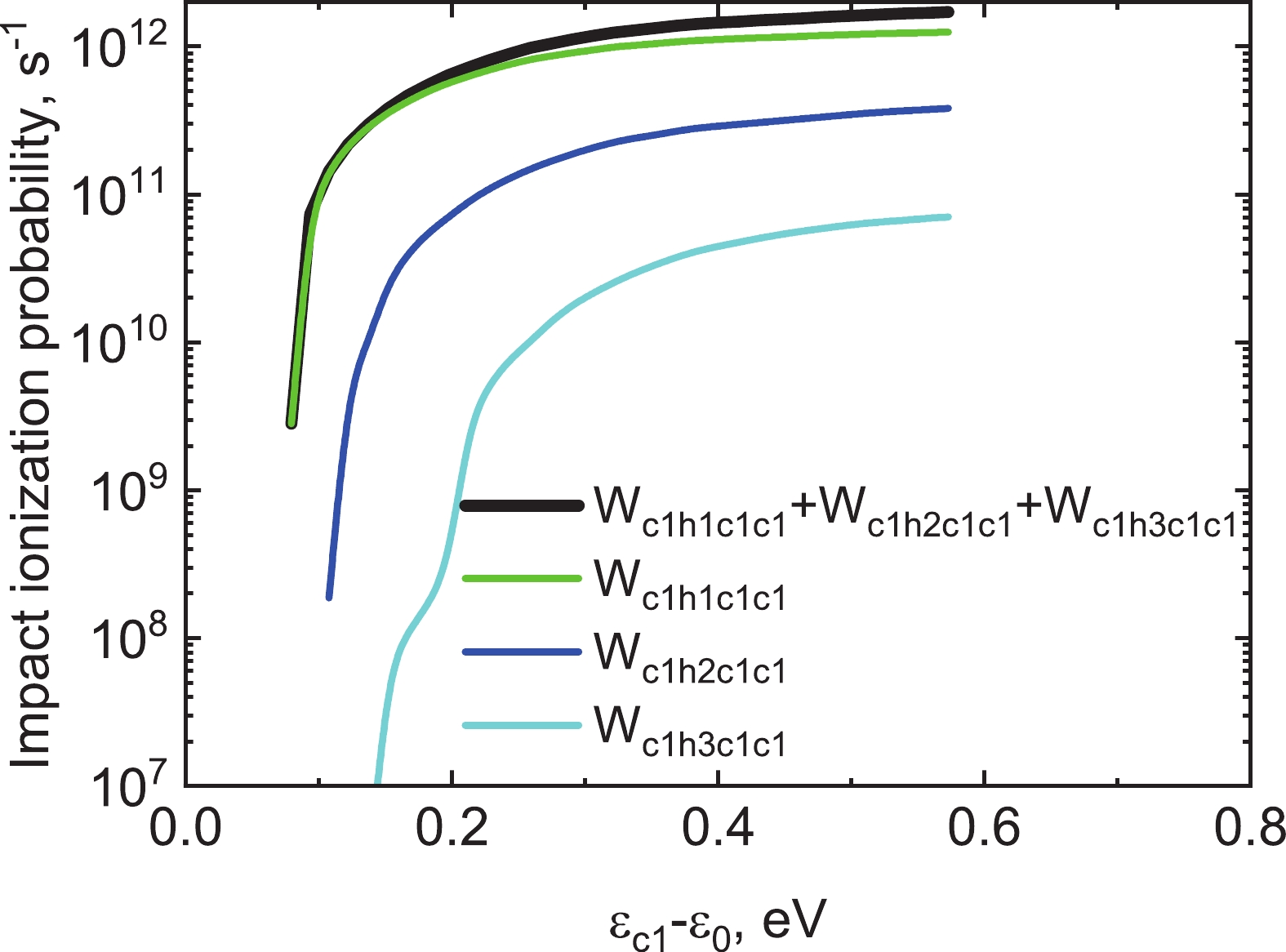
Fig. 4.  (Color online) Dependences of the impact ionization probabilities on the electron kinetic energy when the initial electron state in the conduction band is located in the first electron subband.

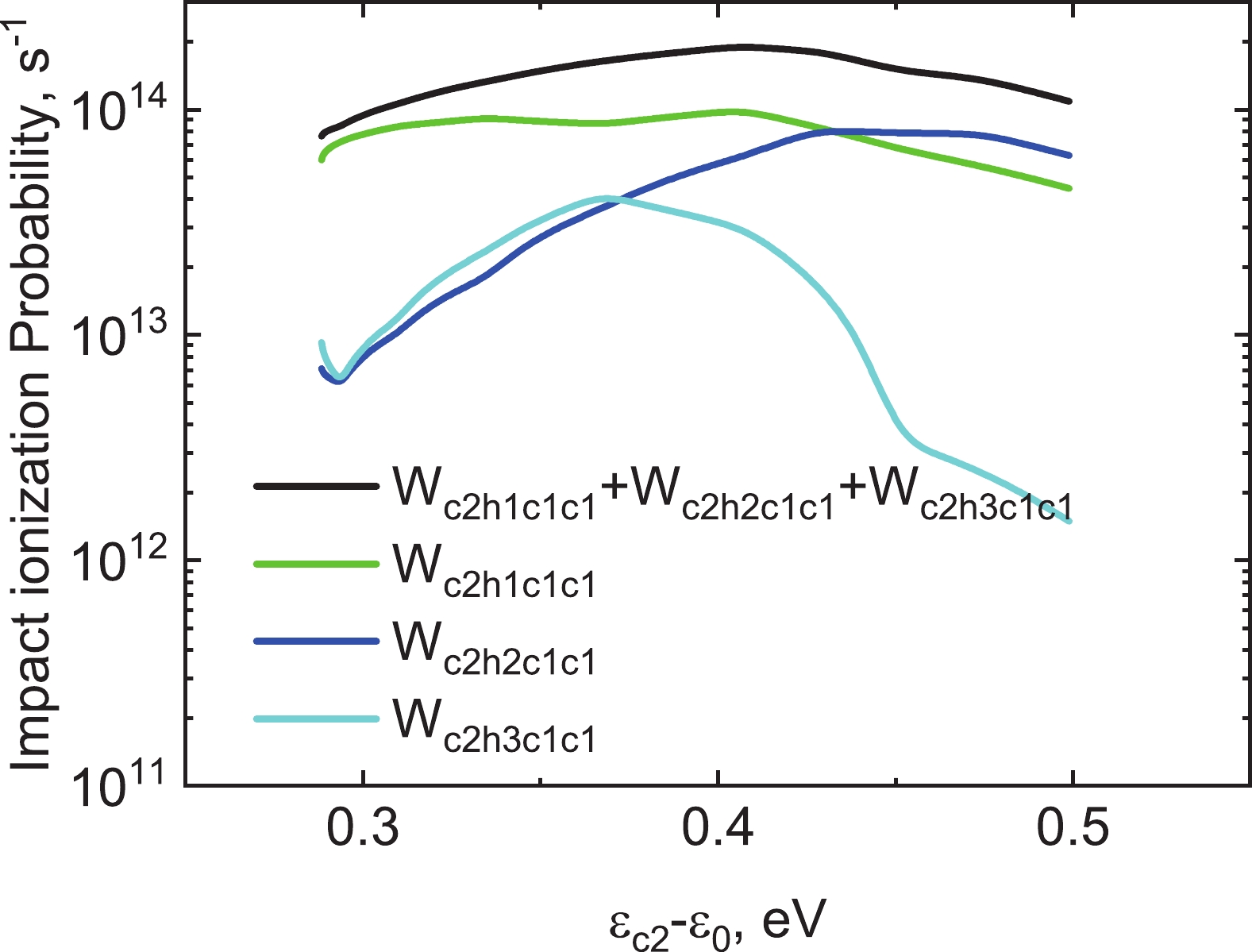
Fig. 5.  (Color online) Dependences of the impact ionization probabilities on the electron energy when the initial electron state in the conduction band is located in the second electron subband. The black line corresponds to the total probability of impact ionization, the colored lines correspond to the probabilities of impact ionization with the transition of electrons from certain valence subbands.

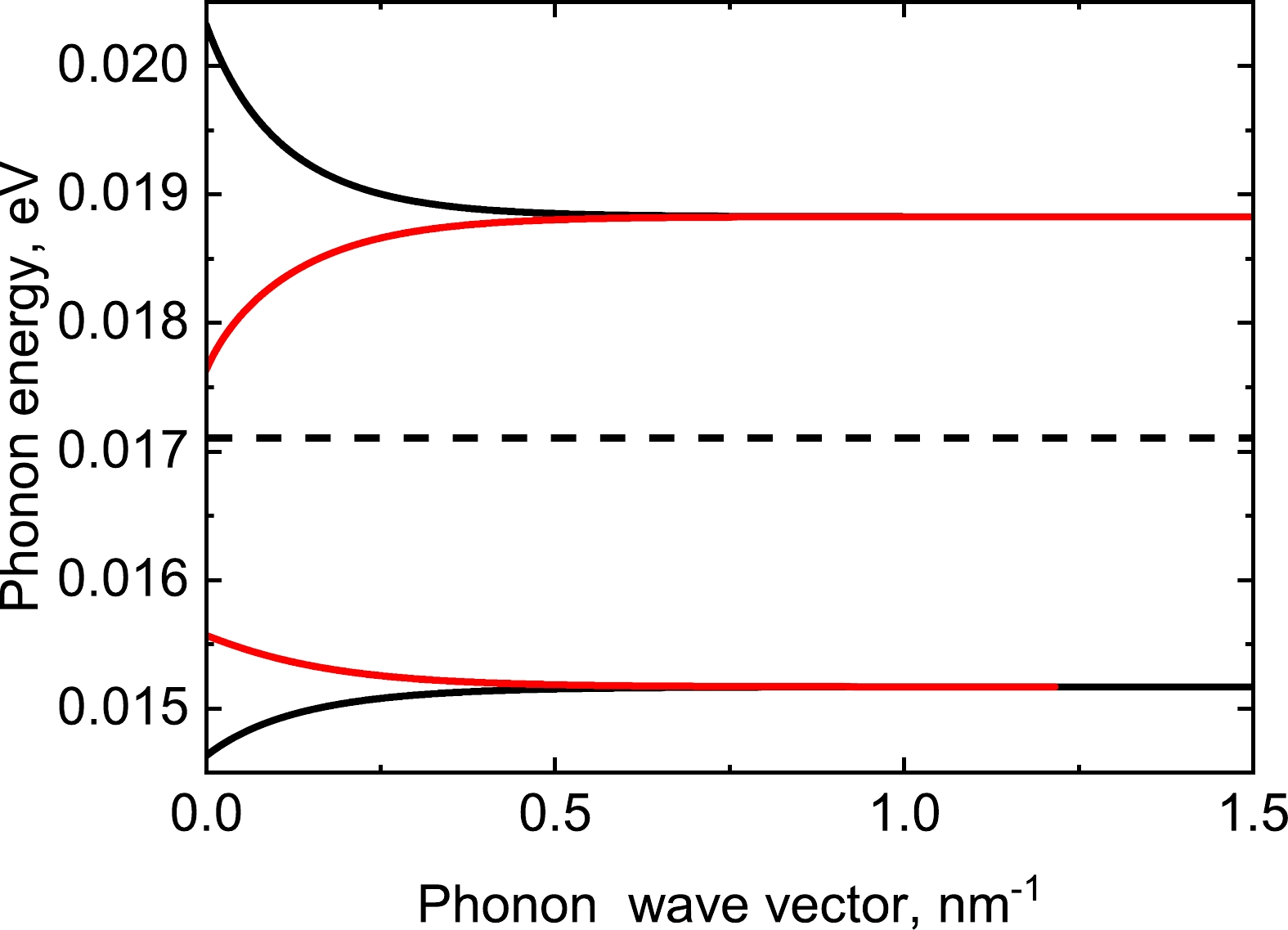
Fig. 6.  (Color online) Optical phonon spectra in a Cd0.067Hg0.933Te/Cd0.7Hg0.3Te quantum well. The solid black lines correspond to even surface phonons, the potential generated by which is an even function relative to the quantum well center. The solid red lines correspond to odd optical phonons, the potential generated by which is an odd function relative to the quantum well center. The dashed line corresponds to bulk-like phonons.

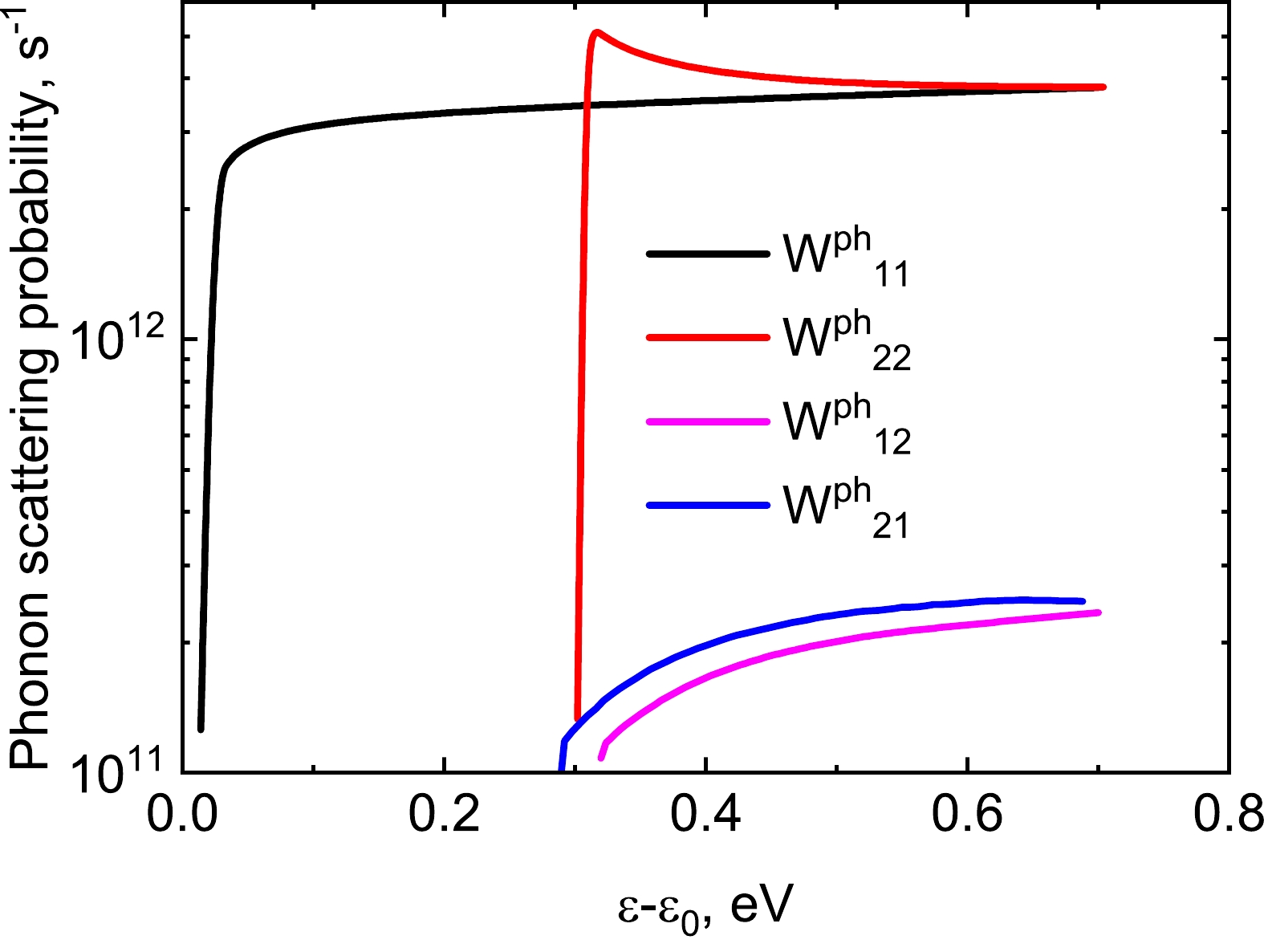
Fig. 7.  (Color online) Dependences of the spontaneous optical phonon emission probabilities on the electron energy.

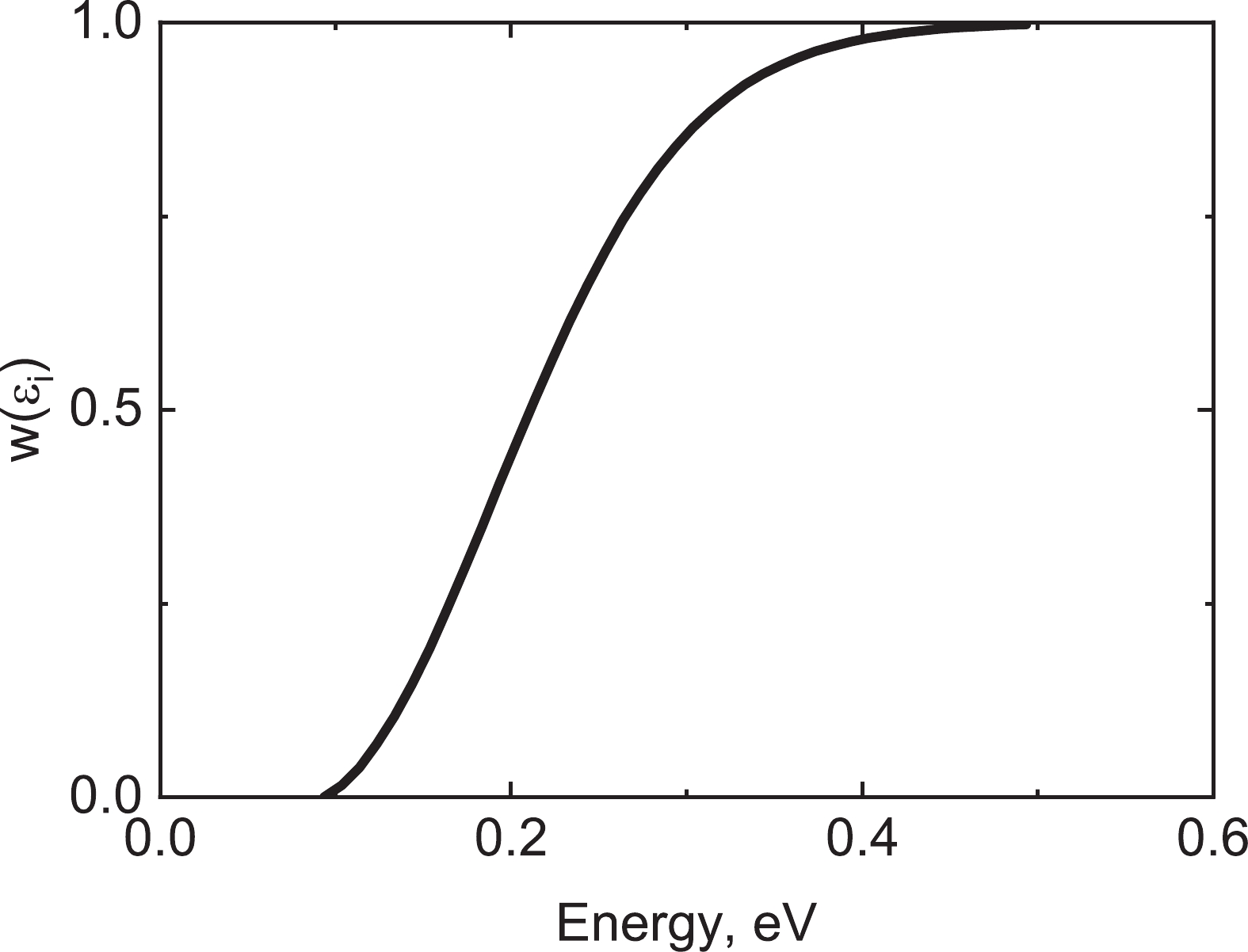
Fig. 8.  Dependence of occurring once impact ionization on the initial energy of an electron “cooling” in the first electron subband

[1]
Sze S M, Ng K K. Physics of Semiconductor Devices. New York: John Wiley and Sons Inc., 2006
[2]
Yuan Y, Tossoun B, Huang Z, et al. Avalanche photodiodes on silicon photonics. J Semicond, 2022, 43(2): 021301 doi: 10.1088/1674-4926/43/2/021301
[3]
Nofriandi A, Hamdi, Ratnawulan, et al. Ultra-sensitive light detection technologies based on single-photon detectors: A review. Sens Technol, 2024, 2(1): 2404268 doi: 10.1080/28361466.2024.2404268
[4]
Tempel S, Winslow M, Kodati S H, et al. A comparative study of impact ionization and avalanche multiplication in InAs, HgCdTe, and InAlAs/InAsSb superlattice. Appl Phys Lett, 2024, 124(13): 131105 doi: 10.1063/5.0189416
[5]
Shen C, Zhang J, Yang L, et al. Study on crystal quality of materials in Zone I of APD P-I-N HgCdTe. J Infrared Millim. Waves, 2024, 43: 174 doi: 10.11972/j.issn.1001-9014.2024.02.005
[6]
Li Q, Xie R, Wang F, et al. SRH suppressed P-G-I design for very long-wavelength infrared HgCdTe photodiodes. Opt Express, 2022, 30(10): 16509 doi: 10.1364/OE.458419
[7]
Dong S, Li N, Chen S, et al. Impact ionization in quantum well infrared photodetectors with different number of periods. J Appl Phys, 2012, 111(3): 034504 doi: 10.1063/1.3681284
[8]
Tao X, Jin X, Gao S, et al. Engineering of impact ionization characteristics in GaAs/GaAsBi multiple quantum well avalanche photodiodes. ACS Photonics, 2024, 11(11): 4846 doi: 10.1021/acsphotonics.4c01343
[9]
Landsberg P T, Nussbaumer H, Willeke G. Band-band impact ionization and solar cell efficiency. J Appl Phys, 1993, 74(2): 1451 doi: 10.1063/1.354886
[10]
Dmitriev A P, Mikhailova M P, Yassievich I N. Impact ionization in AIIIBV semiconductors in high electric fields. Phys Status Solidi B, 1987, 140(1): 9 doi: 10.1002/pssb.2221400102
[11]
Hubmann S, Budkin G V, Urban M, et al. Impact ionization induced by terahertz radiation in HgTe quantum wells of critical thickness. J Infrared Millim Terahertz Waves, 2020, 41(10): 1155 doi: 10.1007/s10762-020-00690-6
[12]
Morozov S V, Rumyantsev V V, Zholudev M S, et al. Coherent emission in the vicinity of 10 THz due to auger-suppressed recombination of Dirac fermions in HgCdTe quantum wells. ACS Photonics, 2021, 8(12): 3526 doi: 10.1021/acsphotonics.1c01111
[13]
Rumyantsev V V, Dubinov A A, Utochkin V V, et al. Stimulated emission in 24–31 μm range and «Reststrahlen» waveguide in HgCdTe structures grown on GaAs. Appl Phys Lett, 2022, 121(18): 182103 doi: 10.1063/5.0128783
[14]
Rumyantsev V V, Mazhukina K A, Utochkin V V, et al. Optically pumped stimulated emission in HgCdTe-based quantum wells: Toward continuous wave lasing in very long-wavelength infrared range. Appl Phys Lett, 2024, 124(16): 161111 doi: 10.1063/5.0186292
[15]
Sotnichuk M K, Ikonnikov A V, Khokhlov D R, et al. Features of persistent photoconductivity in CdHgTe-based single quantum well heterostructures. J Semicond, 2025, 46(4): 042702 doi: 10.1088/1674-4926/24090023
[16]
Razova A A, Rumyantsev V V, Mazhukina K A, et al. Microdisk HgCdTe lasers operating at 22–25 μm under optical pumping. Appl Phys Lett, 2025, 126(12): 121102 doi: 10.1063/5.0253661
[17]
Hildebrand O, Kuebart W, Pilkuhn M H. Resonant enhancement of impact in Ga1-xA1xSb. Appl Phys Lett, 1980, 37(9): 801 doi: 10.1063/1.92086
[18]
Hildebrand O, Kuebart W, Benz K, et al. Ga1-xAlxSb avalanche photodiodes: Resonant impact ionization with very high ratio of ionization coefficients. IEEE J Quantum Electron, 1981, 17(2): 284 doi: 10.1109/JQE.1981.1071068
[19]
Mikhailova M P, Smirnova N N, Slohodchkov S V. Carrier multiplication in InAs and InGaAs p-n junctions and their ionization coefficients. Sov Phys Semicond, 1976, 10: 509
[20]
Zhingarev M Z, Korol’kov V I, Mikhailova M P, et al. Avalanche multiplication and coefficients of impact ionization in p-n homojunctions and heterojunctions made of GaSb and its solid solutions. Sov Phys Semicond, 1980, 14: 802
[21]
Zhinagarev M Z, Korol’kov V I, Mikhailova M P, et al. Dependence of the electron and hole impact-ionization coefficients on the orientation and composition in solid solutions. Sov Tech Phys Lett, 1981, 7: 637
[22]
Stillman G E, Robbins V M, Tabatabaie N. III-V compound semiconductor devices: Optical detectors. IEEE Trans Electron Devices, 1984, 31(11): 1643 doi: 10.1109/T-ED.1984.21765
[23]
Mikhailova M P, Ivanov E V, Danilov L V, et al. Radiative recombination and impact ionization in semiconductor nanostructures (a review). Semiconductors, 2020, 54(12): 1527 doi: 10.1134/S1063782620120210
[24]
Abakumov V N, Perel V I, Yassievich I N. Nonradiative Recombination in Semiconductors. Amsterdam: Elsevier, 1991 https://shop.elsevier.com/books/nonradiative-recombination-in-semiconductors/abakumov/978-0-444-88854-9
[25]
Haug A, Kerkhoff D, Lochmann W. Calculation of auger coefficients for III–V semiconductors with emphasis on GaSb. Phys Status Solidi B, 1978, 89(2): 357 doi: 10.1002/pssb.2220890204
[26]
Takeshima M. Auger recombination in InAs, GaSb, InP, and GaAs. J Appl Phys, 1972, 43(10): 4114 doi: 10.1063/1.1660882
[27]
Benz G, Conradt R. Auger recombination in GaAs and GaSb. Phys Rev B, 1977, 16(2): 843 doi: 10.1103/PhysRevB.16.843
[28]
Gelmont B L, Sokolova Z N, Yassievich I N. Auger recombination in direct-gap p-type semiconductors. Sov Phys Semiconductors, 1982, 16(4): 382
[29]
Rytova N S. Coulomb interaction of electrons in a thin film. Doklady Akademii Nauk SSSR, 1965, 163(5): 1118
[30]
Keldysh L V. Coulomb interaction in thin semiconductor and semimetal films. JETP Lett, 1979, 29: 658 doi: http://jetpletters.ru/ps/1458/article_22207.shtml
[31]
Willatzen M, Lew Yan Voon L C. The k p Method: Electronic Properties of Semiconductors. Berlin, Heidelberg: Springer, 2009 doi: https://link.springer.com/book/10.1007/978-3-540-92872-0
[32]
Polkovnikov A S, Zegrya G G. Auger recombination in semiconductor quantum wells. Phys Rev B, 1998, 58(7): 4039 doi: 10.1103/PhysRevB.58.4039
[33]
Rumyantsev V V, Razova A A, Bovkun L S, et al. Optical studies and transmission electron microscopy of HgCdTe quantum well heterostructures for very long wavelength lasers. Nanomaterials, 2021, 11(7): 1855 doi: 10.3390/nano11071855
[34]
Zholudev M, Teppe F, Orlita M, et al. Magnetospectroscopy of two-dimensional HgTe-based topological insulators around the critical thickness. Phys Rev B, 2012, 86(20): 205420 doi: 10.1103/PhysRevB.86.205420
[35]
Afanasiev A N, Greshnov A A, Zegrya G G. Competition between isotropic and strongly anisotropic terms in the impact ionization rate of narrow- and middle-gap cubic semiconductors. Semiconductors, 2024, 58: 572 doi: https://journals.ioffe.ru/articles/59957
[36]
Huang K, Zhu B F. Dielectric continuum model and Fröhlich interaction in superlattices. Phys Rev B, 1988, 38(18): 13377 doi: 10.1103/PhysRevB.38.13377
[37]
Yu P, Cardona M. Fundamentals of semiconductors. In: Physics and Material Properties. Fourth edition. Heidelberg: Springer 2010
[38]
Zheng R S, Matsuura M. Electron–optical-phonon interaction in quantum wells consisting of mixed crystals. Phys Rev B, 1999, 60(7): 4937 doi: 10.1103/PhysRevB.60.4937
[39]
Talwar D N, Vandevyver M. Vibrational properties of HgCdTe. J Appl Phys, 1984, 56(6): 1601 doi: 10.1063/1.334144

Appendix.pdf

  • Search

    Advanced Search >>

    GET CITATION

    shu

    Export: BibTex EndNote

    Article Metrics

    Article views: 21 Times PDF downloads: 4 Times Cited by: 0 Times

    History

    Received: 22 January 2026 Revised: 24 March 2026 Online: Accepted Manuscript: 09 April 2026

    Catalog

      Email This Article

      User name:
      Email:*请输入正确邮箱
      Code:*验证码错误
      V. Ya. Aleshkin, A. A. Dubinov, V. V. Rumyantsev. Impact ionization in narrow band gap CdHgTe quantum well with “resonant” band structure[J]. Journal of Semiconductors, 2026, In Press. doi: 10.1088/1674-4926/26010032 ****V. Ya. Aleshkin, A. A. Dubinov, and V. V. Rumyantsev, Impact ionization in narrow band gap CdHgTe quantum well with “resonant” band structure[J]. J. Semicond., 2026, accepted doi: 10.1088/1674-4926/26010032
      Citation:
      V. Ya. Aleshkin, A. A. Dubinov, V. V. Rumyantsev. Impact ionization in narrow band gap CdHgTe quantum well with “resonant” band structure[J]. Journal of Semiconductors, 2026, In Press. doi: 10.1088/1674-4926/26010032 ****
      V. Ya. Aleshkin, A. A. Dubinov, and V. V. Rumyantsev, Impact ionization in narrow band gap CdHgTe quantum well with “resonant” band structure[J]. J. Semicond., 2026, accepted doi: 10.1088/1674-4926/26010032

      Impact ionization in narrow band gap CdHgTe quantum well with “resonant” band structure

      DOI: 10.1088/1674-4926/26010032
      CSTR: 32376.14.1674-4926.26010032
      More Information
      • V. Ya. Aleshkin:Vladimir Aleshkin got his PhD in Lobachevsky state University of Nizhny Novgorod in 1986. Since 1991 he was senior research fellow in Institute for Physics of Microstructure Russian Academy of Sciences (IPM RAS). In 2002, he defended his dissertation for the degree of Doctor of Physical and Mathematical Sciences in IPM RAS. Now he is chief researcher of IPM RAS. His scientific interests include optical and electrical properties of semiconductor nanostructures, semiconductor lasers and detectors
      • A. A. Dubinov:Alexander Dubinov got his MS degree in 2002 at Lobachevsky University of Nizhny Novgorod and PhD degree in 2005 at the Institute for Physics of Microstructures of RAS, Nizhny Novgorod, Russia. Now he is a senior researcher in the Institute for Physics of Microstructures of RAS. His research interests include semiconductor lasers, waveguides and new optical materials
      • V. V. Rumyantsev:Vladimir Rumyantsev got his MSc from Lobachevky State University in 2005 and PhD degree at the Institute for Physics of Microstructures of RAS. Now he is a lab head at the Institute for Physics of Microstructure. His research interests include semiconductor light sources in mid-infrared and terahertz ranges, photoconductivity and carrier lifetimes in narrow gap semiconductors
      • Corresponding author: aleshkin@ipmras.ru
      • Received Date: 2026-01-22
      • Revised Date: 2026-03-24
      • Available Online: 2026-04-09

      Catalog

        /

        DownLoad:  Full-Size Img  PowerPoint
        Return
        Return