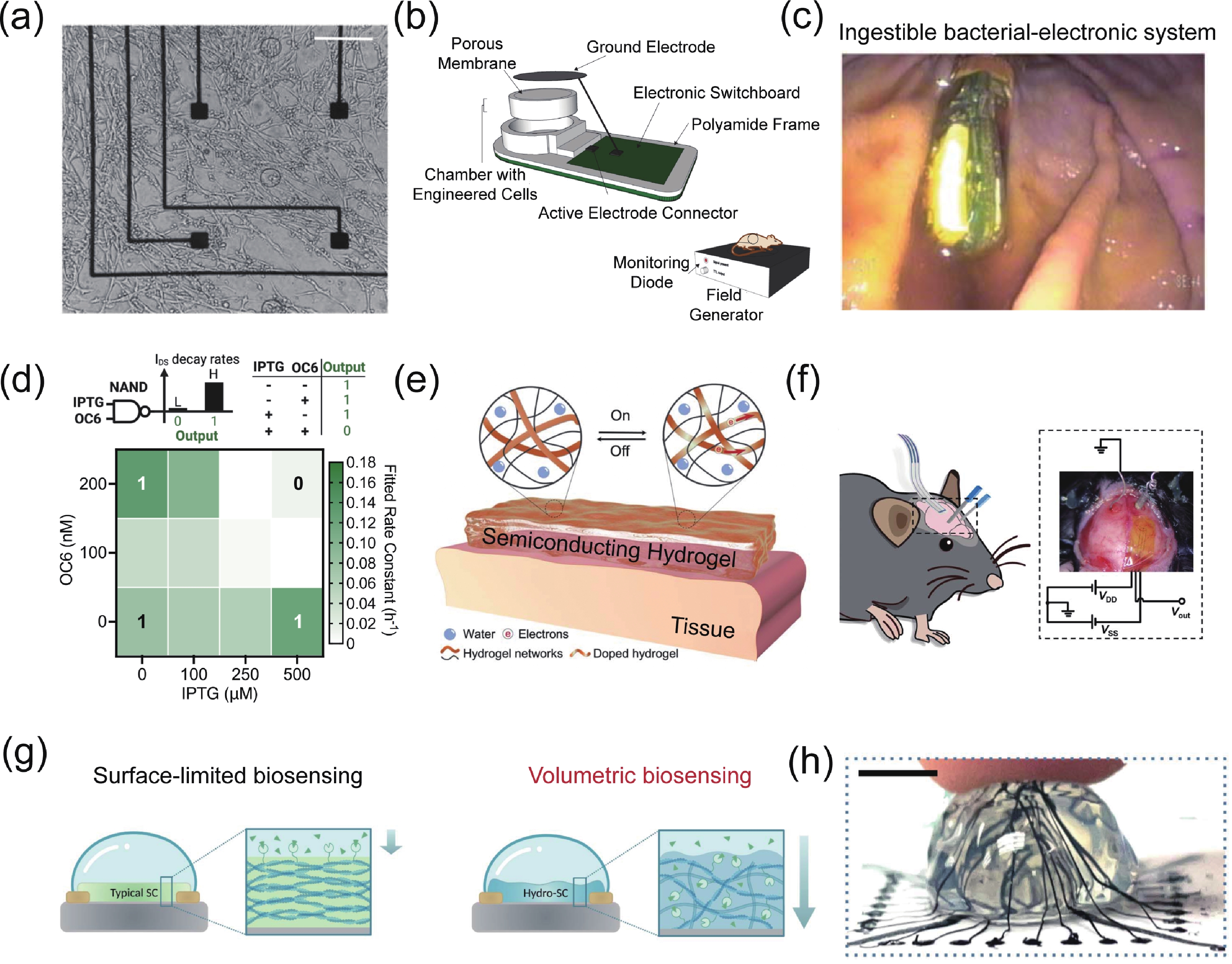
| [1] |
Rodrigo-Navarro A, Sankaran S, Dalby M J, et al. Engineered living biomaterials. Nat Rev Mater, 2021, 6(12): 1175 doi: 10.1038/s41578-021-00350-8 |
| [2] |
Kim S, Eig E, Tian B Z. The convergence of bioelectronics and engineered living materials. Cell Rep Phys Sci, 2024, 5(9): 102149 doi: 10.1016/j.xcrp.2024.102149 |
| [3] |
Huang H, Chen X N, Bai J, et al. The rise of hydrogel transistors. Nat Rev Electr Eng, 2026, 3(1): 61 doi: 10.1038/s44287-025-00231-0 |
| [4] |
Cullen D K, Patel A R, Doorish J F, et al. Developing a tissue-engineered neural-electrical relay using encapsulated neuronal constructs on conducting polymer fibers. J Neural Eng, 2008, 5(4): 374 doi: 10.1088/1741-2560/5/4/002 |
| [5] |
Purcell E K, Seymour J P, Yandamuri S, et al. In vivo evaluation of a neural stem cell-seeded prosthesis. J Neural Eng, 2009, 6(2): 026005 doi: 10.1088/1741-2560/6/2/026005 |
| [6] |
Goding J, Robles U A, Poole-Warren L, et al. A living electrode construct for incorporation of cells into bionic devices. MRS Commun, 2017, 7(3): 487 doi: 10.1557/mrc.2017.44 |
| [7] |
Rochford A E, Carnicer-Lombarte A, Kawan M, et al. Functional neurological restoration of amputated peripheral nerve using biohybrid regenerative bioelectronics. Sci Adv, 2023, 9(12): eadd8162 doi: 10.1126/sciadv.add8162 |
| [8] |
Krawczyk K, Xue S, Buchmann P, et al. Electrogenetic cellular insulin release for real-time glycemic control in type 1 diabetic mice. Science, 2020, 368(6494): 993 doi: 10.1126/science.aau7187 |
| [9] |
Shi J Y, Kim S, Li P J, et al. Active biointegrated living electronics for managing inflammation. Science, 2024, 384(6699): 1023 doi: 10.1126/science.adl1102 |
| [10] |
Mimee M, Nadeau P, Hayward A, et al. An ingestible bacterial-electronic system to monitor gastrointestinal health. Science, 2018, 360(6391): 915 doi: 10.1126/science.aas9315 |
| [11] |
Chen B Z, Kang W, Sun J, et al. Programmable living assembly of materials by bacterial adhesion. Nat Chem Biol, 2022, 18(3): 289 doi: 10.1038/s41589-021-00934-z |
| [12] |
Wang Z H, Bai H T, Yu W, et al. Flexible bioelectronic device fabricated by conductive polymer–based living material. Sci Adv, 2022, 8(25): eabo1458 doi: 10.1126/sciadv.abo1458 |
| [13] |
Rivnay J, Raman R, Robinson J T, et al. Integrating bioelectronics with cell-based synthetic biology. Nat Rev Bioeng, 2025, 3(4): 317 doi: 10.1038/s44222-024-00262-6 |
| [14] |
Keene S T, Lubrano C, Kazemzadeh S, et al. A biohybrid synapse with neurotransmitter-mediated plasticity. Nat Mater, 2020, 19(9): 969 doi: 10.1038/s41563-020-0703-y |
| [15] |
Gao Y, Zhou Y C, Ji X D, et al. A hybrid transistor with transcriptionally controlled computation and plasticity. Nat Commun, 2024, 15: 1598 doi: 10.1038/s41467-024-45759-1 |
| [16] |
Li P Y, Sun W X, Li J L, et al. N-type semiconducting hydrogel. Science, 2024, 384(6695): 557 doi: 10.1126/science.adj4397 |
| [17] |
Dai Y H, Wai S, Li P J, et al. Soft hydrogel semiconductors with augmented biointeractive functions. Science, 2024, 386(6720): 431 doi: 10.1126/science.adp9314 |
| [18] |
Atkinson J T, Su L, Zhang X, et al. Real-time bioelectronic sensing of environmental contaminants. Nature, 2022, 611(7936): 548 doi: 10.1038/s41586-022-05356-y |
| [19] |
Liu D Y, Bai J, Tian X Y, et al. Increasing the dimensionality of transistors with hydrogels. Science, 2025, 390(6775): 824 doi: 10.1126/science.adx4514 |



 Biqin Yang obtained his B.E. degree in Biomedical Engineering from Sichuan University. He is currently pursuing a Ph.D. in Materials Science at the School of Materials Science and Engineering, Peking University. His research focuses on novel bioelectronic materials and devices with advanced biocompatibility and biofunctional properties.
 Zhi Zhang received her Ph.D. degree from Donghua University in 2020 and conducted postdoctoral research at Peking University from 2021 to 2023. She is currently an Associate Professor at the School of Materials Science and Engineering, Peking University. Her research focuses on organic semiconducting materials and flexible bioelectronics.
 Ting Lei obtained his B.S. and Ph.D. degrees from Peking University in 2008 and 2013. He conducted postdoctoral research at Stanford University with Prof. Zhenan Bao from 2013 to 2018. He is currently a Boya Distinguished Professor at the School of Materials Science and Engineering, Peking University. His research focuses on organic or polymeric functional materials and their applications in flexible electronics and bioelectronics.
 DownLoad: