| [1] |
Indiveri G, Liu S C. Memory and information processing in neuromorphic systems. Proc IEEE, 2015, 103(8): 1379 doi: 10.1109/JPROC.2015.2444094 |
| [2] |
Lan G T, Lian H, Qin Z T, et al. Organic photonic synapses for application of bioinspired neuromorphic visual perception and beyond. Adv Funct Mater, 2025: e22513
|
| [3] |
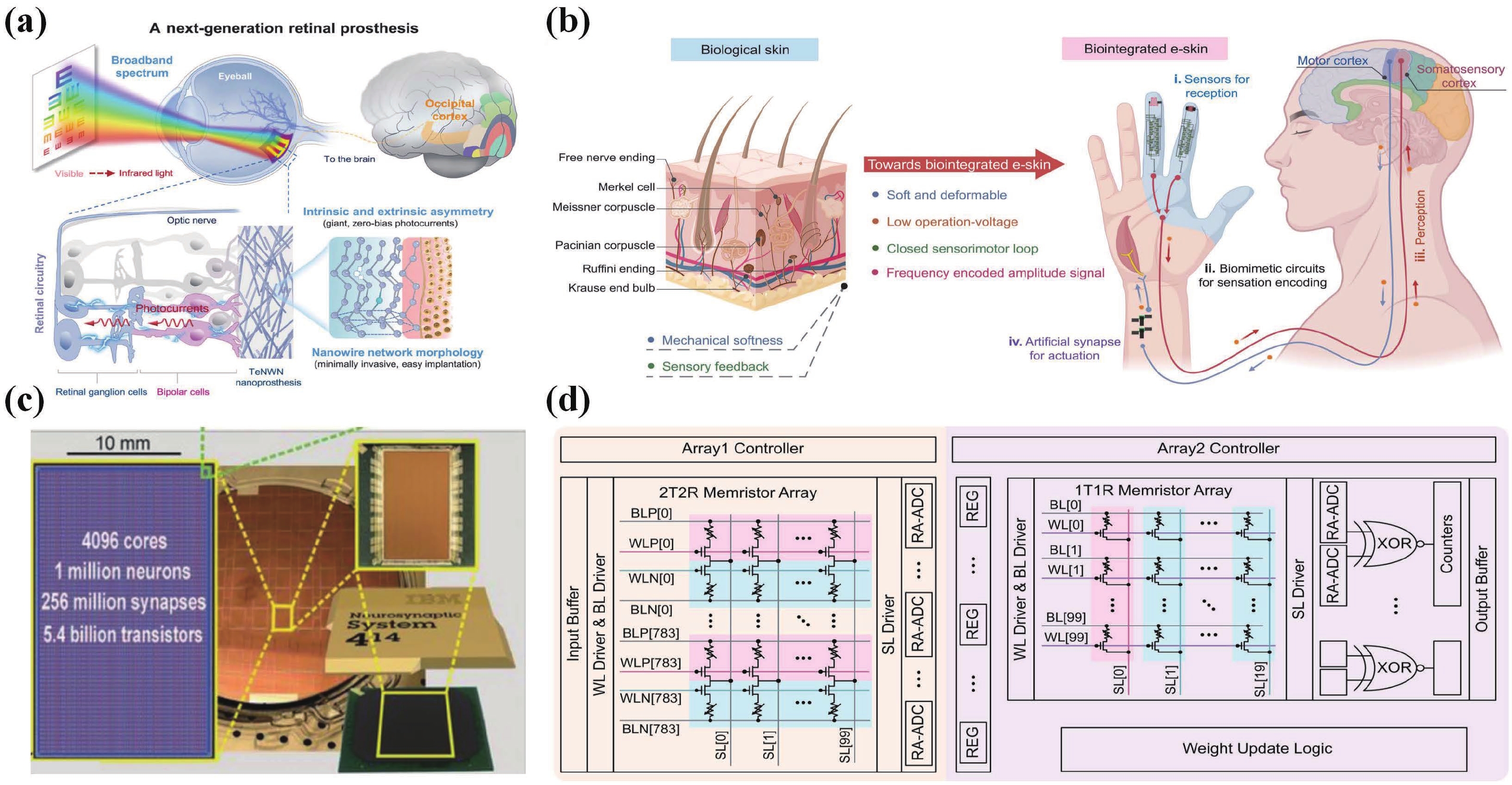
Liu X, Dai S L, Jin Y Y, et al. Near-infrared organic photoelectrochemical synaptic transistors by wafer-scale photolithography for neuromorphic visual system. Nat Commun, 2026, 17: 197 doi: 10.1038/s41467-025-66891-6 |
| [4] |
Wang W C, Jiang Y W, Zhong D L, et al. Neuromorphic sensorimotor loop embodied by monolithically integrated, low-voltage, soft e-skin. Science, 2023, 380(6646): 735 doi: 10.1126/science.ade0086 |
| [5] |
Bao R, Wang S Y, Liu X X, et al. Neuromorphic electro-stimulation based on atomically thin semiconductor for damage-free inflammation inhibition. Nat Commun, 2024, 15: 1327 doi: 10.1038/s41467-024-45590-8 |
| [6] |
Gu L L, Poddar S, Lin Y J, et al. A biomimetic eye with a hemispherical perovskite nanowire array retina. Nature, 2020, 581(7808): 278 doi: 10.1038/s41586-020-2285-x |
| [7] |
Chen J W, Zhou Z, Kim B J, et al. Optoelectronic graded neurons for bioinspired in-sensor motion perception. Nat Nanotechnol, 2023, 18(8): 882 doi: 10.1038/s41565-023-01379-2 |
| [8] |
Wang Y, Gou S F, Dong X Q, et al. A biologically inspired artificial neuron with intrinsic plasticity based on monolayer molybdenum disulfide. Nat Electron, 2025, 8: 680 doi: 10.1038/s41928-025-01433-y |
| [9] |
Zhang N, Wang Y, Yan Y J, et al. Floating-gate synaptic transistors for energy-efficient neuromorphic computing. Adv Mater, 2026, 38(8): e15605
|
| [10] |
Wang S Y, Jiang C Y, Yu Y Y, et al. Tellurium nanowire retinal nanoprosthesis improves vision in models of blindness. Science, 2025, 388: eadu2987 doi: 10.1126/science.adu2987 |
| [11] |
Zhou Y, Fu J W, Chen Z R, et al. Computational event-driven vision sensors for in-sensor spiking neural networks. Nat Electron, 2023, 6: 870 doi: 10.1038/s41928-023-01055-2 |
| [12] |
Li S J, Wu T, Xu J L, et al. Biomimetic multimodal tactile sensing enables human-like robotic perception. Nat Sens, 2026, 1: 52 doi: 10.1038/s44460-025-00006-y |
| [13] |
Chang J K, Maltby T, Moineddini A, et al. Piezoelectric nanofiber–based intelligent hearing system. Sci Adv, 2025, 11: eadl2741 doi: 10.1126/sciadv.adl2741 |
| [14] |
Zhong B W, Qin X K, Xu H, et al. Monolithic cell-on-memristor architecture enables wafer-scale integration of oscillatory chemoreceptors for bio-realistic gustatory chips. Nat Mater, 2026, 25: 275 doi: 10.1038/s41563-025-02436-y |
| [15] |
Merolla P A, Arthur J V, Alvarez-Icaza R, et al. A million spiking-neuron integrated circuit with a scalable communication network and interface. Science, 2014, 345: 668 doi: 10.1126/science.1254642 |
| [16] |
Yao P, Wu H Q, Gao B, et al. Fully hardware-implemented memristor convolutional neural network. Nature, 2020, 577: 641 doi: 10.1038/s41586-020-1942-4 |
| [17] |
Zhang W B, Yao P, Gao B, et al. Edge learning using a fully integrated neuro-inspired memristor chip. Science, 2023, 381: 1205 doi: 10.1126/science.ade3483 |
| [18] |
Liu Z W, Mei J, Tang J S, et al. A memristor-based adaptive neuromorphic decoder for brain–computer interfaces. Nat Electron, 2025, 8: 362 doi: 10.1038/s41928-025-01340-2 |
| [19] |
Yu R H, Wang Z, Liu Q, et al. A full-stack memristor-based computation-in-memory system with software-hardware co-development. Nat Commun, 2025, 16: 2123 doi: 10.1038/s41467-025-57183-0 |
| [20] |
Ning H K, Wen H D, Meng Y, et al. An index-free sparse neural network using two-dimensional semiconductor ferroelectric field-effect transistors. Nat Electron, 2025, 8: 222 doi: 10.1038/s41928-024-01328-4 |



 Zifei Gao received her Bachelor's degree from Hefei University of Technology in 2024. She is now a doctoral student in the School of Integrated Circuits and Micro-Nano Electronics Innovation at Fudan University, and her research focuses on neuromorphic devices and computing.
 Ziye Di received her Bachelor's degree from Central South University in 2022. She is now a Ph.D. candidate in the School of Integrated Circuits and Micro-Nano Electronics Innovation at Fudan University, and her research focuses on the interdisciplinary application of neuromorphic devices in medicine.
 Xiaofan Zhang received her Bachelor's degree from Taiyuan University of Technology in 2023. She is now a master's student in the School of Integrated Circuits and Micro-Nano Electronics Innovation at Fudan University, and her research focuses on neuromorphic computing and brain-computer interfaces.
 Shuiyuan Wang received the Ph.D. degree in microelectronics from the state key laboratory of ASIC and system, school of microelectronics, Fudan University. His main research interests are in a variety of novel electronic and optoelectronic devices based on atomic-scale 2D materials, in particular synaptic electronics, neuromorphic devices and computation based on 2D semiconductors, and more recently in bioelectronics.
 Peng Zhou is a full professor at the state key laboratory of ASIC and system, school of microelectronics, Fudan University, China. He received his B.S. (2000) and Ph.D. (2005) degrees in Physics from Fudan University, China. Currently, Prof. Zhou is interested in novel high-efficiency and low-power electronic devices based on 2D layered materials, focusing on the application of 2D materials in memory, including 2D ultrafast flash memory, floating gate memory, synaptic and neuromorphic electronics.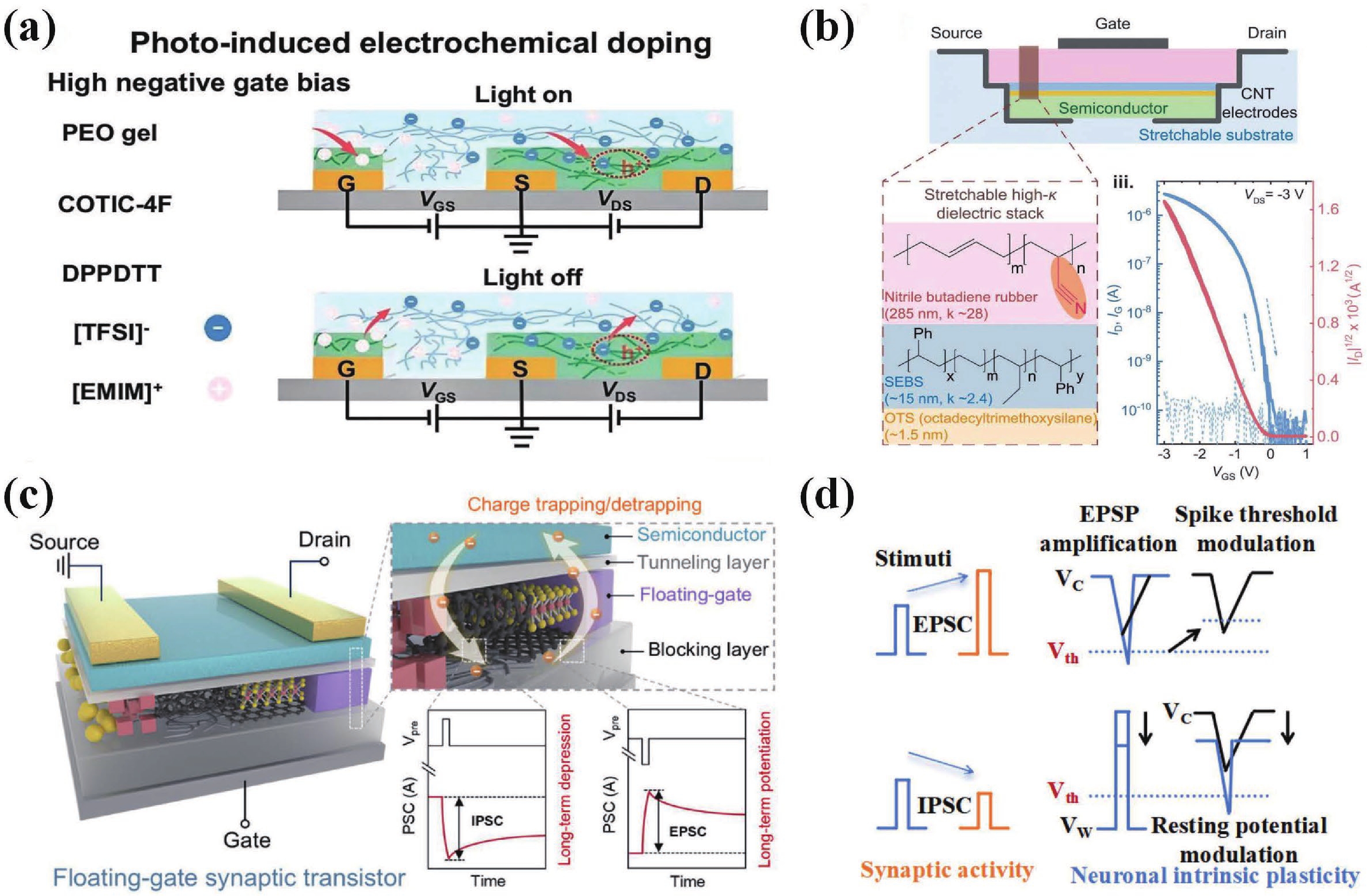
 DownLoad: