


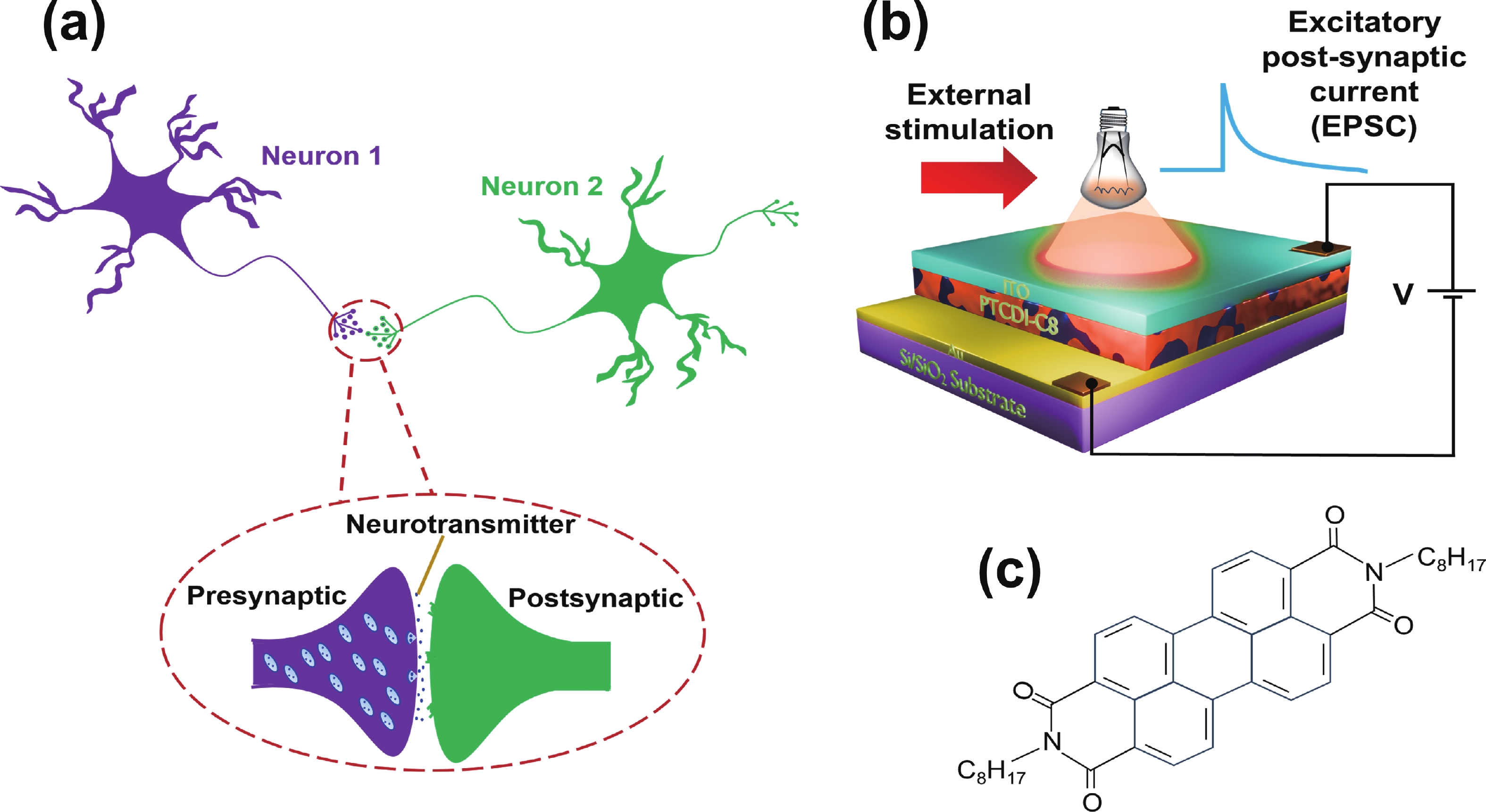
Fig. 1.
(Color online) (a) Schematic diagram of the biological synaptic structure. (b) 3D illustration of the vertical two-terminal synaptic device. (c) Chemical structure of PTCDI–C8.
ARTICLES
Sirsendu Ghosh§, Gaurav Shukla§, Ramesh Singh Bisht and Pramod Kumar
Corresponding author: Pramod Kumar, pramod_k@iitb.ac.in
Abstract: Synaptic devices are required to break the Von Neumann bottleneck by incorporating memory and processing within the same physical location and hence improve the computational strength for artificial intelligence and the Internet of Things (IoT). In this article, we report the synaptic characteristics of a two-terminal device, where an organic semiconductor (OSC) N, N'–dioctyl–3,4,9,10–perylenedicarboximide (PTCDI–C8) is sandwiched between Indium tin oxide (ITO) and gold (Au) on a silicon/silicon–dioxide (Si/SiO2) substrate, under multi-stimulus activation. The synaptic device utilizes a tungsten lamp that emits a broad spectral range from ultraviolet (UV) to infrared (IR) as a pre-synaptic signal, while providing a change in current as a post-synaptic signal. We demonstrate the short-term plasticity (STP) and long-term plasticity (LTP) based on exposure time. Electron–hole pairs are generated in OSC when UV–visible light is absorbed from external stimulation, which triggers the output current, whereas the IR component introduces a thermally assisted contribution that further enhances charge transport. Hence, the effect of temperature is also observed, which simultaneously acts as an external stimulation for the synaptic device. Under temperature accompanied by optical stimulation, the learning-forgetting-relearning phenomenon is also achieved in this work. Additionally, logic operation and associative learning phenomena are demonstrated by the device under IR and tungsten source. The change in current depends on the exposure time and the temperature generated on the surface. Since temperatures above 45 °C are hazardous to human beings, this synaptic device is useful in measuring and retaining this information. The incorporation of temperature with light is not commonly used as an external synaptic stimulus in the same device, hence it can find its applications in neuromorphic computing and artificial sensory neuron systems, which is also capable of sensing and retaining thermal information.
Keywords: organic semiconductors, heat and light-regulated stimulation, synaptic, learning-forgetting-relearning, associative learning
| [1] |
Tang Y, Nyengaard J R, De Groot D M G, et al. Total regional and global number of synapses in the human brain neocortex. Synapse, 2001, 41(3): 258 doi: 10.1002/syn.1083
|
| [2] |
Finnema S J, Nabulsi N B, Eid T, et al. Imaging synaptic density in the living human brain. Science translational medicine, 2016, 8(348): 348ra96
|
| [3] |
Burr G W, Shelby R M, Sebastian A, et al. Neuromorphic computing using non-volatile memory. Adv Phys X, 2017, 2(1): 89
|
| [4] |
Ohno T, Hasegawa T, Tsuruoka T, et al. Short-term plasticity and long-term potentiation mimicked in single inorganic synapses. Nature Mater, 2011, 10(8): 591 doi: 10.1038/nmat3054
|
| [5] |
Seok H, Lee D, Son S, et al. Beyond von Neumann architecture: Brain-inspired artificial neuromorphic devices and integrated computing. Adv Elect Materials, 2024, 10(8): 2300839 doi: 10.1002/aelm.202300839
|
| [6] |
Pershin Y V, Di Ventra M. Neuromorphic, digital, and quantum computation with memory circuit elements. Proc IEEE, 2012, 100(6): 2071 doi: 10.1109/JPROC.2011.2166369
|
| [7] |
Liu X, Huang W, Kai C H, et al. Photogated synaptic transistors based on the heterostructure of 4H-SiC and organic semiconductors for neuromorphic ultraviolet vision. ACS Appl Electron Mater, 2023, 5(1): 367 doi: 10.1021/acsaelm.2c01390
|
| [8] |
Yang C D, Qian J, Jiang S, et al. An optically modulated organic Schottky-barrier planar-diode-based artificial synapse. Adv Opt Mater, 2020, 8(13): 2000153 doi: 10.1002/adom.202000153
|
| [9] |
Li C, Gu Y J, Li X M, et al. A light-responsive molecular dielectric surface for ultraviolet-selective organic optoelectronic artificial synapses. ACS Appl Electron Mater, 2025, 7(11): 4832 doi: 10.1021/acsaelm.5c00275
|
| [10] |
Lan S Q, Ke Y D, Chen H P. Photonic synaptic transistor based on P-type organic semiconductor blending with N-type organic semiconductor. IEEE Electron Device Lett, 2021, 42(8): 1180 doi: 10.1109/LED.2021.3090906
|
| [11] |
Fan L Z, Kim D K, Jennings J H, et al. All-optical physiology resolves a synaptic basis for behavioral timescale plasticity. Cell, 2023, 186(3): 543 doi: 10.1016/j.cell.2022.12.035
|
| [12] |
Van Hook M J. Temperature effects on synaptic transmission and neuronal function in the visual thalamus. PLoS One, 2020, 15(4): e0232451 doi: 10.1371/journal.pone.0232451
|
| [13] |
Feng Z D, Saha L, Dritsa C, et al. Temperature-dependent structural plasticity of hippocampal synapses. Front Cell Neurosci, 2022, 16: 1009970 doi: 10.3389/fncel.2022.1009970
|
| [14] |
Pyott S J, Rosenmund C. The effects of temperature on vesicular supply and release in autaptic cultures of rat and mouse hippocampal neurons. J Physiol, 2002, 539(2): 523 doi: 10.1113/jphysiol.2001.013277
|
| [15] |
Montgomery J C, MacDonald J A. Effects of temperature on nervous system: Implications for behavioral performance. Am J Physiol Regul Integr Comp Physiol, 1990, 259(2): R191
|
| [16] |
Gao Y, Han X E, Gao X, et al. Temperature-dependent plasticity in organic synaptic transistors for adaptive learning and data encryption. Mater Des, 2025, 255: 114152 doi: 10.1016/j.matdes.2025.114152
|
| [17] |
Li E L, Lin W K, Yan Y J, et al. Synaptic transistor capable of accelerated learning induced by temperature-facilitated modulation of synaptic plasticity. ACS Appl Mater Interfaces, 2019, 11(49): 46008 doi: 10.1021/acsami.9b17227
|
| [18] |
Ghosh S, Shukla G, Kumar P. Artificial short term synaptic behavior of organic polymer device capable of detecting both visible and infrared signals. Mater Today Commun, 2025, 47: 113115 doi: 10.1016/j.mtcomm.2025.113115
|
| [19] |
Wang H N, Li Y, Yao B, et al. Gold nanoparticles-decorated N, N'-dioctyl-3, 4, 9, 10-perylene tetracarboxylic diimide active layer towards remarkably enhanced visible-light photoresponse of an n-type organic phototransistor. Thin Solid Films, 2021, 718: 138478 doi: 10.1016/j.tsf.2020.138478
|
| [20] |
Efros A L, Delehanty J B, Huston A L, et al. Evaluating the potential of using quantum dots for monitoring electrical signals in neurons. Nature Nanotech, 2018, 13(4): 278 doi: 10.1038/s41565-018-0107-1
|
| [21] |
Godavarthi S K, Hiramoto M, Ignatyev Y, et al. Postsynaptic receptors regulate presynaptic transmitter stability through transsynaptic bridges. Proc Natl Acad Sci USA, 2024, 121(15): e2318041121 doi: 10.1073/pnas.2318041121
|
| [22] |
Lovinger D M, Mateo Y, Johnson K A, et al. Local modulation by presynaptic receptors controls neuronal communication and behaviour. Nat Rev Neurosci, 2022, 23(4): 191 doi: 10.1038/s41583-022-00561-0
|
| [23] |
Hao D D, Chen T Q, Guo P, et al. Artificial optoelectronic synaptic devices based on vertical organic field-effect transistors with low energy consumption. Adv Compos Hybrid Mater, 2023, 6(4): 129 doi: 10.1007/s42114-023-00712-6
|
| [24] |
Osaki T, Duenki T, Chow S Y A, et al. Complex activity and short-term plasticity of human cerebral organoids reciprocally connected with axons. Nat Commun, 2024, 15: 2945 doi: 10.1038/s41467-024-46787-7
|
| [25] |
Pantev C, Wollbrink A, Roberts L E, et al. Short-term plasticity of the human auditory cortex. Brain Res, 1999, 842(1): 192 doi: 10.1016/S0006-8993(99)01835-1
|
| [26] |
Zhao P F, Peng X Y, Cui M Q, et al. Multifunctional two-terminal optoelectronic synapse based on an organic semiconductor film. ACS Appl Polym Mater, 2023, 5(10): 8764 doi: 10.1021/acsapm.3c02012
|
| [27] |
Mukherjee B, Sim K, Shin T J, et al. Organic phototransistors based on solution grown, ordered single crystalline arrays of a π-conjugated molecule. J Mater Chem, 2012, 22(7): 3192 doi: 10.1039/c2jm14179e
|
| [28] |
Sun Y M, Wang Y F, Yuan Q. Artificial nociceptor based on temperature responsive of synaptic transistor for electronic skin. Appl Mater Today, 2024, 40: 102355 doi: 10.1016/j.apmt.2024.102355
|
| [29] |
López J C. A fresh look at paired-pulse facilitation. Nat Rev Neurosci, 2001, 2(5): 307 doi: 10.1038/35072519
|
| [30] |
Atluri P P, Regehr W G. Determinants of the time course of facilitation at the granule cell to Purkinje cell synapse. J Neurosci, 1996, 16(18): 5661 doi: 10.1523/JNEUROSCI.16-18-05661.1996
|
| [31] |
Zhang Y C, Chen H, Sun W Q, et al. All-photonic synapses for biomimetic ocular system. Adv Funct Mater, 2024, 34(49): 2409419 doi: 10.1002/adfm.202409419
|
| [32] |
Zucker R S, Regehr W G. Short-term synaptic plasticity. Annu Rev Physiol, 2002, 64: 355 doi: 10.1146/annurev.physiol.64.092501.114547
|
| [33] |
Monday H R, Younts T J, Castillo P E. Long-term plasticity of neurotransmitter release: Emerging mechanisms and contributions to brain function and disease. Annu Rev Neurosci, 2018, 41: 299 doi: 10.1146/annurev-neuro-080317-062155
|
| [34] |
Atkinson R C, Shiffrin R M. Human memory: A proposed system and its control processes. Psychology of Learning and Motivation. Amsterdam: Elsevier, 1968: 89
|
| [35] |
Fisher J S, Radvansky G A. Degree of learning and linear forgetting. Q J Exp Psychol, 2022, 75(8): 1483 doi: 10.1177/17470218211056464
|
| [36] |
Murre J M J, Dros J. Replication and analysis of ebbinghaus’ forgetting curve. PLoS One, 2015, 10(7): e0120644 doi: 10.1371/journal.pone.0120644
|
| [37] |
Hu S G, Liu Y, Chen T P, et al. Emulating the Ebbinghaus forgetting curve of the human brain with a NiO-based memristor. Appl Phys Lett, 2013, 103(13): 133701 doi: 10.1063/1.4822124
|
| [38] |
Tian Q L, Chen X T, Zhao X N, et al. Temperature-modulated switching behaviors of diffusive memristor for biorealistic emulation of synaptic plasticity. Appl Phys Lett, 2023, 122(15): 153502 doi: 10.1063/5.0142742
|
| [39] |
Chen D D, Choi Y, Qian C, et al. Stabilizing analog signal processing of artificial synapse under heat fluctuations through light-temperature antagonistic operation. Adv Funct Mater, 2024, 34(39): 2405244 doi: 10.1002/adfm.202405244
|
| [40] |
Wang S Y, Shi X F, Gong J Y, et al. Artificial retina based on organic heterojunction transistors for mobile recognition. Nano Lett, 2024, 24(10): 3204 doi: 10.1021/acs.nanolett.4c00087
|
| [41] |
Qian C, Oh S, Choi Y, et al. Solar-stimulated optoelectronic synapse based on organic heterojunction with linearly potentiated synaptic weight for neuromorphic computing. Nano Energy, 2019, 66: 104095 doi: 10.1016/j.nanoen.2019.104095
|
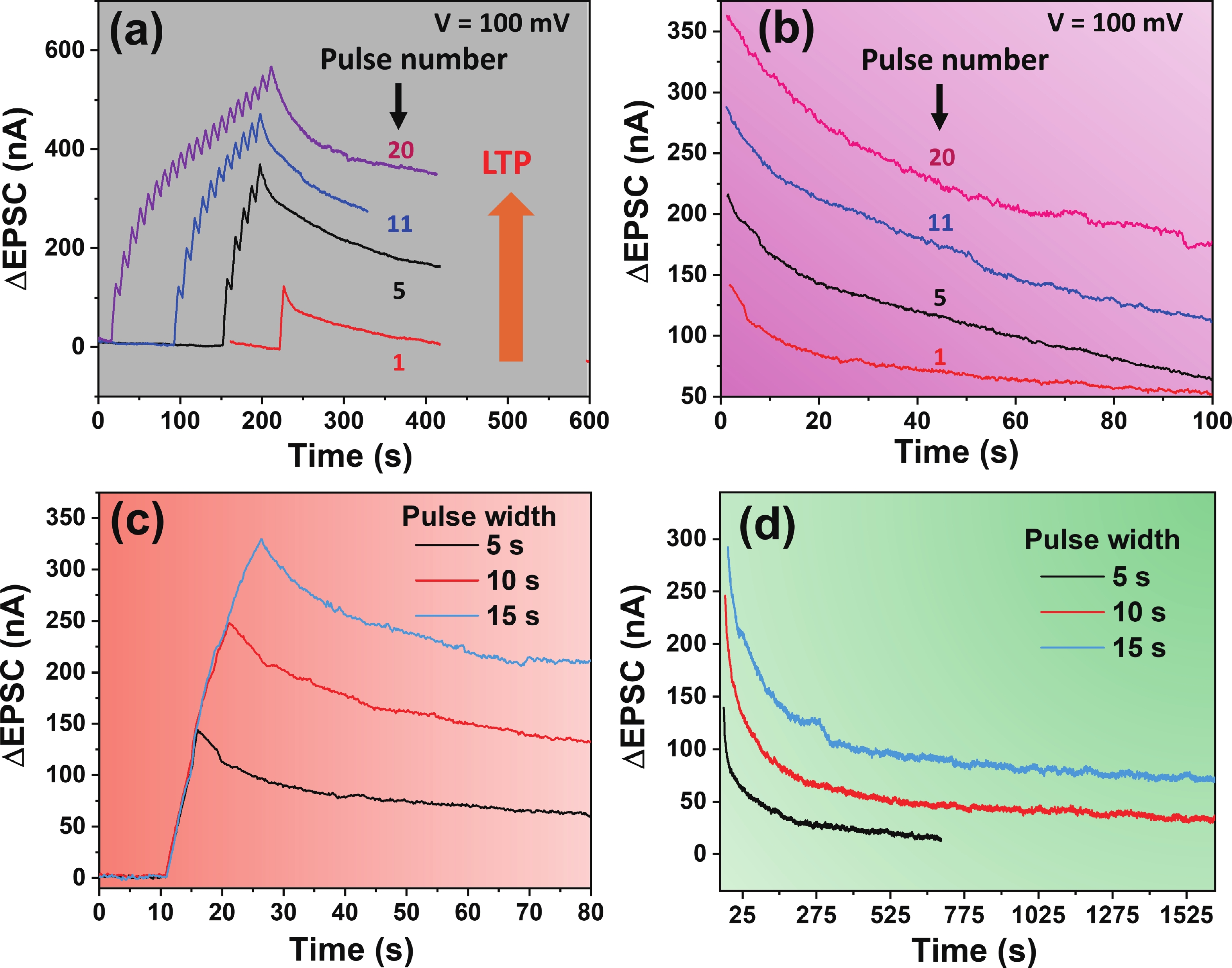
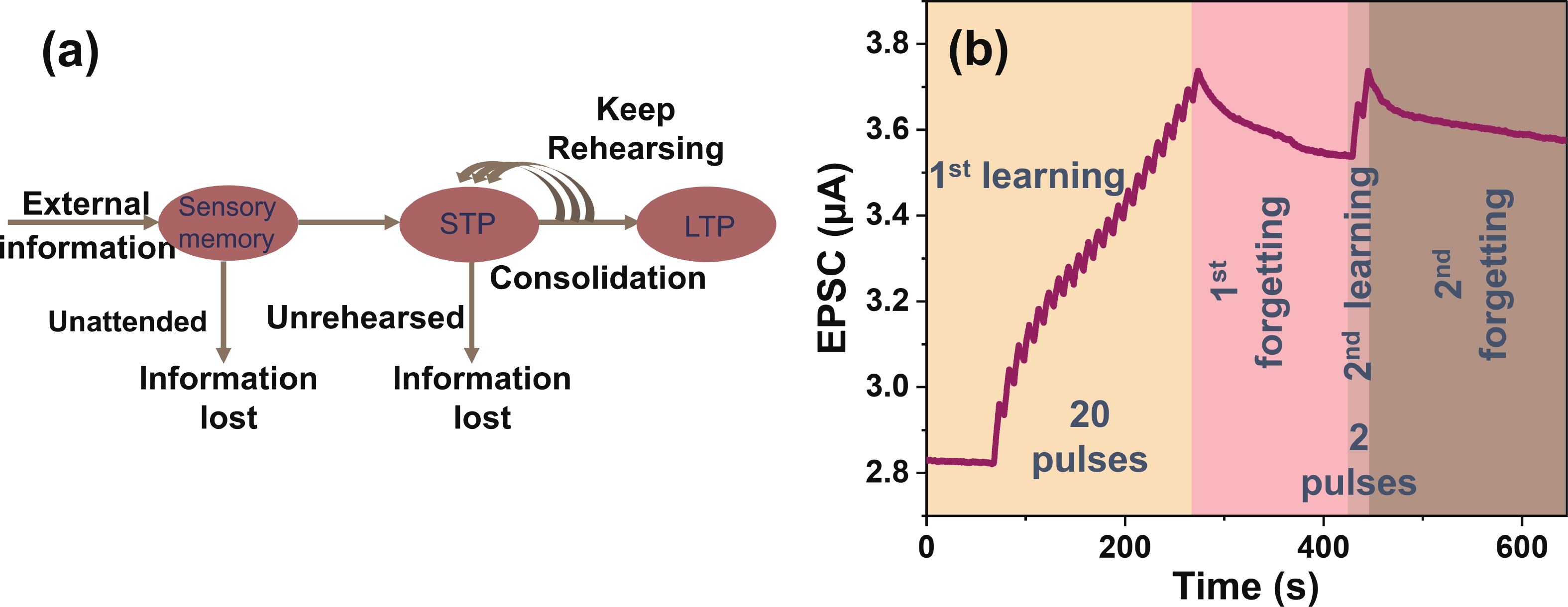
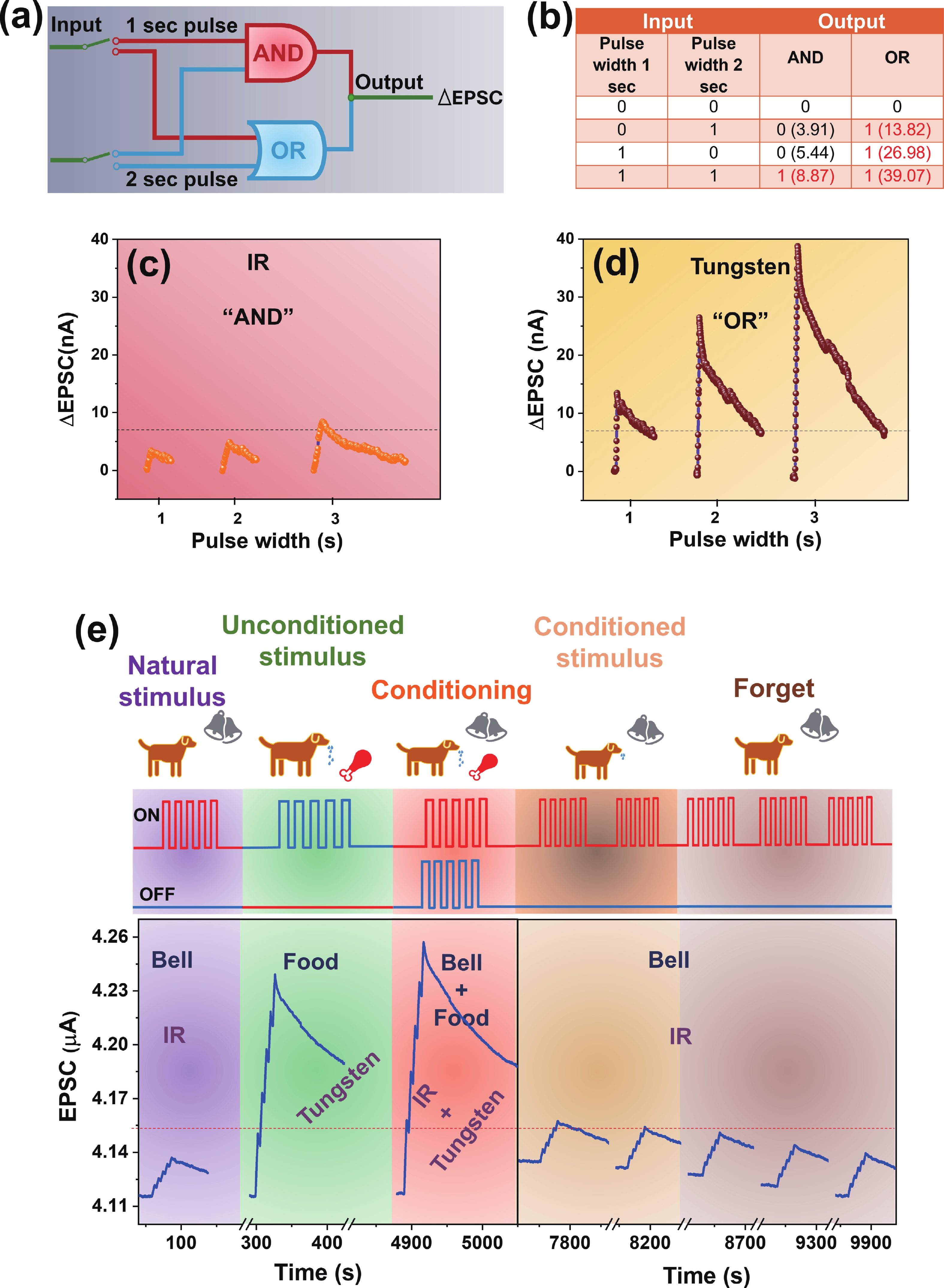
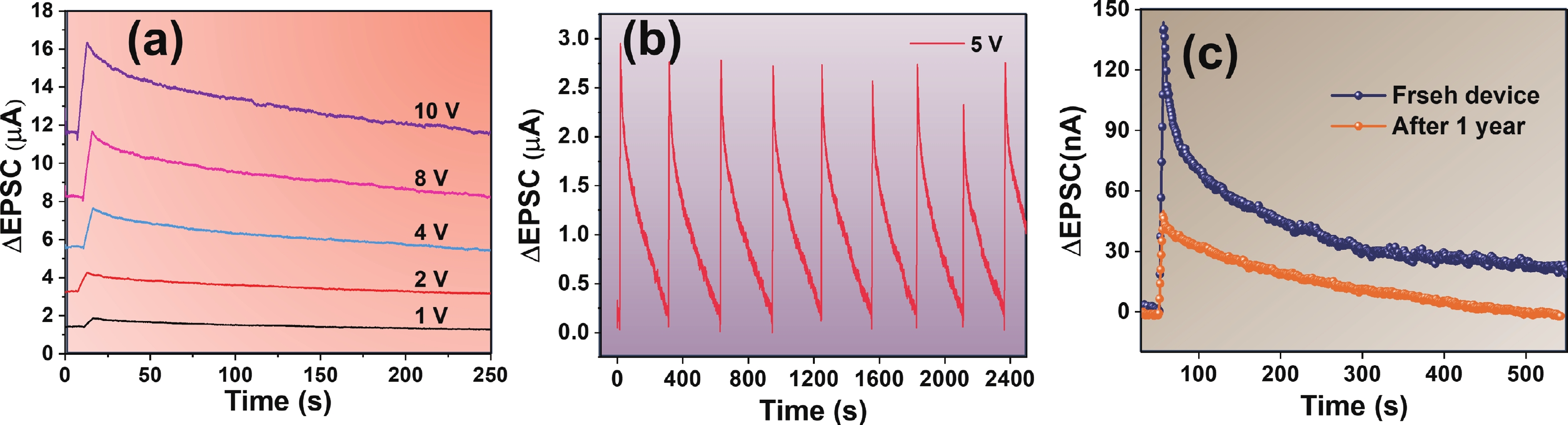
Table 1. Comparison of recent devices incorporating temperature as an external stimulus.
| Device structure | Type of contact | Channel layer preparation | External stimulation | Characteristics time from PPF index (τ1, τ2) | Synaptic properties |
Ref. |
| Si/TaOx/PMMA/Pentacene/Cu | Transistor | Thermal deposition | Temperature dependent voltage pulse | 68−245 ms, 0.917−1.231 s | EPSC, PPF index, post-tetanic potentiation, information encryption, decryption, self-annihilation | [16] |
| Pt/Amorphous carbon/Ag | Two-terminal | Sputtering method | Voltage pulse with temperature modulation | − | EPSC, STP, LTP, LTD, STDP, forgetting behavior | [38] |
| Glass/ITO/Chitosan/PVA + PVK/Al | Transistor | Spin-coating | Voltage pulse with the variation of temperature | 1.6 and 35.2 s | EPSC, STP, PPF index, LTP, associative learning | [28] |
| Si/PTCDI–C8/CuPc/Au | Transistor | Thermal evaporation | Voltage pulse with light-temperature ambivalent | − | EPSC, STP, LTP, LTD | [39] |
| Si/SiO2 /PVP + QD/IDTBT/Au | Transistor | Spin-coating | Voltage pulse with different temperatures | 589 ms | EPSC, STP, PPF index, LTP, LTD, associative learning | [17] |
| Si/SiO2/PMMA/C8-BTBT//PTCDI–C8/Au | Three-terminal | Thermal evaporation | Light pulse, 405 nm, 520 nm | − | EPSC, PPF index, visual transient effect, visual memory system | [40] |
| Si/SiO2/p-6P/CuPc/Au | Three- terminal | Thermal evaporation | Optical pulse, 365 nm along with voltage pulse | − | EPSC, STP, LTP, LTD, image recognition | [41] |
| aSi/SiO2 /Au/PTCDI–C8/ITO | Two-terminal | Spin-coating | Simultaneous opto-thermal co-stimulation | 13.18 s | EPSC, STP, PPF index, LTP, learning-forgetting-relearning, logic gate, associative learning | This work |
| aWe have used dynamic thermal stimulus (IR) coupled with optical excitation (UV–visible) unlike conventional works where temperature is a static external condition. | ||||||
 DownLoad: CSV
| [1] |
Tang Y, Nyengaard J R, De Groot D M G, et al. Total regional and global number of synapses in the human brain neocortex. Synapse, 2001, 41(3): 258 doi: 10.1002/syn.1083
|
| [2] |
Finnema S J, Nabulsi N B, Eid T, et al. Imaging synaptic density in the living human brain. Science translational medicine, 2016, 8(348): 348ra96
|
| [3] |
Burr G W, Shelby R M, Sebastian A, et al. Neuromorphic computing using non-volatile memory. Adv Phys X, 2017, 2(1): 89
|
| [4] |
Ohno T, Hasegawa T, Tsuruoka T, et al. Short-term plasticity and long-term potentiation mimicked in single inorganic synapses. Nature Mater, 2011, 10(8): 591 doi: 10.1038/nmat3054
|
| [5] |
Seok H, Lee D, Son S, et al. Beyond von Neumann architecture: Brain-inspired artificial neuromorphic devices and integrated computing. Adv Elect Materials, 2024, 10(8): 2300839 doi: 10.1002/aelm.202300839
|
| [6] |
Pershin Y V, Di Ventra M. Neuromorphic, digital, and quantum computation with memory circuit elements. Proc IEEE, 2012, 100(6): 2071 doi: 10.1109/JPROC.2011.2166369
|
| [7] |
Liu X, Huang W, Kai C H, et al. Photogated synaptic transistors based on the heterostructure of 4H-SiC and organic semiconductors for neuromorphic ultraviolet vision. ACS Appl Electron Mater, 2023, 5(1): 367 doi: 10.1021/acsaelm.2c01390
|
| [8] |
Yang C D, Qian J, Jiang S, et al. An optically modulated organic Schottky-barrier planar-diode-based artificial synapse. Adv Opt Mater, 2020, 8(13): 2000153 doi: 10.1002/adom.202000153
|
| [9] |
Li C, Gu Y J, Li X M, et al. A light-responsive molecular dielectric surface for ultraviolet-selective organic optoelectronic artificial synapses. ACS Appl Electron Mater, 2025, 7(11): 4832 doi: 10.1021/acsaelm.5c00275
|
| [10] |
Lan S Q, Ke Y D, Chen H P. Photonic synaptic transistor based on P-type organic semiconductor blending with N-type organic semiconductor. IEEE Electron Device Lett, 2021, 42(8): 1180 doi: 10.1109/LED.2021.3090906
|
| [11] |
Fan L Z, Kim D K, Jennings J H, et al. All-optical physiology resolves a synaptic basis for behavioral timescale plasticity. Cell, 2023, 186(3): 543 doi: 10.1016/j.cell.2022.12.035
|
| [12] |
Van Hook M J. Temperature effects on synaptic transmission and neuronal function in the visual thalamus. PLoS One, 2020, 15(4): e0232451 doi: 10.1371/journal.pone.0232451
|
| [13] |
Feng Z D, Saha L, Dritsa C, et al. Temperature-dependent structural plasticity of hippocampal synapses. Front Cell Neurosci, 2022, 16: 1009970 doi: 10.3389/fncel.2022.1009970
|
| [14] |
Pyott S J, Rosenmund C. The effects of temperature on vesicular supply and release in autaptic cultures of rat and mouse hippocampal neurons. J Physiol, 2002, 539(2): 523 doi: 10.1113/jphysiol.2001.013277
|
| [15] |
Montgomery J C, MacDonald J A. Effects of temperature on nervous system: Implications for behavioral performance. Am J Physiol Regul Integr Comp Physiol, 1990, 259(2): R191
|
| [16] |
Gao Y, Han X E, Gao X, et al. Temperature-dependent plasticity in organic synaptic transistors for adaptive learning and data encryption. Mater Des, 2025, 255: 114152 doi: 10.1016/j.matdes.2025.114152
|
| [17] |
Li E L, Lin W K, Yan Y J, et al. Synaptic transistor capable of accelerated learning induced by temperature-facilitated modulation of synaptic plasticity. ACS Appl Mater Interfaces, 2019, 11(49): 46008 doi: 10.1021/acsami.9b17227
|
| [18] |
Ghosh S, Shukla G, Kumar P. Artificial short term synaptic behavior of organic polymer device capable of detecting both visible and infrared signals. Mater Today Commun, 2025, 47: 113115 doi: 10.1016/j.mtcomm.2025.113115
|
| [19] |
Wang H N, Li Y, Yao B, et al. Gold nanoparticles-decorated N, N'-dioctyl-3, 4, 9, 10-perylene tetracarboxylic diimide active layer towards remarkably enhanced visible-light photoresponse of an n-type organic phototransistor. Thin Solid Films, 2021, 718: 138478 doi: 10.1016/j.tsf.2020.138478
|
| [20] |
Efros A L, Delehanty J B, Huston A L, et al. Evaluating the potential of using quantum dots for monitoring electrical signals in neurons. Nature Nanotech, 2018, 13(4): 278 doi: 10.1038/s41565-018-0107-1
|
| [21] |
Godavarthi S K, Hiramoto M, Ignatyev Y, et al. Postsynaptic receptors regulate presynaptic transmitter stability through transsynaptic bridges. Proc Natl Acad Sci USA, 2024, 121(15): e2318041121 doi: 10.1073/pnas.2318041121
|
| [22] |
Lovinger D M, Mateo Y, Johnson K A, et al. Local modulation by presynaptic receptors controls neuronal communication and behaviour. Nat Rev Neurosci, 2022, 23(4): 191 doi: 10.1038/s41583-022-00561-0
|
| [23] |
Hao D D, Chen T Q, Guo P, et al. Artificial optoelectronic synaptic devices based on vertical organic field-effect transistors with low energy consumption. Adv Compos Hybrid Mater, 2023, 6(4): 129 doi: 10.1007/s42114-023-00712-6
|
| [24] |
Osaki T, Duenki T, Chow S Y A, et al. Complex activity and short-term plasticity of human cerebral organoids reciprocally connected with axons. Nat Commun, 2024, 15: 2945 doi: 10.1038/s41467-024-46787-7
|
| [25] |
Pantev C, Wollbrink A, Roberts L E, et al. Short-term plasticity of the human auditory cortex. Brain Res, 1999, 842(1): 192 doi: 10.1016/S0006-8993(99)01835-1
|
| [26] |
Zhao P F, Peng X Y, Cui M Q, et al. Multifunctional two-terminal optoelectronic synapse based on an organic semiconductor film. ACS Appl Polym Mater, 2023, 5(10): 8764 doi: 10.1021/acsapm.3c02012
|
| [27] |
Mukherjee B, Sim K, Shin T J, et al. Organic phototransistors based on solution grown, ordered single crystalline arrays of a π-conjugated molecule. J Mater Chem, 2012, 22(7): 3192 doi: 10.1039/c2jm14179e
|
| [28] |
Sun Y M, Wang Y F, Yuan Q. Artificial nociceptor based on temperature responsive of synaptic transistor for electronic skin. Appl Mater Today, 2024, 40: 102355 doi: 10.1016/j.apmt.2024.102355
|
| [29] |
López J C. A fresh look at paired-pulse facilitation. Nat Rev Neurosci, 2001, 2(5): 307 doi: 10.1038/35072519
|
| [30] |
Atluri P P, Regehr W G. Determinants of the time course of facilitation at the granule cell to Purkinje cell synapse. J Neurosci, 1996, 16(18): 5661 doi: 10.1523/JNEUROSCI.16-18-05661.1996
|
| [31] |
Zhang Y C, Chen H, Sun W Q, et al. All-photonic synapses for biomimetic ocular system. Adv Funct Mater, 2024, 34(49): 2409419 doi: 10.1002/adfm.202409419
|
| [32] |
Zucker R S, Regehr W G. Short-term synaptic plasticity. Annu Rev Physiol, 2002, 64: 355 doi: 10.1146/annurev.physiol.64.092501.114547
|
| [33] |
Monday H R, Younts T J, Castillo P E. Long-term plasticity of neurotransmitter release: Emerging mechanisms and contributions to brain function and disease. Annu Rev Neurosci, 2018, 41: 299 doi: 10.1146/annurev-neuro-080317-062155
|
| [34] |
Atkinson R C, Shiffrin R M. Human memory: A proposed system and its control processes. Psychology of Learning and Motivation. Amsterdam: Elsevier, 1968: 89
|
| [35] |
Fisher J S, Radvansky G A. Degree of learning and linear forgetting. Q J Exp Psychol, 2022, 75(8): 1483 doi: 10.1177/17470218211056464
|
| [36] |
Murre J M J, Dros J. Replication and analysis of ebbinghaus’ forgetting curve. PLoS One, 2015, 10(7): e0120644 doi: 10.1371/journal.pone.0120644
|
| [37] |
Hu S G, Liu Y, Chen T P, et al. Emulating the Ebbinghaus forgetting curve of the human brain with a NiO-based memristor. Appl Phys Lett, 2013, 103(13): 133701 doi: 10.1063/1.4822124
|
| [38] |
Tian Q L, Chen X T, Zhao X N, et al. Temperature-modulated switching behaviors of diffusive memristor for biorealistic emulation of synaptic plasticity. Appl Phys Lett, 2023, 122(15): 153502 doi: 10.1063/5.0142742
|
| [39] |
Chen D D, Choi Y, Qian C, et al. Stabilizing analog signal processing of artificial synapse under heat fluctuations through light-temperature antagonistic operation. Adv Funct Mater, 2024, 34(39): 2405244 doi: 10.1002/adfm.202405244
|
| [40] |
Wang S Y, Shi X F, Gong J Y, et al. Artificial retina based on organic heterojunction transistors for mobile recognition. Nano Lett, 2024, 24(10): 3204 doi: 10.1021/acs.nanolett.4c00087
|
| [41] |
Qian C, Oh S, Choi Y, et al. Solar-stimulated optoelectronic synapse based on organic heterojunction with linearly potentiated synaptic weight for neuromorphic computing. Nano Energy, 2019, 66: 104095 doi: 10.1016/j.nanoen.2019.104095
|





Article views: 115 Times PDF downloads: 37 Times Cited by: 0 Times
Received: 08 April 2026 Revised: 12 June 2026 Online: Accepted Manuscript: 07 August 2026Uncorrected proof: 10 October 2026
| Citation: |
Sirsendu Ghosh, Gaurav Shukla, Ramesh Singh Bisht, Pramod Kumar. Thermo-optoelectronic synaptic device for heat and light-regulated neuromorphic applications and artificial sensory neuron system for humanoids[J]. Journal of Semiconductors, 2026, In Press. doi: 10.1088/1674-4926/26040010
****
S Ghosh, G Shukla, R S Bisht, and P Kumar, Thermo-optoelectronic synaptic device for heat and light-regulated neuromorphic applications and artificial sensory neuron system for humanoids[J]. J. Semicond., 2026, accepted doi: 10.1088/1674-4926/26040010

|
 Sirsendu Ghosh received his B.Sc. and M.Sc. degrees in Physics from the University of Calcutta, India, in 2018 and 2020, respectively. He is currently a doctoral student at the Indian Institute of Technology Bombay, India. His research interests include simulation and experimental studies of organic semiconductor-based devices, particularly field-effect transistors, resistive switching, neuromorphic computing, and emerging memory technologies
 Gaurav Shukla received his B.Sc. and M.Sc. degrees from the University of Allahabad, India, and earned his Ph.D. in Physics from the DST-Centre for Nano and Soft Matter Sciences, Bangalore, in 2022. He subsequently held postdoctoral positions at the Indian Institute of Technology Bombay and the Nanoscience Institute–CNR, Pisa, Italy, before joining the National Quantum Mission of India in 2025. His research focuses on nanofabrication, quantum and superconducting devices, neuromorphic systems, surface engineering, structural colors, and plasmonic nanostructures, bridging materials science, condensed matter physics, and device engineering
 Pramod Kumar is a professor and doctoral advisor at the Department of Physics, Indian Institute of Technology Bombay. He received his Ph.D. from Jawaharlal Nehru University, New Delhi, India. He later held postdoc positions at the Israel Institute of Technology, Haifa, Israel and the Biorobotics Institute, Pontedera, Scuola Superiore Sant'Anna, Pisa, Italy. His primary research interests focus on the application of organic semiconductors, the interface between organic and inorganic semiconductors, charge carrier transport in disordered systems, field effect transistors, sensors and artificial intelligence integration with sensors and devices
| [1] |
Tang Y, Nyengaard J R, De Groot D M G, et al. Total regional and global number of synapses in the human brain neocortex. Synapse, 2001, 41(3): 258 doi: 10.1002/syn.1083
|
| [2] |
Finnema S J, Nabulsi N B, Eid T, et al. Imaging synaptic density in the living human brain. Science translational medicine, 2016, 8(348): 348ra96
|
| [3] |
Burr G W, Shelby R M, Sebastian A, et al. Neuromorphic computing using non-volatile memory. Adv Phys X, 2017, 2(1): 89
|
| [4] |
Ohno T, Hasegawa T, Tsuruoka T, et al. Short-term plasticity and long-term potentiation mimicked in single inorganic synapses. Nature Mater, 2011, 10(8): 591 doi: 10.1038/nmat3054
|
| [5] |
Seok H, Lee D, Son S, et al. Beyond von Neumann architecture: Brain-inspired artificial neuromorphic devices and integrated computing. Adv Elect Materials, 2024, 10(8): 2300839 doi: 10.1002/aelm.202300839
|
| [6] |
Pershin Y V, Di Ventra M. Neuromorphic, digital, and quantum computation with memory circuit elements. Proc IEEE, 2012, 100(6): 2071 doi: 10.1109/JPROC.2011.2166369
|
| [7] |
Liu X, Huang W, Kai C H, et al. Photogated synaptic transistors based on the heterostructure of 4H-SiC and organic semiconductors for neuromorphic ultraviolet vision. ACS Appl Electron Mater, 2023, 5(1): 367 doi: 10.1021/acsaelm.2c01390
|
| [8] |
Yang C D, Qian J, Jiang S, et al. An optically modulated organic Schottky-barrier planar-diode-based artificial synapse. Adv Opt Mater, 2020, 8(13): 2000153 doi: 10.1002/adom.202000153
|
| [9] |
Li C, Gu Y J, Li X M, et al. A light-responsive molecular dielectric surface for ultraviolet-selective organic optoelectronic artificial synapses. ACS Appl Electron Mater, 2025, 7(11): 4832 doi: 10.1021/acsaelm.5c00275
|
| [10] |
Lan S Q, Ke Y D, Chen H P. Photonic synaptic transistor based on P-type organic semiconductor blending with N-type organic semiconductor. IEEE Electron Device Lett, 2021, 42(8): 1180 doi: 10.1109/LED.2021.3090906
|
| [11] |
Fan L Z, Kim D K, Jennings J H, et al. All-optical physiology resolves a synaptic basis for behavioral timescale plasticity. Cell, 2023, 186(3): 543 doi: 10.1016/j.cell.2022.12.035
|
| [12] |
Van Hook M J. Temperature effects on synaptic transmission and neuronal function in the visual thalamus. PLoS One, 2020, 15(4): e0232451 doi: 10.1371/journal.pone.0232451
|
| [13] |
Feng Z D, Saha L, Dritsa C, et al. Temperature-dependent structural plasticity of hippocampal synapses. Front Cell Neurosci, 2022, 16: 1009970 doi: 10.3389/fncel.2022.1009970
|
| [14] |
Pyott S J, Rosenmund C. The effects of temperature on vesicular supply and release in autaptic cultures of rat and mouse hippocampal neurons. J Physiol, 2002, 539(2): 523 doi: 10.1113/jphysiol.2001.013277
|
| [15] |
Montgomery J C, MacDonald J A. Effects of temperature on nervous system: Implications for behavioral performance. Am J Physiol Regul Integr Comp Physiol, 1990, 259(2): R191
|
| [16] |
Gao Y, Han X E, Gao X, et al. Temperature-dependent plasticity in organic synaptic transistors for adaptive learning and data encryption. Mater Des, 2025, 255: 114152 doi: 10.1016/j.matdes.2025.114152
|
| [17] |
Li E L, Lin W K, Yan Y J, et al. Synaptic transistor capable of accelerated learning induced by temperature-facilitated modulation of synaptic plasticity. ACS Appl Mater Interfaces, 2019, 11(49): 46008 doi: 10.1021/acsami.9b17227
|
| [18] |
Ghosh S, Shukla G, Kumar P. Artificial short term synaptic behavior of organic polymer device capable of detecting both visible and infrared signals. Mater Today Commun, 2025, 47: 113115 doi: 10.1016/j.mtcomm.2025.113115
|
| [19] |
Wang H N, Li Y, Yao B, et al. Gold nanoparticles-decorated N, N'-dioctyl-3, 4, 9, 10-perylene tetracarboxylic diimide active layer towards remarkably enhanced visible-light photoresponse of an n-type organic phototransistor. Thin Solid Films, 2021, 718: 138478 doi: 10.1016/j.tsf.2020.138478
|
| [20] |
Efros A L, Delehanty J B, Huston A L, et al. Evaluating the potential of using quantum dots for monitoring electrical signals in neurons. Nature Nanotech, 2018, 13(4): 278 doi: 10.1038/s41565-018-0107-1
|
| [21] |
Godavarthi S K, Hiramoto M, Ignatyev Y, et al. Postsynaptic receptors regulate presynaptic transmitter stability through transsynaptic bridges. Proc Natl Acad Sci USA, 2024, 121(15): e2318041121 doi: 10.1073/pnas.2318041121
|
| [22] |
Lovinger D M, Mateo Y, Johnson K A, et al. Local modulation by presynaptic receptors controls neuronal communication and behaviour. Nat Rev Neurosci, 2022, 23(4): 191 doi: 10.1038/s41583-022-00561-0
|
| [23] |
Hao D D, Chen T Q, Guo P, et al. Artificial optoelectronic synaptic devices based on vertical organic field-effect transistors with low energy consumption. Adv Compos Hybrid Mater, 2023, 6(4): 129 doi: 10.1007/s42114-023-00712-6
|
| [24] |
Osaki T, Duenki T, Chow S Y A, et al. Complex activity and short-term plasticity of human cerebral organoids reciprocally connected with axons. Nat Commun, 2024, 15: 2945 doi: 10.1038/s41467-024-46787-7
|
| [25] |
Pantev C, Wollbrink A, Roberts L E, et al. Short-term plasticity of the human auditory cortex. Brain Res, 1999, 842(1): 192 doi: 10.1016/S0006-8993(99)01835-1
|
| [26] |
Zhao P F, Peng X Y, Cui M Q, et al. Multifunctional two-terminal optoelectronic synapse based on an organic semiconductor film. ACS Appl Polym Mater, 2023, 5(10): 8764 doi: 10.1021/acsapm.3c02012
|
| [27] |
Mukherjee B, Sim K, Shin T J, et al. Organic phototransistors based on solution grown, ordered single crystalline arrays of a π-conjugated molecule. J Mater Chem, 2012, 22(7): 3192 doi: 10.1039/c2jm14179e
|
| [28] |
Sun Y M, Wang Y F, Yuan Q. Artificial nociceptor based on temperature responsive of synaptic transistor for electronic skin. Appl Mater Today, 2024, 40: 102355 doi: 10.1016/j.apmt.2024.102355
|
| [29] |
López J C. A fresh look at paired-pulse facilitation. Nat Rev Neurosci, 2001, 2(5): 307 doi: 10.1038/35072519
|
| [30] |
Atluri P P, Regehr W G. Determinants of the time course of facilitation at the granule cell to Purkinje cell synapse. J Neurosci, 1996, 16(18): 5661 doi: 10.1523/JNEUROSCI.16-18-05661.1996
|
| [31] |
Zhang Y C, Chen H, Sun W Q, et al. All-photonic synapses for biomimetic ocular system. Adv Funct Mater, 2024, 34(49): 2409419 doi: 10.1002/adfm.202409419
|
| [32] |
Zucker R S, Regehr W G. Short-term synaptic plasticity. Annu Rev Physiol, 2002, 64: 355 doi: 10.1146/annurev.physiol.64.092501.114547
|
| [33] |
Monday H R, Younts T J, Castillo P E. Long-term plasticity of neurotransmitter release: Emerging mechanisms and contributions to brain function and disease. Annu Rev Neurosci, 2018, 41: 299 doi: 10.1146/annurev-neuro-080317-062155
|
| [34] |
Atkinson R C, Shiffrin R M. Human memory: A proposed system and its control processes. Psychology of Learning and Motivation. Amsterdam: Elsevier, 1968: 89
|
| [35] |
Fisher J S, Radvansky G A. Degree of learning and linear forgetting. Q J Exp Psychol, 2022, 75(8): 1483 doi: 10.1177/17470218211056464
|
| [36] |
Murre J M J, Dros J. Replication and analysis of ebbinghaus’ forgetting curve. PLoS One, 2015, 10(7): e0120644 doi: 10.1371/journal.pone.0120644
|
| [37] |
Hu S G, Liu Y, Chen T P, et al. Emulating the Ebbinghaus forgetting curve of the human brain with a NiO-based memristor. Appl Phys Lett, 2013, 103(13): 133701 doi: 10.1063/1.4822124
|
| [38] |
Tian Q L, Chen X T, Zhao X N, et al. Temperature-modulated switching behaviors of diffusive memristor for biorealistic emulation of synaptic plasticity. Appl Phys Lett, 2023, 122(15): 153502 doi: 10.1063/5.0142742
|
| [39] |
Chen D D, Choi Y, Qian C, et al. Stabilizing analog signal processing of artificial synapse under heat fluctuations through light-temperature antagonistic operation. Adv Funct Mater, 2024, 34(39): 2405244 doi: 10.1002/adfm.202405244
|
| [40] |
Wang S Y, Shi X F, Gong J Y, et al. Artificial retina based on organic heterojunction transistors for mobile recognition. Nano Lett, 2024, 24(10): 3204 doi: 10.1021/acs.nanolett.4c00087
|
| [41] |
Qian C, Oh S, Choi Y, et al. Solar-stimulated optoelectronic synapse based on organic heterojunction with linearly potentiated synaptic weight for neuromorphic computing. Nano Energy, 2019, 66: 104095 doi: 10.1016/j.nanoen.2019.104095
|
 26040010_Supplementary Information.pdf
|

|

 WeChat ID
Journal of Semiconductors © 2017 All Rights Reserved 京ICP备05085259号-2