


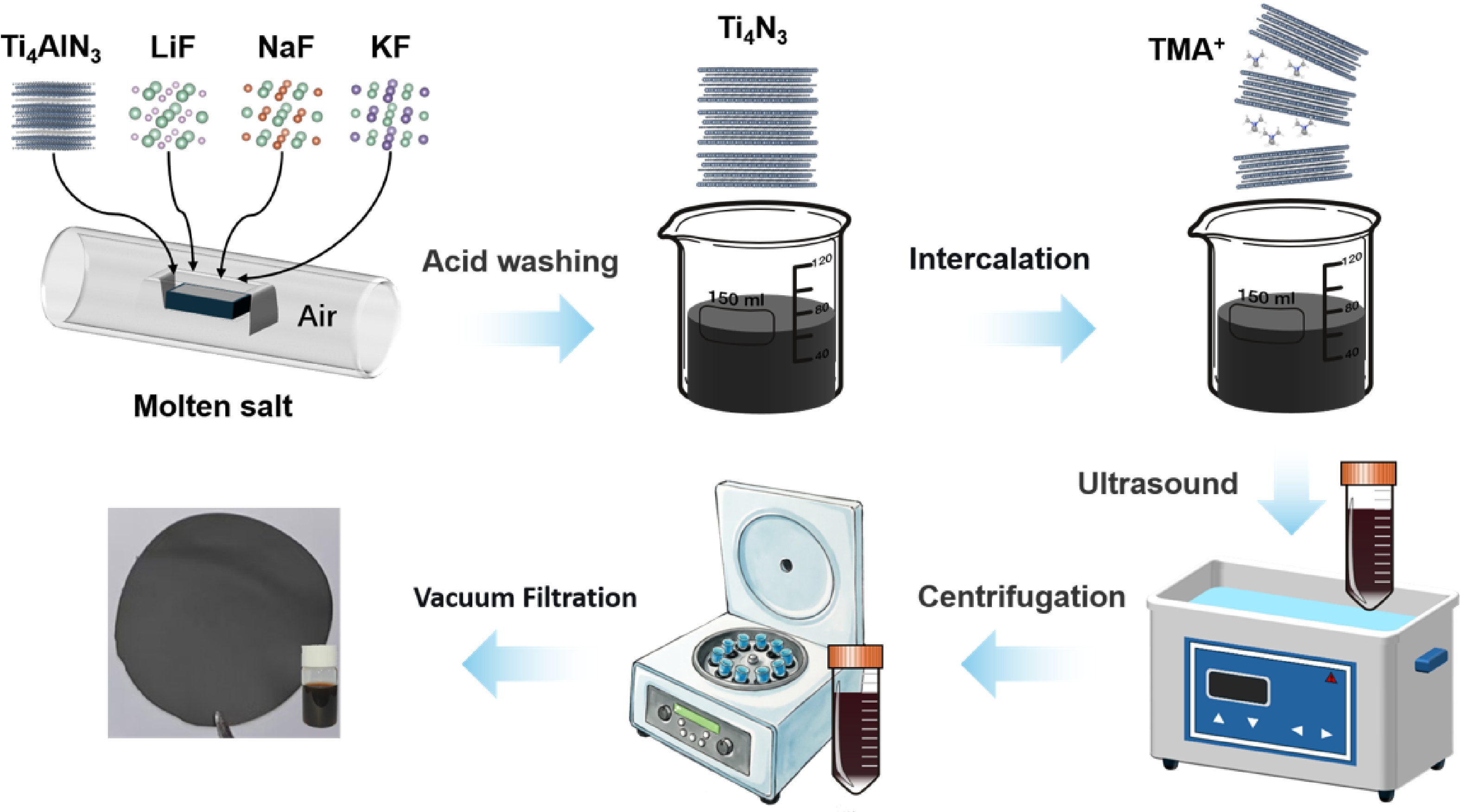
Fig. 1.
(Color online) Schematic illustration of the O2-assisted molten salt etching of Ti4AlN3 MAX phase to produce oxygen-terminated Ti4N3 MXene nanosheets.
ARTICLES
Yibo Xing, La Li and Guozhen Shen
Corresponding author: La Li, lali@bit.edu.cn; Guozhen Shen, gzshen@bit.edu.cn
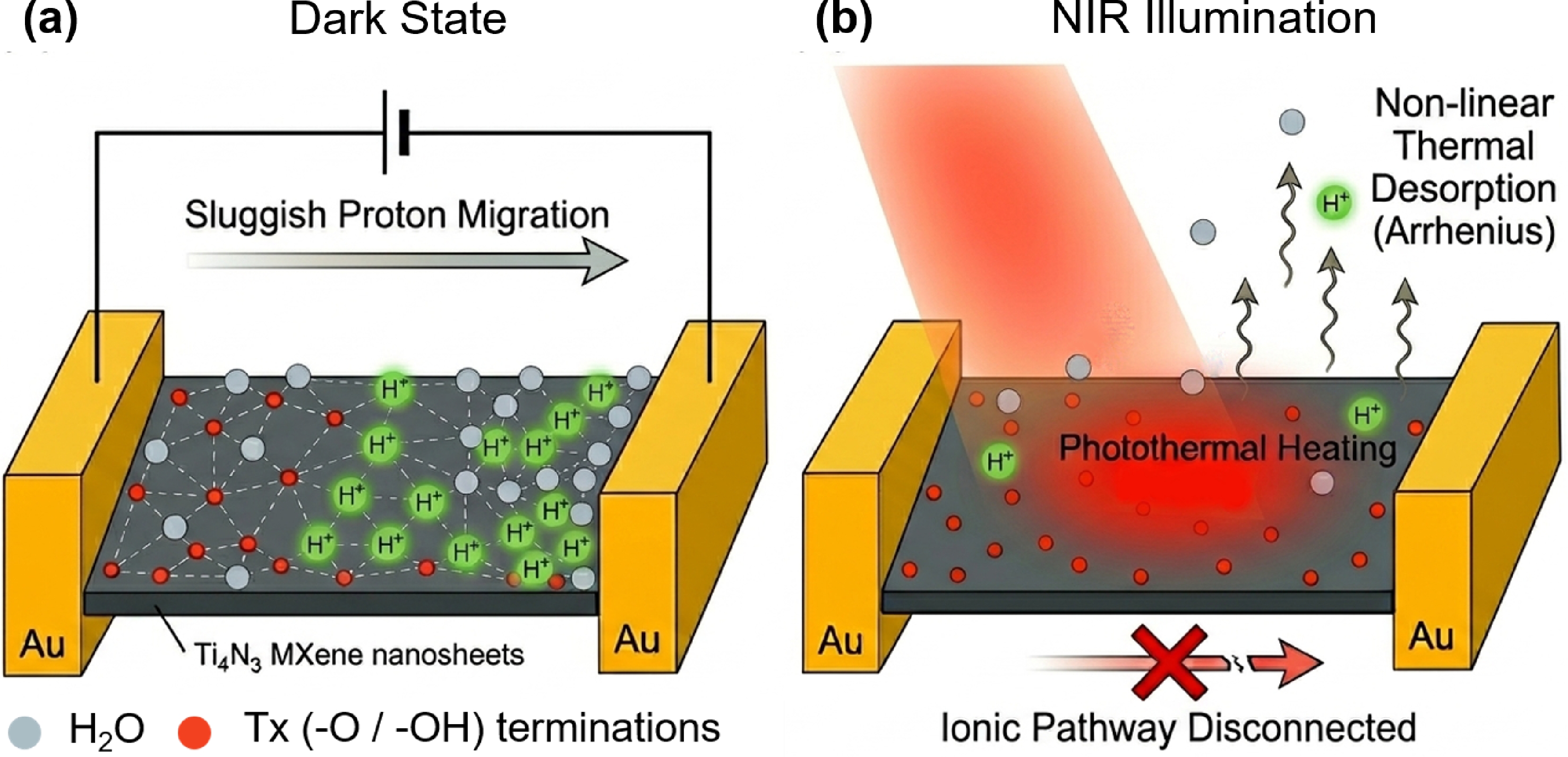
Abstract: Progress in understanding optoelectronic properties of the two-dimensional (2D) transition metal carbides and nitrides (MXenes) is hindered by a dearth of exploring novel intrinsic semiconductor materials from MXene families. Here, we prepared 2D Ti4N3 MXene nanoflakes via the molten salt etching method, which was then employed to fabricate a flexible broadband near-infrared (NIR) photodetector. The assembled Ti4N3 MXene based photodetector exhibits a stable response to the lasers of 808, 852, 915, 980, and 1060 nm. Under high-power IR illumination, the device deviates entirely from conventional positive photoconductivity, displaying an anomalous superlinear negative photoresponse with a power-law exponent of α = 1.54 and a response time of ~0.7 s. The negative photoconductivity behavior of the Ti4N3 MXene based devices is driven by a robust photothermal-ionotronic coupling mechanism: the intense IR-induced local heating heavily disrupts the interfacial hydrogen-bonding networks, triggering an Arrhenius-type non-linear desorption of confined water and protons that effectively disconnects the ionic conduction pathways. This work provides fundamental insights into the photothermal-dominated carrier and ion dynamics in 2D materials, paving the way for next-generation optoelectrical devices and neuromorphic sensory systems.
Keywords: Ti4N3 MXene, NIR photodetector, flexible photodetector, flexible electronics, negative photoconductivity
| [1] |
Zheng Y Q, Wang L X, Chen Y J, et al. Sensitive shortwave infrared organic photodetectors enabled by nonfullerene acceptor featuring an ultralow optical bandgap of less than 1.0 eV. Adv Mater, 2026, 38(15): e20509 doi: 10.1002/adma.202520509
|
| [2] |
Peng L C, Dosil M, Mandal D, et al. Synthesis of monodisperse InSb colloidal quantum dots by monomer concentration control for short-wave infrared photodetectors. Nat Commun, 2026, 17: 3871 doi: 10.1038/s41467-026-70367-6
|
| [3] |
Wu J F, Zhang J L, Jiang R Q, et al. High-sensitivity, high-speed, broadband mid-infrared photodetector enabled by a van der Waals heterostructure with a vertical transport channel. Nat Commun, 2025, 16: 564 doi: 10.1038/s41467-025-55887-x
|
| [4] |
Zhang C, Niu Y L, Zhang Z Y, et al. Recent progress in infrared detection from material advances to integrated intelligent systems. Adv Mater, 2026, 38(20): e21432 doi: 10.1002/adma.202521432
|
| [5] |
Koppens F H L, Mueller T, Avouris P, et al. Photodetectors based on graphene, other two-dimensional materials and hybrid systems. Nature Nanotech, 2014, 9(10): 780 doi: 10.1038/nnano.2014.215
|
| [6] |
Hu C Q, Chai R Q, Wei Z M, et al. ZnSb/Ti3C2Tx MXene van der Waals heterojunction for flexible near-infrared photodetector arrays. J Semicond, 2024, 45(5): 052601 doi: 10.1088/1674-4926/45/5/052601
|
| [7] |
Meng X H, Du Y H, Wu W B, et al. Giant superlinear power dependence of photocurrent based on layered Ta2NiS5 photodetector. Adv Sci, 2023, 10(20): 2300413 doi: 10.1002/advs.202300413
|
| [8] |
Jawa H, Varghese A, Ghosh S, et al. Wavelength-controlled photocurrent polarity switching in BP-MoS2 heterostructure. Adv Funct Mater, 2022, 32(25): 2112696 doi: 10.1002/adfm.202112696
|
| [9] |
Zhang T, Mazzio K A, Wang R J, et al. Conductivity hysteresis in MXene driven by structural dynamics of nanoconfined water. Nat Commun, 2025, 16: 7447 doi: 10.1038/s41467-025-62892-7
|
| [10] |
Ding H M, Tong X, Zhang Y. Surface reduction boosts free electron concentration in MXene for enhanced photothermal performance. Sci Adv, 2026, 12(20): eaee2009 doi: 10.1126/sciadv.aee2009
|
| [11] |
Wan S J, Chen Y, Huang C J, et al. Scalable ultrastrong MXene films with superior osteogenesis. Nature, 2024, 634(8036): 1103 doi: 10.1038/s41586-024-08067-8
|
| [12] |
Zhou L H, Duan Z Y, et al. Curvature-variable image sensor array with Mo2TiC2TxMXene for dark-field multiview 3D reconstruction application. ACS Nano, 2026, 20(10): 8879 doi: 10.1021/acsnano.6c00364
|
| [13] |
Hassan T, Kim J, Manh H N, et al. Semiconducting properties of delaminated titanium nitride Ti4N3Tx MXene with gate-tunable electrical conductivity. ACS Nano, 2024, 18(34): 23477 doi: 10.1021/acsnano.4c06966
|
| [14] |
Urbankowski P, Anasori B, Makaryan T, et al. Synthesis of two-dimensional titanium nitride Ti4N3 (MXene). Nanoscale, 2016, 8(22): 11385 doi: 10.1039/C6NR02253G
|
| [15] |
Zhang T Q, Zheng Z J, Lu H, et al. Rational design of periodic porous titanium nitride MXene as a multifunctional catalytic membrane. Nanoscale, 2023, 15(22): 9813 doi: 10.1039/D3NR01647A
|
| [16] |
Pranada E, Ngozichukwu B, Yoo R, et al. Hydrogen evolution and oxygen reduction on OH/F-terminated titanium nitride MXene reveal the role of the surface termination group in electrocatalysis. ACS Catal, 2025, 15(2): 982 doi: 10.1021/acscatal.4c05247
|
| [17] |
Jang M, Kim S H, Kim S, et al. Unleashing 2D MXene’s plasmonic effect for advanced photonic device applications. Adv Funct Mater, 2024, 34(46): 2405341 doi: 10.1002/adfm.202405341
|
| [18] |
Yuan Y J, Liang M S, Li T, et al. Laser-architected MXene composite for photoenhanced microsupercapacitor. Sci Adv, 2025, 11(39): eady0136 doi: 10.1126/sciadv.ady0136
|
| [19] |
Zhang Q, Li W, Zhao R X, et al. Real-time observation of two distinctive non-thermalized hot electron dynamics at MXene/molecule interfaces. Nat Commun, 2024, 15: 4406 doi: 10.1038/s41467-024-48842-9
|
| [20] |
Sun F P, Liu W. Ionic-electronic coupled 2D semiconductor with giant TCR for broadband visible-to-infrared dual-mode photodetection. Adv Funct Mater, 2025, 35(52): e11818 doi: 10.1002/adfm.202511818
|
| [21] |
Ghidiu M, Lukatskaya M R, Zhao M Q, et al. Conductive two-dimensional titanium carbide ‘clay’ with high volumetric capacitance. Nature, 2014, 516(7529): 78 doi: 10.1038/nature13970
|
| [22] |
Xiao D Y, Wang Q W, Hu D J, et al. Synthesis and antioxidant properties of Ti2N-MXenes with electron transfer and hydrogen donating mechanisms. J Mater Sci, 2025, 60(18): 7507 doi: 10.1007/s10853-025-10875-w
|
| [23] |
Ngozichukwu B, Pranada E, Johnson D, et al. Nanolayered Ti4N3Tx MXene retains its electrocatalytic properties after prolonged immersion in solvents. ACS Appl Nano Mater, 2024, 7(11): 13765 doi: 10.1021/acsanm.4c02503
|
| [24] |
Chang Q H, Chen W, Song J X, et al. Hysteretic ion transport in MXene layered nanochannels for memcapacitance. Appl Surf Sci, 2023, 639: 158229 doi: 10.1016/j.apsusc.2023.158229
|
| [25] |
Zheng Z B, Yang X, Lv L, et al. Artificial oxyanion reservoir accelerates oriented ionic migration in MXene-based synaptic memristor for neuromorphic computing. Surf Interfaces, 2025, 63: 106315 doi: 10.1016/j.surfin.2025.106315
|
| [26] |
Chen J H, Zhu M Y, He G, et al. A super-hygroscopic SA-MXene@LiCl composite membrane with fast ab/desorption kinetics for efficient sorption-based atmospheric water harvesting. Desalination, 2025, 595: 118319 doi: 10.1016/j.desal.2024.118319
|
| [27] |
Li B W, Xie P S, Chen B J, et al. Electrode-dependent and tunable sub-to-super-linear responsivity in Mott material-enabled near-infrared photodetectors for advanced near-sensor image processing. Adv Mater, 2024, 36(49): 2410952 doi: 10.1002/adma.202410952
|
| [28] |
Lounasvuori M, Sun Y, Mathis T S, et al. Vibrational signature of hydrated protons confined in MXene interlayers. Nat Commun, 2023, 14: 1322 doi: 10.1038/s41467-023-36842-0
|
| [29] |
Parsons T, Lee J, et al. Self-organized metasurface enabling negative photoconductance and memristive behavior via van der Waals interaction. J Appl Phys, 2026, 139(10): 105301 doi: 10.1063/5.0321260
|
| [30] |
Wang X M, University S, Kan G Y, et al. Molecularly engineered 2D amphiphilic evaporator for efficient solar evaporation via hydrogen bonding disruption. ACS Mater Lett, 2026, 8(2): 591 doi: 10.1021/acsmaterialslett.5c01456
|
| [31] |
Zhang S Q, Lin J, et al. Negative photoconductivity in porous boron nitride nanofibers: For high on/off ratio thermally assisted conductivity modulation photodetectors. ACS Photonics, 2025, 12(10): 5649 doi: 10.1021/acsphotonics.5c01414
|
| [32] |
Song Y G, Baek I H, Kim G S, et al. Humidity-mediated room-temperature NO2 sensing using 2D SnS2 nanoplates. Appl Surf Sci, 2026, 729: 166253 doi: 10.1016/j.apsusc.2026.166253
|
| [33] |
Zhao Q N, Sun D M, Wang S, et al. Enhanced blocking effect: A new strategy to improve the NO2 sensing performance of Ti3C2Tx by γ-poly(l-glutamic acid) modification. ACS Sens, 2021, 6(8): 2858 doi: 10.1021/acssensors.1c00132
|
| [34] |
Chen X Q, Hu J Y, Chen P, et al. UV-light-assisted NO2 gas sensor based on WS2/PbS heterostructures with full recoverability and reliable anti-humidity ability. Sens Actuat B Chem, 2021, 339: 129902 doi: 10.1016/j.snb.2021.129902
|
| [1] |
Zheng Y Q, Wang L X, Chen Y J, et al. Sensitive shortwave infrared organic photodetectors enabled by nonfullerene acceptor featuring an ultralow optical bandgap of less than 1.0 eV. Adv Mater, 2026, 38(15): e20509 doi: 10.1002/adma.202520509
|
| [2] |
Peng L C, Dosil M, Mandal D, et al. Synthesis of monodisperse InSb colloidal quantum dots by monomer concentration control for short-wave infrared photodetectors. Nat Commun, 2026, 17: 3871 doi: 10.1038/s41467-026-70367-6
|
| [3] |
Wu J F, Zhang J L, Jiang R Q, et al. High-sensitivity, high-speed, broadband mid-infrared photodetector enabled by a van der Waals heterostructure with a vertical transport channel. Nat Commun, 2025, 16: 564 doi: 10.1038/s41467-025-55887-x
|
| [4] |
Zhang C, Niu Y L, Zhang Z Y, et al. Recent progress in infrared detection from material advances to integrated intelligent systems. Adv Mater, 2026, 38(20): e21432 doi: 10.1002/adma.202521432
|
| [5] |
Koppens F H L, Mueller T, Avouris P, et al. Photodetectors based on graphene, other two-dimensional materials and hybrid systems. Nature Nanotech, 2014, 9(10): 780 doi: 10.1038/nnano.2014.215
|
| [6] |
Hu C Q, Chai R Q, Wei Z M, et al. ZnSb/Ti3C2Tx MXene van der Waals heterojunction for flexible near-infrared photodetector arrays. J Semicond, 2024, 45(5): 052601 doi: 10.1088/1674-4926/45/5/052601
|
| [7] |
Meng X H, Du Y H, Wu W B, et al. Giant superlinear power dependence of photocurrent based on layered Ta2NiS5 photodetector. Adv Sci, 2023, 10(20): 2300413 doi: 10.1002/advs.202300413
|
| [8] |
Jawa H, Varghese A, Ghosh S, et al. Wavelength-controlled photocurrent polarity switching in BP-MoS2 heterostructure. Adv Funct Mater, 2022, 32(25): 2112696 doi: 10.1002/adfm.202112696
|
| [9] |
Zhang T, Mazzio K A, Wang R J, et al. Conductivity hysteresis in MXene driven by structural dynamics of nanoconfined water. Nat Commun, 2025, 16: 7447 doi: 10.1038/s41467-025-62892-7
|
| [10] |
Ding H M, Tong X, Zhang Y. Surface reduction boosts free electron concentration in MXene for enhanced photothermal performance. Sci Adv, 2026, 12(20): eaee2009 doi: 10.1126/sciadv.aee2009
|
| [11] |
Wan S J, Chen Y, Huang C J, et al. Scalable ultrastrong MXene films with superior osteogenesis. Nature, 2024, 634(8036): 1103 doi: 10.1038/s41586-024-08067-8
|
| [12] |
Zhou L H, Duan Z Y, et al. Curvature-variable image sensor array with Mo2TiC2TxMXene for dark-field multiview 3D reconstruction application. ACS Nano, 2026, 20(10): 8879 doi: 10.1021/acsnano.6c00364
|
| [13] |
Hassan T, Kim J, Manh H N, et al. Semiconducting properties of delaminated titanium nitride Ti4N3Tx MXene with gate-tunable electrical conductivity. ACS Nano, 2024, 18(34): 23477 doi: 10.1021/acsnano.4c06966
|
| [14] |
Urbankowski P, Anasori B, Makaryan T, et al. Synthesis of two-dimensional titanium nitride Ti4N3 (MXene). Nanoscale, 2016, 8(22): 11385 doi: 10.1039/C6NR02253G
|
| [15] |
Zhang T Q, Zheng Z J, Lu H, et al. Rational design of periodic porous titanium nitride MXene as a multifunctional catalytic membrane. Nanoscale, 2023, 15(22): 9813 doi: 10.1039/D3NR01647A
|
| [16] |
Pranada E, Ngozichukwu B, Yoo R, et al. Hydrogen evolution and oxygen reduction on OH/F-terminated titanium nitride MXene reveal the role of the surface termination group in electrocatalysis. ACS Catal, 2025, 15(2): 982 doi: 10.1021/acscatal.4c05247
|
| [17] |
Jang M, Kim S H, Kim S, et al. Unleashing 2D MXene’s plasmonic effect for advanced photonic device applications. Adv Funct Mater, 2024, 34(46): 2405341 doi: 10.1002/adfm.202405341
|
| [18] |
Yuan Y J, Liang M S, Li T, et al. Laser-architected MXene composite for photoenhanced microsupercapacitor. Sci Adv, 2025, 11(39): eady0136 doi: 10.1126/sciadv.ady0136
|
| [19] |
Zhang Q, Li W, Zhao R X, et al. Real-time observation of two distinctive non-thermalized hot electron dynamics at MXene/molecule interfaces. Nat Commun, 2024, 15: 4406 doi: 10.1038/s41467-024-48842-9
|
| [20] |
Sun F P, Liu W. Ionic-electronic coupled 2D semiconductor with giant TCR for broadband visible-to-infrared dual-mode photodetection. Adv Funct Mater, 2025, 35(52): e11818 doi: 10.1002/adfm.202511818
|
| [21] |
Ghidiu M, Lukatskaya M R, Zhao M Q, et al. Conductive two-dimensional titanium carbide ‘clay’ with high volumetric capacitance. Nature, 2014, 516(7529): 78 doi: 10.1038/nature13970
|
| [22] |
Xiao D Y, Wang Q W, Hu D J, et al. Synthesis and antioxidant properties of Ti2N-MXenes with electron transfer and hydrogen donating mechanisms. J Mater Sci, 2025, 60(18): 7507 doi: 10.1007/s10853-025-10875-w
|
| [23] |
Ngozichukwu B, Pranada E, Johnson D, et al. Nanolayered Ti4N3Tx MXene retains its electrocatalytic properties after prolonged immersion in solvents. ACS Appl Nano Mater, 2024, 7(11): 13765 doi: 10.1021/acsanm.4c02503
|
| [24] |
Chang Q H, Chen W, Song J X, et al. Hysteretic ion transport in MXene layered nanochannels for memcapacitance. Appl Surf Sci, 2023, 639: 158229 doi: 10.1016/j.apsusc.2023.158229
|
| [25] |
Zheng Z B, Yang X, Lv L, et al. Artificial oxyanion reservoir accelerates oriented ionic migration in MXene-based synaptic memristor for neuromorphic computing. Surf Interfaces, 2025, 63: 106315 doi: 10.1016/j.surfin.2025.106315
|
| [26] |
Chen J H, Zhu M Y, He G, et al. A super-hygroscopic SA-MXene@LiCl composite membrane with fast ab/desorption kinetics for efficient sorption-based atmospheric water harvesting. Desalination, 2025, 595: 118319 doi: 10.1016/j.desal.2024.118319
|
| [27] |
Li B W, Xie P S, Chen B J, et al. Electrode-dependent and tunable sub-to-super-linear responsivity in Mott material-enabled near-infrared photodetectors for advanced near-sensor image processing. Adv Mater, 2024, 36(49): 2410952 doi: 10.1002/adma.202410952
|
| [28] |
Lounasvuori M, Sun Y, Mathis T S, et al. Vibrational signature of hydrated protons confined in MXene interlayers. Nat Commun, 2023, 14: 1322 doi: 10.1038/s41467-023-36842-0
|
| [29] |
Parsons T, Lee J, et al. Self-organized metasurface enabling negative photoconductance and memristive behavior via van der Waals interaction. J Appl Phys, 2026, 139(10): 105301 doi: 10.1063/5.0321260
|
| [30] |
Wang X M, University S, Kan G Y, et al. Molecularly engineered 2D amphiphilic evaporator for efficient solar evaporation via hydrogen bonding disruption. ACS Mater Lett, 2026, 8(2): 591 doi: 10.1021/acsmaterialslett.5c01456
|
| [31] |
Zhang S Q, Lin J, et al. Negative photoconductivity in porous boron nitride nanofibers: For high on/off ratio thermally assisted conductivity modulation photodetectors. ACS Photonics, 2025, 12(10): 5649 doi: 10.1021/acsphotonics.5c01414
|
| [32] |
Song Y G, Baek I H, Kim G S, et al. Humidity-mediated room-temperature NO2 sensing using 2D SnS2 nanoplates. Appl Surf Sci, 2026, 729: 166253 doi: 10.1016/j.apsusc.2026.166253
|
| [33] |
Zhao Q N, Sun D M, Wang S, et al. Enhanced blocking effect: A new strategy to improve the NO2 sensing performance of Ti3C2Tx by γ-poly(l-glutamic acid) modification. ACS Sens, 2021, 6(8): 2858 doi: 10.1021/acssensors.1c00132
|
| [34] |
Chen X Q, Hu J Y, Chen P, et al. UV-light-assisted NO2 gas sensor based on WS2/PbS heterostructures with full recoverability and reliable anti-humidity ability. Sens Actuat B Chem, 2021, 339: 129902 doi: 10.1016/j.snb.2021.129902
|





Article views: 58 Times PDF downloads: 14 Times Cited by: 0 Times
Received: 03 June 2026 Revised: 17 June 2026 Online: Accepted Manuscript: 30 July 2026Uncorrected proof: 04 August 2026Published: 12 August 2026
| Citation: |
Yibo Xing, La Li, Guozhen Shen. Ti4N3 MXene based flexible near-infrared photodetector[J]. Journal of Semiconductors, 2026, 47(8): 082606. doi: 10.1088/1674-4926/26060007
****
Y B Xing, L Li, and G Z Shen, Ti4N3 MXene based flexible near-infrared photodetector[J]. J. Semicond., 2026, 47(8): 082606 doi: 10.1088/1674-4926/26060007

|
 Yibo Xing received his bachelor's degree from Henan University of Science and Technology. He is currently pursuing a master's degree at the School of Integrated Circuits and Electronics, Beijing Institute of Technology. His research focuses on the material properties of Ti4N3 MXene and its applications in flexible wearable electronics
 La Li received her Ph.D. degree in applied physics at Jilin University in 2018. She is currently an associate professor at the school of integrated circuits and electronics, Beijing Institute of Technology, China. Her research interests mainly focus on 2D MXene based flexible electronics and eye-wearable electronics
 Guozhen Shen received his Ph.D. degree in Chemistry from the University of Science and Technology of China. He is currently a professor at the School of Integrated Circuits and Electronics, Beijing Institute of Technology (BIT), and the director of the Institute of Flexible Electronics and Intelligent Manufacturing. Before joining BIT, he worked at Hanyang University (Korea), National Institute for Materials Science (Japan), University of Southern California (US), and Huazhong University of Science and Technology (China), the Institute of Semiconductors, CAS (China). His current research focuses on flexible electronic devices for artificial intelligence and healthcare monitoring
| [1] |
Zheng Y Q, Wang L X, Chen Y J, et al. Sensitive shortwave infrared organic photodetectors enabled by nonfullerene acceptor featuring an ultralow optical bandgap of less than 1.0 eV. Adv Mater, 2026, 38(15): e20509 doi: 10.1002/adma.202520509
|
| [2] |
Peng L C, Dosil M, Mandal D, et al. Synthesis of monodisperse InSb colloidal quantum dots by monomer concentration control for short-wave infrared photodetectors. Nat Commun, 2026, 17: 3871 doi: 10.1038/s41467-026-70367-6
|
| [3] |
Wu J F, Zhang J L, Jiang R Q, et al. High-sensitivity, high-speed, broadband mid-infrared photodetector enabled by a van der Waals heterostructure with a vertical transport channel. Nat Commun, 2025, 16: 564 doi: 10.1038/s41467-025-55887-x
|
| [4] |
Zhang C, Niu Y L, Zhang Z Y, et al. Recent progress in infrared detection from material advances to integrated intelligent systems. Adv Mater, 2026, 38(20): e21432 doi: 10.1002/adma.202521432
|
| [5] |
Koppens F H L, Mueller T, Avouris P, et al. Photodetectors based on graphene, other two-dimensional materials and hybrid systems. Nature Nanotech, 2014, 9(10): 780 doi: 10.1038/nnano.2014.215
|
| [6] |
Hu C Q, Chai R Q, Wei Z M, et al. ZnSb/Ti3C2Tx MXene van der Waals heterojunction for flexible near-infrared photodetector arrays. J Semicond, 2024, 45(5): 052601 doi: 10.1088/1674-4926/45/5/052601
|
| [7] |
Meng X H, Du Y H, Wu W B, et al. Giant superlinear power dependence of photocurrent based on layered Ta2NiS5 photodetector. Adv Sci, 2023, 10(20): 2300413 doi: 10.1002/advs.202300413
|
| [8] |
Jawa H, Varghese A, Ghosh S, et al. Wavelength-controlled photocurrent polarity switching in BP-MoS2 heterostructure. Adv Funct Mater, 2022, 32(25): 2112696 doi: 10.1002/adfm.202112696
|
| [9] |
Zhang T, Mazzio K A, Wang R J, et al. Conductivity hysteresis in MXene driven by structural dynamics of nanoconfined water. Nat Commun, 2025, 16: 7447 doi: 10.1038/s41467-025-62892-7
|
| [10] |
Ding H M, Tong X, Zhang Y. Surface reduction boosts free electron concentration in MXene for enhanced photothermal performance. Sci Adv, 2026, 12(20): eaee2009 doi: 10.1126/sciadv.aee2009
|
| [11] |
Wan S J, Chen Y, Huang C J, et al. Scalable ultrastrong MXene films with superior osteogenesis. Nature, 2024, 634(8036): 1103 doi: 10.1038/s41586-024-08067-8
|
| [12] |
Zhou L H, Duan Z Y, et al. Curvature-variable image sensor array with Mo2TiC2TxMXene for dark-field multiview 3D reconstruction application. ACS Nano, 2026, 20(10): 8879 doi: 10.1021/acsnano.6c00364
|
| [13] |
Hassan T, Kim J, Manh H N, et al. Semiconducting properties of delaminated titanium nitride Ti4N3Tx MXene with gate-tunable electrical conductivity. ACS Nano, 2024, 18(34): 23477 doi: 10.1021/acsnano.4c06966
|
| [14] |
Urbankowski P, Anasori B, Makaryan T, et al. Synthesis of two-dimensional titanium nitride Ti4N3 (MXene). Nanoscale, 2016, 8(22): 11385 doi: 10.1039/C6NR02253G
|
| [15] |
Zhang T Q, Zheng Z J, Lu H, et al. Rational design of periodic porous titanium nitride MXene as a multifunctional catalytic membrane. Nanoscale, 2023, 15(22): 9813 doi: 10.1039/D3NR01647A
|
| [16] |
Pranada E, Ngozichukwu B, Yoo R, et al. Hydrogen evolution and oxygen reduction on OH/F-terminated titanium nitride MXene reveal the role of the surface termination group in electrocatalysis. ACS Catal, 2025, 15(2): 982 doi: 10.1021/acscatal.4c05247
|
| [17] |
Jang M, Kim S H, Kim S, et al. Unleashing 2D MXene’s plasmonic effect for advanced photonic device applications. Adv Funct Mater, 2024, 34(46): 2405341 doi: 10.1002/adfm.202405341
|
| [18] |
Yuan Y J, Liang M S, Li T, et al. Laser-architected MXene composite for photoenhanced microsupercapacitor. Sci Adv, 2025, 11(39): eady0136 doi: 10.1126/sciadv.ady0136
|
| [19] |
Zhang Q, Li W, Zhao R X, et al. Real-time observation of two distinctive non-thermalized hot electron dynamics at MXene/molecule interfaces. Nat Commun, 2024, 15: 4406 doi: 10.1038/s41467-024-48842-9
|
| [20] |
Sun F P, Liu W. Ionic-electronic coupled 2D semiconductor with giant TCR for broadband visible-to-infrared dual-mode photodetection. Adv Funct Mater, 2025, 35(52): e11818 doi: 10.1002/adfm.202511818
|
| [21] |
Ghidiu M, Lukatskaya M R, Zhao M Q, et al. Conductive two-dimensional titanium carbide ‘clay’ with high volumetric capacitance. Nature, 2014, 516(7529): 78 doi: 10.1038/nature13970
|
| [22] |
Xiao D Y, Wang Q W, Hu D J, et al. Synthesis and antioxidant properties of Ti2N-MXenes with electron transfer and hydrogen donating mechanisms. J Mater Sci, 2025, 60(18): 7507 doi: 10.1007/s10853-025-10875-w
|
| [23] |
Ngozichukwu B, Pranada E, Johnson D, et al. Nanolayered Ti4N3Tx MXene retains its electrocatalytic properties after prolonged immersion in solvents. ACS Appl Nano Mater, 2024, 7(11): 13765 doi: 10.1021/acsanm.4c02503
|
| [24] |
Chang Q H, Chen W, Song J X, et al. Hysteretic ion transport in MXene layered nanochannels for memcapacitance. Appl Surf Sci, 2023, 639: 158229 doi: 10.1016/j.apsusc.2023.158229
|
| [25] |
Zheng Z B, Yang X, Lv L, et al. Artificial oxyanion reservoir accelerates oriented ionic migration in MXene-based synaptic memristor for neuromorphic computing. Surf Interfaces, 2025, 63: 106315 doi: 10.1016/j.surfin.2025.106315
|
| [26] |
Chen J H, Zhu M Y, He G, et al. A super-hygroscopic SA-MXene@LiCl composite membrane with fast ab/desorption kinetics for efficient sorption-based atmospheric water harvesting. Desalination, 2025, 595: 118319 doi: 10.1016/j.desal.2024.118319
|
| [27] |
Li B W, Xie P S, Chen B J, et al. Electrode-dependent and tunable sub-to-super-linear responsivity in Mott material-enabled near-infrared photodetectors for advanced near-sensor image processing. Adv Mater, 2024, 36(49): 2410952 doi: 10.1002/adma.202410952
|
| [28] |
Lounasvuori M, Sun Y, Mathis T S, et al. Vibrational signature of hydrated protons confined in MXene interlayers. Nat Commun, 2023, 14: 1322 doi: 10.1038/s41467-023-36842-0
|
| [29] |
Parsons T, Lee J, et al. Self-organized metasurface enabling negative photoconductance and memristive behavior via van der Waals interaction. J Appl Phys, 2026, 139(10): 105301 doi: 10.1063/5.0321260
|
| [30] |
Wang X M, University S, Kan G Y, et al. Molecularly engineered 2D amphiphilic evaporator for efficient solar evaporation via hydrogen bonding disruption. ACS Mater Lett, 2026, 8(2): 591 doi: 10.1021/acsmaterialslett.5c01456
|
| [31] |
Zhang S Q, Lin J, et al. Negative photoconductivity in porous boron nitride nanofibers: For high on/off ratio thermally assisted conductivity modulation photodetectors. ACS Photonics, 2025, 12(10): 5649 doi: 10.1021/acsphotonics.5c01414
|
| [32] |
Song Y G, Baek I H, Kim G S, et al. Humidity-mediated room-temperature NO2 sensing using 2D SnS2 nanoplates. Appl Surf Sci, 2026, 729: 166253 doi: 10.1016/j.apsusc.2026.166253
|
| [33] |
Zhao Q N, Sun D M, Wang S, et al. Enhanced blocking effect: A new strategy to improve the NO2 sensing performance of Ti3C2Tx by γ-poly(l-glutamic acid) modification. ACS Sens, 2021, 6(8): 2858 doi: 10.1021/acssensors.1c00132
|
| [34] |
Chen X Q, Hu J Y, Chen P, et al. UV-light-assisted NO2 gas sensor based on WS2/PbS heterostructures with full recoverability and reliable anti-humidity ability. Sens Actuat B Chem, 2021, 339: 129902 doi: 10.1016/j.snb.2021.129902
|

 WeChat ID
Journal of Semiconductors © 2017 All Rights Reserved 京ICP备05085259号-2

 DownLoad: