


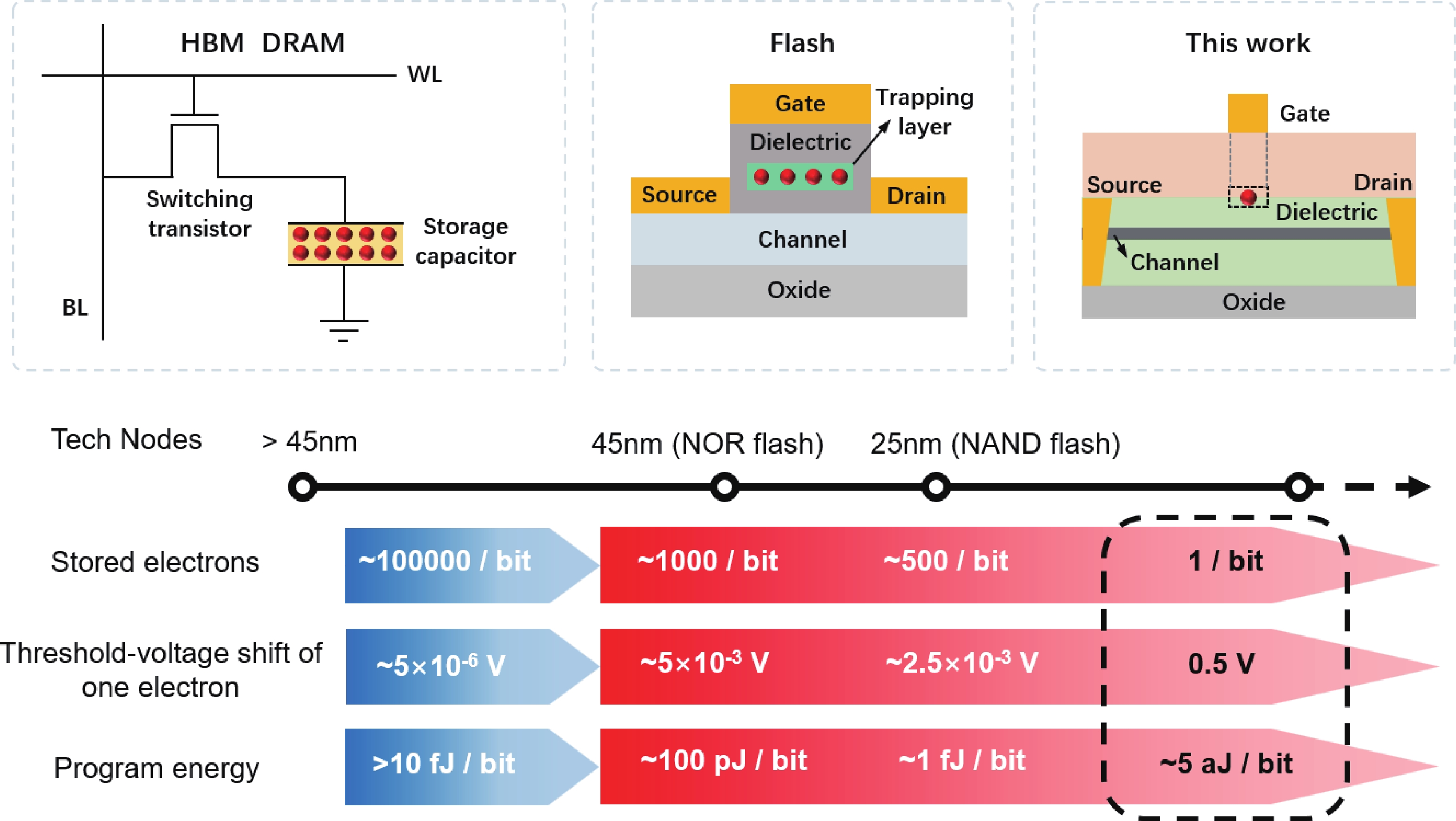
Fig. 1.
(Color online) Comparison of HBM DRAM, flash memory and the proposed single-electron memory in terms of store electrons, threshold-voltage shift of one electron, and program energy.
EDITORIAL
Corresponding author: Shushen Li, sslee@semi.ac.cn
| [1] |
Kahng D, Sze S M. A floating gate and its application to memory devices. Bell Syst Tech J, 1967, 46(6): 1288 doi: 10.1109/T-ED.1967.16028
|
| [2] |
Pavan P, Bez R, Olivo P, et al. Flash memory cells-an overview. Proc IEEE, 1997, 85(8): 1248 doi: 10.1109/5.622505
|
| [3] |
Yano K, Ishii T, Sano T, et al. Single-electron memory for giga-to-tera bit storage. Proc IEEE, 1999, 87(4): 633 doi: 10.1109/5.752519
|
| [4] |
Lue H T, Hsu T H, Wang S Y. Study of incremental step pulse programming (ISPP) and STI edge effect of BE-SONOS NAND Flash. 2008 IEEE International Reliability Physics Symposium, 2008: 693 doi: 10.1109/RELPHY.2008.4558992
|
| [5] |
Lue H T, Hsiao Y H, Hsieh K Y, et al. Scaling feasibility study of planar thin floating gate (FG) NAND Flash devices and size effect challenges beyond 20nm. 2011 International Electron Devices Meeting, 2011: 9.2.1 doi: 10.1109/IEDM.2011.6131519
|
| [6] |
Liu C S, Xiang Y T, Wang C, et al. Robust single-electron memory with quantum states manipulation. Science, 2026, 393(6808): 294 doi: 10.1126/science.aeg6638
|
| [1] |
Kahng D, Sze S M. A floating gate and its application to memory devices. Bell Syst Tech J, 1967, 46(6): 1288 doi: 10.1109/T-ED.1967.16028
|
| [2] |
Pavan P, Bez R, Olivo P, et al. Flash memory cells-an overview. Proc IEEE, 1997, 85(8): 1248 doi: 10.1109/5.622505
|
| [3] |
Yano K, Ishii T, Sano T, et al. Single-electron memory for giga-to-tera bit storage. Proc IEEE, 1999, 87(4): 633 doi: 10.1109/5.752519
|
| [4] |
Lue H T, Hsu T H, Wang S Y. Study of incremental step pulse programming (ISPP) and STI edge effect of BE-SONOS NAND Flash. 2008 IEEE International Reliability Physics Symposium, 2008: 693 doi: 10.1109/RELPHY.2008.4558992
|
| [5] |
Lue H T, Hsiao Y H, Hsieh K Y, et al. Scaling feasibility study of planar thin floating gate (FG) NAND Flash devices and size effect challenges beyond 20nm. 2011 International Electron Devices Meeting, 2011: 9.2.1 doi: 10.1109/IEDM.2011.6131519
|
| [6] |
Liu C S, Xiang Y T, Wang C, et al. Robust single-electron memory with quantum states manipulation. Science, 2026, 393(6808): 294 doi: 10.1126/science.aeg6638
|





Article views: 141 Times PDF downloads: 30 Times Cited by: 0 Times
Received: 17 July 2026 Revised: Online: Accepted Manuscript: 17 July 2026Uncorrected proof: 20 July 2026Published: 12 September 2026
| Citation: |
Shushen Li. One Electron, One Memory State[J]. Journal of Semiconductors, 2026, 47(9): 090101. doi: 10.1088/1674-4926/26070031
****
S S Li, One Electron, One Memory State[J]. J. Semicond., 2026, 47(9): 090101 doi: 10.1088/1674-4926/26070031

|
 Shushen Li, Professor at the Institute of Semiconductors, Chinese Academy of Sciences (CAS), Academician of the Chinese Academy of Sciences. His research interests include semiconductor device physics
| [1] |
Kahng D, Sze S M. A floating gate and its application to memory devices. Bell Syst Tech J, 1967, 46(6): 1288 doi: 10.1109/T-ED.1967.16028
|
| [2] |
Pavan P, Bez R, Olivo P, et al. Flash memory cells-an overview. Proc IEEE, 1997, 85(8): 1248 doi: 10.1109/5.622505
|
| [3] |
Yano K, Ishii T, Sano T, et al. Single-electron memory for giga-to-tera bit storage. Proc IEEE, 1999, 87(4): 633 doi: 10.1109/5.752519
|
| [4] |
Lue H T, Hsu T H, Wang S Y. Study of incremental step pulse programming (ISPP) and STI edge effect of BE-SONOS NAND Flash. 2008 IEEE International Reliability Physics Symposium, 2008: 693 doi: 10.1109/RELPHY.2008.4558992
|
| [5] |
Lue H T, Hsiao Y H, Hsieh K Y, et al. Scaling feasibility study of planar thin floating gate (FG) NAND Flash devices and size effect challenges beyond 20nm. 2011 International Electron Devices Meeting, 2011: 9.2.1 doi: 10.1109/IEDM.2011.6131519
|
| [6] |
Liu C S, Xiang Y T, Wang C, et al. Robust single-electron memory with quantum states manipulation. Science, 2026, 393(6808): 294 doi: 10.1126/science.aeg6638
|

 WeChat ID
Journal of Semiconductors © 2017 All Rights Reserved 京ICP备05085259号-2

 DownLoad: